How many different ways are there to explain cutting-edge physics to readers who want to get to grips with the subject? Benjamin Bahr, a quantum-gravity theorist at the University of Hamburg, and experimental particle-physicist Boris Lemmer from the University of Göttingen have hit upon the idea of using cartoons. The pair teamed up with Canadian cartoonist Rina Piccolo to create this series of 76 mini-essays about a range of topics in physics, each illustrated with one large cartoon and several smaller drawings.
The focus in Quirky Quarks: a Cartoon Guide to the Fascinating Realm of Physics is squarely on cosmology, quantum physics and particle physics, with wormholes, tachyons, extra dimensions and other far-out material collected in a chapter dubbed “beyond the boundaries of our knowledge”. The entries are authoritative and clearly written – if a little over-eager – with the cartoons providing a welcome light relief. Disappointingly, though, there is very little on “everyday” physics. Casual readers may also be deterred by the relatively steep price, which is at odds with the book’s “fun” approach.
Back in 2015, the surprise hit of the popular-science world was a slender volume with the English title Seven Brief Lessons on Physics. Written by the Italian-born theorist Carlo Rovelli, and intended as a basic introduction to post-Newtonian physics, the book’s Italian edition sold some 300,000 copies. Rovelli’s follow-up, Reality Is Not What It Seems, is longer and a bit more technical, and unlike its predecessor, it focuses on loop quantum gravity – Rovelli’s main research area and a topic seldom covered in general-audience publications.
The book begins conventionally, with the atomic theories of Democritus and other thinkers from the ancient Greek world, and then (rather regrettably) treats the ensuing 1.5 millennia as if nothing scientific happened whatsoever. After Democritus and Ptolemy, we jump from Copernicus, Kepler and Galileo to Newton, Faraday and Maxwell; and finally Einstein and a coterie of early 20th-century quantum revolutionaries.
Despite this standard-issue structure, the ideas of Democritus and other great scientists of the past are not mere starting points, but touchstones for all subsequent theories, and Rovelli refers back to them regularly throughout the book. His treatment of relativity, and particularly his claim that special relativity is “more difficult to digest than general relativity” (clearly, being a loop quantum gravity theorist does exciting things to one’s digestion), are also unusual. However, Rovelli has a gift for presenting complex ideas in a way that makes them seem intuitive, without diminishing their depth or lustre.
Physicists wishing to grasp the essentials of loop quantum gravity without tangling with its mathematics could not wish for a better guide in the book’s second half, when the subject matter passes from “what…we credibly know about the world, to what we don’t yet know but are trying to glimpse”.
At first glance, it seems as though the tides are just a bit of simple physics – the Moon’s gravity tugs on the oceans, and the Sun has a smaller but similar effect. But why then, do tides in some places rise and fall roughly twice a day, while elsewhere the cycle only occurs once in 24 hours? Why does Canada’s Bay of Fundy have an enormous tidal range of 16 m whereas just 50 km away in the Northumberland Strait the range is a piddling 1.6 m?
These and other questions perplexed some of history’s greatest scientists and in Tide: the Science and Lore of the Greatest Force on Earth, author Hugh Aldersey-Williams explains how we came to understand why the oceans rise and fall, and indeed, how the course of history can turn on the tide. Attacking on an exceptionally high tide, for example, was seen as crucial to the success of the D-day landings in the Second World War. The Allies, he explains, used a mechanical tidal prediction machine designed 1872 by William Thomson (later Lord Kelvin) to calculate the tides along the Normandy coast using a hodge-podge of incomplete information.
The best part of the book though, is Aldersey-Williams’ contemplative description of a complete tidal cycle – from ebb to flood, and back again – that he experienced one warm September day on a lonely creek near the Norfolk coast. “The warming mud that has not seen the Sun for half a day raises a sweet shellfish odour,” he writes, “The seabed is coming to life.”
Using the second law of thermodynamics to explain why dogs pant, how best to get tomato ketchup out of a glass bottle and why Hawaii is so great for surfing, is a pretty unusual approach to understanding physics. Helen Czerski, self-described “bubble physicist” at University College London, TV presenter and author of Storm in a Teacup: the Physics of Everyday Life, wants to make physics accessible to everyone. She takes the science of the everyday – tea sloshing around in a mug, swimming goggles fogging up, bees collecting pollen – to explain basic physics concepts.
Czerski shows how the same physical laws are applicable on astronomical and microscopic scales, as well as to current science topics, such as climate change and medical testing. Even when you know the physics, it can be a revelation to realize that, for example, popcorn pops due to the same gas laws that cause thunderstorms, and it’s fun to take a detour via the short-lived invention of rocket post (yes – that is mail sent by rocket and it really happened, though many letters were blown up during early tests).
The one drawback of this is the brevity of topics. Each one- or two-page example could easily fill a whole chapter, but that would be a very different kind of book. In a friendly, chatty style that includes anecdotes from her personal and professional life, Czerski manages to make spilled coffee fascinating; tree growth astonishing; telecommunications intuitive. She has a comedic flair, including lots of details that are odd or silly, but what really makes this book readable is her evident enthusiasm, and not just for bubbles.
The UK’s Government Communications Headquarters (GCHQ) has, over the last few years, published puzzles that keen members of the public could solve to get noticed by the organization’s recruitment team. What they didn’t let on, though, is that what we’ve seen until now is a mere glimpse of a giant puzzle archive going back decades.
Internally, GCHQ employees have been designing and setting each other puzzles since the 1980s. The mindbenders first took place over the Christmas period, evolving to include an Easter Teaser and even a real-life Treasure Hunt, where about 50 staff descend on a Cotswold town. The GCHQ Puzzle Book is a chunky compendium where readers are introduced to the whole back catalogue, which has remained secret until now.
One puzzle type that stands out as being particularly “meta” is the Puzzle Hunt – a set of pictorial puzzles that don’t come with any questions, so that the solver has to first work out what to do for each part, then after solving them, combine the answers to solve a final puzzle, which itself has no question. Tantalizing too is the “artwork” on the book’s inside cover, which is a collection of higgledy-piggledy letters. Together with the advice that “there may be more questions in the book than those which are immediately obvious”, the artwork looks suspiciously code-like.
There is also an entirely fresh “competition” puzzle to be solved; get in quick as the deadline to enter is 28 February 2017. Keen-eyed readers will spot that Physics World gets a mention. That’s because in 2013, for the 25th-anniversary issue of Physics World, we worked with GCHQ to produce a set of physics-themed puzzles, the first of which is included in the book’s introduction.
What has the US military ever done for us? While it is possible to respond to this question in a number of ways, for Greg Milner the most compelling answer is the time-and-navigation network known as the Global Positioning System. In his book Pinpoint: How GPS is Changing Technology, Culture, and Our Minds, Milner, a US-based science journalist, argues that this constellation of 31 satellites has had a greater impact on human civilization than almost any other development of the past quarter-century.
For readers whose experience of GPS is limited to sat-navs and smartphone mapping apps, this may seem like an overstatement. But as Milner shows, a plethora of other technologies – including crucial ones such as the “synchrophasors” that collect real-time data from electrical grids – also depend on the faint-but-oh-so-precise timing signal that GPS provides.
The importance of GPS is all the more impressive for the recent, accidental and insidious nature of its rise. The modern system was not operational until the 1980s, and its US military sponsors were astonishingly myopic about its potential. One of Milner’s many interviewees notes that when he informed superior officers that the system could tell them their exact location, a typical response was “Why do I need a damn satellite to tell me where I am?” Today, the number of GPS-enabled devices is in the billions, and putting numbers on the technology’s economic value is essentially impossible.
But Milner’s book is no mere gee-whiz success story. Chapters focusing on the system’s vulnerabilities and its usefulness in tracking people raise troubling questions about this apparently benign technology. Moreover, while the evidence for GPS changing the way we think is comparatively weak, the idea itself seems plausible. After all, Milner writes, “What is the world if not a maze through which we all navigate, using the tools and maps…at our disposal?”
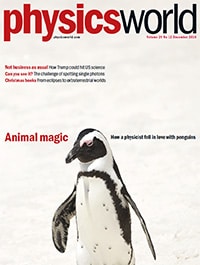
Everyone loves physics. And everyone loves animals, right? In the December issue of Physics World magazine, which is now live in the Physics World app for mobile and desktop, University of Bristol physicist Peter Barham explains how he became an expert in penguins, studying the factors that that affect their survival and discovering how to use the spots on African penguins to identify them. You can also read the article here.
Elsewhere in the new issue, you can enjoy our selection of the best books for Christmas, discover how one physicist became a successful contemporary dancer, and find out how to spot single photons with your naked eye.
Don’t miss either the chance to win a copy of Astronomy Photographer of the Year: Collection 5 in our special prize puzzle.
I’m often asked how as a physicist I managed to end up carrying out research on penguins. The answer is it happened through a set of lucky chances driven by my partner’s passion for these animals. When I first met Barbara, it was very obvious that she loved penguins. At first this made my life quite easy as I could always buy her presents she’d appreciate (a book on penguins, a penguin T-shirt or a cuddly penguin). But later in life it got much more difficult – there is a limit to how many penguin-related items are available.
So eventually we started to travel to see penguins in the wild. That led to meeting up with one of the penguin keepers at Taronga Zoo in Sydney who was able to tell us that there would be an international conference about penguins a couple of years later in South Africa. So it was that just over 20 years ago, we took our summer vacation in South Africa so that we could attend the Third International Penguin Conference in Cape Town.
This was my first biological science conference and it made a striking contrast to the physics meetings I had previously attended. It was so polite. No-one offered any criticism of the speakers (even when a rank amateur such as myself could see basic inconsistencies in some talks). If that had happened at one of the polymer-physics meetings I was used to, the speakers would have been eaten alive by some of the old professors in the audience!
Tagging out: flipper bands, which can adversely affect African penguins, have now been superseded by pattern recognition or microchipping as a means of identification. (Courtesy: iStock/dpchages)
So it came as a real shock to me when halfway through the week a full-on row developed among the biologists after the talk given by one of the leading penguin biologists, Bernard Stonehouse (who was the first person to observe the full breeding cycle of the Emperor penguins through an Antarctic winter). He had decided at the last minute not to give his advertised talk (about interactions between tourists and penguins in Antarctica) but instead harangued the assembled penguin biologists about the way they marked penguins using metal flipper bands.
It had been shown a few years earlier that these bands can adversely affect penguins as they increase the birds’ energy requirements significantly. At the previous International Penguin Conference in 1992 it had apparently been generally agreed that alternative marking methods should be found. Stonehouse had noticed nothing had been done and so made a plea for change. He ended his talk by suggesting that one possible solution might be to use modern materials (such as plastics) to make less harmful bands. Once he finished it seemed everyone wanted to have a say, with many opinions about why plastics were unsuitable – or very suitable – materials.
After a few minutes (and some prodding from Barbara) I decided to intervene and admit that I was a polymer physicist and actually knew something about plastics as materials. Before I knew what had happened I was “volunteered” to develop new plastic flipper bands.
Flipping out
Back at the University of Bristol in the UK, I recruited final-year undergraduate project students to develop the equipment we would need to measure the drag from different styles of bands and to start designing new styles from a range of materials. Within a couple of years we had tested a few designs on penguins at Bristol Zoo and were ready to start testing in the wild – so I set about getting funding for such a project, together with friends I had made during the conference working at the University of Cape Town and the South African Department of Environmental Affairs.
We were lucky enough to get funding from Earthwatch, an environmental charity based in the US, which not only provides money but also volunteers to help with data collection. But just as we were about to start the project, disaster struck.
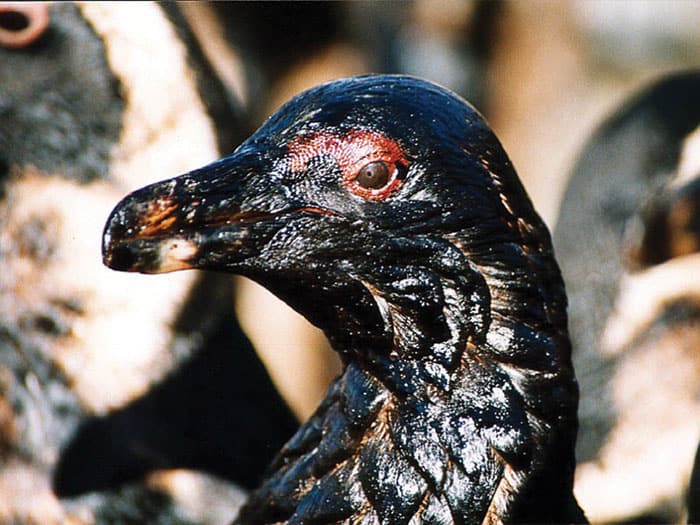
On 23 June 2000 a cargo ship sank between our chosen research site, Robben Island, and another nearby penguin colony on Dassen Island, both of which lie off the coast of South Africa. More than 360 tonnes of viscous fuel oil was spilled, which led to more than half of the penguins breeding on Robben and Dassen islands being oiled. Those that initially avoided the oil were taken 700 km away to Port Elizabeth and released to swim back while the oil spill was being cleaned up, in order to prevent them getting covered in the black stuff. Nearly all the oiled birds were de-oiled and returned to the islands alongside the translocated birds and it was not until they bred the following year (2001) that we could finally get the project under way.
Sticky situation: in 2000 an oil spill near Robben and Dassen Islands, off the coast of South Africa, led to more than half the penguins being oiled. The rescue effort and subsequent penguin research led to some surprising findings. (Courtesy: Rob Crawford)
I soon noticed a number of differences between the ways biologists and physicists design and conduct their research. In biology, research is generally hypothesis driven, while in physics it is more commonly curiosity driven. So we had to design our project to test the hypothesis that the “new” plastic flipper bands had no more effect on the penguins than the “normal” steel bands. To do this we fitted pairs of unbanded penguins with the new bands and compared their breeding success to pairs of penguins fitted with traditional bands. Since all the de-oiled and many of the translocated penguins from the oil spill had been fitted with traditional bands, there was no shortage of “control” birds. But we had to search through the colony to find sufficient numbers of breeding pairs of birds, neither of which were already banded, to fit with the new bands. Then it was just a case of letting the volunteers monitor the nests for a couple of years and seeing whether there were differences in the numbers of chicks raised by the two groups.
Once we had three years of data we were able to start analysing whether the new bands were any good. But once I started looking at the data, I kept noticing inconsistencies and issues that did not seem to make sense. So I adopted a “physics” approach and looked for patterns in the data to see if I could tease anything useful out of them.
Quickly I realized that we had captured some unexpected results that had nothing to do with the bands we were trying to test. We found that the birds that had been de-oiled following the spill in 2000 had lower breeding success compared with birds that had never been oiled. We were then able with one more year of data to show a number of surprising conclusions about the whole rehabilitation process for the penguins. We demonstrated that the translocated birds were breeding as successfully as other birds that had never been oiled. This was important as it confirmed that the idea of translocating unoiled penguins (which was an emergency action taken without knowing whether it would work) had indeed been successful.
Another conclusion from the data was that chicks that had been taken away and hand reared before being released had survived better than naturally reared chicks, and were starting to breed well. This was quite unexpected, as received wisdom at the time was that hand-reared chicks were unlikely to survive at all. The de-oiled birds, meanwhile, were raising no more than half as many chicks as the rest.
Birds of a feather: African penguins go out to sea in the same groups every morning, yet return to their nests in different groups. Why this should be so remains a mystery. (Courtesy: iStock/USO)
These largely unexpected results have led to changes in the priorities for rehabilitation centres around the world. For example, today in a major oil spill, priority is given first to removing clean birds from the area, to prevent them becoming oiled. In cases where it has been established that hand-rearing chicks is feasible, the second priority is given to removing and rearing these chicks. De-oiling oiled birds, meanwhile, is given a much lower priority. Unfortunately for the original research project, the compounding of effects of bands with effects of de-oiling meant that we were not really able to tell how well the new bands were performing.
At the same time, I had wondered why no-one was using the unique spot patterns on African penguin chests as an alternative means of identification – one that required no bands at all. When I discussed this at a meeting on the advisability of banding penguins, I was astonished to find that the biologists did not realize these patterns were unique to each individual. So I went back to Bristol and enrolled the help of our computer scientists to develop a system to extract patterns from photographs or video footage and automatically recognize individual birds.
We managed to develop a working system that uses computer vision technology. The software first identifies penguins in images streamed from a live video camera and then “cuts out” images that contain enough information to extract the spot patterns. These can later be “indexed” by creating the set of all the vectors connecting each spot to every other spot to create a unique identifier. These sets of vectors can then be compared to a database of all the known penguins to identify each individual bird.
We ran this system for three years on Robben Island, noting the patterns of every penguin that passed a fixed camera along one of the main routes they use to come ashore. But generalizing that to any camera at any location has proved a more challenging task, as the lighting conditions greatly affect the ability of the system to recognize penguins and extract spot patterns. Also, as more and more penguins enter the database, it becomes increasingly difficult to test whether a particular pattern is a match for one already in the system but from a different angle or with a spot occluded by some dirt, or whether it is a bird not yet in the system.
We have, however, been able to get some interesting results from this system just by looking for patterns in the data. For example, it seems that penguins going to sea in the mornings tend to do so in the same groups most days – as if they are a group of school children walking to school with their friends. But in the evenings when they return to their nests they seem to do so in different groups. Why this should be so is still the subject of a lot of speculation.
Food focus
A significant advantage of being in a physics department is that undergraduates have to do final-year research projects and are often interested in practical projects – so they can be persuaded to design and make useful instrumentation for field work, usually involving building electronic automatic data-collection systems. For example, one pair of project students created a battery-operated weighing system using a set of commercially available parcel scales combined with a data collection and control system based around an Amicus microprocessor. Importantly, the system is reliable, robust and cheap enough to be used by field biologists. I supervised a Master’s student who put these weighing systems in front of penguin nests along with camera traps, to weigh and identify penguins as they arrived and left the nest.
This sort of system can not only tell us about how much food the adults are bringing their chicks and how well the chicks are growing, but it can also tell us about how the parents partition the effort of raising chicks, for example. But perhaps the most interesting thing it has taught us so far is that the number one factor in determining how many chicks a pair of penguins will raise is just how well fed the adults are right at the start of the breeding process. We found that if the lighter of the two penguins weighs more than 2.4 kg then the pair are very likely to fledge two healthy chicks. But if it weighs less than 2.0 kg they are unlikely to fledge any chicks at all. These results highlight the importance of the availability of food in the non-breeding season, something that had previously been largely overlooked (probably because it is hard to measure).
Physicists often have crazy ideas – one such idea that came up during a meeting with my colleagues at Bristol Zoo was to conduct an experiment to see if we could create a brand new penguin colony. At the time, African penguins, which breed at around 30 islands and two mainland sites around the western and southern coasts of Namibia and South Africa, were doing quite well. But we thought the birds might not do so well in the future, so if we could try and create a colony now, then we would know how to create new colonies from captive-bred birds should it ever become necessary for the survival of the species.
The idea was generally laughed out of court for all sorts of good reasons. A few years later, however, the population of African penguins started to decline rapidly, largely because the fish stocks started to move away from the coastal waters near the islands where the penguins bred. In 2010 the conservation status of the African penguin was re-classified from “vulnerable” to “endangered”. The once-crazy idea of establishing a new penguin colony is now being actively pursued in South Africa and hopefully in the next few years we will see a colony started in an area where fish stocks are holding up well.
Full circle
The current consensus about flipper bands among penguin researchers is that they are not suitable for African penguins (even the recently developed rubber ones which it turned out some penguins managed to remove by themselves!). Instead, birds are identified either at their nests using the unique pattern markings, or by injecting them with microchips, which have no detrimental effects on their behaviour and are relatively easy to read with suitable equipment.
Three years ago I was the chair of the Eighth International Penguin Conference in Bristol and in September this year I was one of the organizers of the Ninth International Penguin Congress in Cape Town, held exactly 20 years after the meeting that first got me involved with penguin research. At that meeting there was a whole session on post-rehabilitation-monitoring research – all triggered from the observations we made accidentally when trying to evaluate flipper bands. So my work has come full circle and although I still consider myself a physicist, I have also become accepted as a real penguin biologist.
See below for a video of Peter Barham explaining how you recognize a penguin in a crowd, as part of Physics World’s 100 Second Science series.
Ghost imaging – a counter-intuitive technique that produces images of an object using photons that have never interacted with it – has been performed for the first time using massive particles. The researchers believe that their new technique of ghost imaging using atoms instead of photons could be used to test fundamental principles of quantum mechanics.
The underlying concept of ghost imaging was first outlined by David Klyshko of Moscow State University in 1988. Pairs of correlated photons with equal and opposite momenta are sent simultaneously down different paths. The object of interest lies in the path of one photon from each pair. This photon may either interact with the object or pass directly to a detector, which records only the time of its arrival. The second photon travels an equal distance to a detector that precisely records both its arrival time and position.
If the photon travelling the first path does not interact with the object, each photon arrives at its detector at exactly the same time. If the first photon interacts with the object, however, it does not reach the detector or is delayed. Crucially, the second detector discards any photons that did not arrive at the same time as a photon hit the first detector. This allows it to build up a “ghost image” of the object in the first path. The technique was first demonstrated experimentally in 1995 by Alexander Sergienko – a former PhD student of Klyshko – and colleagues at the University of Maryland in Baltimore.
Intense atomic source
In principle, the set-up should work perfectly using massive particles such as atoms in place of photons. However, it had never previously been demonstrated because it is difficult to find a source of massive particle pairs that is intense enough to produce an image in a reasonable amount of time and yet has sufficiently precise correlations between particles that the detector can isolate the correlated ones. This is more difficult with massive particles because they travel much more slowly than photons, so the arrival times are less certain.
Now, physicists at the Australian National University in Canberra have solved this problem by splitting a Bose–Einstein condensate of ultracold helium atoms into 12 parts and then colliding the portions together. At each of the 11 collision points, a halo of pairs of scattered, correlated atoms is produced. The researchers allowed the diffracted atoms to fall under gravity, placing a mask in the path of some of the falling atoms and recording only the arrival time of atoms travelling this path. Other atoms had both position and arrival time recorded, and the team combined the information to produce a ghost image of the mask with submillimetre resolution.
Each halo of pairs was scattered with a slightly different momentum and therefore arrived at the detector at a different time, making it possible to correlate the atoms later. “This means that we can increase our data-acquisition rate by more than an order of magnitude,” says team member Sean Hodgman. Nevertheless, producing the image still required three weeks of imaging time.
Atom lithography
The researchers suggest that, with further development, the technique could potentially be used to allow atom lithography, for example, to be monitored and controlled in real time. Hodgman admits he is “sceptical as to whether it will ever actually have an application, but it’s possible”.
The technique could also prove useful for testing the fundamental principles of quantum mechanics with massive particles. In 2012, Anton Zeilinger and colleagues at the Institute for Quantum Optics and Quantum Information in Vienna, Austria, published a proposal to use ghost imaging to test whether or not separated entangled atoms exhibit non-local “Einstein–Podolsky–Rosen” (EPR) correlations between apparently localized properties such as momentum, so that a measurement of one can affect the state of the other. “Measuring EPR correlations with atoms has been a long-term goal of the field, and no one’s managed to come up with a practical scheme,” says Hodgman. Zeilinger’s test cannot be done using the team’s current apparatus but the researchers are working on alternative ways to perform it.
Sergienko, now of Boston University in Massachusetts, is impressed by the researchers’ achievements. “The major interesting feature here is the use of a massive particle,” he says. “To some extent, it’s much more difficult and complex than with photons – maybe that’s the reason people haven’t done it before. These people were able to overcome all the problems and make it work.”
Most of our daily life experiences involve matter subjected to fairly moderate pressures. But once you start to ramp up the pressures some fascinating physics can start to occur, as Shanti Deemyad explains in this video. High pressures can be used to change the density of materials and therefore influence the interactions between atoms. Exotic physical phenomena can occur under these conditions, such as matter changing its form into metastable states – as is seen with the transformation of graphite into diamond.
Deemyad, who is an experimental physicist at the University of Utah in the US, explains some of the different methods for achieving extreme pressures within a laboratory. One of those methods is known as a diamond anvil cell, which can be used to generate pressures as high as those in the Earth’s core. Deemyad shows one of these surprisingly modest-looking devices towards the end of the video.
This video is part of our 100 Second Science series, in which researchers give concise presentations covering the spectrum of physics.


 By Matin Durrani