Light-emitting diodes (LEDs) that are efficient at producing deep-ultraviolet light have been created by Grace Xing, Debdeep Jena and colleagues at Cornell University in the US. The devices could be used to kill a wide range of harmful micro-organisms.
Deep-ultraviolet light has wavelengths between 200–280 nm and is particularly effective at penetrating tiny living organisms and killing them by disrupting their DNA. As a result, deep-ultraviolet light has been used for more than 100 years for controlling harmful viruses, bacteria, moulds and even dust mites. Today, most deep-ultraviolet sources are mercury vapour lamps. Although these devices are very good at what they do, mercury is a highly toxic substance and researchers are therefore trying to develop alternative sources of deep-ultraviolet light.
Low efficiencies
LEDs could offer a way forward, but creating sources that are bright enough to be of practical use has been a challenge. Boosting the efficiency of such devices involves making improvements in three main areas. The proportion of the electrical current passing through the device that makes it to the light-producing “active region” (the injection efficiency) could be increased. Once the electrons get to the right place, the proportion that actually creates light – the internal quantum efficiency (IQE) – could be improved. Finally, the amount of light that emerges from the device (the light extraction efficiency) could be boosted.
Conventional deep-ultraviolet LEDs are based on the compound semiconductor aluminium gallium nitride, but now the Cornell team has shown that devices made from atomically thin layers of gallium nitride and aluminium nitride have higher IQE and light-extraction efficiency. The team was also able to boost the injection efficiency of their LEDs by using a polarization-induced scheme for doping both the n and p regions of the device.
Record breaking
They made three different LEDs that create light with wavelengths of 232 nm, 246 nm and 270 nm. The 232 nm device is the shortest-wavelength gallium nitride LED ever made, beating the previous record of 239 nm set by a research group in Japan.
The next task for the team is to integrate their LEDs in a package that could form the basis of commercial deep-ultraviolet sources. “We do want to package it within the next few months and test it as if it was a product, and try to benchmark it against a product with one of the available technologies,” says Jena.
Those of you who enjoyed Peter Barham’s Physics World feature “Penguin physics” might have – like me – come away enamoured of these little creatures, but not imagining that you could contribute to penguin research yourself.
Imagine my delight then when I discovered that the team behind British Science Week (BSW), which starts today, has teamed up with Penguin Watch, a citizen-science Zooniverse project that is calling for volunteers. The volunteer activity involves looking at photographs and, in each one, marking penguins, chicks, eggs and other animals such as humans. These crowd-sourced data will then then help the University of Oxford project Penguin Lifelines to better understand how threats to the ecosystem disrupt the dynamics of resident wildlife.
Information has been stored in a single atom for the first time. The nascent binary memory was created by Andreas Heinrich at the Institute of Basic Science in South Korea and an international team. It uses a high-voltage signal from the tip of a spin-polarizing scanning tunnelling microscope (STM) to set the direction of the magnetic spin of a holmium atom on a nearby surface – so that spin-up corresponds to storing a “0” and spin-down to storing a “1”. The direction of the spin is read using a single iron atom that is located adjacent to the holmium atom. This involves using the STM tip to apply a radiofrequency signal to the spin of the iron atom, causing it to oscillate. The oscillation (Larmor) frequency of the iron atom is affected by the magnetic spin state of the nearby holmium atom, allowing the stored information to be read. Using this technique, the team showed that the direction of the spin is stable for several hours. Heinrich and colleagues were surprised to discover that two holmium atoms could be placed just 1 nm apart without their magnetic fields interfering. “There are no quantum mechanical effects between atoms of holmium,” says Henirich. “Now we want to know why.” This ability to pack the atoms close together could mean that the storage technique could be used to create high-density memories. The work is described in Nature.
Black hole blew Fermi bubbles six million years ago
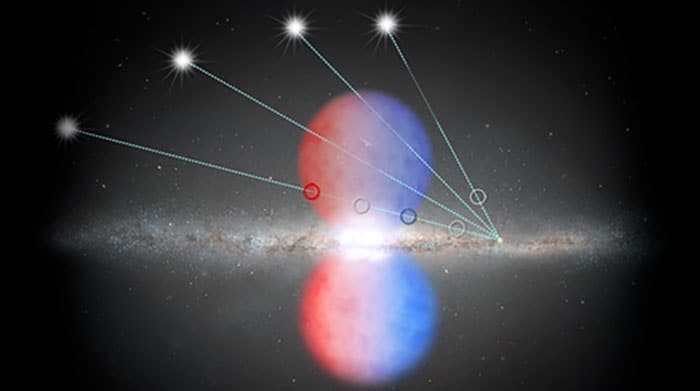
Galactic bubbles: artist’s impression of the two huge gaseous lobes on either side of the Milky Way. (Courtesy: NASA)
The supermassive black hole at the centre of the Milky Way had its last big meal roughly six million years ago. That’s the conclusion of a team of astronomers who used data from NASA’s Hubble Space Telescope to show that the last big object to be consumed by the black hole was a large clump of gas. The Milky Way’s supermassive black hole has the mass of 4.5 million suns and therefore any material that gets too close is drawn in by its powerful gravitational force. The material then swirls around the black hole until it is eventually consumed. However, the material can get so hot that some of the matter escapes along the black hole’s spin axis. Rongmon Bordoloi from the Massachusetts Institute of Technology in the US and colleagues believe that this happened to a large clump of gas six to nine million years ago, and the ejected matter created the huge lobes of material – called Fermi Bubbles – above and below the Milky Way. The team used observations from Hubble’s Cosmic Origins Spectrograph (COS) to analyse the ultraviolet light from 47 galaxy cores – called quasars – including the Milky Way. As the light travels through the bubbles it carries information about the gas speed, temperature and composition. The results provide a new insight into Fermi Bubbles, including how old they are. “We have traced the outflows of other galaxies, but we have never been able to actually map the motion of the gas,” says Bordoloi. The group also saw the presence of silicon and carbon – the fossil remnants of the stellar evolution. The research is described in The Astrophysical Journal.
Polymer coating stabilizes ultrathin silicon
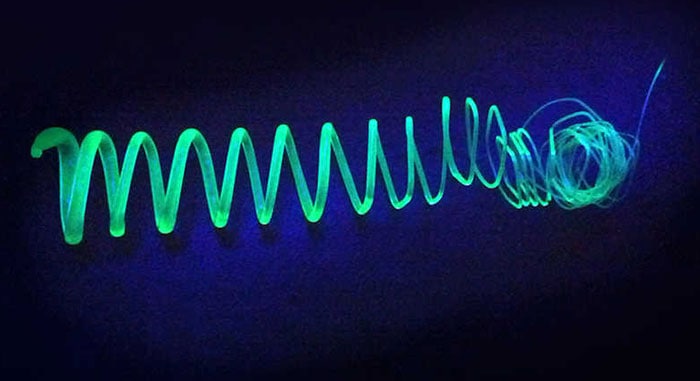
Twisted light: this extruded spiral made of polymer-coated silicon nanosheets is glowing in UV light. (Courtesy: Tobias Helbich / TUM)
A new way of stabilizing sheets of silicon just one atom thick has been developed by researchers at the Technical University of Munich. Since it was first isolated in 2004, graphene has been shown to have a number of unique and potentially useful electronic properties. Many of these arise from the fact that the material is also just one atom thick, and as a result, physicists are keen to create other ultrathin materials with potentially useful properties. Silicon is an intriguing candidate because it is already widely used in electronic devices, and ultrathin sheets of the material have promising optoelectronic properties. Unfortunately, ultrathin sheets of silicon are extremely delicate and disintegrate when exposed to ultraviolet (UV) light. Now, Tobias Helbich, Bernhard Rieger and colleagues have embedded silicon nanosheets in a polymer to protect them from decay. “What makes our nanocomposite special is that it combines the positive properties of both of its components,” says Helbich. “The polymer matrix absorbs light in the UV domain, stabilizes the nanosheets and gives the material the properties of the polymer, while at the same time maintaining the remarkable optoelectronic properties of the nanosheets.” The team also created a photodetector by mounting several of the coated silicon sheets on a silicon-dioxide surface that is coated with gold contacts. The research is described in Journal of Physics D: Applied Physics.
You can find all our daily Flash Physics posts in the website’s news section, as well as on Twitter and Facebook using #FlashPhysics. Tune in to physicsworld.com later today to read today’s extensive news story on a new low-cost source of ultraviolet light.
Two independent groups of physicists in the US have built what they describe as “time crystals” – systems of interacting particles that are driven by a periodic force but which appear to oscillate autonomously. These are not the same as the theoretical time crystal outlined by Nobel-prize-winner Frank Wilczek five years ago, which it was alleged could break time symmetry by oscillating indefinitely without any energy input. But the researchers report that their systems seem to break what is known as discrete time symmetry.
Wilczek put forward his idea in analogy with the highly ordered lattice structure seen in physical crystals such as salt or diamond. The laws of physics tell us that empty space exhibits a symmetry such that no point is different to any other, but crystals break this symmetry since their constituent atoms or molecules sit at very well-defined locations. Given that crystals exist in thermodynamic equilibrium, Wilczek wondered whether it might be possible for systems of particles to spontaneously form repeating structures in time, even in their lowest energy states.
In 2012, Wilczek argued that a time crystal could be created by applying a static magnetic field across a ring of quantum particles. These would then group together in clumps around the ring and rotate. But his proposal, which appears akin to a perpetual motion machine, proved controversial. Patrick Bruno, a theorist at the European Synchrotron Radiation Facility in France, published an analysis showing that the system would not be in its ground state, and that if it were, it wouldn’t rotate. Bruno’s critique was then generalized to show that such time crystals would be physically impossible.
A modest proposal
Undeterred, Wilczek and others recast the idea in a more modest form, such that the particles in the system do not exist in a true state of equilibrium. Such a “discrete time crystal” involves applying a set of periodic forces to a set of spins, such that the orientation of the spins oscillate at an integer multiple of the driving period. Rather than breaking time symmetry per se, this breaks the “discrete” symmetry already created by the driving fields. This is analogous to placing atoms of a different element at, say, every second or third atomic site on the surface of a crystal, which breaks the surface’s existing symmetry.
According to Christopher Monroe of the University of Maryland, who led one of the two experimental teams, these time crystals must have two particular properties if they are to be considered real, self-contained entities. One is “rigidity”, the ability to maintain a fixed oscillation period while external parameters – such as the driving period – vary. The other condition is that the system must not heat up, even though it requires energy to oscillate. “This allows us to drive the system, but have it remain in quasi-equilibrium,” he says.
These time crystals tick in a reliable way and have long-range correlations
Frank Wilczek, MIT
To create their time crystal, Monroe and colleagues used trapped ions. They exposed around a dozen strongly interacting ytterbium-ion spins to a sequence of periodic laser pulses. These pulses drove the system at a particular rate, while additional laser beams added randomness to each spin’s rotation – creating disorder that prevented the system from heating up. The researchers found that the oscillation period of the spins remained at the expected, fixed value – and, crucially, that it did so even when the pulse period changed slightly. “That is the smoking gun,” says Monroe. “It is a property of the system, like the fixed lattice of a crystal.”
Natural set-up
The other experiment, led by Mikhail Lukin of Harvard University, involved a less precise but more natural set-up. It consisted of nearly a million spins formed by impurities in diamond known as nitrogen-vacancy centres. The driving field in this case came in the form of microwave pulses, while the heat-suppressing noise arose naturally as a result of a random variation in the dipole interaction between vacancy centres. Here too, the researchers were able to oscillate spins at integer multiples of the driving period – twice and three times as long, in this case – which remained unaffected by changes to the driving parameters.
Chetan Nayak of Microsoft Station Q in California – who wrote a commentary to accompany two papers in Nature describing the work – says that the “rigidity” observed by the two groups provides evidence of discrete time crystals. But he says that the case will only become watertight when they show that the spin oscillations remain in phase for a period of time that is exponentially long compared with some parameter of the system, such as its physical length. “The next generation of experiments would have to overcome some technical hurdles to see this,” he says. “But I think that these hurdles can be overcome.”
Bruno, meanwhile, has a more basic objection. He argues that the latest results provide useful information in the study of non-equilibrium quantum systems, but that they fall a long way short of what he says would have been the “radical change of paradigm” accompanying a confirmation of Wilczek’s original theory. “For systems out-of-equilibrium, the spontaneous breaking of time-translation invariance, per se, is neither new, nor surprising, nor mysterious,” he says.
Wilczek, however, describes himself as “ecstatic” at the latest research. He concedes that the results do not constitute a “fundamental breakthrough in physics in the sense of rewriting the Standard Model, for example”. But he argues that being able to “spontaneously break discrete time symmetry” is “qualitatively new”. And he adds that the research could lead to practical applications, such as the development of a clock for quantum computers. “These time crystals tick in a reliable way and have long-range correlations,” he says.
At a fundamental level, the physical universe can be thought of as information. All the stuff we observe arises from chains of yes-or-no questions. This “it from bit” concept was introduced in 1990 by the theoretical physicist John Wheeler. Now, however, a new idea has arrived that is even more fundamental, where the universe is conceptualized in terms of quantum bits of information – “qubits”.
This radical “it from qubit” was the subject of a feature in the January issue of Physics World. Authors Patrick Hayden and Robert Myers describe how collaborations between the high-energy physics and quantum-information communities may hold the key to a unified theory of quantum gravity. Find out how to access that article here.
Proton therapy is an increasingly popular treatment technique that uses beams of protons to accurately target and destroy cancerous tumours. A new Physics World Discovery ebook, Proton Beam Therapy, takes a close look at the physics of this cancer treatment, its benefits and the challenges associated with bringing this approach into the clinical mainstream.
The ebook is written by Harald Paganetti, director of physics research at Massachusetts General Hospital and professor of radiation oncology at Harvard Medical School. He is a pioneer in advanced Monte Carlo dose calculations for proton therapy, and is considered the world expert on the relative biological effectiveness of proton beams.
In the last few decades, proton therapy has transitioned from research laboratories into the clinical setting – making this publication particularly timely. There are currently around 60 proton therapy facilities worldwide, and this number is increasing rapidly. “Proton therapy is becoming a standard treatment option but there are still many challenges in terms of the physics, biology and clinical use of protons, which are summarized in this ebook,” Paganetti explains.
Regular listeners of the Physics Worldpodcast will have noticed that things have been a little different for the past couple of months. That’s because we’ve handed over the presenter mic to science communicator Andrew Glester, who has brought his own unique style to proceedings. Based in Bristol, UK, just a few kilometres from the Physics World HQ, Glester is a presenter and co-founder of Cosmic Shed– a podcast about science and storytelling, recorded in Andrew’s garden shed.
Internationally, women only represent 25% of researchers in the physical sciences, compared with 40% in health and life sciences. This is the finding of a new study published by Elsevierthat examines the gender trends across 27 research areas in 12 countries during the periods 1996–2000 and 2011–2015. According to the work, while the past 20 years has seen a significant increase in the percentage of women in scientific research, with nine of the 12 countries now over 40%, the physical sciences are still dominated by men. For physics and astronomy in both the UK and US, around 22% of researchers were women in 2011–2015. Although this is an increase from 15% during 1996–2000, women are still under-represented. Portugal, meanwhile, has the best ratio of women to men in physics and astronomy, with 37% of researchers being female. The team behind the study hopes that the empirical evidence will help governments, funders and institutions worldwide as they develop gender-balance initiatives. "[The report] will enable us to explore ideas about the causes of gender inequality in science," explains Uta Frith of University College London in the UK, who provided guidance for the report. The study, which is freely available online, used high-quality data sources including Elsevier's SciVal and Scopus, and the World Intellectual Property Organization (WIPO).
Mystery of drying paint cracked by new calculations
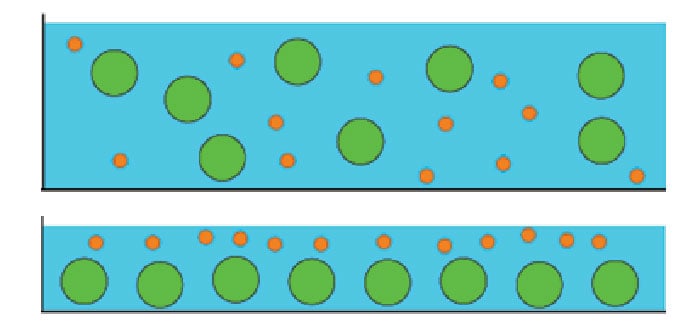
Watching paint dry: diagram showing how larger particles eschew the air interface as paint dries. (Courtesy: J Zhou et al. / Phys. Rev. Lett.
Last year, physicists made the surprising discovery that smaller particles in a layer of drying paint tend to move towards the air–paint interface, whereas larger particles move towards the surface being painted. This upended conventional wisdom, which suggested that smaller particles (which experience more random motion than larger particles) are more likely to diffuse away from the air interface. This response was expected to be driven by increased particle concentration near the air interface that is caused by evaporation. Now, Jiajia Zhou, Ying Jiang and Masao Doi at Beihang University in Beijing have come up with an explanation for why particles stratify in the opposite way. Writing in Physical Review Letters, they describe a model system that contains particles of two different sizes. The system is governed by the standard diffusion equation as well as an interaction between particles of different sizes. Their calculations suggest that the large particles do not tend to move towards the air interface because their size makes it difficult for them to push their way through the region of high particle concentration. This restricted mobility also features in a popular explanation of the "Brazil-nut effect", whereby larger nuts in a shaken tin of mixed nuts tend to congregate at the top of the tin. The research could lead to the development of new techniques for creating layered structures – and better paint.
Gravitational-wave pioneer Ronald Drever dies
Gravitational wave pioneer Ronald Drever has died. (Courtesy: American Physical Society)
The Scottish physicist Ronald Drever, a key person behind the direct detection of gravitational waves, has died at the age of 85. Drever was born in 1931 in Bishopston, Scotland, and after studying a BSc in physics at the University of Glasgow, he graduated with a PhD from the same institution in 1958. Drever continued to work at Glasgow, setting up a research group on gravitational-wave physics and began building a prototype detector. In 1979, Drever then moved to the California Institute of Technology, where he worked on a gravitational-wave programme with the theorist Kip Thorne. Together with Rainer Weiss from the Massachusetts Institute of Technology, the trio co-founded the Laser Interferometer Gravitational-wave Observatory (LIGO), which is located in Hanford, Washington and Livingston, Louisiana. Drever retired in 2002 and his death comes just a year after LIGO announced the first direct detection of gravitational waves.
You can find all our daily Flash Physics posts in the website's news section, as well as on Twitter and Facebook using #FlashPhysics. Tune in to physicsworld.com later today to read today's extensive news story on how a time crystal has been created in the lab.
I was born in 1971, by which time astronaut John Glenn had orbited the Earth and Neil Armstrong had walked on the Moon. My parents were witness to these monumental achievements, but sadly they knew nothing of a team of phenomenal black women who quietly played a pivotal part in making these significant moments possible. My family didn’t know their amazing story or how it would relate to me when I started dreaming about becoming an astronaut. As an African American woman, a physicist and a current employee of the National Aeronautical and Space Administration (NASA), Margot Lee Shetterly’s book, Hidden Figures: the Untold Story of the African American Women Who Helped Win the Space Race, both excited and moved me.
I was eager to delve into the untold true story of the African American female mathematicians who came to work at NASA (then known as the National Advisory Committee for Aeronautics) at Langley Field campus in Hampton, Virginia, following the labour shortages of the Second World War. Part of the segregated West Area Computers division, these human “coloured computers”, who had previously worked as underpaid maths teachers in segregated public schools, stayed on at Langley after the war ended. They became a crucial part of America’s race into space during the Cold War, as they calculated the flight paths that would send Armstrong to the Moon.
Before I had even known of the book, in July 2016 I was given the opportunity to watch the trailer for the upcoming film Hidden Figures, based on Shetterly’s book. I recall having goose bumps down my arms and back while watching the excerpts, alongside cast members Janelle Monáe and Aldis Hodge, together with other NASA employees, including astronaut Victor Glover. I felt an overwhelming connection to the women I watched on-screen and I knew it was my duty to read the book and discover more about their story that was omitted from the history of space that I had been told.
I was ready to learn about the sacrifices made by these women who played a key role in integrating NASA and providing a pathway for me to follow. The book mainly outlines the contributions of four women: Dorothy Vaughan, Mary Jackson, Katherine Johnson and Christine Darden. We learn about their personal lives, their careers and their contributions to NASA. There are two passages in particular that really resonated with me, and I have a feeling that many other African Americans in science, technology, engineering and mathematics will agree. The first was the bit that mentioned the “West Computers” having to “prove themselves equal or better, having internalized the Negro theorem of needing to be twice as good to get half as far”. Also, the fact that “not everyone could take the long hours and high stakes of working at Langley, but most of the women in West Area Computers felt that if they didn’t stand up to the pressure, they’d forfeit their opportunity and maybe opportunity for the women who would come after them” really drew me into parts of the story. I personally identified the most with Johnson who, like me, has three children. As the first black graduate from the University of Alabama with a concentration in physics, I also connected with Jackson who was NASA’s first black female engineer.
Although I was fascinated with the story being told, I unfortunately found the book somewhat difficult to read. The depth with which Shetterly chronicles the women’s lives clearly shows her deep personal connection to the story, as well as her own history with NASA – her father was a research scientist at Langley. But at the same time, the book was written in a more distant way than I was expecting – the book often spans further out to address the wider historical context of the time, instead of remaining true to the women’s stories. The prologue describes the author’s personal experience of the subject and provides a short account of her view of the story and her dedication to unveiling the history – it was beautifully written by Shetterly and was one of my favourite parts of the book.
Since the release of the film I have watched it eight times, and for three of those I had the honour of viewing it with Johnson’s granddaughter, Katherine Michelle Sanders. Each time she was present, Sanders provided little quips on what was true or false and even expanded on a part of the history that the film omitted. This film moved me to tears each time I watched it and I still sometimes find myself angry that women and minorities are currently dealing with the same issue of bias that Johnson and her colleagues had to face in their day. In my current role as president of the National Society of Black Physicists (NSBP), so many people have approached me and felt compelled to share stories of similar segregation, being left out of important meetings or generally treated differently due to their gender or race.
Hidden Figures is an inspiring story that outlines the significant and remarkable impact these intelligent and brave African American women had on some of NASA’s greatest hits. The film and book should be seen and read by all young African American girls, as it not only proves to them that they can be black, female and top-notch mathematicians and engineers, but also shows them that the pathway has already been laid for them and that their participation in science will go some way to lessening the large disparity that exists when it comes to race and gender in science. For me, the book and film provided insight into the women who preceded me at NASA and provided context to those “giants” on whose shoulders I stand. I can only imagine the dreams I might have dreamed if I had known this story before now.
Hidden Figures: the Untold Story of the African American Women Who Helped Win the Space Race by Margot Lee Shetterly (2016 William Collins 368pp £16.99hb)
Hidden Figures directed by Theodore Melfi (2016 Fox 2000 Pictures, Chernin Entertainment, Levantine Films, TSG Entertainment)
What would you say are the core “products” of academic research? Most people, when asked this question, talk about research papers, trained scientists, books and perhaps even data. But this list misses a critical component of much of the research being done today: software.
We all know that much of modern physics research relies on the development of specialist software, whether it’s for experiments that create a huge amount of data such as the Large Hadron Collider, or for supercomputer simulations modelling the distribution of dark matter in the early universe. More than 90% of UK academics use software, according to a survey of Russell Group Universities (Hettrick et al. 2014 UK Research Software Survey 10.7488/ds/253). About 70% say their research would be impractical without it and more than half develop their own. Why, then, is software in physics not as visible as it arguably deserves to be?
Part of the problem here is that the research paper is becoming an increasingly unsatisfactory way of describing modern, data-intensive research. Academic publishing hasn’t changed substantially since the first communications in the journal Philosophical Transactions in 1665. Academics writing down their thoughts and sharing results with their peers in a journal-based system (paper or electronic) is the same solution we’ve had for more than 300 years.
Yet the full spectrum of activities in modern physics (and many other disciplines) simply can’t be completely described with text, a few equations and the occasional plot or figure. To completely describe the origin of any individual result, researchers need to share both their ideas and results (perhaps in the form of a paper) but also the data they collected and the analyses they carried out to reach their conclusions.
This idea of sharing more than just a paper isn’t new. In 1995 statisticians Jonathan Buckheit and David Donoho wrote “An article about a computational result is advertising, not scholarship. The actual scholarship is the full software environment, code and data, that produced the result.” Buckheit and Donoho argued that papers about “computational science” (the same argument also holds for physics) aren’t sufficiently complete descriptions of the work. They’re simply “adverts” for the research that we place in journals. For a third party to properly understand the research, they would need to be able to see all of the components that resulted in the paper (Wavelets and Statistics, New York: Springer, pp55–81).
The publishing problem
With dependencies on software woven into the fabric of modern research, finding ways for researchers to share this work seems like it should be a high priority.
On the face of it, asking researchers to share a more complete description of their research is hard to argue against. In reality though, there are a number of factors limiting progress. Probably the biggest impediment is that for many researchers, especially those in the early stages of their career, the pressure to publish as many papers as possible trumps almost every other activity. Publishing anything in addition to a peer-reviewed paper requires additional time and effort that most researchers simply cannot afford.
But as we move towards a future where a growing fraction of research output is described by data and software, it becomes increasingly urgent to find ways of at least capturing references to software in papers and ideally establishing community norms for the publishing of these tools.
There are a number of challenges to actually doing this. First, it’s not completely obvious how a researcher should cite software in a paper. Unlike a paper, which is a static “snapshot” of a research idea, popular software packages often have lifetimes of many years and are released multiple times with different version numbers and often with subtly different behaviour of the tools. As a result, capturing both the software name, location (i.e. where to find it) and the version of the software used is considered by many to be the minimal useful citation. Another obstacle is that even if an author wants to cite a piece of software, many journals don’t let them cite anything other than papers in their bibliographies. Finally, most academic fields lack cultural norms, such as dedicated journals, for publishing research software, which in turn means that spending time doing so generally isn’t recognized as a creditable research output. Put bluntly, why would anyone spend time publishing anything other than papers if it doesn’t contribute substantially to their career?
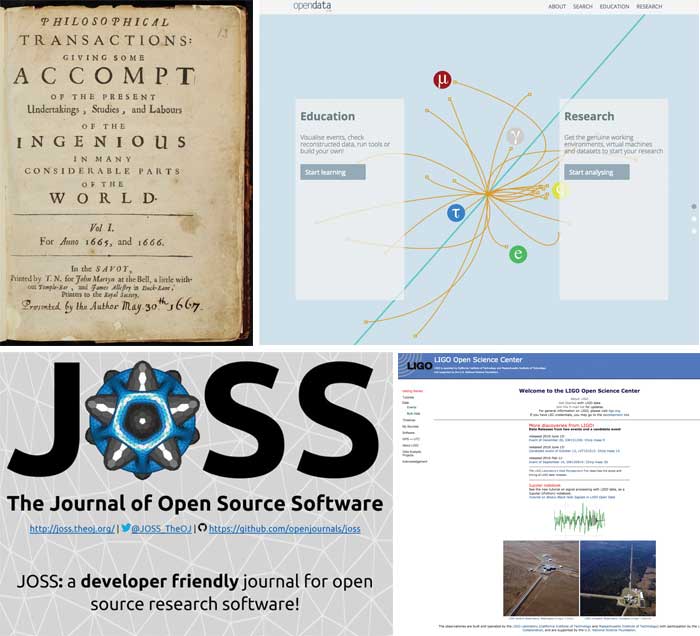
Change has been slow since the first scientific journal was published in 1665 (top left) and it is rare for journals to publish papers about software despite its increasing importance. A recent exception is The Journal of Open Source Software (bottom left). In the meantime, large science collaborations have found other methods of sharing their software and data, such as online portals from CERN (top right) and LIGO (bottom right).
Large physics collaborations are one area where all research outputs, including software and data, are shared well. This is probably because of a number of factors, including, first, that the collaborations are so large that there are individuals who devote most of their time to authoring software for data analysis and reduction and so they “go the extra mile” in publishing their code. Second, the results from these experiments have such a high impact in science that the community expectations for publishing all the research products (code, data, papers) is higher. Third, the community interested in reproducing these big results is large and so it’s more efficient for the wider community if the project releases software tools that enable others to check the data analyses.
A good recent example of a large collaboration publishing its research products well was in February 2016, when members of the Laser Interferometer Gravitational-Wave Observatory (LIGO) collaboration announced they had made the first detection of a gravitational wave. When announcing their results they published not only a paper describing the detection, but also all of their software used to analyse the data. The collaboration in addition created a complete online analysis environment, the “LIGO Open Science Center”, which leveraged this software in an interactive online environment. Publishing all of the constituent parts of their work meant that anyone with the time and interest could dive into the analysis carried out by the LIGO team, thereby increasing the community’s confidence in this groundbreaking result.
Looking outside of academia
Over the past few decades, there has been a major shift in the cultural norms of developing and sharing software that affects individuals, businesses and parts of academia. The reliance of businesses on closed-source, proprietary software, has given way to open-source software development, with even the biggest stalwarts of proprietary software such as Microsoft embracing open source as the future of technology development.
The term “open source” is often used to describe more than one thing. Strictly speaking, open-source software is software that has been shared publicly together with one of a number of approved licences that describe the conditions by which the code can be modified, reused and shared with others. What can be done with the code varies depending on the licence, but all of them permit the use of the software for any purpose. This is in contrast to, for example, image usage licences, which can specify that an image may not be used for commercial purposes.
In addition to being a collection of licences and legalese, the term “open source” is often used to describe the culture of open-source projects, in which there is an emphasis on working in an open and collaborative way, a focus on transparency and an effort to engage the community. As such, many of the principles of open source are well aligned with the core tenets of the open-science movement and academia more generally.
The success of open source relies not only on the goodwill of software developers and businesses to share their work free of charge, but also on an organically developed “ecosystem” that relies on a variety of factors (see box below). If open-source software is to flourish in the field of physics, physicists should consider adopting some of these key ingredients of success.
Data-science brain drain
Many of the problems we solve in academia, especially in data- and computer-intensive sciences, are, at least functionally, very similar to those in data-rich industries. This has led to a growing overlap in the skills required to be successful in both sectors. Often described with the catch-all term of “data scientist”, an individual capable of collecting, analysing and creating knowledge from data is highly employable in any large, data-driven organization. They might also be a good physicist.
In his 2013 blog post “The big data brain drain: why science is in trouble”, University of Washington data-science researcher Jake VanderPlas captures the essence of the problem facing academia. “The skills required to be a successful scientific researcher,” he writes, “are increasingly indistinguishable from the skills required to be successful in industry.”
VanderPlas is an astronomer and a prolific contributor to open-source tools that are used both in academia, for his research, and in industry, by data scientists. In his blog post, he describes a number of factors that should worry anyone who cares about the long-term health of our universities. First, the individuals most likely to be suffering a career penalty from spending time working on (open-source) software are some of the most employable people outside of academia. Second, the work these individuals contribute to open source is highly visible, and discoverable, because of the significance of these tools in industry. Third, with jobs in industry often paying two or three times more than postdoctoral-level salaries, many of the best and brightest young academics are leaving academia for industry.
One could argue that this “brain drain” is the university system working well for our economy – training a skilled workforce for industry. Unfortunately though, much of modern research is highly data-driven and needs individuals with these skills to make the best use of the voluminous data streams from modern experiments.
An imbalance of incentives
As things currently stand, most academic fields rely on a one-dimensional credit model where the academic paper is the dominant factor. Incentives to publish other parts of the research cycle, such as software and data, do exist but they don’t currently exist at the individual researcher level.
Papers that are accompanied by well-described data and analysis routines should be easier to understand and reproduce, which in turn should lead to an increased level of confidence in any new result. While physics has been left relatively unscathed compared to some other disciplines, without this increased level of transparency, many fields are running the risk of placing too much trust in “black box” methods whereby data are fed into analysis routines and results published with little critical review. Described by some as a reproducibility “crisis”, a number of high-profile retractions of novel results, especially in the biosciences in recent years, have led some scientific and medical publishers such as PLOS to require that submitting authors make software and data available when publishing a paper.
In physics and astronomy, publishers have so far been slower to adopt such requirements. But change is afoot: the American Astronomical Society journals The Astronomical Journal and The Astrophysical Journal, for example – published by IOP Publishing, which also publishes Physics World – now allow software papers describing research software with an astrophysics application. The Elsevier-published journal Astronomy and Computing, meanwhile, is dedicated to topics spanning astronomy, computer science and information technology.
In addition, there is a growing list of journals designed specifically for publishing software papers such as the Journal of Open Research Software, Software X and The Journal of Open Source Software – for which I led the development and continue to play the role of editor-in-chief. While these solutions are not the same as an academic ecosystem that rewards all of the constituent parts of the research output, they are a step in the right direction.
Physics experiments are only getting bigger and their data sets more complex. As such, much of modern research depends upon the availability of high-quality software and data products for community use. If we are to continue to make the best use of these experiments then we’re going to need to train – and retain – a workforce with a broad range of skills including data analysis, visualization and theory. To achieve this is going to require us to rethink what “counts” as an academic contribution.
Authorship and reputation in open source
Authorship is an important potential signal of trust in open source. When choosing an open-source project to solve a problem, knowing who the main authors of a project are is critical for evaluating the potential quality of a package. With platforms such as GitHub, Bitbucket and GitLab, contributions of individuals to the open-source ecosystem are placed front-and-centre on user profiles and easily discovered when viewing a project.
Another core tenet of open source is the reuse of existing tools. There are tens of millions of open-source packages hosted on a variety of platforms and most of these packages “depend” on other open-source tools. Tools such as Libraries aggregate all of these packages and provide rich metrics tracking their usage and the inter-project dependencies throughout the ecosystem. Understanding the “rank” of a project – that is, which projects are most reused by others – is similar to the citation count in the academic literature and is a strong reputation signal for the community.