US agency files charges against open access publisher

The US Federal Trade Commission (FTC) – an independent agency of the US government – has filed charges against the open access publisher OMICS Group. It accuses the publisher of misrepresenting its journals to attract submissions, hiding publication fees ranging from hundreds to thousands of dollars, and making misleading claims about the conferences it organizes.

The FTC is seeking a permanent injunction against OMICS and is also seeking monetary relief, which could include refunds of money paid by researchers. OMICS, which is based in India and has offices in the US and Europe, publishes more than 700 online journals, including a number of physics titles such as the Journal of Physical Chemistry & Biophysics and the Journal of Astrophysics & Aerospace Technology.

The complaint, filed in the US district court in Nevada, also names the president and director of OMICS, Srinubabu Gedela, and two affiliated companies, iMedPub and Conference Series, as defendants. They deny all the allegations.

Undisclosed fees

In a statement, Jessica Rich, director of the FTC’s Bureau of Consumer Protection, says that “the defendants in this case used false promises to convince researchers to submit articles” and “then held that work hostage over undisclosed publication fees.”

According to the FTC, OMICS falsely claims its journals follow rigorous peer-review practices and are indexed by academic databases, such as PubMed Central or MEDLINE. The FTC also says that the firm lists prominent academics as journal editors without their agreement.

The FTC adds that OMICS also states that its journals have high impact factors, but that the publisher fails to make it clear that it calculates its own impact factors, rather than using Thomson Reuters’ widely accepted standard. “In many instances, consumers only discover that their articles will not be peer reviewed and that they owe fees ranging from several hundred to several thousands of dollars after the defendants inform them that their articles have been approved for publication,” the FTC states.

Blocking publication

“Consumers’ attempts to withdraw their articles are frequently rejected, thereby preventing them from publishing in other journals,” says Rich. According to the FTC, OMICS also attracts researchers to conferences – which can cost more than $1000 to attend – with false claims of appearances by high-profile academics.

Following a request for comment, Gedela sent Physics World a link to a letter published in response to the FTC allegations. The six-page letter concludes by dismissing the accusations as “baseless” and accusing the FTC of “favouring some subscription-based journals publishers who are earing billions of dollars rom scientists literature [sic]”.

In the letter, they also note that they “hope” that the FTC understands their “service and contributions to make the scientific and health-care information open access”, adding that they have “answered all the allegations as well as provided further information”. The letter calls on the FTC to drop all proceedings and warns that OMICS may seek “damages for loss of repute and malicious prosecution”.


Flash Physics: MOND explains galaxy densities, fusion boss resigns and university fined for explosion

Modified MOND could explain galaxy densities

The density of ordinary matter in rotating disc galaxies can be explained without the need of dark matter, according to Mordehai Milgrom of the Weizmann Institute in Israel. The observed rate at which galaxies rotate is much greater than expected if only the gravitational pull of ordinary visible matter were holding them together. The extra gravitational glue provided by invisible dark matter is the conventional explanation for this discrepancy. However, in 1983 Milgrom proposed modified Newtonian dynamics (MOND) as an alternative explanation that eschews dark-matter altogether. Instead, MOND modifies Newtonian mechanics such that fast-moving stars in the outer regions of a rotating galaxy experience a greater gravitational tug than slower-moving stars in inner regions. Writing in Physical Review Letters, Milgrom has derived a new modified version of MOND that tries to explain the recent discovery of a strong relationship between the density of visible matter in disc galaxies and the density of matter required to keep the galaxies together. Milgrom says this modified version of MOND “agrees very well” with galaxy-density data and he points out that dark-matter theories cannot explain the density relationship.

US fusion boss steps down

Plasma physicist Stewart Prager

Stewart Prager, the head of the Princeton Plasma Physics Laboratory (PPPL) in New Jersey, has stepped down after eight years in the lab. Prager is the sixth director of the PPPL and joined the lab in late 2008 after a long career at the University of Wisconsin. The PPPL is operated by Princeton University and the lab operates the National Spherical Torus Experiment, which recently completed a $94m upgrade. However, the facility recently encountered a problem when a magnetic coil failed last month, which could knock it out of action for a year. Prager will now continue research in fusion energy and plasma physics at the PPPL after taking a year’s sabbatical.

University faces $115,500 fine for lab explosion

The University of Hawaii at Manoa Pacific Ocean Science and Technology Building

The University of Hawaii has been fined $115,500 (£88,500) to address safety failures that led to an explosion on 16 March at the university’s Manoa campus. The incident happened when postdoc Thea Ekins-Coward was mixing different gases at the Hawaii Natural Energy Institute. A static discharge caused an explosion that led to Ekins-Coward losing an arm as well as almost $1m in damages to the lab. The Hawaii Occupational Safety and Health (HIOSH) agency has now cited the university for 15 “serious” safety violations, including a lack of personal protective equipment and a failure to ensure that safety practices were followed. The university is now requesting an “informal conference” with HIOSH to “clarify the citations and discuss adjustments of the citations”.


  • You can find all our daily Flash Physics posts in the website’s news section, as well as on Twitter and Facebook using #FlashPhysics. Tune in to physicsworld.com later today to read today’s extensive news story on an open-access publisher being accused of misrepresenting it journals.

Gender balance, one woman at a time

What can be done to increase the number of women in physics? This question keeps committees busy and researchers funded, but the solution seems as elusive as squaring the circle. Four years ago, however, I did my bit: I transitioned from male to female. As this also meant that the number of men in physics was simultaneously reduced by one, it was, as they say in football, a “six-pointer”.

I hasten to add that I didn’t transition in order to improve the male-female ratio among physicists; that really would have been a remarkable thing to do. However, it did mean that when my wave function collapsed into the F state, I was able to conduct some controlled social observations in my work as a teacher. I’m the same person and I’m doing the same job, but in a different gender role. After a degree, PhD and postdoctoral research I trained as a teacher in the mid-1990s. I’ve been teaching physics in secondary schools ever since, and the women-in-physics question has long played into my department’s desire to increase the uptake of students taking A-level physics. We have been very successful in attracting boys but, whatever we try, the gender ratio has never strayed much from 4:1; if only the girls would sign up in equal numbers we really would be able to justify those glistening new laboratories that currently we can only dream about.

So, on 20 December 2012, the students in my school were sent home with letters to their parents informing them of an imminent and major change in my personal circumstances. Three weeks later they returned to school bright and eager, but probably with more than physics on their minds when they waited outside my lab. It was all very simple, I told them. Sir becomes Miss, he becomes she and – er – Dr Hayton becomes Dr Hayton. I knew that PhD would come in handy one day. From there life would go on pretty much as normal, as long as we all stood up straight (sometimes my classes even laugh at that joke).

The reaction from the students was wonderful. For two days I thought I had suddenly cracked the knotty problem of pupil indiscipline, as the corridor would fall silent as I walked around the school. However, the novelty value was short-lived and 48 hours later the same corridors were full of active children engaged in their conversations, oblivious to my presence as I passed them by. My relationship with my students reverted rapidly to what I had fostered over the years. It seemed that little had changed. My job was to teach them physics and their job was to learn. Or rather, their job was to try and get me to do as much of their learning as they could get away with. Theory was taught, questions were answered, experiments were done and written up, and attempts by students to sidetrack me from my lesson plans were successfully deflected. Or, at least, they were no more successful than previously. My gender role seemed irrelevant to any of this.

Some things were certainly different though. For 20 years my first lesson for Year 10 students on static electricity has involved me rubbing a balloon on my hair, leaping onto the front desk and placing the balloon on the ceiling, all in one sweeping dramatic movement. In January 2013 I taught two classes in Year 10. The first lesson passed without incident, which was good because I have never admitted the “leaping on the bench” bit to Health and Safety. The following day the other class sat in the same place as I geared up for a repeat performance. For some now forgotten reason, however, I had chosen to wear a skirt that day rather than trousers. I was already well into my run-up when I realized that the activity needed to be replanned as a matter of urgency. The class had to make do with the balloon being stuck to the wall on the other side of the room.

Some activities have definitely got better. I now join the other long-haired people on the styrofoam platform when the Van de Graaff generator comes out, and jewellery can be very useful when demonstrating magnetic and non-magnetic materials. Much of mine, it seems, is fabricated from mild steel rather than more precious materials. But in other respects I miss things that I took for granted. Moving heavy trolleys with dodgy wheels is more of a struggle as I have lost upper body strength and I have first-hand experience of the different way that men and women can be perceived when they open their mouths in meetings. I hasten to add that children seem remarkably free of the prejudices that seem to trouble some folks of my generation about women when it comes to physics and engineering.

But does having a female teacher in years 10 and 11 help girls decide whether to take A-level physics? After four years the answer seems to be “probably not”. Changing my gender role seems to have had no more effect than other strategies that I have employed over the years. What seems to be more important is good teaching, high expectations, a willingness to engage with our students and a love of our subject. But these things attract boys as well, and seemingly in greater numbers. Maybe we should congratulate ourselves for that? In any case, I can sense a sigh of relief from my male colleagues: none of you need to take this particular plunge for the sake of physics.

    • Readers are invited to submit their own Lateral Thoughts. Articles should be 900–950 words, and can be e-mailed to pwld@iop.org


Web life: Azimuth

So what is the site about?

Azimuth is an interesting hybrid. In part, it’s the personal blog of John Carlos Baez, a mathematical physicist at the University of California, Riverside, whose current research focuses mainly on network theory. But it’s also the official blog of something called the Azimuth Project, which Baez set up “to create a focal point for scientists and engineers interested in saving the planet, and make clearly presented, accurate information on the relevant issues easy to find…we want to make it easy for any scientist or engineer to understand the whole problem and understand specialist literature in many subjects outside their particular domain of expertise”.

Who is it aimed at?

The site’s hybrid nature makes its readership hard to pigeonhole. The posts on the environment tend to be written for a general audience, in keeping with the Azimuth Project’s goal of promoting interdisciplinary working. The mathematical posts, in contrast, are often rather technical in nature, and most readers will reach a point where they can go no further. That said, even if you don’t manage to stick with Baez all the way to the end of a lengthy series of posts on (say) large finite ordinal numbers, you are guaranteed to come away having learned something fascinating, and he also provides plenty of links to help interested readers get up to speed.

What are some sample topics?

Over the past few months, Azimuth’s focus has been decidedly mathematical. Indeed, in a summer 2016 series of posts about topological crystals, Baez laments that he feels “a bit guilty putting so much work into this paper when I should be developing network theory to the point where it does our planet some good”. However, he goes on to observe that he needs “a certain amount of beautiful pure math to stay sane”, and with current environmental trends looking so un-beautiful (a recent Azimuth post on coral reefs is particularly sobering), it’s hard to begrudge him the pleasures of his topological retreat.

Can you give me a sample quote?

From a May 2016 post about an extremely long mathematical proof of the Boolean Pythagorean triples problem: “In the 1980s the mathematician Ronald Graham asked if it’s possible to colour each positive integer either red or blue, so that no triple of integers a,b,c obeying Pythagoras’ famous equation: a2 + b2 = c2 all have the same colour. He offered a prize of $100. Now it’s been solved! The answer is no. You can do it for numbers up to 7824…but you can’t do it for numbers up to 7825. To prove this, you could try all the ways of colouring these numbers and show that nothing works. Unfortunately that would require trying [a number that takes up an entire computer screen] possibilities. But recently, three mathematicians cleverly figured out how to eliminate most of the options. That left fewer than a trillion to check. So they spent two days on a supercomputer, running 800 processors in parallel, and checked all the options. None worked…This is one of the world’s biggest proofs: it’s 200 terabytes long! That’s about equal to all the digitized text held by the US Library of Congress. There’s also a 68-gigabyte digital signature – sort of a proof that a proof exists – if you want to skim it. It’s interesting that these 200 terabytes were used to solve a yes-or-no question, whose answer takes a single bit to state: no.”

Simulating inner strain that causes brains to bulge

Simple models of soft solids can be used to accurately assess the damage that may be caused by an evasive brain operation known as a craniectomy. That’s the finding of a team of researchers from the UK and America who used the mathematics of their simple model to develop a realistic simulation of such procedures, which they hope will help to improve patient outcomes.

Traumas such as strokes, tumours and traumatic brain injury can cause the brain to swell. The resulting increase in intracranial pressure can inhibit blood flow and cause parts of the brain to die, with long-lasting or fatal consequences. To relieve the pressure, surgeons may decide, as a last resort, to remove a large section of the patient’s skull and leave a hole in the bone, a procedure known as a craniectomy. In modern medicine, craniectomies have been used for more than a century, but there is archaeological evidence to suggest that similar procedures were being performed thousands of years ago. The procedure is controversial, however, as failure rates are high and outcomes can be poor.

Under pressure

Earlier this month, researchers at the University of Cambridge published the results of a 10 year study on craniectomy. More than 400 people who had suffered traumatic brain injury and had high intracranial pressure were randomly assigned to receive craniectomy or medical care. Six months after the head injury, a quarter of the patients who received a craniectomy had died (27%), compared with half who received medical care (49%). But, the surviving craniectomy patients were more likely to be in a vegetative state or have a severe disability.

Damage occurs because the procedure causes the brain to deform as it bulges through the opening. For example, blood vessels and brain tissue can be squashed, leading to herniation and loss of blood flow, and stretching can damage or kill axons – the long part of nerve cells.

To improve outcomes, it is important to understand the stresses that develop in the brain after the operation. Alain Goriely, a mathematician at the University of Oxford, and colleagues at Stanford University in the US, the University of Oxford and the University of Exeter, decided to tackle this by looking at a simple physical problem: bulging in soft solids. Starting with mathematical models of simple geometries – a cylinder and a sphere – they looked at what happens when a constrained soft-solid that is swelling is only allowed to expand through a single circular hole. What shape does the bulge form? What stresses and stretches develop?

Stretch and slide

The simulations revealed three potential issues that could cause damage. Stretching in the centre of the bulge, compression at the edge of the opening, and regions of high shear stress around the opening, where outward sliding is constrained. The first two of these, in particular, correspond with known issues following craniectomy – axon stretch and constriction of blood flow and cells.

The researchers found that moderate swelling can produce harmful forces. Their estimates show that if the deformation is restricted so that all fibre strains remain below 20%, a relatively modest-sized bulge is produced compared to those seen following craniectomy. Yet, it is know that axons can be damaged by strains as low as 4%.

Goriely says that while most scientists believe stretch causes the most axon damage, the physics of materials shows that “shear is naturally associated with damage”. He adds: “We now believe that shearing is equally dangerous to the brain. Indeed, whereas tissues can resist compression and axons can recover from small extensions, shearing is associated with tissue rupture.”

The team also created a realistic model of a brain encased in a skull, based on magnetic resonance imaging of a female head. Simulations of a craniectomy, using the mathematics developed earlier, reproduced the same findings as seen in the simple models. “The beauty of the problem is that these three mechanisms appear to be universal,” says Goriely, “They hold for idealised geometries like a circular hole in a swelling sphere, but also for a real craniectomy opening in a human brain.” The model-brain simulations showed that a 10% expansion in brain tissue produces axon strain, compression and shear that are above the known damage thresholds for axons.

Difficult compromise

Goriely says that from a “physics point of view”, a craniectomy is a choice between high compressive stresses due to swelling or high strains due to large deformations. “Our method can help shed light on this difficult compromise, and suggest modifications of the procedure that induce less damage,” he adds. The researchers hope that once the computer modelling has been validated, it can help rationalize patient selection, and optimize opening location, shape and size to improve outcomes.

Angelos Kolias, a clinical lecturer in neurosurgery at the University of Cambridge, who was also a co-author of the 10 year study, told physicsworld.com that the craniectomy trial had “confirmed the life-saving nature of the operation”, but cautions that the quality of life of patients following this operation must be closely monitored.

“Bio-engineering approaches, such as the one described, are very promising as they can help us better understand the effects of craniectomy on the brain tissue,” adds Kolias. “Additionally, bio-engineering approaches could help us answer clinical questions regarding the optimal size and location of craniectomy in a patient-specific manner. We believe that a multidisciplinary approach to the issue of brain deformation following craniectomy will play a central role in the efforts to optimize patient outcomes.”

The research is described in two papers in Physical Review Letters and Computer Methods in Applied Mechanics and Engineering.

Flash Physics: Salty life on Mars, predicting molecular properties and a new head for NASA science

Salt mine could help shed light on Martian life

In a bid to determine if there is – or has ever been – life on Mars, researchers in the UK are using Raman spectrometers to study environments on Earth that resemble the planet – including the Boulby salt mine in North Yorkshire. The team hopes to inform the European Space Agency’s 2020 ExoMars mission, which will land a rover on the Red Planet. The rover will be equipped with a host of instruments capable of analysing the composition and structure of material recovered from the near sub-surface of Mars. The researchers at the University of Leicester are part of a larger team that is developing a camera system for the rover’s one Raman spectrometer. Leicester’s Peter Edwards is looking into optimizing its performance by studying various types of samples recovered from extreme environments on Earth. “Parts of Mars are quite similar to the salty environment deep underground at Boulby,” he says, adding: “In these areas we see polygons marked out in the ground similar in some ways to those seen on Mars.”

A better way of predicting molecular properties

A new way of calculating the energy needed to break a molecule into its constituent atoms has been created by Jannis Erhard, Patrick Bleiziffer and Andreas Görling at the University of Erlangen-Nuremberg in Germany. Building on an established computational technique called density functional theory (DFT), the new “power series approximation” (PSA) method improves on how quantum-mechanical interactions between electrons are modelled. PSA models these interactions in terms of three parameters that are derived by fitting them to a set of known binding energies for small molecules. The team was then able to use these parameters to make accurate calculations of several properties of other molecules. While PSA is more accurate than other DFT-based techniques, it is not as good as an alternative method called “coupled cluster single double (triple)” CCSD(T). However, PSA uses just 10% of the computational resources required by CCSD(T). If PSA is able to calculate the properties of technological materials such as semiconductors, it could be used to predict how to make better solar cells, batteries and other devices. The technique is described in Physical Review Letters.

New head for NASA science

Solar physicist Thomas Zurbuchen

Solar physicist Thomas Zurbuchen has been named the new associate administrator for NASA’s science-mission directorate. Zurbuchen, who is based at the University of Michigan in Ann Arbor, will begin the role on 3 October. Although he has never worked at NASA, Zurbuchen has been involved with a number of NASA science missions such as Ulysses, the MESSENGER spacecraft to Mercury and the Advanced Composition Explorer. Zurbuchen earned his PhD in physics at the University of Bern in 1996, after which he joined the University of Michigan. He succeeds John Grunsfeld, who retired from NASA in April.


  • You can find all our daily Flash Physics posts in the website’s news section, as well as on Twitter and Facebook using #FlashPhysics. Tune in to physicsworld.com later today to read today’s extensive news story on the mechanics of the brain.

Diamond magnetometer could help shrink computer hard drives

A nitrogen-vacancy (NV) defect in diamond has been used to create a magnetometer that can measure the broadband magnetic fields generated by hard-disk write heads. The work was done by researchers in Germany and the UK who have shown that a single NV can detect the oscillating and static magnetic fields associated with write heads at nanometre resolution. The new work could help further miniaturize hard-disk drives, thereby increasing their data-storage capacity.

“The hard-disk industry currently has no established sensors that can resolve the magnetic field of write heads on the scale of 5–10 nm,” explains team-member Ingmar Jakobi of the University of Stuttgart. “This is a serious impediment for developing these devices, which will carry the biggest share of data in the ever-growing digital world.”

The NV defect in diamond offers a solution to this problem because it comprises a single electron spin that is highly isolated from its immediate surroundings. This spin is essentially a tiny magnet that could be used to detect changes in a magnetic field over nanometre distances.

Brighter light

Now, a team led by Jörg Wrachtrup at the University of Stuttgart has shown that a single NV can act as an atomic-sized magnetic sensor that can detect the broadband magnetic fields produced by the head of a hard-disk writer. NV centres give off red fluorescent light when illuminated with green light and the intensity of this red light is affected by the presence of an external magnetic field. “Depending on the spin state of the NV defect, we see darker or brighter fluorescence and this allows us to focus on a single defect near a write head using a confocal microscope and determine its spin state,” explains Jakobi.

The spin also has a Zeeman interaction, whereby its energy levels split in the presence of a magnetic field. This means that the strength of an applied static field can be determined by doing magnetic-resonance measurements. Furthermore, the strength of an oscillating field can be determined from measuring spin transition rates.

Because the NV electron spin is more or less confined to a single site of the diamond lattice, the volume that the sensor probes is just a few cubic angstroms. As a result, the spatial resolution achieved by the team depends on its ability to accurately position the NV – as well as how far the NV is from the surface of the diamond.

Shallow NVs

To test their NV-based sensor, the researchers scanned a hard-disk head – which is about 1 mm in size – over the surface of a diamond sample containing NVs. The critical part of the write head, the write pole, is only around 100 nm in size and was positioned near the NVs. “We could first observe how the fluorescence response of NVs change with the applied field direction,” says Jakobi. “It is at its brightest when the field is aligned with the crystal axis along which the defect is oriented and this is therefore a good way to measure the field’s orientation.”

Using the NV centre, the team was able to measure magnetic fields that were oscillating at frequencies approaching one gigahertz. It could also measure millitesla changes in magnetic-field strength over nanometre distances.

The team, which includes researchers from Seagate Technology in Londonderry and Element Six in Oxford, says that the NV defect could be developed into a powerful R&D tool for artificial nano-magnetic devices. “In the hard-disk industry especially, there is huge demand for increased areal-density capacity – that is, smaller bits on the recording medium and therefore smaller structures to read and write data onto,” explains Jakobi. “An atomic-scale NV sensor could therefore play a critical role in helping to miniaturize recording heads and meeting this demand.”

Quality control

Quality-control sensors for production lines are also a possibility, he believes. At the moment, writers are only tested in a finished hard-disk, but the new technique could allow for tests at the wafer stage, early on in the production process, and hence reduce manufacturing costs.

Pengbo Li at Xi’an Jiaotong University in China, who was not involved in this study, says that the new study is “very interesting and important”. “It provides a unique tool for precisely measuring the magnetic fields on the nanoscale and will advance the field of high-precision sensors based on NV centres.”

Wrachtrup and colleagues report their experiments in Nature Nanotechnology.

Flash Physics: Europa’s plumes, reflective atoms, LUX-ZEPLIN goes ahead and LHC elastic collisions

Hubble spots Europa plumes

Astronomers using the Hubble Space Telescope have spotted water jets erupting from Europa – one of Jupiter’s 67 moons. The plumes rise around 200 km above the surface of Europa, which is slightly smaller than the Earth’s Moon with a diameter of about 3100 km. Such plumes have been detected before, when in 2013 Hubble discovered one spraying from Europa’s south pole. Now the craft has spotted plumes three more times, putting the finding on a much firmer footing. The result will also help astronomers to determine whether life exists in the salty ocean hidden under Europa’s icy surface.

Light reflects from just a few atoms

Photograph showing red light being sent through an optical fibre

Light that would otherwise flow freely through an optical fibre has been reflected back using less than 2000 atoms. In experiments done by two independent groups – one led by Julien Laurat at the Pierre and Marie Curie University in Paris and the other by Jürgen Appel at the University of Copenhagen – light was transmitted along very thin fibres that are just a few hundred nanometres in diameter. This is smaller than the wavelength of the light used by the experimenters and this means that about one third of the light propagates on the outside of the fibre in the form of an evanescent wave. By shining two different laser beams of light into the fibre, the teams were able to create a standing wave of evanescent light that can trap atoms in an optical lattice near to the surface of the fibre. The spacing between the atoms was chosen to correspond to an integer multiple of one-half of the wavelength of the light to be reflected. This is the condition for Bragg reflection, and when the experimenters introduced such light into the fibre, they found that as much as 75% was reflected back. With further development, the technique could be used to create optical devices, and it could even find use in quantum simulation and quantum computing. The experiments are described in Physical Review Letters.

Dark-matter detector moves forward

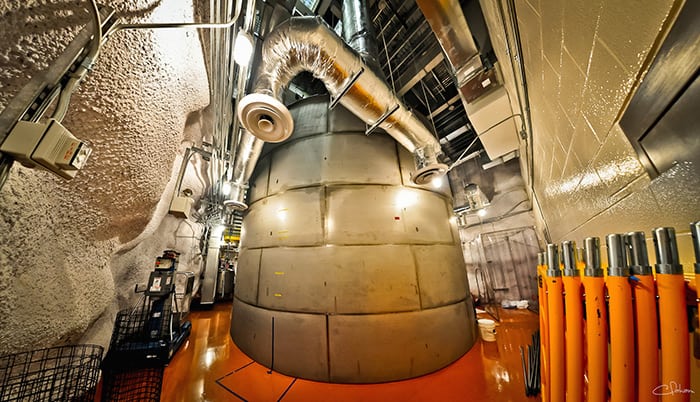
The LZ water tank

The US Department of Energy has approved the start of construction for the LUX-ZEPLIN (LZ) dark-matter detector. Researchers will now begin to build major components for the experiment as well as prepare space for it at the Sanford Underground Research Facility in Lead, South Dakota. When finished in 2020, LZ will hunt for theoretical particles known as weakly interacting massive particles via a chamber filled with 10 tonnes of purified liquid xenon. The detector is named after the merger of two existing dark-matter experiments: the Large Underground Xenon (LUX) experiment in Lead and the UK-based ZEPLIN experiment. LZ, which involves a collaboration of more than 30 institutions and 200 scientists worldwide, is expected to be around 100 times more sensitive than its predecessors.

The LHC begins low-luminosity run to study elastic scattering

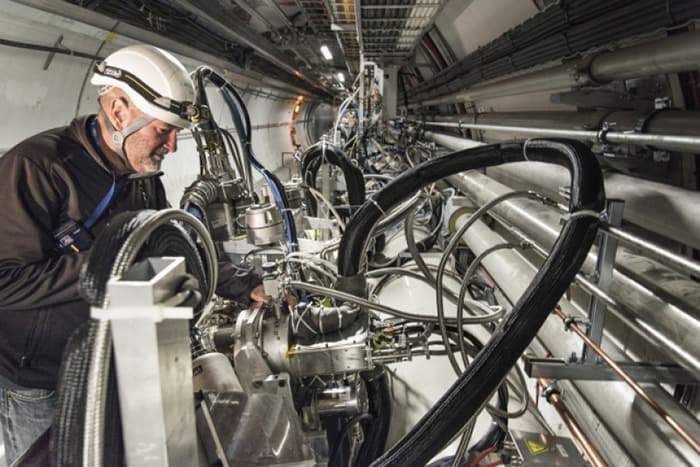
Nicola Turini at CERN

The Large Hadron Collider at CERN in Geneva has begun a special “low-luminosity” run this week. This will allow the ATLAS/ALFA and TOTEM experiments to observe the elastic scattering of protons. This occurs when two protons do not collide head-on in the detectors and so do not create new particles. Instead, the protons exchange glancing blows and are then detected. During a normal high-luminosity run, these elastic interactions are not seen because protons are much more likely to collide with each other and the detector. Elastic scattering is of interest to particle physicists because it provides insights into the internal structure of protons such as the nature of quarks and gluons. The studies should also reveal more about what makes elastic interactions possible and also help to improve our understanding of high-energy cosmic rays.


  • You can find all our daily Flash Physics posts in the website’s news section, as well as on Twitter and Facebook using #FlashPhysics. Tune in to physicsworld.com later today to read today’s extensive news story on diamond magnetometers.

‘Physical cryptography’ uses neutrons to compare nuclear warheads

A new technique for comparing physical objects – while keeping the composition of the objects secret – has been demonstrated by physicists in the US and Italy. Based on a scheme for cryptography, the method involves comparing how radiation is transmitted through two targets and could be used to verify the presence of nuclear weapons in warheads.

Future agreements on the control of nuclear weapons could require that all nuclear warheads be accounted for, including those in storage. This would rely on inspectors being able to tell a real nuclear warhead apart from a fake one. This is important because it would prevent a country from secretly stashing away some of its declared warheads and replacing them with fakes.

Plutonium-239 in a concealed warhead can be revealed by exposing it to a beam of neutrons and measuring how much radiation passes through the warhead. However, imaging a warhead in this way – which is like taking a medical X-ray – would also reveal information about the weapon’s design. That’s a problem because the design needs to be kept secret – even from inspectors – to prevent nuclear proliferation. One way around this problem is to scramble some of the information, but this is open to abuse by both parties.

Zero-knowledge proof

In 2014 Alexander Glaser and Robert Goldston at Princeton University and a colleague at Microsoft Research came up with a proposal for how to compare the contents of two warheads to confirm that they were indeed identical. Their technique is based on the “zero-knowledge proof”, which is described in detail in “Nuclear-inspection protocol inspired by game of marbles”.

Now, Glaser and Goldston have teamed-up with Princeton’s Sébastien Philippe and Francesco d’Errico at Yale University and the University of Pisa to test the protocol in the lab using neutron radiography. Instead of looking at real nuclear warheads, the team used a set of 5 cm steel-and-aluminium cubes that could be arranged in different configurations.

Steel and aluminium absorb neutrons at different rates, enabling the team to mimic the composition of a real warhead, which is made of several different materials. One such arrangement was designated the “true” configuration, which in a verification process would correspond to a warhead that is known to be armed with a nuclear weapon.

The verification process begins by taking an image of the true configuration of blocks that are hidden within a metal shield. This is done by firing a beam of neutrons through the objects and onto an array of “bubble” neutron detectors. These detectors comprise a viscous gel that contains superheated droplets of a fluorocarbon.

If a neutron collides with an atom in a droplet, the absorbed energy causes the droplet to vaporize and create a much larger bubble. An important feature of the detectors is that the bubbles will remain in place for days until the detector is reset. The positions of these bubbles can then be determined by taking a digital photograph of the detector.

Inverse image

This image of the true object is then analysed and an “inverse” image is calculated. When combined with a true image, the sum is what the detectors would register if there were no object being scanned.

The next step is to create the pattern of bubbles associated with the inverse image in a fresh array of detectors. This is done by irradiating them with the appropriate neutron beams. In a real inspection of a nuclear warhead, all of the above steps would be done by the owner of the warhead so that no information is revealed to the inspector.

The final step involves the inspector using the “preloaded” array of detectors to scan an unknown configuration of blocks. If the unknown is indeed the true configuration of blocks (or a real nuclear warhead), then the pattern of bubbles in the detectors will correspond to that expected when no object is in the path of the neutrons. If the blocks do not match the true configuration, then a different pattern will be seen. By looking at the pattern, the inspector can tell if the unknown object is a nuclear warhead without knowing what it, or a nuclear warhead, actually look like.

First demonstration

The team was able to confirm that the technique can be implemented using neutrons and bubble detectors. “This is the first experimental demonstration of a physical zero-knowledge proof,” says Philippe, adding: “We have translated a major method of modern cryptography devised originally for computational tasks into use for a physical system.”

Challenges will still need to be overcome before the technique can be put into practice. These include ensuring that the owner of the warheads actually generates the inverse pattern from a nuclear warhead, and not a decoy weapon. Another problem is that electronic processing is required to make the inverse image, which could be subject to eavesdropping that could reveal information about the composition of the warhead. Detectors loaded with the inverse image would also have to be kept secure as they contain information about the warhead.

Flash Physics: World’s largest radio telescope completed in China, tracing mercury in human hair, limiting universal anisotropy

Flash Physics is our daily pick of the latest need-to-know developments from the global physics community selected by Physics World‘s team of editors and reporters

World’s largest radio telescope completed in China

Work has finished on the Five-hundred-meter Aperture Spherical radio Telescope (FAST) in Guizhou province in southern China. The world’s largest radio telescope, FAST comprises 4450 reflecting panels and is located in a natural depression in a remote region that is very quiet in terms of human radio signals. The collection area is more than twice as big in size as its nearest rival – the 300 m Arecibo telescope in Puerto Rico. FAST covers the 70 MHz–3 GHz frequency range and will be twice as sensitive as Arecibo and capable of surveying the sky 5–10 times faster. It will also be able to look at three times more sky than Arecibo. Built by the National Astronomical Observatories under the aegis of the Chinese Academy of Sciences, the telescope will now undergo a series of tests before astronomers – including some from outside China – are allocated observing time.

Tracing the origin of mercury in human hair

A new analytical technique that helps to identify the chemical forms of mercury in human hair has been developed by an international team of researchers. Human beings are exposed to varying amounts of mercury during the course of daily life – by consuming foods such as fish and rice, via metal-based dental fillings and compact fluorescence lamps, for example – and the neurotoxin can accumulate in the body over time. Determining the source of the mercury is essential for diagnosis and treatment purposes, but currently it is difficult to determine the molecular form of mercury in human tissues and fluids, which could indicate its source. Until today, depending on the suspected source of contamination, mercury intake has been monitored by measurement of mercury concentration in urine, blood or scalp hair. The researchers, based in France and Chicago, used the European Synchrotron Radiation Facility (ESRF) and found that the source of the mercury in human hair can be identified by precisely characterizing its bonding environment. Their experiments showed that, in one case, a mercury spike along a strand of hair was correlated with a specific unsafe removal of a dental amalgam. The team found that the synchrotron data provided signatures of the mercury sources, distinguished exogenous vs endogenous exposure to inorganic mercury, and indicated the timing to within one or two days of an exposure event. These results are published in Environmental Science & Technology.

The universe is isotropic, says latest study of the cosmic microwave background

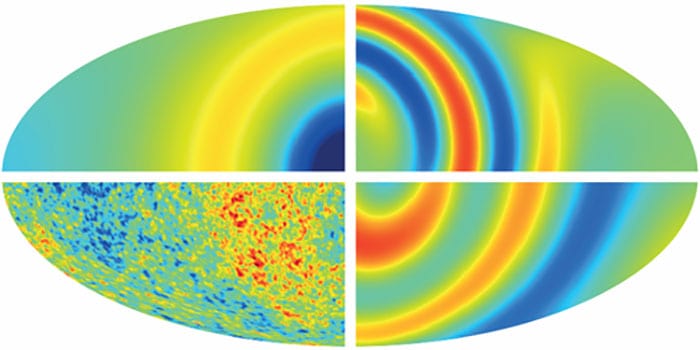
Placing limits on universal anisotropy

The universe is the same in every direction, at least on very large distance scales. That is the conclusion of Daniela Saadeh and colleagues at University College London and Imperial College London, who have looked for evidence of large-scale spatial anisotropies or rotation in the cosmic microwave background (CMB). The CMB was created just after the Big Bang and permeates the cosmos. As a result, it provides a record of how the universe has been expanding over the past 13 billion years. The CMB appears nearly uniform across the sky with tiny fluctuations (about one part in 100,000) that are understood as density perturbations that are associated with the emergence of structures such as galaxies. Saadeh and colleagues have tested a wide range of possible anisotropy and rotation models against CMB data from the Planck satellite, and found the universe to be isotropic to within one part in 121,000. The study is described in Physical Review Letters.


  • You can find all our daily Flash Physics posts in the website’s news section, as well as on Twitter and Facebook using #FlashPhysics. Tune in to physicsworld.com later today to read today’s extensive news story on a new nuclear-inspection protocol inspired by cryptography.
Copyright © 2026 by IOP Publishing Ltd and individual contributors