

Flash Physics: World’s largest radio telescope completed in China, tracing mercury in human hair, limiting universal anisotropy

Flash Physics is our daily pick of the latest need-to-know developments from the global physics community selected by Physics World‘s team of editors and reporters

World’s largest radio telescope completed in China

Work has finished on the Five-hundred-meter Aperture Spherical radio Telescope (FAST) in Guizhou province in southern China. The world’s largest radio telescope, FAST comprises 4450 reflecting panels and is located in a natural depression in a remote region that is very quiet in terms of human radio signals. The collection area is more than twice as big in size as its nearest rival – the 300 m Arecibo telescope in Puerto Rico. FAST covers the 70 MHz–3 GHz frequency range and will be twice as sensitive as Arecibo and capable of surveying the sky 5–10 times faster. It will also be able to look at three times more sky than Arecibo. Built by the National Astronomical Observatories under the aegis of the Chinese Academy of Sciences, the telescope will now undergo a series of tests before astronomers – including some from outside China – are allocated observing time.

Tracing the origin of mercury in human hair

A new analytical technique that helps to identify the chemical forms of mercury in human hair has been developed by an international team of researchers. Human beings are exposed to varying amounts of mercury during the course of daily life – by consuming foods such as fish and rice, via metal-based dental fillings and compact fluorescence lamps, for example – and the neurotoxin can accumulate in the body over time. Determining the source of the mercury is essential for diagnosis and treatment purposes, but currently it is difficult to determine the molecular form of mercury in human tissues and fluids, which could indicate its source. Until today, depending on the suspected source of contamination, mercury intake has been monitored by measurement of mercury concentration in urine, blood or scalp hair. The researchers, based in France and Chicago, used the European Synchrotron Radiation Facility (ESRF) and found that the source of the mercury in human hair can be identified by precisely characterizing its bonding environment. Their experiments showed that, in one case, a mercury spike along a strand of hair was correlated with a specific unsafe removal of a dental amalgam. The team found that the synchrotron data provided signatures of the mercury sources, distinguished exogenous vs endogenous exposure to inorganic mercury, and indicated the timing to within one or two days of an exposure event. These results are published in Environmental Science & Technology.

The universe is isotropic, says latest study of the cosmic microwave background
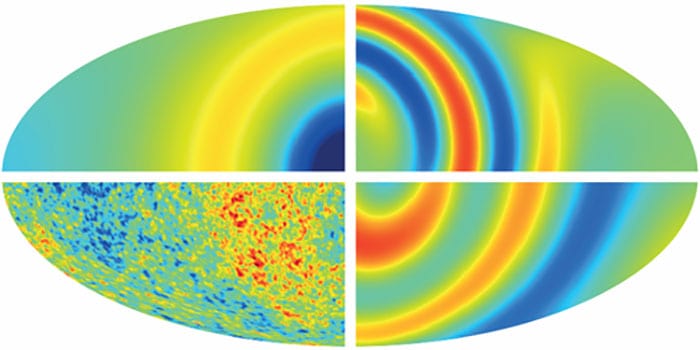
Placing limits on universal anisotropy

The universe is the same in every direction, at least on very large distance scales. That is the conclusion of Daniela Saadeh and colleagues at University College London and Imperial College London, who have looked for evidence of large-scale spatial anisotropies or rotation in the cosmic microwave background (CMB). The CMB was created just after the Big Bang and permeates the cosmos. As a result, it provides a record of how the universe has been expanding over the past 13 billion years. The CMB appears nearly uniform across the sky with tiny fluctuations (about one part in 100,000) that are understood as density perturbations that are associated with the emergence of structures such as galaxies. Saadeh and colleagues have tested a wide range of possible anisotropy and rotation models against CMB data from the Planck satellite, and found the universe to be isotropic to within one part in 121,000. The study is described in Physical Review Letters.


  • You can find all our daily Flash Physics posts in the website’s news section, as well as on Twitter and Facebook using #FlashPhysics. Tune in to physicsworld.com later today to read today’s extensive news story on a new nuclear-inspection protocol inspired by cryptography.
A look back at peer-review week and particle physicists say hello to Hello Kitty

By Matin Durrani

Today marks the end of Peer Review Week  – a “global event celebrating the essential role that peer review plays in maintaining scientific quality”. The event brought together “individuals, institutions and organizations committed to sharing the central message that good peer review, whatever shape or form it might take, is critical to scholarly communications”.

It’s probably fair to say that Peer Review Week – now in its second year – didn’t quite have the media profile of, say, London Fashion Week, but then you have to start somewhere. And celebrating peer review seems a worthy and worthwhile thing to do. I bet even Rio de Janeiro’s Restaurant Week started out small. (more…)

Knitted nanotubes spin an electromechanical yarn

Researchers at the University of Wollongong in Australia and the University of Texas at Dallas in the US have made stretchy, electrically conductive textiles based on Spandex and carbon nanotubes. The composite yarns, which are knitted together, could be used to make actuators and sensors for use in artificial muscles and smart clothing.

Materials that expand and contract in response to some form of stimulus could be useful as actuators or artificial muscle fibres for robotics or smart textiles. They could also make good sensors for lab-on-a-chip devices.

Now, a team led by Javad Foroughi in Wollongong has come up with a knitting technique to produce electrically conducting 3D yarns from the stretchy fabric Spandex (SPX) and multi-walled carbon nanotubes (CNTs). The fibres can be highly stretched and so could make excellent sensors and artificial muscles, say the researchers.

Capacity for work

The team made the yarns by continuously feeding commercially available SPX fibres and CNT aerogel sheets drawn from an aligned forest of tubes into a circulating knitting machine. “The CNT/SPX fabric we made can be stretched to over 600% its original length and has an electrical conductivity of between 870–7092 S/m, depending on the amount of tensile strain we apply to it,” explains team-member Geoffrey Spinks. The mechanical and electrical properties of the fabric are also stable over 10,000 cycles of strain and/or bending.”

When a voltage is applied to the stretched yarn, it heats up and contracts by as much as 33%. As a consequence, it generates a mechanical work capacity of up to 0.64 kJ/kg and a maximum specific power output of 1.28 kW/kg, which is much higher than that produced by human skeletal muscles.

We have already demonstrated a knee-sleeve prototype using our technology

Ray Baughman, University of Texas at Dallas

“Our knitted textile has strain-sensing capabilities as well as being porous, and as such could be used in smart clothing, for example, which monitors the wearer’s movements while at the same adjusting garment fit,” explains team-member Ray Baughman. “We have already demonstrated a knee-sleeve prototype using our technology, and such a device might be used to help repair injury after an accident by monitoring and manipulating knee movement.”

The team says that it is now working on using the CNT knitted textile as a wearable antenna as well as in biomedical applications, like knee sleeves and lymph sleeves. “The lymph sleeve, for example, will be developed using lightweight actuating fabric that will detect swelling and then respond by ‘squeezing’ the arm to enhance lymph flow,” explains Foroughi. “We are also investigating the possibility of employing it in artificial-heart muscles for positive support of the right ventricle,” he says.

The SPX/CNT composite yarn is described in ACS Nano.

Still not even wrong

Disillusioned by the charms of string theory, he began writing a book detailing the history and the “overwhelming triumph” of the Standard Model of particle physics, the birth of string theory and its subsequent “overwhelming failure to find any way to make further progress on fundamental questions”. This year marks the 10th anniversary of that book – Not Even Wrong: the Failure of String Theory and the Continuing Challenge to Unify the Laws of Physics.

Not Even Wrong coincided with the publication of another book – The Trouble with Physics – that had a similar theme and tone, penned by Woit’s friend and renowned physicist Lee Smolin. Together, the two books put the theory and its practitioners under a critical spotlight and took string theory’s supposed inadequacies to task. The books sparked a sensation both in the string-theory community and in the wider media, which until then had heard only glowing reports of the theory’s successes.

To mark the anniversary of Not Even Wrong, Physics World reporter Tushna Commissariat caught up with Woit to talk about the book, the subsequent “string wars” and the sociology of science. In the resulting podcast, you can also find out what has happened in fundamental and particle physics over the past decade – including the discovery of the Higgs particle at the Large Hadron Collider at CERN, but the lack of any supersymmetric particles until now. Woit also explains what he thinks needs to happen in the field to propel it into the future.

Both scientists and philosophers have long hunted for the ultimate theory – one that perfectly explains the universe we observe, from a quark to a quasar. In the mid-1980s string theory emerged at the top of the pile as the most promising candidate in this quest for a “theory of everything”, or more specifically, a theory that unified quantum mechanics and general relativity.

The original theory was a framework in which the point-like particles were replaced by one-dimensional objects called strings. It emerged that for the theory to work and to be mathematically consistent, it would require at least 10 dimensions of space–time, rather than our usually observed four dimensions. The extra dimensions, according to the theory, are “compactified” or fold in on themselves. Each extra dimension can be of a variety of “shapes” and there exist a myriad ways in which they can be compactified, meaning that there are too many possible solutions to be able to make a clear prediction.

Not being able to make clear predictions, combined with the lack of falsifiability, are the major deficiencies of string theory, according to Woit, Smolin and others such as the Nobel-prize-winner Sheldon Glashow, who once said “Sadly, I cannot imagine a single experimental result that would falsify string theory. I have been brought up to believe that systems of belief that cannot be falsified are not in the realm of science.”

String theory still polarizes opinion, but its advocates remain firm and deem it a beautiful and mathematically rigorous framework. As Woit explains in the podcast, “For many years, I’d been thinking that the situation with string theory was really pretty odd…this junction between the public perception of it, the way it had been portrayed and what was actually going on.”

Flash Physics: Seismic CT scans, an acoustic-hologram dove and a room-temperature multiferroic

Spotting deep-Earth tremors via seismic “CT scans”

The largest array of seismometers ever deployed on the sea floor has been used to peer some 160 km underneath a massive tectonic plate that is moving under North America. Coupled with other arrays in the US, the team from the University of California, Berkeley, used seismic tomography to scan the Juan de Fuca plate and part of the Earth’s mantle directly below it. The plate is currently moving under North America and forms a 1300 km-long region referred to as the Cascadia subduction zone. The research has improved our understanding of what drives subduction. This is when a tectonic plate moves sideways and below another, often causing catastrophic earthquakes. The research will also help to refine models of plate tectonics. Currently, the evidence suggests three different scenarios: the plates are pushed from mid-ocean ridges, or they are pulled from their subducting slabs, or their movement is driven by the drag of the viscous mantle material that lies directly below. The new scans show that for the Cascadia subduction zone, a distinct, thin layer separates the plate from the mantle beneath. The work is described in Science.

Manipulating objects using 3D acoustic holograms

A simple new technique to create complex 3D sound fields or “acoustic holograms” has been developed by an international team of researchers. Such fields could be used to move and manipulate microscale objects in both air and liquids without having to touch them, making the technique very useful for applications such as medical imaging and selective heating. Peer Fischer from the Max Planck Institute for Intelligent Systems in Stuttgart, Germany, and colleagues have used a 3D printer to create a plastic plate that, when placed in front of an acoustic transducer, alters the sound waves to create the desired sound field. They use the system to cause microparticles suspended in water to converge into a “dove-of-peace”-like image (seen above). While a similar approach has been demonstrated previously (see “Sonic tractor beam can manipulate objects in mid-air”, Fischer’s technique does away with the need for an array of transducers, replacing it with a single plate. The acoustic holograms are described in Nature.

Material has simultaneous electric and magnetic order at room temperature

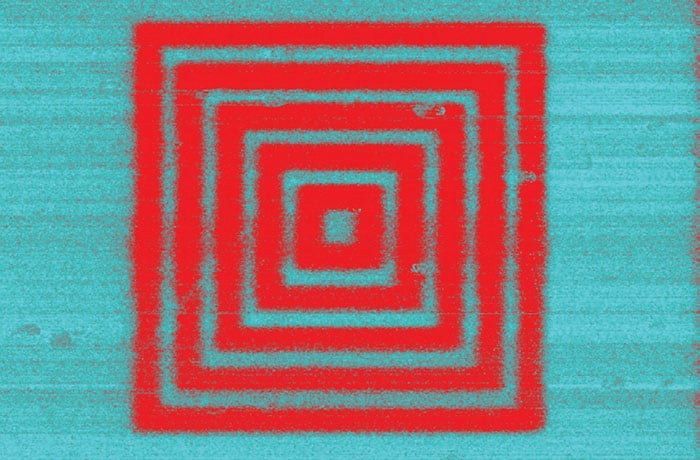
Piezoresponse-force-microscopy image of the new material showing regions of opposite electrical polarization

A new material that has both electric and magnetic ordering at room temperature has been unveiled by researchers in the US. The material is based on alternating layers of two compounds containing lutetium, iron and oxygen – LuFeO3 and LuFe2O4. LuFeO3 is a multiferroic with both a spontaneous electric polarization and magnetization. However, its magnetization is too small to be of much use. LuFe2O4 on the other hand lacks electric polarization but has a strong magnetization. Julia Mundy and Charles Brooks of Cornell University and colleagues found that when a single atomic layer of LuFe2O4 is alternated with nine layers of LuFeO3, LuFe2O4 also becomes multiferroic. Furthermore, the layered material has strong coupling between the electric polarization and magnetization at room temperature – something that had been very difficult to achieve. The material could find use in applications including low-energy computer memories. It is described in Nature.

You can find all our daily Flash Physics posts in the website’s news section, as well as on Twitter and Facebook using #FlashPhysics. Tune in to physicsworld.com later today to read today’s extensive news story on knitted nanotubes.

Probes and priorities: China’s strategy for space

When the Chinese Academy of Sciences (CAS) launched its strategic priority programme in space science in 2011, the goal was to create something similar to the European Space Agency’s “Cosmic Visions” programme. With a stable budget to support space science, Cosmic Visions includes a raft of missions that will take off in the coming decades, including the Advanced Telescope for High-Energy Astrophysics X-ray observatory and the Euclid dark-universe mission.

Likewise, the CAS programme in space science promised five science satellites in its first phase, two of which have already launched. The Dark Matter Particle Explorer (DAMPE) took off in December 2015, while the Shijian-10 satellite launched in April. A decade in the making, according to Wenrui Hu, chief scientist of Shijian-10, the craft consists of an orbital module as well as a retrievable module that returned to Earth on 18 April after two weeks in orbit. It conducted 19 novel experiments under microgravity conditions – such as observing the development of early mice embryos – while experiments in fluid dynamics and combustion will continue in the satellite’s orbital module.

Although one of the missions – the KuaFu solar observatory – was indefinitely postponed in 2014, another two are scheduled for launch later this year. The Quantum Experiments at Space Scale (QUESS) satellite was due to take off in August, as Physics World went to press. It will aim to simultaneously distribute quantum encryption keys from an on-board laser source to two distant ground stations while orbiting Earth at an altitude of 1000 km. The satellite will also conduct experiments to verify Bell’s inequality and to realize quantum entanglement between earthbound and satellite-borne light sources.

The Hard X-ray Modulation Telescope (HXMT), meanwhile, will launch in November. Conceived in 1993 by Tipei Li, an astrophysicist at CAS’s Institute of High Energy Physics and Tsinghua University in Beijing, the mission will carry out a broad band – 1–250 keV – all-sky survey. The HXMT’s launch marks the grand finale of the first phase of the space-science programme.

The CAS is now looking for missions to launch in the second phase of the programme

The first phase received a total of ¥4.7 bn ($700m) during the five years from 2011 to 2015, which was approved on a project-by-project basis. The CAS is now looking for missions to launch in the second phase of the programme, which received a boost in June 2015 when the academy received central government approval to rename its Center for Space Science and Applied Research (CSSAR) to the National Space Science Center (NSSC). Despite the grand name, however, the centre has not yet received its own budget to fund projects. Nor has the creation of the NSSC led to assurances for the future of space science in China.

The next batch

In 2011 and 2013 the then CSSAR selected two batches of candidates for possible second-phase projects for further investigation. As well as a space-based millimetre-range very long baseline interferometry array to capture direct images of stars and planets beyond the solar system, and a follow-up to DAMPE, the projects also included an X-ray timing and polarization (XTP) mission. The XTP is a successor to the HXMT, which would measure the timing, polarization and energy spectrum of X-rays emitted by black holes and neutron stars.

Another mission, the Einstein Probe, is an all-sky soft X-ray monitor to catch transient events such as X-ray bursts generated by implosions of neutron stars or black holes. Weimin Yuan from the CAS’s National Astronomical Observatories, who is the project’s chief scientist, says that although the second phase of the CAS strategic priority programme in space science has not officially begun, the Einstein Probe could take off around 2020 if it is approved soon.

To help promote the second-phase projects, NSSC director Ji Wu and colleagues published an article in the Bulletin of the Chinese Academy of Sciences at the end of last year, which outlined the laundry list of space probes, grouping them into programmes with poetic names and a nod to Chinese culture, including one to “feel the pulse of heavenly bodies” (Tianti haomai in Chinese). This programme aims to study time variations of electromagnetic radiation from astronomical objects and includes the XTP mission as well as cLISA – China’s version of a space-borne gravitational-wave observatory.

Reports in China have pushed an expanded version of this plan as the CAS’s strategic roadmap in space science for the next 15 years. While Wu is upbeat at drumming up public support, privately he is quite frustrated about the lack of stable funding, according to a source familiar with the situation. Wu declined an interview with Physics World, but in comments reported by the Chinese media he said he hopes that – based on the growth rate of research expenditures – the government will invest ¥8 bn, ¥11.6 bn and then ¥15.6 bn in space science in each successive five-year period over the next 15 years.

What the NSSC really wants is a slice of the country’s total space-programme pie, which now mainly supports manned space exploration as well as practical satellites used for navigation, remote sensing and weather forecasting. But Wu may have to wait until the first batch of satellites prove themselves, with much riding on the success of DAMPE before further funds will be released.

Chip shifts frequencies of photon qubits

Engineers in the US have developed a chip that can convert visible light into infrared and back again, while preserving the quantum state of the original photons. This capability would allow quantum devices to transmit information to each other via the existing fibre-optic infrastructure. Researchers say this is a significant step in realizing a quantum network of devices and computers that can exchange information.

For more than a decade, researchers have been developing techniques to allow the construction of a network of quantum devices that could transmit quantum information to each other over long distances. Examples of these quantum devices include rubidium atoms in an ultracold gas and nitrogen-vacancy centres in a diamond. The information is held in the physical state of the individual particles in these systems – known as quantum bits or qubits. Like transistors in a classical circuit, these qubits could be capable of performing computations. Furthermore, quantum information could be exchanged between these stationary qubits by using photons as “flying qubits”.

An important challenge is how to transmit the output of one quantum device to another, says Hong Tang, an electrical engineer at Yale University who was involved in the work. When two quantum devices are based on two different physical systems, their output photons are not at the same frequency. “Unfortunately, most quantum devices operate at different frequencies and don’t really talk to each other,” he says.

Different colours

Even devices based on the same physical system can also run into trouble when quantum information must be transmitted over long distances. One problem is that fibre-optic networks are designed to transmit infrared light, whereas some qubits operate with visible light.

The new chip enables two devices operating at different frequencies to exchange information over long distances by using the existing infrared fibre-optic infrastructure. For example, if a rubidium-based device emitted a visible photon, the chip would convert that photon to an infrared frequency, which could then be transmitted via the fibre-optic network that makes up the Internet. Then, a chip connected to the second quantum device could receive and convert the infrared signal into a visible photon that is readable by its system.

Tang’s team is the first to achieve this precise frequency conversion on a chip. Unlike prior methods, these chips can be manufactured cheaply in large quantities.

Nonlinear ring

The frequency conversion occurs via a small semiconductor ring on the chip that is made of aluminium nitride. This ring is able to produce different frequencies of light via nonlinear effects. Tang’s team directed infrared and visible laser light at the ring using waveguides. They showed that this creates an infrared signal at a different frequency via a process called “difference-frequency generation”. When they sent in two infrared beams, they showed that visible light is produced via a process called “sum-frequency generation”.

“It’s a significant first step,” says Arka Majumdar at the University of Washington, who was not involved with the research. Majumdar is also developing components for a future quantum-network infrastructure. “This chip is like the wires in a classical circuit,” he explains.

The next step, Tang says, is to improve the chip’s frequency conversion efficiency. In the paper, they reported 14% efficiency. But this was due to poor connectivity, Tang says. In future experiments, they will aim to increase the conversion efficiency as high as 100%, which they have already demonstrated the semiconductor to be capable of doing.

Single photons

Majumdar points out that Tang and colleagues have yet to demonstrate that their chip can effectively convert single visible photons. But he has high hopes: “Within 10 years, I think we will be able to really communicate between two quantum systems,” he says.

The chip is described in Physical Review Letters.

My first experience of peer review

My first experience of being peer reviewed did not begin well. Here’s the opening of the referee’s report:

“The purpose of publication is to disseminate knowledge to other people who may be able to use it. Since the model dramatically fails the authors’ own experimental tests more than half of the time, I can’t imagine anyone wanting to use it. I therefore recommend against its acceptance, here or anywhere else.”

What followed was a cavalcade of sarcastic remarks, incorrect assumptions, and occasional admissions that the referee didn’t know enough about the paper’s topic to make judgements (not that it stopped them). My senior co-authors were incensed; I was devastated. The words “I recommend against its acceptance, here or anywhere else” were burned into my brain and even now, more than 10 years later, reading them feels like a punch in the gut.

Shortly after receiving that scathing report, however, one of my senior co-authors took me aside. It turns out that his first peer-review report had been just as bad: he’d been told “Nothing new is in this paper, and what is new, is wrong” (I paraphrase slightly). That paper, he added, had eventually been published, and had gone on to receive more than 60 citations.

Buoyed by this admission, and guided by the referee’s tiny handful of useful comments (plus a far more productive critique from a fellow student), I set to work. A few months later, we submitted a much-altered version of the paper along with a request that, due to the adversarial tone of the original referee’s report, the new version be sent to someone else. This second referee proved more amenable, praising us for a “well-written manuscript with results that are likely to be of interest to many readers” and noting that while our model was indeed flawed, “any simplified model will have such problems”. In conclusion, the second referee wrote, “I think the authors are describing something that is novel, and of utility, and so I recommend that the manuscript be published.” After a few minor revisions, it was.

So in some ways, I suppose my first peer-review experience was a success. The revisions definitely made our paper better, and I’m pleased to report that, just like my co-author’s first paper, it has since gone on to receive more than 60 citations. Doing the revisions also made me a better physicist. My original contributions to the paper had been limited to running someone else’s code and performing experimental tests of someone else’s model, but by the time we resubmitted, I had a very thorough understanding of every aspect of the work.

But at the same time, it was a pretty miserable experience. I was a new PhD student at the time, and several other not-so-pleasant events in the lab had left me desperately short of self-confidence. If my co-authors hadn’t stepped in to reassure me that the first referee’s tone was out of line, I might have quit. Our experience also demonstrates why relying on the opinion of a single referee is a bad idea; although multiple reports do mean more work for scientists and journal editors, the potential for abuse by a single biased, spiteful or grumpy individual is just too great.

So my question for Peer Review Week is this: aside from mandating multiple referees (as many journals do) what changes could be made that would preserve the positive aspects of my first peer-review experience while eliminating the negatives? Please add your suggestions to the comments – and, if you’re brave enough, share your own first experience of peer review.

Flash Physics: Giant glowing ‘space blobs’, SCOAP3 extended for three years, European Spallation Source gains momentum

Key prototype for European Spallation Source completed

A key piece of prototype equipment – the first “beam-transport modules” – for the €1.84bn European Spallation Source (ESS) has been completed this week. Built by engineers at Daresbury Laboratory in the UK, the unit is the first of more than 130 different beam-transport modules that will be designed and built at Daresbury and will make up nearly 70% of the entire accelerator length. Once complete, the ESS, which is situated in Lund, Sweden, will be the world’s most powerful neutron source, capable of peering deep inside a large variety of materials and could lead to advances in medicine, energy, transport and the environment. “The design of these modules is based around many years’ experience of designing modules for cutting-edge accelerators both in the UK and internationally,” says engineer and project-manager Paul Aden. He adds that the project “will deliver the final module in 2019, marking the end of the ESS stage 1 installation, and the point at which the accelerator can be switched on”. Read more about the ESS and the challenges involved in its development in the feature “Sights firmly set on target”, published in our 2015 Physics World Focus on Neutron Science.

SCOAP3 open access initiative gets three-year extension

CERN has announced that the SCOAP3 initiative to provide open access to journal articles written by particle physicists will be extended for three years to December 2019. SCOAP3 was started in 2014 and encourages the “gold” model of open access, whereby published papers can be read free of charge on the Internet and authors pay an article-processing charge to the publisher. Ten journals currently participate in SCOAP3. About 3000 libraries and library consortia, universities, research institutions and funding agencies from 44 countries are members of the initiative. In addition to CERN, which co-ordinates SCOAP3, the International Atomic Energy Agency and the Joint Institute for Nuclear Research are also members.

Uncovering the secrets of giant glowing space “blobs”

A computer simulation of a Lyman-alpha Blob

Astronomers have cracked the mystery of a brightly glowing, rare object in the distant universe, called a “Lyman-alpha Blob”. Such blobs are gigantic clouds of hydrogen gas that span hundreds of thousands of light-years and are found at very large cosmic distances. While it was previously unknown why these gigantic clouds of gas shine so brightly, the international team of researchers used the Atacama Large Millimeter/submillimeter Array (ALMA) and Very Large Telescope and have spotted two galaxies at the heart of one such cloud. Both galaxies are experiencing a frenzy of star formation, which lights up their surroundings. The team also spotted that these starburst galaxies are themselves nestled within a cluster of smaller galaxies, in what they claim is an early phase in the formation of a massive cluster of galaxies. Indeed, the two bigger galaxies will most likely evolve into a single giant elliptical galaxy. The research will be published in the Astrophysical Journal and a preprint is available on the arXiv server.


  • You can find all our daily Flash Physics posts in the website’s news section, as well as on Twitter and Facebook using #FlashPhysics. Tune in to physicsworld.com later today to read today’s extensive news story on a new device that acts as a wavelength converter for quantum networks.

Adventures in search of auroras

Tell people that you study the northern lights for a living and you generally get the response “Really? Have you seen them? I’d love to see them!” There is something about these collisions between electrons and other particles 100 km up in the atmosphere (and the resultant light show) that captivates people. Maybe it’s the sense of adventure, of seeing something that happens far, far away in a cold, inhospitable land – but not so far away or inhospitable as to be completely out of reach. Maybe it’s seeing a beautiful natural spectacle light up the whole night sky. Maybe it’s just awesome, in the literal meaning of the word. Whatever it is, the wonder of the northern lights is a draw for many people around the world.

Melanie Windridge is one such person. Captivated by these fantastic displays and inspired to learn more, in her book Aurora: In Search of the Northern Lights, she describes travelling around the Arctic Circle on a quest to see the biggest and best auroral displays and to understand the physics that drives them. Each stopping point provides the backdrop for understanding the science, which covers everything from the basic physics of plasma in space to the potential consequences of a massive space weather event. Peppered throughout are nuggets of history, putting into context the struggles of earlier aurora explorers to use emerging techniques – such as photography, spectroscopy and quantum mechanics – to understand what they were seeing. Throughout, Windridge manages to convey a sense that although we know a lot about the aurora, we don’t necessarily understand a lot about the aurora.

The basic principles behind the northern lights are well established. A flow of energy, electromagnetic fields and charged particles (plasma) from the Sun strikes the magnetic field of the Earth. Some of this is captured by the Earth’s magnetic field through a process known as reconnection, resulting in a build-up of energy and plasma. When that energy is released, some of the plasma is accelerated along the Earth’s magnetic field and into the atmosphere, where the charged particles lose energy by exciting electrons in neutral atmospheric atoms, causing them to glow. The remaining particles can be trapped in the Earth’s magnetic field, getting up to energies well above those on the Sun and creating the radiation belts. What isn’t so clear, though, is exactly when this will happen or how big any particular auroral event will be – as Windridge discovered on her quest.

“Blue skies” research into the aurora has brought us new information on the physical processes taking place beyond the surface of our planet. The fact that most of the auroral light comes from so-called “forbidden” atomic transitions provided insights into the composition and structure of the upper atmosphere long before any in situ measurements could be made. But it is the space weather aspect of the aurora that really has the potential to affect our day-to-day lives. Processes linked to the aurora can cause power and communications outages, damage to satellites and disruption of air travel. Due to the interconnectedness of much of the technology in our lives, disturbances that would once have been local or insignificant can now cascade into something far greater. As Windridge notes, the eruption of Iceland’s Eyjafjallajökull volcano, a relatively minor event, caused a seven-day disruption to air travel costing over $1bn and affecting more than a million air passengers each day.

Since the start of the space age there have only been a handful of aurora-related events with significant impacts on infrastructure. Of these, the 1989 event that knocked out the electricity supply in the Canadian province of Quebec, and the 2003 Halloween storm that had similar effects on Sweden, are the most notable. Most engineers working in the power sector have not experienced a truly major event, and it is sobering to imagine the impact that the 1859 Carrington event, in which aurora were seen as far south as the Caribbean, would have if it occurred today. When discussing space weather, it can be very easy to verge into scare-mongering, but Windridge tackles this subject in a very sensible and grounded way. The book examines the different ways space weather can interact with ground and space-based technology, the steps that can and are being taken to mitigate these impacts, and how we can improve this resilience in future.

If I have one criticism of Aurora, it is that I found its style somewhat inconsistent. At times, the book reads like the commentary to a documentary; at others a diary of adventures; and at others an in-depth (but accessible) discussion of the science. None of these, on their own, are bad styles, but the way the book jumps between them can be a little jarring. This is particularly noticeable in the early chapters, where the reader is necessarily taken through the basic science behind the aurora as a springboard to understanding the rest of the book. But I would urge people to get beyond that, since Windridge manages to explain the history and science of the aurora in a way that should be understandable to most people who pick up this book.

I don’t study the northern lights for a living; instead, I use them as a way of studying the interaction between the Sun and the Earth and the processes of energy storage and release. But even as a space scientist, I found I learned things from this book. While Aurora is no replacement for the standard textbooks (and it doesn’t pretend to be), it provides a concise and accessible overview of auroral science, and in particular space weather, that puts this research in a useful context. It discusses the past, present and potential future of this research and should be of interest to anyone wishing to know what the aurora is all about.

  • 2016 William Collins £18.99hb 320pp
Copyright © 2026 by IOP Publishing Ltd and individual contributors