Adventures in search of auroras

Tell people that you study the northern lights for a living and you generally get the response “Really? Have you seen them? I’d love to see them!” There is something about these collisions between electrons and other particles 100 km up in the atmosphere (and the resultant light show) that captivates people. Maybe it’s the sense of adventure, of seeing something that happens far, far away in a cold, inhospitable land – but not so far away or inhospitable as to be completely out of reach. Maybe it’s seeing a beautiful natural spectacle light up the whole night sky. Maybe it’s just awesome, in the literal meaning of the word. Whatever it is, the wonder of the northern lights is a draw for many people around the world.

Melanie Windridge is one such person. Captivated by these fantastic displays and inspired to learn more, in her book Aurora: In Search of the Northern Lights, she describes travelling around the Arctic Circle on a quest to see the biggest and best auroral displays and to understand the physics that drives them. Each stopping point provides the backdrop for understanding the science, which covers everything from the basic physics of plasma in space to the potential consequences of a massive space weather event. Peppered throughout are nuggets of history, putting into context the struggles of earlier aurora explorers to use emerging techniques – such as photography, spectroscopy and quantum mechanics – to understand what they were seeing. Throughout, Windridge manages to convey a sense that although we know a lot about the aurora, we don’t necessarily understand a lot about the aurora.

The basic principles behind the northern lights are well established. A flow of energy, electromagnetic fields and charged particles (plasma) from the Sun strikes the magnetic field of the Earth. Some of this is captured by the Earth’s magnetic field through a process known as reconnection, resulting in a build-up of energy and plasma. When that energy is released, some of the plasma is accelerated along the Earth’s magnetic field and into the atmosphere, where the charged particles lose energy by exciting electrons in neutral atmospheric atoms, causing them to glow. The remaining particles can be trapped in the Earth’s magnetic field, getting up to energies well above those on the Sun and creating the radiation belts. What isn’t so clear, though, is exactly when this will happen or how big any particular auroral event will be – as Windridge discovered on her quest.

“Blue skies” research into the aurora has brought us new information on the physical processes taking place beyond the surface of our planet. The fact that most of the auroral light comes from so-called “forbidden” atomic transitions provided insights into the composition and structure of the upper atmosphere long before any in situ measurements could be made. But it is the space weather aspect of the aurora that really has the potential to affect our day-to-day lives. Processes linked to the aurora can cause power and communications outages, damage to satellites and disruption of air travel. Due to the interconnectedness of much of the technology in our lives, disturbances that would once have been local or insignificant can now cascade into something far greater. As Windridge notes, the eruption of Iceland’s Eyjafjallajökull volcano, a relatively minor event, caused a seven-day disruption to air travel costing over $1bn and affecting more than a million air passengers each day.

Since the start of the space age there have only been a handful of aurora-related events with significant impacts on infrastructure. Of these, the 1989 event that knocked out the electricity supply in the Canadian province of Quebec, and the 2003 Halloween storm that had similar effects on Sweden, are the most notable. Most engineers working in the power sector have not experienced a truly major event, and it is sobering to imagine the impact that the 1859 Carrington event, in which aurora were seen as far south as the Caribbean, would have if it occurred today. When discussing space weather, it can be very easy to verge into scare-mongering, but Windridge tackles this subject in a very sensible and grounded way. The book examines the different ways space weather can interact with ground and space-based technology, the steps that can and are being taken to mitigate these impacts, and how we can improve this resilience in future.

If I have one criticism of Aurora, it is that I found its style somewhat inconsistent. At times, the book reads like the commentary to a documentary; at others a diary of adventures; and at others an in-depth (but accessible) discussion of the science. None of these, on their own, are bad styles, but the way the book jumps between them can be a little jarring. This is particularly noticeable in the early chapters, where the reader is necessarily taken through the basic science behind the aurora as a springboard to understanding the rest of the book. But I would urge people to get beyond that, since Windridge manages to explain the history and science of the aurora in a way that should be understandable to most people who pick up this book.

I don’t study the northern lights for a living; instead, I use them as a way of studying the interaction between the Sun and the Earth and the processes of energy storage and release. But even as a space scientist, I found I learned things from this book. While Aurora is no replacement for the standard textbooks (and it doesn’t pretend to be), it provides a concise and accessible overview of auroral science, and in particular space weather, that puts this research in a useful context. It discusses the past, present and potential future of this research and should be of interest to anyone wishing to know what the aurora is all about.

  • 2016 William Collins £18.99hb 320pp

Some nuclei exist close to a quantum phase transition

Physicists in Germany and the US have discovered that certain nuclei exist close to a quantum phase transition, which dictates whether a nucleus resembles a loose collection of alpha particles or looks more like a single tightly bound object. The team found that whether a nucleus is on one side or the other of this phase divide is very sensitive to the specific interactions between individual protons and neutrons. The physicists say that their work could improve the understanding of heavy-element production inside stars.

Physicists know that protons and neutrons bind together inside nuclei via the strong force, an attractive interaction that is far stronger at small scales than is electromagnetism. However, despite decades of research, they still don’t fully understand the internal structure of certain simple light nuclei: those having even and equal numbers of protons and neutrons, and which can be described as clusters of helium-4 nuclei called alpha particles.

The properties of most other nuclei can be successfully reproduced by modelling a nucleus as if it were a liquid in which each proton and neutron feels the collective pull of all the other protons and neutrons. But because alpha particles are particularly stable, nobody has been able to show how a “gas” of non-interacting self-contained alpha particles can transform into a “liquid” nucleus.

Two forces

In the latest work, Ulf Meißner of the University of Bonn and colleagues have come up with an answer. They did so after modelling the effect of two types of strong interaction on the properties of several different light nuclei. Those interactions are made up of a number of sub-interactions that have varying degrees of “locality” – the extent to which they act at a point rather than over a finite distance. One of those interactions – A – is like the strong force that acts within a gas of alpha particles, while the other – B – resembles the strong force in a liquid nucleus.

The researchers’ aim was to show that the relatively simple formulae used to represent these interactions could be used to replace the complex, multi-order expansions usually employed to describe nuclear forces. In this, they succeeded. They incorporated A and B into lattice effective field theory, a type of modelling that represents space and time as a network of lattice points. They found that for beryllium-8, carbon-12, oxygen-16 and neon-20 interactions, B yielded ground-state energies within a few per cent of experimental values, while A gave values of the same parameter that were integer multiples of the alpha-particle ground-state energy – reminiscent of a Bose–Einstein gas of particles.

Family of interactions

Meißner’s team then built a “family of interactions”, with each family member located somewhere on a sliding scale defined by the parameter λ. With λ equal to zero the interaction is A, and when equal to one it is B. For each of the four nuclei, the researchers plotted how the nucleus’s ground-state energy relative to that of an alpha particle varies with λ. The result is a phase diagram with a quantum transition – a diagonal line – for each nucleus. To the left of the line, at small values of λ, the nucleus is a gas, and to the right, at high values, it is a liquid, within which alpha particles interact with one another so that they form the nuclear liquid.

Unlike a classical phase transition, such as the conversion of steam into liquid water, a quantum phase transition takes place at zero temperature. It is driven by quantum fluctuations, which arise as a result of Heisenberg’s uncertainty principle. Meißner’s team points out that because a nucleus’s position on the phase diagram is sensitive to the exact form of the interaction between its protons and neutrons, a more sophisticated version of the calculations they have carried out might potentially knock that nucleus over the transition. In that sense, they wrote, “nature is near a quantum phase transition.”

Testing the Hoyle state

According to Meißner, their phase diagram can be used as a “diagnostic tool” to work out the structure of certain nuclei. In particular, he says, it could be used to investigate the nature of the Hoyle state, an excited state of carbon-12 that is an important step in the production of heavy elements inside of red-giant stars. The idea is to “tune” λ to find out whether the Hoyle state resides on the left or the right of the phase transition. “Some people believe that the Hoyle state of carbon consists of three alpha particles,” he says. “We can now put that idea to the test,” says Meißner, adding that there is the “intriguing possibility” that the state sits exactly on the line.

Other researchers are impressed by the latest work. David Jenkins of the University of York in the UK says there are “a number of fascinating aspects” to the way in which alpha clustering arises naturally from the fundamental interactions of effective field theory. Oliver Kirsebom of Aarhus University in Denmark agrees, suggesting that the insights could help to guide future research. “It would be very exciting,” he says, if it were possible to predict whether the Hoyle state can also decay directly into three alpha particles as opposed to decaying sequentially via single-alpha emissions – research that he and his colleagues are working on.

Witek Nazarewicz of Michigan State University, meanwhile, says that the research might also be relevant to other open quantum systems where clustering could occur, such as neutron-rich nuclei.

The research is described in Physical Review Letters.

Flash Physics: New radiation detectors, agreement on Cherenkov observatory and artificial intelligence

Affordable radiation detectors made from new crystals

Low-cost single crystals that are very good at detecting gamma rays have been created in Switzerland by researchers at the Empa materials lab and ETH Zurich. Maksym Kovalenko and colleagues have shown that the material works just as well as expensive cadmium-telluride crystals, but can be grown using low-cost solvents or even water. The new lead-halide perovskite crystals meet three important criteria for making gamma-ray detectors. They are composed of high-atomic-number elements such as lead, so they are good absorbers of gamma rays. Also, the crystals are semiconductors with extremely long-lived and mobile charge carriers at room temperature. This means that much of the energy absorbed from gamma rays is converted into a large and measureable electronic signal without the need to cryogenically cool the detector. Finally, the material is stable to both changes in temperature and mechanical forces. As well as use in low-cost devices monitoring the environment for radioactive materials – possibly as a chip in a mobile phone – the crystals could also be used to establish the purity of radioactive tracers that are used in medical imaging. The material is described in Nano Letters.

Deal signed for Canary Islands to host northern Cherenkov telescope

Artist's representation of four telescopes proposed for the CTA on La Palma

The northern-hemisphere part of the planned Cherenkov Telescope Array (CTA) observatory will be located at the Roque de los Muchachos Observatory in La Palma, one of Spain’s Canary Islands. The northern CTA will comprise 19 telescopes that will be located at an altitude of 2200 m and will detect flashes of Cherenkov light that are given off when high-energy gamma rays collide with matter in the atmosphere. Roque de los Muchachos is run by the Instituto de Astrofísica de Canarias (IAC), which has just signed an agreement with CTA astronomers that secures 10% of the observation time on the northern CTA for scientists in Spain. A prototype CTA telescope saw first light in 2015 and construction is expected to begin in 2017 on 99 telescopes at the European Southern Observatory facility in Paranal, Chile.

Artificial intelligence discovers new materials

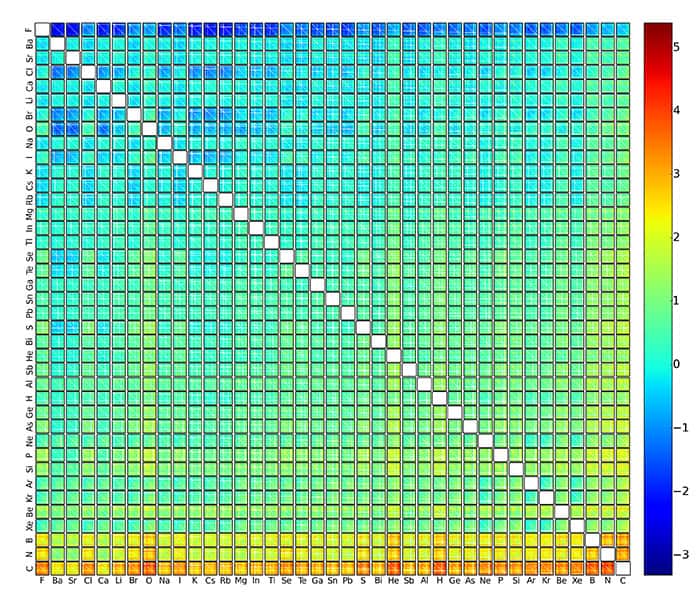
A matrix depicting the formation energy of around two million possible elpasolite compounds

The properties of two million crystalline materials have been calculated by chemists in Switzerland and Sweden using artificial intelligence. The research flagged up 90 previously unknown thermodynamically stable crystals. The work focussed on a family of materials called elpasolites, which occur naturally at several locations worldwide. The transparent materials show promise for use as scintillators in particle-physics detectors, but researchers have been unable to produce a type of elpasolite that is ideally suited for this use. Felix Faber and colleagues at the University of Basel used quantum mechanics to predict the properties of thousands of elpasolite variations and then used this information to “train” an artificial-intelligence system to predict the properties of many more elpasolites. The predictions are described in Physical Review Letters.


  • You can find all our daily Flash Physics posts in the website’s news section, as well as on Twitter and Facebook using #FlashPhysics. Tune in to physicsworld.com later today to read today’s extensive news story on quantum phase transitions in nuclei.

A monument to peer review

The Russian sociologist Igor Chirikov from the National Research University Higher School of Economics in Moscow has much to celebrate during this year’s Peer Review Week.

He is now putting in place plans to build what will be the world’s first monument to anonymous peer review and is expecting it to be complete in mid-October.

Earlier this month, Chirikov began a Kickstarter campaign aiming to raise $1300 by 2 October for a sculptor to turn an “ugly” block of concrete outside the university’s Institute of Education into a die. Not any ordinary numbered die, however, but one that would read “accept”, “minor changes”, “major changes”, “revise and resubmit” and “reject” on its five visible sides.

Chirikov, who is also based at the Center for Studies in Higher Education at the University of California, Berkeley, US, told physicsworld.com that the idea came about as he wanted to acknowledge the role of peer reviewers and use it to “have a good laugh about [the] peer reviewer process together with academics”. He adds, “They are absolutely necessary to advance our knowledge though their contribution is not always recognized. At the same time, I feel for researchers. It’s hard to deal with rejection letters and sometimes nasty comments from reviewers.”

Anyone who pledges $1 will get their names on a nearby sign, while those who give $25 or more will get a small model of the monument. Those who stump up $40 or more will receive two models of the monument while $60 or more will get the title of your paper on the monument itself (although there is only space for 20 titles).

Chirikov already exceeded his target just weeks after starting his fundraising campaign  and has so far raised $2235 via 109 backers. He says that all the cash raised will be spent and that any extra money will enable them to build it faster and to use more durable – and more expensive – materials.

“I hoped that many academics will like the idea but was a bit surprised how fast we’ve reached the fundraising goal,” Chirikov told physicsworld.com. “It means that there are common challenges in [the] academic profession across the world and disciplines. It also means that scholars have a good sense of humour.”

This week IOP Publishing is playing its part in Peer Review Week 2016 and has announced a raft of new initiatives, including a dedicated website about peer review, a new partnership with Publons – a reviewer recognition service – as well as a trial of double-blind peer review.

Why do we want to build a watt balance to determine mass?

When you refer to the mass of something as “10 kg” what you are actually saying? In fact what you mean is that the object in question has a mass equivalent to 10 lots of the platinum-iridium “master kilogram” carefully stored at a bureau just outside Paris. In this video, precision measurement researcher Stephan Schlamminger describes an alternative method for defining a standard kilogram. His proposed approach uses a watt balance which determines mass using fundamental constants as it compares electrical and mechanical power. You can see one of these machines in the video, which Schlamminger presents from the US National Institute of Standards and Technology (NIST) Gaithersburg campus in the US. Schlamminger explains why his method would be advantageous to the existing standard.

This video is part of our 100 Second Science series, in which researchers give concise presentations covering the spectrum of physics.

Physics World Special Report: China

pwchina16-cover-200By Michael Banks

Physics World published its first special report on China in 2011, which looked at China’s lunar programme and how the country was tackling fraud, as well as profiling the Kavli Institute for Astronomy and Astrophysics and the Institute for High Energy Physics, which are both located in Beijing.

Five years on and physics in the world’s most populous country has rapidly expanded, with China building a number of other huge facilities – including the China Neutron Spallation Source and the China Jinping Underground Laboratory. Now close to completion, they will put the country at the forefront of physics.

So what better time to have another special report on China? Based on visits to Beijing, Hong Kong and Shenzhen, the issue, which you can read free here, includes an overview of the current state of physics in the country as well as an interview with Wei Yang, president of the National Natural Science Foundation – the country’s biggest investor in basic science – and a piece looking at how scientists can foster good collaborations with physicists in China.

(more…)

The facts and figures of peer review

infographic-thumbnail

By Tushna Commissariat

I mentioned yesterday that it was the start of “Peer Review Week”, which this year takes “recognition for review” as its theme. Physics World is published by IOP Publishing, which makes us a “society publisher” as we’re wholly owned by the Institute of Physics – a charity. IOP Publishing is also a relatively small operation compared with other large commercial publishers, but we still pack a punch, publishing more than 70 journals.

If you’ve ever wondered just how big a deal peer review is to the publishing sector, the infographic above (click on it to see the whole graphic) reveals some key figures such as the number of reviews completed last year at IOP Publishing, the average time taken to complete a review, as well as the reviewers’ geographical spread.

(more…)

Laser polarization boosts quality of proton beams

The quality of laser-accelerated proton beams can be improved by controlling the polarization of the incident laser light, researchers in the UK have discovered. The finding could help physicists to create compact sources of proton beams for use in medicine, lithography or even astrophysics.

Beams of protons and other positive ions have a wide range of applications, including particle physics, materials processing and medicine. Proton-beam therapy, for example, is used to destroy some cancerous tumours with a minimum of collateral damage to surrounding healthy tissue. However, the practical use of proton and ion beams is held back by the need for large and expensive particle accelerators to generate high-quality beams.

One way forward is laser-plasma acceleration, in which a high-power laser pulse is fired into a target. This creates a plasma in which the electrons separate from the ions. This creates huge electric fields that are capable of accelerating protons, ions and electrons to very high energies.

Messy process

It is very challenging, however, to create high-quality proton beams as Felix Mackenroth of the Max Planck Institute for the Physics of Complex Systems in Dresden, Germany explains: “Compared to conventional accelerators, lasers produce less energetic and less collimated ion beams”

In a previous study, Paul McKenna and colleagues at the University of Strathclyde, together with researchers at Queens University Belfast and the STFC Rutherford Appleton Laboratory in Oxfordshire, looked at the laser acceleration of electrons from a target of ultrathin aluminium foil using the Rutherford Appleton Laboratory’s Gemini laser. A powerful laser pulse from Gemini hits the foil, heating it up so that it becomes a plasma. This disc of plasma in the foil layer is transparent to the pulse and the researchers were able to show that the pulse then diffracts through the plasma disc as it would through a classical aperture. Furthermore, they found that the pattern of electrons ejected from the foil depends on the polarization of the incident laser light.

Water vapour

In this latest research, the team has applied a similar approach to proton acceleration. Even though their experiments are conducted in a vacuum chamber, water vapour naturally condenses on the foil, providing a natural source of protons. The team wanted to see if the structure of the resulting proton beam would be affected by the polarization of the light.

In separate experiments, the researchers irradiated aluminium foils with petawatt pulses of linearly, elliptically and circularly polarized light from Gemini. The pattern of the protons ejected at various energies differed markedly: the lower-energy protons were concentrated into the centre for all the polarizations, for example, but the spread was much tighter for elliptically and circularly polarized light than for linearly polarized light. The higher-energy protons produced by linearly polarized light formed a double-lobe pattern, whereas circularly and elliptically polarized light led to annular density profiles. The experimentally observed patterns closely matched computer simulations, with small deviations fully explained by experimental imperfections, say the researchers.

Black holes

The team plans to “take this research forward with further investigation of approaches to control the ‘relativistic plasma aperture'”, explains McKenna. “This includes polarization control and also control by variation of the intensity profile of the drive laser pulse.” Although the work is currently at the fundamental research stage, McKenna believes it could ultimately have multiple applications for controlling dose deposition in proton-beam therapy, lithography or even astrophysical modelling: “We are exploring the potential applications to other areas of science, including experimental models of astrophysical relativistic plasma jets created by a rotating black-hole accretion disc,” he says.

Other researchers are impressed. “It’s definitely an important contribution,” says Victor Malka of ENSTA Paris-Tech in France, “The quality of the experimental data together with the simulations shows that we [the scientific community] have a very fine understanding of this process.” Felix Mackenroth agrees: “This overall idea that the researchers had is a very neat one and a very significant one as well.”

The research is described in Nature Communications.

Flash Physics: Deborah Jin dies at 47, NASA extends IRIS satellite mission, new UK high-temperature lab

Deborah Jin dies at 47

US physicist Deborah Jin, who was renowned for her groundbreaking work on ultracold atomic gases, died on 15 September at the age of 47. The physicist, who won the 2014 Isaac Newton medal of the Institute of Physics (which also publishes physicsworld.com), lost her battle with cancer, and has been described by colleagues as “one of the great atomic physicists of our day.” Jin joined JILA in 1995 – where she has been a fellow since 2005 – following a degree in physics from Princeton and a PhD from the University of Chicago. Nearly two decades ago, Jin and her then PhD student Brian DeMarco were the first researchers to observe quantum degeneracy in a sufficiently cooled gas of fermionic atoms. They were the first to demonstrate the creation and control of such an ultracold “Fermi gas”, which has since provided us with new insights into superconductivity and other electronic effects in materials. You can read this 2002 feature written by Jin on “A Fermi gas of atoms” and watch her entire 2014 Newton lecture in the video below.

NASA extends its Sun-watching IRIS satellite mission

NASA’s Interface Region Imaging Spectrograph (IRIS) satellite mission has been granted a $19m extension. The small satellite – which makes detailed observations of the Sun in ultraviolet – is built and operated by Lockheed Martin, and the extension has allowed the firm to extend the mission to September 2018, with a possible further extension to 2019. The satellite was launched in 2013 and was initially designed for a two-year mission. This extension will also increase IRIS’s collaboration with other observatories in California and Europe and Chile. “IRIS has taken more than 24 million images or spectral measurements of the Sun since its launch three years ago, and it has led to more than 115 scientific papers,” says Bart De Pontieu, IRIS science lead at Lockheed Martin’s Advanced Technology Center. The satellite will now be studying the tail end of the solar activity cycle, which just peaked – some of the largest flares and most powerful coronal mass ejections occur during this phase of the solar cycle.

Physicist Qi-Kun Xue bags inaugural Chinese science prize

The first winners of the privately sponsored Future Science prize, for discoveries made in China, were announced yesterday in Beijing, and include a physicist. Qi-Kun Xue of Tsinghua University won the physical-science prize for his groundbreaking discoveries “of novel quantum phenomena using molecular beam epitaxy, including quantum anomalous Hall effect and monolayer FeSe superconductivity”. Each prize is worth US$1m, and Xue told Nature News that he will share the money with colleagues who contributed towards both discoveries. Xue completed his PhD in condensed-matter physics from the Institute of Physics, Chinese Academy of Sciences in 1994. His research is important for the development of topological insulators – find out more about their potential applications in this video. To discover more about the rise of physics in China today, take a look at our new Physics World Special Report: China.

New high-temperature lab opens in the UK

Photograph taken inside the High Temperature Facility

A new facility to develop energy-generation systems based on nuclear fusion, nuclear fission and other high-temperature technologies has opened in the UK. The High Temperature Facility (HTF) is located in Warrington in north-west England and is managed by the British company Amec Foster Wheeler. The HTF is open to the research community and is equipped to test materials at temperatures up to 1000 °C and recreate environments containing pressurized gas and liquid metal. The facility will be run in co-operation with the High Temperature Facility Alliance, which comprises the UK’s National Nuclear Laboratory, EDF Energy, the UK Atomic Energy Authority, the nuclear fuel supplier URENCO and four UK universities.


  • You can find all our daily Flash Physics posts in the website’s news section, as well as on Twitter and Facebook using #FlashPhysics. Tune in to physicsworld.com later today to read today’s extensive news story on laser-driven proton acceleration.

Quantum teleportation comes to Hefei and Calgary

Studies done in the Chinese city of Hefei and at Calgary in Canada show that quantum teleportation can be achieved over distances of several kilometres using commercial optical-fibre networks. Carried out by two independent teams of physicists who used slightly different techniques, the demonstrations involved transferring the quantum state of a photon in a process called quantum teleportation. The ability to achieve quantum teleportation is an important benchmark for quantum-optical networks and the research suggests that telecommunication networks could be used for a range of quantum communications such as distributed quantum computing.

First proposed in the 1990s, quantum teleportation involves transporting a quantum state of a particle – the polarization of a photon, for example – across space without moving the particle itself. This involves making a special initial measurement on the particle, transmitting the measurement information to a receiving destination and then reconstructing a perfect copy of the original state. Crucially, the original particle loses all of the properties that are teleported. This satisfies the “no-cloning” theorem of quantum mechanics, which dictates that it is impossible to make a perfect copy of a quantum state.

Charlie in the middle

The recent demonstrations were done by two independent teams – one led by Jian-Wei Pan at the University of Science and Technology of China in Hefei and the other by Wolfgang Tittel at the University of Calgary. Both groups used set-ups that involved an agent called “Alice”, who possesses the quantum state of a photon to be teleported, and an agent called “Bob” who receives the information and recreates the quantum state. Much of the work is done by a third party called “Charlie”, who possesses most of the sophisticated optical equipment needed to achieve quantum teleportation. This is seen as a practical way of achieving quantum teleportation because it only requires Charlie to buy and maintain expensive and delicate equipment.

The use of three “agents” to exchange quantum information is not new. It was first implemented last year by Ronald Hanson and colleagues in the Netherlands, who used it to perform a “loophole-free” Bell-violation experiment. In that experiment, however, the maximum distance between Alice, Charlie and Bob was just 1.28 km. In contrast, the Hefei and Calgary experiments involve optical fibres longer than 10 km.

Bell measurement

The most difficult part of the teleportation exercises is the initial “Bell measurement”. This is made by Alice on the photon to be cloned and also on one photon in a pair of entangled photons. The result of this measurement is then sent to Bob, who also receives the other photon in the entangled pair. Using Alice’s measurement information, Bob then makes a further measurement on the entangled photon, which puts it into the same quantum state as the cloned photon.

In the Hefei implementation, generating the entangled pair and making the Bell measurement are done by Charlie. In the Calgary experiment, Charlie does the Bell measurement but Bob creates the entangled pair. In both cases, Alice supplies the quantum state to be cloned and Bob makes the final measurement. In both experiments, photons travel in excess of 10 km along optical fibres.

Researchers in Calgary used a commercial fibre link for their experiment, but the fibre was “dark” with no traffic running through it. The Hefei fibre network is dedicated to quantum communication and has been specially constructed to minimize interference with quantum signals.

The experiments are reported in two separate papers in Nature Photonics.

Copyright © 2026 by IOP Publishing Ltd and individual contributors