Flash Physics: Deborah Jin dies at 47, NASA extends IRIS satellite mission, new UK high-temperature lab

Deborah Jin dies at 47

US physicist Deborah Jin, who was renowned for her groundbreaking work on ultracold atomic gases, died on 15 September at the age of 47. The physicist, who won the 2014 Isaac Newton medal of the Institute of Physics (which also publishes physicsworld.com), lost her battle with cancer, and has been described by colleagues as “one of the great atomic physicists of our day.” Jin joined JILA in 1995 – where she has been a fellow since 2005 – following a degree in physics from Princeton and a PhD from the University of Chicago. Nearly two decades ago, Jin and her then PhD student Brian DeMarco were the first researchers to observe quantum degeneracy in a sufficiently cooled gas of fermionic atoms. They were the first to demonstrate the creation and control of such an ultracold “Fermi gas”, which has since provided us with new insights into superconductivity and other electronic effects in materials. You can read this 2002 feature written by Jin on “A Fermi gas of atoms” and watch her entire 2014 Newton lecture in the video below.

NASA extends its Sun-watching IRIS satellite mission

NASA’s Interface Region Imaging Spectrograph (IRIS) satellite mission has been granted a $19m extension. The small satellite – which makes detailed observations of the Sun in ultraviolet – is built and operated by Lockheed Martin, and the extension has allowed the firm to extend the mission to September 2018, with a possible further extension to 2019. The satellite was launched in 2013 and was initially designed for a two-year mission. This extension will also increase IRIS’s collaboration with other observatories in California and Europe and Chile. “IRIS has taken more than 24 million images or spectral measurements of the Sun since its launch three years ago, and it has led to more than 115 scientific papers,” says Bart De Pontieu, IRIS science lead at Lockheed Martin’s Advanced Technology Center. The satellite will now be studying the tail end of the solar activity cycle, which just peaked – some of the largest flares and most powerful coronal mass ejections occur during this phase of the solar cycle.

Physicist Qi-Kun Xue bags inaugural Chinese science prize

The first winners of the privately sponsored Future Science prize, for discoveries made in China, were announced yesterday in Beijing, and include a physicist. Qi-Kun Xue of Tsinghua University won the physical-science prize for his groundbreaking discoveries “of novel quantum phenomena using molecular beam epitaxy, including quantum anomalous Hall effect and monolayer FeSe superconductivity”. Each prize is worth US$1m, and Xue told Nature News that he will share the money with colleagues who contributed towards both discoveries. Xue completed his PhD in condensed-matter physics from the Institute of Physics, Chinese Academy of Sciences in 1994. His research is important for the development of topological insulators – find out more about their potential applications in this video. To discover more about the rise of physics in China today, take a look at our new Physics World Special Report: China.

New high-temperature lab opens in the UK

Photograph taken inside the High Temperature Facility

A new facility to develop energy-generation systems based on nuclear fusion, nuclear fission and other high-temperature technologies has opened in the UK. The High Temperature Facility (HTF) is located in Warrington in north-west England and is managed by the British company Amec Foster Wheeler. The HTF is open to the research community and is equipped to test materials at temperatures up to 1000 °C and recreate environments containing pressurized gas and liquid metal. The facility will be run in co-operation with the High Temperature Facility Alliance, which comprises the UK’s National Nuclear Laboratory, EDF Energy, the UK Atomic Energy Authority, the nuclear fuel supplier URENCO and four UK universities.


  • You can find all our daily Flash Physics posts in the website’s news section, as well as on Twitter and Facebook using #FlashPhysics. Tune in to physicsworld.com later today to read today’s extensive news story on laser-driven proton acceleration.

Quantum teleportation comes to Hefei and Calgary

Studies done in the Chinese city of Hefei and at Calgary in Canada show that quantum teleportation can be achieved over distances of several kilometres using commercial optical-fibre networks. Carried out by two independent teams of physicists who used slightly different techniques, the demonstrations involved transferring the quantum state of a photon in a process called quantum teleportation. The ability to achieve quantum teleportation is an important benchmark for quantum-optical networks and the research suggests that telecommunication networks could be used for a range of quantum communications such as distributed quantum computing.

First proposed in the 1990s, quantum teleportation involves transporting a quantum state of a particle – the polarization of a photon, for example – across space without moving the particle itself. This involves making a special initial measurement on the particle, transmitting the measurement information to a receiving destination and then reconstructing a perfect copy of the original state. Crucially, the original particle loses all of the properties that are teleported. This satisfies the “no-cloning” theorem of quantum mechanics, which dictates that it is impossible to make a perfect copy of a quantum state.

Charlie in the middle

The recent demonstrations were done by two independent teams – one led by Jian-Wei Pan at the University of Science and Technology of China in Hefei and the other by Wolfgang Tittel at the University of Calgary. Both groups used set-ups that involved an agent called “Alice”, who possesses the quantum state of a photon to be teleported, and an agent called “Bob” who receives the information and recreates the quantum state. Much of the work is done by a third party called “Charlie”, who possesses most of the sophisticated optical equipment needed to achieve quantum teleportation. This is seen as a practical way of achieving quantum teleportation because it only requires Charlie to buy and maintain expensive and delicate equipment.

The use of three “agents” to exchange quantum information is not new. It was first implemented last year by Ronald Hanson and colleagues in the Netherlands, who used it to perform a “loophole-free” Bell-violation experiment. In that experiment, however, the maximum distance between Alice, Charlie and Bob was just 1.28 km. In contrast, the Hefei and Calgary experiments involve optical fibres longer than 10 km.

Bell measurement

The most difficult part of the teleportation exercises is the initial “Bell measurement”. This is made by Alice on the photon to be cloned and also on one photon in a pair of entangled photons. The result of this measurement is then sent to Bob, who also receives the other photon in the entangled pair. Using Alice’s measurement information, Bob then makes a further measurement on the entangled photon, which puts it into the same quantum state as the cloned photon.

In the Hefei implementation, generating the entangled pair and making the Bell measurement are done by Charlie. In the Calgary experiment, Charlie does the Bell measurement but Bob creates the entangled pair. In both cases, Alice supplies the quantum state to be cloned and Bob makes the final measurement. In both experiments, photons travel in excess of 10 km along optical fibres.

Researchers in Calgary used a commercial fibre link for their experiment, but the fibre was “dark” with no traffic running through it. The Hefei fibre network is dedicated to quantum communication and has been specially constructed to minimize interference with quantum signals.

The experiments are reported in two separate papers in Nature Photonics.

Recognizing peer review and all those who referee

Recognised reviewers: Peer Review Week 2016


By Tushna Commissariat

This week, academic publishers all over the world are celebrating peer review and the vital role it plays in the scientific process. Indeed, this week is officially dubbed “Peer Review Week” and this yearly event aims to bring together “individuals, institutions and organizations committed to sharing the central message that good peer review, whatever shape or form it might take, is critical to scholarly communications”. This is the second time the event is being held, and this year’s theme is “recognition for review”.

(more…)

Flash Physics: TRIUMF licenses isotope-production technology, Marsquakes may help to sustain microbial life, PandaX-II spots no dark matter

Canadian lab licenses isotope-production technology

A consortium of Canadian research institutes including the TRIUMF accelerator lab in Vancouver has granted ARTMS Products a licence to use its proprietary technology to produce the medical-isotope technetium-99m using medical cyclotrons. These cyclotrons can be found in many large hospitals and the move is part of a Canadian effort to produce the isotope without the need for a nuclear reactor. This is necessary because the NRU reactor at Chalk River, Ontario – which currently supplies all of the technetium-99m used in Canada and the US – will stop making technetium-99m at the end of October. ARTMS is based in Canada and run by Paul Schaffer, who also heads up the life-science research division at TRIUMF. The technique involves firing a proton beam at a special target and then rapidly extracting the short-lived technetium-99m.

Marsquakes may help to sustain microbial life on the red planet

Seismic activity on Mars may produce enough hydrogen to sustain bacterial life. That’s the finding of an international team of researchers whose latest study found that rocks that are formed by the grinding together of others during earthquakes are rich in trapped hydrogen. The researchers – based at Yale University in the US, Brock University in Canada and the University of Aberdeen in the UK – say that although Mars in currently not very seismically active, their work suggests that “Marsquakes” could produce enough hydrogen to support small populations of micro-organisms for short periods of time. “This is just one part of the emerging picture of the habitability of the Martian subsurface, where other sources of energy for life may also be available. The best way to find evidence of life on Mars may be to examine rocks and minerals that formed deep underground around faults and fractures, which were later brought to the surface by erosion,” says Yale geophysicist Sean McMahon. The work is published in the journal Astrobiology.

PandaX-II sees no signs of dark matter

Artist's impression of the China JinPing lab

A 500 kg liquid-xenon detector in the world’s deepest underground laboratory has failed to see any hints of dark matter after running for nearly 100 days. The null result obtained by the PandaX-II experiment at the China JinPing laboratory allows physicists to put the most stringent upper-limit yet on the strength of the spin-independent interaction between weakly interacting massive particles (WIMPs) and ordinary matter. WIMPs are a favoured candidate for dark matter – a mysterious substance that appears to account for about 84% of the matter in the universe and has a profound effect on the formation of galaxies and other large-scale structures in the cosmos. Discovering a dark-matter particle would be an important step towards a theory of particle-physics beyond the Standard Model. There is more about the nature of dark matter in this video: “What is dark matter?“. The work is published in Physical Review Letters.

A deeper understanding of material interfaces

A new method that gives physicists a clearer look into the interfaces that exist between different materials has been developed by an international team of researchers. Their work could have many applications in modern electronic devices that are based on semiconductor heterostructures, as well as topological and correlated materials. The team, led by Vladimir Hinkov at Würzburg University, has uncovered important charge properties of correlated oxide interfaces with unprecedented atomic-scale resolution. The work helps to move away from conventional electronic chips based on p–n junctions – which are bulky and use a lot of energy – to transition-metal-oxide interfaces that display a variety of tuneable parameters. To better understand the behaviour of electrons in the latter interfaces, the researchers developed a new method, based on “resonant X-ray reflectometry”, and a new analysis software. The research is published in npj Quantum Materials.


  • You can find all our daily Flash Physics posts in the website’s news section, as well as on Twitter and Facebook using #FlashPhysics. Tune in to physicsworld.com later today to read today’s extensive news story on quantum networks.

Award-winning ‘Bailys Beads’, schoolyard accelerators , pulsar poems and more

By Tushna Commissariat

Its officially that time of the year again when we can marvel at this year’s winners of the Insight Astronomy Photographer of the Year 2016. The awards ceremony, held at the Royal Greenwich Observatory, has unveiled some truly spectacular and ethereal shots of our universe. The overall winner this year is a truly amazing composite image of the 2016 total solar eclipse that shows the ‘Baily’s Beads’ phenomenon and was taken by photographer Yu Jun in Luwuk, Indonesia. In the video above, the judges explain why this particular image was the main winner for the year.

(more…)

Buckling graphene takes a ‘Lévy flight’

The spontaneous buckling of freestanding sheets of graphene has been observed by a team of physicists based in the US, Iran and Belgium. The researchers believe the random process could be used to harvest thermal energy from the environment and could someday be used to power small electronic devices such as remote sensors.

Graphene is a sheet of carbon just one atom thick. Since it was first isolated in 2004, the material has been found to have a number of exceptional electronic and mechanical properties that could be used in a range of applications from electronics to water purification.

Atomic scale

In this latest research, Paul Thibado and colleagues at the University of Arkansas, Shahid Rajaee Teacher Training University and the University of Antwerp used scanning tunnelling microscopy to study the surface of freestanding graphene at the atomic scale.

The team focused on an atom-sized portion of the graphene surface, measuring its height over a period of more than two hours at room temperature. They found that the height of the region varied by as much as 10 nm over that time – a distance that is about 40 times the separation between neighbouring carbon atoms in graphene.

Freestanding graphene is constantly in motion. It moves up and down like a buoy bobbing in the ocean

Paul Thibado, University of Arkansas

Most of the time the motion was akin to a gentle bobbing that is described by Brownian motion – random movement that is expected in such a system. “Freestanding graphene is constantly in motion,” Thibado explains. “It moves up and down like a buoy bobbing in the ocean.”

However, Thibado and colleagues also caught sight of a much more violent motion. Occasionally the region they were observing would swing rapidly from being part of a concave surface to being part of a convex surface and vice versa.

“The bobbing motion is intermittently interrupted when the material flips from looking like the inner part of a bowl to the outer part of the bowl,” explains Thibado, adding “that high velocity, snap-through movement is known as mechanical buckling”.

Random walk

By analysing the frequency of these buckling events, the team worked out that they can be described as a “Lévy flight”. This is a random-walk process in which large excursions from the average position are common. Lévy flights are often seen in biological systems, such as the foraging patterns of animals.

The team believes that this buckling motion could be used to generate electricity from ambient thermal energy. Such an energy source could be used to run low-power devices such as remote wireless sensors.

The research is described in Physical Review Letters.

Flash Physics: New material for heat harvesting, how to make hairy nanorods, a comet breaks up

New material could boost waste-heat harvesting

A new material that emits short-wavelength thermal radiation when heated could be used in systems that convert waste heat into electrical energy. Created by an international team co-led by researchers at Purdue University, the University of Alberta and Hamburg University of Technology, the material comprises alternating layers of 20 nm of tungsten and 100 nm of hafnium oxide. The structure was chosen so that the emission of long-wavelength infrared photons from the material is suppressed while the emission of shorter wavelength photons is enhanced. These shorter wavelength photons have enough energy to drive a photovoltaic cell, while the longer wavelength photons do not. The team tested the material by heating it to 1000˚C and using it to power a photovoltaic cell. They found that the new material produced 90% more electrical energy than a conventional black-body infrared emitter. The material is described in the above video and Nature Communications. It could someday be used to generate electricity from the waste heat produced by industrial processes and even automobile engines.

‘Hairy’ nanorods raise their polymer arms

One-dimensional nanorods that resemble tiny bottlebrushes with polymer “hairs” on their surface have been made by researchers in the US. The nanorods can be made from a wide variety of precursor materials but are all still uniform in size. The nanorods are based on a cellulose backbone and range in size from a few hundred nanometres to a few micrometres in length. Being able to control the physical dimensions of the nanorods is an important achievement because this determines the rods’ optical, electric, magnetic and catalytic properties. Lead researcher Zhiqun Lin at the Georgia Institute of Technology says that the nanorods “are of both fundamental and practical interest” and their potential applications include optics, electronics, photonics, magnetic technologies and more. The research is described in Science.

Hubble spies comet breaking apart

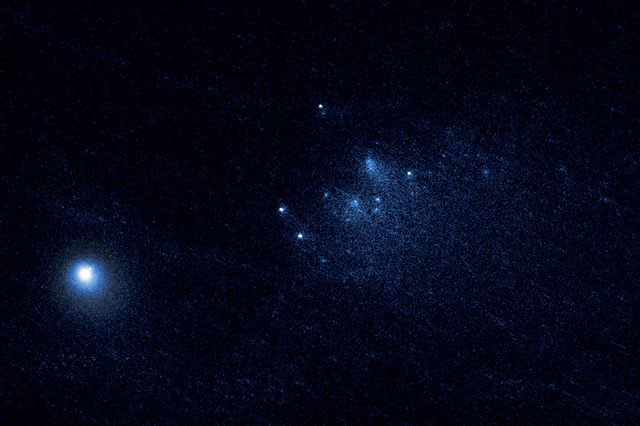
Hubble telescope image of comet 332P/Ikeya–Murakami

The sharpest and most detailed observations of a comet breaking apart have been made by a team of astronomers using NASA’s Hubble Space Telescope. Located about 100 million kilometres from Earth, 332P/Ikeya–Murakami was imaged over three days in January 2016 as 25 fragments consisting of a mixture of ice and dust drifted away from its core. The process occurred in slow motion, with the fragments moving at the walking speed of a human adult, according to David Jewitt at UCLA, who led the team. The astronomers believe that the 4.5 billion-year-old comet may be spinning so fast that material is being ejected from its surface. The resulting debris is now scattered along a 5000 km-mile-long trail, larger than the width of the continental United States. The discovery is described in Astrophysical Journal Letters.

  • You can find all our daily Flash Physics posts in the website’s news section, as well as on Twitter and Facebook using #FlashPhysics. Tune in to physicsworld.com later today to read today’s extensive news story on wobbling graphene.

X-rays yield ghost images


“Ghost imaging” generates images by analysing correlations between two light beams, the more powerful of which doesn’t bounce off the object in question. The technique has already been demonstrated at visible and infrared wavelengths, but now two groups of scientists – one in Australia and Europe, and the other in China – have extended it to the X-ray region. The new results could lead to new methods for medical diagnoses with lower doses of X-rays and for X-ray crystallography of non-crystalline materials, say the researchers.

Ghost imaging involves splitting a light beam into two beams. The “object beam” directed towards the object to be imaged, which has a single pixel “bucket” light detector behind. Meanwhile, the “reference beam” travels straight to a multi-pixel light detector. The idea is to build up a shadow image by incorporating the output from only some of the pixels in the reference detector: those for whom the corresponding parts of the bucket detector are not blocked by the object.

To do this, the detectors are exposed to a broad “speckled” beam whose cross-sectional intensity distribution varies with time. The changing correspondence between the total intensity recorded at the object detector and the pattern of intensities recorded at the reference detector then allows the image to be reconstructed.

Turbulent vision

Ghost imaging at visible wavelengths is already being studied to improve remote imaging of the Earth’s surface by satellites in turbulent conditions. Turbulence scatters light in random directions, which usually makes images noisier. But by measuring the intensity correlations of two correlated beams over an extended period of time, one of which is bounced off the object being observed, the effects of turbulence can be averaged out to almost zero.

There is another advantage of ghost imaging that also makes it attractive at X-ray wavelengths: a good image can still be generated even when the intensity of the object beam is low. This could potentially significantly reduce the size of X-ray doses administered to patients. However, the difficulties involved in building X-ray optics mean that it is far harder to split X-ray beams than it is beams of visible light.

Daniele Pelliccia of RMIT University in Victoria, Australia, and colleagues got round this problem by using X-rays from a synchrotron source – ESRF in Grenoble, France. They directed the synchrotron beam at a sliver of silicon, which left part of the beam undisturbed and diffracted the remainder through a small angle. By placing the object – a copper wire – in one of the beams and then using different portions of a single camera to serve as both object and reference detectors, the researchers were able to generate ghost images of the wire.

Shot noise

The speckle needed in the experiment was generated naturally by the very short pulses of electrons used to produce the X-rays; the distribution of electrons in each bunch being random and yielding what is known as shot noise. To make sure they really had generated ghost images, the team varied the frequency over which they analysed the data. They found, as expected, that they were only able to produce good images when the frequency matched the electron pulse rate. Failure to image at about one pulse per frame means losing the correlation between the two copies of the beam, explains Pelliccia.

Pelliccia says that he and his colleagues are now working out how to exploit this result in order to reduce the dose given in X-ray diagnoses “by at least an order of magnitude” over current levels. Doing so, he points out, will require quite a different technique to the one they used in their experiment, given that synchrotron sources are unsuited to routine medical imaging. In fact, he says, the other new study reporting X-ray ghost imaging, by Shensheng Han of the Shanghai Institute of Optics and Fine Mechanics and colleagues, may point to a more practical alternative.

That research also used X-rays generated by a synchrotron source – the Shanghai Synchrotron Radiation Facility – but did not involve beam splitting. Han and co-workers used a single beam directed at a solitary CCD detector, and instead used an actuator to move the object – in their case a thin gold film with five slits – into and out of the beam. To generate the speckle pattern, the researchers placed another gold film, much wider than the beam diameter and containing randomly distributed holes, between the X-ray source and the object. They found they could produce ghost images by moving the holey film across the beam so as to present a continually changing speckle pattern, and then moving the object into and out of the beam once for each different pattern.

Fourier technique

Pelliccia points out that the Chinese group didn’t generate images directly. Rather, they measured diffraction patterns from the object and then converted those patterns using a Fourier technique. But he says the fact that they created their speckle patterns simply by placing a film in the beam, rather than relying on electron shot noise from a synchrotron, makes it potentially better suited to medical imaging than his group’s technique. He notes that moving a patient in and out of an X-ray beam “wouldn’t be a practical option” but adds that in future it might be possible to move the detector instead of the patient.

In a paper describing their work, Han and colleagues emphasize the importance of their research to crystallography. They say that scientists in future could use their technique to create high-resolution images of non-crystalline samples using “widely accessible laboratory X-ray sources” rather than having to rely on synchrotron sources or free electron lasers. “The structure information of many important molecular materials, such as membrane proteins, is still out of reach because these materials are difficult to grow into macroscopic crystals,” they write.

Ivan Vartaniants of the DESY laboratory in Germany praises the two groups for their “excellent and challenging work”. However, he says that the approach put forward by Pelliccia and colleagues suffers from a number of shortcomings, including the current lack of suitably fast and high-resolution detectors as well as the fact that – unlike copper wire – biological samples will transmit most of the radiation that passes through them.

As regards the technique developed by the Chinese group, Vartaniants queries whether it could be used to image arbitrarily shaped objects and questions whether it really would be suited to conventional X-ray sources, given that the group tested it using a highly coherent, strong flux synchrotron source.

The work of both groups is reported in separate papers in Physical Review Letters.

Flash Physics: Superfluid helium dark-matter detector, Hinkley C will go ahead, why nanotubes are different

UK’s Hinkley Point reactors get the go-ahead

Britain’s prime minister Theresa May has approved the planned construction of the £18bn Hinkley Point C nuclear power station in south-west England. May had unexpectedly put the project under review in July, shortly after taking over as prime minister from David Cameron. Comprising two nuclear reactors, the station will be built by the French company EDF with a £6bn investment from China. According to the UK government, new safeguards have been put in place to ensure that Chinese participation in the project does not compromise the national security of the UK. The decision is expected to open the door to Chinese companies, which are keen to build new reactors elsewhere in the UK. There have been concerns about the high cost of electricity from the plant, which is pegged at £92.50 per megawatt hour and has not been changed by the review. Critics have pointed out that this is much more expensive than energy from a similar facility being built by EDF in France. Hinkley Point C will be based on new European Pressurized Reactor technology, which is being implemented in reactors under construction in Finland, France and China. There is more about Hinkley Point C in the recent Physics World Focus on Nuclear Energy.

Chirality explains why similar nanotubes behave differently

Computer model of a nanotube

Why is it that nanotubes fabricated from seemingly similar nanomaterials exhibit different properties? That is the question asked by researchers at the International School for Advanced Studies (SISSA) in Italy and Tel Aviv University in Israel, who have looked at why materials that have similar structures produce nanotubes that behave differently. For example, while both carbon nanotubes and boron nitride nanotubes are nearly indistinguishable in terms of their structures, they have different responses to frictional forces. The team created computer models of the nanomaterials and studied their characteristics in detail. Team-leader Roberto Guerra says the study showed differences in the chirality of the materials and that this may cause the differences in their properties.

How to detect light dark matter using superfluid helium

Superfluid liquid helium is an ideal medium for detecting low-mass dark-matter particles, according to Katelin Schutz and Kathryn Zurek at the Lawrence Berkeley National Laboratory in the US. While physicists have not been able to detect dark matter directly, several generations of experiments suggest that dark-matter particles have masses below about 10 GeV/c2. As a result, physicists are thinking about how to build detectors that are sensitive to light dark matter at masses as low as 1  keV/c2. This involves looking for extremely rare collisions between dark and ordinary matter in a large detector. The problem is that the dark matter that passes through the Earth is expected to be moving slowly and therefore such collisions will impart tiny amounts of kinetic energy to the detector – making interactions very difficult to see. Schutz and Zurek have calculated that all of the kinetic energy of a dark-matter particle could be absorbed in superfluid helium via the creation of two phonons – particle-like sound waves. These phonons could then be detected using existing technologies. A further benefit of the technique, which is described in Physical Review Letters, is that measurement of the momenta of the two phonons can help distinguish between real dark-matter collisions and background noise. Zurek has a separate paper in the same journal about using superconductors to detect light dark matter.

    • See our video below for more about the nature of dark matter.
    • You can find all our daily Flash Physics posts in the website’s news section, as well as on Twitter and Facebook using #FlashPhysics. Tune in to physicsworld.com later today to read today’s extensive news story on ghost imaging.

The risks and rewards of radiation

One Sunday evening, as I finished reading Timothy Jorgensen’s Strange Glow, I closed the book and turned off the bedside lamps to prepare myself for the next day’s early start. Suddenly, a strong yellow glow caught my eyes. As a medical physicist who deals with X-rays and radioactive materials on a daily basis, I have seen the three-fan radiation symbol countless times, but there, printed on the book cover and shining brightly out of total darkness, it suddenly appeared awful and mysterious. It reminded me of the stories I had just read in Jorgensen’s book, from the very first X-ray image – which famously showed the skeletal ringed hand of Wilhelm Röntgen’s wife – to the innocent “radium girls” who were fatally exposed while painting watch dials with the radioactive paint, and the iconic photos of mushroom clouds rising in the skies of Hiroshima and Nagasaki in August 1945.

Humans have a long-term relationship with radiation. Many radioactive materials have existed for millennia, and some have probably been here ever since the birth of our planet. Yet, only since 1895 – the year Röntgen discovered X-rays in an early version of an X-ray tube invented by William Crookes – have we really started to comprehend the “strange glow” associated with these materials, and to appreciate the mighty power of radiation in treating cancers as well as in inducing them. In many cases, human beings have paid a stiff price for these hard-won lessons.

In Strange Glow, Jorgensen relates a brief history of our dealings with radiation, tracking the most important events and profiling the most pioneering researchers in the field. Through a clear timeline, he describes the discovery of this phenomenon, its health effects, and the risks and benefits of radiation in three distinct sections. All the great discoveries (which all physicist readers should know about and never forget) made by prominent early radiation scientists such as Röntgen, Marie Curie, William Bragg and Thomas Edison are introduced naturally, logically and chronologically. Jorgensen’s lucid writing and strong story-telling skills are demonstrated thoroughly in this book , making it a pleasure to read. Like Stephen Hawking’s A Brief History of Time (which I read a long time ago and still enjoy), Jorgensen’s book introduces only two equations, one on Bragg’s law and the other on Haber’s rule. In its simplicity and conciseness, it greatly contributes to removing some of the mystery and misunderstanding that surrounds radiation.

One real strength of this book is the way it dispels the myth that radiation risks are too complicated for ordinary people to grasp. Jorgensen does this by showing that radiation risks can be estimated effectively without resorting to some “expert” advice or relying on a lot of physics and mathematics background knowledge. This is particularly important in the modern era when radiation has become part of our daily lives, whether it stems from natural sources (such as radon gas in basements), consumer technology (mobile phones, microwaves, airport screening devices and so on) or from medical uses such as diagnostic X-rays, mammography, CT scans and radiation therapy.

Jorgensen, an associate professor of radiation medicine and director of the graduate programme in health physics and radiation protection at Georgetown University, US, has done an excellent job of elucidating many important medical-radiation concepts in layperson’s language. These include radiation-induced DNA damage, effective dose, number needed to treat (NNT) and number needed to harm (NNH). As such, readers can easily develop an objective mindset for assessing the risks of any radiation-related events they encounter. This is to be welcomed, as a more rational perception of radiation risks would help people make sensible decisions on their health – decisions that would reduce rather than increase their risks in the long term.

While a large portion of the book is dedicated to the risks and benefits of radiation, the application of these risks and benefits to the treatment of cancers could be further elaborated. As the author points out, this is a non-trivial task – not least because radiation therapy is primarily used to treat people who already have cancer; every patient and every cancer is different; and even the same cancer in the same patient can respond differently to radiation therapy over time. Hence, personalized radiation therapy with personalized cancer risk assessment would be highly desirable, and is becoming a very hot topic in medical physics research.

In fact, recent epidemiological studies carried out in the UK, France, the US and Australia have confirmed that there is a positive correlation between ionizing radiation and the risk of developing a second cancer in both children and radiation-monitored workers. Mean carcinogenic doses as low as 16 mGy – the sort of dose usually encountered in a CT scan – have been recorded when the targets were radiosensitive organs such as the brain, lungs and red bone marrow. A study carried out by my own group also indicated that the cumulative radiation doses from multiple imaging procedures can be comparable to the “scatter” and “leakage” doses from radiation treatment of cancers – thereby imposing extra risk of developing a second cancer on patients who have already had a primary cancer. This is particularly important for paediatric patients, who are both more vulnerable to the radiation damage and also have a longer life expectancy than the adults.

Mark Twain once described a “classic” as “a book which people praise and don’t read”. In that spirit, then, I will not describe this book as a classic, because I feel it will become a very useful resource to the general public as well as to radiation experts, thanks to its simplicity, conciseness and lucidity. I have certainly learned a lot from the book, as it has helped me project my own perspective on the uses and risks of radiation onto a broader spectrum of issues. I greatly appreciate the author making this book so accessible and readable, and making radiation less formidable than it first appears.

  • 2016 Princeton University Press £24.95/$35.00pb 512pp
Copyright © 2026 by IOP Publishing Ltd and individual contributors