Flash Physics: Philae lander spotted, Diamond Light Source launches electron-microscopy lab, prizes for cosmology and fusion research


Philae lander spotted on comet 67P at long last

Nearly two years after it bounced onto the alien surface of comet 67P/Churyumov–Gerasimenko, Rosetta scientists have managed to locate the “final resting place” of their Philae lander, in images taken by Rosetta’s high-resolution camera. This news could not have come at a better time for the European Space Agency team as the mission is less than a month away from its end. As the picture above shows, Philae is wedged into a dark crack on the comet and the instrument’s orientation clearly reveals why establishing communications was so difficult, following its landing on 12 November 2014. The images were taken on 2 September by the OSIRIS narrow-angle camera, as Rosetta came within 2.7 km of the surface. You can read more about Philae’s tense and exciting first few days on 67P in our previous news stories and blogs.

Scientific, state and film royalty mingle at Kavli Prize ceremony

Winners of the 2016 Kavli Prize in Astrophysics will receive their awards today from Norway’s Crown Prince Haakon in a ceremony in Oslo, Norway. The physics prize was awarded to Ronald Drever, Kip Thorne and Rainer Weiss for the direct detection of gravitational waves. In February, scientists working at the US LIGO detectors in Washington and Louisiana announced they had directly measured gravitational waves for the first time. The US actor Alan Alda and the Norwegian actress Lena Kristin Ellingsen will host the ceremony. The Kavli Prize consists of a $1m prize with the laureates also receiving a gold medal and a scroll.

Diamond Light Source unveils new electron-microscopy facility

A new electron Physical Sciences Imaging Centre (ePSIC) was opened yesterday by the Diamond Light Source in the UK, together with the University of Oxford and the chemicals company Johnson Matthey. Located on the Harwell campus in Oxfordshire, the facility will contain two state-of-the-art electron microscopes that can record information at a rate of up to 200 frames per second, and will allow scientists to actually “see” and analyse individual atoms, within materials, in real time. Andrew Harrison, CEO of the national synchrotron science facility, called this “the most significant day” for Diamond in 10 years, in terms of launching new facilities. Each room in the new facility is carefully isolated from vibrations, is soundproof and has anti-echo walls, and is temperature-controlled to within 0.1 °C, reports Physics World‘s Margaret Harris, who attended the launch. Also of note is that each electron microscope has its own miniature electron accelerator – capable of generating the 100 keV electrons used for imaging – rather than using electrons from the Diamond beamline.

Novel superconductor wins EU SOFT Innovation Prize

The €50,000 EU SOFT Innovation Prize for fusion research has been awarded to researchers at the Karlsruhe Institute of Technology (KIT) and the Swiss Plasma Center (SPC). The prize was awarded yesterday at the 2016 Symposium on Fusion Technology (SOFT) in Prague. KIT researchers designed a new superconducting concept that might be used as a basic element in future high-current cables of fusion power plants, industrial facilities or DC power grids. Sustainable-energy sources and, above all, the reliable distribution of energy are major elements of [Germany’s Energy Transition],” says Holger Hanselka, president of KIT. “The prize reflects KIT’s essential contribution to research, to the transformation of the energy system, and to the viability of our society.”


  • You can find all our daily Flash Physics posts in the website’s news section, as well as on Twitter and Facebook using #FlashPhysics. Tune in to physicsworld.com later today to read today’s extensive news story on when the first stars formed in the universe.

Why do physicists want to redefine basic units as fundamental constants?

In 2018 the International System of Units will be redefined in terms of fundamental constants. Why this change is taking place is explained in this short film presented by Stephan Schlamminger of the National Institute of Standards and Technology (NIST).

This means that base units such as the metre, the second and the kilogram will be redefined in terms of fundamental quantities such as the speed of light (c), the Planck constant (h) and the charge of the electron (e). Doing so will bring together two of the grand theories of modern physics: quantum physics and Einstein’s general theory of relativity.

This video is part of our 100 Second Science series, in which researchers give concise presentations covering the spectrum of physics.

Large-scale metamaterials could combat earthquake shocks


Future cities could be protected from destructive earthquakes using large-scale metamaterial shields to dampen seismic waves, according to new work done by researchers in Europe. The team used 3D modelling to demonstrate the potential of the shields, which are made of arrays of cavities dug into the ground.

Of all natural hazards, earthquakes are perhaps the most catastrophic – they account for more than half of all disaster-related mortalities and have the potential to cause billions of pounds worth of property damage if they strike major population centres. While buildings and other infrastructure can be individually engineered for earthquake resistance, such measures tend to be less effective against large quakes and difficult to implement post-construction, especially within historic buildings.

Inhibited waves

An alternative approach, however, lies in attenuating seismic waves before they can reach high-risk, built-up areas. The advantage of such an approach lies in how it could potentially be used to protect multiple existing structures, without the need for seismic retrofitting. This might be achieved using metamaterials, which allow waves to be manipulated in a variety of unconventional ways.

One previous study, for example, explored the potential of a metamaterial cloak that could be used to divert seismic energy around a structure.

In the new study, however, paper-author Marco Miniaci of the University of Le Havre, France, and colleagues explored the potential of creating band gaps – which inhibit the propagation of seismic waves within a certain frequency range – using locally resonant metamaterials and phononic crystals. Unlike previous studies exploring this approach, their work used 3D models capable of accounting for both body and surface seismic waves, as well as dissipation effects in layered soils.

Different shapes

The metamaterial configurations in their work were composed of two to three rows of cavities, or boreholes – in different shapes and with different fillings – positioned in a square array around the structure to be shielded. The team tested the effectiveness of three different cavity types: a cross-shaped cavity, a hollow steel- or concrete-lined cylinder, and a rubber-coated steel cylinder.

“The exact dimensions will depend on the soil type and the frequency range of the shield,” explains Miniaci, adding that “for sandy conditions and low-frequency seismic excitations, the width, spacing and depth of the cavities – which should be lined with concrete to prevent the surrounding soil from collapsing – could reach 10 m.”

Shields made of all three cavity types were found to be significantly effective in attenuating both bulk and surface waves – with the cross-shaped cavities most effective at attenuating the destructive surface waves. Alongside earthquake engineering, the researchers also propose that scaled-down versions of their arrays might be used to shield against other forms of vibration at higher frequencies. One such application would be in vibration damping around high-speed railway lines; another in creating improved blast protection.

Strong interplay

Bariş Baykant Alagöz, a physicist at the İnönü University, Turkey, who was not involved in this study, says that “the results look promising for the development of passive seismic shield technologies.” Francisco Meseguer – a physicist at the Universidad Politécnica de Valencia in Spain, who was also not a part of the team – agrees. But he also cautions against the assumption that attenuation strategies should focus on surface waves, however, noting that “there is also a strong interplay between bulk and surface waves when they propagate and also scatter in non-uniform soils composed of materials with different mechanical properties, like density and bulk constants.” Meseguer also comments that, while the shield could indeed be useful for protecting single buildings with a specific resonance response, the wavelength range of seismic movements is much larger than the phononic band gap studied.

With their initial study complete, the next steps towards developing their seismic-shield concept should involve experimental tests using scaled models in seismic and vibration labs, says Miniaci.

The research is described in the open-access New Journal of Physics.

Antimatter comes to Brazil

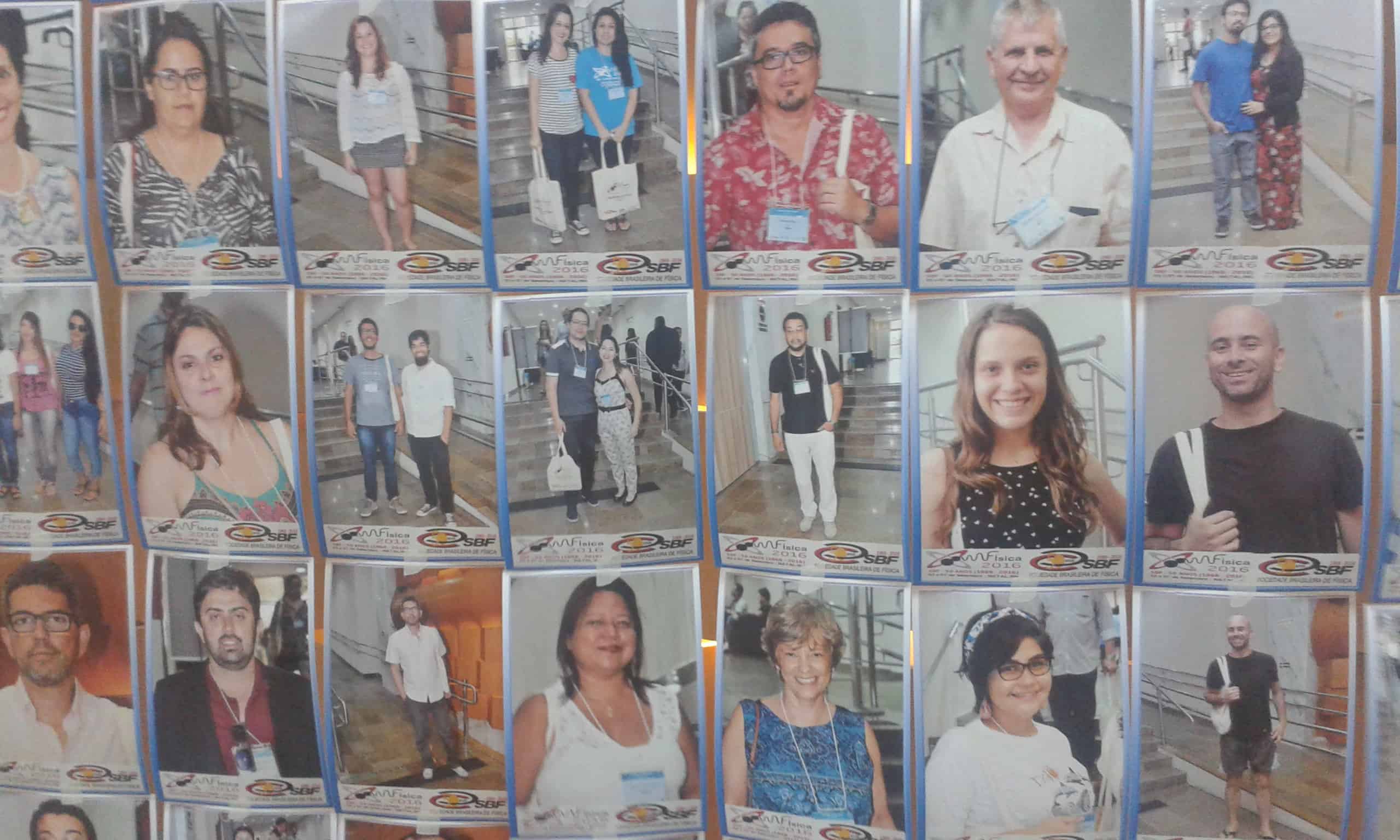
Photo of some of the delegates at the 50th anniversary meeting of the Brazil Physics Society in Natal, Brazil, 5 September 2016

By Matin Durrani in Natal, Brazil

There can’t be many physics experiments to have been visited by members of not one, but two different rock bands. But then there’s something fundamentally captivating about the work of the ALPHA collaboration at the CERN particle-physics lab near Geneva, which is studying the properties of antimatter.

As Jeffrey Hangst from Aarhus University in Denmark revealed in his plenary talk at the 50th anniversary meeting of the Brazilian Physics Society (SBF) yesterday, the ALPHA collaboration has not only played host to a visit from legendary 1970s rockers David Crosby and Graham Nash, but in July also welcomed members of British alternative “space rock” outfit Muse while they were on a visit to CERN.

(more…)

Flash Physics: Producing pristine graphene, SpaceX moves sites, UK’s dark skies, mysterious microcrystals

Producing pristine graphene cheaply

The “wonder material” graphene has held much promise since it was first discovered in 2004. Indeed, the one-atom-thick honeycomb lattice of carbon atoms boasts a number of unique physical, electronic and optical properties – including its strength and electrical conductivity – that lends the material to a host of pioneering applications. But a persistent problem with truly rolling out devices using the 2D material is that of producing low-cost graphene that is, most importantly, defect free, on a large scale. Now, researchers at Friedrich-Alexander-Universiät Erlangen-Nürnberg in Germany say they have successfully synthesized defect-free graphene directly from graphite, for the first time . The graphene – which the team says is of a higher quality than has ever been achieved before – is produced directly from a solution, allowing it to be cut without causing defects. The new method, which is published in the journal Nature Communications, is also low cost and efficient.

SpaceX jumps ship to a new launch site

Following the explosion of a SpaceX rocket on 1 September, the firm says it will shift its flights to a nearly completed second site after damage to its Launch Complex 40 at Cape Canaveral Air Force Station. The private company SpaceX faced a major setback last week when its Falcon 9 rocket exploded ahead of a mission, during a pre-launch “static fire test”. SpaceX will now use launch pad “39A”, which is located a few miles north at NASA’s Kennedy Space Center. Meanwhile, the Federal Aviation Administration is investigating the disaster, which requires the suspension of SpaceX flights pending the results of the probe. Read more about SpaceX’s pioneering founder Elon Musk in our “Once a Physicist” column.

Mysterious microcrystals pave the way to cheaper lasers

Stacks of small, rod-shaped microcrystals, which are easy and cheap to grow, could be used in lasers, thanks to the latest work done by researchers at the National Institute of Standards and Technology in the US and Shandong University in China, which is published in the journal Science Advances. The researchers have discovered a potential way to sidestep longstanding difficulties with making such crystals, which are used to determine a laser’s colour as well as the light’s polarization. While the team says that its microcrystals outperform conventional crystals in some ways, they also challenge conventional scientific theory as to why they perform as they do. “We’ve spoken to a number of experts in different fields worldwide, and none of them can explain it,” says physicist Lu Deng. “Currently, no theory can explain the initial growth mechanism of this exotic crystal. It’s challenging our current understanding in fields from crystallography to condensed-matter physics.”

NASA to gain new InSight in Mars come 2018

NASA has announced that its Interior Exploration using Seismic Investigations, Geodesy and Heat Transport (InSight) mission to Mars will now launch in May 2018, following final approval by the agency’s science-mission directorate. InSight aims to study the deep interior of Mars and was originally scheduled to launch in March, but NASA suspended launch preparations in December 2015 due to a vacuum leak in its main science instrument – the Seismic Experiment for Interior Structure. If the craft successfully launches in May 2018, it is expected to land on Mars by the end of that year.

Dark-sky sites revealed across the UK

Today, the Science and Technologies Facilities Council (STFC) in the UK announced that a host of new stargazing sites perfect for astronomy and free from the dimming effects of urban light pollution have been identified across the country, bringing the total number of Dark Sky Discovery Sites to more than 150. “During the extra hours of darkness this autumn, thousands of people in the UK will be able to experience skies ideal for astronomy, thanks to 17 new Dark Sky Discovery sites” according to the STFC. The Dark Sky Discovery map highlights Dark Sky Discovery Sites and other venues that will be running events through the winter. These locations have been hand-picked to observe the sky on a clear night, offering good public access and great sightlines in all directions.


  • You can find all our daily Flash Physics posts in the website’s news section, as well as on Twitter and Facebook using #FlashPhysics. Tune in to physicsworld.com later today to read today’s extensive news story on using large-scale metamaterials as seismic shields.

Sun, sea, sand – and science

The beach next to the venue of the 50th anniversary meeting of the Brazilian Physics Society in Natal

By Matin Durrani in Natal, Brazil

From London via Lisbon, I arrived yesterday evening in Natal – a city of 800,000 people on the north-eastern tip of Brazil – for the 50th anniversary meeting of the Brazilian Physics Society (SBF).

I was invited by Ricardo Galvão, previous SBF president and chair of the organizing committee, to take part in a session later in the five-day meeting about the development of physics over the next two decades.

As editor of Physics World, which is published by the Institute of Physics (IOP), I’ll be joined by representatives from other physical societies around the world.

(more…)

Terahertz analytics for better plasmas

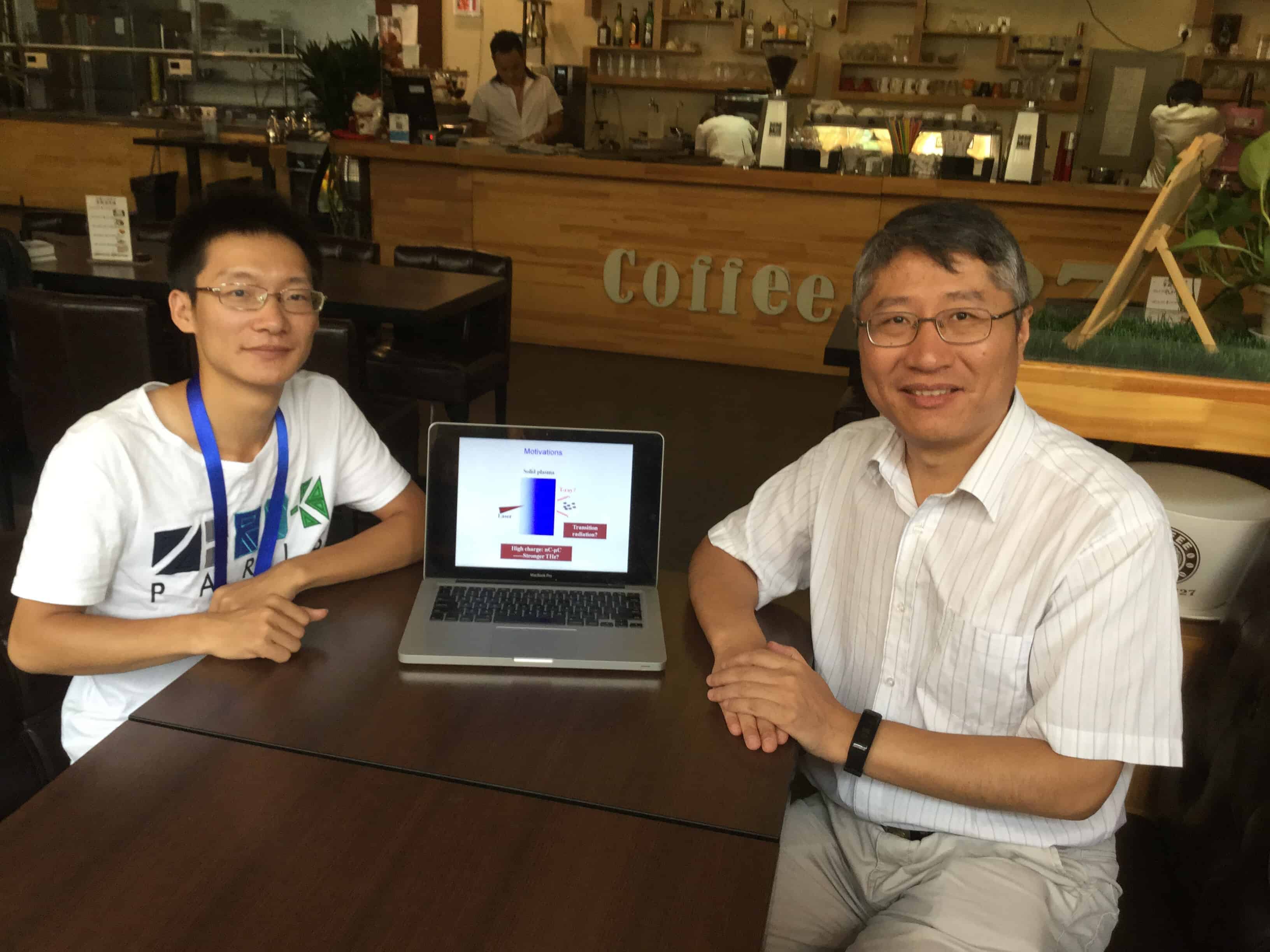
Terahertz generators: Gianqian Liao (left) and Yutong Li

By Hamish Johnston in Beijing 

Today was the last day of the Fall Meeting of the Chinese Physical Society here in Beijing and this morning I grabbed a coffee with Yutong Li and Giuqian Liao. I was hoping to learn more about their work that we covered in May in “Coherent terahertz radiation created in laser plasmas“.

Their technique involves firing a powerful laser pulse at a thin metal foil. This creates a plasma in which electrons are accelerated to high energies before bursting out of the foil. When they emerge, coherent terahertz radiation is given off.

(more…)

A great day out at the Institute of Physics in Beijing

Weyl theorists: Zhong Fang (left) and Hongming Weng

By Hamish Johnston in Beijing 

This morning I had a wonderful visit to see some condensed-matter physicists at the Institute of Physics of the Chinese Academy of Sciences (IOP CAS). First I met with theorists Zhong Fang and Hongming Weng and if you know your equations you can see from the above photo that they work on Weyl semi-metals. Fang is deputy director of the institute and is head of a theoretical physics group that includes six faculty members and about 20 postgraduate students. Avid readers might recall that Fang and Weng were named in the Physics World Top 10 Breakthroughs of 2015 for their work on Weyl fermions.

(more…)

Primal colours across the spectrum, impossible space engines

Physicists and artists have long been intrigued and drawn in by the various mysteries that light and its many colours offer. In the latest installation to be unveiled at the Natural History Museum in London, artist Liz West has unveiled her stunning new work dubbed Our Spectral Vision. The exhibit aims to delve into the long and complex history of the development of colour and vision “through the eyes of nature”. Our regular readers will recall the many physics papers that look into the same, from the structural colour of butterflies to the nanostructures in avian eggshells to the mantis shrimp’s visual superpowers. West’s exhibit deals with many of these topics and more including some fantastic “350 rarely seen specimens, from beautiful birds to fossils of the first organisms with eyes”. If you are based in the UK, do visit the exhibit and otherwise, take a look at the video above to see through West’s eyes.

(more…)

Tapping into light’s hidden information to push fundamental diffraction limit

Scientists have long believed that diffraction limits the minimum distance that can be measured between two adjacent sources of light: if the distance is too short, then the sources appear as one. Now, however, engineers in Singapore have used quantum mechanics to show this not to be the case. The researchers say that new optical techniques based on their discovery might increase the resolving power of microscopes and telescopes by several orders of magnitude.

The resolution of any imaging device is limited by the wave nature of light. That is because light striking a device’s aperture – a lens or mirror, say – are diffracted. These waves arrive at different points on the aperture interfere to produce a diffraction pattern around each point in the image. If the diffraction maximum of one point lies within its neighbour’s minimum, then those two points appear to be merged and are said to be unresolved – a criterion laid down by Lord Rayleigh in the 19th century.

Cursed criterion

In the latest work, Mankei Tsang and colleagues at the National University of Singapore looked at how to measure the distance between two adjacent light sources that are so close that they violate Rayleigh’s criterion. At that point, noise caused by light’s quantum nature – where an image is built up from discrete photons arriving randomly – means the measurement becomes far more difficult with every tiny decrease in separation. The Singapore group has dubbed this problem “Rayleigh’s curse”.

To date, scientists have devised many clever techniques to essentially sidestep this problem. In microscopy, for example, the distance between fluorescent particles is kept to a manageable minimum by ensuring that only a small subset of particles emits at any one time. Astronomers, meanwhile, can sometimes use signal processing to resolve objects that are slightly closer than the Rayleigh criterion allows.

Tsang and co-workers instead used a theory known as “quantum metrology” to work out which physical measurements would yield the most information when carried out on light. In this way, they found it is possible to measure the distance between two light sources with an accuracy that doesn’t depend on how close the sources are to one another. Even when violating Rayleigh’s criterion, they discovered that the error on their measurements remains roughly constant as they reduce the distance, rather than skyrocketing as it does with existing techniques. “Our study shows that Rayleigh’s curse is not a fundamental limit,” says Tsang.

Various schemes

In addition to this result, the researchers also put forward schemes to implement their approach in practice. The key here was to find ways of separating the “useful parts” of the light from the “noisy parts”. In their current paper, published this week in Physical Review X (originally on the arXiv server last November), the group proposes carrying out this sifting using waveguides with spatially varying refractive indices. In a follow-up paper uploaded to the arXiv in December, and published in Optics Express two months later, they proposed a second scheme where incoming light interferes with its spatially inverted counterpart.

Both papers have already led four other groups – another at the National University of Singapore, two in Canada and one largely from the Czech Republic – to carry out experiments on similar schemes. All of the groups were able to overcome the Rayleigh limit, while two of them got to within a factor of two of the fundamental quantum limit identified by Tsang and colleagues. “Our schemes can easily be built using today’s technology, they just require low-loss dielectric optical components,” says Tsang. “People could have done this 20 years ago, if only they knew.”

Seth Lloyd of the Massachusetts Institute of Technology in the US is impressed. “This is awesome work and I am amazed that it hasn’t been done before,” he says. “Perhaps everyone thought it was too good to be true.”

Pushing limits

Currently, the team is concentrating on applying their work to fluorescence microscopy, which, says Tsang, is “the lowest hanging fruit”. However, the results may also have applications in astronomy, the most obvious of which would be astrometry – the meticulous measurement of stars’ positions and movements. The team is also in the process of generalising its theory to widen its application. By using the distance measurements to establish whether bright sources actually conceal multiple objects, he says, the work might become useful in detecting binary stars or hunting for exoplanets.

Tsang also points out that their findings could only be used to improve the performance of telescopes whose resolution is already at the point where it is limited by diffraction and quantum noise. This, he explains, will generally be true of space-based observatories, but on Earth will depend on a telescope’s precise specifications. “If a telescope’s adaptive optics is good enough to minimize the effect of turbulence, then there’s no question that our techniques can help,” says Tsang.

The latest research is published in Physical Review X.

Copyright © 2026 by IOP Publishing Ltd and individual contributors