Thinking man: Rene Descartes may have got some scientific details wrong, but he revolutionized the approach to thinking scientifically. (Courtesy: Science Photo Library)
In the Wallace Collection in London is a sculpture entitled “Descartes Piercing the Darkness of Ignorance”. Completed by Robert Guillaume Dardel in 1782, the sculpture shows the French philosopher, mathematician and scientist struggling to free himself from thick, enveloping clouds, inspired by rays of the Sun emerging from a hole in their midst. It casts René Descartes (1596–1650), who played a foundational role in both describing and using the scientific method, as a triumphant liberator. “No other great philosopher,” observes the venerable Dictionary of Scientific Biography, “except perhaps Aristotle, can have spent so much time in experimental observation.”
Recently, however, Descartes’ image has come under attack. Despite being a pop-culture celebrity for his philosophical remark “I think, therefore I am,” Descartes is routinely scorned for scientific and philosophical missteps. In his 2015 book To Explain the World, for instance, the Nobel-prize-winning physicist Steven Weinberg writes: “For someone who claimed to have found the true method for seeking reliable knowledge, it is remarkable how wrong Descartes was about so many aspects of nature…his repeated failure to get things right must cast a shadow on his philosophical judgement.”
Weinberg elaborates in crisp, no-nonsense prose: “[Descartes] was wrong in saying that the Earth is prolate (that is, that the distance through the Earth is greater from pole to pole than through the equatorial plane). He, like Aristotle, was wrong in saying that a vacuum is impossible. He was wrong in saying that space is filled with material vortices that carry the planets around in their paths. He was wrong in saying that the pineal gland is the seat of a soul responsible for human consciousness. He was wrong about what quantity is conserved in collisions. He was wrong in saying that the speed of a freely falling body is proportional to the distance fallen. Finally, on the basis of observation of several lovable pet cats, I am convinced that Descartes was also wrong in saying that animals are machines without true consciousness.”
How, then, can Descartes deserve to be portrayed as a herald of enlightenment?
The answer lies literally in the clouds – those from which Descartes is emerging in Dardel’s sculpture. These symbolize the lingering influence both of Aristotle and of the Church.
Sequestration
Aristotle’s world was composed of different places (Earth and heavens) populated by different substances (on Earth, natural things and human creations) that obeyed different laws. In his work, The World, which Descartes planned to publish in 1633, he pictured a single universe full of mechanisms that obeyed the same laws. Plants, animals and human bodies were mechanisms (though the latter were connected to souls). The rest of the natural world, too, behaved mechanistically, from sticks and stones to the Sun, Moon and planets. “I have described…the whole visible world as if it were only a machine in which there was nothing to consider but the shapes and movements [of its parts],” Descartes wrote. The scientists’ job was to figure out the mechanisms.
Then Descartes learned of Galileo’s condemnation. Although he was living at the time in the Netherlands, where he was beyond the reach of the Roman Church, Descartes was a believing Catholic and refused to publish anything heretical. But a heliocentric universe, the reason for which the Church had condemned Galileo’s work, was central to Descartes’ mechanistic picture. He therefore withdrew The World and wrote an essay describing his personal path to the new science as the preface to three non-controversial scientific articles he published in book form.
Now known as the Discourse on Method, this essay is one of the finest pieces of philosophical writing. He wrote it in French rather than Latin, so “even those who have not been to school can understand it”. In it, Descartes describes how one day – after long frustrations not knowing which of his beliefs were true, false or ungrounded – he sequestered himself and tried to set aside all received opinions to see if, among all his ideas and opinions, he could hit bedrock.
He could. Try saying to yourself – and meaning it – “I am not now thinking.” You can’t. No politician, theologian or even a God can convince you otherwise. That was only the first of an entire realm of truths that Descartes found he could know and reason about without theology and authority being at all relevant. If you do science this way, starting from clear and distinct ideas and making sure the results hang together like mathematics, he argued, you can’t be heretical. Doing science is like sequestering yourself from the world and theological issues, and those who do it no more reject that world than sequestered members of a jury question the authority of the legal system that set them up.
The critical point
In the end, Descartes got many of the world’s mechanisms wrong. But this should not obscure Descartes’ foundational role in modern science. His far-reaching contribution was to demonstrate how much you can understand of the world when you compose and test mechanisms and models. In his widely read and influential Discourse, Descartes modelled for followers what it is to act like a scientist.
Imagine belittling Adam Smith’s credentials as an economist just because his “pin factory” – the famous thought experiment that he deployed to show the benefits of the division of labour and capitalism – couldn’t cut it in the modern marketplace. Or imagine disparaging Copernicus’s astronomical credentials because he pictured the planets as moving in circles rather than ellipses. While Weinberg is right that Descartes got many of the world’s mechanisms wrong, this does not affect Descartes’ foundational role in establishing the scientific method. For, ironically, Weinberg’s criticism is based on a mechanistic way of thinking that it was Descartes’ extraordinary contribution to help legitimate.
The American Physical Society (APS) has relocated the 2018 annual meeting of the Division of Atomic, Molecular and Optical Physics (DAMOP) over concerns about a new state law that discriminates against members of the lesbian, gay, bisexual and transgender (LGBT) community. The conference, which was due to take place in Charlotte, North Carolina, will now take place in Fort Lauderdale, Florida, in late May or early June of that year.
The relocation is due to the introduction of the Public Facilities Privacy & Security Act – also known as House Bill 2 (HB2) – in North Carolina. An aspect of that bill, which was passed in March, requires people to use public bathrooms that correspond to the gender on their birth certificate. The requirement puts transgender and non-conforming gendered people at risk of arrest if they enter a public bathroom of their gender identity. The law prevents any city in the state from differing from HB2 regarding bathroom rights.
Following the introduction of the law, DAMOP’s 12-member executive committee voted to move the meeting. As the division typically books its meeting three years in advance, it will incur a cancellation fee for withdrawing from the venue. However, that is likely to be small compared with the meeting’s overall total cost.
Member support
DAMOP members overwhelmingly agreed with the decision. “I’m very proud of the APS for making this move and taking a very clear action that shows that the APS values trans physicists,” says Elena Long, a postdoctoral researcher at the University of New Hampshire, who is a member of the APS Committee on LGBT Issues. DAMOP chair Steven Rolston, a quantum physicist at the University of Maryland, says that members are 10:1 in favour of the move, based on feedback he has received.
The APS has recently been working to improve the environment for LGBT+ physicists. In March, the APS committee on LGBT Issues published its LGBT Climate in Physics report – the culmination of two years spent outlining the status of the LGBT community within physics and the barriers its members encounter. It outlined six recommendations to increase inclusion and address the current discriminatory environment, which the APS council has now endorsed. “Physicists should be able to focus on their work, free from having to deal with all forms of harassment and discrimination,” says Long, who is the founder of LGBT+physicists – an online resource for physicists of gender and sexual minorities.
In the increasingly connected world we live in, outbreaks of viruses such as Ebola and Zika pose serious threats to populations and place serious strains on healthcare systems. Quarantines – states of enforced isolation – are a common measure taken to hinder the spread of disease. In this video, Alexandra Fogg of the University of Leicester, UK, introduces an approach to quarantines known as the SIR model, adopted by health officers to predict the spread of epidemics.
This is one of a collection of videos based on student projects from the University of Leicester’s “Physics Special Topics” course, in which students use their physics knowledge to define and answer a quirky or unusual research question. The videos are part of our 100 Second Science series.
Construction has begun on one of the world’s largest and most sensitive cosmic-ray facilities. Located about 4410 m above sea level in the Haizi Mountain in Sichuan Province in southwest China, the 1.2 billion yuan ($180m) Large High Altitude Air Shower Observatory (LHAASO) will attempt to understand the origins of high-energy cosmic rays. LHAASO is set to open in 2020.
Cosmic rays are particles that originate in outer space and are accelerated to energies higher than those that can be achieved in even the largest man-made particle accelerators. Composed mainly of high-energy protons and atomic nuclei, cosmic rays create an air shower of particles such as photons and muons when they hit the atmosphere. Where cosmic rays come from, however, has remained a mystery since they were first spotted some 100 years ago.
Cosmic showers
LHAASO aims to detect cosmic rays over a wide range of energies from 1011–1018 eV using a Cherenkov water detector, covering a total area of 80 000 m2, together with 12 wide-field Cherenkov telescopes. These two types of instrument, which are above ground, will spot the Cherenkov radiation emitted when a charged particle travels through a medium faster than light can travel through that medium. LHAASO will also consist of a 1.3 km2 array of 6000 scintillation detectors that will study electrons and photons in the air showers, while an overlapping 1.3 km2 underground array of 1200 underground Cherenkov water tanks will detect muons.
LHAASO is not the only facility in the world trying to study the origin of cosmic rays. The IceCube facility at the South Pole observes high-energy neutrinos, while the Pierre Auger Observatory in Argentina explores cosmic rays with energies above 1018 eV. “LHAASO will play a complementary role with existing detectors to offer a more comprehensive picture of the cosmic-ray sky,” says Yifang Wang, head of the Institute of High Energy Physics (IHEP) of the Chinese Academy of Sciences.
Challenges ahead
According to IHEP researcher Zhen Cao, who is LHAASO’s chief scientist, the construction of LHAASO will not be easy, with the Cherenkov water detectors being particularly tricky. Benedetto D’Ettorre Piazzoli, a former vice president of the National Institute of Nuclear Physics (INFN) in Italy, who has been involved in Sino-Italian collaborations in cosmic-ray research, agrees, adding that combining all of these detector types will be difficult. “The deployment, debugging, and operations management of many thousands of detectors of different types is very challenging at a level never faced before,” he says.
D’Ettorre Piazzoli is, however, confident that the facility will play an important role in cosmic-ray research. “As LHAASO is a very large installation, with a large amount of many types of detectors allowing the observation of cosmic rays and photons over a wide range of energies, it is expected to provide detailed and statistically relevant information on the transition from the galactic to the extra-galactic contribution,” he adds.
LHAASO is an international collaboration that includes scientists from China, France, Italy, Russia, Switzerland and Thailand. First mooted in 2008, the facility won approval from the National Development and Reform Commission of China in December 2015. Haizi Mountain was selected as the site due to its high elevation and good accessibility – being only 10 km away from Yading Airport – the world’s highest – and about 50 km from Daocheng County, which will be the base for the LHAASO team.
Concerns have been raised by US watchdogs over NASA‘s ambitious plans to send astronauts to Mars in the 2030s. In two reports (see related links) published last week, the US Government Accountability Office (GAO) – which audits government agencies on behalf of the US Congress – warns that tackling “several technical challenges” with the Orion capsule for transporting astronauts to Mars would push costs above the current estimated price tag of $11.3bn.
NASA’s schedule to Mars involves a series of tests of the Orion crew capsule and the Space Launch System (SLS), which is designed to launch Orion towards the red planet. The agency plans its first launch of the SLS late next year – preferably in September and no later than November. Called Exploration Mission 1 (EM-1), the test flight will carry a crewless Orion capsule around the Moon.
The second flight, dubbed EM-2, meanwhile, will carry a four-person crew in the Orion capsule by April 2023. But NASA wants to fast track the launch for August 2021, in what it calls an “aggressive” push. The mission will lift astronauts beyond low-Earth orbit for the first time since the Apollo 17 Moon landing in 1972, where they will practise manoeuvres with the craft.
Later in the decade, NASA then plans to use a robotic mission to capture an asteroid and redirect it into lunar orbit. Astronauts on a fresh Orion mission will explore the asteroid and return to Earth with samples from it. That flight will serve to test new systems – such as solar electric propulsion – for the eventual Mars mission.
Risk and reward
The two GAO reports cast doubt on NASA’s schedule, adding that the cost estimate “lacked support”. They assert that NASA has to tackle a number of issues with the launch site at the Kennedy Space Center in Florida to accommodate the SLS, which could delay the launch beyond 2018. “All the programmes are working with very low management reserves in terms of dollars and time,” says Cristina Chaplain, GAO’s director of acquisition and sourcing management, who led the studies. “It makes it very difficult to manage a programme under those circumstances. It puts them in a position of deferring work to later stages, where it could be more costly and time-consuming to address.”
The GAO adds that NASA only has a 40% chance of meeting the August 2021 date for EM-2, and that by setting such a goal the agency is accepting higher risk. In a response included in the report, Bill Gerstenmaier, NASA associate administrator for human exploration and operations, concedes some of the criticisms, but regards others as unnecessary. “To date, as the GAO correctly noted, Orion continues to perform within the boundaries of the programme cost and schedule commitment,” he writes.
While the situation may seem serious, some regard it as not unusual, given the nature of crewed space missions. “I would have some concerns, but I’m not terribly worried,” says Scott Pace, director of George Washington University’s Space Policy Institute. “For Orion, cost and risk are being traded in a responsible manner.” Yet he questions the early target date for EM-1. “The political support for pulling the schedule in closer is not there now,” he says.
Meanwhile, the US government has approved the first commercial mission to the Moon. The Federal Aviation Administration’s Office of Commercial Space Transportation gave the go-ahead for the Moon Express company to send a robotic lander to the lunar surface next year. Based in Cape Canaveral, Florida, Moon Express plans to equip its small table-sized lander with experiments and commercial cargo, including some cremated human remains.
A couple of years ago, I came across what I thought was a funny (and physics-related) video about a water slide. The slide is called “Verrückt”, which my German-speaking colleagues translate as “mad” or “crazy”, and it caught my attention because it was being built at an amusement park in my home town of Kansas City. As the video shows, the slide experienced a few problems during its testing phase.
“When the rafts are loaded with more than 1000 pounds, the slide becomes unsafe,” says the video’s announcer as the test raft goes airborne. “We’re going to have to redesign the entire slide,” an unnamed official adds.
The story began around this time last year, soon after the LHC was rebooted and began its impressive 13 TeV run, when the ATLAS collaboration saw more events than expected around the 750 GeV mass window. This bump immediately caught the interest of physicists the world over, simply because there was a sniff of “new physics” around it, meaning that the Standard Model of particle physics did not predict the existence of a particle at that energy. But also, it was the first interesting data to emerge from the LHC after its momentous discovery of the Higgs boson in 2012 and if it had held, would have been one of the most exciting discoveries in modern particle physics.
A new type of optical metasurface whose properties can be dynamically reconfigured with a laser pulse has been developed by researchers in the UK. The team believes that its technology, which has lower loss than traditional plasmonic resonators, could be useful for reconfigurable optoelectronic components.
Although metamaterials were originally developed to passively manipulate radiation to achieve perfect lenses or cloaking devices, the field has broadened to encompass materials that can be switched or tuned to modulate their properties. These have often featured plasmonic resonators – subwavelength noble-metal structures that interfere directly with the electromagnetic field of radiation and reshape a wavefront.
To reconfigure these, they can be combined with a so-called phase-change material, which alters its properties in some way in response to an external signal. However, plasmonic resonators often have high losses, especially at optical frequencies. In recent years, therefore, many researchers have produced metasurfaces from silicon or other dielectric materials, because their losses are smaller and they are easier to manufacture.
Laser switch
In the new research, Nikolay Zheludev and colleagues at the University of Southampton have produced metasurfaces purely from the chalcogenide germanium antimony telluride. Many chalcogenides – a class of compounds including sulfides, selenides and tellurides – can exist in both amorphous and crystalline phases. Heating the crystal above its melting point for a few nanoseconds destroys the crystalline structure and turns the material into an amorphous glass.
To trigger the reverse transition, the glass has to be heated to a lower temperature for a longer time (but still less than a microsecond). Chalcogenides have often been used in plasmonic metamaterials to shift the resonant frequencies of the plasmonic resonators by altering their surrounding environment. However, the optical properties of crystalline and amorphous chalcogenides themselves are very different and this phase-changing material is being used in rewritable CDs and DVDs, and is also being developed for new types of computer memory.
The researchers deposited 300 nm-thick films of amorphous germanium antimony telluride onto quartz substrates. They measured the near-infrared absorption of the film across a range of near-infrared wavelengths, finding that it was relatively transparent. Next, they used ion beams to selectively etch away the chalcogenide to produce subwavelength nanogratings. Pronounced absorption resonances appeared, with the resonance frequency dependent on the grating periodicity.
Phase changing
Zheludev’s team scanned a green laser beam over the surface. The light heated the material, causing it to crystallise. Upon measuring the optical properties of the crystalline gratings, the researchers found significant differences: after crystallization, one grating reflected only 20% as much light at 1470 nm as it had when the chalcogenide was amorphous. “We show for the first time that a dielectric metamaterial may be switched through the phase change of the dielectric itself,” says Zheludev. The researchers have not yet demonstrated the reverse transition back to the amorphous form of the grating: this will be more difficult, simply because it requires heating the material above its melting point while maintaining the structure of the grating.
Thomas Taubner of RWTH Aachen University in Germany praises the research, which he says forms part of a move towards all-dielectric, reconfigurable metasurfaces that researchers have worked towards in the past few years. He believes the absence of a reversible phase transition makes this “a first step”, but says that “in the nanophotonics community, the first goal is of course to show the concept and then later to do the engineering.”
The Rio 2016 Olympics will kick off tomorrow and over the next three weeks, while you enjoy watching the world’s top athletes compete in the huge variety of sports, spare a thought for the physics involved. From how to throw a ball to running, from pole vaulting to golf, physics and sport are fellow brethren. Head on over on the JPhys+ blog to read “The big physics of sport round-up!” post and watch our video series above, in between cheering on your favourite teams.
The George Eastman Museum in Rochester, New York, is the oldest photography museum in the world. The Victorian mansion that houses the museum was once home to Eastman himself – a pioneer in photography who in the 1880s helped bring photography to the masses after inventing roll film and designing the Kodak camera. Eastman’s passion for colour and order are reflected in the museum’s manicured gardens, where a diverse selection of blossoms sprouts from strictly symmetrical flower beds.
Within the museum’s walls, there are more than 400,000 photographic objects, including a collection of about 5000 daguerreotypes – images typically no bigger than a postcard, printed on polished copper plates and encased in glass. Sourced from all over the world, examples include a likeness of the “father” of the daguerreotype, French photographer Louis-Jacques-Mandé Daguerre. Invented by Daguerre in the 1830s, daguerreotypes became the first commercially available form of photography.
For about two decades – until other, more efficient photographic methods became available and popular – this early way of recording visual images surged in popularity worldwide. For the first time, people could buy an exact image of themselves. The method was used to capture snapshots of landmarks, famous people, ordinary citizens, as well as notable events such as burning buildings or lively street scenes. Subjects included Queen Victoria and her daughter, US president Abraham Lincoln, writer Harriet Beecher Stowe, the Acropolis in Athens and the waterfront of Cincinnati. The Eastman museum collection includes a daguerreotype of abolitionist Frederick Douglass.
“People went nuts with it,” says Patrick Ravines, a chemist-turned-conservator at Buffalo State College in New York, who studies and collects daguerreotypes. “They used to document everything around the world, and daguerreotypes show things that don’t exist any more.” He points out that researchers can study daguerreotypes to study erosion in natural settings, measure the growth and change of cities, or even see what archaeological sites – such as the Acropolis – looked like in the 19th century. These images serve as a record of their day.
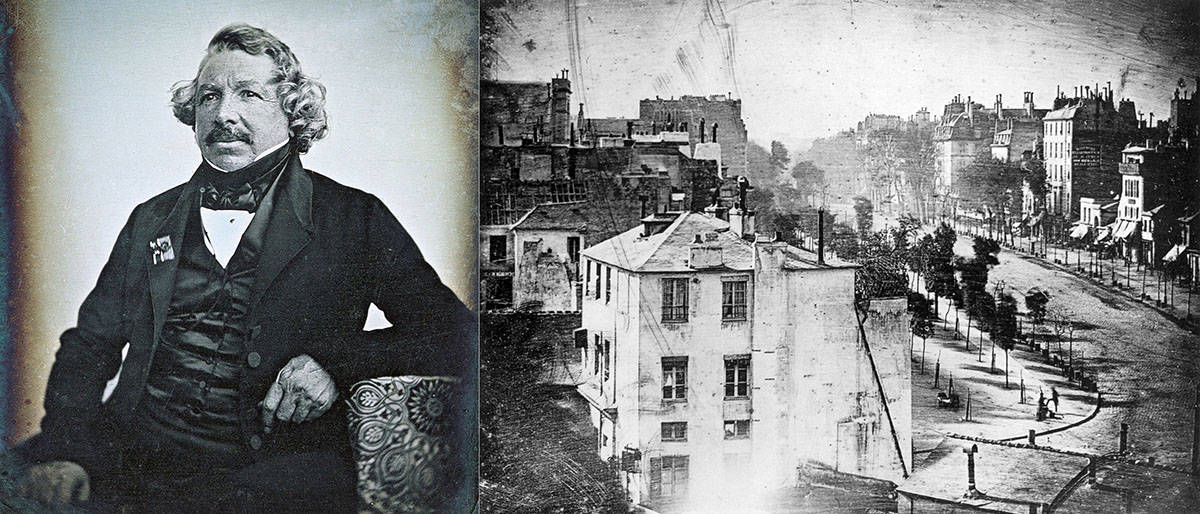
History maker Louis Daguerre, pictured (left) using his daguerreotype process by Jean-Baptiste Sabatier-Blot in 1844. Daguerre’s own daguerreotype of Boulevard du Temple in Paris in 1838 (right) is the oldest surviving photograph of a living person (bottom right) but has suffered severe damage since this copy was created. (Courtesy: George Eastman House, International Museum of Photography and Film; Louis Daguerre)
Yet, like everything, daguerreotypes yield to time, and are now in trouble. Some have become cloudy; others have developed spots. Some are so damaged that they’re no longer recognizable. They’re deteriorating at a rapid clip.
In 2005 art conservator Ralph Wiegandt, then at the Eastman Museum, helped prepare a large exhibition of daguerreotypes to be exhibited at the International Center of Photography in New York City. During the exhibition, curators noticed that 30 of the objects showed signs of inexplicable degradation and were fading fast. To find ways to salvage the images, Wiegandt turned to physicists at the nearby University of Rochester.
One of them was Nicholas Bigelow, who was eager to bring his team to the project. Bigelow’s scientific interest was piqued by the fact that early photographers were using nanotechnology to create the images, even though they were unaware of it at the time. “If you were to take the nanoparticles that form the image on the daguerreotype, you’d have to have between 100 and 1000 of them stacked side by side to be as [wide] as a human hair,” he says in a video interview filmed for the University of Rochester.
To save the daguerreotypes, Bigelow and his fellow scientists would need to follow a three-step process. First, they’d have to understand the surface physics and chemistry of how the images were made. Second, they’d have to identify the processes that fuel degradation. Third, they’d have to get creative – and find ways to use their research to forestall the process, if not reverse it. Fortunately, the team had an arsenal of modern imaging tools at its disposal, including scanning electron microscopes (SEMs), transmission electron microscopes, X-ray scanners and focused ion beam milling, to get beneath the surface of the centuries-old images.
“It’s a surface where history and art and science intersect, and it’s very, very complicated,” says Brian McIntyre, who manages the Integrated Nanosystems Center at the University of Rochester. As he points out, the objects provide the first true – not drawn – images of the world. “They give us a window on the world that really is first light.”
Forming the image
Daguerreotypes aren’t like other photographs. The image is printed using a laborious process that may require hours just to get one shot. It’s printed directly onto a metal plate – which renders each daguerreotype one-of-a-kind and irreproducible. They’re unusually rich in detail. Bigelow says he was drawn to the project after seeing a daguerreotype of the Cincinnati waterfront made in 1848. Zooming in on that image with magnifying lenses reveals an astonishing level of detail. “If you blow this up, and you blow it up, and you blow it up, the level of resolution and detail in this nanotechnology photograph is fantastic,” he says.
Wiegandt, who now continues his daguerreotype work as a visiting research scientist at the University of Rochester, says that well-made daguerreotypes can be enlarged 20–30 times and still reveal minute details of their subjects – a resolution that, today, would require a 140,000-megapixel digital camera.
But the scientists wanted to zoom in even further to see what was happening at the nano level. “It was determined that looking at the surface – the surface science, the surface morphology, the surface physics – was where we ought to start,” recalls McIntyre.
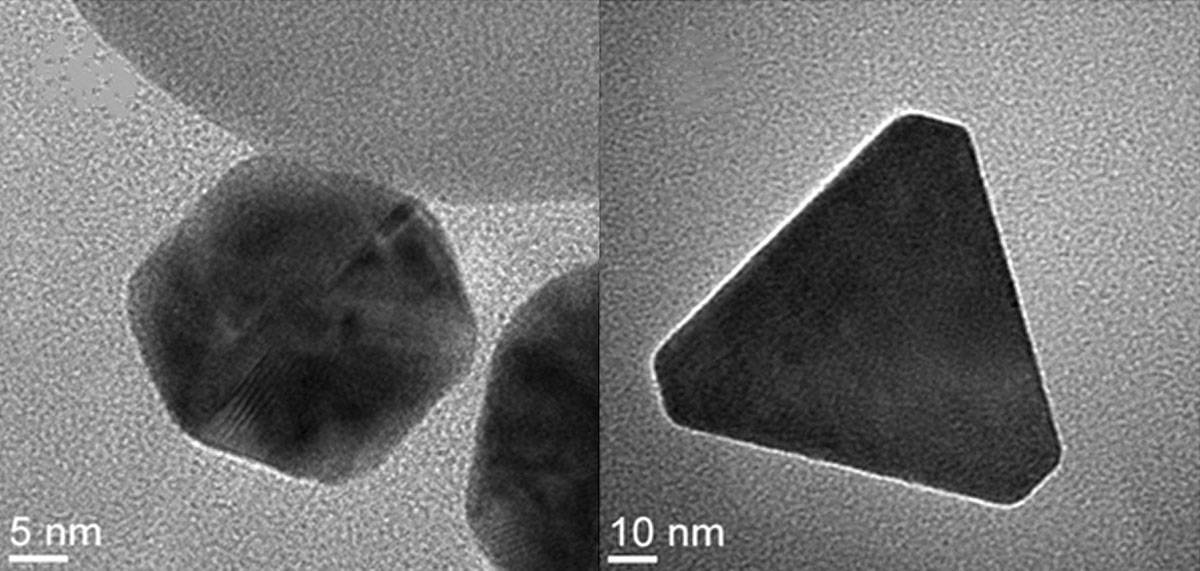
1 The shape of things Transmission electron microscopy of daguerreotypes reveals clear 3D-shaped particles in the amalgam on the surface of the images, including hexagon and truncated triangle. The geometry probably corresponds to the amalgam’s make-up. (CC BY Nanoscale Research Letters 10.1186/1556-276X-7-337)
The process of making a daguerreotype begins when a silver-coated copper plate is painstakingly polished to a mirror finish. The plate is then placed in a closed box with iodine and bromine vapours, which sensitizes it to light and gives it a rose-coloured hue. Next, the picture is taken: the plate is mounted in a camera and exposed to light, usually for a few minutes, to form the image. The plate is then exposed to hot mercury vapours, which create particles of amalgam – a combination of silver and mercury – that develop the image. Finally, the silver iodide is removed, and the image may be “gilded”, which involves coating it with gold chloride.
“The fascinating aspect of daguerreotypes is that you’ve got light interacting with a material – and changing the nature of that material,” says Ravines, who led a study, published in May in the Journal of Imaging Science and Technology (60 30504), that reports what happens at the molecular level during that laborious process. He and his colleagues focused primarily on the steps during which the image was formed – after the plate was exposed to iodine and bromine, but before it was gilded.
Images taken with an SEM of a daguerreotype from Ravines’ personal collection showed that many of the larger amalgam particles – about 200–800 nm in diameter – are hexagonal in shape and pile up in the whites and light greys of the image (figure 1). Their findings corroborate studies by scientist Alice Swan in the late 1970s, and by art conservation scientist M Susan Barger in the 1980s and 1990s, that also revealed the hexagonal shape. In the new study, however, the researchers observed particles with other shapes too, including large trapezoidal solids and other 3D geometries. Ravines suspects those other geometries may correspond to a variety of amalgam species that combine mercury and silver in different proportions.
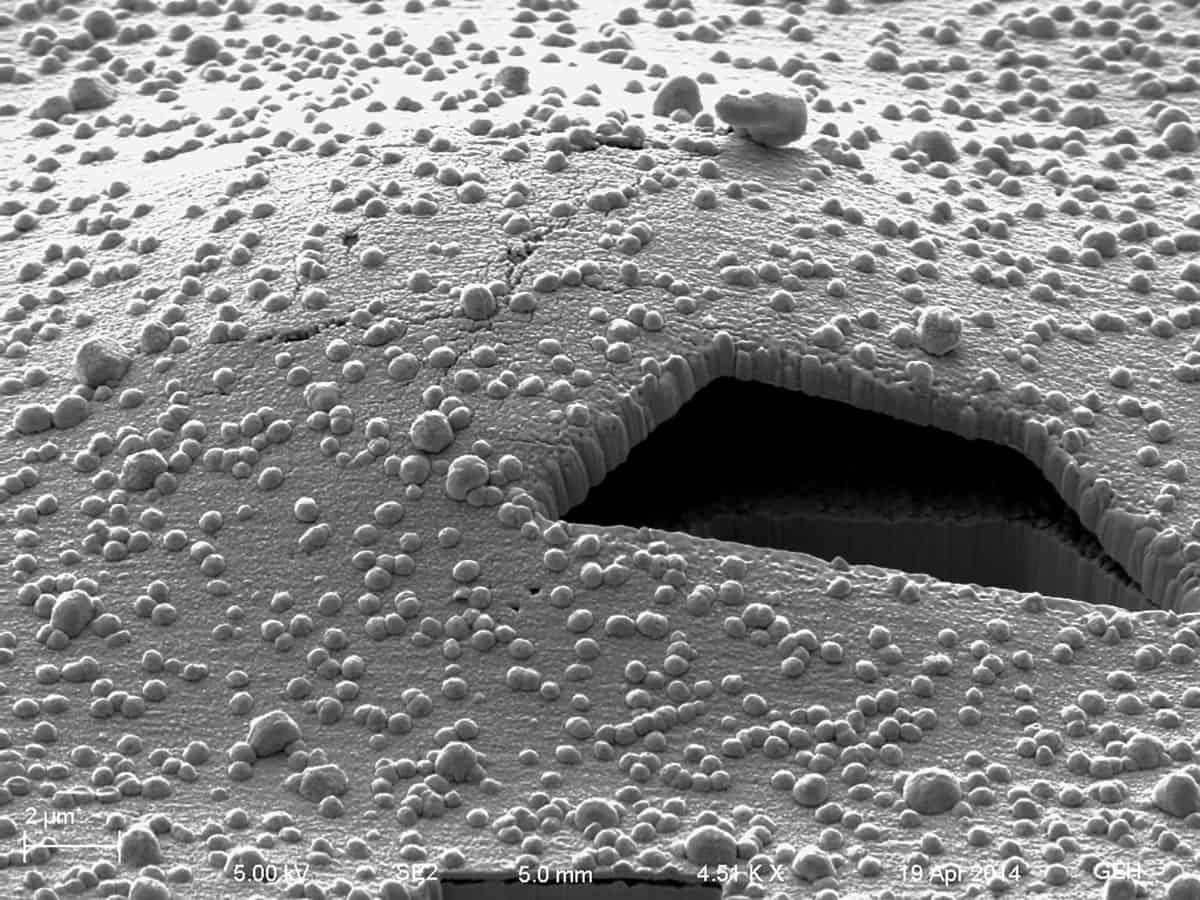
2 It’s the pits Focused ion beam microscopy dramatically shows the condition of surface disruption on a daguerreotype – likely caused by excess gold used to “gild” finish the photograph. (Courtesy: NSF/Brian McIntyre/University of Rochester)
Understanding how nanoparticles and the surface respond to airborne pollutants such as water vapour, sulphur-based gaseous pollutants and other sources of corrosion, says Ravines, could help scientists better observe how the images vanish over time. Figure 2 shows one example of the damage.
Destructive forces
In 2010, with support from a grant from the National Science Foundation, Bigelow, Wiegandt and McIntyre went looking at damage on the nanoscale. They were in for some surprises. Perhaps most startling was the fact that the daguerreotype surface can support life that, ultimately, harms it. “One thing that we never would have expected is that the daguerreotype is a biologically active surface,” says Bigelow. “We have discovered essentially on every daguerreotype we looked at, there are small colonies of fungi growing, and those fungi are damaging the surface.”
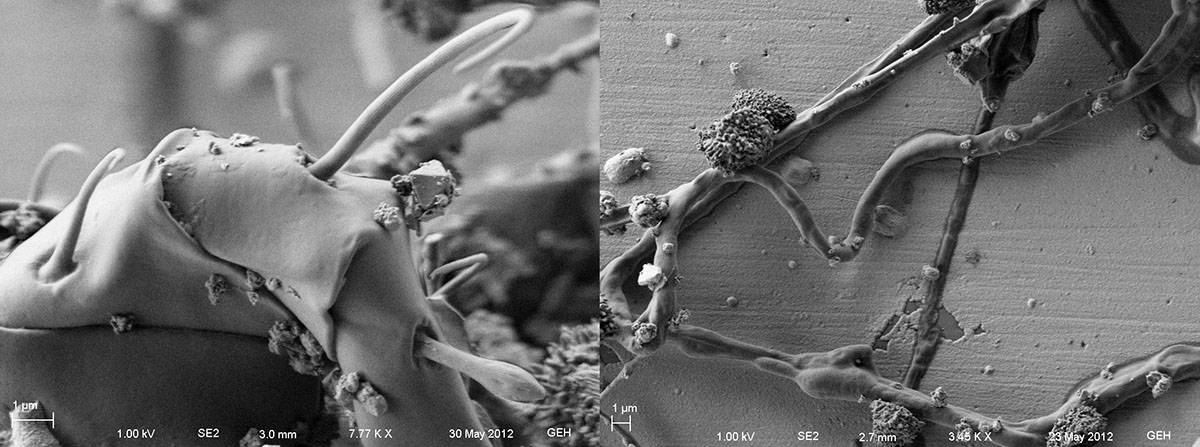
SEM images reveal networks of micron-scale filaments sprawling on the surface (figure 3). The microbes seemed to not only live on the surface, but also interact with it in some way – a discovery that McIntyre likens to finding life on Mars. The surface of a daguerreotype is “pretty darn toxic”, as he puts it. Silver and mercury have antimicrobial properties, but they don’t stop the micro-organisms from spreading across the silver surface of the images.
3 Biological danger One danger for daguerreotypes comes from the colonies of fungi that form on the surface. Shown here are some of the diverse biological forms seen with scanning electron microscopy. The microbes form sprawling networks of filaments that not only live on the surface but interact with it too. (Courtesy: NSF/Ralph Wiegandt/University of Rochester/George Eastman Museum)
The team also found problems lurking beneath the surface. “One thing we’ve observed is that below the image particles, and above the native silver surface, there seems to be a gap forming, and that gap can lead to the uppermost surface of the daguerreotype exfoliating from the underlying silver,” says McIntyre. In extreme cases, this condition leads to large flakes peeling away from the image like ripped pieces of paper – a type of degradation that’s easily visible to the naked eye. In images from SEMs, the gaps resemble networks of underground caves, with the scientists saying these look like Kirkendall voids – cavities that appear at the interface between two attached metals, such as a metal and an alloy in a solder joint. In daguerreotypes, the voids likely form as a result of the reaction between a gold (gilding) solution and the silver. Though the exfoliation mechanism isn’t well understood, those SEM images suggest that the metal seems to be moving, in part, due to it interacting with the solution used to gild the image, though McIntyre admits other factors could be involved.
Writing in the Journal of Imaging Science and Technology, Ravines says he has seen voids beneath the image that raise questions about the overall stability of the surface that the image rests on. Understanding those voids will be important for devising sound conservation treatment strategies. “We have to be careful because of the way that subsurface is almost like Swiss cheese,” he says. “Knowing the way [the daguerreotype] is built allows us to better preserve it.”
Another source of degradation comes, ironically, from historic efforts to preserve the images. Daguerreotypes are typically sealed in cases beneath a cover glass. Over time, moisture accumulates on the underside of the cover glass and dissolves it. The highly alkaline droplets can drip onto the daguerreotype. “We see patterns of degradation associated with the glass coming apart,” McIntyre says. “You try to do the right thing 150 years ago, but your best intensions are foiled by nature.”
Rescue strategy
The first priority in conserving daguerreotypes is to stabilize them in their current state. Following on from the imaging work, Wiegandt began to develop new strategies to protect the artefacts from degrading any further. One tactic included encapsulating the image in a frame filled with an inert gas, such as argon, to prevent pollutants and other corrosive elements from getting inside. That may not be a permanent solution, but it might buy more time. “If you can give the daguerreotype 20 years of life before a recharge, that’s a good investment of time and energy,” says Ravines.
Another tantalizing possibility, says McIntyre, is to undo the damage altogether. “We’ve done some things at the nano level that we think can not only stabilize but perhaps reverse some of the degradation process,” he says. One approach addresses the surface-exfoliation problem In preliminary experiments, he says, the researchers have been developing a way to physically repair that damage – a bit like a nano sewing machine that might stitch the damaged area.
McIntyre cautions, however, that so far they’ve only been able to use this approach in micron-sized areas, and scaling it up to be useful on daguerreotypes in general would be difficult. “I don’t know, frankly, if it’s possible, but it’s certainly conceivable,” he says. “It would be very cool.” Developing a useful tool would also not come cheap.
Daguerreotypes today
Daguerreotypes, in a way, have now come back into fashion. Professional photographers and curious hobbyists can learn how to make them in classes at the Eastman Museum, and successful artists including Adam Fuss have created oversized daguerreotypes many times larger than anything produced in the 19th century. In another 100 years, those works will likely face degradation, too – though perhaps, by then, conservators will have a set of sophisticated tools to keep the images from fading away.
But the benefits of saving daguerreotypes may even extend beyond the art world, with Bigelow and Wiegandt hoping their findings will have applications to other areas of nanotechnology. The amalgam nanoparticles, for example, exhibit “self-assembling” behaviour – a growing area of nanoscience research.
For McIntyre, the project not only demonstrated the interdisciplinary reach of nanoscale physics – but was a professional thrill too. “It’s probably one of the most interesting things I’ve ever worked on,” he says. “It’s not often you get the opportunity to work in the historical realm, the science realm and the art realm simultaneously.”