The UK’s National Physical Laboratory (NPL) – the country’s standards lab – is consulting on making up to 50 compulsory redundancies as it prepares to shift its research priorities towards quantum technologies and big data. The number of redundancies is due to be confirmed on 15 August, with the NPL expected to have already informed the UK government how many of the approximately 780 person workforce will lose their jobs.
Standard setting
Since it was founded in 1900 in Teddington, the NPL has set measurement standards in a range of areas from acoustics to neutron metrology. Recently, the NPL has put a greater focus on developing quantum technologies. It opened the Quantum Metrology Institute last year, which will develop the standards and tests needed for the UK to commercialize quantum technology. Other topics that have seen a more intense focus include medical physics, with an emphasis on cancer detection and treatment, and data science, including how to handle the vast volumes of measurements produced by modern techniques.
Lost experience?
According to Clive Scoggins – a negotiator for the Prospect union that represents NPL workers – the number of potential job losses could approach 70 when combined with voluntary redundancies, representing around 15% of scientific staff. Scoggins warns that Prospect members working at NPL are “extremely concerned” about the apparent lack of detail in plans so far communicated to staff. “Decades of scientific knowledge and experience may be lost before NPL is fully aware of what skills it may require to deliver an extraordinary level of impact in those new areas, as is expected of a world-leading national measurement institute.”
However, Fiona Auty, NPL’s head of communications, emphasizes that many could remain at the lab in different roles, because the lab currently has more than 50 vacancies. While Auty says that “no team is being lost”, she admits there are some areas that will be stopped, but would not say which ones due to the ongoing consultation process. “The NPL wants to invest in new areas and we cannot remain in every area, so this is not a headcount loss exercise but a changing of our science portfolio,” Auty told physicsworld.com. “We are investing where we believe metrology can make a huge difference to current and future areas of growth or challenge for the UK.”
A different mission
Glenn Martyna from the IBM Watson Research Center in New York, US, who is collaborating with the NPL in supervising a PhD student, recognizes that the revolution in big data is a challenge to manage. “The changes wrought by big data are changing NPL,” he says. “I expect both IBM and NPL to survive with slightly different missions.” Martyna’s PhD student is due to complete his course as originally intended, with Auty hoping the majority of the other students working with the NPL – including the 100 or so at its Postgraduate Institute – will likewise be unaffected. “A few will be impacted, but in every case we are looking to retain relationships and students in a way that is mutually sensible,” says Auty.
Quantum physicist Kai Bongs from the University of Birmingham, who collaborates with NPL researchers, is surprised by the changes but is happy that quantum technology will benefit. “Although in the short term there will be some pain, the longer term benefits could be substantial,” he says.
It is commonly claimed that you cannot fold a piece of paper in half more than seven times. That may be true for a standard piece of paper of A4 dimensions, but according to US teenage (at the time) mathematician Britney Gallivan the maximum number of folds is in fact dependent on the initial size of the sheet. In this video, Jack Baker from the University of Leicester, UK, answers the question “how many times could you fold a piece of paper as large as the size of the observable universe?” To find out the answer watch the video.
This is one of a collection of videos based on student projects from the University of Leicester’s “Physics Special Topics” course, in which students use their physics knowledge to define and answer a quirky or unusual research question. The videos are part of our 100 Second Science series.
With its penchant for using centrifuges, water baths and other laboratory tools to whip up novel tastes and textures, modernist cuisine – also known as “molecular gastronomy” – has a reputation for complexity. In his book Molecular Gastronomy at Home, chef Jozef Youssef aims to change that. Using simple, step-by-step guides, Youssef – an alumnus of Heston Blumenthal’s modernist restaurant the Fat Duck – shows adventurous home cooks how to take “culinary physics out of the lab and into your kitchen” by whipping up mousses, infusions and other exciting creations with a (comparatively) limited array of specialist cooking utensils and ingredients.
The book’s focus on techniques, rather than recipes per se, emphasizes the experimental nature of this type of cooking, and readers are strongly encouraged to play around until they get it right. Indeed, in the book’s introduction, Youssef rather charmingly admits that even he “took quite a few attempts to get the results [he] wanted” when trying his hand at a technique called reverse spherification. This technique – the first of 15 to feature in the book – involves adding calcium lactate to a flavoured liquid and then carefully pipetting the resulting mixture into a bath of water and sodium alginate. Sodium alginate is used in the food industry as a gelling agent, and one outcome of this gastro-chemical reaction (performed with yoghurt as the flavouring base) is shown in the photo top left.
For a complete explanation of how this reaction proceeds (and why reverse spherification is so much trickier than basic spherification, in which a flavour + sodium alginate mixture is dripped into a calcium lactate bath) you’ll need to look elsewhere. However, a few chapters towards the end of the book do go into somewhat more detail on the scientific side, and the overall effect is more than enough to whet your appetite – in more ways than one.
A five-qubit trapped-ion quantum computer, which is programmable and reconfigurable, has been demonstrated by researchers from the Joint Quantum Institute in the US. The team’s computing architecture is such that the researchers can programme multiple algorithms into their trapped-ion processor, which is a first. Although the computer is relatively small at five qubits and the algorithms they process fairly simple, the researchers say that there are a variety of ways to scale up this architecture to build a functional quantum computer in the future.
The hallmark of a quantum computer will be its ability to solve certain computational problems – such as factoring large numbers or simulating complex chemical reactions as well as the interactions between large numbers of fundamental particles – exponentially faster and more efficiently than is possible with current classical computing. There are a variety of quantum methods and technologies – including superconducting qubits and trapped ions or quantum annealers and adiabatic quantum computing – that various groups around the world are adapting in the race towards building the first true quantum computer.
Five-ion trap
Chris Monroe’s group at the Joint Quantum Institute and the Joint Center for Quantum Information and Computer Science, at the University of Maryland in the US, uses trapped ions as qubits. In this technique, information is stored in the atomic-ions’ states. Electromagnetically confining a number of such ions, or “trapping” them, the particles can then be entangled by applying appropriate laser beams. The finely tuned laser light manipulates each ion in a specific way, depending upon its state. “In this way, the collective motion of the chain of ions behaves as a data bus that allows qubits to talk to each other,” say Monroe.
These operations are the quantum logic gates in the system, and with ions, the researchers are able to execute gates between any pair of ions in the chain. Monroe further explains that the effective wiring of the quantum computer in this case is enforced from the outside – this is a unique feature of ion qubits, he adds, because “they are not hard-wired and hence their connections can be reconfigured and programmed from the outside”.
While small ion-trap quantum computers have previously been built, each was a single-purpose device, capable of running a particular algorithm or generating a fixed entangled state. Now though, Monroe, together with Shantanu Debnath and colleagues, has demonstrated that the device can be programmed with multiple algorithms.
The team’s processor is made up of five ytterbium ions confined in a linear radio-frequency trap and laser-cooled to form a line, separated by about 5 μm. All of the ions are initially prepared in a standard state and a given algorithm is executed by applying a series of 50–100 laser pulses on particular individual or pairs of ions along the chain. Monroe told physicsworld.com that this “involves a few software steps: first we compile the algorithm from ‘textbook’ operations into the operations that are native to our system”.
Primitive operations
These native operations are then further broken down into pre-calculated laser pulse shapes, which depend upon the position of the particular ions in the chain. “Each of these primitive operations has 99% accuracy or so, and indeed when we concatenate 50–100 of these operations, the net accuracy of the algorithm is in the 70–90% range, depending on the details,” he adds. The team was able to implement these gates with greater than 98% fidelity.
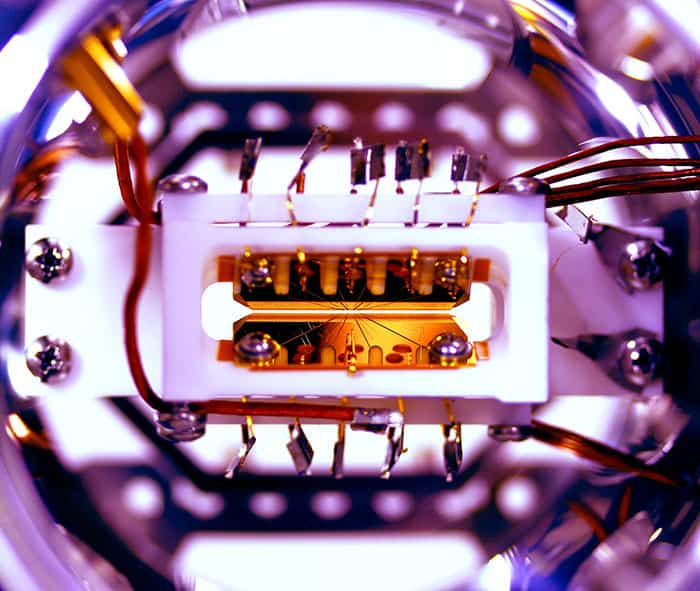
Different view: An ion trap with four segmented blade electrodes used to trap a liner chain of atomic ions for quantum-information processing. Each ion is addressed optically for individual control and read-out using the high optical access of the trap. (Courtesy: Shantanu Debnath and Emily Edwards)
The researchers implemented some quantum algorithms, to see how the system fared as their five qubits worked in tandem. They ran two simple quantum algorithms – the Deutsch-Jozsa and Bernstein-Vazirani algorithms – that perform mathematical functions in a single step. While these can easily be performed on a normal computer, it would take several operations. They also ran a quantum Fourier transformation (QFT), which is a fundamental step in other more complex algorithms. “The QFT involves two-qubit gates between all possible pairs of qubits, and it has never been demonstrated,” says Monroe. Debnath says that it is “a very useful protocol used in the Shor’s factorization and a variety of other phase-estimation problems”, adding that these algorithms “show the flexibility of the processor as a programmable device”.
Atomic perfection
According to Monroe, trapped-ion qubits are more flexible as compared with their solid-state counterparts – they can be replicated and scaled up with negligible variation from qubit to qubit, and can be externally reconfigured using lasers and their quantum states can be initialized and read out with near 100% accuracy. Their downside though, is that they perform a quantum operation relatively slowly (gate times of microseconds or longer). And, as with most quantum systems, the usual challenge “is making sure that the ‘quantumness’ is well preserved as the system is scaled to more qubits”, says Debnath.
More problematic though is the fact that the practical engineering of trapped-ion qubits lags behind that of silicon and solid-state platforms because there are very few industrial companies that make these ionic devices, according to Monroe. “Sandia National Laboratories is one of the few places that manufacture monolithic chips with microfabricated electrodes for the reliable loading and trapping of atomic ions, and the future of this technology will depend upon Sandia and other places like Honeywell, Inc. to produce more varieties of these chips”, says Monroe.
He adds that his Maryland group has been aided by the fact that it uses a particular atomic species of ytterbium (171Yb+) that is also used for atomic clocks, and the control laser they use is industrially produced and has been reliably engineered. “The ion-trap community is dominated by university and federal research laboratories, with students and postdocs instead of professional systems-engineering staff. It can take many years to obtain the infrastructure to get these devices to work reliably and repeatedly.” Despite these issues, Monroe, Debnath and the team are convinced that ion-trap computing has the potential to be scaled up – both by increasing the number of qubits as well as by increasing connectivity between qubits by using photons – to a fully fledged quantum computer.
A room-temperature “supercurrent” has been identified in a Bose–Einstein condensate of quasiparticles called magnons. That’s the finding of an international team of researchers, which says the work opens the door to using magnons in information processing. Other researchers, however, believe the claim is premature, arguing that less-novel explanations have not been ruled out.
The term “supercurrent” describes the resistance-free current of charged particles in superconductors. It also describes the viscosity-free current of particles in superfluid helium. The common denominator of these systems is that they can be described as Bose–Einstein condensates (BECs) – collections of bosons, such as Cooper pairs or Helium-4, that can be described by a single wavefunction.
Frictionless flow
In such systems, the frictionless particles flow continuously. What causes the particles to move is not some external force – supercurrents endure without needing any input force to drive them. Instead, the flow is caused by a gradient in the phase of the BEC wavefunction. Previously, all examples of supercurrents have been at cryogenic temperatures. That’s because heat tends to excite particles into higher quantum states, which would destroy a BEC. The collection of particles would no longer be described by a single wavefunction, which would make macroscopic quantum phenomena such as supercurrents impossible.
In 2006, however, a team led by Sergej Demokritov at the University of Münster and Burkard Hillebrands of the University of Kaiserslautern, both in Germany, made a breakthrough that would pave the way for the new result reported here. The team showed that it is possible to create a BEC of magnons – quasiparticles which are quanta of electron-spin waves – at room temperature. To do this, the researchers applied a process called parametric pumping to a crystal film of yttrium iron garnet – a technique that injected magnons into the crystal’s ground state. They found that, when the magnon density became sufficiently high, the magnons formed a BEC.
Room-temperature first
In the new research, Hillebrands and colleagues produced such a magnon BEC, then heated its centre using a laser pulse. By changing the duration of the pulse, the researchers could alter the temperature difference they created between the laser-lit spot and the rest of the material. The purpose of the heating was to affect the magnetic properties of the material, and so affect the phase of the wavefunction governing the BEC.
The researchers observed the movement of magnons away from the heated region, and found that the magnitude of this flow increased with the temperature difference. Theoreticians in Ukraine and Israel constructed mathematical models of this flow, and believe that it can only be explained by the existence of a magnon supercurrent. “When we first saw it, we didn’t understand it,” says Hillebrands. “Fortunately, we have a very good team including top-level theoreticians.”
The researchers suggest that, in addition to fundamental scientific interest, the work could potentially lead to real-world applications. They say that they have opened the door to using room-temperature magnons for information storage and processing. “If we can now move this into a device where a macroscopic quantum state can be used, then for the future this looks very promising,” says Hillebrands. “This is at the very beginning – I cannot promise a device yet, but it is certainly very worthwhile to look into this new field.”
Insufficient evidence?
Demokritov, however – who was involved in the 2006 work but not this latest research – is sceptical that the researchers have genuinely observed a supercurrent. He believes the researchers have insufficient evidence that the flow is not simply due to the parametric pumping adding energy into the system. He offers the example of a magnetic stirrer, in which a rotating magnetic field turns a bar to stir a fluid. “If you looked at this, and you saw the fluid was rotating persistently, you might say that you had superfluidity at room temperature,” he says. “Of course, this would definitely not be the case because the energy would be brought to the system by the rotating magnetic field underneath the glass. I am afraid, unfortunately, that that is the case here.”
Demokritov also claims that his own team had better experimental evidence for a supercurrent – reported in 2012 in Scientific Reports – than that presented by Hillebrands and colleagues. “We were not so brave as to call it a supercurrent because the issue of dissipation is still open,” he says.
Demokritov is not the only sceptic. In July, physicist Edouard Sonin, at the Hebrew University of Jerusalem, Israel, published a comment on the arXiv preprint server in response to Hillebrands and colleagues’ paper, a pre-print of which was also first posted to the arXiv. He wrote that their pre-print “has not provided persuasive evidence of spin supercurrent” and that the authors neither checked the criteria for existence of a spin supercurrent in yttrium-iron-garnet magnetic films, nor did they discuss the “more natural scenario” that spin transport in their experiment was purely due to dissipation.
Hillebrands maintains that standard magnon-dissipation processes cannot properly explain the phenomena that his group have observed, although he concedes that they “still need to prove” that the flow is completely free of dissipation.
When two atoms are placed in a small chamber enclosed by mirrors, they can simultaneously absorb a single photon. So says an international team of researchers, which has found that the reverse process – two excited atoms emitting a single photon – is also possible. According to the team, this process could be used to transmit information in a quantum circuit or computer.
Physicists have long known that a single atom can absorb or emit two photons simultaneously. These two-photon, one-atom processes are widely used for spectroscopy and for the production of entangled photons used in quantum devices. However, Salvatore Savasta of the University of Messina in Italy, together with colleagues at the RIKEN Institute in Japan, wondered if two atoms could absorb one photon. Savasta asked his PhD student at the time, Luigi Garziano, to simulate the process. When Garziano’s simulation showed that the phenomenon was possible, Savasta was so excited that he “punched the wall,” he told physicsworld.com.
One for two?
Their simulation found that the phenomenon occurs when the resonant frequency of the optical cavity containing the atoms is twice the transition frequency of an individual atom. For example, in a cavity whose resonant frequency is three times that of the atomic transition, three atoms can simultaneously absorb or emit a single photon. The optical-cavity’s dimensions are determined by this resonant frequency, which must be a standing wave. According to the researchers’ calculations, the two atoms would oscillate back and forth between their ground and excited states. Indeed, the atoms would first jointly absorb the photon, ending up in their excited states, before jointly emitting a single photon to return to their ground states. The cycle would then repeat. In addition, they found that the joint absorption and emission can occur with more than just two atoms.
Quantum switch
A two-atom, one-photon system could be used as a switch to transmit information in a quantum circuit, Savasta says. One atom would act as a qubit, encoding information as a superposition of the ground and excited states. To transmit the information outside of the cavity, the qubit would need to transfer the information to a photon in the cavity. The second atom would be used to control whether the qubit transmits the information. If the second atom’s transition frequency is tuned to half the resonance frequency of the cavity, the two atoms could jointly absorb and emit a single photon, which would contain the encoded information to be transmitted. To ensure that the atoms do not re-adsorb the photon, the atom’s resonant frequency can be changed by applying an external magnetic field.
Savasta’s group has begun to look for experimental collaborators to produce its theoretical prediction in the lab. While the experiment could be performed using actual atoms, Savasta plans to use artificial atoms: superconducting particles that have quantized energy levels and behave analogously as atoms, but whose transition energies can be more easily tuned by the experimentalist. In addition, controlling real atoms involves expensive technology, while artificial atoms can be created cheaply on solid-state chips. “Real atoms are only good for proof-of-principle experiments,” he says.
Savasta anticipates that their collaborators will be able to successfully perform the experiment in about a year. “We think that, especially if using superconducting qubits, that this experiment is well within the reach of present technology,” he says.
According to Tatjana Wilk at the Max Planck Institute for Quantum Optics in Garching, who was not involved in the current research, speaking to the American Physical Society’s Physics Focus, she cautions that the excited states of the atoms may not last long enough to be useful in an actual quantum device.
For nearly a decade, British commuters who read the free newspaper Metro on their way to work could regularly expect a shot of science with their morning coffee. The man responsible for this was Ben Gilliland, a graphic designer whose weekly “MetroCosm” science column began in 2005 and ran until mid-2014, when Metro’s chieftains made the much-derided decision to cancel the popular feature (it was eventually replaced with excerpts from New Scientist magazine). Now, after a gap of many months, commuters who miss Gilliland’s scientific stylings can finally get their fix.
Science But Not As We Know It is essentially MetroCosm in book form: a series of short, graphics-heavy summaries of scientific ideas, heavily skewed towards space, physics and astronomy and usually printed on a sharp black background. The main thing that’s changed is that the book format allows Gilliland to group his explanations loosely together by theme, with topics such as “How big is the universe?” and “Mercury’s secrets” classed under “Mysterious Universe” while “The story of the atom” and “Higgs boson: a bluffer’s guide” appear in “Teeny, Tiny, Super-Small Stuff”. Clearly, physicists aren’t the main audience here, but the book would make a great gift for a science-mad pre-teen, and those who work on public outreach may well be inspired by Gilliland’s tireless enthusiasm for communicating big ideas.
Mathematical footprint: Using crime investigations to make numbers come alive. (Courtesy: iStock/TPopova)
As detectives go, Freddy Carmichael isn’t exactly hard-boiled. Sure, he used to work as a private investigator in New York City, but ever since he moved out of the big smoke and into the sunny Los Angeles guesthouse of a sports-mad couch potato called Pete Lennox, it seems like all cases have revolved around…mathematics problems. Naturally, there is a simple explanation for this: Freddy and Pete are the main characters in LA Math, an ingenious attempt to blend detective fiction with mathematical instruction written by James D Stein, an emeritus professor of mathematics at California State University, Long Beach.
Stein’s hybrid series of tales shows Freddy and his slovenly sidekick Pete using a range of mathematical tricks to solve whatever crimes come their way. A case of suspected embezzlement at the city council is resolved with a discussion of percentages. A potentially nasty dispute between LA’s biggest bookies gets cleared up with a bit of probability theory. The mystery surrounding the book’s lone murder – of an heiress who tries to write her killer’s name in blood before she expires – becomes crystal-clear thanks to Pete’s knowledge of compound interest.
The mathematics involved is fairly light (the book’s title refers to “liberal arts” as well as Los Angeles), and so are the detective stories in it in it; despite the book’s noir-ish cover, there is very little gore or grit here and Stein’s style owes more to Rex Stout’s Nero Wolfe tales than to modern crime dramas. Still, the stories are fun and the lengthy mathematical appendices linked with each chapter ensure that you’ll pick up a couple of new tricks.
2016 Princeton University Press £18.95/$24.95hb 256pp
Over the past year the world’s computers, mobile phones and other devices generated some 12 zettabytes of data. And by 2020 that number is predicted to rise to 44 zettabytes – nearly as many bits as there are stars in the universe.
In the August 2016 issue of Physics World magazine – now live in the Physics World app for mobile and desktop – Harald Haas from the University of Edinburgh in the UK explains how the humble household light bulb could soon be transformed into the backbone of a revolutionary new wireless communications network based on visitible light.
Known as “LiFi”, the system could not only contribute to next-generation 5G mobile-phone systems, but also unlock the potential of the “Internet of things”, create”smart” cities, help with the introduction of driverless cars and offer new ways to monitor the health of old people. You can also read the article here.
The August issue also shows how neutrons could help in the search for new drugs, why we need to solve the ethical dilemmas surrounding space mining, and how physicists are helping to save daguerreotype photographs from decay. Don’t miss either our look at the impact of Brexit on European physics.
Over the past year the world’s computers, mobile phones and other devices generated an estimated 12 zettabytes (1021 bytes) of information. By 2020 this data deluge is predicted to increase to 44 zettabytes – nearly as many bits as there are stars in the universe. There will also be a corresponding increase in the amount of data transmitted over communications networks, from 1 to 2.3 zettabytes. The total mobile traffic including smartphones will be 30 exabytes (1018 bytes). A vast amount of this increase will come from previously uncommunicative devices such as home appliances, cars, wearable electronics and street furniture as they become part of the so-called “Internet of Things”, transmitting some 335 petabytes (1015 bytes) of status information, maintenance data and video to their owners and users for services such as augmented reality.
In some fields, this data-intensive future is already here. A wind turbine, for example, creates 10 terabytes of data per day for operational and maintenance purposes and to ensure optimum performance. But by 2020 there could be as many as 80 billion data-generating devices all trying to communicate with us and with each other – often across large distances, and usually without a wired connection.
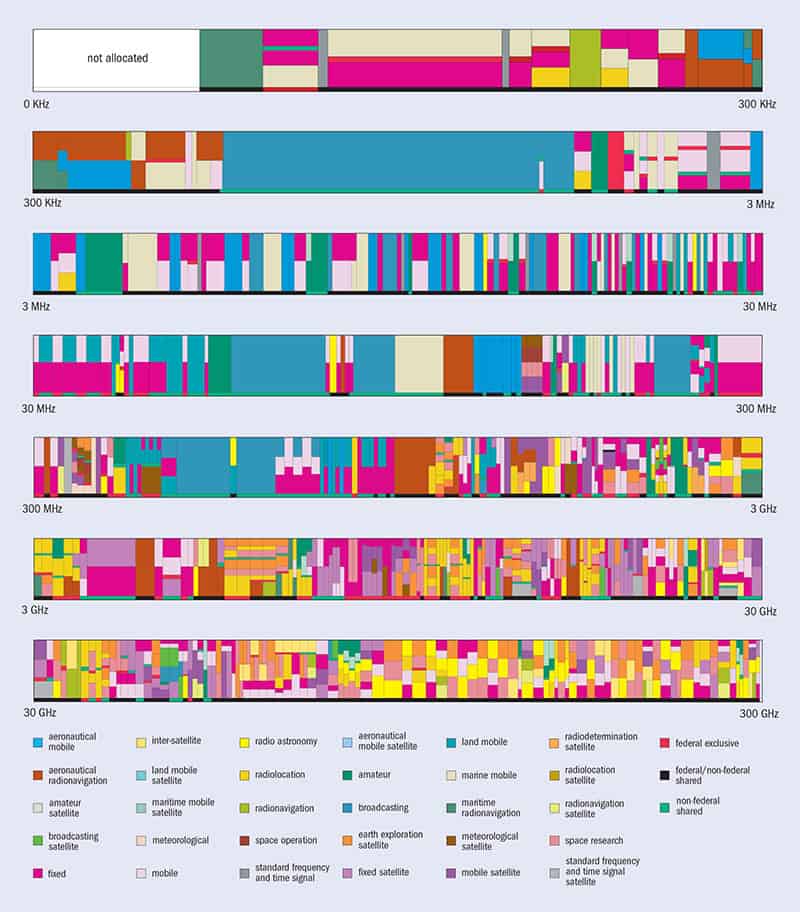
1 A crowded field The radio-frequency spectrum (3 kHz to 300 GHz) in the US has been allocated to various wireless services. Most of the spectrum is already ‘full’ and in many cases the same frequency band is used for multiple services. Visible light (430–770 THz) could be an alternative way of transmitting data wirelessly.
So far, the resources required to achieve this wireless connectivity have been taken almost entirely from the radio frequency (RF) part of the electromagnetic spectrum (up to 300 GHz). However, the anticipated exponential increase in data volumes during the next decade will make it increasingly hard to accomplish this with RF alone. The RF spectrum “map” of the US is already very crowded (figure 1), with large chunks of frequency space allocated to services such as satellite communication, military and defence, aeronautical communication, terrestrial wireless communication and broadcast. In many cases, the same frequency band is used for multiple services. So how are we going to accommodate perhaps 70 billion additional communication devices?
At this point it is helpful to remember that RF is only one small part of the electromagnetic spectrum. The visible-light portion of the spectrum stretches from about 430 to 770 THz, more than 1000 times the bandwidth of the RF portion. These frequencies are seldom used for communication, even though visible-light-based data transmission has been successfully demonstrated for decades in the fibre-optics industry. The difference, of course, is that the coherent laser light used in fibre optics is confined to cables rather than being transmitted in free space. But might it be possible to exploit the communication potential of the visible-light region of the spectrum while also benefitting from the convenience and reach of wireless RF?
With the advent of high-brightness light-emitting diodes (LEDs), I believe the logical answer is “yes”. Using this new “LiFi” system (a term I coined in a TED talk in 2011), it will be possible to achieve high-speed, secure, bi-directional and fully networked wireless communications with data encoded in visible light. In a LiFi network, every light source – a light bulb, a street lamp, the head and/or tail light of a car, a reading light in a train or an aircraft – can become a wireless access point or wireless router like our WiFi routers at home. However, instead of using RF signals, a LiFi network modulates the intensity of visible light to send and receive data at high speeds – 10 gigabits per second (Gbps) per light source are technically feasible. Thus, our lighting networks can be transformed into high-speed wireless communications networks where illumination is only a small part of what they do.
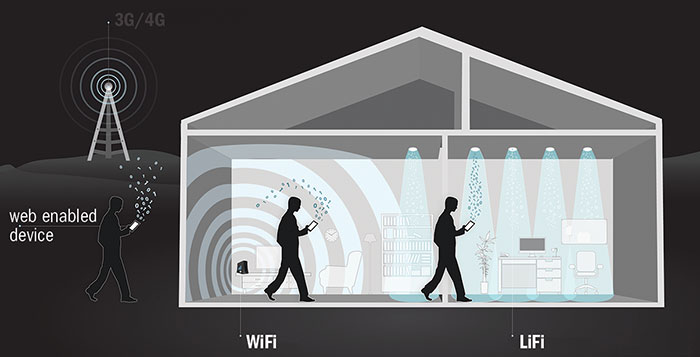
The ubiquitous nature of light sources means that LiFi would guarantee seamless and mobile wireless services (figure 2). A single LiFi access point will be able to communicate to multiple terminals in a bi-directional fashion, providing access for multiple users. If the terminals move (for example, if someone walks around while using their phone) the wireless connection will not be interrupted, as the next-best-placed light source will take over – a phenomenon referred to as “handover”. And because there are so many light sources, each of them acting as an independent wireless access point, the effective data rate that a mobile user will experience could be orders of magnitude higher than is achievable with current wireless networks. Specifically, the average data rate that is delivered to a user terminal by current WiFi networks is about 10 megabits per second; with a future LiFi network this can be increased to 1 Gbps.
2 Data delights Within the LiFi network, every LED light source acts as an access point for wireless multiuser communication. The high density of light sources makes it possible to achieve orders of magnitude improvements in data density compared to current systems. This LiFi network would complement existing RF-based networking technologies such as WiFi.
This radically new type of wireless network also offers other advantages. One is security. The next time you walk around in an urban environment, note how many WiFi networks appear in a network search on your smartphone. In contrast, because light does not propagate through opaque objects such as plastered walls, LiFi can be much more tightly controlled, significantly enhancing the security of wireless networks. LiFi networks are also more energy efficient, thanks to the relatively short distance between a light source and the user terminal (in the region of metres) and the relatively small coverage area of a single light source (10 m2 or less). Moreover, because LiFi piggybacks on existing lighting systems, the energy efficiency of this new type of wireless network can be improved by three orders of magnitude compared with WiFi networks. A final advantage is that because LiFi systems don’t use an antenna to receive signals, they can be used in environments that need to be intrinsically safe such as petrochemical plants and oil-drilling platforms, where a spark to or from an antenna can cause an explosion.
LiFi misconceptions
A number of misconceptions commonly arise when I talk to people about LiFi. Perhaps the biggest of these is that LiFi must be a “line-of-sight” technology. In other words, people assume that the receiver needs to be directly in line with the light source for the data connection to work. In fact, this is not the case. My colleagues and I have shown that for a particular light-modulation technology, the data rate scales with the signal-to-noise ratio (SNR), and that it is possible to transmit data at SNRs as low as –6 dB. This means LiFi can tolerate signal blockages between 46 and 66 dB (signal attenuation factors of 40,000 – 4 million). This is important because in a typical office environment where the lights are on the ceiling and the minimum level of illumination for reading purposes is 500 lux, the SNR at table height is between 40 and 60 dB, as shown by Jelena Grubor and colleagues at the Fraunhofer Institute for Telecommunications in Berlin, Germany (2008 Proceedings of the 6th International Symposium Communication Systems, Networks and Digital Signal Processing 165). In our own tests we transmitted video to a laptop over a distance of about 3 m. The LED light fixture was pointing against a white wall, in the opposite direction to the location of the receiver, therefore there was no direct line-of-sight component reaching the receiver, yet the video was successfully received via reflected light.
Another misconception is that LiFi does not work when it is sunny. If true, this would be a serious limitation, but in fact, the interference from sunlight falls outside the bandwidth used for data modulation. The LiFi signal is modulated at frequencies typically greater than 1 MHz, so sunlight (even flickering sunlight) can simply be filtered out, and has negligible impact on the performance as long as the receiver is not saturated (saturation can be avoided by using algorithms that automatically control the gain at the receiver). Indeed, my colleagues and I argue that sunlight is hugely beneficial for LiFi, as it is possible to create solar-cell-based LiFi receivers where the solar cell acts as a data receiver device at the same time as it converts sunlight into electricity.
A third misconception relates to the behaviour of the light sources. Some have suggested that the light sources used in LiFi cannot be dimmed, but in fact, sophisticated modulation techniques make it possible for LiFi to operate very close to the “turn on voltage” of the LEDs. This means that the lights can be operated at very low light output levels while maintaining high data rates. Another, related concern is that the modulation of LiFi lights might be visible as “flicker”. In reality, the lowest frequency at which the lights are modulated, 1 MHz, is 10,000 times higher than the refresh rate of computer screens (100 Hz). This means the “flicker-rate” of a LiFi light bulb is far too quick for human or animal eyes to perceive.
A final misconception is that LiFi is a one-way street, good for transmitting data but not for receiving it. Again, this is not true. The fact that LiFi can be combined with LED illumination does not mean that both functions always have to be used together. The two functions – illumination and data – can easily be separated (note my previous comment on dimming), so LiFi can also be used very effectively in situations where lighting is not required. In these circumstances, the infrared output of an LED light on the data-generating device would be very suitable for the “uplink” (i.e. for sending data). Because infrared sensors are already incorporated into many LED lights (as motion sensors, for example), no new technology would be necessary, and sending a signal with infrared requires very little power: my colleagues and I have conducted an experiment where we sent data at a speed of 1.1 Gbps over a distance of 10 m using an LED with an optical output power of just 4.5 mW. Using infrared for the uplink has the added advantage of spectrally separating uplink and downlink transmissions, avoiding interference.
Nuts and bolts
Now that we know what LiFi can and cannot do, let’s examine how it works. At the most basic level, you can think of LiFi as a network of point-to-point wireless communication links between LED light sources and receivers equipped with some form of light-detection device, such as a photodiode. The data rate achievable with such a network depends on both the light source and the technology used to encode digital information into the light itself.
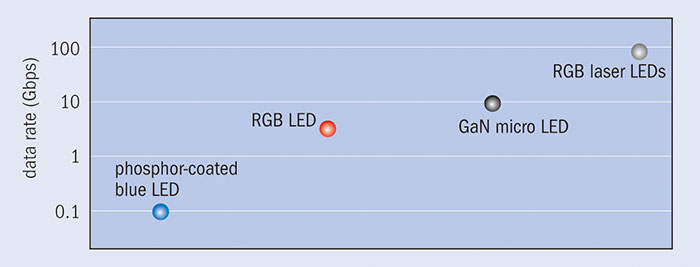
First, let’s consider the available light sources. Most commercial LEDs have a blue high-brightness LED with a phosphorous coating that converts blue light into yellow; the blue light and yellow light then combine to produce white light. This is the most cost-efficient way to produce white light today, but the colour-converting material slows down the light’s response to intensity modulation, meaning that higher frequencies (blue light) are heavily attenuated. Consequently, the light intensity from this type of LED can only be modulated at a fairly low rate, about 2 MHz. It is also not possible to modulate the individual spectral components (red, green and blue) of the resulting white light; all you can do is vary the intensity of the composite light spectrum. Even so, one can achieve data rates of about 100 Mbps with these devices by placing a blue filter placed at the receiver to remove the slow yellow spectral components.
More advanced red, green and blue (RGB) LEDs produce white light by mixing these base colours instead of using a colour-converting chemical. This eases the restrictions on modulation rates, making it possible to achieve data rates of up to 5 Gbps. In addition, one can encode different data onto each wavelength (a technique known as wavelength division multiplexing), meaning that for an RGB LED there are effectively three independent data channels available. However, because they require three separate light sources, these devices are more expensive than single blue LEDs.
3 Faster, brighter, longer A comparison of the various currently available light-emitting diode (LED) technologies and the corresponding achievable LiFi data rates.
A third alternative – gallium-nitride micro LEDs – are small devices that achieve very high current densities, with a bandwidth of up to 1 GHz. Data rates of up to 10 Gbps have recently been demonstrated with these devices by Hyunchae Chun and colleagues (2016 Journal of Lightwave Technology, in press). This type of LED currently is a relatively poor source of illumination compared with phosphor-coated white LEDs or RGB LEDs, but it would be ideal for uplink communications – for example, in an Internet of Things where an indicator light on an oven is capable of sending data to a light bulb in the ceiling – and in the future we may also see these devices in a light bulb due to rapid technology enhancements.
Lastly, white light can also be generated with multiple colour laser diodes combined with a diffuser. This technology may be used in the future for lighting due to the very high efficiency of lasers, but currently its cost is excessive and technical issues such as speckle have to be overcome. However, my University of Edinburgh colleagues Dobroslav Tsonev, Stefan Videv and I have recently demonstrated a white light beam of 1000 lux covering 1 m2 at a distance of 3 m, and the achievable data rate for this scenario is 100 Gbps (2015 Opt. Express23 1627).
As for the modulation, my group at Edinburgh has been pioneering a digital modulation technique called orthogonal frequency division multiplexing (OFDM) for the past 10 years. The principle of OFDM is to divide the entire modulation spectrum (that is, the range of frequencies used to change the light intensity into modulated data) into many smaller frequency bins. Some of these frequencies are less attenuated than others (due to the nature of the propagation channel and LED and photodetector device characteristics), and information theory tells us that the less-attenuated frequency bins are able to carry more information bits than those that are more attenuated. Hence, the dividing of the spectrum into many smaller bins allows us to “load” each individual bin with the optimum number of information bits. This makes it possible to achieve higher data rates than one gets with more traditional modulation techniques, such as on– off keying.
These high data rates make it easier to adapt to varying propagation channels, where the frequency bin attenuation changes with location – something that is important for a wireless communications system. The whole process can be compared to an audio sound equalizer system that individually adjusts low frequencies (bass), middle frequencies and high frequencies (treble) to suit a particular optimum sound profile, independent of where the listener is in the room. My former students Mostafa Afgani and Hany Elgala, together with me and my colleague Dietmar Knipp, have demonstrated what is, to the best of our knowledge, the first OFDM implementation for visible light communication (2006 IEEE Tridentcom129).
The bright future
LiFi is a disruptive technology that is poised to affect a large number of industries. Most importantly, I expect it to catalyse the merger of wireless communications and lighting, which are at the moment entirely separate businesses. Within the lighting industry, the concept of light as a service, rather than a physical object you buy and replace, will become a dominant theme, requiring industry to develop new business models to succeed in a world where individual LED lamps can last more than 20 years. In combination with LiFi, therefore, light-as-a-service will pull the lighting industry to enter what has traditionally been a wireless communications market.
In terms of how it affects daily life, I believe LiFi will contribute to the fifth generation of mobile telephony systems (5G) and beyond. As the Internet of Things grows, LiFi will unlock its potential, making it possible to create “smart” cities and homes. In the transport sector, it will enable new intelligent transport systems and enhance road safety as more and more driverless cars begin operating. It will create new cyber-secure wireless networks and enable new ways of health monitoring in ageing societies. Perhaps most importantly, it will offer new ways of closing the “digital divide”; despite considerable advances, there are still about four billion people in the world who cannot access the Internet. The bottom line, though, is that we need to stop thinking of light bulbs as little heaters that also provide light. In 25 years, my colleagues and I believe that the LED light bulb will serve thousands of purposes, not just illumination.



 By Matin Durrani