APS launches LGBT Climate in Physics report

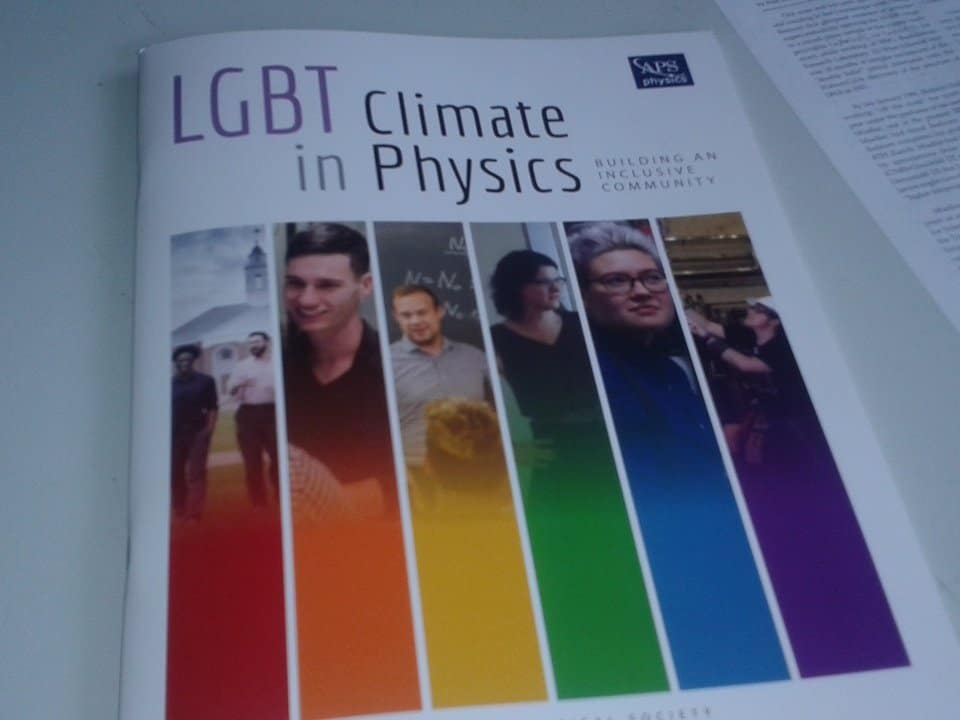
Cover of the American Physical Society's BT Climate in Physics report launched at the APS March meeting

By Matin Durrani in Baltimore, Maryland, US

I’ve been thinking a lot recently about the make-up of the physics community, particularly as this month saw Physics World publish a special issue, “Physics for all: building a more inclusive discipline”, that examined ways to make physics as welcoming as possible for everyone. It looked, for example, at “microaggressions” in physics, the role of unconscious bias and whether physics is just for people from better socioeconomic backgrounds.

One article that attracted particular attention – based on informal feedback and e-mails I’ve received since the issue came out – was “Where people and particles collide”. Written by my Physics World colleague Louise Mayor, it looks at what life’s like for gender and sexual minorities at the CERN particle-physics lab in Geneva and the challenges people there faced in setting up an official LGBT Cern Club. (There is still no such club, but CERN has set up an LGBT “informal network”.)

The issues facing gender and sexual minorities have also been a theme here at the APS March meeting, with the launch this morning of a new APS report LGBT Climate in Physics. The report is based on focus groups, a “climate survey” of more than 320 members of the US LGBT physics community, and follow-up interviews with five survey participants. A further 2596 members of the entire APS community replied to a separate survey, of whom 2.5% identified themselves as LGBT.

(more…)

Bacteria act as tiny lenses to move towards light

Microscopic organisms called cyanobacteria form tiny lenses similar to the human eye to detect light and move towards its source, an international team of scientists has found.

Cyanobacteria are single cell organisms that are similar to microbes that were around more than two-billion years ago, making them one of the longest continuous biological lineages. They are one of the largest groups of bacteria on Earth and are phototrophic, which means that they obtain energy from sunlight through photosynthesis. What’s more, the tiny microbes seek out sunlight and move towards it – a behaviour called phototaxis.

Illuminating question

“Phototaxis in cyanobacteria has been known for more than 50 years but it doesn’t look as though anyone else had really worried about the basic question of how the cell can get information on the direction of illumination,” explains lead researcher Conrad Mullineaux of Queen Mary University of London.

Mullineaux and his colleagues set out to study the phototaxis of the spherical cyanobacteria Synechocystis by observing its response to various light conditions. When exposed to a light source from one direction, the majority of the cells started moving towards the light within about a minute. When exposed to two equal-intensity light sources, from different directions, most of the cells moved to a point midway between the sources. This confirmed previous research, suggesting that Synechocystis can detect the position of a light source and control their movement accordingly.

We noticed the lensing effect more or less by accident
Conrad Mullineaux, Queen Mary University of London

The eureka moment came while the team was observing Synechocystis illuminated from one side. The researchers noticed something odd: the bacteria had an intense light spot on the opposite side of the cell from the light source and the direction of movement. Each cell seemed to be acting as a microscopic spherical lens focusing the light. Mullineaux says that although lensing is a very simple idea, “it never occurred to us, until we noticed the lensing effect more or less by accident”.

To test the idea that Synechocystis move away from the light spots towards the light source, the researchers used highly focused laser light. They found that when they created a light spot on one side of a bacterium, the cell moved in the opposite direction, away from the laser. “This shows that Synechocystis phototaxis is essentially a photophobic response to selective excitation of one side of the cell,” the researchers write.

Distinct patterns

Because the cyanobacteria have diameters of just 3 μm – about five times the wavelength of visible light – measuring the optical properties of the bacteria was challenging. Jan Gerrit Korvink and his team, at the Karlsruhe Institute of Technology in Germany, came up with a solution. They placed Synechocystis cells on a silicon disc coated in a photopolymer that hardens under light, and exposed them to ultraviolet light with a wavelength of 365 nm. Diffraction from the cells caused distinct patterns to form on the surface of the disc and these patterns were then characterized using atomic force microscopy.

“The light was found to be tightly focused on the back plane of a bacterium,” explains Korvink, adding that the spot had a diameter “smaller than the wavelength of the incoming light”. The team also modelled the optical properties of the cell and this showed that the cyanobacteria have a refractive index of 1.4 (see image). “What we don’t know is whether this value varies through the thickness of a bacterium,” Korvink explains. “That would have additional consequences for the way light travels through these organisms.”

Mullineaux says that the optical properties of other microbes should now be studied in greater detail. He adds that while some organisms act as lenses, others could behave as microscopic optical fibres.

The study is described in the journal eLife.

Finding innovation in space

By Margaret Harris

I have a mental block about Carlton House Terrace. This elegant little street in central London is home to several of the UK’s national academies, including the Royal Society and the Royal Academy of Engineering (RAEng), and I’m sure I’ve visited it at least half a dozen times. Yet somehow, whenever I emerge from Charing Cross underground station in the middle of Trafalgar Square, I never know which way to go next.

Fortunately, this is the 21st century, so when the usual disorientation struck me yesterday on my way to an “Innovation in Space” event at the RAEng, I simply pulled out my smartphone. Within seconds, an app told me exactly where I was (plus or minus a few metres) and how to walk from there to 3 Carlton House Terrace. Minutes later, I was safely ensconced in the seminar room, nodding in agreement as the event’s chair, Sir Martin Sweeting, explained how space-related innovations – including, ahem, the network of satellites that make up the Global Positioning System (GPS) – have become an integral part of our daily lives.

(more…)

Steven Weinberg defends his ‘Whig’ view of history

By Matin Durrani in Baltimore, Maryland, US

I wasn’t planning on blogging about the talk that the Nobel-prize-winning physicist Steven Weinberg gave yesterday afternoon here at the APS March meeting. He’d been speaking about his recent book To Explain the World: the Discovery of Modern Science, which examines the history of physics from the ancient Greeks to the present day.

The book ruffled a fair few feathers when it was published last year, with historians and philosophers annoyed at Weinberg’s approach to history, which basically involves judging the past from the standpoint of the present. It’s known as the “Whig interpretation” of history and sees past events as a march towards enlightenment, ignoring dead-ends and blind alleys. It’s the history of winners, if you like.

I have probably mis-stated the criticisms of Weinberg book – I’m no historian – and that’s my point. I felt the arguments against his approach were too subtle and nuanced to fit in a blog. But I changed my mind this morning about covering the session Weinberg appeared in. Not only because the room where Weinberg gave his talk was full to bursting, with about 500 people present, but also because some of the things he said, which I Tweeted yesterday, were proving popular on Twitter. Clearly, people want to hear what Weinberg says – he’s a master of the soundbite – so here, for posterity, are a few of his thoughts.

Weinberg on whether he knew his book would prove controversial: “I knew from the start I was being naughty.”

Weinberg on his basic approach to the history of science: “We should avoid imagining the past is like the present.”

Weinberg on why the Whig interpretation is worthwhile: “If we don’t use the things we have learned, the story we tell has no point.”

Weinberg on what we should investigate as researchers: “The point of science is not to solve the science that happens to be fashionable in the day. It’s to find out about the world.”

Weinberg on whether aesthetics or ethics has a role in deciding which theories in physics one should pursue: “I don’t think ethics plays much of a role in physical science.”

Weinberg on the importance of absorbing new scientific knowledge even if it conflicts with what you believed before: “Finding out you are wrong is a refreshing experience that everyone should have.”

Aged 82, Weinberg has lost none of his showmanship or intellect, with the above being just a sprinkling of his many penetrating insights. He was invited to respond to each of the other speakers at the session in turn – historians David Wootton, Jamil Ragep and William Thomas, and science writer Jennifer Ouellette – and had pithy retorts and remarks to them all.

“I enjoyed very much the first half of your talk,” he told Wootton, for example – the unspoken implication being that the second half was complete rot (even if he didn’t say so).

Ouellette raised the fascinating question of what a Whig historian in 500 years’ time would make of science today? They might, she pointed out, follow the full story of how dark energy was discovered, but wouldn’t understand other questions like why certain projects, rather than others, were funded or supported.

What was clear from yesterday’s session is that Weinberg – one of the giant minds of physics – still, it seems, retains his curiosity, appetite and love of of the subject. And it was great to see him in full flow, even for those who disagree with him.

The everyday physics of knitting, ribbon-curling and more

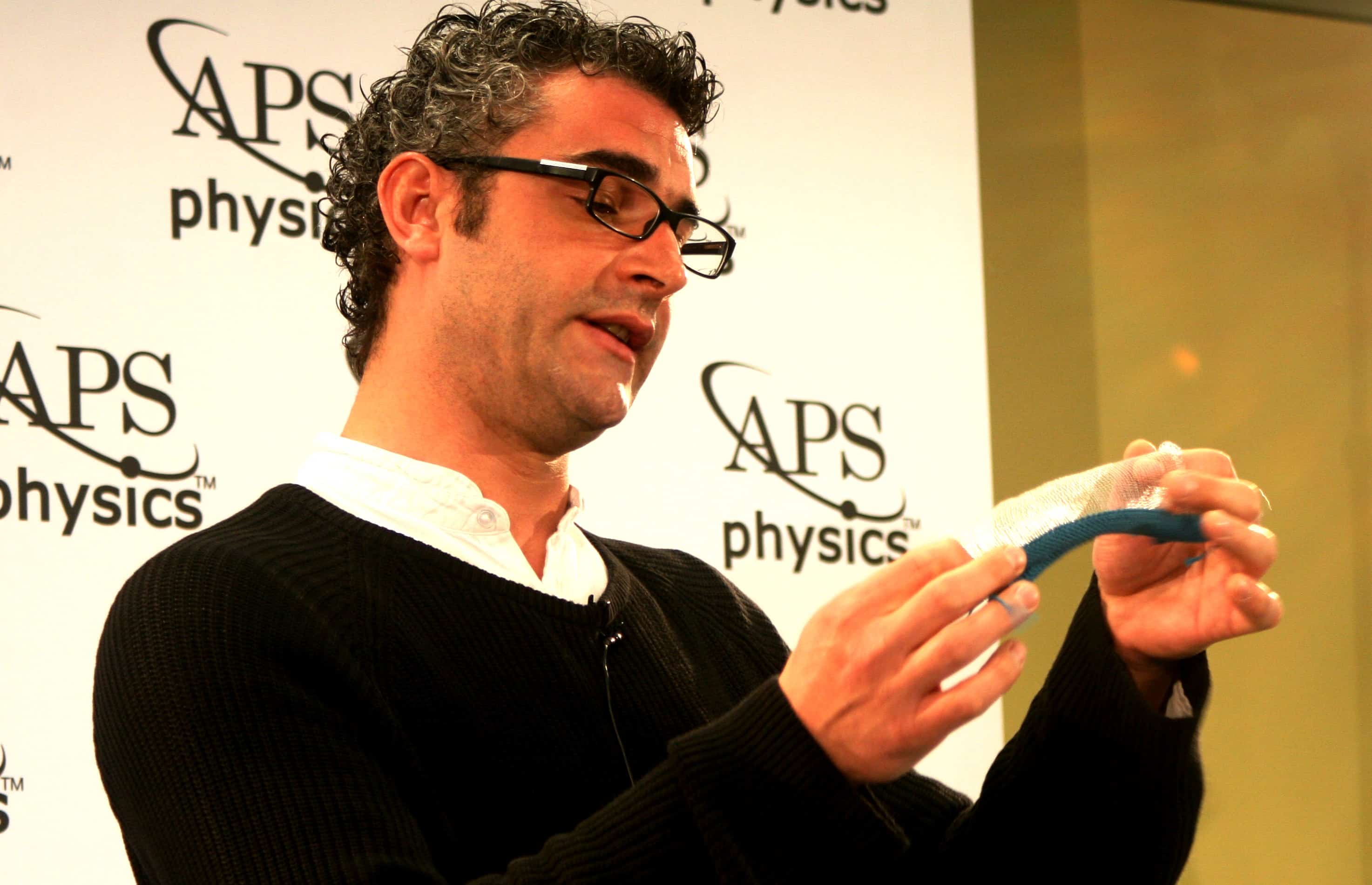
Frédéric Lechenault talked about the physics of knitted materials

By Tushna Commissariat in Baltimore, Maryland, US

You may think that a simple occurrence such as a tree shedding its leaves or an everyday activity such as knitting or ribbon-curling does not involve a great deal of physics, but you would be wrong. In a press session here at the APS March meeting entitled “The physics of everyday life”, three different groups of researches talked about the unexpectedly complex physical principles that govern all of the above mentioned instances.

Sunny Jung of the Bio-Inspired Fluid Lab at Virginia Tech in the US studies the shapes of different leaves and the thickness of their “petioles” or stalks – both of which determine the stresses a leaf can withstand on a windy day and what happens when it ultimately falls. Jung’s team studies this because leaves are actually very good at withstanding all kinds of stress and strain without buckling – something that could be applied to large man-made industrial objects such as suspended road-signs.

The researchers found that slender leaves are more likely to bend under high winds, whereas a flat leaf is more likely to twist at the stem before falling.  They also discovered that the length of the stalk is determined by the size of the leaf, with larger leaves needing longer stems so that sunlight can cover more of their surface area.

(more…)

Cutting the fat from chocolate

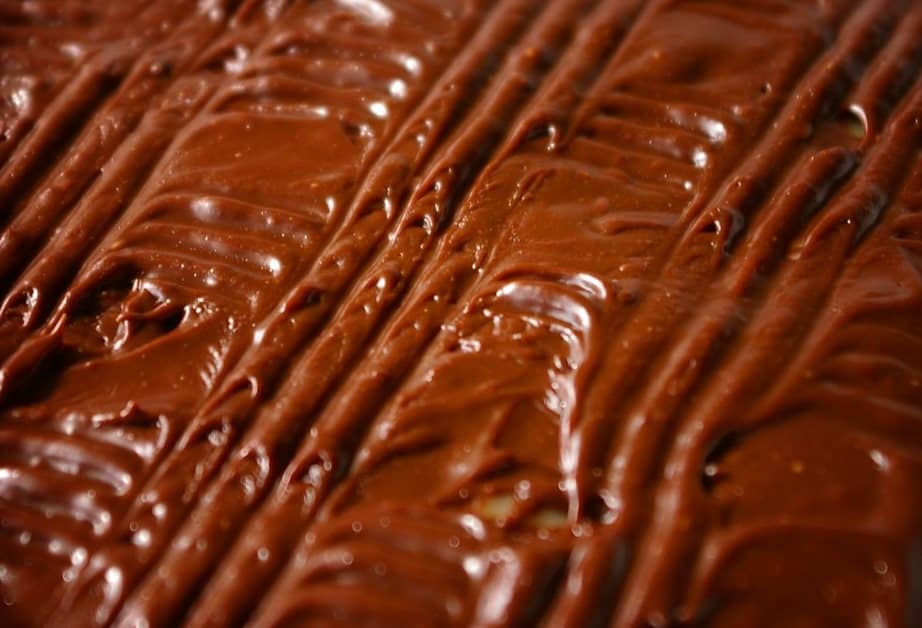
A photograph of chocolate

By Matin Durrani in Baltimore, Maryland, US

A couple of years ago my colleague James Dacey decided to give up eating chocolate, crisps, biscuits and cakes over Lent and it’s a virtuous – if very dull – decision I’ve been following every year since (even if James has long since strayed from the path of righteousness).

It was therefore with a dollop of smug satisfaction that I attended a talk at this year’s APS March meeting by Rongjia Tao – a physicist from Temple University in the US. He has developed a way of cutting the amount of fat in chocolate without, apparently, losing any of the taste.

Now, reducing the fat content in chocolate might seem straightforward – you just get rid of the fat, right? But it’s a harder problem than you’d think for chocolate manufacturers, who have to send liquid chocolate – a suspension of spherical cocoa particles in a melted fat of cocoa butter and other oils – down pipes and tubes.

(more…)

Would you encourage your grandchildren into condensed-matter physics?

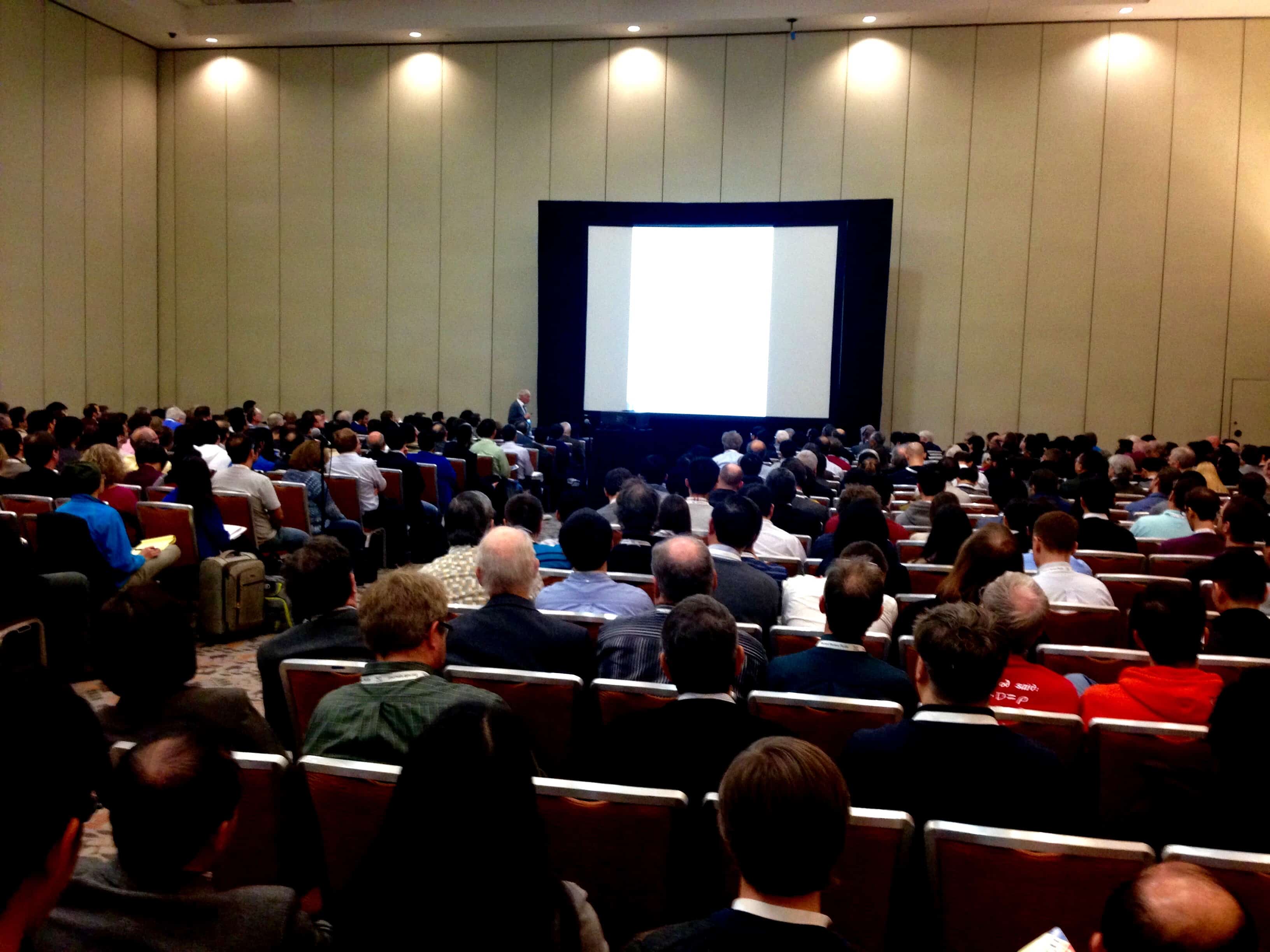
A packed room for Sir Anthony's talk at APS March 2016

By Tushna Commissariat in Baltimore, Maryland, US

One of the most popular talks this morning at the APS March meeting was almost certainly given by Nobel-prize-winning physicist Anthony Leggett of the University of Illinois at Urbana-Champaign in the US.  Leggett, who shared the 2003 Nobel Prize for Physics for his work on superconductors and superfluids, talked about his “Reflections on the past present and future of of condensed-matter physics”.

As the abstract of his talk suggests, Leggett looked at the ways, means and even the very definition of “condensed-matter physics” has changed and “evolved since its inception in the early 20th century, with particular reference to its relationship to neighbouring and even distant disciplines”. He went on to “speculate on some possible directions in which the discipline may develop over the next few decades, emphasizing that there are still some very basic questions to which we currently have no satisfactory answers”.

I missed the beginning of his talk as I was attending the morning’s first set of press briefings (more on those later) but when I did walk into the packed hall for his talk, his slide had the rather interesting title: “Would I encourage my grandchildren to go into condensed-matter physics?” Happily enough, his answer at the end of his talk was a resounding “yes”.

(more…)

Mission to Mars launches in search of signs of life

A joint European and Russian probe to study the atmosphere and surface of Mars has successfully launched today from the Baikonur Cosmodrome in Kazakhstan. The Trace Gas Orbiter (TGO) – a collaboration between the European Space Agency (ESA) and the Russian space agency Roscosmos – also includes the entry, descent and landing demonstrator module (EDM) that will test landing techniques for a future Mars rover.

When the TGO arrives at Mars following a seven-month journey, it will initially stay in a highly elliptical orbit until January 2017. ESA scientists will then use “aerobraking” – taking advantage of the planet’s atmosphere to slow the spacecraft down – to manoeuvre the TGO into a more circular orbit with an altitude of 400 km. “We do not know exactly how long aerobraking will take because this depends on how effectively we can use atmospheric drag,” Jorge Vago, project scientist for the mission, told physicsworld.com.

Researchers expect TGO’s scientific mission to begin in December 2017, when it will then operate for five years. Carrying four instruments including spectrometers, high-resolution cameras and a neutron detector, the TGO will map Mars for sources of methane, which could be evidence for possible biological or geological activity. The mission will also chart hydrogen below Mars’s surface up to a depth of around 1 m. This could, for example, reveal deposits of water-ice below the surface that could help to provide landing locations for future missions. Vago told physicsworld.com that observations with the TGO will be 1000 times better than previous missions.

Towards a Mars lander

The EDM, which is also known as Schiaparelli, will separate from the TGO three days before arriving at Mars. It will then enter the planet’s atmosphere at 21,000 km per hour and decelerate using aerobraking before deploying a parachute. Finally, it will use a thruster to brake just before landing on the surface. During landing and while it is on the surface of Mars, the EDM will monitor the pressure and temperature as well as take images. The probe is expected to last a couple of days on the surface before its battery is drained.

The EDM will be particularly useful for the next part of the joint mission between ESA and Roscosmos. The ExoMars rover, which is due to launch in 2018, will carry a drill and a suite of instruments dedicated to exobiology and geochemistry research, searching for possible signs of life, characterizing the water and geochemical distribution of the surface, and identifying any hazards for future manned missions to the planet. The EDM will be a useful testing ground for the techniques to successfully land the ExoMars rover, while the TGO will be used to communicate with the rover once it is on the surface.

When one becomes two

Getting the ExoMars project off the ground has been far from straightforward. It was initially a European-only mission that consisted of a single rover. Then following budget struggles, ESA joined forces with NASA, with the mission expanded to include an orbiter. But in 2011, due to the need to fund the James Webb Space Telescope, the US pulled out amid tight budgets. ESA then approached Roscosmos, who agreed to join the mission in 2012 with the TGO and ExoMars rover being split into two separate missions.

  • Astrobiologist Lewis Dartnell of the University of Leicester explains how ExoMars will look for evidence of life on Mars in the podcast “Is there life on Mars?

Baltimore braces itself for physics

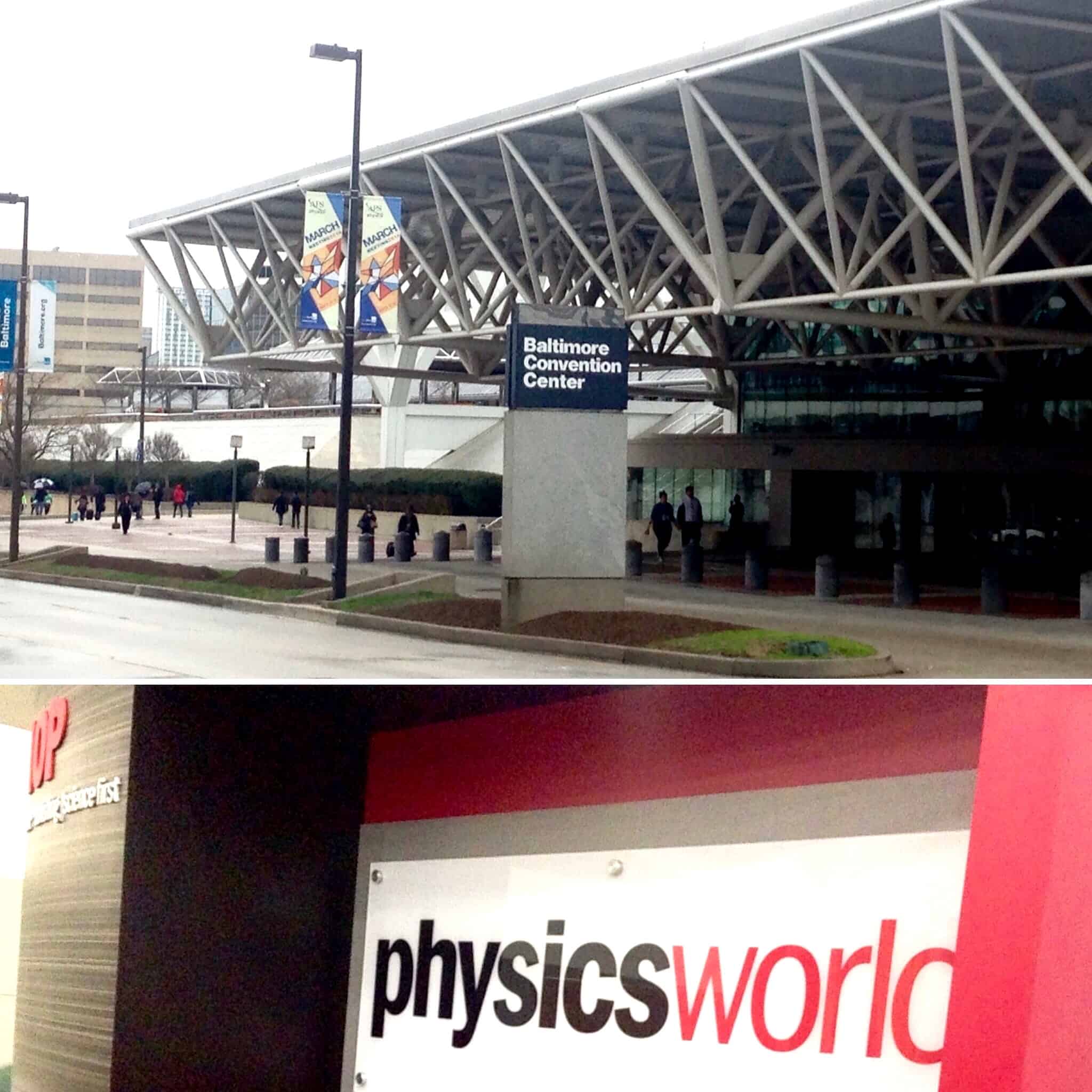
The APS March meeting at the Baltimoe Convention Center (top) and the IOP Publishing stand at the exhibition.

By Matin Durrani and Tushna Commissariat in Baltimore, Maryland, US

So here we are in Baltimore to attend the 2016 March meeting of the American Physical Society (APS). We’re writing this at the window seats in a burrito bar on Pratt Street while staring at the hulk that is the Baltimore Convention Center, where nigh-on 10,000 physicists will be congregating all week.

We’ve been playing a game of “spot the APS attendee” while tucking into our burritos. Without wishing to stereotype physicists (okay, go on then, we will) they’re the ones with the backpacks stuffed with poster tubes, pulling little trolley suitcases, looking lost before veering towards the convention centre.

There are also some physicists inside Chipotle Mexican Grill – you can tell because they’re huddled around laptops looking at PowerPoint presentations showing graphs of Fermi surfaces and topological insultators. Probably not the usual subject of discussion in here.

(more…)

Majorana ‘zero modes’ spotted in superconducting nanowires

An important property of Majorana quasiparticles has been measured for the first time by physicists at the Niels Bohr Institute in Denmark. They found evidence that electrons in tiny nanowires form entangled states that are highly isolated from noise and other external stimuli. Because they are protected from outside influences, these Majorana “zero modes” could be used as quantum bits (qubits) in quantum computers.

First predicted by the Italian physicist Ettore Majorana in 1937, the Majorana particle obeys “non-Abelian” statistics, which means that quantum information encoded in the particles would be highly resistant to decoherence. Decoherence is the bane of physicists who are trying to develop practical quantum computers, and so devices based on Majorana particles could be used in future quantum-information systems.

While physicists have yet to see isolated Majorana particles, some collective excitations of electrons in solids have the same properties as Majorana particles. These “Majorana quasiparticles” have already been glimpsed in several systems, including semiconductor nanowires coated in a superconducting layer. When these nanowires are cooled to near absolute zero, superconducting electrons can exist within the semiconductor. An electron in the wire becomes entangled with electrons on either side of it, creating an uninterrupted chain of entangled electrons along the entire length of the wire.

Electron halves

At either end of this chain are electrons that are entangled only with one electron, which can each be thought of as “half” an electron and are called Majorana modes. Together they form a Majorana quasiparticle. Quantum information stored in such a quasiparticle would be distributed between both ends of the nanowire, meaning it should be protected from being destroyed by external noise.

“The protection is related to the exotic property of the Majorana mode that it simultaneously exists on both ends of the nanowire, but not in the middle,” explains Sven Albrecht, who was part of the Danish team. “To destroy its quantum state, you have to act on both ends at the same time, which is unlikely,” he adds.

An important feature of the Majorana modes is that the energy required to add another electron to the nanowire decreases exponentially with the length of the nanowire. This exponential decay is a signature of the protected nature of the Majorana modes and is something that previous studies have not measured.

Aluminium coating

Now, Albrecht, Charles Marcus and colleagues in Denmark are the first to measure how much energy is required to add just one electron to such nanowires. They began by creating nanowires of the compound semiconductor indium arsenide that were around 1 μm long and 0.1 μm in diameter. These were then coated with aluminium, which is a superconductor at low temperatures. The wires were then deposited onto a silicon substrate, where each wire was surrounded by a set of gold electrodes used to apply voltages to the nanowires and measure the resulting currents.

Crucial to the success of the experiment, according to Marcus, is the fact that the interface between the superconductor and the semiconductor is perfectly crystalline – rather than having randomly positioned atoms. This allows superconducting electrons from the aluminium to flow into the semiconductor to create a state of matter called a “topological superconductor”.

The team studied several different nanowires ranging in length from 330 nm to 1.5 μm. The researchers used a technique called Coulomb blockade spectroscopy to measure the energy needed to add an extra electron to the nanowires. As expected, they found that this energy decreased exponentially as the length of the nanowires increased.

Fast electronics

Marcus told physicsworld.com that the next step for the team is to use its nanowires to create a qubit and demonstrate that it is indeed protected from decoherence. This will require the development of fast electrical connections to the nanowires to read, write and manipulate quantum information in the Majorana modes.

Sankar Das Sarma of the University of Maryland in the US is one of the theoretical physicists who predicted the behaviour of Majorana modes in superconductor-coated nanowires. He describes this latest measurement as a “significant advance” that offers additional evidence that Majorana particles exist in nanowires. “These experiments provide further support for the semiconductor nanowires to be the best-available topological qubits among the many proposed such candidates,” he adds.

The measurements are described in Nature.

  • Hamish Johnston speaks to Charles Marcus and other leading quantum-computing experts in this audio programme.
Quantum computing's challenges, triumphs and applications


Copyright © 2026 by IOP Publishing Ltd and individual contributors