Medical imaging could benefit from new X-ray detector

A new, highly sensitive X-ray detector that could be used for medical imaging has been built by researchers in the US, the Netherlands and China. The researchers anticipate that the detector will allow X-ray images to be taken using smaller doses of ionizing radiation, and therefore smaller cancer risks to the patient.

X-rays are immensely useful for medical diagnosis and treatment monitoring because they are highly penetrating, passing through skin and soft tissue to reveal bone and deep tissue. However, X-rays also pass easily through the materials used in detectors and this makes these devices inefficient. As a result, sophisticated diagnostic protocols such as computed-tomography (CT) scans involve relatively high doses of X-rays to acquire high-quality images – and such doses carry a known cancer risk. Reducing radiation dose by developing more sensitive X-ray detectors is therefore a very active field of research in medical physics.

When an X-ray photon passes through a semiconductor-based detector, it generates electron–hole pairs. A voltage applied across the detecting volume causes the electrons and positive holes to move in opposite directions. By measuring the resulting current, one can calculate the intensity of radiation striking the detector. Modern X-ray detectors normally use amorphous selenium as the detecting material. Jinsong Huang of the University of Nebraska–Lincoln says such devices are easy to manufacture at large scale and integrate into silicon circuits, but their sensitivity is limited by the selenium’s relatively low absorbance of X-rays.

Heavy metal

An atom’s X-ray absorbance is proportional to the fourth power of its atomic number (Z). Therefore, perovskite minerals containing the heavy metal lead (Z = 82) are extremely good absorbers. In 2015, Wolfgang Heiss of Johannes Kepler University Linz and colleagues unveiled an X-ray detector based on a solution-processed perovskite thin film. Unfortunately, the thickest films they could produce were only 60 μm thick – too thin to stop the high-energy X-rays used in medical imaging. Furthermore, these films were polycrystalline, which meant that the electrons and holes tended to recombine at grain boundaries. In the same year, however, several research groups developed techniques for producing single-crystalline thin perovskite films by solution processing.

In this latest research, Huang and colleagues used a modified version of one such technique to produce 2–3 mm-thick single-crystal X-ray detectors of the perovskite methylammonium lead tribromide. These have much higher charge mobilities and lifetimes than previous materials, which allows electrons and holes to be extracted with only a 100th of the applied voltage. This property is important because increasing the voltage also increases the “dark current”, which contaminates the signal.

The researchers say their new detectors are four times more sensitive than amorphous selenium detectors, and are therefore able to detect weaker X-ray signals. However, Huang explains that the detector is not yet sufficient for medical imaging because practical applications require an array of detectors rather than just a single device.

Ease of production

Heiss agrees that the technology must be expanded from a single detector to at least a linear array of detectors before it is suitable for medical applications. Heiss, who was not involved in the research, adds that the semiconductor physics done by Huang’s team is “significant”. The lifetimes and mobilities of the charge carriers, he says, are comparable with those of traditional semiconductor crystals grown by far more delicate and laborious methods. “They get the same quality, but in a much easier way,” he says, “which I think is something astonishing.” He reserves judgment, however, about the medical potential.

John Rowlands of the Sunnybrook Health Sciences Centre in Toronto, who helped develop the amorphous selenium detector, also praises the “excellent, interesting work”, although he too believes obstacles remain to its medical implementation. He says that relying on high charge mobility to obtain charge extraction at low voltage could compromise the resolution of a detector because charges would also drift laterally.

Rowlands also points out that, although the quality of the least exposed parts of the image would be improved, “maybe substantially”, one cannot assume that a smaller dose of X-rays could be used because an optimum number of photons are needed to smooth out their random fluctuations in the other parts of the image. Finally, he says that the parameters referenced in the paper for the quality of amorphous selenium detectors are taken from a paper published in 2000, and since then “amorphous selenium development has not stood still”.

The research is described in Nature Photonics.

Getting a fix on quantum computations

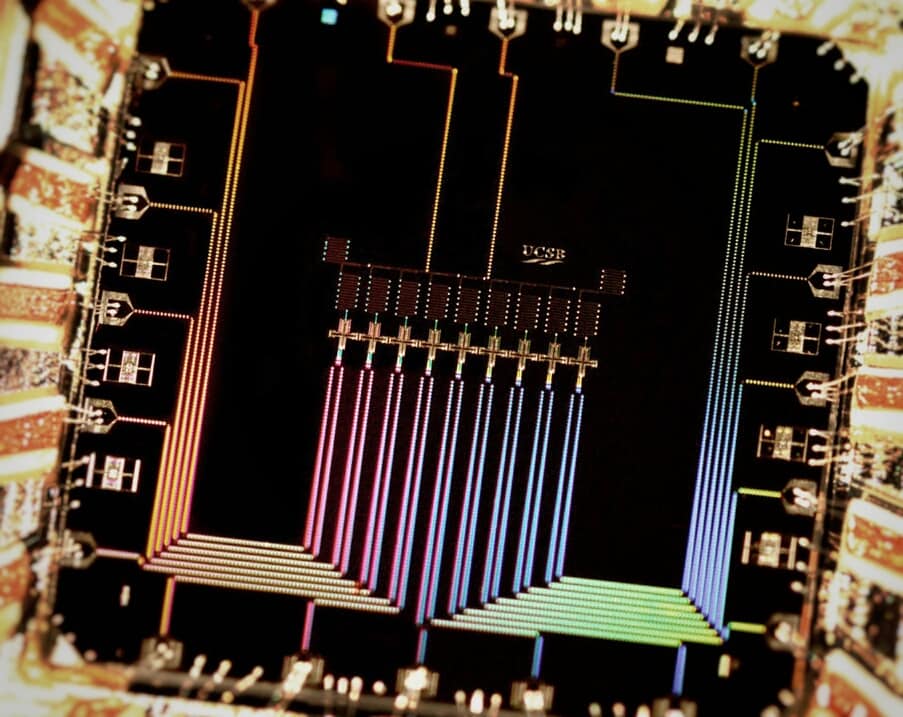
Nine superconducting qubit

By Tushna Commissariat in New York City, US

Although the APS March meeting finished last Friday and I am now in New York visiting a few more labs and physicists in the city (more on that later), I am still playing catch-up, thanks to the vast number of interesting talks at the conference. One of the most interesting sessions of last week, and a pretty popular one at that, was based on “20 years of quantum error correction” and I went along to the opening talk by physicist John Preskill of the California Institute of Technology. I had the chance to catch up with Preskill after his talk and we discussed just why he thinks that we are not too far away from a true quantum revolution.

Just in case you haven’t come across the subject already, quantum error correction is the science of protecting quantum information (or qubits) from errors that would occur as the information is influenced by the environment and other sorts of quantum noise, causing it to “decohere” and lose its quantum state. Although it may seem premature that scientists have been working on this problem for nearly two decades when an actual quantum computer has yet to be built, we know that we must account for such errors if our quantum computers are ever to succeed. It will be essential if we want to achieve fault-tolerant quantum computation that can deal with all sorts of noise within the system, as well as faults in the hardware (such as a faulty gate) or even a measurement.

Over the past 20 years, theoretical work in the field has made scientists confident that quantum computing of the future will be scalable. Preskill says that “it’s exciting because the experimentalists are taking it quite seriously now”, while initially the interest was mainly theoretical. Previously, scientists would artificially create the noise in the quantum systems that they would correct but now actual quantum computations can be fixed. Indeed, Preskill says that one of the key things that has really moved quantum error correction along in the past few years is the concentrated improvement of the hardware used, i.e. better gates with multiple qubits being processed simultaneously.

(more…)

CERN fails to confirm Fermilab tetraquark discovery

A preliminary analysis of data taken by the LHCb collaboration at the CERN particle-physics lab near Geneva casts doubt on the recent claim by physicists on the D0 experiment at Fermilab in the US that they have discovered an exotic particle containing four quarks. Dubbed X(5568), the tetraquark was believed to contain “up” and “bottom” quarks as well as “down” and “strange” antiquarks. Quarks normally group together in pairs to form mesons or threes to make baryons.

The new particle has a mass of 5568 MeV/c2 and was found in proton–antiproton collision data taken over nine years by D0, which ran on the now-defunct Tevatron collider. In a paper submitted to Physical Review Letters and posted on the arXiv server in February, the D0 collaboration identified the tetraquark with a statistical significance of 5.1σ. That is greater than the 5σ that is normally required for a discovery in particle physics.

Excess pairs

Rather than spotting the X(5568) particle itself, however, the D0 physicists identified pairs of BS mesons and pi mesons that are created when X(5568) decays. They spotted an excess of 133 such pairs above the expected background level. Each pair had a total energy of about 5568 MeV, corresponding to the mass of the tetraquark.

As X(5568) should also be produced in proton–proton collisions on the Large Hadron Collider (LHC) at CERN. The LHCb experiment – which is designed to detect B mesons – is in a perfect position to study the new tetraquark. Unfortunately, however, physicists working on LHCb have found no evidence for X(5568), despite having analysed 20 times as many BS meson events as had the D0 team.

Tetraquarks are of great interest to particle physicists because most known hadrons are either mesons, which contain a quark and an antiquark, or baryons, which comprise three quarks. The theory of the strong force – quantum chromodynamics (QCD) – allows for other types of exotic baryons with four quarks (a tetraquark) or five quarks (a pentaquark). But doing calculations using QCD is extremely difficult, so it is not clear what tetraquark or pentaquark configurations are possible.

Charmonium core

X(5568) is particularly interesting because it contains four distinct flavours of quark and antiquark. This is unlike all other known tetraquarks and pentaquarks, which all contain a charm quark/antiquark pair. This led some physicists to speculate that charmonium – a bound state of a charm quark and antiquark – creates a “core” around which tetraquarks and pentaquarks can form.

The LHCb analysis is described in a conference note on the CERN website.

‘New boson’ buzz intensifies at CERN, fire prevention in space and Neil Turok on a bright future for physics

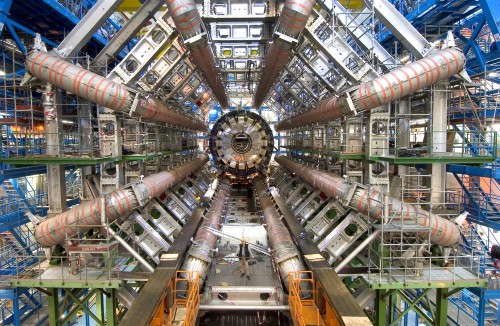
The ATLAS detector at CERN

By Hamish Johnston

Excitement levels in the world of particle physics hit the roof this week as further evidence emerged that physicists working on the Large Hadron Collider (LHC) may have caught sight of a new particle that is not described by the Standard Model of particle physics. If this turns out to be true, it will be the most profound discovery in particle physics in decades and would surely lead to a Nobel prize.

(more…)

Origami-inspired metamaterial changes shape and stiffness on command

“A house that could fit in a backpack or a wall that could become a window with the flick of a switch” are just two fantastical objects that could be made from a new self-folding metamaterial – according to its inventors at Harvard University in the US. Inspired by origami, the material will pop up and fold down on command, and can change both its shape and stiffness. Other possible applications for the new material include retractable roofs and medical implants.

The metamaterial was developed by a team led by Katia Bertoldi, James Weaver and Chuck Hoberman. It was inspired by “snapology”, which is a type of origami that uses modular units of folded paper to create larger objects. In the new approach, each unit cell is an extruded rhombus that has inflatable air pockets along three of its edges (see video). When an air pocket is pressurized, it causes an edge of the unit cell to try to fold flat. By pressurizing different combinations of pockets, the shape of the unit cell itself can be changed.

Interconnected pockets

To create its metamaterial, the team combined 64 unit cells (each about 4 cm across) to make a large cubic structure. Control over the shape of the structure was achieved by dividing the air pockets into three subsets. Pockets in a subset are interconnected so that they can be activated using the same source of compressed air.

It works from the nanoscale to the metre-scale, and could be used to make anything from surgical stents to portable pop-up domes for disaster relief
Johannes Overvelde, Harvard University

An important feature of the metamaterial is that its stiffness changes as it changes shape. As a result, the same metamaterial could have a number of different uses. While compressed air was used to activate their metamaterial, the researchers say thermal, electrical and hydraulic systems could also be used. Weaver adds that the control system could be integrated within the metamaterial, which could lead to the creation of “easily deployable transformable structures”.

“This structural system has fascinating implications for dynamic architecture, including portable shelters, adaptive building facades and retractable roofs,” says Hoberman. “Whereas current approaches to these applications rely on standard mechanics, this technology offers unique advantages such as how it integrates surface and structure, its inherent simplicity of manufacture, and its ability to fold flat.”

Team member Johannes Overvelde points out that the structure can be made over a range of sizes. “It works from the nanoscale to the metre-scale, and could be used to make anything from surgical stents to portable pop-up domes for disaster relief.”

The new metamaterial is described in Nature Communications.

‘Quantum manifesto’ for Europe calls for €1bn in funding

Researchers across Europe are calling on the European Union (EU) to launch a €1bn initiative in quantum technologies to ensure that the continent remains a leader in the field. The group, including the physicist Ignacio Cirac from the Max Planck Institute for Quantum Optics in Garching, Germany, is asking industries, research institutes and scientists in Europe to endorse its “quantum manifesto” before putting it forward to the European Commission.

The manifesto has been written in response to a request by Günther Oettinger – the European Commissioner for Digital Economy and Society – for a common European strategy on quantum technologies. The manifesto calls for a “flagship-scale initiative” – similar to the EU’s 10 year €1bn Graphene Flagship initiative – to begin in 2018, which would invest in education, science, engineering and innovation to unlock the full potential of quantum technologies.

Quantum revolution

According to the manifesto, a “second quantum revolution” is under way that will bring transformative advances to science, industry and society. Yet it points out that there is currently no coherent, large-scale Europe-wide quantum-technologies programme comparable with those in the US and other countries. If this is not addressed, the authors warn that research and development on quantum technologies in Europe “risks fragmentation and replication of efforts”. Indeed, the manifesto points out that a global race for technology and talent has already started, and that Europe cannot afford to lag behind.

Quantum technologies will enable the growth of multiple hi-tech companies
Richard Murray, Innovate UK

Through a flagship programme, the authors say that the EU could support growth in quantum-technology research and propose short- (0–5 years), medium- (5–10 years) and long-term (>10 years) research goals. A flagship programme could build a favourable innovation and business environment for such technologies, facilitate co-ordination between academia and industry, create “quantum-technology professionals”, and co-ordinate public investments and strategies across Europe, as well as promote the involvement of all member regions.

Commercial base

Richard Murray, lead technologist for emerging technologies and industries at Innovate UK and a co-author of the manifesto, says that there is already significant investment from some European countries in quantum technology, as well as a strong base of small and large companies. Yet he says that a better connected and supported quantum technologies “ecosystem” needs to be created.

“This includes scientists to supply good ideas, engineers to turn early prototypes into devices, and innovators to develop commercial products that they can market and sell,” he told physicsworld.com. “While the end applications may be unclear at the moment, one thing is certain: quantum technologies will enable the growth of multiple hi-tech companies, securing a significant number of jobs and economic prosperity for many decades into the future.”

The manifesto authors also include Aymard de Touzalin of the European Commission, Charles Marcus of the Niels Bohr Institute, Freeke Heijman of the EU presidency and Tommaso Calarco of the University of Ulm. They already have more than 400 endorsements for their quantum manifesto and expect to present their plans at the Quantum Europe conference in Amsterdam on 17 May.

A thousand tiny cuts

“What is the meaning of your shirt?”

The question came in the first year of my undergraduate degree. The speaker was one of my physics lecturers. At first, I was simply confused. My T-shirt was emblazoned with the bar-and-circle logo of the London Underground and the slogan “Mind the Gap” – an idiosyncratically British phrase that reminds passengers to watch their step when leaving the train. My professor was European; surely he’d ridden the Underground at some point? I explained it to him anyway, and he nodded, grinning broadly. “Ah, I see.” He paused, seemingly searching for words. “I thought it was…you know…‘two’s company’.” And as he said this, in a gesture I can’t un-see, he cupped his hands to his chest and gave a vigorous jiggle to an imaginary pair of breasts.

This was awkward and embarrassing to witness, and I’m still not entirely sure what he meant. However, it did not really put me off studying physics. Certainly, it was not as bad as the behaviour of Geoffrey Marcy, the exoplanet astronomer who resigned from the University of California, Berkeley, US, in October 2015 after an internal investigation found that he had sexually harassed multiple female students over a period of several years. Marcy’s alleged actions include grabbing the crotch of one woman and putting his hand up the shirt of another; my lecturer’s leering gesture was not in the same league. But even so, it was an unpleasant reminder that, as a woman in a male-dominated field, some of the people I encountered were going to treat me primarily as a possessor of breasts, not as an aspiring scholar. And in a small way, it may even have hurt me academically: from then on, I tried to avoid my lecturer’s office hours unless I knew someone else would also be there.

Within the community of researchers who study bias and diversity, actions like this – small things that make people feel unwelcome or uncomfortable because of who they are, rather than what they are doing – are known as “microaggressions”. It’s an imperfect term, because many such actions or words are not meant to harm. Some are intended as jokes, or even as compliments. “One of the most common microaggressions comes during introductions at a talk or conference. A man will be introduced as ‘This is so-and-so, who went to this university, who accomplished this research, who recently published this paper,’ but when they go to introduce a woman, they will often say ‘We are pleased to introduce the beautiful so-and-so’ – making a comment on appearance,” says Pamela Gay, an astronomer, podcaster and writer at Southern Illinois University Edwardsville in the US.

Such introductions, Gay continues, often mention the fact that a woman in science “managed to be a mother” while publishing research and describe her as “hard-working” instead of using adjectives such as “brilliant” or “talented” that are commonly used to describe men in the same circumstances. This mixture of faint praise and compliments that focus on appearance and motherhood rather than scholarly achievements “tells a woman that what matters is her looks and the fact that she’s capable of having a kid and not totally messing up at work”, Gay says. “That’s not what’s intended, but that’s what’s heard.”
Disabled symbol

Some microaggressions are even less direct. Haley Gomez, an astronomer at Cardiff University, UK, says that members of the public often tell her she doesn’t look like a scientist, and fellow scientists sometimes express surprise that she holds a professorship. “They’re almost giving you a compliment, particularly with ‘you don’t look like a scientist’, but over time, these comments start to make you think, ‘Oh, why don’t I look like a scientist?’ ” Gomez says.

The words “over time” are important, because microaggressions are usually not isolated events. “If it happened once in your whole career, or maybe even a second time, you would probably brush it off, but they do add up,” says Laura McCullough, a physicist at the University of Wisconsin-Stout, US, whose research interests include studies of gender and science. “And you may not realize it’s happening until it’s happened 10, 20 or 30 times, because it is very subtle.” Of the physicists and astronomers interviewed for this article, a few reported experiencing small actions that challenge their identity as scientists, denigrate their abilities or make them feel like outsiders on a weekly or even daily basis. For others, it’s something that happens a few times a year, or is currently rare but was very common at an earlier point in their career. Whatever the frequency, though, the message is clear: these seemingly little things are contributing to a “chilly climate” that drags down women and other under-represented groups in physics, making it harder for them to reach their full potential and convincing some that they would be better off in a different profession.

Battling against bias

Some types of microaggression, such as sexual harassment and gendered descriptions, are directed almost exclusively at women. Others, however, are also common experiences for members of other under-represented groups in physics. Louis-Gregory Strolger is an observatory scientist at the Space Telescope Science Institute in Maryland, US, and he says that some of the microaggressions he’s experienced as a person of colour are similar to those encountered by women in physics. “There is this sense that you are not as capable as your white colleagues – as your white male colleagues, specifically,” Strolger says. “There is always a tendency for other people to ‘double check’ your work, or to give projects of higher standing or things that require a bit more intelligence or meticulousness to people who are not women or of colour.” He classes such actions as microaggressions, he says, “because I don’t think it’s terribly conscious”.

Unconscious bias linked to long-standing cultural stereotypes (see Surely you’re not biased) is certainly a factor behind some microaggressions. “With regards to disability, it comes up with things like the words ‘capable’ or ‘able’,” says Jesse Shanahan, an astronomy graduate student at Wesleyan University in Connecticut, US, and a co-founder of the American Astronomical Society’s working group in accessibility and disability. “People presume that if you have a physical disability, then somehow you’re less intelligent or less intellectually capable.” Shanahan, who has a genetic disorder that affects her joints and impairs her mobility, says that at times she feels like she is “not only fighting against the environment of the field, but also against a Western culture that has sexism and racism and ableism written into it”.
Thumb tack

In other cases, though, it is hard to give perpetrators the benefit of the doubt. “I have a grant from the European Research Council, and I’ve had so many people come up and say to me ‘Oh yeah, I heard it’s really easy for women to get that grant, so that’s why you got it on your first go’,” Gomez says. “And I’m kind of like, ‘Okay, right, thanks for that, it’s nothing to do with my research or my capability or my CV, it’s just because they needed a woman!’ ” Gomez notes that statistics on the grant (which are public) do not support the hypothesis that women have it easier. Moreover, when she asked white male colleagues whether they, too, had had people tell them, to their face, that they had only won a grant due to a single factor, the response was an almost universal “no”. At that point, Gomez says, she decided that the people belittling her achievements were sexist, not merely jealous or bitter.

Strolger has had similar experiences. “At times too numerous to list completely, I’ve had colleagues off-handedly (and sometimes very directly) state the only reason I’ve received a specific award, or job offer, or other opportunity is that I am black, or simply say that if I weren’t black I wouldn’t be as successful,” he says. Such comments have been “wearing”, he says, adding that at times, they have also fed his case of “impostor syndrome” – the feeling of inadequacy some people experience despite having all the necessary skills, talent and qualifications for their jobs (see November 2011 p56).

Taking up bandwidth

Strolger’s brushes with impostor syndrome are one example of how small negative comments and actions can be harmful. Among people who experience frequent microaggressions, loss of confidence is common. Karen Masters, an astronomer at the University of Portsmouth, UK, suggests that academics may be especially prone to this. “When you work in academia, a majority of our feedback is quite negative,” she says. “You submit a paper, your peer reviewer tells you all the things that are wrong with it. Even for very successful academics, this is their experience.” When this “normal” negativity gets augmented with what Masters calls an “underlying sense of, ‘Do you really want to be here, as a woman?’ ” the result is, she says, “tiring”.

For John Asher Johnson, an astronomer at Harvard University, US, and an advocate for minorities in science, the effect of race-based microaggressions is like having a “nagging sub-process called WTF_was_that_racist” running in his brain. Writing on his personal blog in 2014, Johnson called this sub-process “a major drain on the central processing unit”, pointing out that it consumes energy that minority astronomers could otherwise devote to more important things – such as figuring out how the universe works.

Highlighter

Tim Atherton, a soft-matter theorist at Tufts University in the US, agrees that microaggressions can be a serious distraction in the workplace. Atherton is now openly gay (he is a co-organizer of the LGBT+Physicists website), but when he was a postdoc at Case Western Reserve University in the US, in the 1990s, only a few colleagues knew about his sexual orientation. Back then, he says, one of his fellow students regularly brought articles from a right-wing website into their shared office, and would frequently state his belief that gay people were going to hell. “It was very upsetting,” Atherton says. “It didn’t stop me from wanting to go into physics, but it certainly was pretty awful. I found myself pretty miserable at work because of it.”

In addition to being unpleasant and a drag on the confidence of those who experience them, microaggressions are sometimes part of a pattern that includes more serious misconduct. “My first husband was abusive, and I learned a whole lot about abusive behaviour from that,” says one physicist, a woman in her early 50s who prefers to remain anonymous. “It [an abusive relationship] starts with things that you wouldn’t feel comfortable calling people on. And then when that slips by, people can ramp it up. I think microaggressions fit in and contribute to larger problems because they kind of condition people to accept it.”

Both this anonymous physicist and Shanahan, who was harassed by an older male graduate student shortly after she began studying at Wesleyan, say that even moderate and unintentional slights can bring up traumatic memories. “It’s a little bit like an iceberg, where the microaggressions are this tiny tip of something you see, but all of the people who experience them are aware of this vast hidden message,” Shanahan says. “So somebody saying ‘Did you really do this research?’ reminds me of harassment that I experienced. It’s just this nagging reminder that you’re still in this place that doesn’t see you as an equal.”

Another, closely related problem is that when a community allows microaggressions to go unchecked, it becomes harder for the people affected to speak up about more serious cases of discrimination, harassment or bullying. It also creates an impression – justified or otherwise – that complaints will not be taken seriously. “There’s a stereotype of people complaining more if they’re a woman – whining more, can’t cope with the harsh realities of academia, they’re too emotional, all that kind of thing,” Gomez says. “I hear that a lot and that cannot help when the really serious cases do come out.”

Speaking out

If ignoring microaggressions isn’t an option – or, at least, not an option for anyone who wants physics to be a field where talented people of all backgrounds can thrive – the next question is what to do about them. For slights that are minor and clearly unintentional, a gentle correction may be the best way forward. Masters says that when she told a member of the public at an outreach event that she studied galaxies, the man assumed she was an undergraduate and asked what course she was on. When she replied, “Oh, actually, I’m one of the professors here, so let’s talk about galaxies now,” the man “looked a little bit taken aback” but didn’t say anything, and the conversation moved on. “I hope that was a learning experience for him,” Masters says, although she adds that it is “kind of tiring” to keep correcting people.

Atherton suggests that a good strategy is to try to get people to empathize with the person experiencing microaggressions. If you can do that, he says, “you can convince them that even if (for example) they don’t think gay people should get married, or they don’t think that gender is a more fluid construct than binary male/female, they might at least acknowledge that it’s not good to shove their opinions in people’s faces on a daily basis”.

Sometimes, though, appeals to people’s better natures fall flat. Gomez says that she has achieved little by confronting those who challenge her academic credentials. “In one case, I did actually say, ‘Have you looked at my CV? Did you look at my grant application?’ and suggested that they might want to formulate a judgement based on evidence. And they were very open and honest about it [not having looked], but they just couldn’t see the problem with telling me I didn’t deserve the grant or the promotion.”
Online commenting symbols

In cases where a personal, immediate correction seems unlikely to work – or where it might produce an overtly aggressive response – Atherton advises reporting the situation to an authority figure. Although he was initially reluctant to speak up about his officemate’s homophobic comments because he wasn’t “out” to his supervisor, when he finally did say something, it helped. “He [my supervisor] was very good,” Atherton says. “He had a word with the guy and said, ‘Look, I don’t want to infringe on anyone’s freedom of speech, but I really think we should keep these sorts of conversations outside a professional environment.’ I think that was a good way of putting it, because ultimately when we’re professionals we should be thinking about moderating the way we interact with people.”

Another strategy that several people recommended is to speak up about microaggressions when they are directed at someone else, rather than at yourself or a group you belong to. Gay, who is white, says she has sometimes had good responses when she has pointed out microaggressions against other racial groups, while Gomez praises male colleagues who have stepped in to challenge claims that women get special treatment from grant committees. Shanahan, for her part, agrees that “bystander intervention is huge – specifically, bystander intervention by people who are in positions of power”. If two professors are talking to a student, and one of them says something iffy, she explains, “the other professor needs to step in, because it shouldn’t be the job of the person on the lower end of the power relationship to speak up”.

An even better outcome, though, would be for incidents like this to stop happening altogether. Strolger believes that changes in the demographics of physics and astronomy will help. “It really has a lot to do with building a critical mass of women and minorities in those fields, having role models to attract new people in the field, making sure that there is this inclusive environment,” he says. Shanahan, though, warns that numbers alone will not solve the problem. “There have been movements to increase this buzz-word ‘diversity’, which typically means numbers – the percentage of women or people of colour who are in a given field,” she says. “But the problem with that is you don’t address the environment, so all you end up doing is forcing more people to work in hostile work environments or experience even more prejudice and harassment. They often leave.”

McCullough, who is currently writing a book about the status of women in physics, agrees there are wider problems that need to be addressed. “I think really it’s all about the culture,” she says. “We have to first make everybody aware that this is a real issue. There are so many people who still don’t think there’s a problem with bias against women in science, but there is, and we need every talented person to stay in the field.”

Masters, though, is more optimistic. “Many physicists and astronomers are a delight to work with and it is an extremely positive thing that we as a community are facing up to this,” she says. “I trust the majority of my colleagues to look at this with a very evidence-based eye and think, ‘What can we do to make this better?’”


The firm that's made no noise over gravitational waves

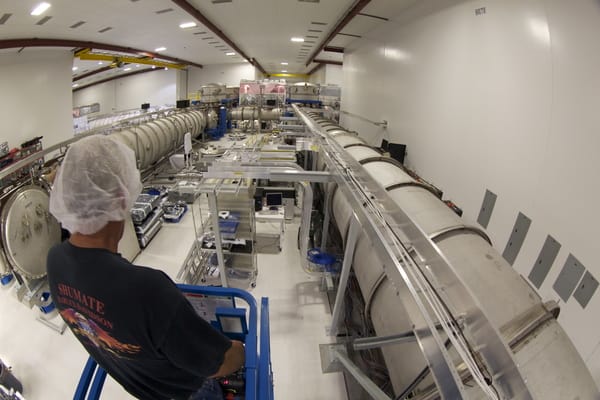
A bird's eye view of LIGO Hanford's laser and vacuum equipment area (LVEA). The LVEA houses the pre-stabilized laser, beam splitter, input test masses, and other equipment.

By  Matin Durrani in Baltimore, Maryland, US

The exhibition hall at this year’s APS March meeting is so big that it can be hard to know who or what to see among the many companies displaying their wares or services. Fortunately, my colleague Joe Breck from IOP Publishing’s office in Philadelphia tipped me off about a great little story featuring Kepco Power Supplies, which is based in Flushing, New York.

I spoke to Mark Kupferberg, executive vice-president for power solutions at the firm, which was founded by his father and his two brothers in 1946 shortly afer the three had finished work on the Manhattan atomic-bomb project. Kepco mainly makes power supplies that convert mains AC into DC electricity, and has recently played a small but vital role in the discovery of gravitational waves, which were first predicted by Einstein 100 years ago.

(more…)

Rare-isotope decay links tiny grains to stellar explosions

A newly discovered state of the sulphur-31 nucleus could help to explain the puzzling isotope ratios found in tiny grains of silicon carbide that are found in some meteorites. The discovery was made at the National Superconducting Cyclotron Laboratory in the US, and provides important information about how elements such as silicon are created in stellar explosions called novae.

Silicon is the eighth most common element in the universe by mass and it comprises nearly 30% of the Earth’s crust. There are three stable isotopes of silicon: 3% of the silicon on Earth is silicon-30, 5% is silicon-29 and the remainder is silicon-28. In 2001 researchers in the US and Spain found five microscopic grains of silicon carbide in a meteorite that contained up to twice as much silicon-30 as found in rocks on Earth. The team suggested that the isotopic anomaly occurs because the grains had been created in classical novae – huge thermonuclear explosions that occur on the surfaces of stars and produce heavy elements in a process called nucleosynthesis. Grains subsequently found in other meteorites have also been attributed to classical novae.

The idea is that phosphorus-30 nuclei created in a nova will decay to silicon-30. For this to happen, however, the phosphorous-30 nucleus must avoid capturing a proton before it decays – because this would result in the formation of sulphur-31. The rate at which this proton capture occurs increases with increasing temperature, and therefore the hotter the nova, the fewer silicon-30 nuclei it produces. The problem with this theory is that calculations based on what we know about nova nucleosynthesis suggest that even more silicon-30 should be present in nova dust grains than has been measured. This has led some researchers to ask whether the grains have another origin.

Challenging cross-section

A crucial input parameter for these calculations is the probability that phosphorous-30 will capture a proton at temperatures found in novae. Called the proton capture cross-section, this has so far proved impossible to measure experimentally, explains team-member Christopher Wrede of Michigan State University (MSU). “You can’t make a target out of phosphorus-30 and bombard a proton beam onto the target,” he says. “Instead, you have to make a target out of protons – hydrogen – and bombard that with a beam of phosphorus-30. It’s very challenging to make a sufficiently intense beam.” As a result, astrophysicists have had to use rough theoretical estimates in their calculations of silicon-30 production.

Wrede and colleagues took a different approach based on the fact that the cross-section depends on the precise energies of unbound sulphur-31 nuclear states (called resonances) that are formed when phosphorus-30 captures a proton. Conveniently, these resonances are the same as those formed when the rare isotope chlorine-31 undergoes beta decay to sulphur-31. The team studied the decay of chlorine-31 ions produced at MSU’s National Superconducting Cyclotron Laboratory, measuring the beta particles and subsequent gamma rays that are emitted.

Identical resonance

The researchers found a new sulphur-31 resonance with energy, spin and parity identical to the resonance formed when phosphorus-30 captures a proton. This, says Wrede, suggests that the capture cross-section is larger than previous estimates. This means that more phosphorus-30 nuclei are converted to sulphur-31 in novae, resulting in fewer silicon-30 nuclei. While this finding goes some way to explain the isotopic composition of the meteorite grains, “we really need to know how strong this resonance is before we can verify that”, Wrede says.

As David Jenkins of the University of York in the UK comments, “What’s surprising is that, despite the very large number of studies of this system, somebody has found something new that wasn’t known before. Previous estimates [of the proton capture cross-section] that have gone into the astrophysical models are clearly inaccurate and incomplete.” He adds, however, that the research still does not pin down the rate at which sulphur-31 is produced in novae. “The obvious further work, which a lot of people have been trying to do, is to try and measure this phosphorus-30 reaction rate directly,” he says.

Wrede and colleagues are hoping to do just that. “There’s a facility being built at out lab called Separator for Capture Reactions (SECAR),” says Wrede. “We hope that in 5–7 years, it will be capable of measuring the proton capture into this resonance directly on phosphorus-30.” The chlorine-31 result will assist this endeavour, he says, because “we will have to tune the beam energy to the exact resonance energy to make the measurement efficiently.” Measuring this cross-section could not only solve the mystery of the grains, the researchers say, but also help astronomers, who often estimate the temperature of novae from the proportion of elements heavier than phosphorus.

The research is described in Physical Review Letters.

LEGO bricks, bony foams and Islamic art aid metamaterial advances

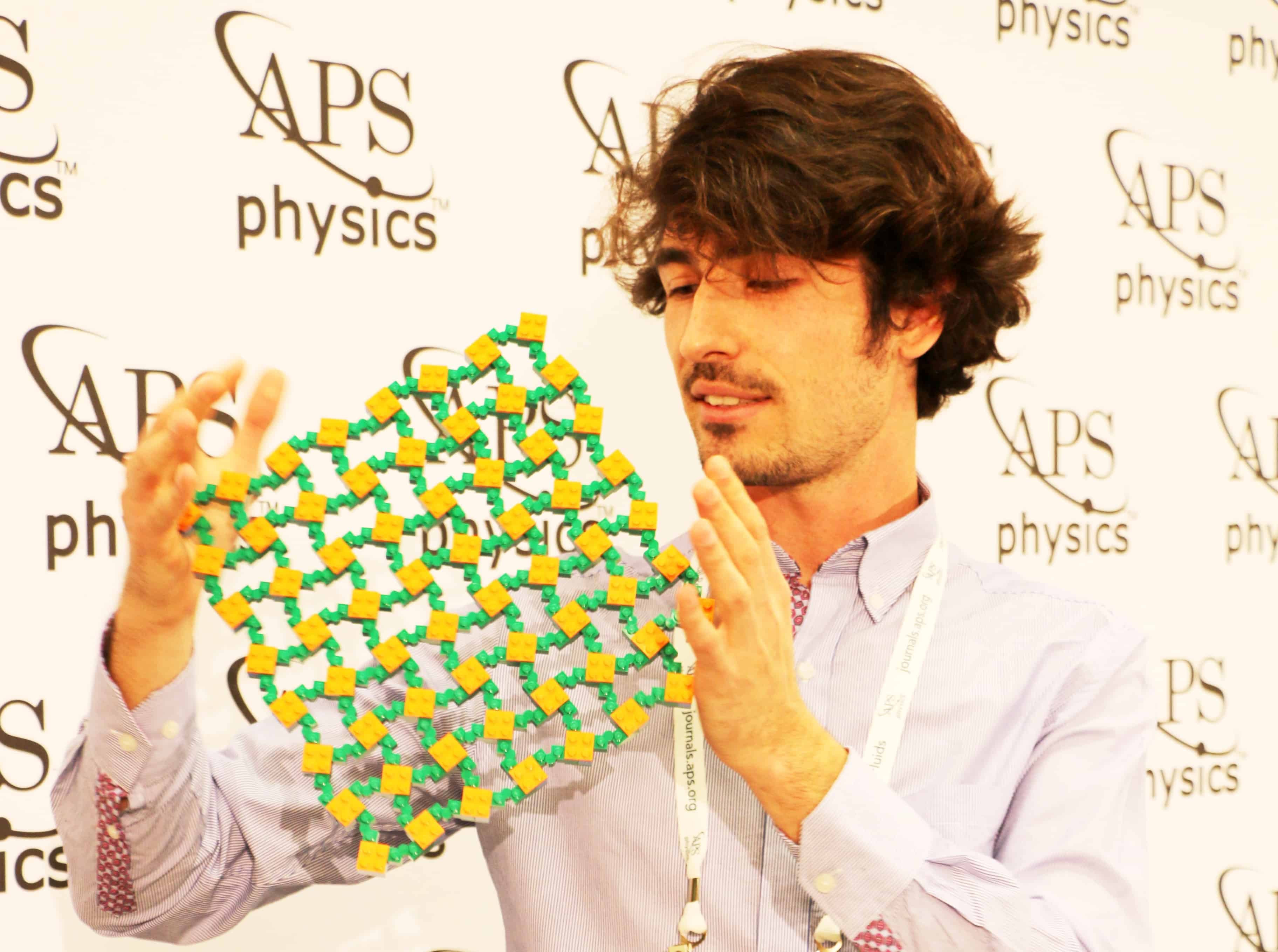
Photograph of Paolo Celli with his LEGO brick platform

By Tushna Commissariat in Baltimore, Maryland, US

Metamaterials are always a hot topic at the APS March meetings, and this afternoon we were treated to an array of the latest developments in the field. Just in case you have not come across the term before, a metamaterial is an artificially crafted material that aims to achieve the naturally unattainable. These materials are engineered to have special physical properties – some metamaterials act as optical or acoustic cloaks, while some can harvest energy or be used to dissipate it in some form.

Paolo Celli of the University of Minnesota in the US loved playing with LEGO bricks as a child. Now, the physicist still gets to play with LEGO, as his team has been using the bricks both to understand how metamaterials interact with waves and also as an inexpensive and accessible outreach medium. While the researchers initially looked at 3D printing to develop their platform material, they soon found that LEGO bricks attached to a baseplate made for an agile, versatile, low-cost platform that was not highly damped and could be easily reconfigured.

Celli and colleagues have already used the LEGO to experimentally demonstrate phononic band gaps and the associated energy-trapping mechanisms. They are currently working on demonstrating the control of wavelengths that are larger than the width of waveguides realized in the brick pattern, with potential applications in subwavelength wave focusing and imaging. We will be talking to Celli tomorrow, so watch out for more on LEGO metamaterials soon.

(more…)

Copyright © 2026 by IOP Publishing Ltd and individual contributors