Looks as if LIGO’s gravitational-wave discovery is still rocking all over the world, as you can now groove to the dulcet tones of singer and physicist Tim Blais, who runs the acapellascience channel on YouTube. With some help from the Perimeter Institute in Canada, the singer has created his latest “nerd-pop” parody, titled “LIGO Feel That Space” (sung to the tune of The Weeknd’s “Can’t Feel My Face”). After you listen to the catchy tune above, take a look at this interview with Blais on the Perimeter website to find out just how he creates his songs and how he went from physicist to a viral YouTuber.
A powerful numerical code that uses Einstein’s general theory of relativity to describe how large-scale structures form in the universe has been created by physicists in Switzerland and South Africa. The program promises to help researchers to better incorporate dark matter and dark energy into huge computer simulations of how the universe has evolved over time.
At the largest length scales, the dynamics of the universe are dominated by gravity. The force binds galaxies together into giant clusters and, in turn, holds these clusters tight within the grasp of immense haloes of dark matter. The “cold dark matter” (CDM) model assumes that dark matter comprises slow-moving particles. This means that non-relativistic Newtonian physics should be sufficient to describe the effects of gravity on the assembly of large-scale structure in the universe. However, if dark matter moves at speeds approaching that of light, the Newtonian description breaks down and Einstein’s general theory of relativity must be incorporated into the simulation – something that has proven difficult to do.
Upcoming galaxy surveys, such as those to be performed by the Large Synoptic Survey Telescope in Chile or the European Space Agency’s Euclid mission, will observe the universe on a wider scale and to a higher level of precision than ever before. Computer simulations based on Newtonian assumptions may not be able to reproduce this level of precision, making observational results difficult to interpret. More importantly, we don’t know enough about what dark matter and dark energy are, to be able to conclusively say which treatment of gravity is most appropriate for them.
Evolving geometry
Now, Julian Adamek of the Observatoire de Paris and colleagues have developed a numerical code called “gevolution”, which provides a framework for introducing the effects of general relativity into complex simulations of the cosmos. “We wanted to provide a tool that describes the evolution of the geometry of space–time,” Adamek told physicsworld.com.
General relativity describes gravity as the warp created in space–time by the mass of an object. This gives the cosmos a complex geometry, rather than the linear space described by Newtonian gravity. The gevolution code is able to compute the Friedmann–Lemaítre–Robertson–Walker metric that solves Einstein’s field equations to describe space–time’s complex geometry and how particles move through that geometry. The downside is that it sucks up a lot of resources: 115,000 central-processing-unit (CPU) hours compared to 25,000 CPU hours for a similarly sized Newtonian simulation.
Other uncertainties
Not everyone is convinced that the code is urgently required, and Joachim Harnois-Déraps of the Institute for Astronomy at the Royal Observatory in Edinburgh points out that there are other challenges facing physicists running cosmological simulations. “There are many places where things could go wrong in simulations.”
Harnois-Déraps cites inaccuracies in modelling the nonlinear clustering of matter in the universe, as well as feedback from supermassive black holes in active galaxies blowing matter out from galaxies and redistributing it. A recent study led by Markus Haider of the University of Innsbruck in Austria, for example, showed that jets from black holes could be sufficient to blow gas all the way into the voids within the cosmic web of matter that spans the universe.
“Central and shining”
“In my opinion, the bulk of our effort should instead go into improving our knowledge about these dominant sources of uncertainty,” says Harnois-Déraps who, despite his scepticism, hails gevolution as a great achievement in coding. “If suddenly a scenario arises where general relativity is needed, the gevolution numerical code would be central and shining.”
Indeed, Adamek views the gevolution code as a tool, ready and waiting should it be required. Newtonian physics works surprisingly well for the current standard model of cold dark matter and dark energy as the cosmological constant. However, should dark matter prove to have relativistic properties, or if dark energy is a dynamic, changing field rather than a constant, then Newtonian approximations will have to make way for the more precise predictions of general relativity.
“The Newtonian approach works well in some cases,” says Adamek, “But there might be other situations where we’re better off using the correct gravitational field.”
It is a battle between man and machine, but one that has been ultimately won by the brute force of computation.
Yesterday as well as today, Google’s DeepMind AlphaGo program has made a breakthrough in artificial intelligence by defeating Lee Sedol – the current world champion from South Korea – at the game of go.
Since its invention in the 1980s, scanning tunnelling microscopy (STM) has opened up a new world of possibilities by enabling researchers to image on the atomic scale. In this latest video for our 100 Second Science series, Peter Wahl from the University of St Andrews in the UK explains the basic principles of STM and explains why its invention has been so revolutionary. He explains how these microscopes overcome the resolution limitations of optical microscopy thanks to the phenomenon of quantum tunnelling.
Like you, I’m not biased. No way, not me. How could I be? I’m the editor of a magazine that’s devoting a whole issue to diversity. I did my PhD with Athene Donald – one of the first female professors of physics in the UK. The Physics World editorial team has more women than men. My father’s from Pakistan and my mother’s from Germany so that makes me ethnically and culturally diverse. I grew up in Birmingham in the English Midlands, which means there’s no way I have a north/south bias. I’m tolerant and fair-minded. I’m not rich or poor. And I’m sure I give everyone an equal chance. If I were a coin and you spun me, you couldn’t predict if I’d land heads or tails. So that’s me: definitely not biased.
But hang on a minute. Here’s the rub. We all like to think we’re not biased but, whatever our background, we all have in-built prejudices. This hidden, or “unconscious”, bias means we naturally prefer the company of certain people, namely those who look and sound like ourselves. It’s not about us being bad or nasty people, although it can mean we end up stereotyping others. Our unconscious bias is just the natural outcome of how we’ve been brought up, where we went to school, who we mixed with, what subject we studied and where we’ve lived. That preference for certain kinds of people can be acceptable socially, but when it comes to positions of power – hiring staff, sitting on funding panels or promoting people – that bias can lead to decisions that are irrational, unfair and possibly even illegal.
Once you’re aware of unconscious bias, it becomes easier to spot. I was recently talking to my colleague Louise Mayor, who’s Physics World’s features editor, after she’d returned from a visit to the European Southern Observatory in Chile. She happened to mention two astronomers she’d spoken to who’d both been using the Atacama Large Millimeter Array to study various cosmic phenomena. Based on the many scientists I’ve met over the years, I automatically pictured the researchers as two white, middle-aged men. I think they had beards too. Wrong! Both astronomers were young women. I’d had a stereotyped picture in my head of the “average” scientist.
I could brush that incident under the carpet as an inconsequential one-off. No harm was done; it was a mere thought that popped into my head. What did it matter that I’d imagined those two astronomers as men? But my unconscious bias can have consequences. It could make me more likely to pick bearded white men to write features or book reviews for Physics World, subtly perpetuating the myth that physics is only for bearded white men. I might pay slightly less attention when speaking to a female physicist on the phone; after all, there have only ever been two female Nobel laureates in physics so it’s surely just efficient to focus more on the thoughts of male physicists?
There is, of course, nothing wrong with publishing articles by bearded white men or listening carefully to the thoughts of male physicists on the phone. It’s just a case of giving everyone a fair chance. Unfortunately, our unconscious bias trickles into all areas of our lives. It can lead to schoolteachers treating boys and girls subtly differently in science classes and to recruiters judging women’s CVs as less striking than those of men. It might also explain why many people organizing scientific conferences end up with all-male panels even though women make up a sizeable proportion of the relevant community (see “Reflecting reality”, below).
Uncovering my bias
To find out how biased I really am, I decided to take several Implicit Association Tests (IATs), which are designed to tease out your subconscious attitudes to everything from race and gender to disability and sexual orientation. Originally developed in the 1990s by US-based social psychologists including Mahzarin Banaji and Anthony Greenwald, these tests form part of Harvard University’s Project Implicit and can be done by anyone online (http://ow.ly/WF9J9). In the case of race, you’re asked to cross-link white and black faces to positive- and negative-sounding words by striking the correct keys on your computer keyboard. There are no wrong answers; the test measures only how fast and accurately you respond.
Before doing the test, I started reading Banaji and Greenwald’s book Blind Spot: Hidden Biases of Good People (2013 Delacorte Press). It warned me that many people who take IATs are shown to have discriminatory views – despite them genuinely believing they hold egalitarian beliefs. And so it proved for me. According to the test, which takes about five minutes to complete, I have a “strong automatic preference for white people compared to black people”. Essentially, I responded faster when faces of white people and good words were paired than when black people and good words were paired. I took the test again just to make sure it hadn’t miscalculated my score, but no, once again it decreed I strongly prefer white people.
That was my ego punctured. There was some comfort, though, in finding that I’m not alone. More than 20,000 people take the online IATs each week, with about 70% of respondents to the race test having a “slight”, “moderate” or “strong” automatic preference for white people. Some 17% have no preference and the rest prefer black people. So despite my best intentions, I’m unconsciously racist – or, as Banaji and Greenwald put it, I’m an “uncomfortable egalitarian”.
Still, surely my attitudes to women in science were going to be beyond reproach? Gender equality is something we take seriously at Physics World so I was banking on a better score on the IAT for that. This time I was asked to link male and female words with arts- and science-related words. Another disaster. The test suggested I have “a strong association of male with science and female with liberal arts compared to female with science and male with liberal arts”. Again, I’m not alone. Overall, 72% of respondents have a “slight”, “moderate” or “strong” association between men and science, with 18% having no association and the rest identifying women more with science.
The impact of bias
Chastened by the results, I continued reading Blind Spot. I’d supposed that having an automatic attitude doesn’t necessarily mean that you endorse it. The test, in other words, might have shown me to be biased, but surely I don’t act that way in real life. Yet as Banaji and Greenwald point out, we are so prone to stereotyping certain groups that even people in those groups can hold such stereotyped views to some extent. A female physicist on, say, a recruitment or grant-allocation panel can unconsciously favour a male applicant because she assumes men are better scientists and that it’ll help her to be part of a powerful “in-group” of male colleagues.
So how can we change our unconscious bias? The bad news is we can’t as it’s ingrained into our automatic thinking. However, being aware of the issue – as I now am – at least means we can recognize our bias and seek to address it. Finding solutions can be tricky but they don’t have to be hard to put into practice. Banaji and Greenwald cite a great example from the US symphony-orchestra scene back in the 1970s, which was then – like physics – dominated by men. Several orchestras changed their auditions by simply adding a screen between a musician and the judging committee. These “blind” auditions led to the proportion of women hired doubling from 20% to 40%. Ironically, the procedure wasn’t adopted to improve the gender ratio, but to ensure judges didn’t pick musicians who’d been trained by a small band of famous teachers.
Change in perspective One way to challenge your biases is to surround yourself with images of people you are biased against, so they stop seeming ‘unusual’ to you. This is the thinking behind social-media campaigns such as #ilooklikeaphysicist. Participants included: (top row) Suma Nallapati (Colorado Governor’s Office of Information Technology), Jennifer Ross (University of Massachusetts Amherst), Maggie Lieu (University of Birmingham), Chiara Mingarelli (California Institute of Technology and Max Planck Institute for Radio Astronomy); (bottom row) Linda French (Illinois Wesleyan University), Becky Douglas (University of Glasgow), Clara Nellist (CERN), Andrea Albert (SLAC National Accelerator Laboratory) and Caitlin Johnson (University of California, Santa Cruz). (Photographs kindly supplied by individual subjects)
One organization tackling unconscious bias is Research Councils UK, which oversees the activities of the UK’s seven research councils. To help ensure that the £3bn it hands out each year in research grants is distributed fairly, it has just launched a new programme that will see more than 1300 people – including peer-reviewers, policy-makers and research-council staff – having access to online training on unconscious bias over the next three years. The training will be based on a series of workshops that will, according to an RCUK spokesperson, “openly explore bias, allowing participants to recognize their own biases and the impact these could have on their decision-making”. With such big sums at stake, even a small shift in behaviour could reap big dividends.
Reflecting reality
One consequence of unconscious bias is that people organizing conferences, who are often men, inadvertently pick people who are just like them. That can lead to situations where all invited speakers or every member of a panel debate is a man, not reflecting the gender ratio of the relevant community. Faced with a backlash, conference organizers will defend themselves by claiming there just aren’t enough suitably qualified or appropriate women to invite onto the panel – it’s “just one of those things”. There’s even a blog (http://allmalepanels.tumblr.com) devoted to mocking all-male line-ups, in which a picture of David Hasselhoff giving the thumbs up appears on a seemingly endless stream of men-only panels.
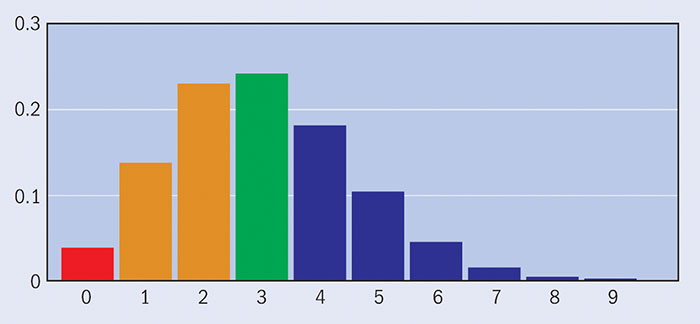
It’s all in the numbers For a 20-member group drawn randomly from a community containing 15% women, this graph shows the number of women in the group on the x axis and the fractional probability of having that many women on the y axis.
To illustrate just how statistically unlikely all-male panels or invited-speaker lists are for a given community, Aanand Prasad – a London-based Web developer – has created the Conference Diversity Distribution Calculator (http://ow.ly/WO3px). It tells you how many women you would expect to find in a random selection of x people assuming they make up y% of available speakers. In the case of physics, women account for about 15% of research-active staff according to 2013 data from the Institute of Physics, which publishes Physics World. This means there’s a 44% chance that, at random, a five-member group would have no women at all. With 10 people, the likelihood falls to 20%, while with 20 people the chance is less than 4%.
I can see many physicists rolling their eyes at the prospect of being forced to sit through training sessions on unconscious bias when they could be do something more useful, like proper work. As they will rightly point out, our unconscious brains are wired up to process and sift vast amounts of information looking for patterns. If you only ever come across, say, male IT staff and female receptionists, then surely it’s just an efficient short cut to assume who’s who if faced with a room full of IT staff and receptionists.
The problem is that when we are in positions of power, our unconscious bias can lead to us holding back others professionally. As the Royal Society put it in a briefing note issued last year to those who decide who should win its grants, awards and fellowships: “We perceive a pleasant fluency of action when we experience familiarity, and this makes us feel confident and in control of our decisions. With unfamiliar members of other groups we are on less sure ground.” As we feel it’s risky to pick a candidate from such a group, scientists “redefine merit to justify discrimination”.
The Royal Society’s note also has five tips for those seeking to avoid unconscious bias (see “Five tips to avoid bias”, below). But another simple solution I came across several times while researching this article is that if you have, say, an unconscious bias against female scientists, then simply put lots of photos of female scientists on your pinboard or screensaver. The idea is that by surrounding yourself with such images, the group you’re biased against will feel less different and more normal to you. With time, you’ll become less prone to making negative, snap judgements about people from that group and more likely to keep your bias under control.
As I finished my exploration of unconscious bias, I came across a fascinating study published last year by a team of psychologists in the US, which showed that some of us have a bias against research that shows a bias (Proc. Natl Acad. Sci.112 13201). Led by Ian Handley from Montana State University, the researchers asked more than 200 university staff to read the abstract of a paper reporting a bias against women in science, engineering, technology and mathematics (STEM) and then to rate the quality of the research. While both men and women rated the findings positively, men ranked it less favourably, agreeing with the results less, finding the study less important and judging it more poorly written. Male STEM staff showed a particular bias against the findings.
Perhaps this article is destined for the same fate.
Five tips to avoid bias
The Royal Society last year issued a briefing note for members of its panels and committees who decide which scientists should get grants, awards or fellowships from the society. In seeking to ensure decisions adhere to the society’s ethos – and so are made “purely on the basis of the quality of the proposed science and merit of the individual” – it offered these five tips: 1. When preparing for a committee meeting or interview, try to slow down the speed of your decision making. 2. Reconsider the reasons for your decision, recognizing that they may be post-hoc justifications. 3. Question cultural stereotypes that seem truthful. Be open to seeing what is new and unfamiliar and increase your knowledge of other groups. 4. Remember you are unlikely to be more fair and less prejudiced than the average person. 5. You can detect unconscious bias more easily in others than in yourself so be prepared to call out bias when you see it.
Researchers in the US have taken images of individual atoms in an ultracold fermionic gas as it makes the transition from a metallic phase to a band insulator and then to a Mott insulator. This is the first study of such a transition in a fermionic gas to be made with single-site and single-particle resolution. While such experiments are routinely done using ultracold bosonic atoms, doing the same with fermions is more challenging because they are difficult to cool. However, the rewards for physicists could be greater because fermionic atoms are a closer match to electrons in a solid, and therefore such experiments could shed light on poorly understood solid systems such as high-temperature superconductors.
Fermions are particles that have half-integer spin, and are constrained by the Pauli exclusion principle, which dictates that no two identical fermions can occupy the same quantum state simultaneously. Fermions include many elementary particles such as quarks, electrons, protons and neutrons, and so their collective behaviour is responsible for the structure of the elements in the periodic table, high-temperature superconductors, the properties of nuclear matter and much more.
Cooling off
Studying strongly interacting systems of fermionic atoms in ultracold gases should allow physicists to study a wide range of collective behaviours. However, creating such systems is difficult because the exclusion principle means that each fermion added to a system comes in at an increasingly higher energy, making such gases very difficult to cool and image. It was only last year that researchers managed to create and image an ultracold fermionic gas in an optical lattice, where single fermions were clearly resolved and certain interactions directly detected (see “Fermionic microscope sees first light“).
A fermionic microscope allows quantum physicists to delve into the intricacies of how strong interactions between fermions lead to complex quantum many-body systems such as spin liquids and d-wave superconductors. Probing such systems with single-site resolution in a lattice should offer key insights into these phenomena.
Fermionic transitions
Now, Daniel Greif, Markus Greiner and other colleagues at Harvard University in the US have created their own fermionic microscope using ultracold lithium-6 atoms that are trapped in a 2D optical lattice. They then used it to take images of the atoms as the system makes the transition from a metallic phase to a band insulator, and then to an interaction-dominated Mott-insulator phase.
When the interaction energy of the gas is small compared with the kinetic energy, the atoms are largely free to move around, although no two fermions will occupy the same lattice site unless their spins are different. But as the interaction energy between atoms is increased to cause a greater repulsion between atoms – limiting the atoms’ ability to hop between lattice sites – phase transitions occur.
In the Mott-insulator state, for example, the repulsion is so strong that an atom cannot hop into a neighbouring site that contains an atom. Because all sites contain one atom, the atoms are unable to move and behave like an insulator in an analogy to electrons in a solid. This kind of self-arranged quantum state could, in principle, have very low entropy, which makes it a good starting point to engineer other many-body quantum systems of interest. Normally, the atoms’ spins do not influence one another during a Mott phase and only their relative positions have any influence. However, at very low temperatures a phenomenon known as “superexchange” kicks in and the spins should be ordered in an alternating and anti-aligned pattern.
New view
Team member Sebastian Blatt told physicsworld.com that the team has extended a fermionic microscope technique developed last year to fermionic lithium-6. “The only two alkali metals that can be laser-cooled and have fermionic isotopes are lithium-6 and potassium-40,” says Blatt. But he also points out that the metals’ atomic structure does not lend itself to the fluorescence-imaging technique used in quantum-gas microscopes, so getting the imaging technique to work at the single-site- and single-atom-resolved level was “a major step forward”.
“The new thing about the imaging is that we can now measure local variables and correlations in this quantum many-body system,” says Blatt, explaining that the fermionic character of the atoms is important because it leads to very different states of matter than those formed in bosonic systems. “Our fermionic lithium-6 atoms are also much closer in character to electrons in solids than typically used bosonic atoms such as rubidium-87. This is both because lithium-6 is a fermion, and because of its relatively small mass,” he adds. This ability to experimentally observe local changes and transitions in ultracold fermionic gasses will help to improve our understanding of fermionic many-body systems.
A simple model that explains why clusters of some living cells will move in response to certain chemicals – even when individual cells do not respond on their own – has been unveiled by physicists in the US. Their model of “collective guidance” could provide important insights into the role of cell motion in multicellular organisms and even help scientists to understand how cancerous tumours form and spread.
Chemotaxis is the process whereby cells move in the direction of a change in the concentration of a chemical in the local environment. It plays a crucial role in the function of some micro-organisms, allowing the tiny creatures to move towards regions with a high concentration of food. Chemotaxis also plays an important role in the development of multicellular organisms by ensuring that different types of cells move to appropriate locations to form tissues and organs. The emergence of some cancerous tumours is believed to involve the breakdown of normal chemotactic processes in the body.
All together now
While some cells will perform chemotaxis as isolated single cells, others such as lymphocytes will only move when they are part of a small group – something that has long puzzled biologists. But now, Wouter-Jan Rappel and colleagues at the University of California, San Diego, and Rice University have created a model of chemotaxis that explains how individual cells can work together to respond to a chemical-concentration gradient.
Laboratory observations suggest that when cells get close together, they tend to move away from each other – an effect called “contact inhibition of locomotion” (CIL). In its model, the team set the strength of the CIL interaction to be proportional to the concentration of a chemotactic chemical. In other words, cells move away from each other more quickly in high chemical concentrations than they do in low concentrations. The team then used the model to simulate the motion of cells in rigid clusters – in which the cells are stuck to each other but are trying to pull apart – and non-rigid clusters in which the cells can pull apart.
In the case of a rigid cluster made of just two cells, both cells want to move away from each other. However, the cell that is in the region of the highest chemical concentration will pull hardest, and therefore the two cells will move in the direction of higher concentration. This scenario also applies to larger rigid clusters, and the model suggests that the chemotaxis velocity increases with the number of cells in the cluster – but then saturates at a maximum value when there are about 60 cells. The team also found that the chemotaxis velocity depends upon the shape of the cluster, as well as its orientation with respect to the chemical-concentration gradient.
Breaking up
The team also looked at non-rigid clusters of cells in which cells are more loosely bound and can move relative to each other or even break free of the cluster. While non-rigid clusters also tended to move towards the region of high chemical concentration, chemotaxis was slower compared with rigid clusters. The simulations also suggested that non-rigid clusters will break apart over time.
The results of the simulations agree with laboratory studies of some chemotactic cells such as lymphocytes, which show that chemotaxis is strongest for larger clusters. Studies of other organisms, however, show no connection between chemotaxis strength and cluster size. The team is now refining its model to try to make it applicable to a wider range of chemotaxis behaviours.
“There is no branch of detective science that is so important and so much neglected as the art of tracing footsteps,” says the fictional detective Sherlock Holmes. Now, UK researchers have developed a new, potentially faster, cheaper and better method for recording impressions of shoeprints from suspects in custody for comparison to prints found at crime scenes.
Given that only a limited number of shoe models are available, shoeprints are less distinctive than fingerprints or DNA traces. However, physicist James Sharp of the University of Nottingham explains that shoeprints can often be linked to a specific item of footwear. “Our gait determines the way we wear our shoes down, so that will give a somewhat distinct pattern when we put our foot on a surface. Also, things like nicks and cuts on the surface of a shoe sole can be used to identify a particular piece of footwear.”
The shoeprint identification process involves a person putting on the shoes of interest and standing on a dye-impregnated pad before standing on a piece of paper. The resulting image is scanned and printed. Somebody looks at the image manually and compares it with a photograph taken at the crime scene. This process is labour intensive and, owing to the high cost of the dye pads and sensitized paper, expensive. It also takes time – a valuable commodity if the police have a suspect in custody.
Escaping light
To improve how shoeprints are taken, Sharp and undergraduate student Jemma Needham have developed an alternative technique that involves the subject standing on a glass surface and rocking his or her feet back and forth to simulate the motion of walking. The glass is illuminated from the side by LEDs such that, when the glass is in contact with air, the illumination is above the critical angle for total internal reflection. This means that light is reflected smoothly from the internal surfaces of the glass and does not emerge from the top or bottom of the glass sheet. However, shoe-sole polymers have refractive indices much closer to that of glass. This means that when a shoe sole is in contact with the surface, the light escapes into the sole and then scatters downwards and emerges from the lower surface of the glass. A webcam underneath the glass records digital images of the contact area as the subject rocks back and forth.
“I’m told by those who know that the images we’re getting are significantly better than what they currently have,” says Sharp.
Imaging expert Nigel Allinson of the University of Lincoln says the work is “an interesting invention, but not revolutionary”, pointing out that similar techniques are already used in some digital fingerprint readers. He also believes that the use of a webcam will not result in an image with sufficiently high resolution. “For that, you need a decent-quality SLR camera [underneath the glass] with a reasonably long focal-length lens so you don’t get distortion,” says Allinson. “That’s going to make quite a big box that you stand on top of, which is a bit impractical.”
Galactic views: the Scottish countryside stretches out beyond the Milky Way. (Courtesy: Crawick Multiverse)
By Hamish Johnston
What to do with an abandoned mine? “Turn it into a neutrino and dark-matter detector” is probably what most physicists would say. But we have lots of those already, so how about “A cosmic landscape worthy of the ancients”? That’s how the artist Charles Jencks describes the Crawick Multiverse, which is located in a former open-cast coal mine in the Scottish countryside about 50 miles south of Glasgow. The “striking landscape of distinctive landforms” includes two mounds representing the Andromeda and Milky Way galaxies and a Comet Walk that uses standing stones to emulate a comet’s tail. If the photograh above is any indication, it looks like a lovely day out.
A quantum computer made of five trapped ions has been used by physicists in Austria and the US to implement Shor’s factoring algorithm. While the system performed the trivial task of factoring the number 15, the researchers say that it could be scaled-up to factor much larger numbers. It is the first implementation of Shor’s algorithm in which prior knowledge of the factors was not used to simplify the computational procedure.
Finding the integer factors of a large odd number is a very time-consuming problem. While some numbers are easier to factor than others, there is no known algorithm that can factor all numbers efficiently. As a result, large numbers and their factors are used in some cryptography systems – and this makes such systems vulnerable to anyone who can come up with an efficient factoring algorithm.
Periodic problem
In 1994, Peter Shor realized that a quantum computer could be much more efficient at factoring large numbers than a conventional computer. Shor’s factoring algorithm begins by using mathematics to transform the problem of factoring a large number into the problem of finding the period of a function that describes a sequence of numbers. Then a quantum computer calculates the period using a quantum Fourier transform. Mathematics is then used to convert this period into the two factors.
In Shor’s original scheme, a quantum computer with 12 quantum bits (qubits) is needed to factor the number 15. While this might not seem like many, creating a functioning quantum computer with this many qubits is beyond the current capability of physicists. However, in 1995, Alexei Kitaev pointed out that the algorithm can be run with fewer qubits (five qubits when factoring 15) if the answer is output one qubit at a time.
This latest work was done by Thomas Monz and colleagues at the University of Innsbruck, and Isaac Chuang and team at the Massachusetts Institute of Technology. Using five trapped calcium-40 ions as qubits, the collaboration used Kitaev’s version of Shor’s algorithm to factor the number 15.
Laser addressing
Their quantum computer comprises a linear Paul trap in which an electric field holds the five ions in a row. The ions are separated by 5 μm, and each ion can be in one of two spin states, which correspond to qubit values of “0” and “1”. Each ion can be addressed individually using a laser with a spot width of just 1 μm.
The quantum calculation begins by loading the periodic function into four qubits of the quantum computer. Then the quantum Fourier transform is done by firing sequences of laser pulses at individual ions. Four qubits are used to perform the quantum calculation, while the fifth is used to transfer information within the computer and also to output the result one qubit at a time.
Although the output of a single calculation was not perfect, it did allow the user to deduce the factors of the number. However, if a calculation is repeated eight times, the uncertainty in the result drops to below 1%.
Scalable computer
Monz told physicsworld.com that all of the processes used in their implementation of Shor’s algorithm can be scaled-up to factor larger numbers. However, this would require a scalable quantum computer. “Our current linear Paul trap would need to be replaced with a segmented trap,” he explains. “We have those in the lab already, but they are (despite being scalable) harder to control and at an earlier stage of development than our linear Paul trap.”
Indeed, Monz says that the team is now focussing on improving the fidelity of its quantum computer by using better lasers, reducing background noise and gaining better control over magnetic fields.
Barry Sanders of the University of Calgary in Canada believes that the importance of this work by Monz and colleagues is that they did not exploit prior knowledge of the factors of 15 in designing their computational procedure. “Previous experiments used such knowledge and thereby oversimplified the circuit,” he explains.