Graphene oxide has antibacterial and antifungal properties and is effective against four important human pathogens, according to a team of physicists and biotechnologists in Italy. Coating medical instruments and devices in the carbon-based material could help to reduce infections, especially after an operation, as well as reducing antibiotic use and antibiotic resistance, say the researchers.
Graphene is a one-atom-thick sheet of carbon atoms, with many unique properties. Graphene oxide is a layered material made of oxygenated graphene sheets with molecules such as epoxide and carboxyl, and hydroxyl groups on its surface. It is easy and cheap to manufacture by oxidising graphite, and can be mixed with different polymers to adjust its properties.
Nano-knife
While this isn’t the first time that graphene-oxide’s antimicrobial properties have been reported, the researchers, who were based at the Catholic University of the Sacred Heart and the Institute for Complex Systems in Rome, say that previous results have been contradictory. Instead, they aimed to analyse how the size and concentration of graphene-oxide sheets affects its antimicrobial action. Lead researcher Valentina Palmieri explains that graphene-oxide’s antimicrobial effectiveness “depends on its size, bacterial exposure to the material and other experimental considerations”.
The team examined the effect of graphene oxide on three bacteria: Staphylococcus aureus and Enterococcus faecalis, which both cause various opportunistic and hospital-acquired infections, and Escherichia coli, which can cause serious food poisoning. They found that 200 nm sheets of graphene oxide in a water solution killed around 90% of S. aureus and E. faecalis, and around 50% of E. coli in less than two hours. Graphene oxide was effective against bacteria, even at concentrations below 10 μg/ml. There are three components to the material’s antibacterial properties. “Graphene-oxide sheets can cut bacterial membranes acting as a nano-knife, wrap the bacteria as a blanket stopping their growth, or oxidise bacterial cellular components,” says Palmieri. The team also found that graphene oxide was effective against the fungus Candida albicans, which causes opportunistic fungal infections, such as thrush, with a similar efficacy as found with E. coli.
Tough on resistance
Antibiotic resistance is an increasing problem. Around 25,000 people in Europe die every year from resistant bacterial infections. Without new antibacterial agents, routine medical procedures and operations could soon become impossible. Palmieri says that while bacteria rapidly evolve resistance to antibiotics, the “antibacterial mechanism of graphene oxide, based on both mechanical injury and chemical oxidation” makes it hard for resistance to develop.
The researchers also point out that graphene oxide can be mixed with biocompatible polymers to make an antibacterial coating suitable for medical equipment susceptible to bacterial colonisation, such as catheters. Surgical tools coated with the material, for example, could kill bacteria. This could reduce the need for antibiotics, decrease post-operative infections and cut recovery times. The team’s research was part of an EU-funded project, dubbed VANGUARD, which is testing the feasibility of using graphene-oxide scaffolds to help repair and regenerate damaged tissue and organs.
“These applications could be revolutionary for the management of hospital-acquired infections, especially for immunocompromised patients,” says Palmieri. “The low cost of graphene oxide makes it particularly relevant for infection control in low-income countries.”
Laura Piddock, director of Antibiotic Action and the public engagement chair at the British Society for Antimicrobial Chemotherapy, told physicsworld.com that the research is “interesting and could provide the basis for a novel preventative agent. However, there is a very long way to go to show that this can be turned into a medicine that is both safe and efficacious”. Palmieri’s team now plans to test the effect of graphene oxide on other pathogens, such as antibiotic-resistant bacteria, like Methicillin-resistant S. aureus (MRSA), viruses, and other fungi.
This is the first film in our new series Faces of Physics, a collection of films that reveal the working lives of people in physics and its related careers. By telling the personal stories of the people involved in science and exploring the impacts of their work, this series will give a realistic picture of what it is like to work in physics. We hope to show that physics is an ordinary activity that can lead to an extraordinary variety of careers.
In this film, engineer Samantha Carter explains how her physics degree led her to a career in renewable energy. “I was really concerned by climate change and I thought that I want to work towards a solution, rather than just be the problem,” she says. “I also thought from a careers point of view that it is a field that is only going to grow as more and more people start to realize what a mess we’re in.”
Having completed a Bachelor’s degree in physics and philosophy, Carter travelled to Africa to work on an energy project in Uganda. Her team – supported by Engineers Without Borders – was hoping to create a supply line of biogas for dairy farmers who need to power refrigerators to keep their milk cool. Energized by the experience, Carter decided to pursue a career in engineering after her return to the UK – she now works as a renewables consultant in Brighton for the engineering firm Mott MacDonald.
We will be publishing more films in the Faces of Physics series throughout 2016. To find out more about the social side of physics, take a look at the March issue of Physics World, a special edition about diversity issues in physics. Find out how to access that issue in this blog post.
As your bus pulls away from Geneva Airport, you gaze at the Jura mountains towering ahead as your thoughts turn to what lies at their feet: the CERN particle-physics laboratory. Home of the Large Hadron Collider, home of discovery, soon you will arrive at one of the hottest places for science on the planet.
You’re excited, yet slightly apprehensive about meeting your workmates. You reckon they’ll share your enthusiasm for scientific discovery, but with thousands of people at CERN from a mix of the lab’s 21 member states, and more countries besides, what will your colleagues be like? How will they react to you – your personality, your nationality, your beliefs, your gender, your ethnicity, your sexuality?
Marco Van Woerden, now a PhD physicist working on the ATLAS experiment, first arrived at the lab in 2010 as a CERN summer student. Having grown up near Amsterdam in the Netherlands – the first country in the world to introduce gay marriage – he was used to a liberal attitude towards sexual and gender minorities. “I was 22 and had already been in a long-term relationship back home. I had told all my friends and family that I was gay and they had accepted it,” he says.
For accommodation, Van Woerden was placed at the CERN hostel in a shared room with a Finnish man he’d never met. “I suddenly found myself wondering how I should behave,” he says. “After all, the ‘social rules’ could be different. How would I tell him that I was gay? Would I have to? I did not have the self-confidence nor the past experience to help me to answer these questions.”
Van Woerden explains that his concerns about societal norms at CERN were tied to a lack of visibility of other gay people. “I felt – against my better judgement – that I was the only gay guy at CERN,” he says. “It was not really discussed among the students and there was no gay club at CERN.”
Need for a network
Van Woerden was not the only newcomer to notice the lack of a visible LGBT community. (LGBT stands for lesbian, gay, bisexual and transgender, but it generally refers to all gender and sexual minorities.) Another physicist who arrived in 2010 was Aidan Randle-Conde, who was embarking on a stint as a postdoc on the CMS experiment. Randle-Conde had studied physics at the University of Oxford, UK, before completing a PhD at Brunel University London and then doing a postdoc at the SLAC National Accelerator Laboratory near San Francisco, US. “These are all very liberal places with strong LGBT presences,” says Randle-Conde, adding that he had found his time at SLAC especially welcoming. “When I found out that CERN had no LGBT group, I was shocked and felt quite sad.”
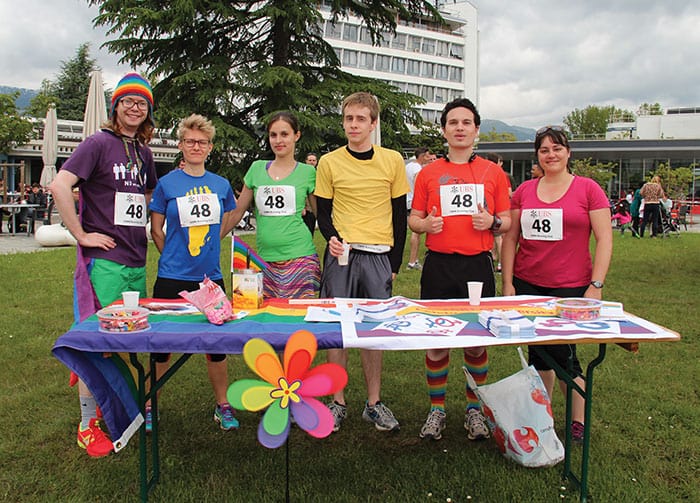
Joining together Members of the LGBT CERN group including Aidan Randle-Conde (left) and Thomas Elias Cocolios (second from right) at a CERN event. (Courtesy: LGBT CERN)
Randle-Conde – who is now based at the Université libre de Bruxelles and continues to work on the CMS experiment – had been an on-and-off LGBT rights campaigner in his spare time since 2001, including a sabbatical as vice-president of the student union at Oxford, when he campaigned for queer rights and other issues such as disability and racial equality. With this experience in hand, in December 2010 he founded the group LGBT CERN together with an old friend from Oxford, Ian Randall, who was then editor of the ALICE collaboration’s newsletter, ALICE Matters. (Randall has written for Physics World several times as a freelance author.)
“One of the main reasons I wanted to set up the LGBT CERN group,” says Randle-Conde, who took the reins as its leader, “was to create a safe space for LGBT people and their allies where they could meet and create a social group.” He explains that one of the main problems most people find when they move to CERN is social integration, since they come from different parts of the world, often not speaking French, and perhaps not staying for long.
For its members, LGBT CERN filled a gap in CERN’s social community. Van Woerden eventually told his summer-internship roommate that he was gay; his roommate replied that it was “not a big deal” for him; and that was that. However, when Van Woerden went on to secure a contract as a technical student on the ATLAS experiment, he didn’t tell his colleagues he was gay, fearing it might affect his future career in particle physics. “In some ways I had become ‘closeted’,” he says. Once LGBT CERN was set up, Van Woerden joined and found that meeting other gay people at his workplace gave him confidence. “The existence of the LGBT club helped a lot,” he says. “I started telling people I am gay.”
Van Woerden’s new network of friends also gave him the courage to deal with some homophobic behaviour he encountered. “I had a rather disturbing experience with a guy who came into my office from time to time to work with a colleague of mine,” he explains. “He made homophobic jokes; not necessarily directed at me, but I was in the room and it made me feel uncomfortable.” The situation was resolved when Van Woerden spoke with his colleague; he never saw the homophobic man again. But, he adds, “I would never have had the courage to take action if I hadn’t had full confidence that people would back me up.”
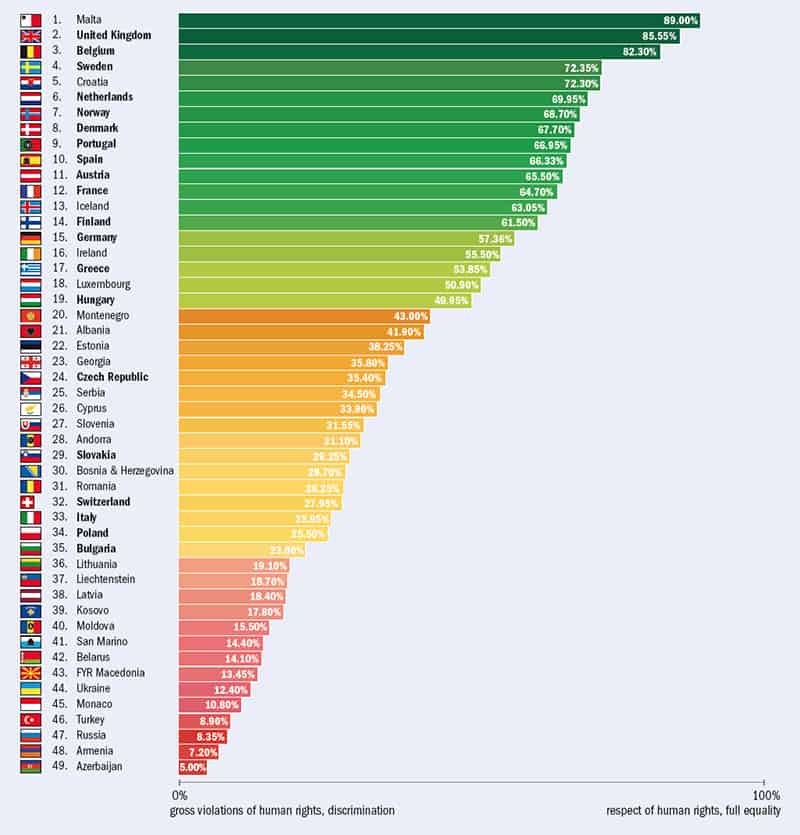
1 Spectrum of attitudes in Europe Rainbow Europe (www.rainbow-europe.org) ranks all 49 European countries on the basis of laws and policies that directly impact the human rights of lesbian, gay, bisexual, trans and intersex people. Countries are scored on criteria in six categories, including bias-motivated speech/violence and freedom of assembly, association and expression. We used the latest data at the time of going to press. CERN’s 20 European member states are highlighted in bold.
A member of LGBT CERN, who prefers to remain anonymous, says that at first he was reluctant to join. “I expected that I would have to be out – a loud and proud LGBT person – identifying myself as a homosexual male in public,” he says. This would have been troublesome for him, he explains, as he is not ready to be out. He also felt that his religious beliefs might cause “some level of friction” with club members, since homosexuality and religious beliefs do not always go hand in hand. However, when he joined the club he was amazed to find that “they welcomed me as an ‘in the closet’ – religious – homosexual person with open arms”. He believes that a safe and welcome platform is needed to make friends and learn the social norms of CERN–Geneva society and that, for him, LGBT CERN is this platform.
As well as providing each other with social support, LGBT CERN is also a space where members can discuss work-related issues unique to their community. For example, if a group member is offered the chance to speak at an international scientific meeting in a country, such as Russia, which has seen violent anti-LGBT attacks in recent years (see figure 1), how should they respond? While one solution would be simply not to attend the conference, turning down a speaking opportunity can count against you. You might not be offered another chance to speak for some time, hampering your career.
A shaky infancy
LGBT CERN is now a well-established group with more than 80 members. But Randle-Conde, who was chair of the club until 2013 when he took up his current position in Belgium, recalls that it had a “shaky infancy”. The first challenge was getting enough people involved. “You can’t have an LGBT group without members,” he says, “and most of the members are ‘invisible’ in the sense that unless someone identifies with a group one can’t tell if an individual is LGBT.” To raise awareness of LGBT CERN, the group put out messages via ally groups such as Young@CERN and Brits@CERN. Slowly and steadily, the membership of LGBT CERN grew. A weekly lunch meet-up at CERN’s “Restaurant 1” and bi-weekly drinks in central Geneva were established, as was a monthly DVD night that was popular with the group’s non-out members.
The next step was to get LGBT CERN recognized as an official CERN Club, of which there are now 53 including the Running Club, the WoMen’s Club (previously the Women’s Club, which was renamed to be more inclusive) and the Collectes à long terme – the “Long-term collection”, which is a CERN Staff Association programme to fundraise money for humanitarian projects. Randle-Conde says the main motivation for LGBT CERN becoming a CERN Club was that it would make the group more visible to potential members. Other benefits would include having some protection from CERN to help deal with any problems that might arise.
In early 2012 members of the LGBT CERN committee therefore contacted Rachel Bray, who leads the Clubs Coordinating Committee (CCC), but were disappointed when Bray told them it was unlikely that LGBT CERN would become an official CERN Club. Around the same time, Randle-Conde says, his group also contacted the then newly created CERN Diversity Office and met its then head, Sudeshna Datta-Cockerill, who is now the CERN ombudsperson. Randle-Conde and Datta-Cockerill have conflicting memories of this meeting. The former says that Datta-Cockerill told him there was “no space in the organization of the Diversity Office for an LGBT group”; however, Datta-Cockerill says that she thought they had some very useful and constructive discussions at the time, which contributed to a proposal that would later be implemented. Since these were face-to-face meetings, no documentation was available to Physics World to verify what was said.
Pursuing CERN Club status
Undeterred, members of the group put together a formal application to be a CERN Club and in July 2012 met the Staff Council of the Staff Association (the CCC’s parent body) to explain why it was pursuing official status as a CERN Club. After the meeting, group members left so that the Staff Council could discuss the application in a closed session, and waited to hear about the decision.
Two days later, Randle-Conde and his fellow applicants received an e-mail from physicist Michel Goossens, then president of the Staff Association, who retired earlier this year after a 36-year career at CERN mostly developing tools for scientific document handling. The e-mail acknowledged that the statutes of LGBT CERN were “compatible” with those of the Staff Association, but added that “there was a consensus to give Council more time for reflection in order to understand whether the form of a club under the aegis of the Staff Association is the best way for the LGBT community to get the visibility and representation they want”. The message went on to lay out plans to communicate with senior management “to define a common approach on the issue at hand in the framework of the Code of Conduct, and the equal opportunities and diversity policies advocated by the Organization”. This would then be reported back to the Staff Council in October.
The following month, in August 2012, an article written by CERN’s then director-general Rolf Heuer, entitled “Strength in diversity”, was posted on the CERN website. “We’re proud of our diversity at CERN, where all individuals can contribute to their full potential, without the need for groupings or associations that foster separateness,” he wrote.
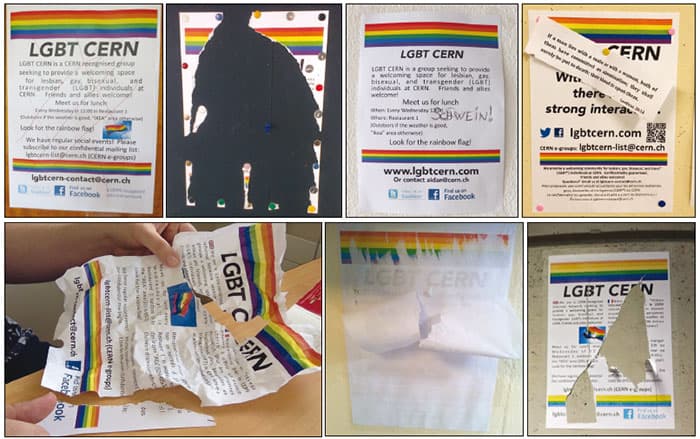
Intolerance on show Seven of the 14 images that were sent to Physics World showing defaced LGBT CERN posters. (Courtesy: LGBT CERN)
In October, Randle-Conde and his fellow applicants received another e-mail from Goossens, containing a formal “position document”. In this, Goossens included the above quote from Heuer and added that this point “is important, since the Staff Association also considers that a diversity policy should not divide by fostering the emergence of interest groups or associations promoting particular communities”. He then delivered the association’s decision on whether LGBT CERN could be an official CERN Club: “taking into consideration the arguments developed previously the Staff Council decided not to recognize LGBT CERN as a ‘Club under the aegis of the Staff Association’, on the basis that it groups members of a particular community, LGBT in this case”.
To outsiders, this might all seem like a trivial matter, but it was a blow to members of LGBT CERN. “Should an organization of several thousand people from across the world seeking more social inclusion and legal protection have an LGBT group?” asks Randle-Conde, rhetorically. “I find it deeply worrying that within the Staff Association this is considered worthy debate at all, as the two sides are not equally valid or equally worthy of attention.”
Thomas Elias Cocolios, who was a research fellow at CERN when the group formed in 2010 and in 2012 went on to work as a research fellow at the University of Manchester in the UK, says that his experience as an LGBT person at CERN was positive overall, and it was only when the Staff Association’s decision was delivered that he realized how dire he felt the situation was. He points out that the LGBT community at Manchester formally organized itself at the same time as LGBT CERN started. “They have received complete support from the university leadership and the university is now a Stonewall Champion,” he says. “It is just a question of how seriously the management considers the issue.”
Another challenge for the group has been people taking down or vandalizing its posters. As well as communicating that LGBT CERN seeks to provide a welcoming space for lesbian, gay, bisexual and transgender individuals at CERN – with friends and allies welcome – the posters also give details of the group’s upcoming events as well as their contact details. Physics World was sent photographs of 14 LGBT CERN posters that had an offensive note attached, been covered with blank paper, been “crossed out” with red pen, had “No post here” or “Schwein!” (pig in German) written over them, had chunks ripped out or been torn off and crumpled. One photo shows an LGBT CERN poster with a printed-out message attached to it quoting the Biblical book of Leviticus: “If a man lies with a male as with a woman…they shall surely be put to death.”
Seeking solutions
Faced with the anonymous hostility represented by the poster defacements, as well as what they felt was a lack of endorsement from CERN’s Diversity Office and Staff Association, in November 2012 the members of the LGBT CERN committee sent a letter to a group of eight people – including Heuer, Datta-Cockerill and Goossens – in which they summarized the events to date and wrote that “choosing not to recognize LGBT groups is no longer seen as a neutral action in Western Europe”.
“We are very disappointed with the position of the Staff Association,” they wrote. “This ruling violates the legislation of the Council of Europe on sexual orientation and gender identity.” To support their argument they appended some passages from the Council of Europe’s adopted recommendation CM/Rec(2010)5 on measures to combat discrimination on grounds of sexual orientation or gender identity. These included the passage: “Member states should take appropriate measures to ensure…that the right to freedom of association can be effectively enjoyed without discrimination on grounds of sexual orientation or gender identity; in particular, discriminatory administrative procedures, including excessive formalities for the registration and practical functioning of associations, should be prevented and removed.”
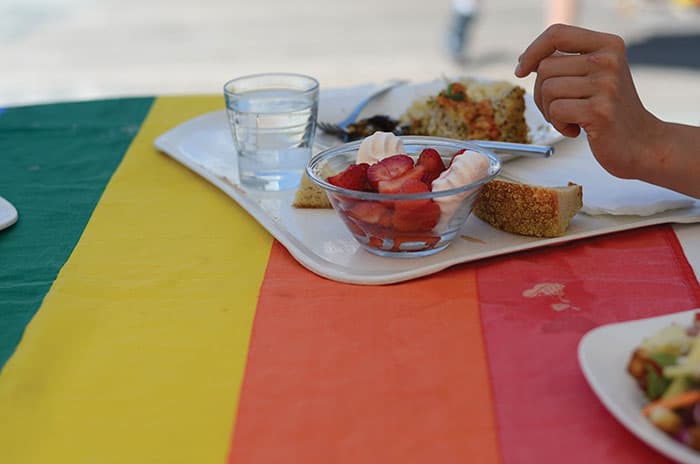
Meeting point LGBT CERN organizes lunches, as well as DVD nights and drinks, both at CERN and in central Geneva. (Courtesy: LGBT CERN)
The LGBT committee wrote that “We…would like to encourage the Staff Association and CERN directorate to revise their current position in keeping with the existing legislation and accept us alongside the other clubs. As members of the CERN community, we think it would be best for everyone if this matter is resolved internally and brought into line with the regulation of the Council of Europe.”
Shortly after sending the letter, the LGBT CERN committee was invited to meet the Diversity Office, which proposed the creation of a system of “Informal Networks” to represent the interests of different self-organized groups, and that LGBT CERN would be the first. “We were very happy with this development,” says Randle-Conde. “We got nearly all of what we asked for, but the situation will still need to change, because we will continue to be seen as separate from the clubs.” The group stuck to its guns of trying to solve the matter internally and it was only when Physics World approached the group in 2015 that it decided to speak out publicly.
Where we are now
Geneviève Guinot, who became leader of the Diversity Programme in 2014, says she believes that LGBT CERN is being appropriately supported with its recognition as an Informal Network. She says that the Clubs are created based on a particular sport, leisure or cultural activity – as opposed to individual characteristics – and that they are open to the external world, whereas the Informal Networks are not. The idea of creating Informal Networks was “to support integration at CERN and give such existing groups an ‘official’ existence at CERN”, she says, adding that there are now nationality and disability networks too. “My team also has regular meetings with the group to discuss matters of concern,” she says. Such matters have included extending the scope of paternity leave to any staff member, regardless of gender, and equal benefits for married couples or couples in a registered partnership, also regardless of gender, both of which have now been implemented at CERN.
Arnaud Marsollier, head of press at CERN, makes another point as to why LGBT CERN is not a CERN Club. He says that clubs are shaped to allow people to share passions and practise activities together in an inclusive way, avoiding, for example, political or religious groups. “LGBT is not a political or religious one, but when you open the door to different types of groups, it might be difficult not to see some kind of lobbying bodies appearing on different topics, rather than clubs to just develop leisure activities,” he says.
As for the poster defacement, Marsollier says disciplinary measures have been taken against at least one person. In addition, the issue was tackled publicly in July 2015 by Heuer. In an article published on the CERN website entitled “Our humanity at CERN”, Heuer wrote “[CERN is] a place where everyone is welcome, and where anyone can succeed, regardless of his or her ethnicity, beliefs or sexual orientation. It is therefore with some disappointment that I have learned of a spate of recent events concerning posters put up around the laboratory by our LGBT community.” He wrote that he was establishing a policy for poster use at CERN involving a series of dedicated poster display areas subject to certain guidelines. “Look out for that policy, but in the meantime, I encourage you all to show respect to your neighbours, regardless of their individual differences,” he continued. “Doing so is part of CERN’s identity. It is part of our humanity.”
According to the current chair of LGBT CERN, the group has not noticed any significant change in the rate of poster removal since Heuer’s statement. As Physics World went to press, the official poster policy had yet to be announced.
Marsollier says that CERN has made “quite significant progress” since LGBT CERN was formed in 2010 considering the “large diversity in sensitivities” at what is a large international collaboration. For many members of LGBT CERN, however, the group’s lack of Club status remains a sore point, even following the establishment of the group as an Informal Network. “As long as we have Clubs for some groups, but not for the LGBT CERN group we will be seen as different and less deserving of support by many people,” says Randle-Conde. “Most people at CERN do not even know what an Informal Network is.” An LGBT CERN member who wishes to remain anonymous expresses a similar sentiment: “The unequal (though improving) treatment of the LGBT CERN group is evidence that CERN still has a long way to go in accepting LGBT people,” he says.
Sound engineer Paul Waton and soprano Lesley Garrett discussing theatre acoustics at the Royal Opera House. (Courtesy: Brian Slater)
By James Dacey
Concert hall acoustics was the theme of a fascinating panel debate last night at the Royal Opera House (ROH) in London. Among the speakers was British soprano and presenter Lesley Garrett who shared her views on the acoustics of some of the great concert halls in which she has performed. She was joined by acoustics engineer Trevor Cox, acoustics consultant Helen Butcher and sound engineer Paul Waton, who has recorded a range of classical concerts for the BBC. Insight: the Art and Science of Acoustics was co-hosted by the Institute of Physics, which publishes Physics World.
Cox – who featured in our 2014 podcast about sonic wonders – set the scene by describing some of the fundamental acoustic considerations in designing a concert hall. We heard clips of Cox playing a saxophone in an “anechoic” chamber, followed by the same sax lick performed in an oil tanker – the place with officially the longest echo in the world. Cox’s point was to show the difference between high clarity at the one extreme and intense reverberation at the other. The sound wasn’t quite “right” in both cases. “Concert hall design is about finding a pleasing balance between these two extremes,” he said.
A measurement made under the “wrong” experimental conditions has given physicists in Canada and China an unexpected insight into how atoms interact with each other in ultracold gases.
Scott Smale was a new PhD student in the lab of Joseph Thywissen at the University of Toronto, when he took spectroscopy data from an ensemble of trapped potassium atoms that were accidently set to interact with each other via a p-wave process, where the atoms do not collide head-on. This was a mistake because conventional wisdom holds that p-wave interactions make atoms very difficult to trap, and the ensemble would very quickly disperse before Smale saw anything. Instead, he was able to measure very distinct features of a gas dominated by p-wave interactions, which he and his colleagues then set about studying in much more detail.
“Nature surprised us,” says Thywissen. “There was a beautiful spectroscopic signal of a new kind of pressure that was due to p-wave interactions.”
P-wave interactions occur when two particles collide with a glancing blow. If the force between the atoms is attractive, the atoms can become bound together in a quantum state with orbital angular momentum.
Contact collisions
To better understand what was going on in its experiment, the Toronto team joined forces with theorists Shizhong Zhang of Hong Kong University and Zhenhua Yu of Tsinghua University. The researchers defined the collisions between atoms in terms of two “contact” parameters. This description differs from that of an ultracold gas in which head-on s-wave collisions dominate and just one contact parameter is needed to describe the pressure due to collisions.
The researchers then measured the values of the contact parameters using a technique called dynamical spectroscopy, which allowed them to prepare and probe the atoms faster than had been done in the past. “Our observations took less than a millisecond,” says Thywissen. “Previous studies were searching for properties that required longer observation. It allowed us to see something before the losses became too significant.”
The study involved two different experimental scenarios. In the first, radio waves were fired at the gas, which caused some of the atoms to transition to an atomic state that does not interact via p-wave collisions. Careful analysis of the transition rate as a function of the applied radio frequency gives the team values for both contact parameters. The second scenario involved switching off the trapping magnetic field and allowing the gas to expand for several microseconds. The momentum distribution of the atoms is then measured and values for contact parameters were derived from these data.
Physicists already know that p-wave interactions play an important role in superfluid helium-3, which forms at ultracold temperatures when fermionic helium-3 atoms become bound into p-wave pairs. These pairs are bosons, which can then condense into a superfluid. The p-wave pairing of electrons is also thought to play a role in the superconductivity of some materials, however evidence for this remains very sketchy.
Trapped gases of ultracold atoms offer physicists a way of studying how interactions between atoms or electrons result in phenomena such as superconductivity and superfluidity. This is because the strength of the interactions between ultracold atoms can be “dialled up” by adjusting the magnetic fields that are used to trap the gas.
Looking for condensation
The team is now designing new experiments to gain a better understanding of p-wave interactions. According to team-member Chris Luciuk, dealing with the loss of atoms to keep the gas together for a longer time is still a key challenge. Options for boosting the lifetime of the gas include confining the atoms to two dimensions and using a laser as well as magnetic fields to fine-tune the interactions. “Ideally, we could look for p-wave pairing leading to condensation,” Luciuk told physicsworld.com.
Extraterrestrial civilizations may be searching for signs of life on distant planets using the same techniques that we employ in our search for alien life. That is the key concept underlying a proposal from a duo of physicists, who want to ensure that we do not miss a possible signal from extraterrestrial observers trying to contact us. The researchers say that we should be looking for signals from extraterrestrial civilizations that could, at a previous time, have spotted Earth as it transited across the face of the Sun and realised that it could be a habitable world. The team has identified a small band in the sky from which Earth could be easily detected, and suggest that we should look for signals coming from that area.
Over the past decade or so, astronomers have discovered more than 2000 exoplanets – those that orbit stars other than the Sun – along with a further few thousand possible exoplanet candidates. Most of these exoplanets have been detected by NASA’s Kepler Space telescope using an indirect detection technique known as the transit method. Kepler looks for small, regular dips in intensity of light from a star, caused by a planet or a system of planets as they pass between the star and Earth. A similar technique, called transit spectroscopy, has allowed astronomers to study the atmospheres of exoplanets, which could hold clues about life on them, should it exist.
Perfect view
Now, Ralph Pudritz from McMaster University in Canada, together with René Heller from the Max Planck Institute for Solar System Research in Germany, have focused their attention back on Earth by presuming that extraterrestrial observers, also adopting the transit method, may have already detected the Earth. “The basic point is that the simplest way to detect the presence of a planet in orbit around a star is to detect the periodic decrease in the star’s light as the planet traverses across its disc. If you measure the percentage drop in the light of a star and observe that this repeats itself regularly, then the chances are good that the light is being blocked by a planet that orbits the star. It also tells you that you are lucky enough to be in the planet’s orbital plane around that star,” explains Pudritz, who is also the founding director of the Astrobiology and Origins of Life interdisciplinary programme at McMaster.
According to the duo, large-scale projects that hope to pick up a signal from an exoworld – such as the Breakthrough Listen initiative – should focus on the Earth’s “transit zone”. This is the region in the sky from which an observer could see the Earth as it transits less than half a solar radius from the centre of the solar disc. The possible exoplanetary systems that enjoy this view are all located in a small strip in the sky that is defined by the projection of the Earth’s orbit around the Sun (the ecliptic) onto the celestial sphere.
An observer could essentially only see a dimming effect if they remained within this zone. “You have to be very close to the midplane of that orbital zone as is shown on the diagram [see above],”says Pudritz, adding that “different observers in the galaxy would see this at different times in Earth’s year as the Sun, and the Earth with it, moves through their night skies.”
Although the transit zone amounts to only about two-thousandths of the entire sky, it is rich in host stars for planetary systems. Indeed, there are approximately 100,000 systems, each of which could include habitable planets or moons, according to the duo. The researchers compiled a list of 82 nearby Sun-like stars that satisfy their criteria. This catalogue can now serve as an immediate target list for SETI initiatives. The team says that if any of these planets host intelligent observers, they could already have identified Earth as habitable, and decided that ours is a rocky world worth probing. Furthermore, we could be receiving their broadcasts today.
See me see you
Some of the exoworlds that lie within our transit zone could also be detected by the European Space Agency’s Planetary Transits and Oscillations of stars (PLATO) mission, scheduled for 2024. “PLATO might even detect the transits of exoplanets, whose possible inhabitants would be able to see the Earth transiting the Sun,” adds Heller, who is also part of the mission. “Such a crazy set-up would offer both them and us the possibility of studying each other’s planets with the transit method.”
Pudritz and Heller told physicsworld.com that their research has further developed “an important idea about how we might build on decades worth of pioneering SETI searches by employing a potentially more powerful search strategy for detecting transmission from extraterrestrial intelligent sources”.
The work will be published in Astrobiology (doi:10.1089/ast.2015.1358).
Valley state: real-life landscapes can be as beautiful as their condensed-matter counterparts. (CC BY-SA BorisFromStockdale)
By Hamish Johnston
Condensed matter is a physicist’s paradise because of the seemingly endless number of ways that atoms can be rearranged to create systems with new and exciting behaviours. A great example of this is the emerging field of “valleytronics”, which is concerned with a property of electrons that emerges in some semiconductors and 2D materials such as graphene.
The eponymous valley is a local minimum in the conduction band of a solid that “traps” electrons into a specific momentum state. Things get interesting when a material has two valleys that result in two distinct momentum states. In some materials these states resemble the quantum-mechanical property of spin: an electron can be in one of two spin states (up or down) and it can also be in one of two momentum states. As a result, this property is sometimes referred to as valley pseudospin.
The new issue looks at ways to make physics a more inclusive discipline, including spotting your unconscious bias, tuning in to talent and tackling “microaggressions” – small acts of injustice that make people uncomfortable because of who they are, not what they do.
A new particle that is a bound state of four different flavours of quarks has been discovered by physicists working on the D0 experiment at Fermilab. Called X(5568), the particle has a mass of about 5568 MeV/c2, and appears to contain “up” and “bottom” quarks as well as “down” and “strange” antiquarks.
Although other tetraquarks have previously been identified, X(5568) is the first in which all of the quarks have different flavours, which could affect our understanding of how quarks interact with each other. The discovery is also notable because X(5568) is produced at a much higher rate in proton–antiproton collisions than had been expected.
The particle was discovered by sifting through data acquired by D0 – an experiment that ran at Fermilab’s Tevatron proton–antiproton collider from 2002 to 2011. The statistical significance of the discovery is 5.1σ, which puts it just above the 5σ required for a discovery in particle physics.
Possible configurations
Most known hadrons are either mesons, which contain a quark and an antiquark, or baryons, which comprise three quarks. A proton, for example, contains two up quarks and one down quark, while a BS meson contains a bottom quark and a strange antiquark.
The theory of the strong force – quantum chromodynamics (QCD) – allows for other types of baryons with four or more quarks. But doing calculations using QCD is extremely difficult, so it is not clear what tetraquark configurations are possible.
A tetraquark could comprise four quarks that are tightly bound to each other or it could be made of two mesons more loosely bound in a molecule-like structure. Indeed, understanding what goes on inside tetraquarks and pentaquarks would provide very important information about QCD itself.
In 2008 physicists working on the BELLE experiment in Japan discovered a tetraquark with a mass of 4430 MeV/c2. The discovery was backed up in 2014 by the LHCb experiment at CERN, which was able to detect the particle with a statistical significance of greater than 13σ. Then in 2015 LHCb physicists discovered that five quarks can be bound together to form pentaquarks.
Charming cores
Until the discovery of X(5568), all known tetraquarks and pentaquarks contained a charm quark/antiquark pair. This led some physicists to speculate that charmonium – a bound state of a charm quark and antiquark – creates a “core” around which tetraquarks and pentaquarks can form. The fact that X(5568) does not contain any quark/antiquark pairs of the same flavour, suggests that charmonium does not hold the key to understanding the formation of tetraquarks.
Another interesting aspect of the X(5568) discovery, according to Tim Gershon of the University of Warwick, is the rate at which it is being produced in the proton–antiproton collisions. The particle appears to be produced at a rate that is several orders of magnitude higher than expected, and Gershon believes that it is very important that the result be confirmed by other experiments.
Gershon, who works on LHCb and was not involved with D0, told physicsworld.com that the LHCb collaboration is now looking through its collision data for evidence of X(5568). He adds that this latest discovery shows that the study of exotic particles such as tetraquarks and pentaquarks will be a rich area for the future for experiments like LHCb.
The International Space Station (ISS) usually has only the human variety of primate on board, but earlier this week a gorilla seemed to have joined the crew. If you thought that this was part of one of the hundreds of planned experiments on the ISS you would be wrong. Instead, it was crew member Scott Kelly’s birthday hijinks after his twin brother sent him the suit for his birthday as the astronaut celebrated a year in space. Kelly will return to Earth in six days’ time.
Interestingly, this is the first time NASA has sent up one half of a pair of twins into space and is studying just how life on the ISS will change Scott’s physiology from that of his twin Mark. Apart from looking at how life in space will alter everything from Scott’s DNA to his gut microbes, this is also a real-life variation of the “twin paradox” experiment where Scott will return to the planet a bit “younger” than his twin in that Scott’s clock runs a bit slower than Mark’s, thanks to the ISS’s orbital speed of 17,000 mph. After reading this, if you feel like you would like a go on the ISS, NASA is currently hiring.