Surreal behaviour spotted in photon experiment

By studying how photons travel through a double slit, physicists in Canada have now shown that some photons follow “surreal trajectories” that appear to defy the laws of physics. Upon closer inspection, however, the experiment reveals that the behaviour of these rogue photons can be explained using the principle of quantum entanglement. The work has resolved a 25-year-old debate based on an alternative interpretation of quantum mechanics.

In the conventional interpretation of quantum mechanics, the motion of a particle is defined by a wave function that gives the probability of the particle being at a certain place at a certain time. The uncertainty principle means that a precise measurement of the particle’s position at a specific time will result in a large uncertainty in what its momentum is at that time – and vice versa. As a result, the concept of a trajectory in the sense of a unique path followed by an object does not exist in quantum mechanics.

In 1952 David Bohm came up with an alternative interpretation of quantum mechanics in which a particle follows a trajectory that is guided by a “pilot” wave function. The probabilistic nature of quantum mechanics would arise from the fact that the initial conditions of the particle are unknown – this is built into the pilot wave function. A precise measurement of the position of a Bohmian particle, for example, would alter the wave function such that a simultaneous measurement of the particle’s momentum must lie within the bounds of the uncertainly principle.

Surreal paths

In 1992 Berthold-Georg Englert and colleagues argued that under certain circumstances – such as when a particle passes through a double slit – some Bohmian trajectories defied explanation. Dubbed “surreal trajectories”, their assertion sparked a debate in the quantum-physics community as to the validity of Bohm’s approach to quantum mechanics. Now, Aephraim Steinberg and colleagues at the University of Toronto have measured surreal trajectories and showed that they are consistent with quantum theory.

The team used a technique called “weak measurement” to trace out the set of trajectories taken by photons through a double slit. This technique involved a gentle probing of the direction of motion of the photons to build up an understanding of the possible routes taken by photons through the apparatus. Crucially, each measurement is so gentle that it does not have a significant effect on the pilot wave function. (See “In praise of weakness“).

Their “double-slit” experiment begins with the production of a pair of photons that are entangled in terms of their polarization. Photon-1 is then sent into a polarizing beam splitter, which produces two parallel beams – one with horizontal polarization and the other with vertical polarization.

Tiny shift

The researchers also perform a weak measurement on the transverse velocity of photon-1 after it emerges from the slits. This is done by passing the photon through a calcite crystal, which causes a tiny shift in its polarization, which is proportional to its transverse velocity. Using focusable optics, the team was able to measure the transverse velocity at different locations, as the photons travel over a distance of about 5 m. Using this information, Steinberg and colleagues were able to build up a set of trajectories taken by the photons.

Because photon-1 and photon-2 are entangled, a measurement of the polarization of photon-2 will reveal which slit photon-1 passed through. However, when Steinberg and colleagues looked at the set of photon-1 trajectories that should have passed through the lower slit (according to photon-2’s polarization), they found that some of the trajectories appeared to have taken photon-1 through the upper slit – and vice versa. These are the surreal trajectories predicted by Englert and colleagues.

However, closer examination of the data revealed that this apparent surrealism depended upon where along the trajectory the measurements were made. Indeed, Steinberg and colleagues identified cases in which photon-1 begins on a trajectory from the lower slit, but then swerves upward into a trajectory that appears to be from the upper slit. Using a technique called quantum-state tomography, they were able to monitor the polarization of photon-2 during this swerve, and saw its value rotate from horizontal (indicating the lower slit) to vertical (indicating the upper slit). As a result, a measurement on photon-2 at the end of the trajectory gives the “wrong” slit.

Vivid illustration

Steinberg and colleagues believe that the photon’s swerve is thanks to quantum interference that occurs when they emerge from the slits. As well as resolving the surreal-trajectory problem, the experiment also provides a vivid illustration of how a property of one entangled particle – the polarization of photon-2 – can be affected by the trajectory of its distant partner.

Rainer Kaltenbaek of the University of Vienna describes the work as “a beautiful experiment that challenges our everyday thinking”. He adds that it “illustrates one of the central issues that quantum entanglement poses for Bohmians”.

The experiment is described in Science Advances.
Fixing the Sun’s magnetic sway on cosmic rays

Using recently released data from the Voyager I satellite mission, researchers in the US have developed a new and accurate formula that describes the Sun’s influence on cosmic rays. Cosmic rays – extremely high-energy charged particles that originate outside of the solar system and travel at nearly light-speed – are studied by numerous experiments because they shed light on some of the most violent phenomena in the universe. The researchers hope that their formula will improve the analysis of cosmic-ray data, by better predicting how these particles are affected by solar wind.

First discovered in 1912 by physicist Victor Hess during a daring hot-air-balloon flight, cosmic rays are constantly bombarding the Earth’s atmosphere, producing showers of secondary particles that even sometimes reach the surface. Cosmic rays are mainly made up of high-energy protons and atomic nuclei. Their origin is still something of a mystery, although recent experimental data from the Fermi Space Telescope have shown that many of them originate from supernovae, while some may come from quasars. Almost all of our observations of cosmic rays are carried out within the heliosphere – the massive magnetic bubble that extends well beyond Pluto’s orbit and contains the solar system.

Solar force field

When the idea of “solar wind” was developed in the early 1960s, researchers realized that cosmic rays would be modulated by the magnetic field embedded within the wind, and developed some formulas to account for this effect. Known as the “force-field approximation”, it takes into consideration the final observed energy of the cosmic rays when they reach the Earth and of the energy of cosmic rays in the surrounding interstellar medium (ISM) – the matter that exists between star systems in a galaxy and is therefore outside of the heliosphere.

While the force-field approximation has been widely employed since 1968, it has several weaknesses. The most important shortcoming is the fact that it does not take into account the strong correlation between the solar modulation and changing solar activity. In fact, the modulation is charge-dependent and varies over time, over a scale of months to years – something that the approximation does not consider.

Understanding the effects of solar modulation is one of the science goals for both the Payload for Antimatter/Matter Exploration and Light-nuclei Astrophysics (PAMELA) experiment and the Alpha Magnetic Spectrometer (AMS), which study cosmic rays in space. Thanks to the detailed and continuous measurements of cosmic rays made by both of these experiments, researchers can now see how the cosmic-ray spectrum changes over relatively short timescales with high statistical precision. Also, recently released data from the Voyager 1 spacecraft – which has most likely left the solar system and is beyond the heliopause – has provided the first measurements of cosmic rays that are unaffected by the solar wind, in the ISM.

Magnetic morphology

Thanks to these advances, Ilias Cholis from Johns Hopkins University in Baltimore, together with colleagues at the Fermi National Accelerator Laboratory and the University of Chicago, has built on the force-field approximation, as well as other simulations done by other groups in the past decade, to refine the modulation formula. Cholis says that the approximation’s simplifying assumptions have been challenging the data from recent experiments. “We now are confident that particles of different charge get affected differently by the embedded field of the solar wind,” he says, explaining that their new formula takes into account previously unknown physical phenomena within the wind. “Also the morphology of the magnetic field within the heliosphere is an important aspect of the problem, as is the energy of the cosmic-ray particles and the time it takes them to propagate form the interstellar medium to the position of the Earth were we observe cosmic rays.”

The team analysed cosmic-ray data, collected by many balloon experiments, from AMS-02 and PAMELA, and also from Voyager 1, over 24 years. The researchers also took into consideration solar-wind data of the last two decades to account for the time dependence of the embedded magnetic field – something that has not been done before.

Seasonal variations

Cholis told physicsworld.com that their final formula for the solar modulation potential accounts for the fact that different cosmic rays with different charge and energy experience a time-varying magnetic field within solar wind. “Since we continuously monitor the solar-wind properties, we will be able to know (within some remaining uncertainty) at a given time what the solar modulation potential will be for particles of given charge and energy. As more data will be collected by AMS-02 over the next decade, those remaining uncertainties will be probed and further constrained,” he adds.

One of the main aims of the AMS-02 experiment is to detect antimatter cosmic rays, which are thought to be produced by annihilating dark-matter particles. Cholis and colleagues hope their formula will help the AMS researchers to reduce systematic uncertainties that crop up in the measurements.

The research is published in Physical Review D.

What is a superfluid?

In the last video from our 100 Second Science series we looked at why superconductivity is such an intriguing curiosity. This time round, John Saunders of Royal Holloway University of London explains the equally weird phenomenon of superfluidity – fluids that flow without friction.

Saunders explains how the transition to superfluid is a quantum process that usually takes places at low temperatures, such as in the cases of helium-3 and helium-4. The condensed-matter researcher goes on to say that superfluid states also occur in neutron stars because they are so dense.

If you enjoyed this video explainer, then check out more from our 100 Second Science series.

‘Big science’ begins

As someone whose career has been spent building gargantuan underground neutrino detectors, I have often wondered what people centuries hence will make of “big science”. Will it have become so ingrained in the way science is done that people will not think of it as something that had to be invented? Or will the penchant for attacking big questions with big experiments have burned itself out, as the building of huge cathedrals seems to have done in Europe?

Whenever the era of big science ends, we can certainly say when it began. In the period just before, during and (especially) after the Second World War, laboratories devoted to projects too big to be accomplished in an individual university lab sprang up around the world. Michael Hiltzik’s Big Science recounts the beginnings of one such lab, the Radiation (or Rad) Lab at the University of California, Berkeley, in the context of a biography of its founding director, Ernest Lawrence. A towering figure of 20th century science, Lawrence is well worth a biography, and Hiltzik’s book makes an excellent read for those interested in the origins of our modern way of doing big science (and the influence of science on public policy), as well as the early days of nuclear physics.

The young Lawrence did not seem destined for greatness. Born in small-town South Dakota and initially sent to a small Lutheran college (from which a transfer for his second year at the University of South Dakota was a big step up), he fell under the influence of a charismatic teacher, William Swann, during graduate study at the University of Wisconsin (just as Lawrence would inspire his later acolytes, including no fewer than seven future Nobel laureates). Lawrence followed Swann through several institutions, all the while building his reputation as a master experimentalist and a person of extraordinary drive and persuasiveness. He settled at Berkeley in 1928 and remained there for the rest of his life, leading its transformation from a physics backwater to one of the world’s premier institutions in the field.

In 1929 Lawrence hit on the idea that would make his career and transform physics. In those early days of nuclear physics, discoveries were coming hot and fast (mostly in Europe), but there were limits to what could be achieved using particles supplied by natural radioactive sources. What was really needed was a way to artificially accelerate particles in a controlled beam to much higher energies than nature provides. Lawrence solved this problem by inventing the cyclotron, and the book does an excellent job of explaining the principles and importance of the device in simple terms.

All Lawrence’s machines were built in collaboration with others, and as he built bigger and bigger devices to achieve higher and higher energies (often starting on the next before the current one was operational), the teams got larger and larger. In building those teams, Hiltzik argues, Lawrence transformed not just one scientific problem, but the way some entire sciences are done. In time, the make-up of these teams morphed from jack-of-all-trades graduate students into groups of expert specialists, melding the skills of engineers, experimentalists and theorists to deliver projects beyond the scope of any small group.

Lawrence followed this model to assemble the teams that built the “calutrons” (a variant on the cyclotron) used to separate the uranium-235 used in the atomic bomb dropped on Hiroshima. This part of the story is particularly interesting, as it shines the spotlight away from Los Alamos and onto the equally important (and vastly larger and more expensive) efforts around the US to provide the exotic materials required for the bombs (the plutonium used in the “Trinity” test device and the Nagasaki bomb was first isolated in Lawrence’s lab as well).

The success of the Manhattan project to build the atomic bombs transformed governments’ views of science, moving scientists to the heart of critical policy discussions and vastly inflating budgets for big science projects. Lawrence rode this wave to gain even greater influence, and to expand his Rad Lab while also building a new laboratory in Livermore. However, there was a cost: as physics became important to politics, politics invaded physics, ending the public career of J Robert Oppenheimer and producing a decades-long rift within the community. (When I was a graduate student at the California Institute of Technology in the early 1980s, I suggested inviting Edward Teller to speak at a colloquium. The biting response from a senior professor was “We aren’t going to pay Teller to come here.”) Lawrence’s standing was badly damaged in the affair, which perhaps explains why, despite his enormous influence, physicists don’t speak of him with the awe they assign to Fermi or Bethe.

The book’s subtitle, Ernest Lawrence and the Invention that Launched the Military-Industrial Complex is unfortunate, because Lawrence certainly didn’t invent the military-industrial complex (just consider what was happening in Germany at the time), and the book doesn’t really claim he did. It does claim he invented big science, and here the case is stronger. The need to build huge apparatus to address deeper questions was inherent in the science, and similar developments were taking place in other sciences (for instance astronomy). Still, the Rad Lab undoubtedly pioneered the model of the major lab used today and had a huge influence on governments and funders. For this reason, I disagree with Hiltzik’s gloomy view of the future of big science, which I think he ties too much to collider physics, whereas in fact the model has moved into many fields.

The book will be a fun read for just about anyone interested enough to pick it up. The differences between Lawrence’s time and our own make fascinating reading, particularly in the shocking attitude to safety. Lawrence had a routine he called “the vaudeville” where he would drink a solution of radioactive sodium-24 and then hold his arm up to a Geiger counter to show how quickly it spread through the body. I wonder if the “ulcerative colitis” that eventually killed him was, in fact, radiation-induced colitis (a known delayed side-effect of radiation therapy with very similar symptoms) induced by this disregard of radiation safety? Another huge change is that all of the physicists in Lawrence’s group were men, and mostly white Christian men at that. After Berkeley hired Oppenheimer, they didn’t hire his protégé Bob Serber because a senior administrator said “One Jew in the department is enough.”

There are also lessons for all scientists in the fact that those at Rad Lab became so focused on building bigger and better machines that they missed a number of discoveries that could have been done with the machines they already had. For example, they failed to discover artificial radioactivity because nobody thought to look for activity remaining after the beam was shut off. In fact, they had wired the detector to turn off when the beam turned off – turning off a Nobel prize in the process.

The book contains a few minor errors in the physics (there are no cyclotrons in CERN’s Large Hadron Collider, isotopes of the same atomic number do not have identical chemistry, and so forth), but very few for a book on complex physics written by a non-scientist, and they don’t detract from the story. The details of Lawrence’s endless pursuit of foundations and rich donors for money may wear a bit for the non-specialist, but his boundless productivity and enthusiasm sweeps the reader along. To give just one example, in later life, while performing a crushing and eventually fatal load of administrative and advisory roles, Lawrence found time to tinker with the embryonic technology of colour television. His improvements were eventually included in the televisions sold by the Japanese company Sony, under the presumably unintentionally ironic name (given Lawrence’s involvement in the Manhattan project) of “Trinitron”. Lawrence was a central player in many of the great events of the 20th century, and this book is a valuable addition to our understanding of the period.

  • 2015 Simon & Schuster £20.23/$30.00hb 528pp

Web life: Nuclear Hitchhiker


So what is this site about?

Nuclear Hitchhiker is a blog and podcast with an ambitious goal: to “educate and inform the public as to how nuclear energy, as well as radiation and other related issues, affect all of us”. It’s run by members of the Centre for Doctoral Training in Nuclear Fission/Next Generation Nuclear, a partnership between the universities of Manchester, Lancaster, Leeds, Liverpool and Sheffield, and its organizer, Mark Williams, says he aims to make the blog “an honest resource for people to learn about nuclear”. Williams is a PhD student – his research is on using uranium’s luminescence properties to characterize how it interacts with geological samples – and since he took over from the site’s founder (Matt Gunther, now a science correspondent for Chemistry World) in 2014, he has been building a list of contributors with expertise in various issues related to nuclear science, engineering and policy.

What are some sample topics?

The blog focuses on a different area each month. So, for example, November 2015 was mostly about renewable energy; posts in December concentrated on nuclear waste disposal; and the first posts of 2016 have zeroed in on the controversial (and highly topical) question of the UK’s Trident nuclear deterrent. Now and then, there are some special “guest posts” – most recently from photographer Ceri Provis-Evans, who contributed a poignant and informative photo essay on his recent trip to Chernobyl, in Ukraine.

Why should I visit?

The nuclear blogosphere is a crowded place, and for certain topics within it, better and more detailed sites do exist. Among the websites profiled in past editions of this column, Alex Wellerstein’s Restricted Data (April 2015 “Web life”, Reviews) should be everyone’s go-to blog for historical info about nuclear weapons programmes, while Gail Marcus continues to write authoritatively on recent (particularly US) industry developments in Nuke Power Talk (October 2010 “Web life”, Reviews). That said, the multi-authored, student-run nature of Nuclear Hitchhiker makes it an interesting new voice in this community, giving it the freedom – and the ability – to explore a wide range of issues from a variety of perspectives. Its strong focus on UK nuclear issues will also appeal to many readers in Physics World’s home country, thanks to short, snappy posts about, for example, Britain’s nuclear deterrent (which different contributors argue the case for and against) and its lack of a geological depository for nuclear waste (which another contributor, David Mills, believes “could be considered reckless”).

Can you give me a sample quote?

From a December 2015 post by Osman Aden: “Public perception of nuclear waste is hindering its safe storage. In 2013 Cumbria’s council vetoed [UK] government plans to locate a suitable waste storage site in the area and recently, the government-owned Radioactive Waste Management agency admitted that there was a ‘nuclear dread’ for people unfamiliar with nuclear waste. Greater consultation with local communities is required to change this. However, the recent vote to allow the government to force local communities to accept waste dumps undermines any collaboration; the secretary of state for energy can now choose suitable locations for waste storage and have the final say on their use. Instead of strong-arming local communities to store our waste against their wishes, surely a greater share of knowledge is needed and a better partnership should be formed with the public to allow communities to be more familiar with the risks and necessities surrounding nuclear waste storage?”

Celtic god of thunder gets an attosecond makeover

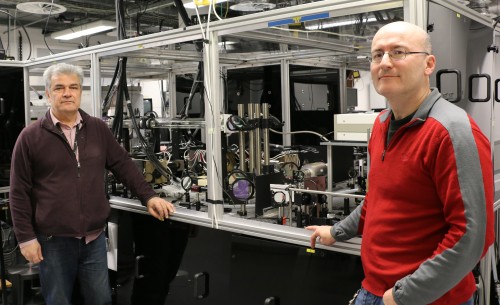
Gods of thunder: Gagik Nersisyan (left) and Matt Zepf at the TARANIS laser facility

By Hamish Johnston

I recently had the pleasure of visiting Matt Zepf, who directs the Centre for Plasma Physics at Queen’s University Belfast. Zepf and his colleague Gagik Nersisyan showed me around the TARANIS laser facility, which creates extremely bright flashes of light just like its namesake the Celtic god of thunder.

TARANIS is about to upgraded to TARANIS-X, which will deliver ultrashort pulses of extreme ultraviolet light (EUV) that are just a few attoseconds (10–18 s) in duration. Each attosecond pulse will deliver more than 10 µJ, which Zepf says will make TARANIS-X the most powerful laser of its kind by a comfortable margin.

(more…)

Computer program dreams up new quantum experiments

Quantum mechanics is so hard to understand that even experts do not entirely trust their intuition – and this makes it difficult for physicists to come up with new experiments that put the theory to the test. Now, physicists at the University of Vienna in Austria have devised a computer algorithm for designing new quantum experiments that are beyond our wildest dreams.

The idea was developed by graduate student Mario Krenn and colleagues in the group of quantum-physicist Anton Zeilinger. The algorithm is dubbed “Melvin”, and the team believes that it might be able to explore hitherto unknown properties and behaviours of quantum systems. In doing so, Melvin would take the complexity of quantum experiments to a level beyond the imaginations of human designers.

“High-dimensional” entanglement

These experiments include those with the particular goal of achieving quantum entanglement between many particles. Experimental methods for achieving entanglement of two or a very few particles are well-known. But entanglement is so counter-intuitive that it can be very difficult to see how to combine the known experimental “building blocks” to attain a more complicated state, such as “high-dimensional” entanglement between many of the particles’ degrees of freedom.

Melvin works that out unencumbered by human preconceptions. The algorithm is supplied with a set of standard experimental components that it can combine and reshuffle to achieve the desired goal. These elements consist of devices for manipulating the trajectories and quantum properties of photons. These include beam splitters, which can send a photon in two possible directions, thereby putting it into a superposition of two quantum states.

Melvin begins by assembling the elements of this toolbox randomly, and seeing if any of the configurations achieves the experimental goal. If so, Melvin then simplifies the arrangement of elements as much as possible before delivering the configuration to the user. If the goal is not achieved, it starts again with another random arrangement. After typically several days of computation on a standard laptop, Melvin can deliver several optimized solutions to the specified task.

All I was doing was guessing, and I thought that this is something the computer can do
Mario Krenn, University of Vienna

The idea began, says Krenn, when his colleague Mehul Malik wondered if a particular high-dimensional form of a quantum state called a Greenberger–Horne–Zeilinger (GHZ) state (which involves three or more entangled particles) could be created. “Several of us tried for some time to find a way to implement it experimentally” – but without success, he says. Finally, Krenn says, “it occurred to me that my intuition about how the set-up would work was wrong – basically all I was doing was guessing. And I thought that this is something the computer can do as well, but a few thousand times faster than me.”

In its first demonstration, Melvin came up with 51 new kinds of experiment for making high-dimensional GHZ states. In a second implementation, the Vienna team found how to achieve cyclic transformations of photon states, such that a sequence of transformations eventually returns the photon to its initial state. Such sequences could be useful in quantum-information processing. Here, Melvin found good solutions from around 1022 possible configurations of the experimental building blocks – and was eventually able to reduce the number of elements required to just four. Krenn and colleagues have now started to implement some of Melvin’s solutions in the lab.

Genuine creativity

Because Melvin does not follow intuitive reasoning, the researchers say, it is not bound by conventional ideas about how to achieve a goal. They suggest that according to some definitions this makes Melvin genuinely creative. Some of the solutions may, however, defy intuition, even when the answer is known to be correct. In the proposed experiments for making a high-dimensional GHZ state, Krenn admits that he is still puzzled what exactly is going on. “There is one very intricate step for which I can write down every step mathematically, but which is very difficult to explain intuitively,” he says. “I think that is unique in quantum physics,” he adds. He expects that this confounding of intuition will be all the more common with increasing complexity in the tasks that Melvin tackles.

Clever idea

“This is a very clever idea, and I can see that a lot can be done with it,” says Daniel Greenberger of the City College of New York, a specialist in the fundamental aspects of quantum theory. It will work best, he says, “where there are only a finite number of pieces of equipment and a finite number of different experiments that are not too complicated”. But Melvin is not going to invent new theories, Greenberger cautions. “Totally new thought arrangements are beyond it, at least in the foreseeable future, so it won’t replace the scientific community yet.”

The research is described in a preprint on arXiv and in a paper to be published in Physical Review Letters.

Progress update in Chinese physics

Photo of Wenlong Zhan, president of Chinese Physical Society, at meeting with Paul Hardaker and Matin Durrani, 23 February 2016

By Matin Durrani

China continues to make great progress in physics, with new facilities and projects starting up all the time. Just this week we’ve reported on plans to build a new neutrino experiment at the China Jinping Underground Laboratory (CJPL). The world’s deepest lab, it’s located under a mountain – with about 2400 m of rock cover – in China’s south-western Sichuan province.

Physics World has long kept a close eye on the progress of the physics community in China and in fact we published our first ever special report on the country in 2011. Since then, however, so much more has been going on that we felt it’s time to make a return trip and will be producing another special report in September this year to give you further insights into physics in China.

(more…)

World’s deepest lab targets neutrinos

An international group of researchers has issued a “letter of intent” for a new neutrino experiment to be built at the China Jinping Underground Laboratory (CJPL). The scientists believe that the proposed Jinping Neutrino Experiment would measure solar and geoneutrinos better than any other facility in the world, thanks to its extremely low level of background radiation.

CJPL is located under a mountain – with about 2400 m of rock cover – in China’s south-western Sichuan province. Completed in 2010, it is currently the deepest underground lab in the world, and hosts two dark-matter experiments: CDEX and PandaX. Work began in 2014 to expand CJPL so that it has room for four more experimental chambers – each 12 m wide and 130 m long. The expansion is expected to be complete by the end of this year.

Deep detector

The new letter of intent has been authored by scientists at Tsinghua University, along with others elsewhere in China, Germany and the US, and outlines the science that the Jinping Neutrino Experiment would carry out. Costing around 300m yuan (£32m) to design and build, it will feature 4000 tonnes of liquid scintillator or water-based liquid scintillator, and will aim to obtain precise measurements of the electron neutrino fluxes generated by the Sun. Although previous observations have shown that neutrinos oscillate from one flavour to another, John Beacom, a theorist at Ohio State University and a member of the proposal, says that current measurements could be more refined to offer “tremendously exciting” results.

The experiment would also study electron antineutrinos generated in the Earth’s mantle and crust, which could be used to measure the amount and distribution of uranium and thorium inside of the Earth. Compared with other geoneutrino detectors, CJPL is located far away from nuclear power plants, which could affect the measurements. Shaomin Chen, a physicist at Tsinghua, says that the researchers will now place a small detector at CJPL to carry out a preliminary study. If all goes well, Chen says they could design and build the detector within the next five years.

A preprint of the letter is available on the arXiv server.

Mary, Queen of Scottish banknotes

To learn about Somerville’s academic achievements and personal life, Dacey visits the University of Oxford’s Somerville College. Founded in 1879, it was originally a women-only institution and is named after Somerville, who achieved international acclaim during her lifetime. Famous alumni include chemistry Nobel laureate Dorothy Hodgkin, and the only female prime ministers of the UK and India to date: Margaret Thatcher and Indira Ghandi. Today, the college accepts both men and women but maintains its reputation for being one of the more open and progressive of Oxford’s colleges. Dacey meets Somerville’s current principal Alice Prochaska, a historian by training, who describes Somerville’s formative years and how her influence lives on at the college today.

Prochaska describes how Somerville first encountered mathematics from an unlikely source – an algebra puzzle in a woman’s magazine. Without the support of her parents – who thought maths could turn a female mind to mush – Somerville showed a combination of genius and sheer determination to teach herself Euclidian geometry by candlelight. Under the encouragement of her second husband, William Somerville, she developed a flair for interpreting some of the leading mathematics of her day and communicating this to a wider audience via her accessible writing. One of her best received publications was her book On the Connexion of the Physical Sciences, originally published in 1834 and hailed by many of the period’s leading thinkers, including Charles Darwin. To learn about the influence of Somerville’s work and how she became a fixture in Europe’s intellectual circles, Dacey also meets with science historian Allan Chapman.

In the second half of the podcast, Prochaska talks about some of the challenges that women in science still face today, and discusses some of the initiatives in place at Oxford to encourage diversity. If you would like to find out more about diversity issues in physics, make sure you don’t miss the March issue of Physics World, a special edition on this topic.

Copyright © 2026 by IOP Publishing Ltd and individual contributors