A new study of how light causes diatomic molecules to break apart has revealed significant flaws in the traditional theory describing the photodissociation process. The work has been carried out by physicists and chemists in the US and Poland, and suggests that the dissociation of molecules prepared in pure quantum states is best described by a recently developed quantum-chemistry model. As well as providing further insights into the quantum nature of molecules, the experimental technique could form the basis of a new source of entangled atoms for matter-wave experiments.
Photodissociation occurs when a molecule is blown apart by absorption of a photon, and it has long been used to study the physics and chemistry of molecules. The process usually involves the electric-dipole moment of the molecule coupling to the oscillating electromagnetic field of the photon – although symmetry considerations forbid this interaction in some situations.
The process is usually studied by creating an ultracold, supersonic molecular beam that is irradiated with light from a pulsed dye laser. However, the minimum achievable temperature of such a molecular beam is too high to allow molecular ensembles to be prepared in pure quantum states before dissociation. Instead, what is observed is the average of the dissociation patterns of multiple quantum states. These observations are described very well by the quasi-classical model for electric-dipole dissociation that was developed in the 1960s by Richard Zare and Dudley Hershbach of the University of California, Berkeley, in 1963. Hershbach shared the 1986 Nobel Prize for Chemistry for his work on molecular beams.
Optical lattice
Now, physicist Tanya Zelevinsky of Columbia University and colleagues have done a much more subtle experiment. They confined ultracold (5 μK) strontium-88 atoms in an optical lattice, before bringing them together by photon absorption to produce excited Sr2 molecules. These then decayed rapidly to their lowest-energy (ground) quantum state. These molecules could then be further excited to specific higher-energy bound states, which could then be studied.
Having prepared samples of these molecules in the desired quantum states, the researchers exposed them to pulses of linearly polarized 689 nm laser light. This causes the molecules to break apart and the team measured the trajectories of the ejected atoms. The researchers were also able to prepare pure samples of molecules that cannot dissociate through electric-dipole interactions. As a result, they were able to study weaker, previously unobserved magnetic-dipole and electric quadrupole dissociation processes.
To understand their results, Zelevinsky and colleagues joined forces with quantum chemists at the University of Warsaw, who calculated the expected emission patterns using the quasi-classical approximation.
Complete disagreement
“They basically all disagree,” says Zelevinsky. “In some cases, it wasn’t surprising from what people have suggested in the past, but, in some cases, we were a bit surprised that [the quasi-classical approximation is] not applicable.” Zelevinsky points out that the angular distributions of the dissociation patterns often change as the energy of the photons increases, and that many of the distributions are not cylindrically symmetric about the polarization axis of the laser pulse. “All of that is to do with us creating two different final end states that undergo matter-wave interference,” she explains.
The Warsaw researchers also predicted the emission patterns using a more sophisticated, fully quantum model that they co-developed in 2012, and found much better agreement (see figure). This new model could even predict the fragment distribution for the forbidden transitions correctly.
The team now plans to look at molecules in higher-energy states to study how the quantum model becomes obscured by more classical behaviour. “In all of the energies we’ve done, it’s very distinctly quantum,” says Zelevinsky.
Matter waves
The atomic fragments emerge from the dissociation process in an entangled state, and Zelevinsky suggests that the experimental technique could provide a useful source of matter waves for atom optics experiments. The method could also be used to determine the binding energies of molecules in specific states.
“It’s beautiful work,” says experimental atomic physicist Simon Cornish of Durham University, who was not involved in the study. “The quality and the clarity of the results are just outstanding.”
Seeing an aurora such as the “northern lights” is high on many people’s bucket lists. These flickering lights – which appear when charged particles get trapped by the Earth’s magnetic field and crash into the atmosphere, making it glow – are among nature’s most fantastic displays, and there is a lot of luck involved in catching a glimpse of them. You have to be in the right place: typically between 20 and 30 degrees from the pole. You need clear, dark skies, far away from cities and their associated light pollution. And, perhaps most importantly, you need the right “space weather”: a high-speed “solar wind” and a strongly southward interplanetary magnetic field.
One thing you do not need, though, is the Earth itself. With its thick atmosphere and strong magnetic field, our planet is well equipped to give us a good light show, but it is not the only place in our solar system where auroras can happen. Two other examples are Jupiter and Saturn, which have very thick atmospheres (they are the gas giants after all) and strong magnetic fields. Missions to study their auroras are currently under way, giving us more information about these planets’ atmospheres and their surrounding space environments – and producing a few surprises, too.
An aurora’s fingerprint
Here on Earth, and in most other places in the solar system, the Sun is the main source of aurora-producing charged particles. The hot, uppermost layer of the Sun’s atmosphere is the source of the solar wind, a diffuse plasma of electrons and protons travelling through space at about 400 km/s, carrying the Sun’s magnetic field with it. When this solar wind reaches a planet’s magnetic field, it usually deflects around it. However, when the Sun’s magnetic field and that of the planet are anti-parallel to each other, they can merge. When this happens, solar-wind particles are able to enter the planet’s magnetosphere. Some particles then travel directly down into the atmosphere on the planet’s “dayside” (the side facing the Sun) and trigger auroral emission there.
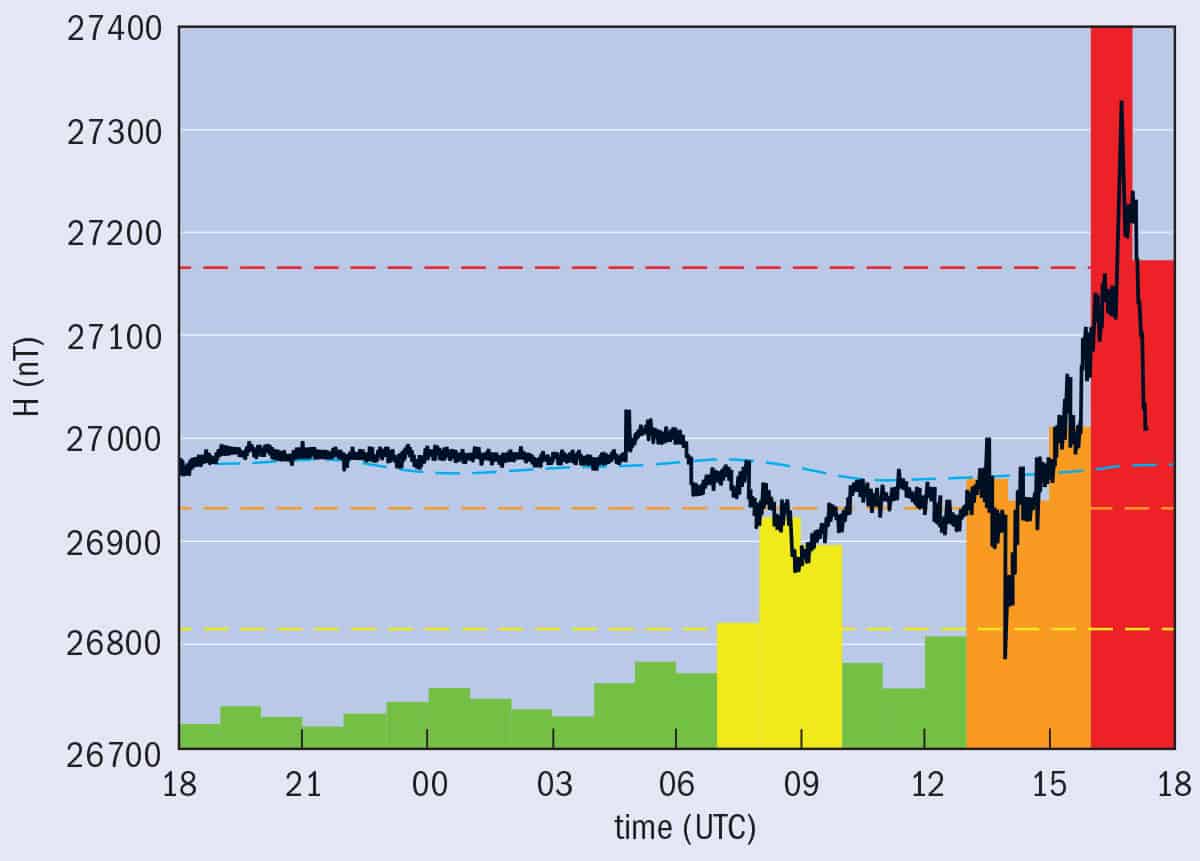
1 Forecasting an aurora
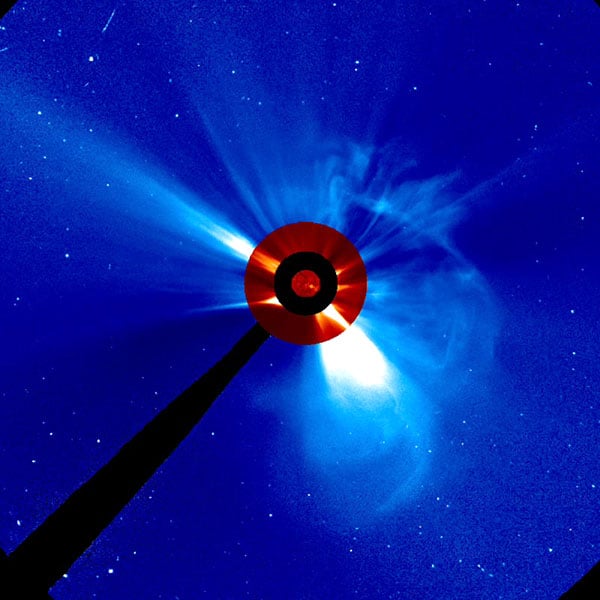
a (Data source: AuroraWatchNet)b (Courtesy: NASA’s Solar and Heliospheric Observatory)
The graph (a) shows the H-component of the magnetic field (the component that points towards magnetic north) as recorded by AuroraWatchUK on 16–17 March 2015. Coloured bars indicate how much the magnetic field at a given moment deviates from the average for a “quiet” day (blue dashed line), with green indicating “quiet”, yellow “minor geomagnetic activity”, amber “active” and red “stormy”. The dashed red line represents the threshold that triggers a “red alert”. The image left (b) shows the coronal mass ejection that caused the 17 March aurora.
But the solar wind also causes the planet’s magnetic field lines to be convected away from the Sun, forming a kind of magnetic “tail”. After an interval in which this magnetic tail becomes “loaded” with field lines, the magnetic field undergoes an explosive reconfiguration and injects plasma back towards the planet on the nightside. Some of this plasma reaches the atmosphere and causes bright auroral displays. Larger events can be triggered by solar activity such as high-speed streams of solar wind or coronal mass ejections (large clouds of solar plasma threaded with magnetic field). When one of these reaches the Earth’s magnetosphere it can transfer a lot of energy, leading to exceptionally large, bright auroras (see figure 1).
Auroras normally form a circular shape around the pole connected to a ring of magnetic field lines. By tracing along these magnetic field lines away from the planet, we can find out where in the magnetosphere the charged particles are coming from. Even something as basic as an aurora’s colour gives us a wealth of information. Because different species of atoms have different energy levels, the jumps between levels determine the energy and hence the wavelength of the light they emit. For example, the common green colour in the northern lights comes from oxygen atoms more than 100 km above the Earth’s surface. Red auroras can be seen when enough electrons excite different transitions in the less dense oxygen higher up in the atmosphere, while a deep red at the bottom of the green curtain is indicative of higher-energy electrons penetrating deeper into the atmosphere and exciting nitrogen molecules.
Flickering lights, alien skies
Extraterrestrial auroras were first detected in 1979 by the Voyager spacecraft at Jupiter and by Pioneer 11 at Saturn. Since the Pioneer and Voyager flybys, auroras have been observed using Earth-based telescopes and the Hubble Space Telescope. Beginning in 2004, though, Saturn’s aurora has been studied extensively by the Cassini spacecraft, which began orbiting the ringed planet that year. Ulyana Dyudina and colleagues at the California Institute of Technology, US, used images from Cassini’s Imaging Science System to show that Saturn’s auroras range in colour from red at the lowest altitudes, to pink slightly higher in the atmosphere, where the emission is brightest, up to a fainter, purple colour at the atmosphere’s outer edge. These colours are characteristic of the hydrogen gas that makes up Saturn’s atmosphere. Further investigations may reveal which specific atomic transitions could emit photons with the observed intensity, helping us understand the density of Saturn’s atmosphere and the range of electron energies that are impacting it.
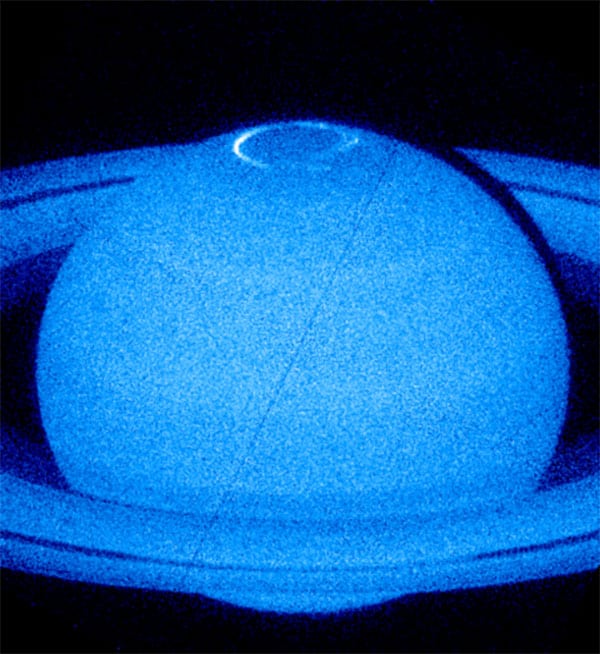
The shape of Saturn’s aurora is at first glance very similar to that of the Earth. Typically, it forms an oval around the gas giant’s northern and southern magnetic poles. However, there are some differences. Saturn rotates with a period of less than 11 hours and many features in the aurora rotate with the planet’s atmosphere, either at the same rate or some fraction of it. One effect of the rotation is that Saturn’s aurora is usually brighter on the “dawnside” of the planet, where the atmosphere and magnetic field are rotating towards the Sun, compared with the “duskside” where they are rotating away.
Polar attraction? Saturn and its aurora as seen in ultraviolet light by the Hubble Space Telescope. (Courtesy: NASA/ESA/S V Badman, Lancaster University)
Another difference between Earth’s aurora and Saturn’s is the source of the charged particles that cause the atmospheric emission. One of the major discoveries of the Cassini mission has been the presence of geysers on Enceladus, one of Saturn’s moons, and this discovery was actually sparked by observations of Saturn’s magnetic field. The Cassini magnetometer team, led by Michele Dougherty at Imperial College London, UK, identified that Enceladus must be producing plasma because Saturn’s magnetic field lines were perturbed around the moon’s southern pole. Subsequent flybys revealed a series of stripes in the icy surface, from which water plumes are emitted. These water plumes turn out to be a significant source of plasma in Saturn’s neighbourhood.
Most of the plasma originating from Enceladus spreads out into an extended disc and, along with plasma originating from Saturn’s rings and its other icy moons, forms a reservoir for generating Saturn’s auroral oval. This isn’t the only thing going on, though. Observations made while Cassini was approaching Saturn in 2004 revealed that the aurora also responds to the solar wind conditions. When the solar wind blows quickly past the planet and compresses its magnetosphere, then – a bit like what happens on Earth – bright and broad auroral storms occur. Under these conditions, Saturn’s aurora forms a spiral shape: it is broader and located at higher latitude on the nightside of the planet, and curves round through the dayside to a narrower and lower latitude arc near midnight. This indicates that the strongest injection of electrons happens on the nightside and that field lines further from the planet (with footprints at higher latitudes in the atmosphere) become active. All the observations made so far indicate that Saturn’s aurora results from a complex interaction affected by the planet’s rotation, material coming from Enceladus and the surrounding solar wind.
Another effect of Enceladus’ activity is that, as it perturbs the local magnetic field, some of the surrounding plasma is beamed along the magnetic field lines and deposited in Saturn’s atmosphere, producing an auroral spot. Wayne Pryor of Central Arizona College and Abi Rymer from Johns Hopkins University, both in the US, showed that the auroral spot and electron beam were only sometimes present to mark the footprint of Enceladus. The reason for the variability of Enceladus’ auroral spot is still unknown, but could relate to the plume activity on the moon itself.
The green glow of home
The auroras at Saturn will soon be probed in more detail than ever, as Cassini performs the final stages of its mission by going into a highly inclined orbit that passes close to Saturn’s atmosphere, inside its famous rings. Meanwhile, NASA’s Juno mission is scheduled to go into a similarly inclined, low-altitude orbit around Jupiter (see “Brave new Jupiter” by Stephen Ornes). Both missions will measure the energy and direction of charged particles close to their respective planets’ atmosphere and image the aurora at unprecedented spatial resolution. Another exciting opportunity to learn what is behind different auroral features is Jupiter’s largest moon Ganymede, which has its own magnetic field embedded within Jupiter’s, and auroral ovals in its oxygen atmosphere. This system will be studied for the first time by the European Space Agency’s upcoming JUICE mission, due to arrive at Jupiter in 2030.
The best opportunity for humans to see extraterrestrial aurora first-hand would probably come during a mission to Mars
Beyond Saturn in the outer reaches of the solar system, we know (thanks to the Voyager spacecraft flybys in the 1980s) that the ice giants Uranus and Neptune also have auroras. However, it has proven difficult to detect them using Earth-based telescopes, and hence their characteristics are still not understood.
The best opportunity for humans to see extraterrestrial aurora first-hand would probably come during a mission to Mars. Although Mars lacks a global magnetic field like the Earth’s, it does have localized “mushrooms” of magnetic field looping out from the planet’s crust, and Martian auroras have been detected by spacecraft. Observations made by the MAVEN mission, analysed by Nick Schneider of the University of Colorado, US, showed that these Martian auroras are not limited to the regions where the crustal magnetic field is strongest, but are widespread, as the magnetic field carried in the solar wind drapes through the atmosphere. The small amounts of oxygen in Mars’ atmosphere could even give its auroras a familiar green glow – a welcome sight, perhaps, for any homesick observers on the surface of the red planet.
After a five-year journey to Jupiter, travelling some 3.2 billion kilometres, NASA’s Juno craft has finally arrived at the largest planet in our solar system. Having sped towards Jupiter at more than 25,750 kph, JUNO fired its braking rocket yesterday at 11:18 p.m. EDT for 35 minutes, so that it could be captured by Jupiter’s gravity. JUNO has now entered a highly elliptical orbit around the poles of the planet – taking it within 4800 km of the planet’s atmosphere – and will now spend more than a year taking data to understand how the planet formed and whether it has a rocky core.
“The spacecraft worked perfectly, which is always nice when you’re driving a vehicle with 1.7 billion miles on the odometer,” says Rick Nybakken, Juno project manager from the Jet Propulsion Laboratory. “Jupiter orbit insertion was a big step and the most challenging remaining in our mission plan, but there are others that have to occur before we can give the science team the mission they are looking for.”
A lot to see and do
Scott Bolton, principal investigator of Juno from the Southwest Research Institute in San Antonio, adds: “Our official science-collection phase begins in October, but we’ve figured out a way to collect data a lot earlier than that. Which when you’re talking about the single biggest planetary body in the solar system, is a really good thing. There is a lot to see and do here.”
Mission scientists hope that Juno will help them to understand how Jupiter formed and evolved and what hides beneath the planet’s clouds. Jupiter’s composition is dominated by hydrogen and helium, but its atmosphere also contains heavier elements including carbon, nitrogen and oxygen. However, astronomers do not know how this thick, hot atmosphere is structured or how much water it contains.
JUNO will also map Jupiter’s magnetic field in unprecedented detail, possibly revealing details about its origin. Jupiter’s magnetic field is around 10 times stronger than Earth’s, producing the largest magnetosphere of any planet in the solar system, extending some three million kilometres. “One of the reasons that the Juno mission is so exciting is because we can map Jupiter’s magnetic field without having to look through the crustal magnetic fields, which behave like a jumble of refrigerator magnets,” says Jack Connerney, deputy principal investigator and head of the magnetometer team at NASA’s Space Goddard Flight Center.
A destructive end
Named after the wife of the Roman god Jupiter, Juno is the second probe to orbit Jupiter. The first was NASA’s Galileo satellite, which launched in 1989, and spent eight years circling the planet’s equator (rather than its poles) and studying the Jovian moons. Yet Galileo suffered technical problems – its antenna did not fully open – which meant that the mission could not send back as much data as scientists had anticipated.
Juno will study Jupiter using nine on-board instruments, including a particle detector, camera, magnetometer, microwave radiometer and spectrometer. To protect the instruments from the intensity of radiation surrounding Jupiter, they are housed in a protective vault with centimetre-thick titanium walls.
Juno is powered by three 9 m arms that hold 19,000 solar cells. In January it set the record for the furthest distance a solar-powered probe has travelled in the solar system, breaking a record set by the European Space Agency’s Rosetta spacecraft.
Once Juno has carried out its mission, the probe will be sent crashing into the planet – as the Galileo probe did – to stop it contaminating Jupiter’s ocean-bearing moon, Europa.
There is much more about the Juno mission in the July issue of Physics World: “Brave new Jupiter”.
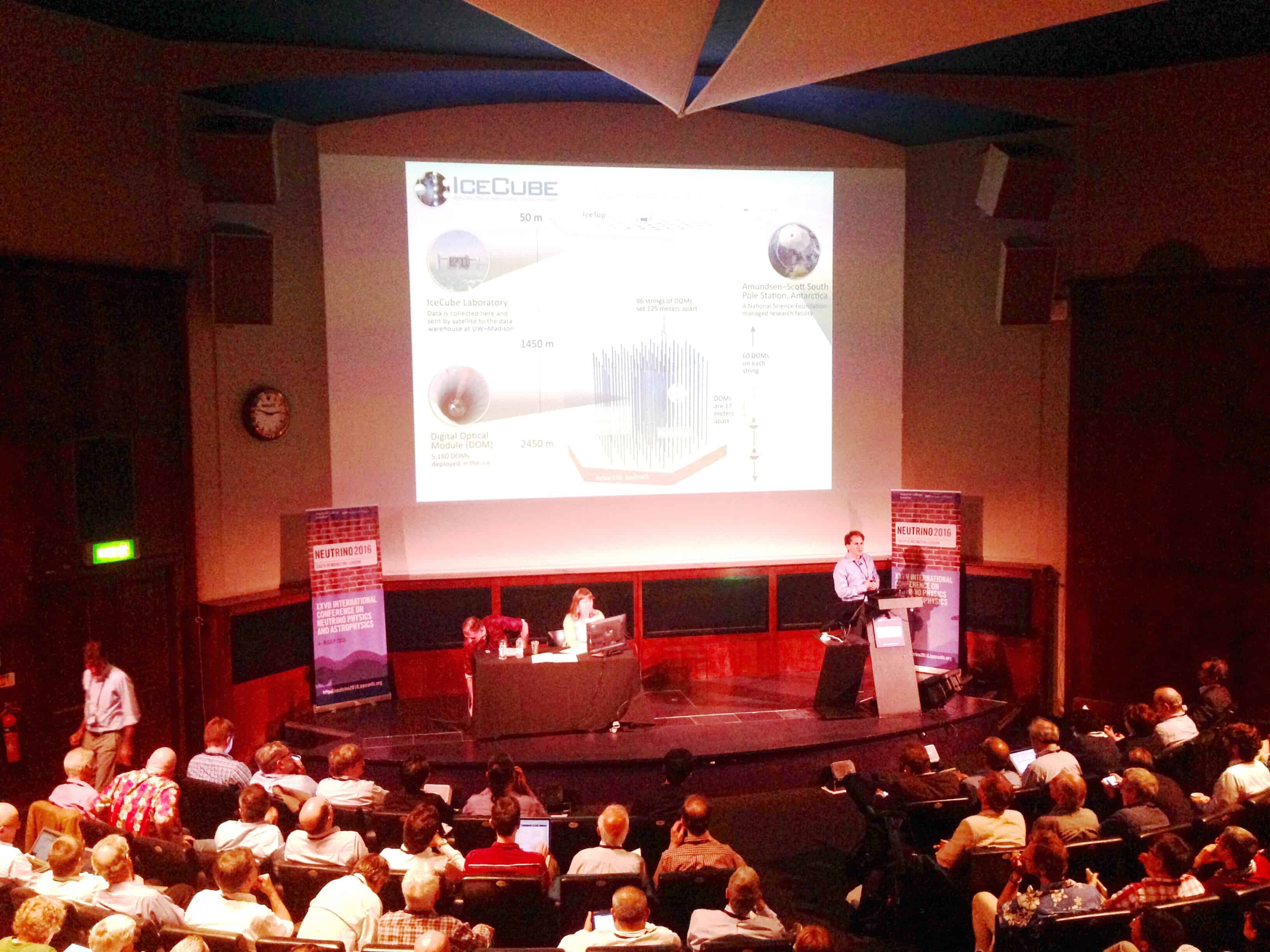
Cool operator: Marek Kowalski talking about IceCube at the Neutrino 2016 conference. (Courtesy: Tushna Commissariat)
By Tushna Commissariat at the Royal Geographical Society in London
“There are still many things to be studied in neutrinos,” said 2015 Nobel laureate Takaaki Kajita at the first talk of the Neutrino 2016 conference that began in London today. I couldn’t help but notice that his statement rang very true, as the day’s talks touched on everything from high-energy neutrinos to dark-matter searches to monitoring nuclear reactors. This year, more than 700 physicists from all over the world are attending the week-long conference, which is taking place at the historic Royal Geographical Society in London.
Researchers at the Oak Ridge National Laboratory in the US and Uppsala University in Sweden have developed a new electron-microscopy technique that can detect magnetism at the atomic scale. The technique exploits distortions – or “aberrations” – in how the microscope’s electron beam is focussed, and could be used could be used to study magnetic domains in devices such as computer hard-disk drives.
Electron microscopes focus beams of electrons in much the same way that optical microscopes focus light. Just like their optical counterparts, the lenses in an electron microscope are not perfect, and this results in distortions in microscope images. These distortions can be minimized using an aberration-correction system, and now Oak Ridge’s Juan Carlos Idrobo and colleagues have used such a system to introduce a specific aberration to their electron beam to make it sensitive to tiny magnetic domains in a material.
Electron energy loss
The new technique is based on an effect called “electron energy-loss magnetic circular dichroism” (EMCD), whereby a magnetic material will absorb energy at different rates from electron beams with different values of orbital angular momenta. Beginning in 2006, physicists in Austria and Germany have shown that EMCD can be used in electron microscopes to image magnetic domains as small as 1–2 nm. While this is tiny, it is still much larger than individual atoms in a solid, which tend to be about 0.1 nm in size.
This latest work improves the spatial resolution of EMCD by using the fact that an electron beam with a specific type of aberration will interact with a magnetic material in much the same way as an electron beam carrying orbital angular momentum. Idrobo and colleagues used their microscope’s aberration-correction system to create an electron beam with an aberration called four-fold astigmatism. They fired the beam at a sample of lanthanum manganese arsenic oxide (LaMnAsO) and used a technique called electron energy-loss spectroscopy (EELS) to analyse how the electron beam lost energy as it passed through the sample.
By scanning the beam across the sample, they were able to build up an image of the checkerboard antiferromagnetic ordering in the material. Specifically, they were able to see that the direction of the magnetic moments of neighbouring manganese atoms alternated from pointing up to pointing down.
Highly distorted
“Four-fold astigmatism is a type of aberration present in electron lenses,” explains Idrobo. “Imagine a wine glass full of water. If you place the glass at a certain distance from an object, you can see how the glass behaves as a magnifying lens. However, you will also notice that the magnification is better at the centre of the glass and becomes highly distorted at the edges of it. This is spherical aberration.
“If the glass were not spherical but instead wider or taller, then you would see the effects of two-fold astigmatism because of light having different foci in the vertical and horizontal directions of the glass. Four-fold astigmatism occurs in a lens that has four different directions; each with focusing planes rotated 45° with respect to each other.” The reason why the researchers used four-fold astigmatism to measure the magnetic ordering in LaMnAsO is because this material has four-fold crystal symmetry.
Popular instrument
Idrobo says that the team’s accomplishment is important for two reasons. The first is that it shows that, rather than always being a bad thing, aberrations in electron beams can be used to perform useful measurements. The second reason is that the method they developed for controlling the electron beam is easy to implement in aberration-corrected scanning transmission electron microscopes. “Since most modern materials-science characterization laboratories use this kind of instrument, studying magnetism in materials at high spatial resolutions will now be [with]in the reach of a large number of scientists,” he adds.
The team, reporting its work in Advanced Structural and Chemical Imaging, says that it is now trying to see what other physical phenomena, besides magnetism, it can measure using these aberrated probes. “We have some ideas of what can be done and are working really hard to see how far we can go. So stay tuned!” Idrobo says.
Early next week NASA’s Juno spacecraft will fire its blasters and pop itself into orbit around Jupiter. On 24 June the approaching spacecraft fell under the spell of the planet’s powerful magnetic field and the transition was captured by Juno’s Waves instrument, which measures radio and plasma waves.
The signals have been converted to sound and you can listen to them in the above video. There are two abrupt changes in the signal from Waves. One is a shift from a high-pitch whisper to a low-frequency roar that occurs when Juno crosses Jupiter’s bow shock. This is where the supersonic solar wind is slowed by the planet’s magnetic field and the roar is the equivalent of a sonic boom here on Earth.
A new method for 3D-printing micro-sized, high-quality compound lenses directly onto image sensors or optical fibres has been developed by researchers at the University of Stuttgart in Germany. The technique could be used to create tiny lenses for a variety of applications, including endoscopes for medical imaging and cameras for tiny drone aircraft.
Existing methods for creating sub-millimetre-sized lenses involve injection moulding or diamond grinding. However, both techniques are limited in the size and shapes of the lenses they are capable of manufacturing. Conventional techniques are also unable to combine multiple lens elements. Together, these limitations make it very difficult to create multi-lens systems with non-spherical lens shapes, which are needed for high-performance applications.
Laser writing
Now, Timo Gissibl and colleagues have devised a new lens-manufacturing technique called two-photon direct laser writing. This uses a pulsed red femtosecond laser – with 780 nm wavelength and pulses shorter than 100 fs – focused onto a surface that is immersed in a liquid photoresist. The simultaneous absorption of two photons of the laser light at the focal point exposes the photoresist, causing polymers to crosslink and solidify to build up a transparent element on the surface.
By scanning the laser, multi-lens optical systems – composed of single lenses in a supporting shell – of any shape, configuration and size can be rapidly produced according to a previously designed computer model. When the exposure process is complete, the unexposed photoresist can be washed away with a solvent, leaving the optical element behind.
This is a giant leap forward for optics, which allows for accurate and reliable manufacturing at sizes about one order of magnitude smaller than before
Timo Gissibl, University of Stuttgart
“This is a giant leap forward for optics, which allows for accurate and reliable manufacturing at sizes about one order of magnitude smaller than before,” says Gissibl, explaining that while the micro-lens systems are only 125 μm wide – barely larger than the width of a human hair – and 200 μm long, their optical performance is similar to conventional microscope objectives, or compound photographic lenses.
The researchers have created a variety of demonstration lenses, which display some of the potential applications for the technique. In one example, the team fabricated an array of lens systems, with four refractive interfaces, which they printed directly onto five-megapixel CMOS image sensors of the kind used in digital cameras.
The technique could also be used to create extremely thin endoscopes, suitable for inserting into the smallest bodily openings, or even the innards of machinery. The team created a prototype optical system for this that involved printing three lenses onto the end of an optical fibre so thin that it could pass through a typical syringe needle. The researchers were able to show that objects 3 mm from the lens could be observed at the other end of the fibre, which was 1.7 m long.
Bee-sized robots
Other possible applications include surround-cameras for mobile phones, compact image sensors for self-driving cars and robots, and even tiny video cameras for bee-sized robot drones.
“We believe that 3D printing of optics is going to open an entire new era of optics manufacturing,” says Gissibl, highlighting the rapid nature of the optics printing process, which can go from the drawing board to a computer model and finally to a finished, printed lens in less than a day. “We are going to open potentials just like computer-aided design and computer-integrated manufacturing did in mechanical engineering a few years ago,” he adds.
“Ultrafast laser 3D lithography once again shows itself to be a unique tool for the practical realization of intelligent dreams,” says Mangirdas Malinauskas, a physicist from the Vilnius University in Lithuania, who was not involved in this study. Commending the work for up-scaling the application to produce lenses of outstanding quality, he adds: “It is obvious now that [the research] will attract the attention of both scientific groups and industrial manufacturers.”
Members of NASA’s Juno mission are bracing themselves for the final moments of the craft’s five-year-long journey to Jupiter, which will finally reach its quarry just a few days from now (late on 4 July in North America, early morning on 5 July in Europe). There’ll be an anxious, 40-minute period of radio silence as the spinning craft fires its thrusters and slows down enough to be captured by the gas giant’s gravity.
During that time, staff at NASA’s Jet Propulsion Laboratory will be waiting, nervously, for Juno’s instruments to flicker back on and allow data-taking to begin as the craft starts a year-long orbit of the planet.
Devoted to planetary science, the special issue includes amazing images from NASA’s New Horizons mission to Pluto, an investigation into auroras on planets other than Earth, and an analysis of what we know about Vesta and Ceres – the two largest bodies in the main asteroid belt.
Brian Schmidt speaks to young scientists in Lindau. (Courtesy: Lindau Meeting)
By Alaina G Levine, at the Lindau Nobel Laureate Meeting in Germany
One of the best things about being at the 66th Lindau Nobel Laureate Meeting is that there are surprises around every corner. The organizers give you a programme, but you might not even realize the significance of an event until you are knee deep in it.
This morning, I attended one of four “Science Breakfasts” held this week, in which Nobel laureates and leaders in various industries share the stage and discuss topics of interest to the young scientists who have travelled from all over the world to participate in the meeting.
Over croissants and orange juice, the 2011 physics Nobel laureate Brian Schmidt took part in a lively discussion that itself was a mouthful: “Decoding science leadership: Developing capacity for leading innovation in a rapidly evolving 24/7 world with disruptive opportunities and challenges”.
A quantum computer that can simulate interactions between fundamental particles has been unveiled by physicists in Austria. Four trapped ions were used to model the physics that describes the creation and annihilation of electron–positron pairs. While the result can be easily calculated using a conventional computer, problems that are beyond the reach of even the most powerful supercomputers could be solved by the computer if it could be scaled up to include about 30 ions.
The strange laws of quantum mechanics make it very hard for classical computers to model the behaviour of large numbers of microscopic particles. Because these objects can exist in superpositions and be entangled with one another, the amount of classical processing power needed to fully describe their interactions rises exponentially as the number of particles increases. It was this fact that prompted physicist Richard Feynman in the early 1980s to propose using quantum systems themselves – in the form of quantum computers – to model the behaviour of other quantum systems.
That vision has started to become reality in recent years, as scientists build quantum computers to simulate chemical reactions or devise new types of condensed-matter systems. These devices are nothing like the fabled all-purpose quantum computers capable of factorising large numbers, which would contain large numbers of quantum bits, or qubits. Instead, to date they contain just a handful of qubits, operating either as analogue devices – in which the interactions between qubits closely resemble those between the simulated particles – or digitally, where each interaction is represented by a series of discrete logical operations.
Gauge theories
Peter Zoller, Rainer Blatt and colleagues at the University of Innsbruck and the Institute for Quantum Optics and Quantum Information (IQOQI) have created a digital quantum computer and have used it to simulate the physics of a gauge theory. These theories describe how fundamental particles such as quarks or electrons interact with one another, and are at the heart of the Standard Model of particle physics. However, they impose severe constraints on modelling because each interaction they describe must obey a series of conservation laws not needed in other types of simulations. But over the last few years, theorists have begun to put forward algorithms that would allow quantum computers to model gauge theories.
The Austrian team has devised and implemented a quantum algorithm for efficiently modelling a simple type of gauge theory: one-dimensional quantum electrodynamics. The computer that the researchers use to run the algorithm uses four calcium ions as qubits. These are confined by electric fields and manipulated by a laser, so that each ion can exist in a superposition of two energy levels and can become entangled with the other ions.
Each ion represents a point in space, and its two energy levels correspond to the presence or absence of a particular subatomic particle – either an electron or a positron. Initially, the states of all four ions are set to show no particles, which means that the simulated system at that point is a pure vacuum. The ions’ quantum states are then changed by a series of red laser pulses fired at them. Those pulses can represent three effects: the creation or annihilation of electron–positron pairs in the vacuum; long-range electrical (Coulomb) interactions between the particles; or the energy associated with the particles’ masses. Once the sequence of laser pulses has ended, the final state of each qubit is read out using a second (blue) laser beam that causes the ions to emit light when they are in one energy state, but not when they are in the other.
Proof-of-principle
The team found that its quantum computer generated the correct final states within the margin of error imposed by laser noise and other limitations in the laboratory equipment. Although the calculation can be easily done using a normal desktop computer, team member Christine Muschik of IQOQI says the results provide a proof-of-principle demonstration that quantum computers can be used to simulate the interactions described by gauge theories.
The research is described in Nature. In an accompanying commentary, Erez Zohar of the Max Planck Institute of Quantum Optics in Garching, Germany, agrees that the research shows it is “realistic to use quantum-optics techniques to study particle physics and fundamental forces”. He believes that the quantum computer built by the Austrian group “serves as a beacon” to other physicists trying to build more complex devices, which, he says, might be able to simulate particle systems in more than one dimension or accommodate more complex gauge theories such as quantum chromodynamics.
Team member Esteban Martinez of the University of Innsbruck says that quantum simulators should outperform the best classical computers when they have about 30 qubits. He points out, in fact, that his group already has a simulator with that many ions, but says that the performance of this device is limited by the difficulty of addressing single ions and by instabilities in the lasers and magnetic fields. “We are working to improve all these things so that we can operate 30 ions in the same way that we currently operate four,” he says. As to when that might be possible, “10 years is a perfectly reasonable timescale,” he says.


 By Matin Durrani