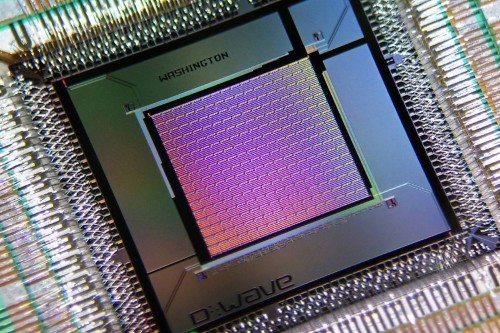
Is it or isn’t it? The D-Wave 2X quantum processor. (Courtesy: D-Wave Systems)
By Hamish Johnston
This morning I was speaking to quantum-entanglement expert Jian-Wei Pan, who shares the Physics World Breakthrough of the Year 2015 award for his work on quantum teleportation. Pan briefly mentioned research reported earlier this week by John Martinis, Hartmut Neven and colleagues at Google Research whereby a D-Wave 2X quantum computer was used to perform a computational task 100 million times faster than a classical algorithm.
This is a remarkable result, but does it mean that D-Wave’s controversial processors actually work as quantum computers? Some quantum-computing experts are urging caution in how the research is interpreted.
Synonymous with the fictional world of Star Trek, the idea of teleportation has intrigued scientists and the public alike. Reality caught up with fiction in 1993, when an international group of physicists proved theoretically that the teleportation of a quantum state is entirely possible, so long as the original state being copied is destroyed. Successfully teleporting a quantum state therefore involves making a precise measurement of a system, transmitting the information to a distant location and then reconstructing a flawless copy of the original state. As the “no cloning” theorem of quantum mechanics does not allow for a perfect copy of a quantum state to be made, it must be completely transferred from one particle onto another, such that the first particle is no longer in that state.
Complete and perfect
In other words, a complete and perfect transfer is completed when the first particle loses all of the properties that are teleported to the other. The first experimental teleportation of the spin of a photon was achieved in 1997, and since then, everything from individual states of atomic spins, coherent light fields and other entities have been transferred. But all of these experiments were limited to teleporting a single property, and scaling that up to even two properties has proved a herculean feat.
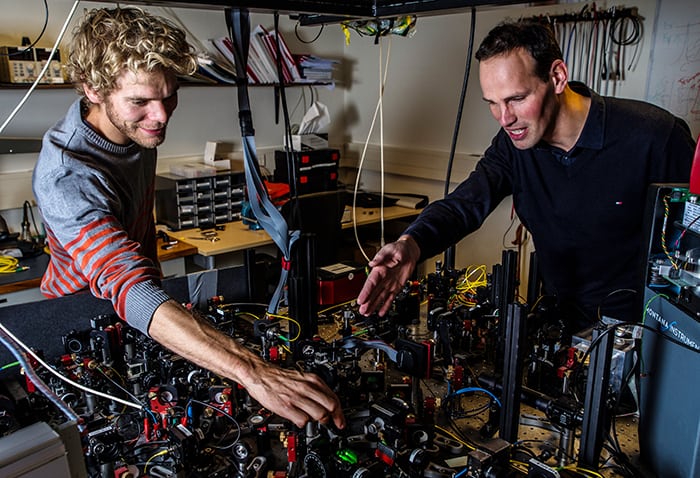
Pan and Lu’s team has now simultaneously transferred a photon’s spin (polarization) and its orbital angular momentum (OAM) to another photon some distance away. Teleportation experiments usually require a “quantum channel” via which the transfer actually takes place. This channel is normally an extra set of “entangled” photons with quantum states that are inextricably linked so that any change made to one instantly influences the other. In this experiment, this is a “hyper-entangled” set, where the two particles are simultaneously entangled in both their spin and their OAM (see “Two quantum properties teleported together for first time”).
Although it is possible to extend Pan’s method to teleport more than two properties simultaneously, this becomes increasingly difficult with each added property – the likely limit is three. To do this would require the ability to experimentally control 10 photons, while the current record is eight. The team is currently working hard to change that though, and Pan says that they “hope to reach 10-photon entanglement in a few months”. An alternate method that is also being developed could allow the team to double that figure to 20 within three years. “We should be able to teleport three degrees of freedom of a single photon or multiple photons soon,” he adds.
The ability to teleport multiple states simultaneously is essential to fully describe a quantum particle, and is a tentative step towards teleporting anything larger than a quantum particle. Pan adds that “quantum teleportation has been recognized as a key element in the ongoing development of long-distance quantum communications that provide unbreakable security, ultrafast quantum computers and quantum networks”.
• Watch our Google+ Hangout, where physicsworld.com editor Hamish Johnston talks with Pan and Lu about all things quantum
The top 10 were chosen by a panel of six Physics World editors and reporters, and the criteria for judging the top-10 breakthroughs included
fundamental importance of research;
significant advance in knowledge;
strong connection between theory and experiment; and
general interest to all physicists.
Now for our nine runner-up breakthroughs, which are listed below in no particular order.
To the Project 8 collaboration, for measuring the cyclotron radiation from individual electrons emitted during the beta decay of krypton-83. This radiation is emitted as the electron passes through a magnetic field, and allows the team to make a very precise measurement of the energy at which the particle is emitted. Project 8 is now working hard to improve the precision of the measurement so it can be used to calculate one of the most elusive quantities in physics – the mass of the electron antineutrino that is also given off during the beta decay.
To Zahid Hasan of Princeton University, Marin Soljačić of MIT, and Zhong Fang and Hongming Weng of the Chinese Academy of Sciences, for their pioneering work on Weyl fermions. These massless particles were predicted by the German mathematician Hermann Weyl in 1929. Working independently, a team led by Hasan, and another led by Fang and Weng, spotted telltale evidence for quasiparticles that behave as Weyl fermions in the semimetal tantalum arsenide. Soljačić and colleagues have spotted evidence for Weyl fermions in a very different material – a “double-gyroid” photonic crystal. The massless nature of Weyl fermions means that they could be used in high-speed electronics; and because they are topologically protected from scattering, they could be useful in quantum computers.
To Bas Hensen, Ronald Hanson and colleagues of the Delft University of Technology, for making a measurement of Bell’s inequality that is simultaneously free from both the locality and detection loopholes. Their experiment involved entangling spins in diamonds separated by 1.28 km and then measuring correlations between the spins. The large separation between the diamonds and the relative ease with which the spins can be measured ensured that the experiment is loop-hole free – and its result confirmed the existence of the seemingly bizarre concept of quantum-mechanical entanglement.
To Jorge Martins of the Institute of Astrophysics and Space Sciences and the University of Porto and colleagues in Portugal, France, Switzerland and Chile, for being the first to measure a high-resolution optical spectral signature of light reflected from an exoplanet. The team used the High Accuracy Radial velocity Planet Searcher instrument at the European Southern Observatory’s La Silla Observatory to study light from 51 Pegasi b – which was first spotted in 1995. Using a new technique that they developed, Martins and colleagues were able to measure the planet’s mass, orbital inclination and reflectivity, which can be used to infer the composition of both the planet’s surface and atmosphere.
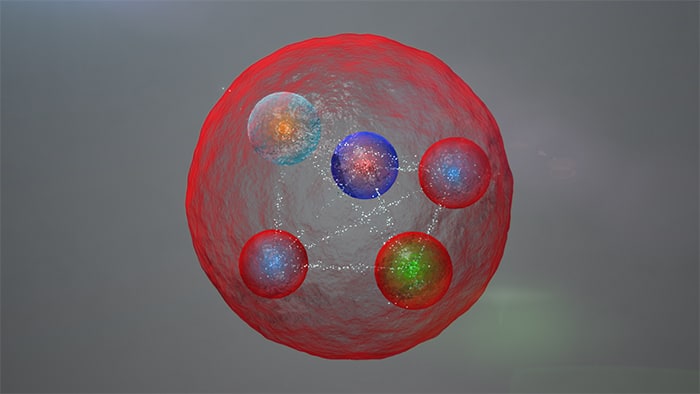
To the LHCb collaboration at CERN, for showing that five quarks can be bound together in particles called pentaquarks. First predicted in the 1970s and the subject of controversy in the 2000s, the existence of pentaquarks was resolved this year when two pentaquarks with masses around 4400 MeV/c2 emerged from proton collisions at the LHC. Both signals had statistical significances greater than 9σ – much higher than 5σ, which is the golden standard for a discovery in particle physics.
To Mikhail Eremets and colleagues at the Max Planck Institute for Chemistry and the Johannes Gutenberg University – both in Mainz, Germany – for discovering the first material that is a superconductor at a temperature that can occur naturally on the surface of the Earth. The team found that hydrogen sulphide under an extreme pressure of 1.5 million atmospheres is a superconductor up to a temperature of 203 K, which is 19 K warmer than the coldest temperature ever recorded in Antarctica. While further research is needed to understand why superconductivity arises in this material, the discovery could pave the way to the holy grail of superconductors: a material that superconducts at room temperature.
To Michelle Espy and colleagues at the Los Alamos National Laboratory in the US, for creating a practical, portable ultralow-field magnetic resonance imaging (MRI) system. Unlike conventional MRI systems that use superconducting coils to create very high magnetic fields, the new system relies on much-weaker fields that are much easier to create in remote locations. This, however, means that the system must be capable of detecting much-weaker signals, which it does using superconducting quantum interference devices (SQUIDs). With its low power requirements and lightweight construction, the team hopes that its prototype design can soon be deployed for use in medical centres in developing countries, as well as in military field hospitals.
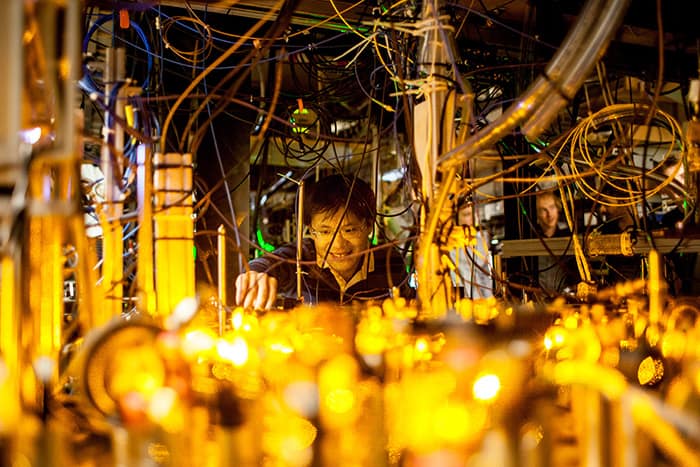
To Lawrence Cheuk, Martin Zwierlein and colleagues at MIT, for building the first “fermionic microscope” – a device that is capable of imaging up to 1000 individual atoms in an ultracold gas. Great strides have been made in understanding how electrons interact with each other in materials. This has been done by cooling fermionic atoms to ultracold temperatures, and then using light and magnetic fields to fine-tune the interactions between the atoms. The fermionic microscope takes this approach one important step further by allowing physicists to observe the behaviour of individual fermions as the gas cools. The new technique could soon be used by researchers to observe magnetic interactions between atoms, and could even be used to detect quantum entanglement within the ensemble.
To Andrew Dzurak, Menno Veldhorst and colleagues at the University of New South Wales in Australia and Keio University in Japan, for creating the first quantum-logic device made from silicon. Their controlled-not (CNOT) gate is a fundamental component of a quantum computer and was made using conventional semiconductor manufacturing processes. The device uses electron spin to store quantum information, and the researchers now plan to scale up the technology to create a full-scale quantum-computer chip.
Japan’s Akatsuki spacecraft has finally entered orbit around Venus after taking a five-year detour through the solar system. Launched in May 2010 by the Japanese Space Agency (JAXA), Akatsuki failed in its first attempt at entering orbit around Venus and has spent the last five years circling the Sun. Now that the mission is back on track, Akatsuki will study the planet’s violent atmosphere and could confirm if there are active volcanoes on its surface.
After making the seven-month journey to Venus in 2010, Akatsuki began firing its thrusters to put it in orbit around the planet. Instead of firing for more than 9 min as required, the thrusters shut down after 2–3 min and the spacecraft put itself into a “safe mode”. By the time JAXA engineers had worked out what had happened, it was too late to complete the manoeuvre.
Second time lucky
A second chance came three days ago, when Akatsuki approached Venus again and the thrusters were fired for 20 min. JAXA has now confirmed that the probe is in a stable orbit that will take it as close as 400 km to the surface of Venus. Regular operation of the probe’s scientific instruments is scheduled to start in April 2016.
Akatsuki means “dawn” in Japanese, and the 500 kg probe cost around $220m to build and launch in 2010. Akatsuki is expected to gather data for two years using its five on-board cameras. Two of these instruments operate in the near-infrared regime and will study the planet’s surface and the motion of clouds, as well as the size of particles that make up the clouds. A long-wave infrared camera, meanwhile, will measure the temperature at the “cloud top”, which lies around 65 km above the planet’s surface.
Lightning and airglow
The final two cameras are an ultraviolet imager to measure sulphur dioxide at the cloud top, and a lightning and airglow camera, which will capture lightning flashes that have never been observed on the planet before.
Often called Earth’s “sister planet” thanks to its similar mass and size, Venus orbits closer to the Earth than any other planet in our solar system. However, Venus’s climate is very different from that of Earth. Its atmosphere contains mostly carbon dioxide and is a sultry 460 °C, with the high temperatures believed to be caused by a “runaway greenhouse effect”. And while Venus rotates at around 6.5 km per hour, its atmosphere rotates at a violent 360 km per hour. Akatsuki should soon boost our understanding of what lies within Venus’s blankets of cloud.
We’ve all admired the delicate butterflies, cranes and flowers created by those who have mastered the art of paper-folding. But far from being a decorative curiosity, origami techniques are increasingly being used to solve real-world problems in physics and beyond. From solar panels and telescope lenses to designer materials and nanoscale machines, the ability to create 3D objects from 2D materials has energized physicists and created a new realm of interdisciplinary research.
The term “origami” comes from the Japanese words “ori”, meaning folding, and “kami”, meaning paper. However, the art of folding paper to create sculptures and shapes arose independently over the course of the last millennium in Europe, China and Japan. In Eastern cultures, origami representations played a symbolic role in wedding and funeral ceremonies, while in the West they were more a dinner-time novelty for the social elite. In the 1950s, though, the work of a new generation of origami artists inspired a renaissance of the craft, which became an art form in its own right.
The aim of origami is to turn a flat piece of paper into a 3D sculpture or model by folding it in different ways. The most common origami techniques are the “valley” fold, where the paper is folded upwards into a 3D “V” shape with a crease at the bottom, and the “mountain” fold, where the crease is at the top and the paper is folded downwards in a 3D “Λ” shape. Most other techniques in origami are a variation on – or combinations of – these two folds.
Almost any flat material can be used for origami, provided it holds a crease. Origami artists generally use specialist paper for their creations, but materials such as cloth, money, leather, metal, leaves, pasta and even tortillas can also be used. One thing that origami purists frown on is anything that involves cutting the paper or other material used in their creations. However, a variation of the craft has arisen in which folding and cutting are combined to produce delicate – and usually symmetrical – sculptures, patterns and shapes. This is known as kirigami, from the Japanese “kiru” meaning to cut. What both origami and kirigami forbid, however, is any sticking or taping of the materials used. Structure and stability are provided solely by the folding and cutting of the material by the artist.
More than just paper cranes
Origami’s ever-growing role in science lies in the fact that both it and kirigami can create 3D structures from a flat, 2D material, giving researchers ways of packing large sheets of material into small spaces. One of the most common techniques for achieving this is the “Miura-ori” pattern (see box below), which combines valley and mountain folds to allow a flat sheet to be folded into a much smaller volume using just a compressional force in the plane of the sheet – and likewise for the compressed sheet to be unfolded with minimal force. This approach was used, for example, in 1995 to unfold a solar panel on a Japanese satellite called the Space Flyer Unit.
Engineers at the Lawrence Livermore National Laboratory in the US, working with American physicist and origami master Robert Lang, used a more complex folding pattern to develop a prototype 5 m-diameter space-telescope lens that could be folded into a cylinder for launch and then unfolded once in orbit. (Sadly, the 100 m version was never built.) And engineers Zhong You and Kaori Kuribayashi from the University of Oxford, UK, used an origami fold pattern called the “waterbomb” to develop a medical stent that can be inserted in folded form into a clogged artery and then deployed to open up the blood vessel and restore blood flow.
The principles of origami mean that when paper or any other suitable material is folded, its mechanical properties are determined by the specific pattern of the folds. Physicists can therefore use origami fold patterns to design materials with the properties that they need. And it is in this area of “designer mechanics” that the really exciting developments are happening.
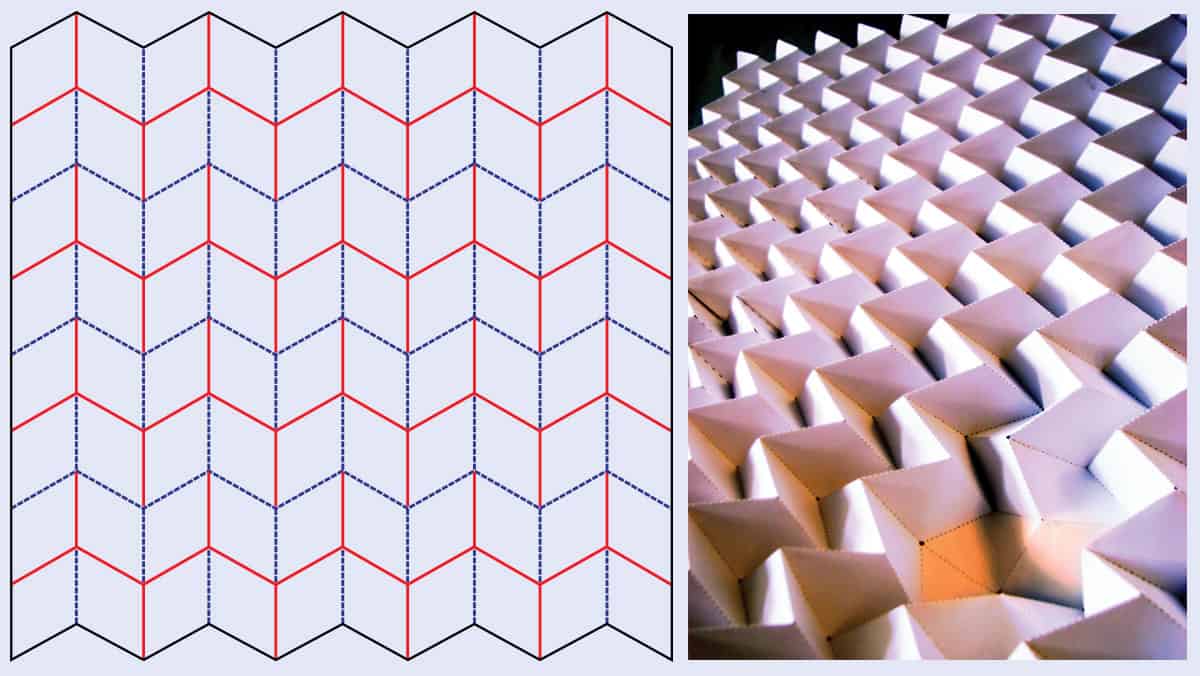
The Miura-ori pattern
(Courtesy: Jesse L Silverberg, Arthur A Evans, Lauren McLeod, Ryan C Hayward, Thomas Hull, Chris D Santangelo and Itai Cohen; Jesse L Silverberg)
The “Miura-ori” pattern – developed by astrophysicist Koryo Miura, after whom it is named – combines valley and mountain folds to allow a flat sheet to be folded into a much smaller area. One unusual physical property it gives a material is that if you pull on opposite ends, the material becomes wider in a perpendicular direction, while if you compress them, the material becomes more narrow.
Initially designed for use with solar panels on spacecraft, Miura-ori is also gaining popularity as a way of folding maps. This is because the folding pattern, using parallelograms instead of the usual squares or rectangles, places less stress on the folds and makes them less likely to tear or wear out.
In a paper last year in Science (345 647), a team led by physicist Jesse Silverberg at Cornell University explored the Miura-ori tessellation as a metamaterial design. The group found, for example, that the compressive modulus of the structure can be tuned by adding a “pop-through defect”, which can be achieved on the paper version by pushing one of the vertices so that it pops out in the other direction. Such “lattice defects” can be used to create analogues of crystallographic structures such as vacancies, dislocations and grain boundaries.
To see the effect for yourself, cut out the template above along the black line, crease all the solid red lines so they form “mountain folds” that point up off the page, crease all the dashed blue lines so they form “valley folds” that point down into the page. You should be able to collapse all the creases in one simple movement so that it folds flat, or squeeze it from the sides to collapse it into a much smaller area.
A focus on folding
So what’s caused the recent surge of interest in origami in physics and engineering? There are three main reasons, says Itai Cohen, a complex-matter physicist at Cornell University in the US. First, we’re learning more about how origami works. “The mathematics of origami have recently undergone a revolution,” he says. This means that we now know more about how to make the fold patterns we want. Second, the development of laser cutters and 3D printing makes it easier to generate these patterns. And third, improved polymer fabrication methods mean that we can create microscale polymers with
responsive properties.
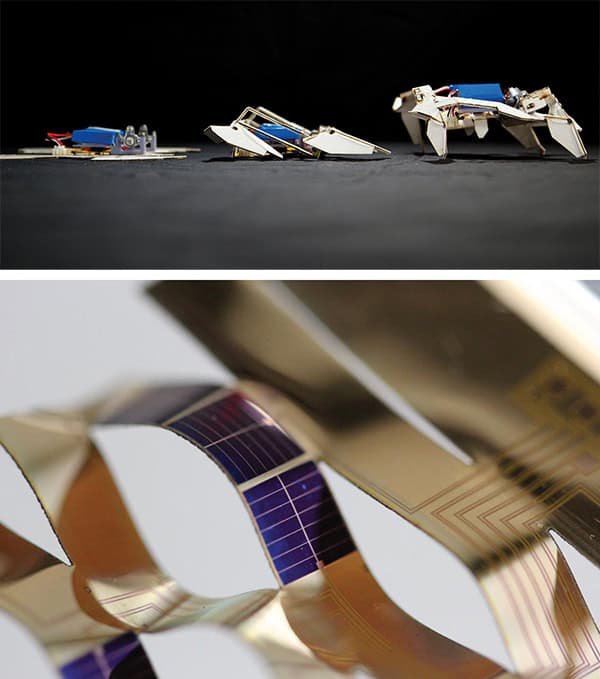
Folding and cutting Origami has been used to make a robot (top) that starts out flat, folds and assembles itself into a complex shape and can then crawl away. Kirigami is the basis of dynamic solar-cell structures (bottom) capable of tracking the Sun as it moves across the sky. (Courtesy: Seth Kroll, Wyss Institute; Aaron Lamoureux/University of Michigan)
Another reason for the increased focus on origami by physicists is that origami is scale-invariant. In other words, because the principles of origami are geometrical in nature they can be applied at the largest or smallest scales imaginable – and the geometry will still work. This property is of particular interest for physicists working at the smaller end of the size spectrum. “We can make shapes with almost atomistic resolution,” says biophysicist Ulrich Keyser at the University of Cambridge, UK, who uses origami techniques to create DNA structures. “It’s a huge advantage.”
This approach is not without its challenges, mainly because folding paper is not as simple as you might think. Origami is complicated and researchers often use simplifying assumptions, such as perfect hinges and rigid facets, that do not hold in reality. “The basic theory is a good first step,” says Cohen, “but you need to do all this extra stuff to figure out what is going on in the experiment.”
Another difficulty, says Paul McEuen, a nanoscale physicist at Cornell, is that we do not yet have a thorough understanding of how origami systems will behave when pulled or compressed. For this, we need both a better understanding of origami behaviour and improved design tools. And even when we do know how particular fold patterns work, it is not always straightforward to create them because some materials are harder to work with than others.
Materials need a high degree of homogeneity if they are to be useful for origami or kirigami, otherwise, it can be difficult to predict how they will behave
A general rule of thumb is that origami techniques work well on materials that are thin, but not so thin that they are invisible to the naked eye. Thicker sheets tend to buckle or deform when folded, while materials behave entirely differently on the nanoscale. “A graphene sheet is difficult to crease,” McEuen adds. “It just pops back into shape.” Furthermore, says chemical engineer Nick Kotov at the University of Michigan in the US, materials need a high degree of homogeneity if they are to be useful for origami or kirigami. Otherwise, it can be difficult to predict how they will behave when folded or compressed.
Research priorities
For such a relatively new discipline, current research into origami and kirigami techniques is broad. For some scientists, the focus is on understanding more about how such techniques work with different materials: Christian Santangelo, a condensed-matter physicist at the University of Massachusetts Amherst in the US, for example, is exploring the relationship between the geometry of materials and their mechanical properties. Others, such as Cohen, are trying to understand the basic design principles to tune the mechanical properties of real-world (as opposed to ideal) materials, in which, for example, a fold causes a slight deformation and uses up a tiny bit of the material. And You, who brought us the origami stent, is currently developing approaches to folding thicker materials.
Researchers are also using origami and kirigami to build things. “We’re extending origami to the very small scale,” says Cohen. “We’re trying to fold graphene, to realize the 2D-to-3D paradigm in the thinnest materials that are available – or will ever be available, really.” In doing so, Cohen hopes to be able to create tiny devices that can measure key information about their environment and report back the results. McEuen, meanwhile, is seeking to build and activate ever more complex structures including the world’s “softest” electronics, which could be stretched across a cell to record when neurons fire.
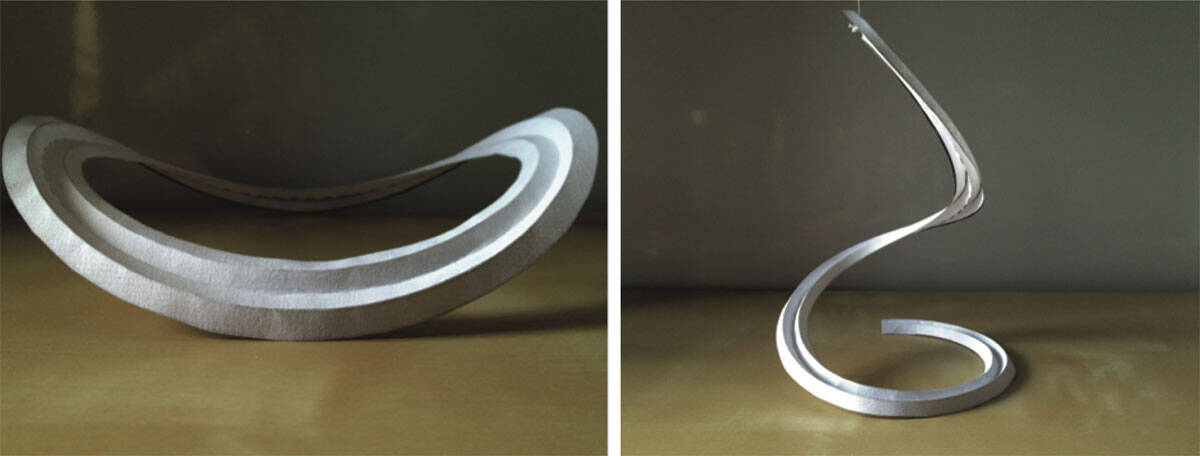
Curvaceous Christian Santangelo and his team study the geometry and mechanical properties of folded materials. (Courtesy: M A Dias and C D Santangelo (2012) EPL100 54005)
As for Kotov, he wants to overcome the lack of homogeneity in materials used for origami and kirigami by using layer-by-layer assembly to produce composite structures based on graphene and carbon nanotubes. Kotov is especially interested in materials requiring a combination of properties, such as conductivity and “stretchability”. While there is usually a trade-off between the two, Kotov has already succeeded in making electrically conductive composite sheets more elastic – increasing their strain from 4% to 370% without affecting their conductivity.
And it’s not just graphene. Keyser has used origami techniques to create self-assembly DNA structures and is now exploring the physics of membrane transport and the role that new membrane proteins could play in shaping biological membranes at the nanoscale. His longer-term aim, though, is to use origami to build DNA-based protein replacements. If successful, this “nanomedicine” could provide a valuable new weapon to help combat genetic diseases.
A bright future
It appears that origami and kirigami techniques can be applied to many different areas of research. But is this just an interesting novelty or the start of something more profound? Cohen is cautious. “It depends,” he says, “on whether we can move beyond the exploratory phase to identifying a particular problem that is worthy of solution.” Santangelo is more confident, explaining that “people are going to start making real things using origami”. But McEuen is outright optimistic. “I think you’ll see it emerge as a major paradigm for how to build complex structures,” he says. “It will be the standard way of building stuff.”
For Kotov, the future of origami and kirigami will be about how small we can make the folds and cuts, potentially taking us from microscale to nanoscale fabrication, which could lead to a new generation of materials for electronics. “Stretchable electronics is clearly one of the strong fields of application for kirigami composites,” he says. “The trends for electronics are for them to be conformable, biomimetic and human friendly. But the materials are the bottleneck here.” Kotov also expects new developments in optics, once origami and kirigami get down to the scale of the wavelength of visible light.
Further developments are likely to come from the way in which origami and kirigami are not only bringing together researchers from different fields but artists, architects and designers, too. Santangelo agrees. “It’s much more interdisciplinary than anything else I’ve done,” he says.
And although we should not overlook origami’s aesthetic appeal, its fun and its beauty, the application of origami and kirigami to modern problems is a serious endeavour. It is one that could change forever how we build things in physics.
We live in the age of photography. The huge popularity of Instagram, Snapchat and the “selfie” suggests that the old idiom of a picture being worth a thousand words has never rung more true. It is no surprise then that this mania for photography has hit a team of tenacious astronomers, who want to capture something infinitely more exotic than the stars, galaxies and nebulae that the Hubble Space Telescope and its many successors regularly image.
The subject of these astronomers’ fancy though, is an elusive muse. Hidden behind colossal veils of gas and dust, some 26,000 light-years away, the tiny spot of their fascination is one of the most difficult things to image in the universe – a black hole. More specifically, they want to capture the four-million solar mass supermassive black hole that lies at the heart of our Milky Way galaxy, dubbed Sagittarius A* (SgrA*).
It sounds an impossible feat – after all, as its name suggests, a black hole is a point in space from which nothing, not even light, can escape. But that problem is not about to stop the researchers involved in the Event Horizon Telescope (EHT), who are determined to image SgrA* within the next few years.
Bright horizons
Supermassive black holes are thought to lie at the centres of most galaxies in the universe, and astronomers are keen to decipher their key properties – such as how these behemoths “eat”, how their extreme gravity affects the space–time around them, and how some of them fuel the massive jets of material that spew out from the galaxies that host them.
A black hole’s “event horizon” is the boundary at which even light cannot escape its gravitational pull, as the velocity required to do so would be greater than the speed of light – something forbidden by Einstein’s general theory of relativity. The theory – which celebrates it centenary this year – introduced the radical notion that space–time is dynamic and affected by matter. General relativity can be verified either on some of the largest scale structures in the universe – such as a galaxy supercluster – or in places where the effects of gravity are extreme. While the theory has passed many tests, the EHT researchers want to see just how well it holds up at the “ultimate proving ground” – a black hole’s edge.
The impact of a supermassive black hole is felt across an entire galaxy, spread out over hundreds of thousands of light-years. But according to Sheperd Doeleman of the Haystack Observatory at the Massachusetts Institute of Technology (MIT), the real action – or more precisely, the gravitational structures that the researchers are keen on observing – happens very close to the black hole itself. According to Doeleman, who is the lead astronomer at the EHT, observing such structures as they change and evolve is one of the main motivations of the group.
While black holes may have a far-reaching impact and a gargantuan mass – the largest detected to date is thought to have a mass 17 billion times that of our Sun – they are relatively small; the biggest of them could fit snugly within the solar system. Although SgrA* is the black hole with the largest “apparent” size as viewed from Earth, thanks to its proximity to us, trying to visually resolve its structures is as challenging as spotting an orange on the Moon. “Imagine your friend is holding a quarter in Los Angles and you’re standing in New York, and now you can read the date on the quarter,” says Doeleman.
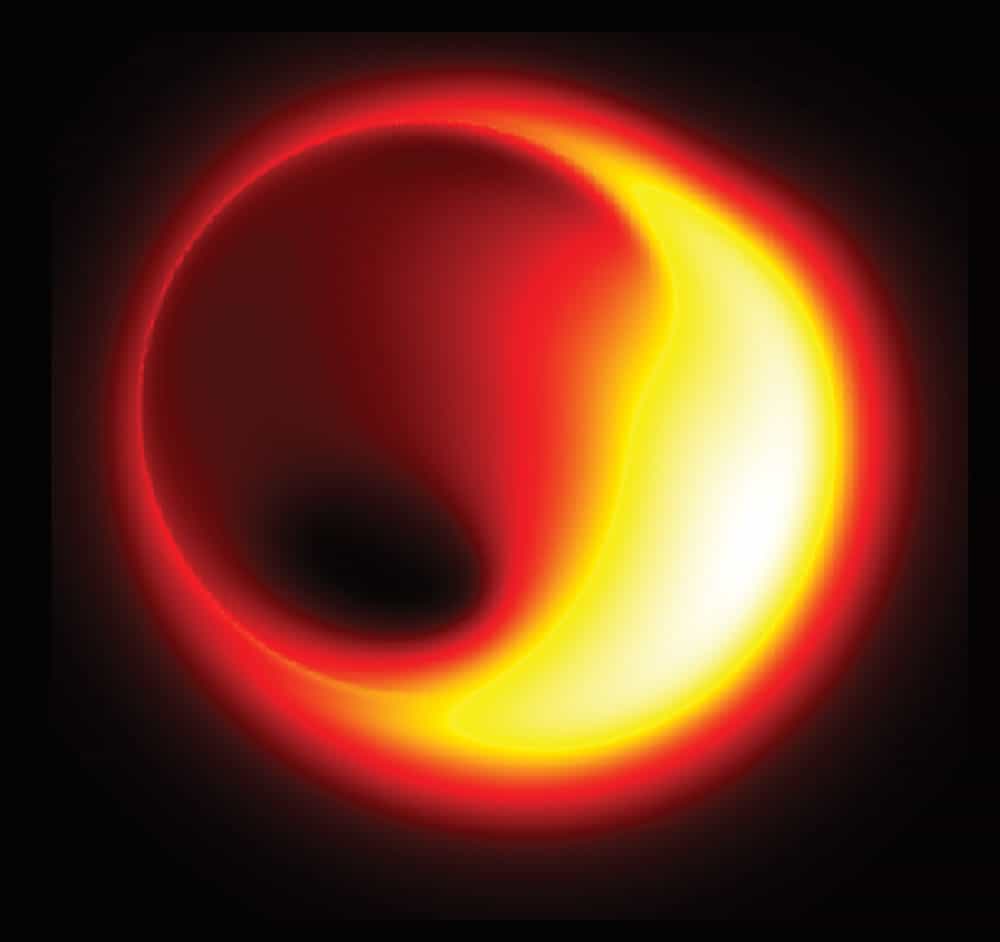
Despite their name, black holes are not all dark. The gas and dust trapped around them in an accretion disc is so compact that it is often heated to billions of degrees even before it is swallowed, making the objects glow brightly. Indeed, general relativity also predicts that a black hole will have a “shadow” around it. Thanks to the immense gravity at the event horizon, the light generated by heated in-falling gas will follow a hyperbolic trajectory – sometimes even looping back on itself instead of travelling in a straight line. The result is a shadow-like ring that encloses a dark centre. The light may warp in such a way that it takes a 180° turn, which would allow astronomers to study the far side of the object.
The shadow is of great interest as its size and shape depends mainly on the mass, and to some small extent the possible spin, of the black hole, thereby revealing its inherent properties. Theoretical predictions based on general relativity have already ruled out certain shapes – an egg-shaped shadow for example, is not on the menu. Seeing SgrA*’s actual shadow will therefore be “yet another consistency check for general relativity,” says Avery Broderick of the University of Waterloo and the Perimeter Institute for Theoretical Physics in Canada. Broderick, who is a theorist and part of the EHT team, has modelled what the shadow should look like. He told Physics World that the shadow’s appearance “encodes information about the surrounding space–time, acting like a CAT-scan of the environment”. These observations therefore “will set the stage for strong-gravity research”.
Directly observing SgrA*’s shadow, which is only 50 micro arcseconds across, is no mean feat. Astronomers would need a telescope with an angular resolution comparable to the event horizon; such an instrument would be roughly the same size as our planet, which is clearly impractical. The EHT astronomers will instead resort to a radio-astronomy technique known as very-long-baseline interferometry (VLBI), in which synchronized radio signals, from an astronomical source, are picked up by a network of individual radio telescopes and telescopic arrays scattered across the globe.
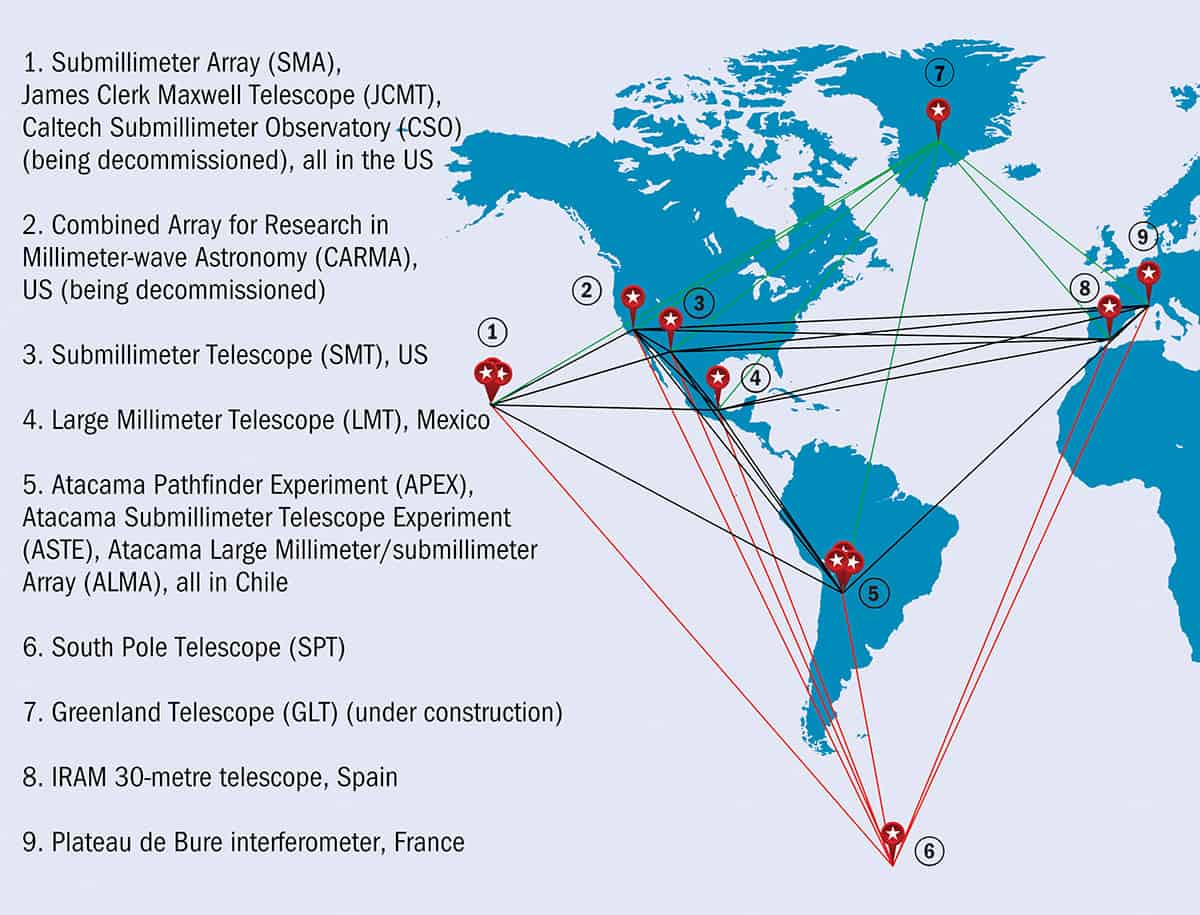
Cross-continental web: The 13 radio telescopes – past, present and future – involved in the Event Horizon Telescope. This map also shows the coincident visibility lines between telescopes. Telescopes connected by these lines will work together to image black holes like SgrA*. Green lines indicate connections used for objects in the northern sky, red lines for objects in the southern sky, and black lines denote telescopes viewing both northern and southern skies. (Courtesy: Perimeter Institute)
The distance between each pair of telescopes or facilities determines a “baseline”, and together these baselines effectively create a massive virtual telescope the size of a continent or larger. The signals received at each “antenna” (each individual telescope dish) in the network are precisely tagged with a very accurate time stamp, normally using an atomic clock at each location. The signals are later correlated and used to build up a complete image.
The technique lets astronomers build up an Earth-scale telescope “mirror”, with only little points silvered at the spots where each antenna lies. As a radio source is observed over the course of a night, the Earth’s rotation means that each silvered point spins out into a line, filling in enough of the mirror to make an image. The resolution that can be achieved using the VLBI technique is proportional to the observing frequency, which is at the submillimetre wavelength for the EHT. Early measurements have shown that it is possible to resolve some of SgrA*’s structures at 1.3 mm. According to Broderick and Doeleman, these observations confirmed that short-wavelength VLBI can be used to directly probe SgrA*’s event horizon. Each antenna in the EHT will eventually detect SgrA* at very high frequencies to penetrate the dust and haze that surrounds it.
When the EHT becomes fully functional in the next few years, it will consist of telescopes and arrays that extend from Hawaii to Spain, all of which will study SgrA* simultaneously. This will make it the highest-resolution instrument on Earth, taking images with up to 2000 times better resolution than the Hubble Space Telescope. The improvement is largely due to technological advances made in the last two years, including a doubling of the radio-frequency space within which the EHT can image, which has made the entire array more sensitive. The number of telescopes in the array itself has also been nearly doubled, and will continue to grow once the Plateau de Bure interferometer in France and the Greenland Telescope (under construction) join the EHT.
What the EHT astronomers are most excited about this year is the successful completion of their five-year-long programme to upgrade the Atacama Large Millimeter/submillimeter Array (ALMA) in Chile to join the EHT. ALMA was designed so that each antenna pair creates a single baseline, the longest of which can be up to 16 km. For ALMA to be able to synch with the other EHT telescopes, the EHT team and the astronomers and engineers in Chile needed to turn ALMA into a “phased array”, such that its 66 individual antennae function as a single radio dish 85 m in diameter. In this kind of an array, the signals from each antenna are added together, which for ALMA requires adding specialized electronic equipment and computing abilities designed and built at the National Radio Astronomy Observatory in the US, the National Astronomical Observatory of Japan and MIT’s Haystack Observatory.
A key piece of technology added last year was a custom-built hydrogen maser that the EHT team installed, which allows ALMA’s data to be time-stamped so they can be processed with the other sites’ data. Following the upgrade, ALMA joined forces with APEX in January this year to create a 2.08 km baseline – a proof-of-principle test to check that ALMA can synch with the EHT by spring 2017 at the latest. ALMA and APEX simultaneously observed a quasar, “0522-364”, which is a very radio-bright source. ALMA successfully used its new maser to ensure both telescopes were truly in synch by time-stamping the data, which are now being processed at MIT. According to Doeleman, the successful observation marked “a huge step toward making first images of a black hole” with the EHT.
Beyond the veil
Once the EHT is fully ready, Doeleman hopes that astronomers will be able to do more than image SgrA*’s shadow and that they will be able to detect structural changes in the morphology of SgrA* in real time. Black-hole shadows were originally thought to be static, but according to Doeleman, our latest understanding suggests that they may vary, changing shape as the black hole accretes more mass.
On the horizon: A simulated shadow of SgrA*’s event horizon, cast against the bright surrounding accretion flow. The crescent-like feature is caused by oncoming regions appearing brighter and receding regions appearing dimmer, while the large circular feature is caused by the gravitational deflection of light. (Courtesy: Avery Broderick, Perimeter Institute, University of Waterloo)
This, he says, was initially seen as a problem – their image could get “smeared out” when SgrA* is active (it is currently relatively quiet as there is not too much matter falling into it). But Doeleman realized that this potential bug could become a feature – even if the researchers cannot take an image when SgrA* is swallowing matter.By using triplets of the EHT’s antennae in combination, the astronomers could look for real-time changes in the accretion flow, thereby detecting what Doeleman describes as the object’s “very heartbeat”. They would then be looking at the evolution of a black hole’s structure, resolved in real time. This is surprisingly easy: if SgrA* is indeed a non-spinning black hole, as our current theories suggest, then matter trapped in its accretion disc should revolve around the hole once every half hour. If SgrA*is spinning, this number would drop to mere minutes for matter moving in the same direction as its spin, or increase to around five hours if the matter were moving in the opposite direction. Either way, this means that the EHT could potentially see structural changes several times during a single night’s observation – an amazing feat considering the vast timescales normally involved in astronomy.
Valued-added science
One of the main benefits of the EHT is that no new telescopes or arrays need to be built specifically for it. Instead, EHT astronomers simply book time on already existing telescopes and add some extra hardware and software (such as ALMA’s maser) where needed. Indeed, Broderick describes it as a “value-added project” as it is ultimately much cheaper than building a facility from scratch. Doeleman adds that they were purposefully slow and measured in building up the EHT’s current array – which has been on the drawing board since 2008 – by proving to staff at each site that they can deliver interesting results, thanks to the successful observations made to date.
Despite the benefits, coordinating with lots of people all over the world to determine policies and funding is tricky. Another problem is having to send experts to far-flung locations for each of the EHT’s observational runs, which means that the group members spend a lot of time travelling. They also miss the odd observational window when there are unexpectedly good weather conditions at all the sites. In the future, the group plans to put specific software into place at each site, such that the telescopes can be remotely accessed from a central location.
Data are currently recorded on custom-built high-capacity, high-speed hard-drives that are filled with helium and are hermetically sealed to stop them being damaged by the extreme conditions (such as low atmospheric pressure) where most of the telescopes are located. The data-filled drives at each location are then flown to centres in Europe and MIT to be processed. Doeleman explains that with so much data collected in a single night’s observation, air travel is surprisingly the fastest and most secure means of transmission. The team therefore has to quickly transfer the recorded data and send the drives back for the next round of observations. Doeleman hopes that they can make this process more efficient in the near future, especially when the number of data gathered will be up to 1 petabyte per site for each five-day observational session when the array is running at full capacity.
Adventure science
With the EHT researchers spanning the globe, they are currently transforming from an ad-hoc group to a real collaboration. And that progress is helped by a history of successful results and long-term collaborations with facilities like ALMA.
For Doeleman, the project embodies the spirit of “adventure science”, motivating team members as they scatter to high-altitude sites from Hawaii to Mexico all the way to the South Pole. “There is some faint echo, which reaches back across 100 years, to the kind of observations that were done to first vet general relativity,” he adds, referring to Karl Schwarzschild reportedly solving Einstein’s field equations in the trenches of the First World War, and Arthur Eddington who travelled to Brazil to observe the 1919 solar eclipse in a bid to confirm Einstein’s prediction that the light from stars close to the Sun would be distorted. “This is one of the aspects of the project that really resonates with people,” says Doeleman. “At least, that is what gets me going.”
Woolly hats are being donned and there’s a nip in the air as the longest night of the year in the Northern hemisphere approaches. All this darkness makes it the perfect season to gaze up at the stars, planets and puffy nebulae above. But binoculars and amateur telescopes can only enhance the view by so much. To really push the boundaries of how far and how fine we can see, we must turn to international telescope projects both on the ground and in space.
To update you on what we think are the most exciting current and future projects we bring you the Physics World Focus on Astronomy and Space, which you can read free of charge in its entirety.
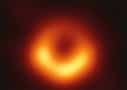
One particularly ambitious imaging effort is described in the article “Portrait of a black hole“, in which Physics World reporter Tushna Commissariat reports on how a group of astronomers plans to take the first-ever image of a black hole. Despite their name, black holes are apparently not black and the Event Horizon Telescope collaboration has already begun pointing a network of ground-based telescopes at its target: Sagittarius A*, the supermassive black hole at the centre of our galaxy.
If you believe in scientific progress, you will agree that the fate of all theories is to be replaced with better ones. Newton’s theory of gravitation was good; Einstein’s was better; someday we will find one that is better still, and so on. But does this mean that better theories are actually held back by inferior ones? In other words, if “wrong” ideas had not been so widely accepted, might “right” (or less wrong) ideas have arrived sooner?
To judge from comments I’ve seen in (and about) several recent popular-science books, some eminent scientists seem to think so. Their arguments are rather like a scientific version of Gresham’s law: the economic principle that “bad money drives out good”. This law got its name in the 19th century, but it was remarked upon much earlier by (among others) Nicolaus Copernicus – the father of heliocentric theory. He observed that when pared-down gold and silver coinage circulated widely, people hung on to any unadulterated currency they could find. Eventually, only the bad currency changed hands.
Copernicus’s link with Gresham’s law adds irony to the views of cosmologist Joe Silk, who argued (in a Nature review of Frank Wilczek’s book A Beautiful Question, which I reviewed for Physics World in October) that Copernicus’s Sun-centred universe was “held back” by Ptolemy’s Earth-centric, epicycle-laden version. According to the physicist Steven Weinberg, meanwhile, Ptolemy himself suffered from similar problems: in his book To Explain the World (see “The cradle of modern science”), Weinberg sighs that the ancient astronomer allowed his scientific acuity to be clouded by the “bad theory” of astrology. Weinberg also argues that the 14th-century French polymath Nicole Oresme was on the threshold of discovering heliocentrism before he “finally surrendered” to the misconceived Ptolemaic orthodoxy – the good idea crowded out by a bad one. (In a nice twist, Oresme, too, is sometimes credited with Gresham’s law.)
Cosmology is not the only sphere in which this notion that “bad ideas drive out good” supposedly applies. In To Explain the World, Weinberg also argues that René Descartes’ muddled ideas in physics “delayed the reception of Newtonian physics in France”. Meanwhile, in chemistry, the putative element phlogiston is often portrayed as a bone-headed impediment to Antoine Lavoisier’s oxygen-based system. And in the closest thing I’ve seen to a suggestion that science would work a whole lot quicker if history didn’t get in the way, the evolutionary biologist Jerry Coyne has proposed that “if after the fall of Rome atheism [and not Christianity] had pervaded the Western world, science would have developed earlier and be far more advanced than it is now”. That’s just one of many reasons why Coyne has argued (most recently in his book Faith Versus Fact) that “science and religion are incompatible”.
Historians of science tend to be much more relaxed about “wrong” ideas. Their task, after all, is not to adjudicate on science but to explain how ideas evolved. This requires them to understand theories in the context of their times: to see why people thought as they did, not to hand out medals for getting things “right”. In other words, they do history. At its worst, however, this position has sometimes led to the suggestion that there is no right and wrong in the history of science. In this extreme “relativist” view, modern science is no more valid than medieval philosophies, and today’s theories have gained acceptance solely because of social and political factors, not because they are objectively any better.
Plenty of scientists and historians have exposed this view as an imposture; David Wootton’s recent book The Invention of Science is but one example. But even if we reject extreme relativism and accept that science develops ever-more-reliable theories about the world, must we also conclude that better theories are delayed by worse ones?
I believe this idea should be resisted, but not so much because it makes for bad history (although it does), or because it gives the likes of Weinberg licence to call Plato silly and Francis Bacon irrelevant (see what I mean?). Rather, I think the scientific version of Gresham’s law denies the realities of how science is done.
No-one sticks with a wrong theory, in the face of a better one, knowing that it is wrong. We do so because we are human and stubborn and attached to our own ideas, and also because we are terribly prone to confirmation bias, seeing only what suits our preconceptions. But whatever the reason, we also think the old theory is actually better – that it gives a better account of why things are the way they are. In other words, at least some of our reasons for sticking with old theories are the same as those that prompt us to come up with new (and occasionally better) theories.
What’s more, theories aren’t good solely (or even) because they are eventually proved “right”. They are good if (among other things) they offer an adequate account of why things are the way they are, without too many arbitrary assumptions. They should be both consistent with and motivated by observations, and ideally they should also have a degree of predictive power. Ptolemy’s cosmology met those conditions, more or less, for centuries. So did Newton’s theory of gravity. In contrast, Max Planck’s proposed quantum fell short, at least at first. Taken at face value, quanta undermined the Newtonian physics that was otherwise so successful, without (at that point) a compelling reason to do so. That’s why Planck initially regarded quanta as a mathematical convenience, rather than real physical entities. Just imagine if Newton himself, lacking even Planck’s motivation, had pulled quanta arbitrarily out of a hat – would that have been a “good” theory? I think not.
We love to deride people who dismissed an idea that proved to be right. But sometimes they had good grounds for doing so. There was no widely accepted empirical evidence for quantization as a fundamental property until Einstein’s work on the specific heat of solids in 1907; contrary to common belief, studies of the photoelectric effect didn’t offer compelling support until several years later. A similar defence can even be made for the cardinals who allegedly refused to look through Galileo’s telescope to confirm his claims with their own eyes. After all, the telescope was a new invention of unproven reliability (could one be sure it didn’t create illusions?), and without some practice it was far from easy to use or to interpret what one saw.
So how can we distinguish “good” theories from “bad” ones? When we are taught the scientific method at school, the answer is, usually, “Do an experiment!” Indeed, Richard Feynman (in one of his many quotable moments – see “Between the lines”) attested that “Nature cannot be fooled”. Unfortunately, the notion that experiments can be trusted to deliver a clear verdict on the rights and wrongs of theories is simplistic – just ask anyone who has had to defend their conclusions against rival interpretations. In peer review, your clean, decisive experimental result quickly becomes a battle against potential confounding factors and alternative explanations. If you’ve experienced that, you have encountered something called the Quine–Duhem thesis, which says, in essence, that there’s always more than one way to read the data. (More strictly, the thesis is that no scientific hypothesis can make predictions independently from other hypotheses.)
Of course, some experiments are decisive. In The Invention of Science, Wootton cites the early 16th-century voyages of Amerigo Vespucci, which showed that the New World was a separate continent, not the “back end” of Asia – thereby destroying the theory that the Earth was made of non-concentric spheres of earth and water, with the solid sphere breaking the surface of the liquid one at just one place. But even so, the Quine–Duhem thesis deserves to be much better known among working scientists. Add in the current talk of a “replication crisis” in the life and social sciences (Nature526 163), and the fantasy that experiments resolve everything – so-called “experimental realism” – looks increasingly threadbare.
Some famous scientists have stated explicitly that they refuse to accept experiment as the ultimate authority anyway. If observations of the 1919 solar eclipse had failed to support general relativity, Einstein averred that “I would have been sorry for the dear Lord, for the theory is correct.” His Princeton colleague, the mathematician Herman Weyl, claimed that “My work always tries to unite the true with the beautiful; but when I had to choose one or the other, I usually chose the beautiful.” Not all theorists hold such strong views about beauty as a guide, but even so, if a theory were dropped the moment an experimental result seemed to contradict it, progress would be impossible.
Ultimately, science does seem able to find ever more dependable, more accurate, more predictive theories. It works. But this doesn’t mean we should imagine that bad theories or ideas hold back good ones. To do so is to put the cart before the horse, or to suppose that history has a goal (something that, of all people, an evolutionary biologist like Coyne ought to recognize as a mistake). Instead, we need to explore in detail how science evolves: as Wootton puts it, “to understand how reliable knowledge and scientific progress can and do result from a flawed, profoundly contingent, culturally relative and all-too-human process”. When we start wishing away history, we lose sight of that process.
The best measurement yet of the lifetime of the electron suggests that a particle present today will probably still be around in 66,000 yottayears (6.6 × 1028 yr), which is about five-quintillion times the current age of the universe. That is the conclusion of physicists working on the Borexino experiment in Italy, who have been searching for evidence that the electron decays to a photon and a neutrino; a process that would violate the conservation of electrical charge and point towards undiscovered physics beyond the Standard Model.
The electron is the least-massive carrier of negative electrical charge known to physicists. If it were to decay, energy conservation means that the process would involve the production of lower-mass particles such as neutrinos. But all particles with masses lower than the electron have no electrical charge, and therefore the electron’s charge must “vanish” during any hypothetical decay process. This violates “charge conservation”, which is a principle that is part of the Standard Model of particle physics. As a result, the electron is considered a fundamental particle that will never decay. However, the Standard Model does not adequately explain all aspects of physics, and therefore the discovery of electron decay could help physicists to develop a new and improved model of nature.
This latest search for electron decay was made using the Borexino detector, which is designed primarily to study neutrinos. It is located deep under a mountain at the Gran Sasso National Laboratory to shield it from cosmic rays and comprises 300 tonnes of an organic liquid that is viewed by 2212 photomultipliers.
Photon hunting
The Borexino team focused on a specific hypothetical decay process in which an electron in the organic liquid decays to an electron neutrino and a photon with energy 256 keV. This photon then goes on to interact with electrons in the liquid to produce a distinct flash of light that is detected by the photomultipliers.
The physicists sifted through all of the photomultiplier signals recorded from January 2012 to May 2013, looking for signatures of a 256 keV photon. To do so, they first had to subtract the signals from a number of unrelated processes that occur in the detector and produce similar amounts of light as a 256 keV photon. These include the radioactive decays of several trace isotopes in the detector, as well as light from the neutrino collisions that Borexino is designed to detect. After taking these background signals into consideration, the team was able to say that no electron decays were observed during the 408-day run.
Borexino’s organic liquid contains a vast number of electrons (about 1032), and the fact that no electron decays were seen during the search allowed the team to estimate a minimum value for the average lifetime of the electron. The researchers’ minimum lifetime of 6.6 × 1028 yr is more than 100 times greater than the previous lower limit of 4.6 ×1026 yr. This was measured back in 1998 by the Borexino Counting Test Facility, which was a precursor to the current experiment.
Invisible channels
Gianpaolo Bellini, who is spokesperson for Borexino, told physicsworld.com that if the detector could be further purified to virtually eliminate all background radiation, the minimum lifetime measurement could be boosted to greater than 1031 yr. He points out that Borexino could also be used to search for decays into the “invisible channel” whereby an electron is converted into three neutrinos, or could even look for the “disappearance” of an electron into extra dimensions.
Victor Flambaum of the University of New South Wales in Australia told physicsworld.com that searches for the violation of apparent symmetries are very important because even a small violation can have profound implications on our understanding of the universe. Flambaum, who is not a member of the Borexino team, points out that the experimental discovery that charge–parity (CP) symmetry is violated was made by observing the decays of kaons. CP violation plays an important role in our current understanding of why there is much more matter than antimatter in the universe.
Falling in: Sir Roger Penrose’s sketch of a black-hole collapse. (Courtesy: Tushna Commissariat)
By Tushna Commissariat
So much has been said about Einstein and his general theory of relativity (GR) that one would assume there isn’t two entire days worth of talks and lectures that could shed new light on both the man and his work. But that is precisely what happened last weekend at Queen Mary University London’s “Einstein’s Legacy: Celebrating 100 years of General Relativity” conference, where a mix of scientists, writers and journalists talked about everything from the “physiology of GR” to light cones and black holes, to M-theory and even GR’s “sociological spin-offs”.
The opening talk, “Not so sudden genius”, was given by journalist and author of “Einstein: A hundred years of relativity“, Andrew Robinson. The talk was very fascinating and early on Robinson outlined that Einstein stood on the shoulders of many scientists and not just “giants” such as Newton and Mach. But he also acknowledged that the scientist was always a bit of a loner and he preferred it this way. Robinson rightly pointed out that until 1907, Einstein was “working in brilliant obscurity” and later, even once fame found him, rootlessness really suited Einstein’s personality – he described himself as “a vagabond and a wanderer”.
The Pierre Auger Observatory – the world’s largest cosmic-ray observatory – is set for a $14m upgrade that will also see its operations extended until 2025. The AugerPrime upgrade will involve installing scintillation detectors alongside the 1660 existing water Cerenkov detectors. This will enable more precise measurements of the mass of particles that make up cosmic rays, as well as help to identify the origin and nature of such particles.
The facility, which covers an area of 3000 km2 in Argentina, measures the cascade of secondary particles produced when a cosmic ray hits the Earth’s atmosphere. By observing these particles, astronomers can obtain information on the mass, direction and energy of the original cosmic ray.
Recent results have shown that at the highest energies – 1018–1021 eV – the number of cosmic-ray particles decreases much faster than at lower energies. A better understanding of the mechanisms responsible for this flux suppression should help infer the maximum energy of cosmic rays and identify what is responsible for accelerating cosmic rays to such high energies. However, this requires more detailed measurements of the highest energy rays.
Unique capabilities
The new 4 m2 scintillators will complement the existing Cerenkov water detectors and enable electrons and muons to be separated in the secondary shower more efficiently. Researchers will also be aided by a 23 km2 area of new buried muon detectors. “The ratio of electrons to muons turns out to be very sensitive to the mass of the primary particle,” says Pierre Auger Observatory spokesperson Karl-Heinz Kampert. “AugerPrime will address a number of fundamental scientific problems that cannot be addressed anywhere else within the next decade or more.”
Measuring the fluxes of both muons and electrons should make it easier to identify cosmic rays that are high-energy protons. This is important because they are deflected less by cosmic magnetic fields and do a better job of pointing back to their distant sources than cosmic rays that are heavy, highly charged, nuclei.
“It has been said that identifying the sources of cosmic rays is the ‘holy grail’ of our field,” says Gordon Thomson, co-principal investigator for the Telescope Array cosmic-ray observatory in Utah. “This is exactly the aim of the AugerPrime project. The technique of counting both muons and electrons in air showers has been used successfully in previous experiments, and I believe it will work very well for the Auger experiment also.”
Better electronics
Work will start on the upgrade next year, which will also include faster and more powerful electronics to facilitate the new detector components and enhance the overall performance of the observatory.