Computer program dreams up new quantum experiments

Quantum mechanics is so hard to understand that even experts do not entirely trust their intuition – and this makes it difficult for physicists to come up with new experiments that put the theory to the test. Now, physicists at the University of Vienna in Austria have devised a computer algorithm for designing new quantum experiments that are beyond our wildest dreams.

The idea was developed by graduate student Mario Krenn and colleagues in the group of quantum-physicist Anton Zeilinger. The algorithm is dubbed “Melvin”, and the team believes that it might be able to explore hitherto unknown properties and behaviours of quantum systems. In doing so, Melvin would take the complexity of quantum experiments to a level beyond the imaginations of human designers.

“High-dimensional” entanglement

These experiments include those with the particular goal of achieving quantum entanglement between many particles. Experimental methods for achieving entanglement of two or a very few particles are well-known. But entanglement is so counter-intuitive that it can be very difficult to see how to combine the known experimental “building blocks” to attain a more complicated state, such as “high-dimensional” entanglement between many of the particles’ degrees of freedom.

Melvin works that out unencumbered by human preconceptions. The algorithm is supplied with a set of standard experimental components that it can combine and reshuffle to achieve the desired goal. These elements consist of devices for manipulating the trajectories and quantum properties of photons. These include beam splitters, which can send a photon in two possible directions, thereby putting it into a superposition of two quantum states.

Melvin begins by assembling the elements of this toolbox randomly, and seeing if any of the configurations achieves the experimental goal. If so, Melvin then simplifies the arrangement of elements as much as possible before delivering the configuration to the user. If the goal is not achieved, it starts again with another random arrangement. After typically several days of computation on a standard laptop, Melvin can deliver several optimized solutions to the specified task.

All I was doing was guessing, and I thought that this is something the computer can do
Mario Krenn, University of Vienna

The idea began, says Krenn, when his colleague Mehul Malik wondered if a particular high-dimensional form of a quantum state called a Greenberger–Horne–Zeilinger (GHZ) state (which involves three or more entangled particles) could be created. “Several of us tried for some time to find a way to implement it experimentally” – but without success, he says. Finally, Krenn says, “it occurred to me that my intuition about how the set-up would work was wrong – basically all I was doing was guessing. And I thought that this is something the computer can do as well, but a few thousand times faster than me.”

In its first demonstration, Melvin came up with 51 new kinds of experiment for making high-dimensional GHZ states. In a second implementation, the Vienna team found how to achieve cyclic transformations of photon states, such that a sequence of transformations eventually returns the photon to its initial state. Such sequences could be useful in quantum-information processing. Here, Melvin found good solutions from around 1022 possible configurations of the experimental building blocks – and was eventually able to reduce the number of elements required to just four. Krenn and colleagues have now started to implement some of Melvin’s solutions in the lab.

Genuine creativity

Because Melvin does not follow intuitive reasoning, the researchers say, it is not bound by conventional ideas about how to achieve a goal. They suggest that according to some definitions this makes Melvin genuinely creative. Some of the solutions may, however, defy intuition, even when the answer is known to be correct. In the proposed experiments for making a high-dimensional GHZ state, Krenn admits that he is still puzzled what exactly is going on. “There is one very intricate step for which I can write down every step mathematically, but which is very difficult to explain intuitively,” he says. “I think that is unique in quantum physics,” he adds. He expects that this confounding of intuition will be all the more common with increasing complexity in the tasks that Melvin tackles.

Clever idea

“This is a very clever idea, and I can see that a lot can be done with it,” says Daniel Greenberger of the City College of New York, a specialist in the fundamental aspects of quantum theory. It will work best, he says, “where there are only a finite number of pieces of equipment and a finite number of different experiments that are not too complicated”. But Melvin is not going to invent new theories, Greenberger cautions. “Totally new thought arrangements are beyond it, at least in the foreseeable future, so it won’t replace the scientific community yet.”

The research is described in a preprint on arXiv and in a paper to be published in Physical Review Letters.

Progress update in Chinese physics

Photo of Wenlong Zhan, president of Chinese Physical Society, at meeting with Paul Hardaker and Matin Durrani, 23 February 2016

By Matin Durrani

China continues to make great progress in physics, with new facilities and projects starting up all the time. Just this week we’ve reported on plans to build a new neutrino experiment at the China Jinping Underground Laboratory (CJPL). The world’s deepest lab, it’s located under a mountain – with about 2400 m of rock cover – in China’s south-western Sichuan province.

Physics World has long kept a close eye on the progress of the physics community in China and in fact we published our first ever special report on the country in 2011. Since then, however, so much more has been going on that we felt it’s time to make a return trip and will be producing another special report in September this year to give you further insights into physics in China.

(more…)

World’s deepest lab targets neutrinos

An international group of researchers has issued a “letter of intent” for a new neutrino experiment to be built at the China Jinping Underground Laboratory (CJPL). The scientists believe that the proposed Jinping Neutrino Experiment would measure solar and geoneutrinos better than any other facility in the world, thanks to its extremely low level of background radiation.

CJPL is located under a mountain – with about 2400 m of rock cover – in China’s south-western Sichuan province. Completed in 2010, it is currently the deepest underground lab in the world, and hosts two dark-matter experiments: CDEX and PandaX. Work began in 2014 to expand CJPL so that it has room for four more experimental chambers – each 12 m wide and 130 m long. The expansion is expected to be complete by the end of this year.

Deep detector

The new letter of intent has been authored by scientists at Tsinghua University, along with others elsewhere in China, Germany and the US, and outlines the science that the Jinping Neutrino Experiment would carry out. Costing around 300m yuan (£32m) to design and build, it will feature 4000 tonnes of liquid scintillator or water-based liquid scintillator, and will aim to obtain precise measurements of the electron neutrino fluxes generated by the Sun. Although previous observations have shown that neutrinos oscillate from one flavour to another, John Beacom, a theorist at Ohio State University and a member of the proposal, says that current measurements could be more refined to offer “tremendously exciting” results.

The experiment would also study electron antineutrinos generated in the Earth’s mantle and crust, which could be used to measure the amount and distribution of uranium and thorium inside of the Earth. Compared with other geoneutrino detectors, CJPL is located far away from nuclear power plants, which could affect the measurements. Shaomin Chen, a physicist at Tsinghua, says that the researchers will now place a small detector at CJPL to carry out a preliminary study. If all goes well, Chen says they could design and build the detector within the next five years.

A preprint of the letter is available on the arXiv server.

Mary, Queen of Scottish banknotes

To learn about Somerville’s academic achievements and personal life, Dacey visits the University of Oxford’s Somerville College. Founded in 1879, it was originally a women-only institution and is named after Somerville, who achieved international acclaim during her lifetime. Famous alumni include chemistry Nobel laureate Dorothy Hodgkin, and the only female prime ministers of the UK and India to date: Margaret Thatcher and Indira Ghandi. Today, the college accepts both men and women but maintains its reputation for being one of the more open and progressive of Oxford’s colleges. Dacey meets Somerville’s current principal Alice Prochaska, a historian by training, who describes Somerville’s formative years and how her influence lives on at the college today.

Prochaska describes how Somerville first encountered mathematics from an unlikely source – an algebra puzzle in a woman’s magazine. Without the support of her parents – who thought maths could turn a female mind to mush – Somerville showed a combination of genius and sheer determination to teach herself Euclidian geometry by candlelight. Under the encouragement of her second husband, William Somerville, she developed a flair for interpreting some of the leading mathematics of her day and communicating this to a wider audience via her accessible writing. One of her best received publications was her book On the Connexion of the Physical Sciences, originally published in 1834 and hailed by many of the period’s leading thinkers, including Charles Darwin. To learn about the influence of Somerville’s work and how she became a fixture in Europe’s intellectual circles, Dacey also meets with science historian Allan Chapman.

In the second half of the podcast, Prochaska talks about some of the challenges that women in science still face today, and discusses some of the initiatives in place at Oxford to encourage diversity. If you would like to find out more about diversity issues in physics, make sure you don’t miss the March issue of Physics World, a special edition on this topic.

Ring laser reveals subtle seismic motion

A laser gyroscope located deep beneath the Gran Sasso mountain in central Italy has made the first deep-underground measurements of the rotational motion that passing seismic waves generate in the Earth’s crust. The ability to make such measurements could boost our understanding of the strain that rocks undergo before an earthquake takes place, say the scientists who carried out the research.

Earthquakes release large amounts of pent-up energy in the form of seismic waves, which propagate in all directions from the quake’s epicentre. When those waves reach the Earth’s surface they can cause the ground to move along one or more orthogonal axes – up and down, back and forth, and side to side. But seismic waves can also generate much smaller rotational motions, in which the ground rotates around one or more of the three axes.

According to Gilberto Saccorotti of Italy’s National Institute for Geophysics and Volcanology (INGV), rotational motion is important to measure for a number of reasons. For one thing, seismologists can determine the speed of a seismic wave – and so better understand the kind of rock it propagates through – by comparing the magnitudes of the rotational and translational motions that it generates. In addition, better measurements of ground rotation during strong earthquakes would allow for more robust building regulations. “Circular motion, like horizontal motion, can be very dangerous,” he says. “Structures haven’t been designed with that in mind but are instead meant to resist vertical forces, i.e. their own weight.”

Circular motion, like horizontal motion, can be very dangerous
Gilberto Saccorotti, National Institute for Geophysics and Volcanology

Seismometers are not naturally suited to measuring this circular motion because they are based on pendulums or masses-on-a-spring, which respond in the same basic way, whether the devices’ housing moves up and down or is tilted. While arrays of seismometers can be used to measure circular motion, the relativity weak nature of these events means that only the strongest signals can be detected in this way.

Frequency shift

Ring-laser gyroscopes, on the other hand, are designed specifically to measure rotational motion. These devices record the very tiny differences in frequency between two laser beams sent in opposites directions around an optical circuit that is fixed rigidly to the ground. The frequency offset reflects the rate at which the ground rotates. Ring lasers in Germany, New Zealand and the US have been detecting earthquakes’ rotational ground movements for about the last two decades, but the fact that these instruments are located at or just below ground level exposes them to disturbances – be they of natural or human origin – that originate close to the Earth’s surface.

In the latest work, Saccorotti and colleagues at the INGV and Italy’s National Institute for Nuclear Physics (INFN) used a ring laser called GINGERino, consisting of four 3.6 m-long sides mounted on a block of granite. Housed 1400 m underground at the Gran Sasso National Laboratory, the device is largely shielded from the tiny variations in air pressure that can trouble ring lasers at shallower depths. It is the forerunner of an experiment called Gyroscopes in General Relativity (GINGER), which will use at least three large ring lasers arranged at right angles to one another to try and measure the very subtle “frame-dragging” effect predicted by Einstein’s general theory of relativity.

Using GINGERino, the INFN-INGV group was able to record a magnitude-seven earthquake that occurred under the Atlantic Ocean during a week of data-taking in June 2015. The researchers say that although their data exhibit a poor signal-to-noise-ratio, they were still able to detect rotational motion generated by the earthquake’s seismic waves in the rock surrounding the lab.

Potential earthquake precursors

According to Saccorotti, the result shows the feasibility of installing a long-term experiment in the Gran Sasso lab – be it GINGER or a single, larger ring laser. Such a device would systematically record rotational ground motions over a two- to four-year period. This would allow the detailed study of the elastic deformation of rock caused by the gradual build-up of energy across a geological fault ahead of an earthquake. “That deformation can include rotational motion, so having a very sensitive device in a low-noise environment opens up interesting possibilities for studying a potential earthquake precursor”, he says, pointing out that Gran Sasso is in one of the most seismically active regions of Italy.

Ulrich Schreiber of the Technical University of Munich, who collaborates with the Italian group, points out that the field of “rotational seismology” is now quite well established, thanks to the availability of improved ring-laser gyroscopes. But he nevertheless praises the latest work. “GINGERino is a prototype instrument that has still to mature a fair bit before reaching its full potential,” he says. “But being able to observe rotational motion from remote earthquakes in a deep-underground laboratory is an important step forward.”

The research is reported on the arXiv preprint server.

How LIGO will change our view of the universe

Results and data from the Advanced Laser Interferometer Gravitational-wave Observatory (aLIGO) collaboration – which revealed last week that it had observed a gravitational wave for the first time – are already providing astronomers and cosmologists the world over with previously unknown information about our universe. While the current results have posed intriguing questions for astronomers regarding binary black-hole systems, gravitational-wave astronomy will also revolutionize our understanding of the universe during its infancy, according to cosmologist and Perimeter Institute director Neil Turok.

Many scientists, such as LIGO veteran Kip Thorne, have pointed out that the collaboration’s results have opened a new window onto the universe. Each time that this has happened in the past, unexpected phenomena have come to light – for example, the advent of radio astronomy revealed the universe’s most luminous objects in the form of quasars and pulsars.

Pristine objects

Turok told physicsworld.com that black holes – some of the most prolific producers of these ripples – are some of the simplest objects in the universe. He points out that when it comes to these “perfectly pristine objects”, there are “not too many parameters that need to be determined” because a black hole’s dynamics are mainly determined by its mass. Turok also points out that gravitational waves will provide even deeper insights, as they involve the fundamental force of gravity, which itself is still something of a puzzle.

Indeed, for Turok, this is what is most exciting about aLIGO’s discovery, which he says “may mark a bit of a transition as gravitational-wave observatories become the high-energy colliders of the future as we probe gravity and other extremely basic physics”. Gravitational waves can go to a time/place that, currently, we have very little information about – the early universe, which is opaque to all electromagnetic radiation.

Looking back in time

Thankfully, gravitational waves can travel freely through the hot plasma of the early universe and could be used “to look back to a trillionth of a second after the Big Bang”, according to Turok. For him, the discovery is very timely, as he is currently working with colleagues on a new theoretical proposal for “shockwaves” produced a millionth of a second after the Big Bang, which would have been present across all scales in the early universe. If these shockwaves exist, they would have an effect on the measured density variation that is seen in the cosmic microwave background, and could only be detected by gravitational radiation. Once they have a more complete theoretical description, Turok is convinced that LIGO and its successors such as the LISA Pathfinder and other space-based experiments could pick up the shockwave signal, if it exists.

Ultimately, Turok is delighted by LIGO’s discovery, and although he says that it is “much more important than any prize”, he is sure that it will win not only a Nobel prize, but also a slew of others, such as the Breakthrough prize.

A preprint of Turok’s paper on shockwaves is available on the arXiv server.

More on gravitational waves and LIGO

Waves of soup, spying on gravity and touring the solar system

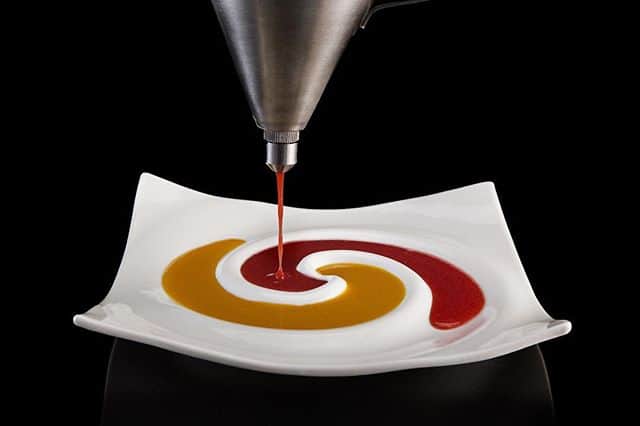
Nathan Myrvold's gravity-inspired soup bowl (Courtesy: Modernist Cuisine).

By Hamish Johnston

Nathan Myhrvold knows a lot about gravity (he worked with Stephen Hawking) and a lot about food (he wrote Modernist Cuisine) so it’s not really surprising that he has designed a soup bowl inspired by the collision of two black holes. Created in 2014, the bowl was made to hold two different types of soup in swirls of space–time. Now that the LIGO observatory has spotted a gravitational wave from the collision of two such black holes, I’m guessing sales of the bowl will be out of this world.

(more…)

Ultrathin lens is free of chromatic aberrations

A new type of flat, ultrathin lens designed to be free of chromatic aberrations has been developed by researchers in the US. The device has a variety of potential applications, from ultralight imaging systems for drone aircraft to more compact lenses for mobile-phone cameras.

Lenses for cameras, eyeglasses and other applications are traditionally based on refractive optics, which involves using curved lenses to bend light rays. The “optical power” of a conventional lens – how strongly it bends light – is proportional to its thickness, which means that a conventional refractive lens cannot be very thin. Refractive lenses also suffer from chromatic dispersion, wherein blue light bends more than red, and therefore multiple images are produced over a range of focal lengths. Multiple lenses can cancel out this dispersion, but this adds further to the weight, thickness and cost of a lens system.

Diffractive lenses offer a route to ultrathin lenses by redirecting light using the interference between light waves as they pass through a series of slits in a thin opaque material. Such lenses can be effectively flat, and therefore much lighter and thinner than refractive optics. However, diffractive lenses suffer from much larger dispersion. And to further complicate matters, this dispersion is anomalous with red light bending more than blue.

Thin metasurface

In 2015 Federico Capasso of Harvard University and colleagues showed that a flat lens can be made that focuses all of the colours of broadband light in the same plane. The team then unveiled a device that focused broadband infrared light onto a single line using a thin metasurface.

To be used in a camera, you need to be able to form good images, and that will require a little bit more work
Rajesh Menon, University of Utah

This device used dielectric resonators that interact directly with the electromagnetic field of light waves to impart any desired phase shift. However, this new technology brings its own challenges. Making the metasurfaces requires precision engineering because the resonators have to be smaller than the wavelength of the focussed light. Metasurfaces are also inherently polarization-sensitive, whereas a general-purpose camera lens needs to focus unpolarized light.

Now, Rajesh Menon of the University of Utah and colleagues have focused broadband visible light using a different approach that involves creating a series of grooves in a soda-lime glass surface. The height and width of each groove was selected using a computer algorithm that optimized focusing across the entire visible spectrum. This involved using the conventional dispersion of the glass material to compensate for the anomalous dispersion of the grating, such that waves would be focused on the same line irrespective of wavelength.

Less precision needed

To test their device, the researchers illuminated the lens with light at variable wavelengths, measuring the distances at which light of different wavelengths was focused. The difference was comparable with commercial “achromatic” refractive lenses, and rotating the polarization of the light made no detectable difference. Furthermore, creating the patterned surface does not require the same degree of precision engineering as resonators. The smallest feature size on the glass surface was 3 μm, whereas the researchers calculated that a metasurface to do the same job would need resonators just 39 nm in size.

Menon and colleagues are now working to develop their lens further. “What we have shown is only one function of the lens – focusing,” Menon says. “To be used in a camera, you need to be able to form good images, and that will require a little bit more work.”

“Both [Menon and Capasso] have contributed to an important advance in making diffractive lenses a practical proposition for broadband applications,” says John Pendry of Imperial College London. Pendry suspects the costs associated with mass production of Capasso’s design might be manageable. “The technologies used for making chips can get down to that sort of resolution for volume production,” he says. “Performance would be a better metric for comparison. It remains to be seen which solution wins in practical terms.”

The lens is described in Scientific Reports.

A big Lidl telescope in Belfast

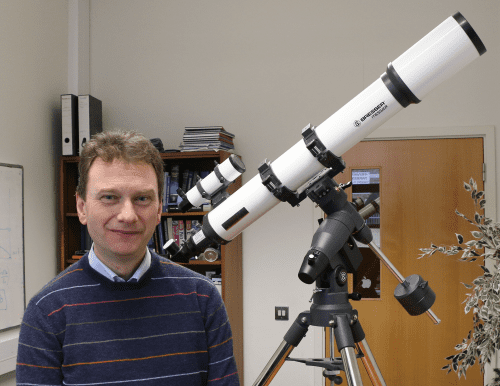
Alan Fitzsimmons and his telescope

By Hamish Johnston

There is an old joke in the UK about going to the discount supermarket Lidl for a pint of milk and coming home with a new set of power tools or ski-wear for the entire family. That’s because the retailer is famous for its seemingly random special offers. One week it could be car accessories and the following week the same shelves could be stocked with pyjamas or camping gear.

But Alan Fitzsimmons of Queen’s University Belfast deserves an award for best physics-related Lidl bargain with this huge telescope that he bought at the supermarket. It makes perfect sense to me – both Lidl and the telescope’s maker Bresser are German companies and, of course, Germany is famous for its optics.

(more…)

Chinese lab confirms antineutrino anomalies

Analysis of more than 300,000 electron antineutrinos emitted by nuclear reactors in China provides the best evidence yet that the flux and energy distribution of such particles do not agree with theoretical predictions. While the disparities could be caused by deficiencies in current models describing neutrino production and detection, a hitherto unknown fourth neutrino could also explain some of the disagreement with theory.

The data were obtained from the international Daya Bay Reactor Neutrino Experiment, which consists of eight antineutrino detectors that look for antineutrinos emitted by six nearby nuclear reactors. This latest measurement was done using six of these detectors, each containing 20 tonnes of a gadolinium-doped liquid scintillator that emits a tiny flash of light when an electron antineutrino interacts with a gadolinium nucleus.

Mysterious bump

Data were collected over 217 days, allowing the team to measure the energies of the antineutrinos to within 1% uncertainty – which the researchers claim is the most precise measurement to date. But instead of agreeing with current models of antineutrino production, the energy spectrum contained a large excess of antineutrinos at an energy of 4–6 MeV with a statistical significance of 4σ.

Although this is less than the 5σ normally required for a “discovery” in particle physics, the existence of this bump is backed up by two other reactor neutrino experiments – Double Chooz in France and RENO in Korea. Both have already seen excesses at 4–6 MeV, with significances of 3σ and 3.5σ, respectively.

Despite the excess at 4–6 MeV, however, the total number of antineutrinos detected at Daya Bay with energies in the 1–7 MeV range was 6% less than predicted by theory. This deficiency was first identified in 2011 by Thierry Lasserre and colleagues at CEA Saclay in France, who evaluated data from a number of different reactor experiments.

According to Lasserre and colleagues, one explanation for the overall deficit of antineutrinos is that the missing particles have oscillated into a hypothetical fourth type of neutrino as they travel from reactor to detector. One candidate is the “sterile” neutrino, which is predicted by certain extensions of the Standard Model.

If they exist, sterile neutrinos would interact extremely weakly, if at all, with ordinary matter, and so would be even harder to detect than conventional neutrinos. However, the existence of sterile neutrinos could be inferred from discrepancies between measured and predicted neutrino fluxes.

More evidence needed

According to Lasserre, who is not part of the Daya Bay collaboration, physicists seeking sterile neutrinos will have to wait several years for better evidence. “We need new experiments dedicated to search for sterile neutrinos, and several of them are currently being realized,” he says. “We may expect new results within the next three years.”

As for the excess of antineutrinos at 4–6 MeV, Lasserre says this anomaly is relatively new, having first been identified in 2014. “Daya Bay now provides the most precise data, and this is a great result, but we don’t have yet any solid explanation of what it means exactly,” he explains.

However, Lasserre adds it is unlikely that the bump is related to sterile neutrinos, but could instead be related to limitations in our understanding of how antineutrinos are produced in reactors or of how the detectors work. Daya Bay Collaboration co-spokesperson Kam-Biu Luk of the University of California at Berkeley concurs. “This unexpected disagreement between our observation and predictions strongly suggested that the current calculations would need some refinement,” he says.

The Daya Bay measurement also provides important information for physicists studying how neutrinos from nuclear reactors oscillate between flavours as they travel long distances to remote detectors. According to the collaboration, such experiments may “need to revisit the models underlying their calculations”. This includes the JUNO detector, which is currently being built 200 km from Daya Bay.

The research is reported in Physical Review Letters.

Copyright © 2026 by IOP Publishing Ltd and individual contributors