

Physicists blow magnetic bubbles

The capacity of computer memory could be boosted by exploiting tiny magnetic vortices known as skyrmions. That is the vision of physicists in the US, who have made individual skyrmion “bubbles” at room temperature by pushing magnetic domains through a narrow gap in a thin ferromagnetic-metal film – just as bubbles can be made by blowing on a soap-covered gap.

Skyrmions are particle-like regions within a field where all of the field vectors point either towards or away from a single point – a bit like the way in which spines are arranged on a hedgehog. Skyrmions were originally proposed in the 1950s by British physicist Tony Skyrme, who found they could explain the emergence of protons and neutrons from the field that mediates the strong nuclear force. But while skyrmions never really took off in particle physics, their underlying mathematics has been applied to other areas of physics.

The crucial point about a skyrmion is that it is topologically stable. This means that, while its shape can be altered, the “twistedness” of a skyrmion cannot be broken without first removing the singularity that holds it together. This resembles the behaviour of a Möbius strip, which must be cut if it is to be transformed into a normal loop – no amount of bending will do the job.

Tiny yet stable memory

This is a quality that could make skyrmions ideal for use in computer memory. Hard disks work by encoding 0s and 1s using the direction of atomic magnetic moments within small regions, or domains, on the surface of a ferromagnetic material. But there is a limit to how small these domains can be made before the magnetization becomes unstable. The great stability of skyrmions means they could potentially occupy far smaller areas – having dimensions of just a few nanometres, rather than the roughly 50 nm of today’s best drives – and the very small electric current needed for their operation means they would consume less energy.

In the latest research, Axel Hoffmann of the Argonne National Laboratory in Illinois and colleagues have made a device consisting of a very thin layer of a cobalt-iron-boron alloy – a ferromagnet – sandwiched between layers of tantalum metal and tantalum oxide. They pattern this multilayered film so as to create a wire 60 μm wide with a narrow (3 μm) constriction about halfway along.

Normally, the magnetic moments of electrons within a thin film of ferromagnetic material point along the plane of the film, but the layered structure of this device orients those moments perpendicular to the plane. The researchers apply a magnetic field to create a long “stripe” of domains with upward-pointing magnetization, surrounded by areas of opposing magnetization, and then switch on an electric current flowing from left to right along the wire.

That current exerts a force on the magnetic domains, moving them to the right. But since the current cannot flow outside of the wire, it is constrained to funnel through the constriction, thus introducing a vertical component to its left–right motion. That in turn pushes the sides of the stripes outwards as the latter emerge from the narrow gap. This expansion continues until the head of each stripe forms a bubble shape that then breaks off and continues to move rightwards (see figure).

“This bubble disconnects, just like an expanding soap bubble or a drop from a dripping tap,” explains Hoffmann. “It has the exact topological structure of a magnetic skyrmion.”

Everyday materials

A significant advantage of this scheme over alternative ways of generating skyrmions, says Hoffmann, is its use of transition metal alloys and other metallic films that are already found in commercial memory devices. The device also operates at room temperature, so doing away with the need for expensive refrigeration equipment. In addition, he says, whereas skyrmions are usually manipulated within lattices, here they have been isolated.

According to Hoffmann, these skyrmions could have a number of uses. One would be to make logic gates. An AND gate, for example, could potentially consist of two joined wires that would generate an output only if skyrmions were present in both wires. However, the most straightforward application would be encoding data using the presence or absence of skyrmions. In particular, “racetrack memory”, which involves reading and writing to mobile magnetic domains on a fixed wire, suffers from the fact that stripe-shaped domains can easily be corrupted by defects in the wire. Point-like skyrmions, in contrast, could move around such defects, he says.

Kirsten von Bergmann of the University of Hamburg in Germany, whose group in 2013 reported having created and destroyed skyrmions on a thin film of palladium and iron, praises the latest work, which she says is “a significant step towards implementation” of real devices. But she cautions that significant hurdles remain, including the need for better control over the positioning and movement of individual skyrmions. Also crucial, she says, is size. The American group has produced skyrmions with a diameter of about 1 μm, which is one to two orders of magnitude too large to be useful, she estimates.

Hoffmann acknowledges this shortcoming but believes it can be overcome. He says that other research groups have been able to make room-temperature skyrmions as small as 100 nm across (the greater thermal energy at higher temperatures perhaps making it more difficult to prevent small skyrmions from unwinding). Reducing the scale by another factor of 10, he says, “is not so unrealistic”.

The research is reported in Science.
Tinker, tailor, physicist, spy?

Bruno Pontecorvo was the only nuclear physicist who defected from the West after contributing to Allied nuclear research during the Second World War. His flight to the Soviet Union in 1950 rang alarm bells throughout the physics community, but especially in the UK, where he had been employed in the Atomic Energy Research Establishment at Harwell. Since then, the questions of whether Pontecorvo passed restricted information before his defection, and what contribution he made to Soviet atomic energy research after it, have been the focus of several enquiries. The recent declassification of documentation produced by the British security services has revamped the search for answers, and Frank Close’s Half-Life: the Divided Life of Bruno Pontecorvo, Physicist or Spy is the latest book to take advantage of this newly available information.

At this point, I must offer a caveat. Mine is one of two previous works that Close describes as “excellent books” about Pontecorvo (thank you, Frank), and his biography of this Italian-born scientist stems from his reading (and dissecting, as I now realize) of both my published work and several conversations we have had on the subject of “Bruno”. Reading Close’s book was thus an unusual experience for me (at one point, I declared “This is not true!” only to turn to the book’s endnotes and gasp; the source cited was my own book), and so writing this review is a little unusual as well. So, reader, I beg your pardon: I will describe Close’s book, but I cannot comment on it.

Close has carefully examined the declassified papers and gained additional information from a number of other sources. The result is a rich account, containing details on Pontecorvo’s life and career that previous works on atomic espionage overlook. What struck me especially was the description of Pontecorvo’s research on the ethereal “quadium”: a hydrogen isotope wrongly assumed to have potential as an ingredient for a new type of atomic bomb.

It made me wonder whether Ponte-corvo’s one-way trip to Moscow was solicited precisely because of this useless -component. If this is the case, then the Pontecorvo episode would probably fit better in a Monty Python sketch than in the latest James Bond film: in this version of the story, the physicist was headhunted to complete the Soviets’ ultimate nuclear weapon, only to produce a device that fizzled out even before being weaponized. One may also wonder if the Soviets were then, in effect, stuck with “Dr Quadium” (a.k.a. Pontecorvo) and his family, but could not say so.

Close’s book has other surprising twists that would, however, hardly feature in a thriller by Ian Fleming. He describes, for example, how Pontecorvo’s mamma sent him a letter just before his flight to Russia in which she urged him to tell her the truth – as if he were a naughty child caught with his hands in the cookie jar. There is also a shy and mysterious Swedish woman, Marianne Nordblum, among the supporting characters – but she is hardly a deceitful temptress intending to steal Pontecorvo’s secrets. Instead, she is his wife, a woman prone to depression who Bruno loved “to bits”.

By now, you will have realized that I lied when I wrote that I would not comment on Close’s biography. The truth is that his book has the invaluable merit of taking the reader away from the expected cast of covert spies intending to steal secrets (and intelligence agents eager to catch them at it) and placing real human affairs at the centre of the narrative instead. Bruno Pontecorvo thus appears as the ingenuous genius that he was; the naive and lumbering main character of his life’s drama.

On the other hand, when Close does focus on the “spy trail”, I wonder whether his book perhaps gives more credit to espionage literature than the genre deserves. In particular, Close alleges that, before his defection, Pontecorvo might have been the one who smuggled uranium powder to the “Mata Hari” of Massachusetts, Leontine Theresa Cohen. Close also claims that the notorious double agent Kim Philby warned Moscow about Pontecorvo, thus instigating the latter’s defection. He thus renews the doubt that has been haunting many before: was the physicist a spy?

Even if we consider Pontecorvo’s naivety to be apocryphal, and regard as misleading the lack of non-anecdotal evidence on his Communist background, an examination of what Robert De Niro (as ex-CIA operative Jack Byrnes in the film Meet the Parents) calls “circles of trust” gives -reasons to doubt that he was. Spy rings existed in both the US and Canada, but their operatives, with the notable exception of Klaus Fuchs (an exception nonetheless), were recruited among English-speaking Communist Party members. Could Pontecorvo trust them? Could they trust him?

Yes, atomic spies did exist, and, yes, there are still more unidentified codenames in the US counterintelligence “Venona Project” than there are known agents with names and surnames. But the allegory of modern crusaders fighting against scheming Communist infidels to protect a “holy grail” of atomic secrets has rapidly decayed. This narrative was constructed after the first Soviet atomic test in order to cast a negative light on the Communist atomic -programme, but it actually hid the fact that Allied governments encouraged the exchange of scientific information with Soviet Russia right up until 1944.

After the war, other nations joined the race for atomic energy, and they too exchanged “secrets”, above and beyond ideologies and legal protocols. In 1970, for example, a French colleague of Pontecorvo, Lev Kowarski, revealed that many physicists had learned through the grapevine about a Canadian reactor called ZEEP, which became a prototype for the Norwegian JEEP and the Swedish SLEEP. Pressed by his interviewer, though, Kowarski denied committing security violations. “A certain amount of leakage is unavoidable,” he said. One wonders whether he was thinking about his Norwegian colleague Gunnar Randers, who first learned about atomic energy in wartime Britain, was recruited by US officials to acquire secrets of the Nazi nuclear project and, finally, unbeknownst to the Americans, consulted with the French in order to complete a Norwegian reactor. Was Randers ever accused of espionage? Of course not: he was appointed NATO’s science adviser.

Thanks to his contagious enthusiasm, Close has gone a long way towards reconstructing Pontecorvo’s life, and thereby uncovering the real man behind the fictional spy. The acknowledgments at the end of the volume show how many people he has contacted to find the fresh evidence that makes this important appraisal possible. Pontecorvo’s flight to the Soviet Union is still a mystery, but it is thanks to Close that the veil that shrouds a crucial episode in the history of the Cold War may soon fall.

  • 2015 Basic Books £20.00/$29.99hb 400pp

How to make a better quantum thermometer

A theoretical framework for creating practical quantum thermometers that are optimized for taking the temperature of tiny structures as varied as living cells and quantum bits has been created by physicists in Spain and the UK. The work identifies an important trade-off between the precision and operating range of such quantum probes, and also describes how they could be used in the lab.

The temperature of an everyday object can easily be taken by putting it into contact with a thermometer. But this is much trickier when the object is extremely cold, extremely small or both. This is because heat will be exchanged between the thermometer and the object, ultimately affecting the measurement. The growing interest in creating nanometre-sized quantum devices for use in computing, metrology and other applications means that physicists must gain an understanding of the thermodynamics of these systems. This requires the ability to measure the temperature of such devices to nanometre precision – an ability that could also be also useful for taking the temperature of living cells.

Gold and diamond thermometers

In 2013, for example, Mikhail Lukin of Harvard University and colleagues used a tiny diamond (just 100 nm in diameter) to measure the temperature within a living cell at a spatial resolution of 200 nm (see “Nanodiamond thermometer takes temperature of biological cells“). Other researchers have shown that quantum dots – tiny pieces of semiconductor – can be used to measure the temperature of electrons in samples cooled below 1 K.

These tiny probes can be thought of as “quantum thermometers” because they sense the effect of heat energy on the fragile quantum states of an otherwise isolated system. Such systems are very sensitive to external stimuli such as heat, which makes them very good temperature probes. However, their development is in its infancy, and much work must be done to create quantum probes that are optimized for use in specific situations.

Now, Luis Correa, Mohammad Mehboudi and Anna Sanpera of the Universitat Autònoma de Barcelona, along with Gerado Adesso of the University of Nottingham, have done a theoretical investigation of what types of quantum systems make the best temperature probes. They have also done calculations to find out what are the best ways of operating these hypothetical devices.

Fully thermalized

The team looked at “fully thermalized thermometers”, which are devices that are in thermal equilibrium with the system they are measuring. This is much like a traditional mercury or alcohol thermometer immersed in a beaker of water.

The team’s calculations revealed that the probe’s heat capacity – the amount of energy required to raise its temperature by one degree – is an important parameter in the design of a quantum thermometer. The heat capacity is related to the number of different ways that the system can be excited from its ground state – its degrees of freedom – and the calculations show that increasing the number of degrees of freedom boosts the precision of the measurement.

However, the team found that increasing the degrees of freedom also narrows the range of temperatures in which the probe is effective – which means that designing a practical probe would involve a trade-off between precision and range.

Range versus precision

In the case of the Lukin’s diamond thermometer, thermal energy can excite the ground state of its atom-like system into one of two degenerate excited states (degrees of freedom). If more degenerate excited states were available, then the diamond thermometer would be more precise, but would function over a narrower range of temperatures. This trade-off suggests that other quantum systems that do not have a large number of degenerate excited states – such as the harmonic oscillator – could be used as practical temperature probes that work over wide temperature ranges.

The team points out that an effective way of probing the temperature of a tiny object would involve first using a low-precision, wide-range probe to make a rough measurement. Then successively more precise probes would be used to reduce the uncertainty in the measurement.

The team also looked at “partially thermalized thermometers” that are able to take the temperature of an object without being at thermal equilibrium with it. Such a probe would be useful if the system to be measured was unstable and existed for a time that is much shorter than the time it would take for probe and object to equilibrate. In this case, they found that the probe should be at its lowest possible temperature when applied. They also found that while the precision of a partially thermalized measurement increases with the number of degrees of freedom, the temperature range of the probe remains constant.

Correa and colleagues hope that their theoretical framework will help to improve experiments that measure heat dissipation in nanometre-sized circuits, and also guide scientists in developing new ways to study the transfer of heat in living cells.

The research is described in Physical Review Letters.

Success, failure and women in physics

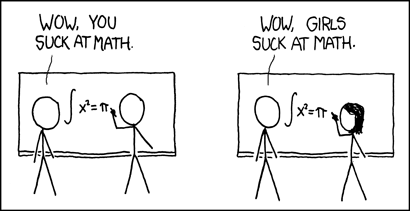
xkcd comic

By Margaret Harris

Giving out science careers advice is tricky. On the one hand, you want to be encouraging – not least because if you aren’t, there is a chance that your advisee will go on to win a Nobel prize, and you will then look extremely silly. But on the other hand, you also want to prepare the person, mentally, for the possibility of failure. Otherwise, when they do fall short, they may not know how to recover and try again.

The need for balance between encouraging big dreams and preparing for failure was one of the central insights to come out of Sunday’s panel on “Feminism, sexism and bringing up girls” at the Cheltenham Science Festival. After one of the panel members, psychologist Tanya Byron, noted that in clinical practice she sees many bright, successful girls whose fear of failure is “absolutely destroying them”, her fellow panellist Gabriel Weston put her finger on the heart of the problem. How, Weston asked, do we celebrate young women’s achievements and encourage their dreams without also pushing them to be “perfect little glass statues” who shatter under pressure?

(more…)

Table-top spectroscopy technique tracks phonons

Researchers at the Massachusetts Institute of Technology (MIT) have measured how far heat-carrying lattice vibrations – or phonons – travel in a material using a table-top optical spectroscopy technique. Phonons are normally studied using neutron scattering and other methods that require access to major facilities, so the new method makes it easier to characterize the thermal properties of materials. Indeed, the technique could help in the design of computer chips that run cooler and lead to better thermoelectric materials that convert heat into electricity.

The diffusion of heat in relatively large objects is well described by Fourier’s law, which relates the rate of heat transfer to the difference in temperature between hot and cold regions. Heat energy is carried through materials by phonons, and Fourier’s law applies when the distance a phonon can travel before scattering – its mean free path – is much smaller than the object. However, this does not apply to many of the nanostructures in today’s computer chips, making it difficult to understand how heat flows out of these objects without having detailed knowledge of how the phonons behave.

Large facilities

To further complicate matters, different phonon modes in the same material can have different mean free paths, which must be taken into consideration when working out heat transfer at the nanoscale. However, measuring the mean free paths of phonons in materials is an onerous task, as lead researcher Gang Chen explains. “Extracting the mean free path of phonons normally relies on techniques such as inelastic neutron scattering on single crystals, which requires large facilities that are not always readily available or accessible,” he says. “Our work shows that we can do it on an optical table in the lab.”

The researchers studied heat dissipation from tiny metallic dots – the smallest measuring around 30 nm across – patterned on a substrate such as silicon or silicon–germanium crystals. They began by heating their samples using an intense, ultrashort laser pulse. The dots are heated by absorbing the energy from the laser and the heat is conducted to the underlying material. A second and much weaker laser pulse is then fired at the dot to measure its temperature using an established technique called time-domain thermoreflectance.

“Since some of the phonons in our sample have longer mean free paths than the size of the dots, we cannot describe heat conduction by the ‘classic’ Fourier heat-diffusion theory,” Chen explains. “Instead, heat is conducted in a regime that we call ‘quasi-ballistic’. By varying the dot size, we sample different phonons with different mean free paths. And since laser beams may excite both electrons and holes in the semiconductors we studied (something that complicates the signal), we design the structures in such a way as to avoid this problem.”

Hotter than predicted

He adds that the technique is a new way to extract phonon mean free paths in solids. “Our work also reveals that when the heat source is smaller than the distance travelled by phonons, the Fourier law underestimates how hot the heat source becomes. This has implications for modelling the thermal properties of materials and designing microelectronics devices, which are in fact currently modelled as obeying the Fourier law,” he says.

The results imply that in the drain region of semiconductor devices such as metal-oxide-semiconductor field-effect transistors (MOSFETs), the temperature rise may be higher than predictions based on the bulk thermal conductivity. Heat is typically dissipated in this region, which is around tens of nanometres thick.

Many applications

Controlling the thermal properties of such materials is important for many applications, including thermoelectrics, for thermal insulation, and for dissipating waste heat in integrated circuits. However, doing this is more difficult than it might seem, since thermal transport in solids generally involves heat carriers travelling over varying distances and it is not easy to determine how these carriers distribute themselves in a sample.

The team, which includes Mildred Dresselhaus of MIT, Lingping Zeng, who is in Chen’s group at MIT, Yongjie Hu of the University of California, Los Angeles, and Austin Minnich of the California Institute of Technology, says that it is now busy further improving and simplifying its technique so that it can be used to characterize the thermal properties of a host of other materials.

The research is described in Nature Nanotechnology.

Liquid droplets create logic circuits

Multiple droplets of a magnetic fluid have been used to create all of the fundamental logic circuits within a computer. Created by researchers in the US, the circuits are made by having the interacting droplets move through a matrix of interconnected tracks while under the influence of an applied magnetic field. While still at an early stage, the research could provide a new platform for creating lab-on-a-chip technologies, as well as provide insights into the fundamental physics of collective behaviour.

While electronic computers process abstract information, it is often the case that their ultimate function is to control a real physical system such as a manufacturing or sensing process. Now, Manu Prakash and colleagues at Stanford University in California have created a system that combines the control of both information and matter at the same time.

Their circuits are based on droplets of water that contain magnetic nanoparticles, which are sandwiched between a thin layer of oil and a piece of glass embedded with iron tracks. When a rotating magnetic field is applied, it creates a set of rotating energy minima.

Ratcheting and repulsion

If the base was just a sheet of iron with no tracks, the droplets would travel around in circles, following the energy minima created by the field. However, by carefully designing the iron tracks and incorporating breaks at the right places, the researchers can create a “ratchet” effect whereby every complete rotation causes a droplet to move into an adjacent energy minimum. Therefore, instead of travelling in circles, a droplet moves in a specific direction through the circuit. Furthermore, by creating two tracks that are mirror images of each other, two droplets will rotate in opposite directions in response to the same field.

The droplets also repel each other because of a combination of hydrodynamic and magnetic forces. Prakash says that this mutual repulsion between droplets allows the team to create “the droplet equivalent of a transistor” in which the presence (or absence) of one droplet will dictate the path taken by another droplet. Using this, and denoting the binary numbers 1 and 0 by the presence and absence of a droplet, respectively, the researchers created droplet logic gates. These gates can perform the complete set of Boolean-logic operations, which forms the basis of computer programs.

By combining these gates appropriately, says Prakash, the researchers could, in principle, execute any computer program. Crucially, Prakash explains, all of the droplet logic operations run at exactly the same clock frequency – that of the applied field. This enables the parallel processing crucial to electronic logic, in which, for example, the output of one logical operation can depend on two inputs, each of which is, in turn, the output of separate previous logical operations. The universal clock frequency ensures that both inputs arrive at exactly the same time and are read correctly by the logic gate.

Manipulating matter

Prakash stresses that the purpose of the research is not to supersede the electronic computer, but instead to enable what he describes as “algorithmic manipulation of matter”. A droplet moving through such a circuit can encase molecules or cells, thereby delivering them to particular places or ordering them in specific ways. This could be useful for the chemical or biological analysis of samples in lab-on-a-chip systems or in the directed or self-assembly of larger structures from components carried in droplets.

Manoj Chaudhary of Lehigh University in Pennsylvania says that he found the research “quite fascinating”. “People have been working on what we call digital fluidics for quite some time,” he says, “but they have been controlling the motion of droplets one after another. The researchers have tried to build a new philosophy here by controlling multiple droplets simultaneously.” Chaudhary suspects that the research may have applications to fundamental physics by building in noise or nonlinearity, and looking for signs of collective behaviour emerging from large numbers of interacting droplets.

In the video below, Manu Prakash and colleagues explain how their droplet logic circuits work.

The research is described in Nature Physics.

Is dark energy becoming marginalized?

By Tushna Commissariat

Here at Physics World, we enjoy a good debate and late last week, a paper appeared on the arXiv server that is bound to kick up quite the storm, once it has been peer-reviewed and published. Titled “Marginal evidence for cosmic acceleration from type Ia supernovae”, the paper was written by Subir Sarkar of the Particle Theory Group at the University of Oxford and the Niels Bohr Institute in Copenhagen, together with colleagues Alberto Guffanti and Jeppe Trøst Nielsen. It suggests that the cosmic expansion may not be occurring at an accelerating rate after all, contrary to the findings of previous Nobel prize-winning work and most of our current standard cosmological models, including that of dark energy.

Indeed, the researchers’ work suggests that the evidence for acceleration is nowhere near as strong as previously suggested – it is closer to 3σ rather than 5σ, and allows for expansion at a constant velocity. Nielsen et al. have come to this conclusion after studying a much larger database of type Ia supernovae – 50 of which were studied in the original work, while this study looks at 740 – that are used as “standard candles” to detect cosmic acceleration.

This study is sure to make many cosmologists sit up and take notice, and an interesting discussion is sure to follow. So watch this space and check back in with us, once the paper is published and we catch up with Sarkar and his colleagues.

Getting into the mind of Maxwell

Malcolm Longair on the beauty of Maxwell's equations

By Matin Durrani

In case you’ve forgotten – and shame on you if you have – 2015 has been designated the International Year of Light and Light-based Technologies (IYL 2015).  There’s been loads going on all over the globe, which you can follow on the excellent IYL 2015 blog, and we at Physics World have been in on the act too don’t forget. Our March 2015 issue was devoted to light and we also produced a digital-only collection of our 10 best features on light, which you can read free here.

(more…)

The landscapes of CERN, 20 years of BECs and the truth about toilet swirl


By Hamish Johnston

Everyone knows that water in a draining sink or toilet swirls in opposite directions on opposite sides of the equator…or does it? For the answer, watch the instructions in the above video and then go to “The truth about toilet swirl”.

Physicists at CERN are a lucky bunch. As well as having the world’s most energetic collider at their disposal, they are also surrounded by the natural beauty of the Alps and the Jura mountains. However, I've always felt that the CERN site itself and the flat farmland that overlays the Large Hadron Collider (LHC) are rather dull.

(more…)

Ultracold ions put friction to the test

"Dragging" ultracold ions across an optical lattice has provided important insights into friction. By tweaking the distance between the ions, Alexei Bylinskii, Dorian Gangloff and Vladan Vuletić of the Massachusetts Institute of Technology in the US were able to reduce the friction between the two by a factor of 100. Their work could provide important insights into "superlubricity" and further the development of tiny mechanical devices.

Friction often occurs as a "stick–slip" process whereby two objects slide over each other with a jerking motion. While this suggests that the objects are alternatively grabbing and then releasing each other, the exact physical process is not well understood at the atomic scale. Even more puzzling is the phenomenon of superlubricity, in which some objects can slide over each other with zero friction.

Stuck in the gaps

One possible explanation for these processes is that friction is greatest when the spacing between atoms at the surface of one object is the same or commensurate with the spacing at the surface of the other object. In this case, all of the atoms on one surface will become stuck in the gaps between atoms in the other surface. When a sliding force is applied, it must be large enough to wrench all of these atoms out of the gaps before they slip into the next gap and become stuck again. If the gaps and atoms are incommensurate, fewer atoms will get stuck and friction will be weaker. If the mismatch is very large, then superlubricity could occur. This is the essence of the Frenkel–Kontorova (FK) model of friction, which was first suggested more than 75 years ago.

To understand how this transition from slip–stick to superlubricity occurs, Vuletić's team looked at what happens when a line of equally spaced ions slides across a 1D optical lattice – which is essentially a standing wave of light with peaks and troughs of intensity. The experiment involves cooling ytterbium ions to a temperature of near absolute zero (48 μK), and holding as many as six ions in a line using electric fields. The mutual electrical repulsion of the ions causes them to separate with a spacing of 6 μm. The wavelength of the optical lattice is about 185 nm.

Drag and drop

The line of ions is "dragged" across the lattice by applying an electric field in that direction. When an ion "slips" from one trough to the next, it emits fluorescent light, which is detected by a microscope. When the ions and the lattice are commensurate, the team measures a relatively large friction force. When the experiment is repeated several times using ion separations that are increasingly incommensurate, friction falls by a factor of 100.

By observing the light emitted by the ions as they move, the team showed that all of the ions in a commensurate line were sticking simultaneously after a slip. However, in a mismatched line only some of the ions appeared to be sticking after a slip – behaviour that is predicted by the FK model.

"What we can do is adjust at will the distance between the ions to either be matched to the optical lattice for maximum friction, or mismatched for no friction," Vuletić says. He describes the commensurate stick–slip process as being like an earthquake: "There's force building up, and then there's suddenly a catastrophic release of energy." In contrast, incommensurate sliding is much smoother, with some ions sticking in troughs and others ending up at peaks where they are free to move. An animation of both motions is shown in the video above.

Temperature dependent

The researchers also found evidence that temperature had a very significant effect on the friction – even at 48 μK. This is because their observations are best described by a model that includes the thermal motion of the ions.

Friction is important for those trying to build extremely small machines, because frictional processes that have little effect on large devices can completely gum up a nanoscale device. Therefore, the insights from this latest research could lead to the development of materials with tailored frictional properties. The work could also provide important insights into the operation of "molecular motors" in living organisms, which make clever use of friction.

The research is reported in Science.

Copyright © 2026 by IOP Publishing Ltd and individual contributors