How to efficiently capture carbon dioxide out of thin air

A novel synthetic material that is a thousand times more efficient than trees at capturing carbon dioxide from the atmosphere was presented by Klaus Lackner, director of Arizona State University’s new Center for Negative Carbon Emissions, at a meeting of the American Physical Society in Maryland last Sunday. According to Lackner, the amount of carbon dioxide in the atmosphere has reached the point where simply reducing emissions will not be enough to tackle climate change. Referring to recent environmental reports, Lackner emphasized the need for prolonged periods of carbon capture and storage – also known as “negative carbon emission”.

Trees and other biological matter are natural sinks of carbon dioxide but they do not trap it permanently and the amount of land required is prohibitive. “There is no practical solution that doesn’t include large periods of negative emission,” says Lackner, adding that “we need means that are faster than just growing a tree.” During the past few years, Lackner and his colleagues have developed a synthetic membrane that can capture carbon dioxide from the air passing through it. The membrane consists of an “ion-exchange” resin – positive anions in the resin attract carbon dioxide, with a maximum load of one carbon-dioxide molecule for every positive charge. This process is moisture sensitive, such that the resin absorbs carbon dioxide in dry air and releases it again in humid air. As a result, this material works best in warm, dry climates.

Show and tell

Lackner plans to install corrugated collecting panels incorporating the membrane material on the roof of the Center for Negative Carbon Emissions this summer. The researchers hope that this public installation will demonstrate the economic feasibility and efficiency of a new technology that can address the issue of climate change, and help shift the debate from reduced carbon emissions to negative carbon emissions.

To keep costs low, the first step – capturing the carbon from the air – is free. “We made it cheap by being passive. We can’t afford to be blowing air around,” says Lackner. The resin itself is readily available and can be mass-produced, because it is already widely used to soften and purify water. The collectors trap between 10 and 50% of the total carbon dioxide that passes through. Compared with the amount of carbon dioxide that a typical tree collects during the course of its lifetime, these panels are a thousand times more efficient.

Panels of carbon-capture resin

“I believe we have reached a point where it is really paramount for substantive public research and development of direct air capture,” says Lackner. “The Center for Negative Carbon Emissions cannot do it alone.”

Post trappings

Lackner estimates that about a hundred-million shipping-container-sized collectors would be needed to deal with the world’s current level of carbon emissions. As these collectors would typically become saturated within an hour, Lackner envisions a possible “ski-lift” approach where saturated panels are taken away to a humid environment to release their carbon dioxide and then recycled back to the dry air for more carbon capture.

The question also remains of what to do with the carbon dioxide once it is trapped. Burying it is one option, which is something Lackner says is likely, given the sheer quantity of carbon that must be captured. His centre is also testing ways to recycle the carbon dioxide and sell it to industries that could use it to make products such as fire extinguishers, fizzy drinks and carbon-dioxide-enhanced greenhouses, and even synthetic fuel oil.


Balloon-borne experiment will reveal how cosmic rays damage computer memories

By Tamela Maciel at the APS April Meeting in Baltimore, Maryland

A group of undergraduate students at Drexel University in Philadelphia is ready to click “confirm” on an Amazon order that will include a weather balloon, a memory storage device, a GPS, a Geiger counter and a BeagleBoard computer (described to me as a “beefier version of Raspberry Pi”). For less than $2000, this team of physics, engineering and computer-science students plans to launch a weather-balloon experiment that will measure the effects of cosmic rays on DRAM memory devices at high altitudes.

The team is part of the Drexel University Society of Physics Students and the members presented their experiment design at the April Meeting of the American Physical Society in Baltimore, Maryland, last weekend.

DRAM is a very quick and simple type of electronic memory – each bit takes the form of a capacitor that either has charge or doesn’t, according to whether it’s storing a zero or one. Unfortunately, this simple design can make the bits very sensitive to radioactivity or cosmic rays, which can cause bits to flip values and introduce “soft errors” into the data.

(more…)

Elect a physicist

It’s the issue no-one is talking about in the run-up to the UK’s general election on 7 May, but I’m convinced that a brand-new party is set to make significant inroads on the British political scene, increasing both its overall share of the vote and its number of parliamentary seats.

“What is this bold new force?” I hear you ask. “Is it the Green Party? The Scottish or Welsh nationalists? The UK Independence Party (UKIP)?” My friends, it is none of these. Nor is it the Conservatives, Labour or the Liberal Democrats (the three parties that traditionally grab the lion’s share of seats at Westminster), or any of the parties representing Northern Ireland. It is something far more novel. More interesting. And above all, more able to solve the Schrödinger equation.

I’m talking about the Physics Party.

(more…)

What technologies do you love the most?

Here at Physics World, we’ve had a regular programme of videos since 2009, when I led the way into a brave new multimedia world by interviewing the director-general of CERN Rolf-Dieter Heuer. What Heuer had to say was pretty interesting and the question-and-answer format is a common genre among  online videos, but I have to admit that a film of two guys talking to each other while sitting on chairs in an office isn’t the most riveting thing you could ever watch. Even if the chairs were at CERN and one was occupied by the boss of one of the world’s top physics labs.

Since those early days, Physics World has developed and diversified its multimedia efforts, thanks in part to the ideas and inspiration of my colleague James Dacey, who has the rather grand job title of multimedia projects editor. Our content now includes a rolling programme of video documentaries, our 100-second-science strand and even an animation.

(more…)

Fight over light

Until the end of the 17th century, writes art historian Kenneth Clark, artists thought of light as “an act of love”, for it seemed to reveal, brighten and intensify nature. Light was the principle of epiphany, the self-disclosure of the world and its beauty.

Isaac Newton’s famous 1704 book Opticks seemed to massacre that picture. Subtitled A Treatise of the Reflections, Refractions, Inflections and Colours of Light, it saw Newton treat light as just a mechanical phenomenon governed by mechanical laws. Colour is subjective, a sensation produced after light rays strike the eye. Sunsets, rainbows and moonbeams are explained by geometry in action, followed by the brain in motion.

Many poets and artists reacted badly. Keats said Newton had “unwoven the rainbow”, while his fellow poet Thomas Campbell protested that science had replaced “lovely visions” with “cold material laws”. Few of Newton’s critics went as far as Johann Wolfgang von Goethe (1749–1832). Not content with complaining, he undertook experiments to write his own, artistically friendly, Farbenlehre (or Theory of Colours) in 1810.

Colour wars

Aside from his prolific poems, plays, novels and drawings, Goethe was an avid scientific researcher. He collected botanical, geological and zoological specimens. He owned electrical and optical instruments, and composed treatises on anatomy and botany. Goethe’s studies convinced him that the widely distributed variation of natural forms (plants, say) were related and flexible, as if they derived from a single unity or archetype (Urpflanze).

Animal forms also seemed to derive from an archetype. Yes, features such as horns, limbs and tails might vary, but only in a way that unifies them with each other and their surroundings. Goethe’s ideas about morphology – he coined the term in fact – crudely prefigure the discovery of evolution. The task of biological science, he thought, was to discern these archetypes, which make all biological forms intelligible and which have no further explanation, and to understand how they vary with the environment.

Goethe saw archetypes as reaching throughout nature. The title of his 1809 novel Elective Affinities, for instance, is derived from a scientific term (from the era before the periodic table) about the tendency of certain substances to relate with others. The novel transposes the idea to human relationships, exploring parallels between human and chemical interactions.

When Goethe published Farbenlehre the following year, he likened Newton’s theory of colours to an old fortress hastily erected with “youthful impetuosity” and subsequently supplemented with “towers, battlements and embrasures” to seem imposing. We honour it, make pilgrimages to it, teach it – but in the end it is “uninhabitable”. The only people who still live in it are “a few aged soldiers”. Goethe promised to “raze the Bastille”, and erect a new, modern fortress using a truly scientific procedure.

Newton’s old fortress is uninhabitable, Goethe continued, because colour is also an archetype – not a cranial byproduct but an “elemental natural phenomenon” that humans directly apprehend. It arises through the mixture of light and darkness in the presence of a “turbid” medium, such as air or moisture, and exhibits myriad variations depending on viewing conditions. Goethe’s book even included colour plates to be viewed through prisms to observe such properties as intensifications, neutralizations, refractions and halos of light.

Goethe’s Farbenlehre did not dent the Bastille. Newton’s Opticks had defects, including his division of the rainbow into seven colours and his denial of the possibility of achromatic telescopes, but these errors were rectified by later scientists. Yet Goethe’s book inspired many. Beethoven asked to read it. J M W Turner incorporated aspects into his work, as did Wassily Kandinsky and other abstract painters. Philosophers who seriously investigated its ideas included G W F Hegel, Arthur Schopenhauer and Ludwig Wittgenstein. It was a key text for the “anthroposophist” movement – a spiritualist philosophy founded by the esoteric philosopher Rudolf Steiner in the early 20th century.

More recently, speaking at a 1968 conference on quantum mechanics in Cambridge, UK, the German physicist Carl von Weizsäcker invoked Goethe’s ideas in trying to interpret concepts in quantum theory, while Werner Heisenberg sympathetically mentioned Goethe’s work on colour in 1971. But why did so many people find Goethe’s failed assault on Newton fascinating?

The critical point

Many physicists have been bitten by the colour bug – including Erwin Schrödinger and Richard Feynman, who devotes two chapters to it in Lectures on Physics. But to explore colour, Feynman admits, requires going “beyond physics in the usual sense”. Those inspired by Goethe felt the need to rescue not only the exploration of colour, but other science as well, from “physics in the usual sense”; from reductive explanations that replace experience with mechanics. No merely scientific explanation of colour, Goethe’s admirers would argue, can tell everything about its experience.

But Goethe’s attack was misplaced. Newton said his Opticks was about the mechanics of light, not the experience of colour. Furthermore, Goethe wrecked his phenomenological instincts with so many preconceptions – such as his view of archetypes and of the power of opposites – that no rigorous researcher today would start with it.

Still, Goethe’s polemics fascinate because he seems to champion a way of doing science that is different from the “usual sense”. Science, then and now, is often pictured as an activity that’s mostly about postulating “correct” mechanisms underneath phenomena, rather than about discerning phenomena in the first place. As the philosopher Ernst Cassirer wrote, “The mathematical formula strives to make the phenomena calculable, that of Goethe to make them visible.” The problem is that the first way threatens to drive out the second. Goethe inspired those who viewed his anti-reductive approach – colour is a human, not a spectroscopic, phenomenon – as rescuing not only the science of colour, but an entire way of being a scientist.

XENON1T will join the hunt for dark matter this autumn

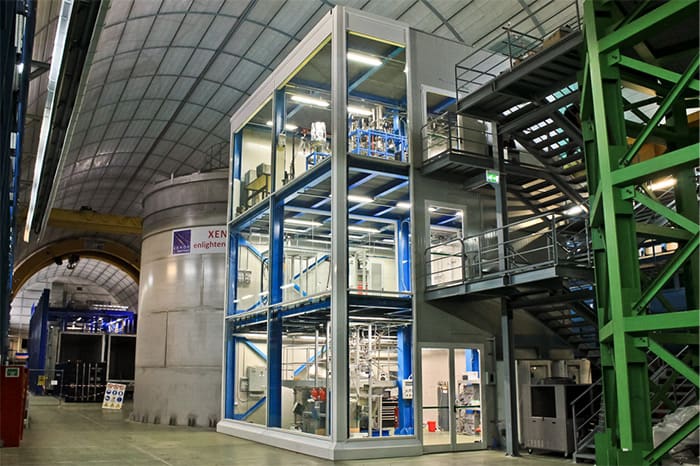
The hunt for dark matter will gain a more-than-an-order-of-magnitude boost in detection sensitivity when the next-generation XENON1T detector achieves first light this autumn. The challenges of constructing the world’s largest direct-detection dark-matter experiment and the scientific prospects for the future were presented by project spokesperson Elena Aprile of Columbia University, US, at the April Meeting of the American Physical Society in Maryland last weekend.

The XENON experiment began 10 years ago with XENON10, a 25 kg tank of liquid xenon deep under a mountain at the Gran Sasso National Laboratory in Italy. XENON100 followed in 2008 with 161 kg of liquid xenon and more than a hundred times the sensitivity of its predecessor. As the latest iteration, XENON1T is far more than a “second generation” detector – it contains 3300 kg of xenon and another hundred times the sensitivity of XENON100.

The world’s current limit on the dark-matter interaction rate was set in 2013 by the Large Underground Xenon (LUX) detector in South Dakota – a limit that XENON1T is expected to surpass by about a factor of 40. The goal of most direct-detection dark-matter experiments is to observe a weakly interacting massive dark-matter particle (WIMP) as it scatters off the nucleus of an atom. If dark matter is a particle at all, then WIMPs are our current best candidate. XENON1T has been designed to be particularly good at detecting heavy WIMPs with masses of 50 GeV and above.

Photograph of the XENON1T detector at Gran Sasso

Waiting game

“Direct detection is very simply looking for the scattering of a WIMP with a nucleus in a detector, so that we can measure its energy. Our first challenge is that the energy you expect is extremely low,” explains Aprile. While the observation of such scattering events has yet to be confirmed in any detector, physicists can put limits on certain properties of WIMPs by running experiments for several years. Aprile told physicsworld.com that “only a week of data with XENON1T will be sufficient to reach the best limit we have today on the spin-independent WIMP-nucleon cross-section”. Current detectors would have to run for centuries to achieve the same projected sensitivity as XENON1T, which, combined with a planned extension in 2018, will be the most sensitive dark-matter experiment for “quite some time to come”, she says.

The holy grail in this business is a very low background
Elena Aprile, Columbia University

Apart from the challenge of actually detecting a WIMP, dark-matter detectors must also account for background noise that arises from a variety of sources such as cosmic rays and radioactivity. “Above all, the holy grail in this business is a very low background,” says Aprile. Indeed, XENON1T will have the lowest background rate in the world thanks to the natural shielding of the Earth above the detector, and further shielding from the four metres of water that will surround the xenon tank. The water tank will make it possible to rule out false signals that come from muons as they emit telltale Cherenkov light in water, unlike a WIMP. The xenon tank itself will be equipped with light-catching photomultiplier tubes, specially designed to operate in liquid xenon, to accurately pinpoint a dark-matter interaction.

Cold and pure

Collecting, purifying and storing several thousand kilograms of xenon is a major task in itself. “Running the cryogenics for more than a year has never been done before and is not trivial,” says Aprile. An entirely closed system is vital to preserve every last gram of expensive gas. A new service building attached to the detector will provide the cooling, purification and safe recovery of xenon in the case of any emergency, such as an earthquake.

XENON1T is now in an advanced stage of construction, and detector commissioning is expected to begin this June. First data collection begins this autumn. Our current picture of dark matter includes many different theories and, as Aprile comments, a “zoo of candidates”. XENON1T, and its 2018 expansion into XENONnT, will set the lowest limits yet on dark-matter interaction. She adds that the direct search for dark matter with laboratory detectors is a relatively “cost-efficient field” where modest experiments “have the potential to truly transform our view of the universe”.

Amazing science demo three: Talking Sparks

This is the third in a series of “five amazing physics demonstrations” presented by science-demo guru Neil Downie and his adept assistant Matthew Isbell.

In a special feature in the April 2015 issue of Physics World, Downie describes his five best demos of all time, all of which use everyday equipment to illustrate fundamental physics concepts. In the article, Downie describes how his fondness for the five experiments comes from the fact that, with a bit of creativity, each one can be easily adapted to explore physical concepts further. In the digital edition of the April issue, each demonstration is accompanied by a video in which Downie walks you through how you would present each demonstration to an audience. Full details of how to access the digital edition are available at the bottom of this article.

In this third demo from the series, Isbell demonstrates one of the earliest forms of radio communication: the Marconi spark-gap transmitter. Unlike other demos in the series, there are no bazookas, canons or bobsleighs, but the beauty of this demo lies in its simplicity. It is easy to see how the Victorians would have been amazed at how a few metal poles and a spark could transmit messages through the air as if by magic.

Talking Sparks

So what’s this all about? Electromagnetic waves – and radio waves in particular – are so integral to modern life, from mobile phones to satellite communications, that it is easy to forget how frustratingly hard it was for the early pioneers to detect radio waves. Sparks were used to create electrical oscillations down a transmitting rod, creating radio waves that could be sent to a receiver of similar size. But the received radio waves were almost imperceptible and the medium only became useful with the invention of the “coherer” – an incredibly simple but formidable amplifying device. This experiment shows why.

What bits and pieces do I need? To make your radio transmitter (shown above), you need two, metre-long metal wires or tubes as well as a small, flat piece of wood. Attach one end of each tube to the wood, leaving a gap of a couple of centimetres between them. You’ll also need a piezoelectric lighter to create a spark between the two ends. The receiver consists of two metal wires or tubes of the same shape and size as the transmitter, also attached to a piece of wood. To make the coherer, take a 2 cm-long plastic tube with a 4 mm inner diameter and half-fill it with metal filings between two metal end-plugs. Place your coherer between the two tubes of the receiver and then connect a multimeter – set to the “beep” position – across it. If you don’t have a multimeter, you can connect a 3 V battery and light-emitting diode (LED) with a ~100 Ω resistor and the coherer in series, which will light up when a radio signal is detected.

How do I get going? Position the transmitter and receiver facing each other a metre apart, with both arms lying horizontally. Place your lighter in the gap between the two rods on the transmitter and click it to make a spark. As soon as you click the lighter, you should find that the receiver will beep and stay on. Tap the receiver with your finger and the beep will go off. Try moving the transmitter and receiver further and further apart; with luck, your simple radio will have a range of at least 10 m.

And what physics will I learn? The igniter’s piezoelectric crystal generates an electric charge when squeezed. When this is discharged, the resulting spark sets up a (briefly) oscillating current in the two halves of the transmitter, which act as a dipole antenna. This current turns into a radio wave that is picked up by the receiver, in which similar (but much weaker) oscillations of current are produced. The coherer is actually an insulator because the metal filings inside it mostly do not touch; it only conducts when the receiver picks up radio waves, creating a tiny spark across the filings, which then melt and fuse together.

What can cosmic rays tell us about dark matter?

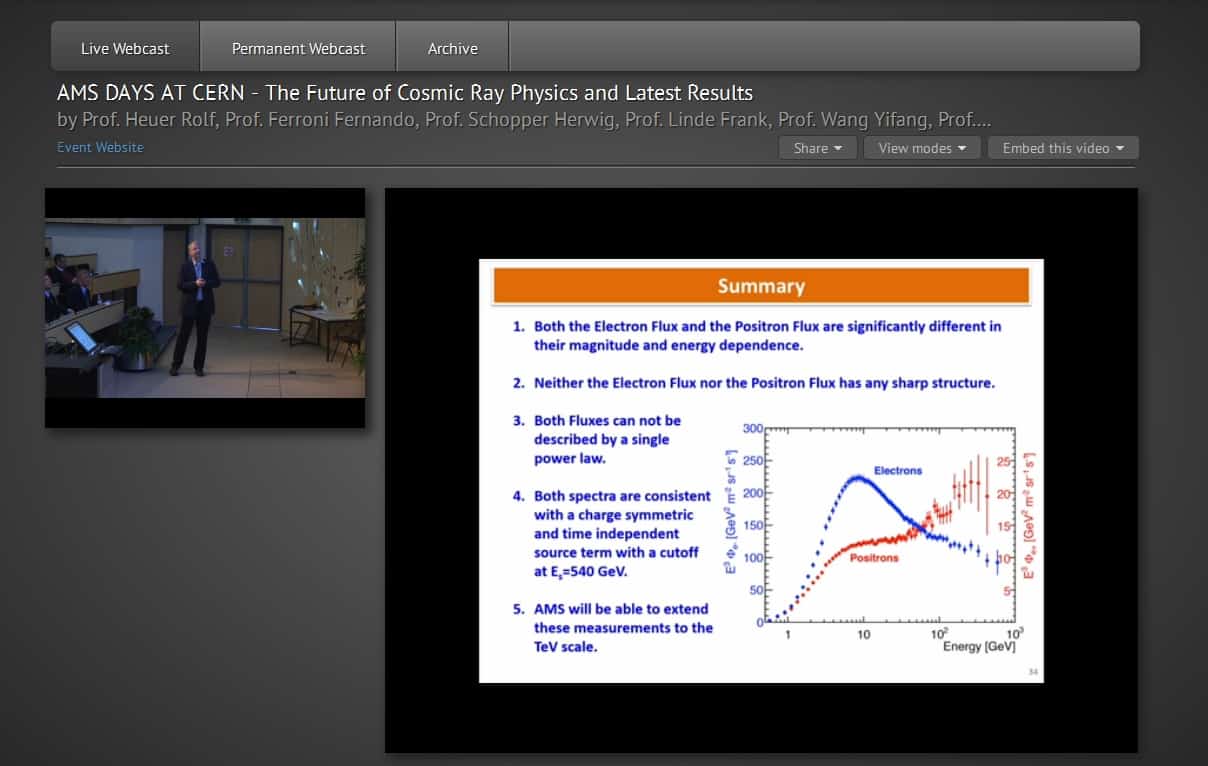
The positron excess as seen by AMS

Cosmic rays, dark matter and other astrophysical mysteries are being debated with much vigour at a three-day conference that began this morning at CERN in Geneva. Called “AMS Days at CERN”, the meeting will include presentations of the latest results from the Alpha Magnetic Spectrometer (AMS).

Located on the International Space Station, the AMS measures the energy of high-energy charged particles from the cosmos – otherwise known as cosmic rays. These particles are of great interest because they offer us a window into some of the most violent processes in the universe. Some cosmic rays have probably been accelerated during supernova explosions while others could be produced as matter is sucked into the supermassive black holes that lie at the centres of many galaxies.

(more…)

Rosetta’s bouncing probe finds no magnetic field on comet 67P

The comet 67P/Churyumov–Gerasimenko has no global magnetic field, according to scientists working on the European Space Agency’s Rosetta mission. The magnetic measurements were made in November last year by the mission’s Philae lander, which bounced twice from the comet’s surface before settling down. This is the first reliable measurement of the magnetic field of a comet, and the null value provides important information about the magnetic fields present in the early solar system. The result also casts doubt on the idea that magnetic forces played an important role in the formation of comets.

Comets are a mixture of dust, rock and frozen gases that probably formed in the outer reaches of the very early solar system. Comets have not changed much since then, so they could provide important insights into the material from which the Sun and the planets formed. Exactly how comets are created is not clear, and one possibility is that magnetic forces between grains of iron-based dust helped pull together dust and gases to create progressively larger objects that eventually become comets.

If these magnetic-dust grains accumulated in the presence of an external magnetic field, their magnetic moments would align and give the comet an overall magnetization. Therefore if comets such as 67P/Churyumov–Gerasimenko have global magnetic fields, this would tell scientists something about the magnetic fields that existed in the early solar system.

Solar wind

Detecting a comet’s weak magnetic field, however, is extremely difficult because the field strength drops off rapidly the further away the probe is from the surface of the comet. In addition, magnetic effects created by the solar wind must be taken into account when making extremely precise magnetic measurements.

In the 1980s, the GIOTTO spacecraft found no discernible magnetic field around Halley’s comet. However, this was a “fly-by” measurement made at a distance of about 600 km, and is not considered conclusive. Other magnetic measurements of comets have also proven inconclusive, while similar measurements on asteroids have found some to be magnetic and others not to be.

The Rosetta mission arrived at 67P/Churyumov–Gerasimenko last year, and deployed the Philae lander to the comet’s surface. Scientists have now used data from two of its instruments to measure the magnetic properties of the comet. The first is the Rosetta Lander Magnetometer and Plasma Monitor (ROMAP) on the Philae lander. ROMAP is deployed on the end of a 60 cm retractable rod, and detects the local magnetic field as well as the ambient level of charged particles. The second instrument is the Rosetta Plasma Consortium Fluxgate Magnetometer (RPC-MAG). This is based on the main Rosetta spacecraft, and monitored the solar wind as ROMAP travelled to the comet’s surface on Philae, bounced twice and then settled down on the surface.

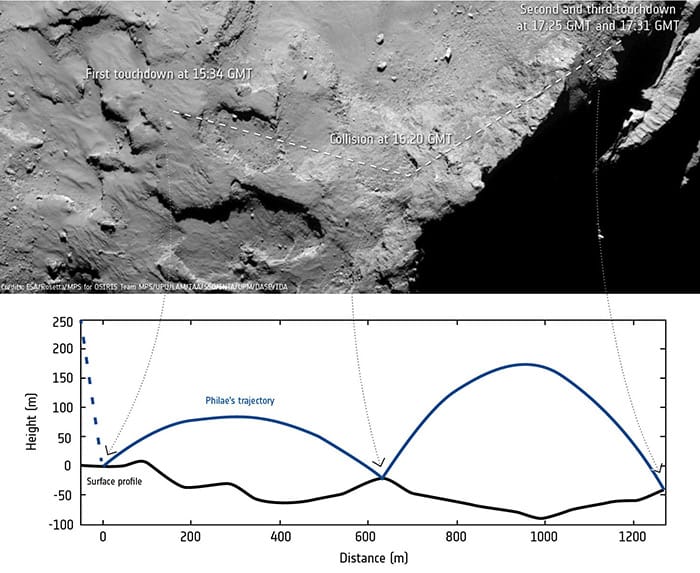
Magnetic-field data from ROMAP on Philae

Bouncing along

While the bouncing was not planned, it did provide scientists with magnetic measurements at three different points along a 1.2 km stretch of the comet’s surface. Measurements were also taken as the lander flew over the comet between bounces, reaching a height of about 150 m. After correcting for the effects of the solar wind as determined by RPC-MAG, the team found very little variation in the magnetic field measured by ROMAP, which was less than about 2 nT. In comparison, Earth’s magnetic field is about 25–65 μT at the surface.

If the nucleus of the comet is assumed to be a magnetic dipole, then the team calculates it would have a dipole strength of less than 1.6 × 108 Am2. On the other hand, if the magnetic field is the result of randomly oriented pieces of magnetic rock within the comet, the specific magnetic moments of those rocks would have to be less than about 3.1 × 10–5 Am2/kg. This is much smaller than the specific moment of material found on the surface of the Moon or in meteorites on Earth.

Low magnetic fields

Putting all of this together, the team has concluded that the comet is not magnetic. An important consequence of this is that 67P/Churyumov–Gerasimenko must have formed in a region of low magnetic fields. “We now know that magnetic fields were not strong in the early solar system,” explains Karl-Heinz Glassmeier of the Technical University of Braunschweig in Germany.

Furthermore, if 67P/Churyumov–Gerasimenko is typical of other comets, then magnetic forces are unlikely to have played a role in pulling together objects that are greater than about 1 m across during the formation of comets and possibly planets. However, team member Hans-Ulrich Auster – also at Braunschweig – points out that the Rosetta measurements do not rule out the possibility that magnetic forces were involved in pulling together particles that were several centimetres or less in size.

The research is described in Science.

‘Cosmic shear’ reveals dark matter in new high-resolution map

The largest high-resolution and contiguous map of dark matter in the universe has been unveiled by the Dark Energy Survey. The researchers who created the map say that it demonstrates the potential for a technique based on weak gravitational lensing to be used for studying dark matter and dark energy. Called “cosmic shear”, the technique is now being used to regenerate a full-sized 3D map, which should be completed in 2020.

Dark matter is an invisible entity that appears to interact only through gravity. Physicists believe it accounts for four-fifths of the matter in the universe and, while they have some ideas as to what it could be made of, it has never been detected directly.

Dark energy is even more elusive. It is the general label for the unexplained observation that the expansion of the universe is accelerating. This is contrary to the basic prediction of Einstein’s general theory of relativity, which suggests that gravity should be slowing the expansion down. The easiest way to model this acceleration is to add a “cosmological constant” to the equations of general relativity. However, no-one is sure what this constant should represent physically, or whether it has been a constant throughout the lifetime of the universe.

Galaxies and supernovae

The Dark Energy Survey (DES) is a collaboration of research institutions in the US, Brazil, the UK, Germany and Spain that aims to gain insight into these two mysterious entities. The survey uses a 4 m optical–infrared telescope at the Cerro Tololo Inter-American Observatory in Chile. This instrument can peer eight-billion years into the past, with the ultimate goal of mapping hundreds of millions of galaxies and thousands of new supernovae, as well as all of the dark matter in-between.

The astronomers are interested in dark matter because the way that it clumps together reveals something of the nature of dark energy. If dark matter was not so clumpy in the distant past, then that might suggest that dark energy was not stretching it out as rapidly as it is today. And that in turn might suggest that dark energy is not best represented by a cosmological constant, after all.

Starting point

Since the DES began in August 2013, the collaboration has released a few small test maps charting regions known to have a high density of dark matter. Now, the team has released what it claims is the biggest contiguous map of dark matter in high definition. “For me, it’s the starting point of where we’re going to go with the Dark Energy Survey,” Sarah Bridle, an astrophysicist at the University of Manchester in the UK and a member of the DES, told physicsworld.com. “We’re getting 30 times this area over the next five years.”

The density of dark matter was computed with data from the DES using a relatively new technique known as “cosmic shear”. This is a weak form of gravitational lensing whereby light is bent from its normally straight path by a gravitating mass. Cosmic shear makes galaxies appear to be orientated in a biased direction – not randomly, as is actually the case. By analysing these orientations statistically, astrophysicists like Bridle can work out how much dark matter there is, and where.

Large and lovely filaments

The DES map offers no great surprises. It reveals that dark matter exists in large filaments that link together the visible galaxies and galaxy clusters. Astrophysicists knew this already, not least from projects such as the Canada–France–Hawaii Telescope Lensing Survey, which has already produced dark-matter maps of similar resolution, albeit not so big. According to Bridle, however, the DES map is a “proof of concept” that cosmic-shear methodology works well on large scales, and could help other astrophysicists study galaxy formation. “And the pictures look lovely,” she jokes.

The current map charts 150 square degrees of sky, and was produced using computing resources equivalent to running 500 ordinary desktop computers for two weeks. That is just a small fraction of the 5000 square degrees expected over the next five years from the full DES map, which will allow proper tests of the most popular model of how the universe is evolving – the lambda-cold-dark-matter model. “If there was a departure from that model, that would be major news,” says Bridle. “And that’s something that could come out of the survey in the next five years.”

The DES map and analysis will be uploaded to the arXiv preprint server on Tuesday 14 April.

  • In the video below, Luke Davies of the University of Bristol explains the fundamental physics of dark matter.

Copyright © 2026 by IOP Publishing Ltd and individual contributors