Intense, extremely short pulses of X-rays have been used for the first time to reconstruct 3D images of individual virus particles. Developed by an international team of physicists, the diffraction technique could make it possible to map the structure of infectious viruses such as HIV, influenza and herpes, shedding light on possible ways to combat diseases caused by these infectious agents.
Scientists have used X-ray diffraction to image live cells, viruses and simple nanostructures in 2D using a technique called nanocrystallography. This involves incorporating a number of identical particles (viruses, for example) into a crystal – a time-consuming and expensive process that does not work for some particles. Now, a team led by Janos Hajdu at Uppsala University in Sweden has tested a technique that avoids crystallization with the added benefit of delivering 3D images.
We outrun radiation damage but we only get one shot per sample
Janos Hajdu, Uppsala University
Brighter than the Sun
The team focused on the Acanthamoeba polyphaga mimivirus, which is about 450 nm across. The researchers injected virus particles into an aerosol stream, which was then subjected to high-energy pulses from an X-ray free-electron laser at Stanford University. Each pulse lasted just 70 fs and delivered a peak power density more than 1018 times that of sunlight hitting the Earth.
Such an extremely intense pulse will vaporize a mimivirus particle, but not before the X-rays scatter from the virus and create a diffraction pattern that is recorded by a bank of detectors. “We outrun radiation damage but we only get one shot per sample,” explains Hajdu. Because X-rays primarily scatter off of electrons, the diffraction patterns that Hajdu and his team recovered can be used to calculate the distribution of electrons within the mimivirus particles.
Hajdu and his team scattered X-rays off nearly 200 identical mimivirus particles, collecting one 2D diffraction pattern from each event. To make sure that the particles were not altered by being injected into an aerosol, the team showed that mimivirus particles that did not intersect the laser pulses were still infectious.
Adding a dimension
With nearly 200 diffraction patterns in hand, Hajdu and his colleagues next set about adding the patterns together to produce a single 3D image. Combining data from different observations not only increases the signal – necessary for small viruses that scatter X-rays weakly – but also gives insights about viral structure that are only possible with 3D observations.
Diffraction patterns: series of 24 diffraction patterns captured from 24 different virus particles. (Courtesy: Tomas Ekeberg et al./Phys. Rev. Lett.)
One important complication that the researchers had to overcome is that they were not all oriented in the same way with respect to the X-ray pulses. Instead, their orientations were randomly distributed. Therefore, it is necessary to retrieve the relative orientation of each mimivirus particle before adding the diffraction patterns together. Hajdu and his team did this using a mathematical optimization algorithm developed by another group of physicists in 2009. Because this algorithm presumes that the particles differ only in orientation, identical particles must be used. Fortunately, many pathogenic viruses that affect humans are reproducible, such as HIV, influenza and herpes.
The researchers achieved a spatial resolution of approximately 125 nm in their final reconstructed image of the mimivirus’s electron density. Better resolutions have been recorded in other 2D studies, but this investigation is important because it shows that 2D diffraction patterns can be combined to produce 3D images of biologically important samples. “We now look forward both to pushing towards higher resolution and studying both smaller and larger samples,” says Hajdu.
Here is a stat for you: around 50% of US physics graduates (both undergraduates and postgraduates) go on to work in industry.
Whether you think that is good or bad, the American Physical Society (APS) wants to do more to support those physicists who don’t pursue a career in academia.
Scientists in Africa are being urged to support construction of their continent’s first synchrotron light source. The call to back plans for an African light source has been made by Herman Winick of the SLAC National Accelerator Laboratory, who is speaking this week at a meeting of the American Physical Society in Texas. Winick first unveiled his vision for such a facility last year and believes that, if built, it could help researchers in Africa to tackle some of the continent’s big issues, such as Ebola and other life-threatening diseases.
There are almost 50 synchrotron light sources in 23 different countries around the world, but Africa is currently the only habitable continent without such a facility. These machines work by accelerating electrons to high energies and then injecting them into a circular storage ring where they emit powerful beams of X-rays. The X-rays can then be used to study the structure and properties of materials in a range of disciplines, from condensed-matter physics to biology.
Early days
Although the African light source is still in the early stages of planning, Winick anticipates that it would have an energy of around 3 GeV. That is similar to other existing facilities such as the Laboratório Nacional de Luz Síncrotron in Brazil, which was the first synchrotron to be built in the southern hemisphere and is currently the only light source operating in Latin America.
Winick wants the African facility to be modelled on the SESAME light source, which is currently being built near Amman, Jordan. Costing $110m, SESAME will open to users next year and, in addition to carrying out top-quality science, seeks to build bridges between researchers from 10 nations in the Middle East and beyond, including Egypt, Jordan, Iran, Israel, Pakistan and Palestine. “Africa should follow the SESAME model,” Winick insists.
Taking ownership
Researchers working on plans for the African light source have already established an interim steering committee, which will help to set up a more permanent international advisory committee to oversee the formation of a scientific case for the synchrotron. “The plan is to bring together those working on synchrotron radiation in Africa,” says Winick, who serves on the interim steering committee.
One potential host for the African light source could be South Africa, which already has around 40 synchrotron users in the country and has been considering hosting such a facility for the last decade. Those plans were boosted in 2012, when scientists on the country’s Synchrotron Research Roadmap Implementation Committee submitted a proposal to the government, followed by a more detailed business plan in 2014.
Role for the ESRF
South Africa is also an associate member of the European Synchrotron Radiation Facility (ESRF) in Grenoble, France, paying around 0.3% of its budget. Indeed, Winick thinks that the ESRF could play a similar role in supporting the African light source as the United Nations Educational, Scientific and Cultural Organization (UNESCO) did in getting SESAME off the ground – namely by bringing together all of the founding members to form a governing council.
The next stage for the fledgling project is for the interim committee to meet in November at the ESRF, in what Winick dubs “t = 0” for the African light source. Winick now calls on researchers across the continent to get behind the project. “They need to get involved and take ownership of it,” he says. The path is unlikely to be quick, with Winick thinking that it will take at least another 15 years before the facility is open for business.
March maze. The conference centre for the APS meeting.
By Michael Banks in San Antonio, Texas
After finally getting my head round the maze-like Henry B Gonzalez Convention Center in San Antonio, it was straight into a packed schedule at this year’s American Physical Society (APS) meeting.
One topic that always causes concern among researchers is the crunch in helium supply.
Gold nanotubes could be used along with near-infrared light (NIR) to destroy cancer cells, according to new experiments by researchers at the University of Leeds in the UK. The tubular nanoparticles could also be used as drug delivery vehicles and as nanoprobes for high-resolution medical imaging.
All living cells can be destroyed by heating them up. This can be particularly useful for killing cancer cells that are resistant to chemotherapy. Indeed, radiofrequency ablation and high-intensity focused ultrasound is routinely employed to heat and destroy tumours. Now, a team of researchers, led by Steve Evans of the School of Physics and Astronomy at Leeds, has found that gold nanotubes irradiated with NIR light can also be used to heat and destroy cancer cells.
Rapid heating
Evans and colleagues say that they have succeeded in controlling the lengths of the nanotubes, and were therefore able to produce nanostructures with the right dimensions to optimally absorb light in the NIR part of the electromagnetic spectrum. The light absorbed by the tubes heats them up, and by using a single-wavelength pulsed laser beam, the Leeds researchers were able to rapidly increase the temperature in the vicinity of the tubes so that it was high enough to destroy cancer cells. NIR light is ideal for this application because it penetrates several centimetres into tissue, and therefore many different types of tumours could be destroyed using this effect.
In addition, by adjusting the brightness of the laser pulse, Evans and colleagues say that they could use the nanotubes to either destroy cancer cells or to image tumours. For the imaging part, they made use of a new type of technique called multispectral optoacoustic tomography (MSOT) to detect the gold nanotubes in colorectal cancer cells in mice. In their experiments, the researchers intravenously injected the nanotubes into the animals and observed that the nanomaterials accumulated at the tumour sites. This is the first time that NIR-light-absorbing gold nanotubes have been used in a biomedical application, says the team.
Minimal toxicity
Because the nanotubes have a hollow central core, they can be loaded with anticancer drugs too, says team member James Mclaughlan from the School of Electronic and Electrical Engineering. “Combining targeting and localized release of therapeutic agents in this way could be used to identify and treat cancer with minimal toxicity to the patient.” Indeed, the researchers say that the mice excreted the gold nanotubes in around 72 hours, so they are therefore unlikely to be toxic to living organisms – an important point to consider when developing nanoparticles for biomedical applications. The fact that the tubes are coated with poly(sodium 4-styrenesulfonate) (PSS) also makes them less toxic to healthy cells while they are in the bloodstream.
Younan Xia of Georgia Tech in the US, who was not involved in this work, says that “although other types of gold structures including nanocages, nanorods and nanoshells have been used to destroy tumours before now, the new aspect in this work is the potential improvement in terms of tumour-targeting efficacy by altering the shape or morphology of the nanostructures”.
The March 2015 issue of Physics World magazine, a special issue about light in our lives that is now out in print, online and via our apps, contains a fascinating feature about an astonishing – and largely unknown – superpower that you perhaps don’t realize you have. It might sound bizarre, but using your naked eyes – and with no additional gadgets whatsoever – you can detect whether or not light is “polarized”. And in the video above, Louise Mayor, features editor of Physics World, tells you how.
We often marvel at the special abilities of animals, such as eagles being able to see four to five times farther than the average human, or how cats always seem to land on their feet. But take a look at our own species and you’ll find we have an astonishing and largely unknown natural talent of our own. It is a bizarre skill and sounds like science fiction, but with the naked human eye – with no additional gadgets whatsoever – most of us can detect whether or not light is polarized, and can even determine the light’s axis of polarization.
Before we begin, remember that light behaves as a transverse electromagnetic wave; it consists of electric and magnetic fields oscillating on perpendicular axes. Light that we observe from natural sources such as the Sun is often “unpolarized” or “randomly polarized” – two descriptors that both mean the light waves reaching us have electric fields orientated in many different ways. Polarized light simply means that the electric fields of all the waves are aligned and oscillate on the same axis.
As a physics teacher, our ability to detect this polarization is something I love sharing with my students. The first step in doing so is to find some polarized light to look at. In class what I normally do is get my students to look at an ordinary non-polarized light source through dedicated Polaroid films. If you have a pair of polarized sunglasses, those should also work well. Another handy source is an LCD computer monitor; for the best result, set the screen to be plain white or blue, which you can do in most text- and image-editing programs.
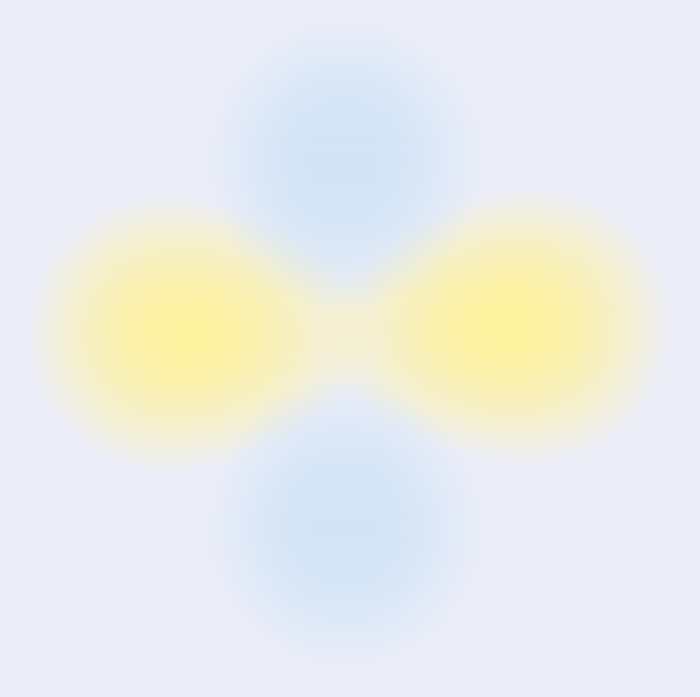
1 What to look for The phenomenon of Haidinger’s brush allows one to detect polarized light with the naked eye. When observing polarized light the brush, seen above, is present in the centre of vision. The size should be about a thumb’s width held at arm’s length. See the main text for more instructions on how to see this. (Courtesy: IOP Publishing)
Now for the fun part. Stare at your polarized light, and – though it may take practice – you should become aware of an image at the very centre of your vision. The image looks a bit like a small yellow bow tie crossed with a blue bow tie (figure 1) and is known as Haidinger’s brush, after the Austrian scientist Wilhelm Haidinger who first reported it in 1844. The blue bow tie is aligned with the electric field of the light you are observing, and so you can use this to determine the axis of polarization of the light. In case you’re wondering how big this image is, for me it’s about the width of my thumbnail held at arm’s length, or approximately two words wide if you’re reading this magazine from a typical distance right now.
Seeing Haidinger’s brush takes a bit of practice, but an encouraging check you can use if you’re looking through a polarizer of some kind is to rotate it, which should make the brush rotate as well, since it’s aligned with the polarization. If you’re looking at an LCD display, on the other hand, tilt your head slowly from side to side and the brush shouldn’t change orientation. It’s a subtle effect, and most of my students report that they see nothing…at first. You might also find that one of the bow ties is more apparent to you than the other – I can see the yellow more readily than the blue myself, but I’ve had students report the opposite.
Incidentally, I find it interesting to teach my students about Haidinger’s brush because if they tell me they can’t see it, I really cannot get behind their eyes and help them. It is an “entoptic” phenomenon – the image is created in the eyeball itself – which is why you will never see a photograph of it.
If you can see the brush, then you can look for polarized light anywhere, not just when looking through your sunglasses. Try looking at the sky, away from the Sun; the sunlight that reaches you via scattering in the sky is partially polarized – an effect that is most pronounced at 90° to the Sun. You can also try looking at reflections, such as in a still lake. Don’t give up if you can’t see it at first!
Unsolved mystery
At this point you are probably wondering: what causes Haidinger’s brush? Well, as it involves the human eye, we would expect the answer to involve at least as much biology as physics. But while a host of explanations have been offered over the last century, nobody really knows for sure. (This is something else I like to tell students – that the world is still filled with common phenomena for which our explanation is missing or uncertain. Fear not, therefore – there is still much work to do!)
One recent explanation was offered by a team led by the physicist Albert Le Floch at the University of Rennes in France, which explains how this phenomenon might occur based on the geometry and biology of the eye (2010 Vision Research50 2048). The human eye contains two types of photoreceptor: rods and cones. The cones are sensitive to colour – and, well, Haidinger’s brush is coloured, so perhaps here we will find our explanation? Cones come in three varieties labelled blue, green and red, corresponding to the frequencies of light to which they are most sensitive.
The explanation of Le Floch et al. depends on just a few critical facts. First, the blue cones, which are the most rare, are missing from the centre of the fovea – the area at the middle of the retina behind the pupil – but away from that centre they are found scattered in among the red and green cones in a circular geometry. Second, when light moves from one material to another, the amount of light transmitted or reflected depends on the angle of the light’s polarization relative to the surface it is incident upon. What this means is that if polarized light enters the eye and then strikes the off-centre blue cones – at an angle slightly off the normal – more light will be transmitted into blue cones along the light’s polarization axis than those along a perpendicular axis. And voilà – we have a vision response that depends upon polarization. Or so says this theory at least.
What good is this to you? Well, one use of the phenomenon is to help correct “lazy eye”, since the brush always appears in the centre of the vision. But for most of us, as we celebrate the International Year of Light, it’s just a fun and fascinating piece of physics to notice and share.
In this video, features editor Louise Mayor explains how to see Haidinger’s brush
Can you see Haidinger’s brush? Did you have any problems? E-mail pwld@iop.org and let us know.
In the opening scenes of Tasneem Zehra Husain’s novel-cum-physics history Only the Longest Threads, a string theorist called Sara and a struggling science writer called Leo meet at CERN on the day the discovery of the Higgs boson is announced. Drawn together by their passion for physics (plus a dash of love-at-almost-first sight), Sara becomes Leo’s muse, urging him to break his journalistic detachment and write about physics through the medium of fiction. The rest of Husain’s novel consists of chapters from Leo’s book (each of which is written from the viewpoint of a fictional witness to an important moment in physics history), interspersed with e-mails between Leo and Sara in which they gush about how amazing it all is. In summary, then, Only the Longest Threads is a book written by a real string theorist and author (Husain), in which a fictional string theorist (Sara) and a fictional author (Leo) write a fictional book about fictional people’s perspectives on real physics. It is all rather laboured, and terribly meta, which is a shame because underneath this clunking exoskeleton is a fine piece of science writing. Husain explains physics concepts well, in strong, imaginative prose, and by describing historical breakthroughs through the eyes of (fictional) contemporaries, she captures the sense of wonder that these discoveries evoked at the time. The first chapter of “Leo’s” book, for example, is written from the perspective of an 18th-century English schoolboy who is reading Newton’s Principia Mathematica for the first time, and one gets an almost palpable sense of how Newton’s science must have seemed like a shaft of light through the darkness. It’s thrilling stuff, and while later chapters do not pack quite the same emotional punch, they do include some excellent, novice-friendly explanations of advanced concepts such as symmetry breaking and what the “gauge” in “gauge theory” is all about. Overall, Only the Longest Threads is a rewarding and thought-provoking read – it’s just a pity that its central premise is too clever by half.
2014 Paul Dry Books $16.95pb 219pp
A breath of fresh air
What is air? A chemist might describe it as a mixture of nitrogen, oxygen and a few other chemicals. A physicist might focus instead on its gaseous nature, with particles whizzing around according to the laws of statistical mechanics. A biologist, an artist and a writer might have different perspectives altogether. None of these descriptions is wrong, but all are incomplete. In his book Air: Nature and Culture, Peter Adey attempts to bring all of these viewpoints together. A geographer at Royal Holloway, University of London, Adey has a magpie’s eye for glittering facts. A baby girl born aboard an aeroplane in 1929 was christened “Airlene”. A 17th-century observer described London’s air as “accompanied with a fuliginous and filthy vapour”. Canaries in “Haldane boxes” were used as air-quality detectors in British mines until 1986. And on and on it goes for 200 pages, most of them lavishly illustrated with all manner of paintings, etchings and scientific diagrams. The result is a book that fizzes with ideas, but also, at times, verges on incoherence. One particularly exhausting paragraph refers to the Futurism founder Filippo Tommaso Marinetti; the writers T E Lawrence, Thomas Pynchon and Antoine de Saint-Exupéry; the Impressionist painters Claude Monet and Carlo de Fornaro; and “the work of Tullio Crali’s Dogfight” (no other context given), all within a space of barely 200 words. Air also shows signs of inadequate editing: Willard Libby’s work on radiocarbon dating won him the Nobel Prize for Chemistry, not peace, while the pioneers of motion science were called Frank and Lillian Gilbreth, not John and Lillian. That said, for the sake of a phrase like “fuliginous and filthy”, your reviewer is willing to forgive rather a lot. If Air is perhaps a bit less, rather than more, than the sum of its many bright and shining parts, it is still a fascinating book that spins a weird and wonderful story out of the air we breathe.
The values of two inherent properties of one photon – its spin and its orbital angular momentum – have been transferred via quantum teleportation onto another photon for the first time by physicists in China. Previous experiments have managed to teleport a single property, but scaling that up to two properties proved to be a difficult task, which has only now been achieved. The team’s work is a crucial step forward in improving our understanding of the fundamentals of quantum mechanics and the result could also play an important role in the development of quantum communications and quantum computers.
Alice and Bob
Quantum teleportation first appeared in the early 1990s after four researchers, including Charles Bennett of IBM in New York, developed a basic quantum teleportation protocol. To successfully teleport a quantum state, you must make a precise initial measurement of a system, transmit the measurement information to a receiving destination and then reconstruct a perfect copy of the original state. The “no-cloning” theorem of quantum mechanics dictates that it is impossible to make a perfect copy of a quantum particle. But researchers found a way around this via teleportation, which allows a flawless copy of a property of a particle to be made. This occurs thanks to what is ultimately a complete transfer (rather than an actual copy) of the property onto another particle such that the first particle loses all of the properties that are teleported.
The protocol has an observer, Alice, send information about an unknown quantum state (or property) to another observer, Bob, via the exchange of classical information. Both Alice and Bob are first given one half of an additional pair of entangled particles that act as the “quantum channel” via which the teleportation will ultimately take place. Alice would then interact the unknown quantum state with her half of the entangled particle, measure the combined quantum state and send the result through a classical channel to Bob. The act of the measurement itself alters the state of Bob’s half of the entangled pair and this, combined with the result of Alice’s measurement, allows Bob to reconstruct the unknown quantum state. The first experimentation teleportation of the spin (or polarization) of a photon took place in 1997. Since then, the states of atomic spins, coherent light fields, nuclear spins and trapped ions have all been teleported.
But any quantum particle has more than one given state or property – they possess various “degrees of freedom”, many of which are related. Even the simple photon has various properties such as frequency, momentum, spin and orbital angular momentum (OAM), which are inherently linked.
More than one
Teleporting more than one state simultaneously is essential to fully describe a quantum particle and achieving this would be a tentative step towards teleporting something larger than a quantum particle, which could be very useful in the exchange of quantum information. Now, Chaoyang Lu and Jian-Wei Pan, along with colleagues at the University of Science and Technology of China in Hefei, have taken the first step in simultaneously teleporting multiple properties of a single photon.
In the experiment, the team teleports the composite quantum states of a single photon encoded in both its spin and OAM. To transfer the two properties requires not only an extra entangled set of particles (the quantum channel), but a “hyper-entangled” set – where the two particles are simultaneously entangled in both their spin and their OAM. The researchers shine a strong ultraviolet pulsed laser on three nonlinear crystals to generate three entangled pairs of photons – one pair is hyper-entangled and is used as the “quantum channel”, a second entangled pair is used to carry out an intermediate “non-destructive” measurement, while the third pair is used to prepare the two-property state of a single photon that will eventually be teleported.
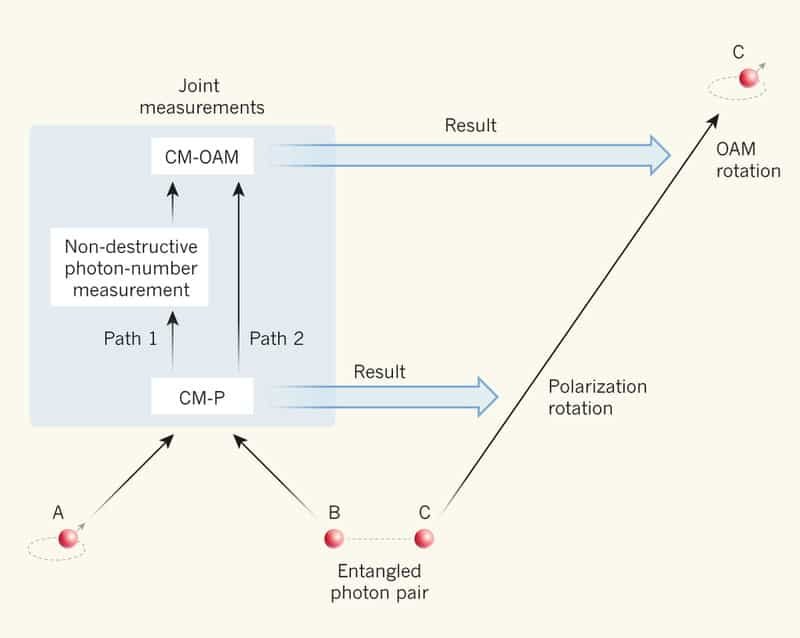
This schematic shows exactly how the polarization and the OAM was teleported via the comparative measurements and an intermediate non-destructive step. (Courtesy: Nature)
The image above represents Pan’s double-teleportation protocol – A is the single photon whose spin and OAM will eventually be teleported to C (one half of the hyper-entangled quantum channel). This occurs via the other particle in the channel – B. As B and C are hyper-entangled, we know that their spin and OAM are strongly correlated, but we do not actually know what their values are – i.e. whether they are horizontally, vertically or orthogonally polarized. So to actually transfer A’s polarization and OAM onto C, the researchers make a “comparative measurements” (referred to as CM-P and CM-OAM in the image) with B. In other words, instead of revealing B’s properties, they detect how A’s polarization and OAM differ from B. If the difference is zero, we can tell that A and B have the same polarization or OAM, and since B and C are correlated, that C now has the same properties that A had before the comparison measurement.
On the other hand, if the comparative measurement showed that A’s polarization as compared with B differed by 90° (i.e. A and B are orthogonally polarized), then we would rotate C’s field by 90° with respect to that of A to make a perfect transfer once more. Simply put, making two comparative measurements, followed by a well-defined rotation of the still-unknown polarization or OAM, would allow us to teleport A’s properties to C.
Perfect protocol
One of the most challenging steps for the researchers was to link together the two comparative measurements. Referring to the “joint measurements” box in the image above, we begin with the comparative measurement of A and B’s polarization (CM-P). From here, either one of three scenarios can take place – one photon travels along path 1 to the middle box (labelled “non-destructive photon-number measurement”); no photons enter the middle box along path 1; or two single photons enter the middle box along path 1.
The middle box itself contains the second set of entangled photons mentioned previously (not shown in figure) and one of these two entangled photons is jointly measured with the incoming photons from path 1. But the researcher’s condition is that if either no photons or two photons enter the middle box via path 1, then the measurement would fail. Indeed, what the middle box ultimately shows is that exactly one photon existed in path 1, and so exactly one photon existed in path 2, given that two photons (A and B) entered CM-P. To show that indeed one photon existed in path two required the third and final set of entangled photons in the CP-OAM box (not shown), where the OAM’s of A and B undergo a comparative measurement.
The measurements ultimately result in the transfer or teleportation of A’s properties onto C – although it may require rotating C’s (as yet unknown) polarization and OAM depending on the outcomes of the comparative measurements, but the researchers did not actually implement the rotations in their current experiment. The team’s work has been published in the journal Nature this week. Pan tells physicsworld.com that the team verified that “the teleportation works for both spin-orbit product state and hybrid entangled state, achieving an overall fidelity that well exceeds the classical limit”. He says that these “methods can, in principle, be generalized to more [properties], for instance, involving the photon’s momentum, time and frequency”.
Verification verdicts
Physicist Wolfgang Tittel from the University of Calgary, who was not involved in the current work (but wrote an accompanying “News and Views” article in Nature) explains that the team verified that the teleportation had indeed occurred by measuring the properties of C after the teleportation. “Of course, the no-cloning theorem does not allow them to do this perfectly. But it is possible to repeat the teleportation of the properties of photon A, prepared every time in the same way, many times. Making measurements on photon C (one per repetition) allows reconstructing its properties.” He points out that although the rotations were not ultimately implemented by the researchers, they found that “the properties of C differed from those of A almost exactly by the amount predicted by the outcomes of the comparative measurements. They repeated this large number of measurements for different preparations of A, always finding the properties of C close to those expected. This suffices to claim quantum teleportation”.
While it is technically possible to extend Pan’s method to teleport more than two properties simultaneously, this is increasingly difficult because the probability of a successful comparative measurement decreases with each added property. “I think with the scheme demonstrated by [the researchers], the limit is three properties. But this does not mean that other approaches, either other schemes based on photons, or approaches using other particles (e.g. trapped ions), can’t do better,” says Tittel.
Pan says that to teleport three properties, their scheme “needs the experimental ability to control 10 photons. So far, our record is eight photon entanglement. We are currently working on two parallel lines to get more photon entanglement.” Indeed, he says that the team’s next goal is to experimentally create “the largest hyper-entangled state so far: a six-photon 18-qubit Schrödinger cat state, entangled in three degrees-of-freedom, polarization, orbital angular momentum, and spatial mode. To do this would provide us with an advanced platform for quantum communication and computation protocols”.
Suitcase packed, I am now on the way to San Antonio for the 2015 American Physical Society (APS) meeting, which begins on Monday.
More than 9000 physicists will be heading to Texas for one of the biggest physics meetings of the year.
Having just put the finishing touches to my schedule for the five-day conference, we should be set to hear exciting results on mechanically programmable materials, the first metamaterial superconductor and the latest in flexible, stretchable electronics.
Yet there is also a more fun side to the conference with delegates also learning about modelling zombie outbreaks as well as participating in the famous APS physics sing-along.
So keep tabs on physicsworld.com for all the latest from the 2015 APS meeting.