New physics department opens in the UK

A new department of physics opens this month at the University of Lincoln in the UK, in the latest stage of an ambitious plan to expand the university’s research output. The department forms part of Lincoln’s new school of mathematics and physics, which will be headed by Andrei Zvelindovsky – a computational physicist who was previously at the University of Central Lancashire in Preston. Located at Lincoln’s £150m waterfront campus – just 50 km from the birthplace of Sir Isaac Newton – the school will carry out research and offer undergraduate physics degrees.

The opening is part of a renewed interest in physics in the UK, which has seen the number of students starting undergraduate physics degrees jump by 44% between 2008 and 2013 to nearly 4800. This resurgence is in stark contrast to the period between the 1980s and mid-2000s when several university physics departments closed across the country.

We are investing heavily in interdisciplinary science, including at the interface between life sciences, chemistry and physics
Andrew Hunter, pro vice chancellor of the University of Lincoln

The University of Lincoln, which adopted its current name in 2001, is located in the historic cathedral city of Lincoln. With roots in the arts, humanities and both the applied and social sciences, the university has been branching out into core science in recent years, having already opened schools in chemistry, engineering, life sciences and pharmacy. “We are investing heavily in interdisciplinary science, including at the interface between life sciences, chemistry and physics, and we need a full spectrum of subjects for this to be effective,” says Andrew Hunter, Lincoln’s pro vice chancellor.

Focus on computation

The new school’s research will initially centre on computational physics, including molecular modelling, which is Zvelindovsky’s particular area of interest. He will be joined at Lincoln by Marco Pinna – a former PhD student of his at Central Lancashire – and Manuela Mura, who has a PhD from King’s College London. The department hopes to build links with materials scientists elsewhere in the university, with research into theoretical and applied physics following too.

Zvelindovsky expects Lincoln to have at least six academics in post by next summer, with the long-term aim being to bring this number up to 30. Undergraduate degrees will be provided as well, with three-year Bachelor’s degrees and four-year Master’s degrees in physics and mathematics being offered from next year.

Zvelindovsky expects an intake of 40–50 students in 2015 for both physics and maths, with the number of students rising to more than 100 within a few years. “We will aim for eventual growth to an intake of more than 150 and a total population of more than 400,” he adds. Most of Lincoln’s 12,800 students have traditionally come from the east of England and the East Midlands, but the university is now expanding its reach, with the proportion of international students having risen from 2% to 12% since 2010.
Between the lines

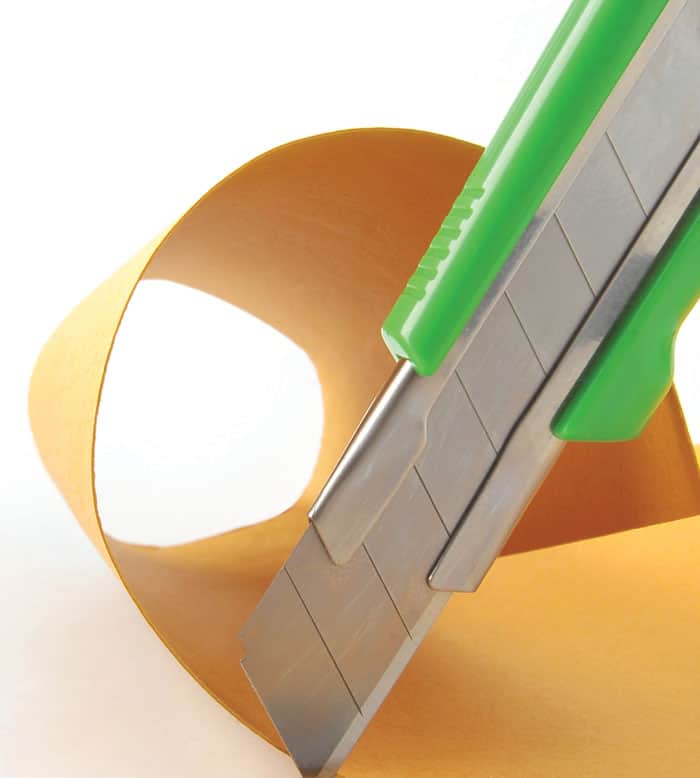
Photo of a razor blade slicing a sheet of paper

Razor sharp

Mark Miodownik’s fascination with materials science began when, as a young schoolboy in London, he was slashed with a razor blade by a mugger on the tube. As he tells it in his book Stuff Matters, he reacted to the incident by becoming obsessed with steel, peppering his parents with questions such as “Why does a razor blade cut while a paper clip bends?” and “Why don’t spoons taste of anything?”. Miodownik’s obsession soon broadened to include other types of material, and now, as a materials scientist at University College London, he has written a book that will surely fire others with the same enthusiasm. Packed with details about materials from concrete and glass to chocolate and graphite, Stuff Matters is nevertheless an almost effortless read, one that mixes history, personal stories and science with a rare degree of skill. The chapter on paper is a good example. Having begun by describing paper’s physical structure, Miodownik then moves into a poignant discussion of how we use it to preserve memories, before concluding with an amusing rant about how much of the stuff gets flushed down toilets. But what really makes this book stand out is not the high quality of its anecdotes or explanations. Rather, it is the way Miodownik uses them to persuade readers that materials are as much a part of human culture as the arts, technology and literature they make possible. Materials, in a very deep sense, matter.

  • 2014 Penguin Press £9.99pb 272pp

Big-Seers and edge-goers

The idea behind this book, which is called The Edge of the Sky, is to explain everything we know about the world using only the ten hundred most used words. This is much harder than it sounds, because a lot of the words that people who study our world (and all that is outside it) like to use are ones that not many people use very much. “Stars” and “Sun” are okay, and so are some harder things like “dark matter” and “red shift”. But to talk about other things, the student-person who wrote this book, Roberto Trotta, has to write words like “student-person” even when he really means something a little bit different. (Also, one time he slips up and uses the word “minute” to mean “very small” even though a nearly same word, meaning a short piece of time, is the one that is really in the ten hundred.) Sometimes his work-around words are funny, like when a person in the book asks herself if maybe she should have been a doctor or “one of those people who wear horse hair on their head and try to trip people up for a living” instead of being a student-person who uses a Big-Seer to look at far-away stars. At other times, the work-around words make The Edge of the Sky sound like a night-time story told by people who lived long ago, and that is kind of pretty. But the book also shows that sometimes, writing about things using only simple words makes them harder to understand, not easier.

  • 2014 Basic Books $19.99 144pp

Radiant exaggerations

Early in the opening chapter of his book The Age of Radiance, author Craig Nelson blithely proclaims that “we are now living in the twilight of the atomic age, the end of both nuclear arsenals and nuclear power”. Given that Russia and the US currently have more than 1000 operational strategic warheads each, and nuclear power plants produce more than 10% of global electricity, this statement seems frankly bizarre. But Nelson doesn’t stop there. The rest of the book’s breathless first chapter seems to consist almost entirely of scientific name-checking, pop-culture references and bombastic overstatements, with a few head-scratching factoids (Isaac Newton died of mercury poisoning?) thrown in. After that, one might have expected the book to settle down a bit, and indeed it soon does – but not until after Nelson makes the absurd claim that “nearly every one” of the advances that occurred in the first 50 years of the atomic age “was made, astonishingly enough, by an academic nonentity”. This exaggeration is so wild that Nelson barely bothers to defend it, although he does describe one of these supposed “academic nonentities”, Marie Curie, as “one hell of a broad” and also “tough as cancer”. (Physics World is not sure which of those characterizations is more inappropriate. It will have to think about it.) This is all deeply unfortunate, because in many respects the book is actually rather fun to read. Nelson, a professional journalist, clearly knows how to tell a good story, and his narrative is loaded with choice quotations from the atomic era’s extensive archives. Moreover, the book’s conclusion – essentially, that humankind should use nuclear science responsibly, instead of turning away through “fear, superstition and ignorance” – is one that most physicists will agree with. But only if they make it to the end without hurling the book across the room.

  • 2014 Simon and Schuster £19.99/$9.99hb 448pp

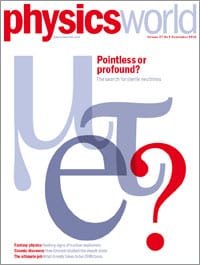
Pointless or profound?

Cover of Physics World September 2014 issue
The cover feature of the September 2014 issue of Physics World, which is out now in print and digital formats, concerns “sterile neutrinos” – a hypothesized fourth kind of neutrino in addition to the familiar electron, muon and tau neutrinos. Sterile neutrinos are controversial – they have never been detected and we are not even sure if they exist at all. But if they do, sterile neutrinos could potentially solve a raft of unsolved problems in physics, including why neutrinos themselves have mass, what makes up dark matter and why there is so much more matter than antimatter in the universe.

In the article, you can find out more about the mysteries these hypothetical particles could solve. But since they might not exist, why – you may wonder – would anyone bother looking for them? In other words, is the search for sterile neutrinos pointless or profound? Check out the September issue to find out more.

If you’re a member of the Institute of Physics (IOP), you can now enjoy immediate access to the new issue with the digital edition of the magazine. If you’re not yet in the IOP, you can join now to get full access to Physics World as well as many other member benefits.

For the record, here’s a run-down of other highlights of the September issue.

• Peering through the fog – Scientists in China have revealed ambitious plans to construct a huge smog chamber to help combat the nation’s worsening air quality. But as Ling Xin reports, some are unconvinced that it will make a difference.

• Building bridges with art – With mathematicians having an annual get-together to talk about maths and art, Pangratios Papacosta argues that it is time that physics follows suit.

• The right questions – Robert P Crease discusses a book by a theoretical-physicist-turned-philosopher that seeks to upend some long-standing views.

• A fourth type of neutrino – If disappointments continue at the high-energy frontier, you might be hearing a lot more about the sterile neutrino, says Jon Cartwright.

• Einstein’s steady-state cosmology – Last year, a team of Irish scientists discovered an unpublished manuscript by Einstein in which he attempted to construct a “steady state” model of the universe. Cormac O’Raifeartaigh describes the excitement of finding this previously unknown work.

• Fantasy physics for nuclear testers – In November a group of scientists will scour a small patch of the Middle East for signs that a nuclear explosion has taken place. Edwin Cartlidge describes their delicate mission and the sophisticated gadgetry they will rely on in this giant role-playing game.

• A space cowboy’s tale – James Dacey reviews the film The Last Man on the Moon, directed by Mark Craig.

• A classy look through mathematics – Dean Burnett reviews Alex Through the Looking Glass: How Life Reflects Numbers and Numbers Reflect Life by Alex Bellos.

• Leadership required – What does it take to lead a lab with more than 2000 staff
members and an annual budget in excess of 800m? As CERN celebrates its 60th anniversary this month, Sharon Ann Holgate finds out what’s expected of the lab’s next director-general.

• Once a physicist – meet entrepreneur, politician and founder of Next Big Thing Chris Philp.

• Lessons of the Angry Birds universe – in this month’s Lateral Thoughts, Rhett Allain looks at the physics of the most popular smartphone apps.

Connecting physics with Argentine industry

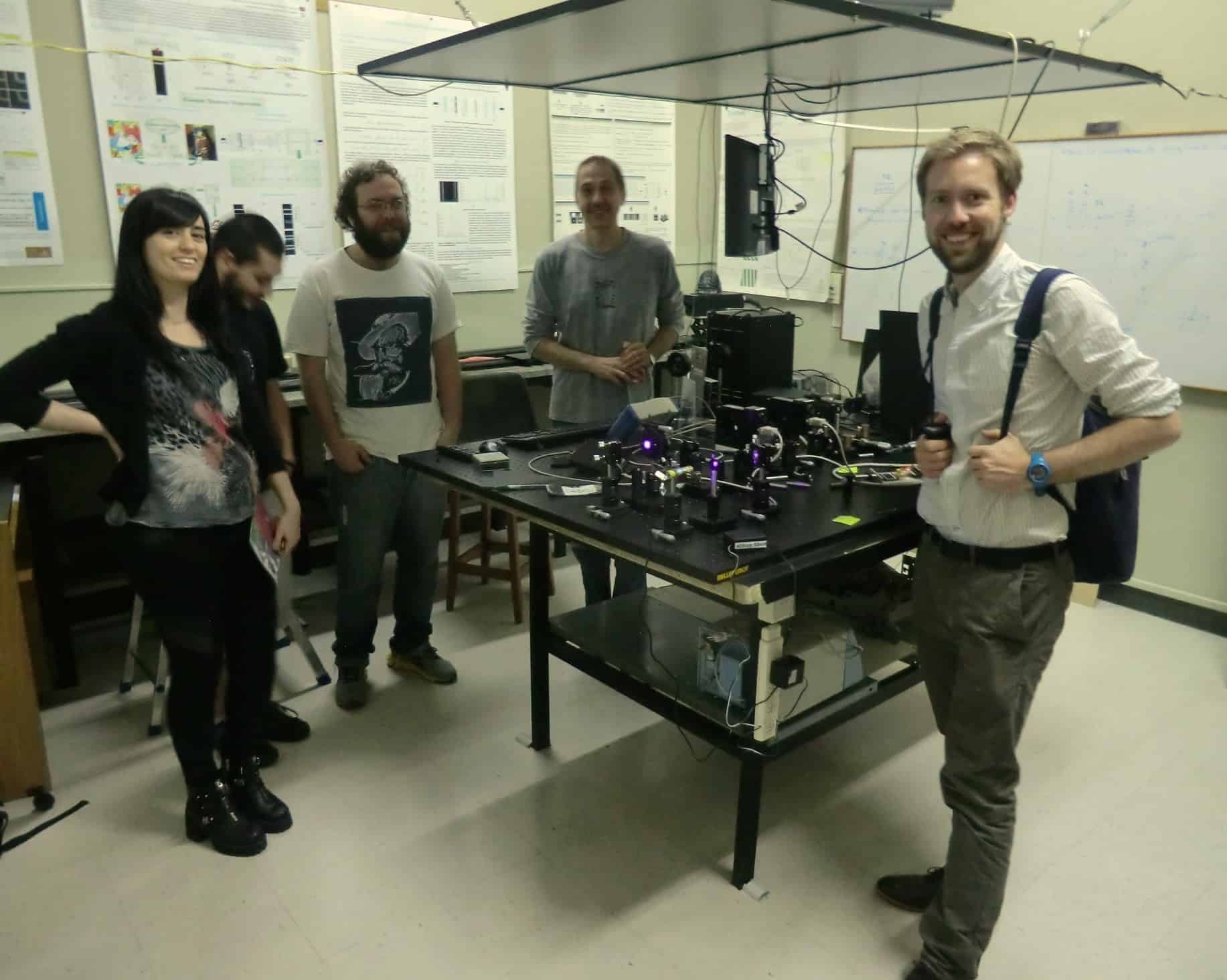
Photo of scientists in an optics lab

By James Dacey in Buenos Aires, Argentina

This week, physics PhD students and advanced undergraduates from across Argentina will flock to the University of Buenos Aires for the physics department’s winter school. It’s an annual event where budding researchers spend a few days at the nation’s premier academic institution to learn about some of the latest developments in fundamental research. The year, however, the meeting will be focused on bridging the gap between academia and industry.

I’ve been in Buenos Aires as part of a fact-finding mission to learn about the physics-education system in Argentina. After meeting with various people involved with Argentine physics education, it seems to me that the theme of this year’s winter school at the University of Buenos Aires is indicative of a change in the way physics is being presented to students. The subject is being rebranded from a purely intellectual pursuit into a practical science that can equip students with highly sought-after professional skills. The bigger picture, of course, is that right now the Argentine economy needs all the fresh ideas and workforce it can get!

(more…)

Radiation levels near Fukushima, trust in science and fun with correlations

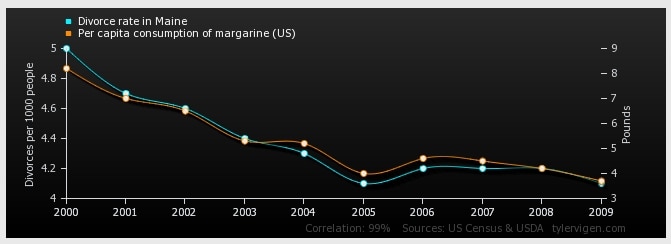
A graph tracking the divorce rate in Maine 2000–2009 and per capita consumption of butter in the US over the same years, showing that they follow a similar line

This week’s Red Folder begins in Japan, where the 2011 disaster at the Fukushima nuclear power plant continues to cause misery for the 100,000 or so local people who still cannot return to their homes. But who is to blame? Writing in World Nuclear News, Malcolm Grimston of Imperial College London argues that radiation levels in much of the current exclusion zone are no higher than natural levels in other parts of Japan – and much lower than natural levels in some other populated regions worldwide. Grimston concludes that “an overzealous infatuation with reducing radiation dose, far from minimizing human harm, is at the heart of the whole problem”. His article is called “What was deadly at Fukushima?”.

(more…)

Reality is a concept you can apply to your cats

Will Schrödinger's catch be hitching a ride on LISA Pathfinder? (Courtesy: ESA)

By Tushna Commissariat in Stockholm, Sweden

“Reality is a concept you can apply to your cats,” says Rainer Kaltenbaek to a room full of journalists and physicists, “so long as you don’t talk to Schrödinger.” Indeed, he warns us to not bother applying reality to anything that exists at the quantum level as we will just end up disappointed.

I am in Stockholm at a workshop for science writers being hosted at the Nordic Institute for Theoretical Physics (NORDITA) and the idea of completely forgetting “reality” is one of the many interesting things I have been pondering. Over the past two days we have discussed Bell’s loopholes, using your bathtub as an analogue laboratory to study black (and white) holes and learned about problems that even the best quantum computers (if they could be built) will not be able to solve.

(more…)

Pleiades distance debate resolved, say radio astronomers

A long-running debate about the distance to the Pleiades cluster of stars has been resolved, claims a team of radio astronomers in the US. The researchers conclude that the cluster is almost exactly as far away as originally thought. This contradicts analyses of data from the Hipparcos satellite cluster, which suggested that the cluster is 13 parsecs closer than astronomical models predict. The astronomer who made those Hipparcos calculations, however, is standing by the original results, claiming that there are errors and unjustified assumptions in the new research.

The Pleiades is the star cluster most obvious to the naked eye in the night sky, and has been known since antiquity. In modern astronomy, the distance to the Pleiades is used to calibrate the cosmic-distance ladder, allowing the distances to star clusters and galaxies that are further away to be inferred. For this reason, it is important to know this distance precisely, and multiple calculations of it have been made using various methods.

The generally accepted distance was about 134 parsecs (about 437 light-years) until, in 1999, Floor van Leeuwen of the Institute of Astronomy in Cambridge, UK, used data from the European Space Agency’s Hipparcos satellite to produce what was the most precise calculation to date. The result was obtained with trigonometric parallax, using the apparent shift in the position of the target star relative to distant “fixed” stars as the Earth orbits the Sun. This is independent of any stellar models, depending only on the fundamental laws of geometry.

Controversial analysis

Van Leeuven arrived at a distance of about 120 parsecs. He refined his analysis in 2009, reaching a similar conclusion. This figure was highly controversial as the potential theoretical implications of such an unexpected discovery were huge, putting into question the amount of helium in the stars making up the Pleiades and even suggesting that hitherto unknown physics governs the early lives of stars.

In the new research, Carl Melis of the University of California, San Diego and colleagues at several other US institutions did their own trigonometric-parallax measurement of five selected stars in the Pleiades cluster using very long baseline radio interferometry. In this technique, measurements are made by linked radio antennas spread across the world, giving the total resolution of a telescope the size of the Earth. The researchers found that the distances of all five stars were in broad agreement with the original figure, with the lowest value being 134.8 parsecs and the highest being 138.4.

Melis says that, taken together with all the other measurements of the distance to the Pleiades cluster that back current theoretical models, these measurements demonstrate conclusively that the Hipparcos data were erroneous. “We’ve already come to that conclusion,” says Melis. “This is just reiterating it, and really hitting the hammer on the head of the nail and driving it into the coffin.”

Not convinced

Van Leeuwen, however, is not convinced. Hipparcos catalogued more than 100,000 stars, including multiple clusters like the Pleiades, and found answers in line with predictions for the others. The distance to the Pleiades was calculated from separate measurements of more than 50 stars, and Van Leeuwen says that, for that distance to be incorrect, Hipparcos would have needed to give wrong answers in these specific measurements. He adds that there is no convincing explanation for how this could have occurred.

He questions several technical details of the new measurements, such as the fact that the proper motions (the velocities relative to the Sun) of the Pleiades stars vary widely, whereas the proper motions of the stars within a cluster should be almost the same. “As soon as you bring the proper motions in line with each other,” he says, “all the parallaxes will change.” He also says that the Hipparcos figure can be explained. “There is no new physics needed,” he says. “The only thing that’s needed is a re-assessment of the depths of the convection layers in these stars, which have conveniently been assumed to be fixed and constant during the main sequence phase.”

Waiting on Gaia

In 2013 ESA launched Gaia, a successor to Hipparcos with much higher specifications, such as higher-sensitivity cameras, that will measure the parallaxes of thousands of stars in the Pleiades cluster. The design principles are conceptually similar, which leads Melis and colleagues to suggest that the unidentified error they believe distorted the Hipparcos measurements of the Pleiades could also affect Gaia. Nevertheless, Melis suspects that “the Gaia measurement is not going to be the same as the Hipparcos measurement…Hopefully then the Hipparcos community is going to have to face the fact that Hipparcos did not produce the correct result.”

The research is published in Science.

Ion beams simulate nuclear-reactor damage

Damage to nuclear-reactor components caused by neutron irradiation across several years can be simulated with ion beams in just a few days. That is the finding of researchers in the US, who have used ions to create the same fabric of tiny structural defects found in long-running reactors. The new technique could help engineers anticipate problems arising in existing facilities and inform the development of more robust reactor designs for the future.

Neutron irradiation can have significant effects on the structure of materials used in nuclear reactors. Individual atoms can be displaced and larger defects can build up over time, weakening or even deforming the material. Understanding the nature and extent of this damage is important to ensure safe reactor operation.

One approach is to place samples in test reactors that can produce damage at a faster rate than their working counterparts. However, these facilities are expensive to operate and can still take decades to produce the required levels of damage.

Ions instead

An alternative solution lies in replicating neutron damage with a different type of irradiation: ion beams. Building on decades of research, Gary Was of the University of Michigan and colleagues have unveiled the first working emulation of neutron damage using ion beams. “The amount of damage that is created with an ion is very dependent on its energy,” Was explains. “It turns out that the damage spectrum from 5 MeV ions is pretty close to that from fission neutrons.”

The team demonstrated the concept by trying to recreate damage seen in a steel duct that for seven years had surrounded the fuel assembly in a nuclear reactor on the Hanford Site in Washington. Microstructural damage to the duct had already been studied extensively by researchers from the Los Alamos National Laboratory using atom probe microscopy, electron microscopy and other techniques.

Atoms on the move

Using a sample made from metal from the same batch that was used to manufacture the original duct, Was and colleagues followed a two-stage analysis procedure at the Michigan Ion Beam Laboratory. First, a beam of helium ions is used to insert helium nuclei into the sample. This simulates the in-reactor production of helium by neutrons. The second stage involves heating the sample to 460 °C and subjecting it to a beam of iron ions. The sample itself is mostly iron as well, and the introduction of these ions simulates atomic displacements within the material without introducing any new elements.

One possible drawback of using ions is that unlike neutrons, which easily penetrate deep into materials and cause damage throughout, ion beams only scratch the surface of a sample. This means that the effects of ion-beam irradiation are confined to within a micron of the surface of the sample. However, the researchers explain that this creates more than enough damage for analysis.

The irradiation process lasts four days and creates the same fabric of damage seen in the original duct. Defects seen in both the sample and duct ranged from 1–20 nm in size and came in a variety of forms. These include dislocation loops, voids and precipitates – the latter being tiny regions containing a different structure than that of the surrounding material.

Translatable technique

According to Was, the method is already “quite translatable to other materials” and, in the future, the researchers hope to adapt it so that they can simulate a range of irradiation environments and reactor operational histories. In addition to assessing potential issues arising in existing reactors, the researchers hope that their method could help inform the development of the next generation of reactor designs. These plants will likely have more intense radiation environments than today’s facilities, and this will require components that are capable of withstanding higher levels of irradiation damage.

“The use of ion beams to mimic the irradiation damage produced in a reactor is a vital tool to developing a better understanding of how materials are affected by high-irradiation doses,” comments Philipp Frankel, a materials scientist at the University of Manchester. He adds that the work demonstrates exactly the type of validation studies need to provide confidence in these techniques.

Karl Whittle – a nuclear materials researcher from the University of Sheffield – agrees, but says that care must be taken when comparing the damage caused by different types of irradiation. Regardless, further work in this area, he says, would make it possible “to examine the long-term effects of damage, and develop mechanisms for mitigation of [its effects]”.

The research is described in the journal Scripta Materialia.

Physics World 2014 Focus on Vacuum Technology is out now

Vacuum technology is big business these days, with companies in the sector producing advanced scientific equipment that is vital not only for academic research, but also for manufacturers in other industrial sectors.
Physics World 2014 Focus on vacuum technology
In fact, one giant of the vacuum industry – Swedish firm Atlas Copco – bought its UK rival Edwards Vacuum for an eye-watering $1.5bn last year.

If you want to find out more about why Atlas Copco forked out so much cash, don’t miss the latest Physics World focus issue on vacuum technology, which includes an interview with Geert Follens, president of Atlas Copco’s newly created vacuum-solutions division. In the interview, Follens discusses the takeover in more detail and explains why he expects further strong growth in the vacuum market.

Elsewhere in the issue, you can read about a European Union project uniting academia and industry to improve vacuum metrology for production environments. Such efforts are vital even in the drinks industry, where the Van Pur brewery in Poland, for example, uses equipment from KHS Plasmax to coat the inside of bottles with an ultrathin layer of glass using plasma impulse chemical vapour deposition under vacuum.

(more…)

Gardening in space

For a few weeks two summers ago, a courgette blogged its experiences aboard the International Space Station (ISS) (“Diary of a Space Zucchini”). One morning, the vegetable – dubbed Space Zucchini – described a thin sliver of atmosphere as “like a rainbow, but only of shades of blue” that filled the gap between Earth and space with “electrifying diaphanous beauty”. Another day it (the blogger’s gender is unclear) characterized a spacesuit as an astronaut’s version of a seed pod.

Seeing its neighbour Sunflower grow with lopsided seeds, Space Zucchini later remarked, “We are living on a frontier and things are different here.” Other of the vegetable’s blog entries concerned the birth of a younger sibling, whose development Space Zucchini found indicative of unsuspected truths about plant growth, including the lack of need for gravitational signals in aspects of the process. “On the frontier,” it noted solemnly, “even a baby sprout can teach us something new.”

Who knew that vegetables – well, a courgette’s technically a fruit – were so literate? In fact, this one’s even done a poignant reading over National Public Radio. But apart from being a bit of fun, the activities of Space Zucchini – and its rumoured alias, the astronaut Don Pettit – gave me ideas for new ways to talk about the scientific process.

Life of an “uber-geek”

I decided to get in touch with Pettit, who told me that he is an “uber-geek” whose thoughts turn to science at the slightest provocation. “I’ll be having a quiet, intimate moment with my wife,” he confessed, “catch a drop of water sliding down a glass out of the corner of my eye – and suddenly I’m thinking about surface tension! In the kitchen, I’ll collapse a plastic bag and wonder why it crinkles, or wonder why some powder I’ve spilt fans out.”

Pettit, who is a chemical engineer by training, became an astronaut in 1997. While carrying out experiments on board the ISS in 2002 he realized that, in the weird environment of space, our normal intuitions about simple things like bubbles, flames, liquids and spinning objects don’t necessarily apply. “The explanations are not in the back of a book,” he says. “You have to figure them out.”

Realizing that all it takes to “think up cool things [is to] have a bit of geek in you”, Pettit began to make videos in the ISS of his coolest ideas. In fact, by his third excursion to the ISS, which ran from December 2011 to July 2012, Pettit had amassed about 100 hours of video footage. NASA gave the material to the American Physical Society, which began editing the videos into approximately six-minute segments. There are 14 so far, which together have received some five million hits to date, and Pettit says he has enough footage for a further 45.

Lava lamps in zero g

In one video, Pettit is shown getting a droplet of water to orbit about a knitting needle, then coaxing several droplets to spiral crazily up and down the needle “like flies at a picnic”. Another video has him winging yo-yo tricks that are impossible on Earth. He also watches spinning objects, such as cylinders and bottles, oscillate between rotational and translational motion. “It’s not new physics,” Pettit says, “but it’s astounding to see.”

Elsewhere, Pettit puts a globe of water on a speaker and uses tone generators to create sine and square standing waves. “After playing with that for a while,” Pettit told me, “I thought, ‘What happens when you play music?’.” He fashioned a didgeridoo – an Aboriginal instrument – from the ISS’s vacuum cleaner hose, donned a tank top that he’d cut from an ISS crew shirt to look more like a musician, and used the instrument to create more waves on the water, pointing out their spacing, resonance frequencies and so forth.

“You can look at it as an art form or as a physics exercise,” he said. “One of my colleagues described it as a zero-gravity equivalent of a lava lamp.”

Pettit’s wit and enthusiasm make the videos far more exciting than the scripted and boring fare usually issued by NASA’s publicity machine. After NASA officials asked him to do something about pendulums – which of course don’t move in space – he started thinking what he could do that was pendulum-like. On his last flight, Pettit took into orbit a weak spring about a metre long and made from it a very thin wire. Using the spring like a pendulum in the weightless environment of space, Pettit demonstrated principles of simple-harmonic oscillation by clamping the spring at either end and fixing a mass in the middle. The frequency it vibrates at depends on the spring constant, and adding more mass makes it oscillate more slowly.

Pettit is back in line for another flight but no date has been set. “I have lots of new ideas for when I return,” he says.

The critical point

Pettit’s blogs, videos and other clips on YouTube show the marvels that can be produced when the gravitational field is switched off and other phenomena – such as surface tension, electromagnetism and sound waves – dominate instead. But his work (and all the talk about courgettes) also got me thinking about resemblances between a laboratory and a garden.

Like a lab, a garden is a special environment where unusual conditions make it possible to grow things that do not appear, or do so rarely, in the wild. Similarly, a laboratory’s special environment allows us to stage new kinds of events, be they subatomic particles or sunflower sprouts. The fact that these events may only take place in laboratories does not mean that they are unworldly. It’s just the other way around: the special laboratory environments make these events part of our world – and their mere existence helps us understand the wild better.

Just ask Space Zucchini!

Copyright © 2026 by IOP Publishing Ltd and individual contributors