Molecules line up for X-ray diffraction

A new X-ray diffraction technique that works on single organic molecules has been demonstrated by an international team of researchers. The team hopes that, with further development, the method could be used to work out protein structures and even investigate entire living cells.

X-ray diffraction is a powerful tool for determining molecular structures and was famously used by James Watson and Francis Crick to reveal the double helix of DNA. However, the diffraction signal from individual molecules is weak and physicists have taken two main approaches to amplify it. One is to incorporate large numbers of the molecules into a regular crystalline array – Watson and Crick’s approach – however, not all molecules can be crystallized. The second is to boost the X-ray exposure time and/or intensity, which has the downside of altering or even destroying the molecule in the process.

In 2000 researchers at Uppsala University in Sweden, led by biochemists Richard Neutze and Janos Hajdu, suggested using ultrashort pulses from a high-intensity X-ray free-electron laser. While such pulses destroy the molecules, repeating the measurement on multiple samples would allow a diffraction image to be built up. To make the technique work, however, the molecules in successive samples would all have to be oriented the same way.

Now, Jochen Küpper of the Centre for Free Electron Laser Science in Hamburg and colleagues in Germany, Denmark, the Netherlands, Sweden and the USA have created a beam of molecules that fits the bill. Working at the Stanford Linear Accelerator Laboratory in California, the team began with an ultracold beam of 2,5-diiodobenzonitrile molecules bathed in polarized laser light. Each molecule contains two iodine atoms that are on opposite sides of a benzene ring. The electric field of the laser light causes the molecules in the beam to line up along the axis defined by these two atoms.

Powerful X-ray laser

The researchers then pass the beam through pulses from the Linac Coherent Light Source (LCLS), which is the world’s most powerful X-ray free-electron laser. Powerful electrodes placed around the interaction point allow the team to collect and detect iodine atoms that are ejected from the molecules by the intense X-ray pulses. By tracing these atoms back to where they were liberated from the molecules, the team was able confirm that the molecules were properly aligned.

Diffracted X-rays from multiple pulses were combined to create a diffraction pattern that was then used to estimate the distance between the two iodine atoms. The result was an iodine–iodine separation of 800 pm, whereas the known distance is 700 pm. This discrepancy is not surprising, the researchers say, because the wavelength of the X-rays was 620 pm, making it difficult to resolve distances finer than this. Shorter wavelengths of 100–200 pm have since become available at the LCLS and will be soon available at the European XFEL, which will open in Hamburg in 2015. The researchers hope to use these shorter wavelengths to obtain detailed structural information about larger biochemical molecules, such as peptides.

Neutze, who was not involved in this latest work, is impressed: “Using an applied laser field to align the molecules is clearly an advance and it works extremely well.” He says that extending the method to more complex and interesting chemical and biochemical systems will be “an uphill challenge”, but concludes that he “would not have expected the data to be this convincing in the first place”.

“Important proof of principle”

John Helliwell, a crystallographer at the University of Manchester, also calls the research “an important proof-of-principle demonstration”. However, he points out that some of the team published a theoretical paper in 2005 that surveyed various molecules of increasing complexity and biological relevance, and calculated the degree of angular alignment necessary to resolve important details of their structures. He suggests that a more convincing test of the technique would involve copper phthalocyanine, which was the simplest of the molecules surveyed.

Küpper, who was not an author on the 2005 paper but who currently holds the record for molecular alignment, responded by saying “The alignment parameters for copper phthalocyanine assumed in that paper are simply not achievable with current understanding and technology.” He has received a grant from the European Research Council to investigate the creation of molecular beams of identical, pre-aligned large molecules such as peptides. Helliwell agrees with this aim. “This is important research, which should indeed be strongly supported,” he says.

The research is published in Physical Review Letters.

There is much more about the European XFEL in this video interview with DESY’s director Helmut Dosch.

Disorder sharpens optical-fibre images

Researchers in the US have created an optical fibre that is very good at transmitting images even though it is highly disordered. The fibre was developed by Arash Mafi and colleagues at the University of Wisconsin-Milwaukee, Corning Incorporated and Clemson University, who say it is the first ever, practical application of an effect from condensed-matter physics called “Anderson localization”. The fibre could be used in endoscopy and other imaging systems.

First identified by the US physicist Philip Anderson in 1958, Anderson localization refers to the fact that the interference of waves scattering from random impurities in a crystal can bring the propagation of a wave to an abrupt halt – an effect called “localization”. Anderson, who went on to share the 1977 Nobel Prize for Physics for his work on this topic, originally formulated his theory to understand the metal–insulator transition. Although measuring the Anderson localization of electrons in solids has proven to be difficult, physicists have had more luck seeing the effect with light and sound waves.

Surprisingly simple

Mafi and colleagues’ fibres consist of 40,000 strands of poly (methyl methacrylate) (PMMA) mixed randomly with 40,000 strands of polystyrene and then drawn into a fibre with a square cross-section that is 250 μm wide. As light passes down the fibre, it cannot scatter into the plane normal (or “transverse”) to the direction of travel because of the random distribution of PMMA and polystyrene. But as the disorder does not extend along the length of the fibre, the light is free to propagate in that direction. This effect, dubbed “transverse Anderson localization”, was first identified in 2008 by Moti Segev and colleagues at Technion in Israel.

The team showed that its technique works by sending tiny images – some just 30 μm across – along a 5 cm section of fibre. The images were created by placing a small stencil of various digits (such as the number “6”) across the face of the fibre and illuminating it with a blue laser. After emerging from the opposite end of the fibre, the image was magnified by a lens and then captured with a CCD detector. By measuring the blurriness of the image, the team says that light entering the fibre deviates by barely 10 μm from its initial trajectory as it passes along the fibre – a distance called the “localization length”.

Patent protected

The team then repeated the experiment using commercial fibres that are designed to carry images. The performance of all the fibres was calculated using the mean structural similarity index (MSSIM), which is a measure of how true the resulting image is to the original object. The MSSIM values revealed that the team’s fibre was slightly better than the commercial products – the team’s fibre scored 0.5877 while the best commercial MSSIM was 0.5591. Mafi told physicsworld.com that the team’s fibre has “clear potential to be significantly better, after improving the fibre specs”.

As for practical applications of the research, Mafi says that the team has taken out a joint patent with Corning on the technology, although there are “no immediate plans” to commercialize the work, despite having discussed the commercial potential of the fibre. “I personally consider the imaging applications such as endoscopy as the main potential,” he says. “Data multiplexing is more far-fetched but conceivable.”

Segev agrees that imaging is an important application. “The advantage of using disordered fibres for imaging is that, in principle, they are able to reach higher resolution than conventional fibre bundles because the Anderson-localized modes can be narrower,” he says.

The system is described in Nature Communications and a preprint is available on arXiv.

New prize targets student science journalism

There are many routes into science journalism, and my own journey was certainly not carved into a stone tablet when I was a child. In short, I was always fascinated by the ideas and concepts of science but my real passion was the communication of those ideas to others. (I was also fairly useless at the practical aspects of my BSc in natural sciences.) It was only later on, during my Master’s degree when I started writing for the student newspaper, that I started to seriously think about making a career out of this journalism game. I vividly remember the excitement of seeing my name in print those first few times. The idea that someone might actually pay me to include my name in their publication was too much to resist.

I knew of course that I was not alone in this career choice. The crucial next step for any budding journo is to build a strong portfolio of work and achievements to mark you out from the crowd. This helps you to grab the attention of those potential employers, who will quite likely be hurling you straight onto the front line of their operation as a junior reporter.

If you are a student in the UK or Ireland also hoping for a career in science media then here is an opportunity to get some vital recognition. The Institute of Physics (IOP) and IOP Publishing, which publishes Physics World, are sponsoring a new prize to recognize excellence within student journalism. It will be awarded to a popular science publication published in print or online, where your publication will be judged on its content, creativity in choice of content, and the way the content is presented.

The IOP student science publication prize is part of the 2014 Association of British Science Writers (ABSW) Awards. As well as the kudos, the winning entrant will be awarded £300, with the runner up receiving £200. Entries for the prize will close at midnight on Sunday 23 March. Find out how to apply, along with the details of all the other awards on the ABSW website.

Navigating new cultures

Many physicists will study or work overseas at some point during their careers. Indeed, the field’s international nature means that even those who remain in their home countries will regularly interact with colleagues from around the globe. While being exposed to new cultures can be enriching, cultural differences can also create challenges for physics graduates who choose to do further study overseas, accept a short-term secondment or research post in another country, or even just attend a foreign conference. Fortunately, the downsides can be minimized with some planning and insider knowledge.

Consider Clive Alabaster, a Norway-based British physicist who is a co-director and consultant at White Horse Radar. His work has taken him to a wide range of countries, including Australia, Canada, Germany, Malaysia, South Korea and – while in his former role as a lecturer at the UK’s Cranfield University – Saudi Arabia. Alabaster says that he read up on all of these countries before travelling, but before his Saudi trip, he also sought advice from the university’s international-affairs office and an Arabic-speaking colleague who had previously worked there. From them, he says, “I learned if somebody passes you something, you must accept it in your right hand and pass it right hand to right hand”. At mealtimes, Alabaster adds, you will keep being offered food in Saudi Arabia until you decline it. “It’s perfectly okay to decline, but if you have accepted it onto your plate you should finish it,” he says.

Speaking the language

Alabaster also recommends learning at least some of the local language when working abroad, even if your working language is English. “If you can say ‘please’, ‘yes’ and ‘thank you’, people will look very kindly on that,” he explains. But as with most things, the more you put into studying a language, the more you will get out. Erik Lucero, an American-born physicist who is now a research scientist at HRL Laboratories in the US, served as the “international ambassador” for his PhD research group at the University of California, Santa Barbara. He says that as well as boosting his language skills, classes in basic Japanese “helped prime me for the culture” before he travelled to Japan to promote the group’s research at the country’s RIKEN institute. By talking to colleagues who had worked in Japan, Lucero also discovered that having business cards is “a big deal” there because that is how people exchange details. In the US, he adds, “I wouldn’t have ever thought of needing them, especially as a graduate student.”

Some communication differences are less easily dealt with. Elizabeth Tasker is a physicist at Hokkaido University in Japan, and has previously worked in Canada and the US after studying in her native UK. In contrast to people in these other countries, who typically nod their heads to signal agreement and understanding, Tasker notes that “Japanese people nod and smile to show they are listening, but they may not be understanding anything. This leads to many misunderstandings and strange conversations.” She advises that anyone who comes to work in Japan from overseas should “be prepared to roll with the mistakes”, adding,”You will be misunderstood so you always need a plan B!”

When in Rome…

Another way to maximize your effectiveness is to look out for, and adapt to, differences in working practices. For example, after discovering that Norway’s working hours are shorter than the UK’s, Alabaster says that he now avoids arranging meetings there before 10 a.m. or after 4 p.m. Management styles can also differ widely. Sylvi Händel, a postdoctoral researcher in physics at the University of California, Los Angeles, who has previously worked in Australia and studied in the UK, has experienced this first-hand. In her native Germany, she says, “When you have done something wrong or not completed a task…people are very direct and will tell you. In the UK, people will rather suggest an alternative idea to you, so it is a totally different approach.”

Keep in mind though that some differences that you encounter will be personal rather than cultural. When it comes to business negotiations, “Aggressive, passive, hard-working, lazy, selfish, constructive, honest and devious approaches exist everywhere,” says John Hassard, a UK-born physicist at Imperial College London, who has founded companies in Qatar and Bahrain. Hassard, who is currently based in Qatar, but has also worked in the US, Japan and Switzerland, advises finding out about any specific procedures relevant to the country you are working in before starting business negotiations. Otherwise, though, he recommends treating everyone the same.

World map showing where each of the six physicists mentioned in the article were born, studied, worked and visited

Social interactions

For Händel, the biggest cultural challenge of working abroad is meeting and making friends with people outside of the work environment. “I usually deal with the problem by joining a local sport or hobby group,” she says, adding that it is “helpful to engage in watching the ‘national sport’ with colleagues, just to get in touch with people”. Similarly, Lucero connected with colleagues in the physics lab he visited at China’s Zhejiang University by inviting them to play the tile game mah-jong, which is, he explains, “very culturally relevant to the Chinese”.

Social differences are more numerous than professional ones, according to Riccardo Sturani, an Italian-born physicist who is currently on a four-year research contract at the Universidade Estadual Paulista in Sõo Paulo, Brazil. A veteran observer of cultural differences, Sturani has studied in Italy and France, and worked as a postdoc in Finland, Switzerland and Italy before moving to Brazil. He says that Finland gave him the biggest cultural shock because it took more time to get to know people there. “In Finland, people tend to interact less with you on a human level because they don’t want to invade your privacy,” he says. “It’s because of their natural shyness and their way to show respect and consideration for you.”

As challenging as working overseas can be, many physicists find it well worth the effort. “Of course it’s hard to jump-start a new life in a new city,” Sturani says. “You don’t even know where to shop for food, let alone who to go out with at the weekend. But you usually know your colleagues already because you’ve met them at conferences, and I like the challenge and excitement of learning new languages and being part of a different culture.” There can be professional advantages as well. Although he has never lived outside the US, Lucero says that he feels “very fortunate to have been able to go abroad and see how other people in the world do great physics”. He adds “For my own growth as a scientist, seeing the slight differences in their approach to the work was very important for me to reflect on and I’ve tried to integrate these different approaches into how I work now.”

Snip and tuck

By Tushna Commissariat at the APS March Meeting in Denver

Origami – the traditional Japanese art of paper folding – has long intrigued mathematicians and physicists alike. In addition to understanding the mechanics of it, its principles have been applied to the folding of DNA and other nanoscale structural designing, as well as in the folding of rigid sheets using hinges. Indeed, the latter is used for a variety of purposes: from the simple folds of a paper bag with a flat bottom to the folding of airbags and telescopes, and even to simulating the folding of large solar panels for space satellites (known as the Miura fold, named after its inventor the Japanese astrophysicist Koryo Miura).

This morning, I went along to an APS session that looked at “extreme mechanics”, where researchers were talking about the origami and kirigami – a version of origami that involves folding and making small cuts to a single sheet of paper – of structural metamaterials.

Jesse Silverberg of Cornell University (the more avid of readers may recognize Silverberg’s name from his work on mosh-pits and collective behaviour) was talking about the mechanical properties of “origami-inspired materials”. Such materials, according to Silverberg, could be the ultimate next-generation materials that are responsive and tunable. He also looks at what would happen if deliberate faults or defects were introduced into such folds, because “defects are known to dramatically alter the bulk properties in other periodic materials, [so] we introduce defects into the folding pattern to investigate their effects on the macroscopic mechanical properties”. Interestingly, the researchers found that a single defect increases the overall stiffness of a material, but this could also be mitigated by the introduction of a second defect in the opposite direction, as this serves to cancel out the first and the material goes back to its original state.

Also speaking at the session was Pablo Damasenco of the University of Michigan. He talked about the simulations and experiments carried out by his group that tuned the mechanical properties of nanocomposite sheets via “secondary structures” patterning – or using the art of kirigami. As Damasenco’s abstract rather eloquently says “ despite the small set of building blocks used for their assembly, naturally occurring materials such as proteins show remarkable diversity in their mechanical properties, ranging from something resembling rubber – low stiffness, high resilience and extensibility – to silk – high stiffness and strength” and this was his inspiration.

His simulations reveal the main cutting features that would be necessary to obtain a desired material extensibility. He also found that cuts can induce elastic behaviour in otherwise stiff materials, that the tunable properties are scalable from the micro to the macro and that the method could allow researchers “reversible access” to 3D structures from 2D materials.

There was also a later session where other researchers showed how they have crafted 3D grapheme structures and devices using kirigami, but I didn’t have the time to attend that. Suffice to say that origami is on the APS radar – so get folding.

Tiny membrane converts radio waves to light

A device that detects ultra-weak radio waves by converting them into light signals has been created by physicists in Denmark and the US. The device does not require costly cryogenic cooling and could be put to practical use in a range of applications, from radio astronomy to magnetic resonance imaging. The researchers also believe that the technology could provide an essential building block of a “quantum internet” of the future.

Detecting extremely weak radio waves is at the heart of many modern technologies, including satellite navigation, long-distance communications, radio telescopes and magnetic resonance imaging (MRI) systems. In some detectors, weak radio signals are converted into optical signals that can then be transported long distances via optical fibres. In addition to requiring expensive modulators to convert the electronic signals into optical signals, these converters must be cooled to cryogenic temperatures, making them expensive and inconvenient to operate.

The new device was created by Eugene Polzik and colleagues at the University of Copenhagen, along with researchers at the Technical University of Denmark and the Joint Quantum Institute at the University of Maryland. The team says that its device can detect extremely weak radio waves by converting them directly into light signals. These signals can then be transmitted and analysed using standard optical tools and the device uses much less energy than conventional modulators.

High performance and efficiency

The detector works at room temperature and Polzik says that it “promises performance comparable to the best cryogenically cooled electronics”. “Moreover, the radio signals in our method are efficiently converted into optical signals, which can be transmitted via optical cables with much lower loss than electrical signals can be transmitted by metal wires,” he says.

At the heart of the device is an antenna that is connected to a capacitor. One of the two capacitor plates is an extremely high-quality silicon-nitride membrane that is about 500 μm across and about 200 nm thick, after being coated with a reflective layer of aluminium.

When the capacitor encounters radio waves at its resonant frequency, the nanomembrane vibrates. “The radio waves detected by the antenna induce charge fluctuations in the capacitor,” says Polzik. “By applying an external bias voltage to the capacitor, we can convert these fluctuations into mechanical vibrations of the membrane.” A laser beam is bounced off the membrane, which produces an optical phase shift that can be measured using standard optical techniques. “We have thus converted a radio signal detected by the antenna into an optical signal,” says Polzik.

Running hot

When traditional radio receivers pick up faint radio waves, heat-related noise can distort the signal. But when radio signals are converted into a resonant mechanical vibration, the random effect of heat becomes negligible. The reflected light picks out the radio wave with little of the noise that affects standard radio receivers.

The new device has a room-temperature sensitivity of 100 pV Hz–1/2 for radio waves at 1 MHz. The team expects that this could be improved by a factor of 20, which would put the receiver on a par with the best devices using cryogenics.

The next steps for the team are to use microfabrication techniques to further miniaturize the device so that it fits on a chip and to improve its sensitivity. “We also plan to extend the frequency range of the devices from a megahertz domain to the hundred megahertz to the gigahertz domain, which is most relevant for applications in communication and sensing,” says Polzik.

A quantum internet

Potential applications of the detector include those that currently use cooled preamplifiers. These include high-resolution nuclear-magnetic-resonance systems and radio telescopes – both of which rely on liquid-helium-cooled detectors. Chip-sized devices could lead to smaller and more energy-efficient communication devices and navigation systems.

In the long term, the technology could make it possible to convert quantum states of microwave radiation into optical quantum states, claims Polzik. “Such a conversion will be an important step towards distributed quantum networks. It may help researchers to use optical photons – ideal carriers of quantum information – to connect distant superconducting qubits,” he says.

Clear technological potential

Physicist Mika Sillanpää at Aalto University in Finland, who was not involved in the study, says that the research “has clear technological potential” to become reality in the future. “From the basic-research standpoint, the work creates a hybrid physical system, which has potential to function in the quantum-mechanical limit,” he says.

Sillanpää adds that the technology could be used as a “router” or node to connect quantum computers. “At the moment this is mostly hype, but might become reality one day,” he says.

The detector is described in Nature.

Robotic cowboys and clams, the SQUID at 50 and more

Pierre-Thomas Brun shows off his lassoing skills

By Tushna Commissariat at the APS March Meeting in Denver

It has been another exceedingly busy day the APS March Meeting – there were sessions on the SQUID’s many applications, robotic clams, global health physics and the spread of epidemics, and even some toys based on physics principles. Here’s another quick round-up of the fascinating talks.

On SQUID row
It’s the 50th birthday of the superconducting quantum interference device or SQUID – a very sensitive magnetometer that accurately measures extremely subtle magnetic fields – this year, and there were sessions this morning to discuss its impact to date as well as possible future applications. Kent Irwin from Stanford University discussed how superconducting photon detectors that are used in a host of astronomical and cosmological observations are being amplified using SQUIDs. Such SQUID-boosted sensors are being used to make more accurate measurements of the cosmic microwave background (CMB) – to look at its power as well as certain polarizations modes it exhibits. As certain experiments look for signs of gravitational waves in in the CMB polarization, this could be particularly helpful.

Next, Catherine Foley from CSIRO spoke about the how the field of geological exploration and observations could benefit from the SQUID. She talked about how it was the discovery of high-temperature superconductors that endeared the SQUID to the mining industry and how it was then adapted to meet mineral-exploration needs. The method that uses “transient electromagnetics” along with SQUIDS was ultimately successful in making mineral discoveries and proved financially fruitful. Foley also touched on the challenges involved, including convincing the industry that using a SQUID was better than the more commonly used magnetic coil.

Clammy robots
Kerstin Nordstrom from the University of Maryland is fascinated by the Atlantic razor clam, thanks to how quickly and efficiently it can burrow into silty underwater soil. Nordstrom explained that as the bivalve contracts and expands while it burrows, it excites the soil particles around it, making the earth act almost like a fluid that the clam can easily dig through. Her team has built a robotic version of the mollusc, in an attempt to see if it could work as a novel, lightweight anchor for small boats. The anchor could tunnel into the underwater soil while the boat is moored and then just as easily dig its way back out when the time came to weigh anchor and head home.

Playful physics
Ending the day on a lighter note was a talk by two researchers who look to physics for inspiration when making toys. Tadd Truscott from Brigham Young University spent a lot of time skipping stones with his son. When he came across the Waboba ball that easily skips on water, the physicist in him was intrigued. He and colleagues looked into the elasticity and fluid dynamics involved with the Waboba ball and found that elasticity was key. As the Waboba ball hits water, it deforms into a pancake-like shape, increasing the amount of its surface area in contact with the water, inducing a hydrodynamic lift that skips it forward.

Pierre-Thomas Brun from the Ecole Polytechnique Fédérale de Lausanne in Switzerland is more of a cowboy at heart. His work looks at the art of lasso throwing and he has modelled one of the simplest tricks, known as “flat loop”, that professional trick ropers perform. He also compared his simulations with high-speed videos of a professional doing the same trick, as well as a mechanical “robo-cowboy” hand and wrist. His results offer a guide on how to spin a lasso like a real live cowboy. The work may also have applications in understanding how ropes, which are ubiquitous in nature – from DNA chains to yarn to hair to transatlantic oceanic cables – can be studied. Brun’s tips for someone starting out with their first lasso: buy a flexible rope and begin with a large loop.

Partying bacterial biofilms throw out streamers

By Tushna Commissariat at the APS March Meeting in Denver

The word “streamers” doesn’t normally bring bacteria to mind, but it’s all the rage with biophysicists studying the mechanics of bacterial biofilms that grow where there is fluid flowing. A biofilm is any group of microorganisms where cells stick to each other on a surface – either a living or non-living surface will do. A rather simple example of this is the slimy film that develops over our teeth each night.

Biophysicist Knut Drescher from Princeton University gave a fascinating talk at the APS March Meeting on Monday about his research into why biofilms that grow specifically in the presence of a flowing fluid – such as in channels in soil, filtration systems, as well as medical devices such as stents or urinary catheters – are rapidly clogged, causing a variety of problems and infections. Biofilms in such a case form 3D thread-like “streamers” that are responsible for the rapid clogging. It was initially thought that these streamers formed along the walls of the original film and then expanded inwards, but Drescher and colleagues found that it was actually the other way around – the fishing-line-like streamers grew from the middle and rapidly extended outwards, clogging a channel within minutes.

(more…)

Magnetic supreme court judges, easier visa access, visualizing arXiv and more

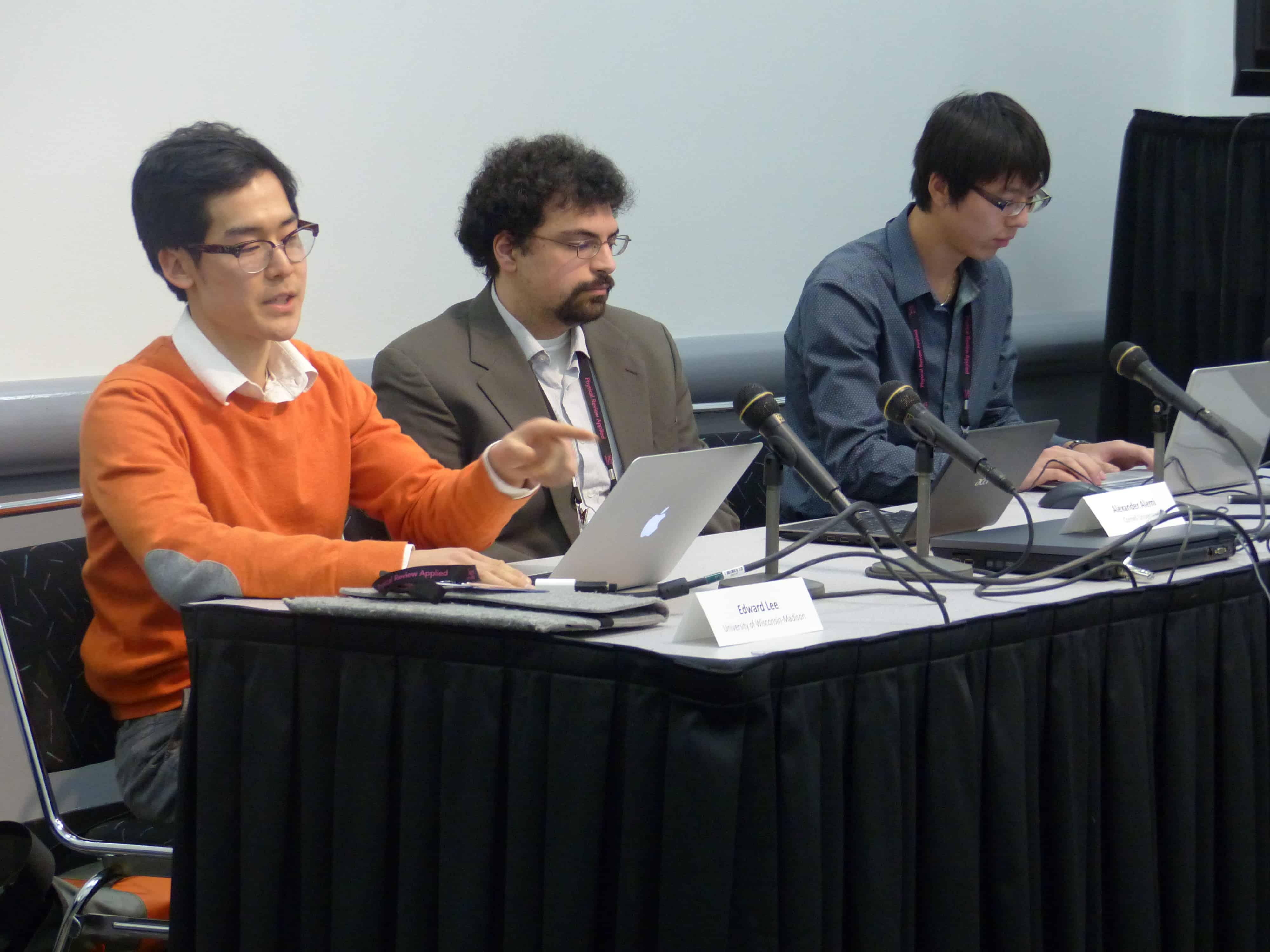
Lee talks about his supreme court model, as Alemi and Zeng listen in.

By Tushna Commissariat at the APS March Meeting in Denver

With the amazing variety of interesting talks at the APS meeting yesterday, I couldn’t possibly write up each and every one – I’d have to take today off, and there’s yet more physics to be learned today! In light of that, below is a short round-up of some of yesterday’s speakers and their work.

STEMming international interest

This session, chaired by the APS director of international affairs Amy Flatten, was a panel discussion of what the US could and should be doing to improve visa policies for visiting scientists and engineers, making it a less onerous task. On the panel were Al Teich from George Washington University, Kathie Bailey from the National Academy of Science (NAS) and, interestingly, Matthew Gillian from the visa office of the US Department of State (DOS). Teich has just finished an in-depth study of the hurdles actually faced by STEM researchers and has been campaigning for simple, inexpensive changes to visa regulations that could remove the hurdles. He also pointed out that globally, the competition for talent is intensifying, so “the US needs to facilitate travel for foreign scientists, not make it more difficult”.

Bailey is in charge of the International Visa Office (IVO) at the NAS, and she encouraged people with visa issues – such as very delayed times – to get in touch with them. She said that out of all the cases reported to her office, 63% of applicants were from China and 15% were from India and that these two countries almost always topped her list. Her take-home message was to encourage all applicants to “apply early” – three to four months before you want to travel – and to be honest throughout the process.

Gillian talked about all the measures that the various US embassies world over have adopted over the past few years to make the application process a bit smoother as well as pointing out that while certain administrative changes could be made, other more far-reaching ones would be legislative and out of the hands of the DOS.

Model systems

Another session looked at a whole host of complex, information-heavy social systems that could be studied and modelled to gain more insights into their working. Edward Lee from the University of Wisconsin-Madison has built a model that can accurately predict the voting outcomes of the US Supreme Court. His model, which looked at nearly 40 years of data from 1946 to 2005, provided some intriguing insights into the voting patterns of the nine judges. For example, it found that nearly 40% of votes were unanimous and that the next 20% of votes were 5:4, representing what Lee referrers to as the “ideological right–left split”. And here is the best bit – Lee’s simple model is based on magnetism, where each judge is a magnetic spin!

Alexander Alemi from Cornell University has set his sights on mining the arXiv server to determine its “structure” in hopes to generate more than just scientific papers from it. Using a free Google tool called “word2vec” he has attempted to visualize a 7-year data-set of texts from arXiv in what he calls 300D space – the project is known as arXplor. The code assigns a particular colour to a word in a subcategory, say “particle physics” or “English” or “name”, and then looks for “non-trivial connections” to other words. Finding such key related words is only the tip of the iceberg as far as Alemi is concerned – he hopes to develop this idea to provide an extremely smart search to scientists, flagging up related research and researchers that may not have appeared in  general search. You can take a look at arXplor here.

Xiaohan Zeng from Northwestern University spoke about the gender differences seen in scientific collaborations across all of the science disciplines. His work found that women are as collaborative as men – something that has been debated in the past – but they seek new collaborations and publish in smaller teams in come cases. He also pointed out that women, unfortunately, publish less than men overall – a factor that needs to be considered. His research also showed that more gender-diverse research groups tended to publish more and that different subsection work differently, either publishing in large groups or as single researchers.

Take a look at my Twitter feed @tushna42 (and the hashtag #apsmarch) to see my live Tweets from all of the above sessions.

Metal nanotubes make for better batteries

Researchers in the US have taken an important step towards understanding exactly how single-walled carbon nanotubes (SWCNTs) boost the performance of lithium-ion batteries. The team found that metallic SWCNTs are able to accommodate more lithium atoms than semiconducting SWCNTs, which could lead to better performance. The research also reveals how semiconducting SWCNTs could be made to take up more lithium. The work could have a broad practical impact because lithium-ion batteries are used in a range of portable electronic devices.

SWCNTs are frequently employed as additives in lithium-ion batteries to improve the lifetime of the battery and its charge and discharge rates. However, SWCNTs come in two electronic flavours – metallic and semiconducting – and it was not clear whether both types were boosting performance or if one flavour was responsible for the bulk of the improvement.

Spacing is important

Now, researchers at Northwestern University and the Argonne National Laboratory in the US have found that a nanotube’s electronic type affects how easily it can accommodate lithium. Their research also reveals that the spacing between nanotubes in a battery also appears to influence the uptake of lithium.

The team, led by Mark Hersam of Northwestern, used a technique called density gradient ultracentrifugation (DGU) to separate metallic and semiconducting SWCNTs. SWCNTs are always produced in a mix of both electronic types – typically 33% metallic and 67% semiconducting.

The researchers dispersed unsorted tubes in water using two surfactants. Because the surfactant wraps around the tubes in a different way depending on their electronic type, the metallic and semiconducting tubes end up with different buoyant densities and can therefore be separated using DGU.

Sorting tubes

After sorting the tubes into metallic and semiconducting batches, the team processed them into freestanding films using vacuum filtration. The films were subsequently used as the cathodes in lithium-ion half-cell batteries with the lithium metal as the anode. The researchers measured properties such as cell capacity, charge-transfer (or Coulomb) efficiency, and battery cycling rates of devices made from each type of tube to determine how easily each one took up lithium. These studies were augmented with theoretical calculations.

Hersam and colleagues found that metallic SWCNTs accommodate lithium much more efficiently than their semiconducting counterparts. Another important discovery was that, if made denser, the semiconducting SWCNT films also begin to take up lithium at levels that are comparable to metallic SWCNTs. This is because lithium is more easily accommodated at the junctions between tubes, says Hersam.

Fundamental questions

“This work answers some fundamental questions concerning how lithium interacts with SWCNTs, which in turn affects the performance of lithium-ion batteries that contain these carbon nanostructures,” he says. “SWCNTs improve battery performance thanks to increased charge and discharge rates, as well as having the added advantage of prolonging battery life.”

The team says that it is now exploring the use of other nanomaterials, such as graphene, as additives or coatings in the electrodes of lithium-ion batteries. “By understanding the attributes and limitations of each class of material, we will be able to rationally design composites that maximize overall battery performance,” says Hersam.

The current work is described in ACS Nano.

Copyright © 2026 by IOP Publishing Ltd and individual contributors