The electronics wonderkid from Ulan Bator

One inspiring example of the power of online technology to break down global barriers to education is the story of Battushig Myanganbayar from Ulan Bator in Mongolia. In 2012, aged just 15, he took a free online course called “Circuits & Electronics” offered by the Massachusetts Institute of Technology (MIT) and surprised many people by achieving a perfect score. Myanganbayar has since moved to the US, where he has started an undergraduate degree at MIT that he hopes it will serve as a launch pad to a fruitful career in science.

In this video, Physics World journalist James Dacey visits MIT to meet Myanganbayar and find out more about this remarkable student. Myanganbayar explains that he wanted to learn about how devices such as the iPhone work but he had no experience of such topics through Mongolian state education. “Every time when I learn new stuff, every time when I’m working on a new project, I think about how it could bring happiness for people in the future and that gave me a lot of energy,” he explains.

As if his personal achievements are not impressive enough, Myanganbayar has also created a series of videos on YouTube in which he explains some of the more difficult concepts from the MOOC in Mongolian, having translated them from the original English versions. In this film, Dacey also asks Myanganbayar about how he is finding the transition to a new culture and how he is settling into university life. Just as he did with the online electronics course, Myanganbayar seems to be taking everything in his stride and he talks about how he has developed a keen interest in photography since arriving at MIT.

The course on circuits and electronics that helped Myanganbayar secure his place at MIT is an example of a new development in education known as massive open online courses, or MOOCs. These short courses are free to anyone in the world with a suitable Internet connection and they typically combine video lectures with assignments such as problem sets and extended projects. The MIT electronics course is offered through an online platform known as edX, which was launched in 2012 thanks to initial investments by MIT and Harvard University. You can watch another short film, “Physics lab for the YouTube generation”, about how the MIT physics department is now starting to incorporate the edX technologies into its undergraduate teaching programme.

“The electronics wonderkid from Ulan Bator” was produced in conjunction with the March 2014 issue of Physics World, which is a special issue about education.

And don’t forget that if you want to read Physics World each month, then you can do so through our digital edition, which can be accessed online or via our Apple and Android apps simply by becoming a member of the Institute of Physics. You can join the Institute as an IOPimember quickly and easily online. This membership includes an annual digital subscription to Physics World.

Five celebrities who are quantum physicists in disguise

Charlotte Church

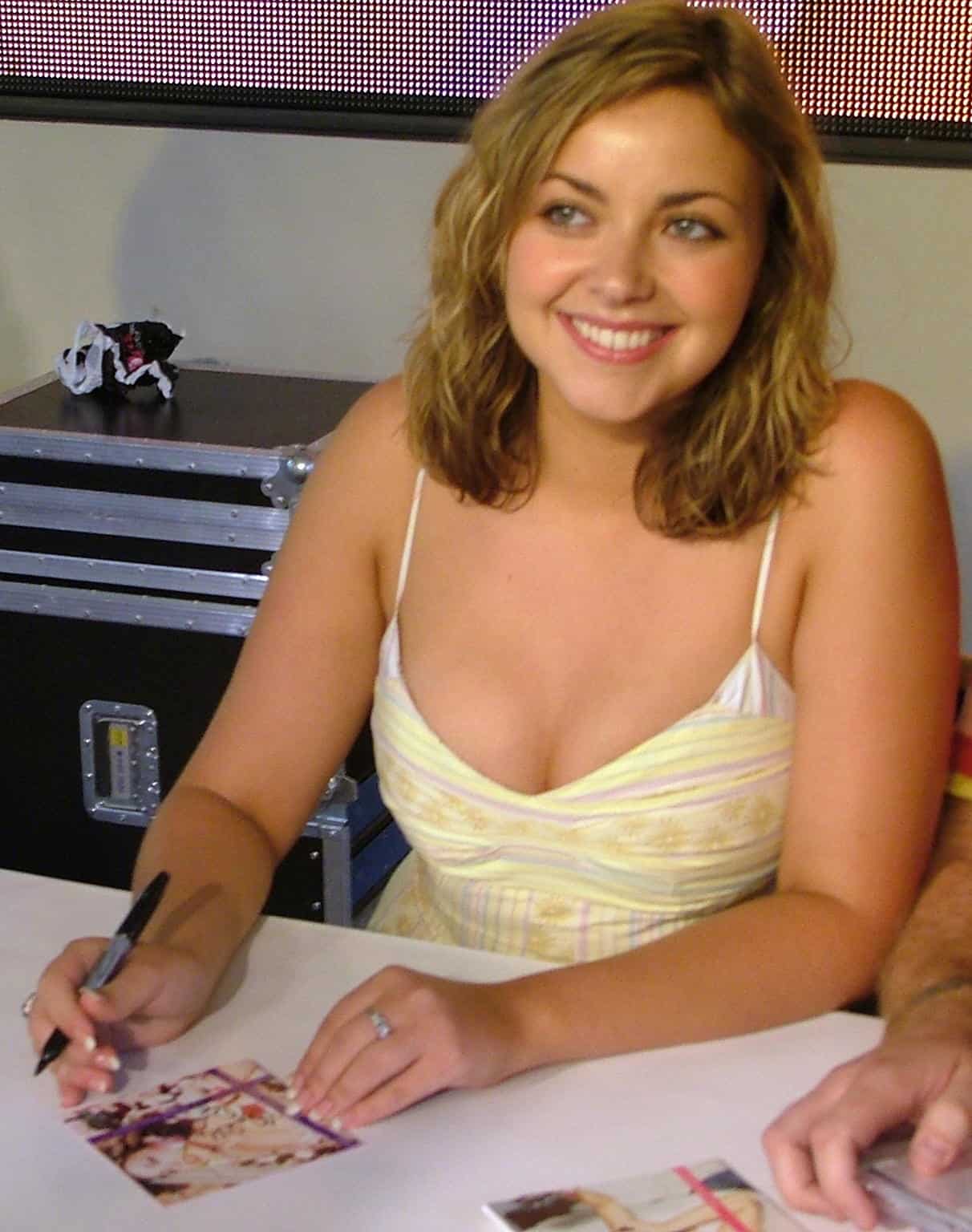
This week the Welsh pop star Charlotte Church (right) has released her latest EP entitled Four. In a conversation with New Scientist, Church explained that the EP’s opening track “Entanglement” was in fact named after the quantum-mechanical phenomenon known affectionately to physicists as “spooky action at a distance”. She has since told BBC Wales that she may well take her interest in science to the next level by studying for a physics degree.

There are of course several really famous people who are more directly connected with physics, having studied the subject in some form before going on to become luminaries in other fields. Examples include the Queen guitar-god Brian May, and arguably the most powerful woman in the world the German chancellor Angela Merkel. But Church is one of a new brigade of celebrities who are discovering the joys of physics after having already reached stardom for other abilities. The armchair psychologist might suggest that learning about the mechanics of the cosmos offers a refreshing alternative to the shallow nature of life that often comes with the celebrity lifestyle, or at least our view of it as presented by the media.

So for “outing yourself” as a physics nerd we salute you Charlotte. Here is a list of celebrities who beneath the surface are in actual fact quantum physicists in disguise.

Will-i-am

1. Will.I.am

The US megastar, perhaps best known as one of the founding members of Black Eyed Peas, has long talked about science and technology with the same passion he talks about music. In 2012 he became the first person to have their song played on Mars, when his single “Reach for the stars” was premiered by the Mars Curiosity rover. Mr I.am has since revealed that he wants to return to university to study computer science because he is fascinated by the ideas of quantum mechanics.

2. Charlotte Church

Within the space of a few years Charlotte Church went from childhood classical music sensation to red-top-newspaper regular. Her successful shift into pop music in the mid-2000s was documented in excessive detail by a British tabloid media obsessed with her personal life and her every night out on the town. But in recent times Church has been re-establishing herself as a serious artist, with the release of a series of EPs with a more alternative rock sound. The latest in this series, Four, is inspired by science, including the tracks “Entanglement” and “Death and mathematics”.

3. Anne Hathaway

Anne Hathaway

The Hollywood actress has been quoted many times expressing her joy of physics. “Any spare time I have, I bury my head in a physics textbook,” she told GQ magazine in an interview in March 2010.  “I’m reading a lot about Einstein. I like theories. I want to understand string theory. I’m dying for someone to explain quarks to me!”  The star of The Devil Wears Prada was at it again in December of that year, telling the Telegraph that she was learning about string theory in her spare time by reading Brian Greene’s The Elegant Universe. Let’s hope it wasn’t just Anne’s thing for 2010 and she has maintained her interest in fundamental science.

Tiger Woods

4. Tiger Woods

Whereas others on this list have been happy to promote their new-found quantum geekery, Tiger Woods’ public outing as a physics fan is probably something he wishes never happened. Cast your mind back to 2009 and the media frenzy that surrounded the revelations of his multiple extramarital affairs. You may remember that in late November of that year, Woods crashed his car into a tree during an incident outside his home. To our great surprise, photographed on the floor of his Cadillac Escalade was a copy of none other than Get a Grip on Physics by veteran UK science writer John Gribbin.

Following this bizarre revelation, the paperback, which was out of print, shot up the Amazon sales charts from number 396,224 to 2268 as the last few hundred copies were snapped up by eager punters. We’re not condoning the circumstances that surrounded this “physics-fan outing” but we certainly approve of your reading choices Tiger.

 5. Mark Everett

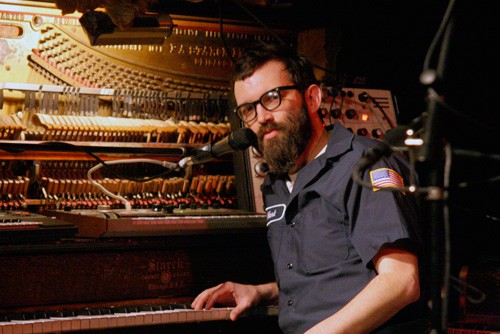
The Eels frontman is perhaps not in the public gaze with the same intensity as some of the other celebs mentioned here, but his connection with quantum physics is perhaps the strongest of them all. That is because Mark Everett is the son of physicist Hugh Everett III, the founder of the “many worlds” interpretation of quantum mechanics.

Mark Everett

A full explanation of Mark’s father’s idea could easily fill an entire book; indeed it has. But the basic idea is that the quantum nature of reality means that multiple outcomes to events can occur simultaneously in different “worlds”. The mindboggling consequence of the logic is that there could be alternative human histories, whereby people evolved to have three heads and/or bright blue skin.

Mark was never close to his father, who died of a heart attack when Mark was still a teenager. But in 2007 the critically acclaimed musician unearthed a hoard of his father’s possessions with the assistance of the investigative journalist Peter Byrne as part of a BBC documentary. Byrne wrote about the experience in a feature for a 2010 feature for Physics World and he also presented this special online lecture for physicsworld.com.

Over to you

This list is by no means exhaustive. So if you can think of any other celebs out there who are quantum physicists in disguise then please let us know. We are looking for you to share the names of famous people who have expressed an interest in physics. Or you may identify celebs whom you believe have an inner physicist waiting to be outed. Either post a comment on this article or let us know on Twitter using the hashtag #quantumcelebs.

Also, if you want to find out more about quantum mechanics and its enduring appeal:

Plutopia forever

Kate Brown does research in places where most of her colleagues prefer not to travel. Her wonderful first book, A Biography of No Place (2005), explored the pre-Second-World-War history of the westernmost borderland of the Soviet Union, which was then home to a mix of ethnic minorities, including Polish, German, Ukrainian and Jewish. For her new book Plutopia, Brown visited two of the world’s most radioactively contaminated regions: the areas near the Hanford Nuclear Reservation in Washington State and the Maiak Combine in the Ural Mountains, once the centres of plutonium production for the American and Soviet nuclear industries. Her primary interest lies in exposing the dark underside of their military-economic activities: the history of environmental pollution and the development of segregated “atomic cities” that provided privilege and better protection for the plants’ permanent staff, but not for the “commoners” who lived and farmed just outside the fence.

Brown, a historian at the University of Maryland, Baltimore County, invented the word “plutopia” to characterize these cities, whose citizens were compensated for their risky work and diminished liberties with an abundantly consumerist lifestyle designed to ensure their loyalty and conformity. The city of Richland, near the Hanford site, began as an outpost of the Manhattan Project, housing workers from the US plutonium-production facility in a racially segregated settlement. After the end of the Second World War, it evolved into a futuristic city that provided its residents – predominantly blue-collar workers – with privileged middle-class salaries and standards of living, including better housing, schools, policing and special healthcare services.

In the early years, Richland’s Soviet counterpart, Ozersk, segregated its permanent civilian workforce from conscripted soldiers and prisoners, but motivated them with the sense of duty and self-sacrifice that came directly out of the wartime effort of saving the country from foreign invasion. Not only the rank-and-file, but also top scientists and generals, exposed themselves to high levels of radiation during work emergencies. By 1960, when the Soviet Union had achieved a modicum of security through nuclear deterrence, the city made a transition to a more peacetime mode and followed Richland in adopting a consumerist strategy. The concept of the “middle class” is not in a literal sense applicable to Soviet society, which did not permit the development of a truly rich, upper class. However, its elites were allowed a lifestyle that reminds Western observers of their own middle classes; just as in Richland, blue-collar workers in Ozersk received salaries and perks that would have been appropriate for white-collar professionals in the rest of the country.

The litany of environmental crimes at both plutopia sites extends over decades. During the early years, in a hurry to produce plutonium, the plants often processed irradiated fuel without letting it cool down long enough for the most radioactive, short-lived isotopes to decay. And when the Maiak Combine’s waste-storage facility overfilled in 1949, Soviet managers did not dare interrupt production. Instead, they decided to release radioactive liquids into the river Techa, contaminating its basin forever. That same year, their American counterparts ordered the so-called “Green Run” – a release of highly radioactive waste into the Columbia River that was, they claimed, a scientific experiment.

The waste facilities at both sites leaked and released isotopes into the air. Originally meant to be temporary, they were constructed upon a wishful assumption that science would eventually figure out how to dispose of radioactive garbage. In 1957 a storage container at Maiak overheated and exploded, producing Chernobyl-scale contamination in the Urals. Soviet authorities ordered the resettlement of villages from the most dangerous area along the Techa, but the resettlement took several years and was not even completed, leaving some inhabitants within the heavily polluted zone. In the US, special interests of land speculators ensured that areas near the Hanford site were irrigated and sold to aspiring farmers who were not informed of the risks.

Plant supervisors – whether appointed by Soviet atomic agencies or by corporate subcontractors such as General Electric or Westinghouse – established similarly styled regimes of corporate loyalty, secrecy, public assurances of safety and intimidation of whistle-blowers. In Plutopia, Brown gives voice to critics of the cover-up practices as she describes her travels to the polluted areas, interviews those who challenged the atomic establishment or were victimized by it, and reports stories of accidents, illnesses and genetic deformities possibly related to radioactive exposure.

Brown is aware that her informants are not always reliable sources. Indeed, many are prone to the sorts of rumours and conspiracy theories that are abundantly generated around all closed sites that place strict control over information. But at the same time, they are also bearers and collectors of unique information that has often been ignored or overlooked. Overall, Brown does a careful and convincing job as a sceptical investigator. She reports personal stories and tries to independently verify and separate reliable from unconfirmed parts, while admitting that many questions remain unresolved.

One such unresolved problem concerns health risks associated with long-term exposure to radiation in relatively low average doses. In the early years, when radiation monitoring was restricted primarily to high-intensity gamma rays, workers at certain stages of plutonium production were often overexposed to other dangers. Having observed deteriorating health and some terminal cases among employees, Soviet doctors coined the term “chronic radiation sickness” and imposed limits on the overall time workers could spend in dangerous areas. Over the years, they treated about 1000 patients suffering from this disease, but their American colleagues have been reluctant to accept the diagnosis.

In the meantime, some medical crimes were also committed. During the late 1960s, US researchers used prisoners in Walla Walla, near the Hanford site, as experimental subjects and exposed their testicles to high doses of radiation. Soviet doctors did not deliberately set up conditions for human experimentation, but they still engaged in what Brown calls “a crime of opportunity” by studying diseases and genetic disorders among villagers who had been left to live along the banks of the radioactive Techa for two generations. For the more dangerous work of cleaning up and containing accidents, both sites used so-called “jumpers” – workers conscripted or hired on a limited-term basis who were subsequently transferred elsewhere and no longer monitored for health effects.

Brown visited contaminated villages on the Techa and talked to their residents, but could not get inside the security zone encircling Maiak and Ozersk. This leaves the Soviet side of her story somewhat lacking in primary accounts, especially for the chapters describing the early years of construction. To fill the gap, she uses narratives from the secondary literature about atomic spies. However, such literature is neither very reliable (when writing about spies, many authors feel entitled to embellish stories beyond reason), nor especially relevant to the topic (unlike Los Alamos, Hanford is not known to have leaked classified information to the Soviet side). At the same time, some very appropriate sources are missing. I was surprised to find no mention of Zhores Medvedev, who blew the cover of secrecy over the 1957 radioactive disaster in the Urals, or of Mikhail Grabovsky’s Plutonievaia Zona (2002) and other quasi-autobiographical books. Vladislav Larin’s Kombinat Maiak (2005), the most detailed existing account of the zone’s ecological problems, is used in a limited way. Insiders – residents of plutopia – could have provided more information, both in writing and in possible interviews.

The winding down of the Cold War left plutopia’s managers worried: what would happen to their cities and employees once plutonium was no longer a top priority for the government? As it turned out, pollution is a profitable business and cleaning it up guarantees an even more perpetual source of spending than the initial production of radioactive materials. Thus, even in the post-Cold-War world, grants continue to pour into the military-industrial complex of the atomic cities, and to the haves rather than the have-nots. In her conclusion, Brown hints cryptically that “We are all citizens of plutopia.” Her core metaphor may indeed be extendable to our increasingly segregated societies, to those living in gated communities or in states heavily guarded against immigration, and for whom the existence of such freedom-restricting boundaries is justified by the sense of entitlement, privilege and hierarchy created by the boundaries themselves.

  • 2013 Oxford University Press £16.88/$27.95hb 416pp 528pp

Cambridge physicists divided over Hawking chair

A new chair designed to lure the world’s brightest minds in cosmology to the University of Cambridge has generated a heated debate among physicists at the institution. Supporters of the Stephen W Hawking Professorship, set up in the Department of Applied Mathematics and Theoretical Physics (DAMTP), say that the $6m (£3.6m) that accompanies the new position will allow the university to compete with the richest US institutions when hiring top scientists. Critics, however, argue that in agreeing to an unusual set of conditions attached to the donation, the university has placed financial gain ahead of meritocracy and has undermined its independence.

The position was made possible by a donation to the university by the US philanthropist Dennis Avery, heir to part of a fortune made in the commercialization of sticky labels, and his wife Sally Wong-Avery. A long-time friend of Hawking, Avery announced that he would fund the new professorship at the astrophysicist’s 70th-birthday celebrations in January 2012. This was the latest in a series of donations to the university by Avery that include support for his alma mater Trinity Hall and a 2006 gift of £1m used to create a new centre for theoretical cosmology within the DAMTP.

“Equal to or greater than the average salary”

The new donation includes $2m that is being given to the university to set up an endowment fund that will provide some of the new professor’s basic stipend. This salary, according to the deeds, must be “equal to or greater than the average salary and benefits received by other professors of similar years of service, or rank” within the DAMTP. The remaining $4m will be controlled by a group of trustees – three senior university officials and Avery’s stepdaughter Natasha Wong. This cash will then be used to top up the salary by as much as the trustees deem necessary to hire or retain the candidate of choice – up to a maximum of 2.6% of the capital (which today would mean about £67,000).

Although there is no fixed salary for the position, it is likely to be in the region of twice the value of the basic salary for a professor at Cambridge. The new chair is also atypical in that it has an expiry date – the professor being appointed initially for seven years, and then for a further possible five or 10 years. After stepping down from the Hawking position, the holder would then be guaranteed a regular professorship until they retire.

Highly charged

Senior members of the university had begun negotiating the terms of the deal with Avery before he died unexpectedly in the summer of 2012. Faced with the stark choice of accepting the money with all of the strings attached or rejecting what would have been a welcome boost to departmental coffers, academics discussed the issue in a highly charged meeting of the university’s governing Regent House on 14 January.

The Cambridge University Reporter recorded DAMTP biophysicist Raymond Goldstein as saying at the meeting that he was struck by the “financial, legal and semantic gymnastics” used in the deeds to justify partitioning the $6m, which, he argued, was designed to “circumvent the normal salary structures of the university to guarantee a specific and outsized benefit to the chair holder”. Goldstein added that he was “almost speechless” at the requirement that the Hawking professor’s basic salary be at least as great as that of their colleagues, pointing out that this could grant the professor a pay rise whenever another member of the department earned an increase. “This cannot be fair,” he told those at the meeting. “I thought we strove to have a meritocracy in this university.”

Indignity of reassessment

Another member of the DAMTP, fluid-dynamics expert Adriana Pesci, argued at the meeting that the new chair could threaten departmental funding if several former holders were to co-exist within the department. She also claimed that the need to assess the Hawking professor after seven years represented an “indignity” for that person, and warned that “this could become the precedent necessary to justify instituting post-tenure review for everyone”.

In the end, the numerous concerns voiced by critics were not quite enough to halt the plans. On 25 February the university announced that 746 members of Regent House had voted in favour of the proposals and 606 against. The professorship then came into effect on 1 March. However, the trust’s rules seem to imply that no-one will be appointed while Hawking remains director of research at the DAMTP. Hawking will be supported by the trust’s core endowment, although it appears he will not receive any supplementary salary from the donation. In an open letter he wrote in February, Hawking urged fellow academics to vote in favour of the professorship, adding that he intends to continue his DAMPT directorship “under the same conditions as currently”.

Split in two

Speaking to Physics World, DAMTP head Peter Haynes acknowledges that the terms of the donation “were not straightforward”, but he believes that they can nevertheless be made to work “in a way that doesn’t go outside the spirit of the regulations of the university”. He says that the interest generated on the $2m will not be enough to cover the professor’s basic stipend and explains that the shortfall could be made up by recruiting one fewer lecturer. He remains confident, however, that the professorship will not drain other resources from the department. He admits that he does not “totally understand” why the fund was split into two, but decided that nonetheless the donation was a good thing. “One lump sum would have been simplest,” he says, “but you have to decide whether the enormous opportunities offered by the donation outweigh the potential complications.”

Did dark matter help kill off the dinosaurs?

Two theoretical physicists in the US have made a surprising connection between dinosaur extinction and dark matter. Lisa Randall and Matthew Reece of Harvard University believe that some of this mysterious invisible matter – which makes up 85% of all matter in the universe – could exist in a special form that affects the rate at which comets strike our planet. A comet crashing into Earth about 66 million years ago is one possible reason why these giant creatures died off.

Comets have smashed into Earth throughout its history, creating huge craters and possibly causing mass extinctions, such as that which befell the dinosaurs. Many of these comets come from the Oort cloud, which is a huge halo of small icy objects that surrounds the Sun, out to a distance of about one light year. But rather than being entirely random, there is some evidence that the frequency of comet impacts oscillates on a timescale of about 35 million years.

Although this oscillation is not certain, if it is true, there could be something on that timescale that affects the rate at which comets from the Oort cloud are sent towards Earth. Two possible explanations have been proposed so far. One – dubbed the “nemesis hypothesis” – involves the gravitational pull of an as-yet-undiscovered distant companion star to the Sun. The other involves the oscillating pull of the dense galactic disc as the solar system crosses and re-crosses the plane of the Milky Way.

Wrong kind of dark matter

In their new study, Randall and Reece have focused on this second hypothesis, and set about rectifying some of its known flaws. One shortcoming is that the density gradient of normal matter in the galactic disc is too small to have much of an effect on the Oort cloud. As dark matter accounts for about 85% of all matter in the universe, one might think a disc packed with lots of dark matter could resolve the problem. Unfortunately, both theory and observations suggest that dark matter forms a near-spherical halo around galaxies like the Milky Way, rather than being concentrated in the disc.

The problem for anyone suggesting that dark matter affects the rate at which Oort-cloud comets hit the Earth is that the most likely candidates for dark matter – known as weakly interacting massive particles (or WIMPs) – only interact via gravity and the weak force. These interactions are not strong enough for a disc to form, which normally requires strong electromagnetic interactions between atoms, molecules, dust and other conventional types of matter.

However, last year Randall and Reece – along with JiJi Fan and Andrey Katz – proposed a different type of dark matter called partially interacting dark matter (PIDM). Such dark-matter particles interact via an electromagnetic-like interaction, perhaps involving the emission of “dark photons”. The four physicists argued that a small fraction of dark matter could be PIDM without much affecting the known dark-matter distribution of galaxies. Furthermore, they argued that the interactions between PIDM particles could be strong enough to form a dark galactic disc that shadows the visible disc (see “Do dark-matter discs envelop galaxies?”).

Ample interacting dark matter

By calculating the effects that such a dark disc could have on the shapes of galaxies and how galaxies interact with each other, Randall and colleagues reckon that 5% or less of all dark matter in a galaxy could be PIDM – roughly on a par with the amount of conventional matter in our galaxy. This finding has now prompted Randall and Reece to calculate the effects of this dark disc on the Oort cloud. They conclude that their dark-disc scenario for an oscillating comet cratering rate is about three times more likely that a simple constant cratering rate, which they describe as a “mild preference”. The study suggests that the surface density of the Milky Way’s dark disc is about 10 solar masses per square parsec and has a thickness of about 10 parsecs. By comparison, astronomers believe that the density of normal matter in the disc of the Milky Way is about seven solar masses per square parsec.

Randall and Reece point out that their dark disc is large enough that it should be detectable by the European Space Agency’s Gaia space mission, which is currently studying the Milky Way in unprecedented detail. The research is described in a preprint on arXiv.

  • In the video below, Luke Davies of the University of Bristol explains why physicists believe that the universe is full of dark matter.

The cost of stereotypes

When a 2012 study showed that scientists subconsciously favour male students over females when assessing their employability as early-career researchers, it generated plenty of debate – not least among women, who were, according to the study, just as likely to be biased as the men were.

Some of these discussions got rather overheated, but one cogent criticism of the study did emerge.  Roughly, it was this: might the scientists’ preference for men over equally well-qualified women be a rational response to the fact that, because of various barriers, women in science often need to be better than their male counterparts in order to have an equal chance of success?

The question was an awkward one, since it implied that women in science could be caught in a vicious circle, with the negative effects of bias in the workplace making it “rational” to be biased in hiring (and, in turn, making such workplace bias more likely to persist).  However, a new study appears to rule out this argument by finding similar patterns of hiring bias against women even when the “job” is an arithmetical task that, on average, women and men perform equally well.

In their study, Ernesto Reuben, Paola Sapienza and Luigi Zingales examined the effects of gender stereotypes in an artificial market where male and female “employers” were presented with male–female pairs of “candidates” and asked who they would hire to complete an arithmetical task.  When employers had no information about the candidates other than their appearance, they chose the man 66% of the time (out of 507 male–female pairs).  When, in a second experiment, employers also heard the candidates’ self-reported performance on a previous, similar arithmetical task, they still picked the man 66% of the time – even though in around half of the 160 male–female pairs, the woman had outscored the man. When the researchers themselves informed employers about candidates’ past performance, the bias was smaller, but employers still hired the man 57% of the time (out of 265 pairs).

The researchers also showed that in some circumstances, employers’ biased hiring decisions correlated with their pre-existing negative views of women and mathematics, as measured by an Implicit Association Test (IAT).  Male and female employers who held stereotypically negative views about women’s mathematical abilities (IAT scores > 0) were more likely to predict that male candidates would outperform females on the second task if they were given (a) no information or (b) only self-reported information about the candidates’ past performance.

This correlation vanished when past-performance information came from the researchers themselves, suggesting that “stereotypes did not seem to affect [employers’ decisions] when the information was provided by a neutral third party”. However, even with good, neutral information, employers still chose female candidates less often than male ones: in one sub-experiment involving 265 hiring decisions, employers chose a lower-performing male over a higher-performing female a whopping 82.7% of the time.

Based on these results, the researchers concluded that “stereotypes do indeed affect the demand for women in mathematics-related tasks, regardless of quality considerations”.

Graphene oxide could make textiles smarter

A new type of strong and flexible yarn with practical electronic properties has been made by researchers in Australia and Ireland. Spun from graphene oxide, the yarn has the highest capacitance ever seen in such graphene-based fibres. The researchers believe that the yarn could find use in “smart” textiles.

Smart textiles are those that incorporate electronic components such as displays, sensors and actuators. While still in their infancy, they could find use in a wide range of applications, from clothing that monitors the wearer’s environment for dangerous chemicals, to furnishings that alter their appearance in response to ambient light levels or changes in temperature.

In addition to being strong, flexible and lightweight, yarns and fibres used in smart textiles must have the right electronic properties. Materials with large capacitance are particularly useful because they can be used to create “supercapacitors” that store electrical energy within the textile. Although researchers have made significant progress by developing yarns from carbon nanotubes and graphene, most of these fibres are still far from ideal. In particular, the best capacitance values reported to date are about 265 F/g, which is less than half that of the theoretical maximum for graphene-based materials.

Unrivalled electrochemical capacitance

Now, Gordon Wallace of the University of Wollongong in Australia and colleagues have made yarns and fibres from graphene oxide and reduced graphene oxide that are not only highly flexible and lightweight, but that also have unrivalled values of electrochemical capacitance as high as 410 F/g.

“Our structure is a first for graphene oxide,” claims team member Seyed Hamed Aboutalebi. “Until now, 3D architectures of graphene-based capacitors were mainly limited to graphene ‘papers’ and micro-supercapacitors, which although interesting in their own right, are not really practical when it comes to making intelligent fabric.”

The researchers made their yarns using a new wet-spinning technique. This allowed them to produce unlimited lengths of highly porous yet dense, mechanically robust and flexible graphene yarns from liquid crystals of very large graphene-oxide sheets. Graphene oxide is a sheet of carbon just one atom thick that is covered with hydroxyl groups.

Supercapacitor building blocks

The researchers believe that the yarns could be used as the building blocks for supercapacitors in fully functioning smart textiles. The yarns have a Young’s modulus that is greater than 29 GPa, which makes them as strong as yarns made from natural fibres such as hemp. They also have a high electrical conductivity of about 2500 S/m and a very large surface area – about 2600 m2/g for graphene oxide and 2210 m2/g for reduced graphene oxide. In a practical two-electrode configuration, capacitance values of 410 F/g per graphene-oxide electrode can be achieved. Aboutalebi points out that this high capacitance occurs because the ions can travel fairly fast and without resistance in the fibres.

“The yarns might be ideal in powerful next-generation multifunctional renewable and wearable energy-storage systems,” he says. “Our method of making these yarns is simple and can be scaled up to produce mass quantities of the structures.”

The team, which includes researchers from Dublin City University and the University of Sydney, says that it is now busy working on making easily processed self-assembled, self-oriented and molecularly ordered graphene-based hybrids for use in intelligent fabrics.

The yarns are described in ACS Nano.

New ways to teach and learn physics

By Matin Durrani

If there’s one thing that unites pretty much all of us who like physics, it’s that we’ve all sat through physics classes at some point in our lives. We all know teachers and lecturers who’ve been brilliant and inspired us, but equally we’ve all sat through classes that have quite frankly bored us out of our pants.
PWMar14-cover-200

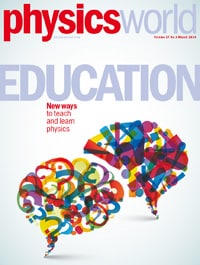
In the March 2014 issue of Physics World a PDF copy of which you can download free of charge – we offer a snapshot of just some of the many innovative ideas that exist for learning and teaching physics. It’s not an exhaustive selection, but includes topics that we felt were interesting or novel.

So, download the issue to find out about the huge growth of “massive open online courses”, or MOOCs, in which universities make their lectures freely available in video form on the Internet, and discover Philip Moriarty’s behind-the-scenes experiences as one of the stars of the Sixty Symbols series of YouTube science videos.

Elsewhere, check out the great feature by BBC science presenter Fran Scott, who reveals her four golden rules for engaging children with science, and discover the importance of helping children develop computer-programming skills from an early age. Don’t miss out either on Eugenia Etkina and Gorazd Planinšič’s article on the implications for teachers of the fact that learning involves physical changes in the brain.

(more…)

Getting a measure of Brazilian research

If you’ve been keeping an eye on this blog, you’ll remember that I spent a week in Brazil last November gathering material for an upcoming Physics World Special Report, which will examine the challenges and opportunities facing physicists in the world’s fifth largest country. I travelled to São Paulo, São José dos Campos and Rio de Janeiro, visiting everywhere from the first overseas offshoot of the International Centre for Theoretical Physics to the Brazilian National Observatory, where Brazilian research pretty much began.

I’ve just been putting the finishing touches to that report, which includes news, features and an exclusive interview with the Brazilian science minister Marco Antonio Raupp, who is a physicist by training. Brazil’s investment in science has more than quadrupled over the last decade and in the interview Raupp outlines his priorities for the Brazilian research community. Stay tuned for the Physics World Special Report, which we’ll make available via this website from next month. (One rather flippant question we asked Raupp is who he thinks will win this year’s FIFA World Cup taking place across Brazil this summer – we didn’t have room to fit his answer into the report, but I can exclusively reveal on this blog that the Brazilian science minister has got his money on the home nation. Well, he would say that, wouldn’t he?)

Meanwhile, I received an e-mail over the weekend from my IOP Publishing colleague Susan Curtis, who’s in Brazil right now to kick off another project that will highlight some of the most exciting scientific research to emerge from the country. This time round, IOP Publishing is working in partnership with the Brazilian Materials Research Society to produce a Science Impact report focusing on materials research in areas as diverse as electronics, energy, and biology and medicine. It follows IOP Publishing’s first Science Impact report on physics in Brazil, which was published last year in partnership with the Brazilian Physical Society.

During the week, Susan will be meeting some of Brazil’s leading materials scientists to get their take on the most interesting work currently coming out of the country. Before the serious work started, though, she took the opportunity of a free Sunday afternoon in São Carlos – some 200 km north-west of São Paulo – to visit the city’s ecological park. The park boasts some exotic creatures, including brightly coloured macaws, jaguars and pumas, spectacled bears, and the rather magnificent llama picture above.

Bananaman, fusion boy, an astronaut and more

By James Dacey

The Red Folder is bulging this week with some weird and wonderful physics stories from around the Web. Here is a round-up of some of the best we have stumbled across.

One of the more eye-catching articles this week included the surreal image of Stephen Hawking posing for a picture with a bunch of men all dressed as Bananaman. In case you’re not familiar with this brilliant character, Bananaman is a comedy super hero created in the 1980s by British cartoonists who valued the importance of nutrition. When Eric Wimp – an ordinary British schoolboy – eats a banana he turns into our hero, a fully grown man in a blue and yellow suit with special powers to rival both Batman and Superman. Anyway, I digress. According to the Telegraph, the 10 besuited chaps in question were on a stag do in Cambridge. They were lost (perhaps a few too many banana liqueurs?) when they turned a corner and spotted the world-famous cosmologist getting out of a car. The result was a group shot with far more a-peel than any of those self-indulgent Oscars selfies that have been doing the rounds this week. Please accept my apologies for that bad pun.

(more…)

Copyright © 2026 by IOP Publishing Ltd and individual contributors