

Web life: Space Politics

So what is this site about?

As all space scientists know, getting astronauts to the International Space Station or robots to another planet requires more than just technical know-how. It also requires money. And if you want money, it is a truth universally acknowledged that, sooner or later, you’re going to need to deal with politics. This is where the Space Politics blog comes in. Under the tagline “Because sometimes, the most important orbit is the Beltway” – a reference to the ring road that encircles Washington, DC – it offers regularly updated, detailed information about funding, changes to mission timetables and other workings of government that relate to space exploration.

Who is behind it?

Space Politics is the work of Jeff Foust, a journalist and aerospace analyst based in Maryland, US. This isn’t his only project, though: in addition he writes the blog NewSpace Journal, which is dedicated to the space industry’s growing entrepreneurial wing, and edits a weekly online magazine called The Space Review. Oh yes, and he also freelances for other people’s space-related publications and works as an aerospace analyst at a management-consultancy firm. All three of Foust’s space websites are updated with remarkable regularity, and somehow, he still finds time to write a blog about his favourite baseball team, the Washington Nationals. Impressive.

Who is it aimed at?

Although Foust writes clearly in plain English, without too much jargon, you will need to be reasonably familiar with the ins and outs of House and Senate space sub-committees, Congressional Budget Office reports and NASA review panels to understand the importance of the issues that Space Politics covers. And as you may have guessed already, the blog is very US-centric. You won’t find much detailed information here about the internal workings of the European Space Agency, JAXA or the Russian, Indian and Chinese space programmes, although Foust does occasionally report on their activities as they relate to America’s.

Why should I visit?

Funding policy is one of those topics that can seem really boring – right up to the point when it starts to affect something you care about, whereupon it suddenly becomes very interesting. (Kind of like insurance and pensions, then.) Not many people have the patience or the interest to trawl through the minutiae of who said what in yesterday’s meeting of this or that minor committee, but as Foust’s blog demonstrates, this stuff can be hugely important. A good example comes from a post in November 2013 about a report by the planetary science sub &nsash; committee of the NASA Advisory Council. Among other things, this report revealed that budgetary constraints may force NASA to choose between two of its highest-profile missions: the Saturn – circling Cassini and the Mars-roving Curiosity. Ouch.

Can you give me a sample quote?

While attending a conference of the American Institute of Aeronautics and Astronautics in early autumn 2013, Foust wrote about the effects of continued budget uncertainty on the US space community. “‘How many of you know what your budget is going to be next year? Raise your hand,’ said Larry James, a retired Air Force lieutenant general and the new deputy director of JPL… As you might expect, effectively no-one in the audience of several hundred space professionals did. That uncertainty about civil and military space budgets as fiscal year 2014 approaches was a recurring theme at the conference yesterday, where government and industry officials emphasized the ‘changing landscape’ of the industry and the need for innovation. With NASA expected to at least start the fiscal year next month under a continuing resolution (CR), one that could potentially be extended for the full year (just yesterday the chairman of the House Appropriations Committee introduced a CR that runs through 15 December), plus the prospects of another round of across-the-board cuts triggered by sequestration, few at the conference expressed a lot of optimism about the agency’s fiscal situation.”
Nearby brown dwarf has partly cloudy skies

The weather forecast for a brown dwarf located just 6.6 light-years from Earth includes periods of patchy clouds, say astronomers in Germany, the UK and France. The team is the first to glimpse such features on a brown dwarf. The discovery lends insight into weather on “hot Jupiters” – giant planets that orbit so close to their star that they are lost in its glare, making them difficult to observe.

A brown dwarf is a failed star. Born with less than 8% of the Sun’s mass, it never gets hot enough to sustain the same nuclear reactions that power main-sequence stars such as the Sun. Instead, a young brown dwarf glows red from the heat of its formation and also from short-lived nuclear reactions, then it cools and fades. Brown dwarfs are about as large as Jupiter but more massive and also much hotter, so they serve as surrogates for studying hot Jupiters. Moreover, like the Earth and Jupiter, many brown dwarfs have clouds. As a brown dwarf rotates, its clouds come into and out of view, which causes the light observable from it to vary.

Cooler than the Sun

Brown dwarfs are much cooler than the Sun and therefore shine most profusely at infrared wavelengths. On 10 February 2013 Kevin Luhman of Pennsylvania State University was examining images from NASA’s Wide-field Infrared Survey Explorer (WISE) spacecraft when he discovered the nearest brown dwarf to Earth. It is so close that only two star systems are nearer: the triple-star Alpha Centauri, which is 4.4 light-years away; and Barnard’s Star, which is 6.0 light-years distant. Luhman then found that our new neighbour – named “Luhman 16” – is actually a couple: two brown dwarfs orbiting each other.

“Until now, all brown dwarfs were too far away and too faint,” says Ian Crossfield of the Max Planck Institute for Astronomy in Heidelberg, who led the team that has taken images of clouds on one of these brown dwarfs. “We just couldn’t study them in enough detail to resolve features on their surfaces.”

Because of its proximity, Luhman 16 boasts the brightest brown dwarfs that are known. They are about twice as far apart as Mars is from the Sun and orbit each other roughly every quarter century. Although similar in temperature – Luhman 16 A, the brighter one, is at 1500 K, whereas Luhman 16 B is at 1450 K – their atmospheres differ. Luhman 16 A’s light does not fluctuate, suggesting a featureless atmosphere. So Crossfield and colleagues focused their attention on Luhman 16 B, whose light does vary. Because the brown dwarf is in the southern constellation Vela, the researchers observed its near-infrared spectrum with the Very Large Telescope in Chile.

Clouds in a spin

The astronomers used a technique called Doppler imaging, which exploits a star’s spin to map the distribution of bright and dark areas. As a star turns, one edge moves towards us and light from this edge is blueshifted. Meanwhile, the opposite edge moves away and light from this part of the star is redshifted. If there is a dark cloud on the brown dwarf, it will block some of this light and an astronomer will see a dimming of blueshifted light when the cloud is at the edge moving towards us, and a dimming of redshifted light when the cloud is moving away from us. This effect is greatest at the star’s equator and does not occur at the poles, so the technique can also provide information about the latitudes of the clouds.

“For the first time we were able to see features geographically localized in 2D across the globe of the brown dwarf,” Crossfield says. “We were able to see patchy features all across the surface, which are consistent with partial cloud cover.” He says that bright areas probably indicate clear regions where we see deeper, into hotter layers of the atmosphere that radiate more energy; dark areas are clouds that block the radiation.

Rock and molten iron

These clouds have an exotic composition, however: they do not contain water. “They are made of silicate rocks and molten-iron droplets kept aloft by vigorous atmospheric motions,” Crossfield says, because the brown dwarf is much hotter than the Earth.

Luhman 16 B spins fast, once every 4 hours and 52 min – twice as quickly as Jupiter, the solar system’s fastest spinning planet, which rotates every 9 hours and 55 min. Jupiter’s spin creates bands in its atmosphere, but the current observations do not indicate whether Luhman 16 B exhibits the same phenomenon.

The brown dwarf’s namesake praises the new work. “It’s a really neat result,” says Luhman. “It’s a nice illustration of the power of having an object that close to the Sun.” He recalls how he detected the brown dwarf a year ago. “It was a startling discovery,” he says. “It was surprising to find something that close to us that hadn’t already been found.” No-one had unearthed such a nearby star for almost a century: astronomers spotted the faintest star in the Alpha Centauri system in 1915 and Barnard’s Star in 1916.

Crossfield and colleagues monitored Luhman 16 B for only one rotation period, but later this year they will watch it for a longer time, hoping to produce what Crossfield calls “the first weather movies of an object outside the solar system”.

The researchers report their work online today in Nature.

The designated survivor

It is not unusual for physicists to find themselves leading a country. Angela Merkel, who studied physics at the University of Leipzig from 1973 to 1978, has been Germany’s chancellor since 2005, while in 2010 Japan elected former physicist Naoto Kan as its prime minister – a position he held for just over a year.

Yet while the nuclear physicist and current US energy secretary Ernest Moniz may be 14th in the US presidential line of succession, if something really terrible had happened yesterday, he may have found himself leading the world’s biggest economy.

That is because he was appointed “designated survivor” while US president Barack Obama delivered his State of the Union address.

(more…)

Accelerating science and technology at the Cockcroft Institute

Particle accelerators are used by just about every branch of science and technology these days: from chemists studying molecules using X-ray free-electron lasers to doctors treating eye cancer using beams of protons. And, of course, there are the particle physicists, who recently used the Large Hadron Collider at CERN to find the Higgs boson.

All of these applications, and many more, are the focus of the UK’s Cockcroft Institute of Accelerator Science and Technology, which is located at Daresbury Laboratory in the Cheshire countryside, half way between Liverpool and Manchester.

In this video, Cockcroft Institute co-founder and its first director, John Dainton, explains why researchers in the north of England banded together to create the facility, which first opened its doors in 2006.

The video also features the head of Daresbury Laboratory, Susan Smith, who talks about how the institute benefits from being located at Sci-Tech Daresbury – a national science and innovation campus that includes the lab plus more than 120 hi-tech companies.

Dainton and Smith also talk about the Compact Linear Accelerator for Research and Applications (CLARA), which will provide a test bed for developing the technology for free-electron lasers. The ultimate goal of CLARA is to support the creation of a national free-electron-laser facility in the UK.

Earlier this year, Dainton recorded a 100 Second Science video that answers the question “Why is fundamental science important?“.

  • For more information on free-electron lasers and to find out what is coming up in the field over the next few years, check out the recent special issue on the topic published by J. Phys. B. All articles are free to read until 28 February 2014

Classroom seismometers could monitor earthquakes worldwide

A novel design for an educational seismometer is shaking up physics lessons in New Zealand and the US. Based on a vertical, slinky-like coiled-spring design, the “TC1 seismometer” is both cheap and robust, making it an ideal tool for teaching students of all ages about the physics of the Earth.

“Seismometers for Schools” projects are a great way to teach a wide range of scientific topics. By examining or even assembling a seismometer in the classroom, students benefit from hands-on experience as they learn about the geophysics behind earthquakes and the sensors that detect them. While such educational programmes can be found running in many countries – including the UK, Australia, Europe and the US – they have traditionally been somewhat expensive, with demonstration seismometers ranging in cost from around £450 to £1000.

Cheap, cheerful and sturdy

To address this issue, Ted Channel of Boise State University has come up with an alternative. Wrapped in a transparent case – allowing students to freely examine its inner workings – the TC1 is a vertical seismometer with an elegantly simple design and a cost of only $350 (around £210), making it significantly cheaper than its counterparts.

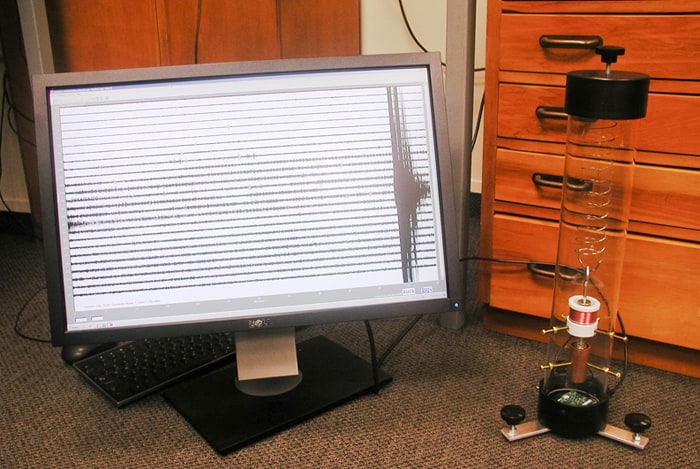
The TC1 works using a coiled spring, which suspends a small neodymium magnet. This magnet hangs within a coil of copper wire, which is attached to an outside case. When ground movement shakes the seismometer, the hanging magnet acts as a harmonic oscillator, remaining still in relation to the motion of the copper coil, in which a measureable current is induced. To isolate ground movements from the ringing of the oscillator, a second magnet, suspended beneath the first, damps the system by inducing eddy currents in a surrounding cooper tube. The resulting signal is then translated and filtered by a microcontroller, whose USB output can be plugged directly into a computer.

Photo showing the TC1 seismometer and the output signal seen on the screen

Kasper van Wijk – the physicist who brought the TC1 project from Boise State to the University of Auckland – explains that the design is ultimately a balance between data quality and practicality. “We needed something that was bulletproof,” he says, “that could resist kids kicking it and jumping [around] it.” The vertical design of the TC1 is key in acting to keep the device in equilibrium; traditional, horizontal solutions, while more precise, rely on a precise internal balance that is less resistant to being jostled in a classroom setting.

Global records

Of course, professional seismologists might dismiss the TC1 as being nothing more than a toy; a notion seemingly supported by the device’s harmonic frequency of around 1 Hz, at which many seismic signals are absorbed by the Earth. Despite this, however, the TC1 is still capable of detecting earthquakes of magnitudes greater than six globally, and local events of magnitudes greater than four.

To this date, the project has placed seismometers in around 50 schools in New Zealand, America and Australia. These seismic stations are gathered in an online network, called the Z-NET. Ten more stations in New Zealand are also planned, following a grant from the Society of Exploration Geophysicists. At Boise State – and possibly soon in Auckland – the TC1s have also been used as the foundation of a service learning programme. In this, second-year university students assemble TC1s in their classes, before taking the finished seismometers to local schools to teach the younger students, thereby cementing their own understanding of the physical principles behind the device.

Open-source spirit

The TC1 is suitable for kids of all ages, “from 5 to 80”, jokes Van Wijk, and – being based on principles of open hardware and software – the designs are freely available for any individual or school to construct their own. The researchers even report having received 3D-printing templates, made by an enthusiast, which could be used to produce the TC1’s component parts. Certainly, interest in the novel design is growing, with Van Wijk reporting that the Australian school seismometer programme has recently purchased 10 TC1s for use alongside the research-grade devices that they have traditionally placed in their schools.

Paul Denton, who leads the School Seismology Project at the British Geology Survey (BGS), says that he is “very impressed by the simplicity and cheapness of [the TC1] design”. Following the TC1’s open-source spirit, the BGS is now developing its own version, in collaboration with MindsetsOnline, a UK not-for-profit company that specializes in educational toys and learning aides. The aim is to make a simpler and cheaper model, Denton says, adding that “the key components are still a mini-slinky in a Perspex tube, but we have coupled this with a new 16-bit USB digitizer that can work with either a PC running free data-logging software, or now with code running on Raspberry Pi systems, allowing cheap seismology to provide a real-world link for computer science projects”.

The design of the TC1 seismometer is published in The Physics Teacher.

Energy can be teleported over long distances, say physicists

Energy could be moved over long distances by quantum teleportation, according to calculations done by a team of physicists in Japan. While energy teleportation is not a new concept, it had been thought that the amount of energy that could be sent dropped rapidly beyond short distances. The new proposal removes this shortcoming, allowing energy to be transferred much farther. The team believes that the theory could be verified in a semiconductor device and that similar energy teleportation could have occurred in the early universe.

Quantum teleportation is a remarkable idea that was first proposed by IBM’s Charles Bennett and colleagues in 1992. It involves two parties, usually called Alice and Bob, who “teleport” a quantum state between each other. The scheme allows Alice to send information about an unknown quantum state to Bob, who is then able to construct a perfect copy of that state. To do so, the pair exchange classical information while sharing particles that are entangled quantum mechanically with each other. Physicists have since been able to teleport atomic states over distances of several metres and photon states over distances greater than 100 km.

While this formulation of quantum teleportation does not provide a means to exchange energy, in 2008 Masahiro Hotta of Tohoku University unveiled a theory explaining how energy could be teleported. In Hotta’s formulation, Alice sends Bob the information that he needs to extract energy from the vacuum. This extraction is possible because in quantum field theory the vacuum is not devoid of energy but contains virtual particles that continually bubble-up and then vanish.

Entangled vacuum

Hotta’s idea arises from the fact that nearby points in the quantum vacuum are entangled. This means that if Alice and Bob are close to each other, then Alice should be able to make a measurement of her local field and use the result of her measurement to gain information about Bob’s local field. If Alice then passes this information to Bob through a classical channel (for example by calling him on the telephone), Bob can use the information to devise a strategy for extracting energy from his local field. This energy will always be less than the energy Alice expended in making her initial measurement. Thermodynamically, this means that Alice can “teleport” energy to Bob in the form of the information he needs to extract energy from the quantum vacuum.

Unfortunately, the degree of entanglement between Alice’s and Bob’s local fields decays rapidly with distance. Indeed, the fraction of Alice’s energy input that Bob can recover is inversely proportional to the sixth power of their separation. As a result, the exchange of significant amounts of energy across meaningful distances would be extremely difficult in practice.

In this latest work, Hotta and colleagues at Tohoku University propose a way round this limitation by using squeezed vacuum states. These states are identical to the vacuum state everywhere except in the region between Alice and Bob, where the energy density is much higher. The result is that entanglement can be maintained over much larger distances. Indeed, if an appropriate squeezed state is chosen, Alice and Bob’s local quantum states can remain entangled across an arbitrarily large distance.

Quantum Hall states

The researchers propose that such squeezed states could be generated in the laboratory by suddenly expanding the length of the edge path travelled by electrons in a quantum Hall state. The quantum Hall effect is seen in thin semiconductors – essentially 2D sheets – that are exposed to a strong magnetic field. Electrons in a quantum Hall state flow unimpeded in one direction along the edge of the semiconductor and provide a “quantum correlation channel” in which entanglement occurs. Hotta says he is currently working with team member Go Yusa to create such a system in the lab.

Hotta and colleagues also point out that squeezed states might have occurred early in the history of the universe when the cosmos underwent a brief period of rapid expansion, dubbed inflation. Quantum information expert Renato Renner of ETH Zurich is open to the idea that such a squeezed state might have been created during cosmological inflation. He is not convinced, however, that the phenomenon could be applied to the development of quantum electronic devices. He points out that energy must be expended to create squeezed states, which could make practical applications difficult to achieve.

The work is described in Physical Review A and a preprint is available on arXiv.

Spacecraft duets, suprise supernovae, the dark side of physics and more

http://youtu.be/7l8cm52qUDE

By Tushna Commissariat

While you would not actually be able to hear the uplifting notes of the music in the vast emptiness of space, a newly composed string and piano orchestral piece has unexpected ties to the cosmos. That’s because it is based on 36 years’ worth of data from NASA’s Voyager 1 and 2 spacecraft. Domenico Vicinanza, a trained musician with a PhD in physics who works at GÉANT, a European data-network company, says that he “wanted to compose a musical piece celebrating Voyager 1 and 2 together, so I used the same measurements (proton counts from the cosmic-ray detector over the last 37 years) from both spacecrafts, at the exactly same point in time, but at several billions of kilometres of distance [of] one from the other”. The result of this “data sonification” is a rather beautiful piece of music – one of the best examples of physics and the arts coming together that we have heard. Of course, the story garnered considerable interest…you can read more about on the Wired and Guardian websites.

(more…)

Coming soon: Rydberg the movie

Movies of Rydberg atoms – those containing an electron excited to a high-energy state – could soon be made using free-electron lasers. That is the claim of Adam Kirrander and Henri Suominen of the University of Edinburgh in the UK, whose calculations suggest that the motion of an atom’s electron cloud can be tracked on picosecond timescales. As well as improving our knowledge of how chemical reactions proceed, their technique could also help physicists gain a better understanding of the curious phenomenon of “slow light”.

In addition to having a large electron cloud, an unusual feature of a Rydberg atom is that its highly excited electron can exist as a coherent superposition of several different atomic orbitals. These orbitals interfere with each other, which means that the electron cloud changes shape with time. These fluctuations are much slower than the movement of electrons nearer the atomic nucleus, which is why Kirrander and Suominen argue that the fluctuations could be tracked by firing intense and coherent pulses of X-rays at the atoms.

Such pulses can be produced at accelerator-based free-electron lasers such as the Linac Coherent Light Source (LCLS) at the SLAC National Accelerator Laboratory in California or the X-ray Free Electron Laser (XFEL), which is set to come online at DESY in Hamburg, Germany in 2016. Kirrander and Suominen have also calculated that the motion of the corresponding “electron hole” in the atom – the superposition of inner orbitals that the electron has left behind – can be visualized as well. As the inner electrons are involved in chemical reactions, the new technique could therefore be a powerful tool for chemists.

Pump and probe

The experiment proposed by the Edinburgh researchers would involve firing a pulse of “pump” light lasting about 1.5 ps from a conventional laser at a noble gas, whuch would put some of the atoms into a coherent superposition of highly excited states. A few picoseconds later, an X-ray “probe” pulse from a free-electron laser would then be fired at the gas, with some of this radiation scattering elastically from the electron cloud. The wavelength of the X-rays would be on a par with the size of the Rydberg atoms, which means that the scattered radiation would create a diffraction pattern.

This pattern could then be converted into a direct image of the electron cloud using a mathematical algorithm, while a “movie” of its motion could be made by repeating the measurement and varying the delay between the pump and probe pulses in increments of several picoseconds. Peter Weber of Brown University in the US told physicsworld.com that such an experiment should be feasible at the LCLS or XFEL as his team has already carried out “conceptually similar experiments” on molecules at the LCLS, although he did not specifically look at the electronic wavefunctions.

“Truly phenomenal”

While the Rydberg states of noble gases are not particularly interesting to chemists, Weber says that extending the new experimental concept to molecules would allow real chemical information to be obtained. That is because Rydberg states are “observers” of molecular structure, so Kirrander and Suominen’s technique could provide important information about the electron-density distributions of the inner electrons that take part in a reaction. “Many chemical reactions rearrange electrons, sometimes on excited electronic surfaces, and to observe the rearrangement of electrons while reactions proceed would be truly phenomenal,” Weber says.

The technique could also be used to gain a better understanding of how X-rays interact with electrons in atoms and molecules – a process that lies at the heart of X-ray diffraction. Physicists know that slow-moving electrons scatter elastically from X-rays, while fast-moving electrons interact via inelastic processes. Kirrander believes that the new technique could shed light on the crossover regime between these two processes, which would help scientists interpret scattering data from free-electron lasers.

Another possible use for the technique could be the study of an effect called “Rydberg blockade”, which occurs in ultracold atomic gases. In this case, the excited electron is shared by several nearby atoms and it is not possible for other Rydberg states to form in the vicinity. Rydberg states propagate through the atomic gas like a sluggish photon and have been used by physicists to create “slow light”.

UPDATE: The proposal has now been published in Physical Review Letters.

Quasar shines a bright light on cosmic web

The first view of part of a filament of the “cosmic web” might have been glimpsed by astronomers, thanks to a quasar acting like a torch to illuminate the gas. The observations, made by an international team of researchers, could be the first evidence of the long-predicted large-scale structure of matter in our universe – a network of filaments thought to connect all matter, including galaxies and gas clouds. The team claims that its observations are challenging current theories and models of large-scale structures and can be used to further test and refine our understanding of how the universe evolved.

Cosmic labyrinth

Matter in the universe is not uniformly distributed. Instead, it exists in filamentary structures with intervening voids. The web is thought to have formed about 380,000 years after the Big Bang, when the universe was still young and the cosmic microwave background (CMB) – the thermal remnant of the Big Bang – came into being. While the growth and appearance of the web depends on the cosmological model used, its presence is a widely accepted theoretical prediction that has been backed up by various calculations and simulations, such as the Millennium Simulation.

The most recent CMB data from the Planck mission reveal a universe that is composed of 26.8% dark matter and 68.3% dark energy, while less than 5% is made up of “normal” visible matter, such as galaxies and gas clouds. This normal matter and dark matter is thought to co-exist in the cosmic web, as scientists believe that it is the dark matter that dictates where the galaxies and gas clouds form. In other words, the gas “feels” the gravity force of the dark matter and therefore traces it out across the cosmos. But only a tiny fraction of this gas is dense enough to produce the stars and galaxies that seem to form at points where filaments of the web intersect. Most of the gas, however, is too diffuse to produce stars and or emit its own light, thus making it difficult to observe. With the exception of some rare galaxy clusters, the cosmic-web gas is “cold” (at a temperature of 104 K) and so has never been directly detected. While the intergalactic gas is normally discerned by its absorption of light from bright background sources, the sparseness of a bright enough source means that the 3D structure of the web and how the gas is distributed is not revealed.

In order to get round this problem, Sebastiano Cantalupo of the University of California, Santa Cruz (UCSC) in the US, along with colleagues in the US and Germany, began looking for cosmic gas that is lit by one of the brightest sources in the universe – a quasar. Quasars are hugely energetic and luminous active galactic nuclei that are found in the furthest reaches of the observable universe. When lit by the ultraviolet (UV) light emitted by a quasar, the cosmic gas emits radiation at a particular wavelength of hydrogen (Lyman-α) in a process that is similar to fluorescence.

Nebulous torch

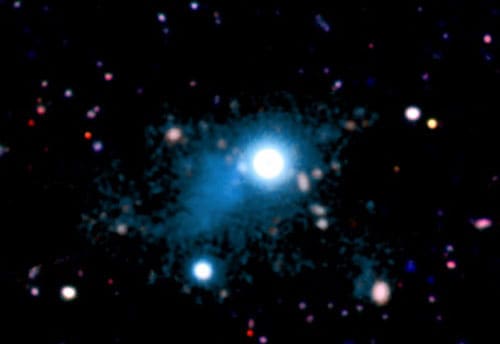
Cantalupo told physicsworld.com that the team built a narrow-band filter to study this Lyman-α radiation. “Originally, in the UV, the emission wavelength is stretched by the expansion of the universe and as it travels across 10 billion light-years, which is the distance to the quasar that we selected, it is shifted into the optical and therefore it is detectable with our optical telescopes,” he says. This new technique is referred to as “quasar fluorescent illumination”. Using the 10 m Keck I Telescope at the W M Keck Observatory in Hawaii, the team detected the presence of a long filament of gas or a nebula. It has a projected length of approximately 460 kiloparsecs (1,500,520 light-years) and was illuminated by the distant, radio-quiet quasar UM 287. The researchers conclude that it is part of the cosmic web, and Cantalupo and colleagues have dubbed their nebula the “Slug Nebula” in honour of the UCSC mascot – the banana slug.

Image of the quasar and the illuminated nebula

Cantalupo further explains that the amount of radiation emitted by the filament depends on how much hydrogen is illuminated, as well as its density and distribution. This allows the team to infer the mass and physical properties of a cosmic web filament – an otherwise extremely difficult thing to do without having a direct image. When compared with predictions from simulations, the researchers found very good agreement when it came to the morphology of the filament. “This is the first time that such a large intergalactic filament has been detected. It extends well beyond the galactic environment of the quasar and therefore it is a confirmation of the existence of such structures predicted by models,” says Cantalupo.

Large-scale discrepancies?

The team’s observation does, however, present a challenge to our previous understanding of the web. “The filament appears too bright given the typical density and distribution of hydrogen gas in the simulated cosmic web,” says Cantalupo. One possible explanation of the discrepancy, he explains, is that the gas in the web is actually much denser and has a much more “clumpy distribution” than is predicted by current models. “This is telling us that we are likely missing some physical mechanism on intergalactic scales in our models. Our observation therefore is a unique (so far) laboratory to increase our physical knowledge on how matter is distributed in the universe,” he says.

In terms of the larger implications of this observation, the researchers say that they are still at the very early stages of their work but that the current study is a proof of concept that the new quasar-fluorescent-illumination technique works. “We need more than one filament for a proper statistical study and to draw implications on dark matter, dark energy and the large-scale structure of the universe,” says Cantalupo. “We are observing other quasars and we have other preliminary detections but ‘illuminated’ filaments appear to be rare. This is probably because of the fact that the opening angle of the ‘quasar light beam’ is small, as confirmed by other indirect studies of quasar emission, and therefore we need to observe a large sample of quasars to get more results.”

Cosmic muse

Currently, the team is increasing its sample of quasars using different filters on both the Keck and Gemini telescopes. Also, a new instrument – MUSE – has been delivered to the Very Large Telescope, ESO, in Chile, which can deliver several times more sensitivity than the narrow-band imaging the team is using now and will allow the researchers to detect more diffuse and larger structures around quasars. MUSE is also ideally suited to allow the researchers to look into an even earlier phase of the history of the universe.

The research is published in Nature.

Uncovering the truth in social media

“On 27 August…Mars will look as large as the full Moon.”

This was a sentence from a widely circulated e-mail in 2005, in the lead up to one of the closest encounters between Earth and Mars in recorded history.

That our neighbouring planet could appear as prominent as the Moon is, of course, complete claptrap. Since the “Mars hoax” first appeared in 2003, it has re-emerged several times over the past decade.

The Mars hoax is an example of a “meme”, a piece of content or an idea that is spread virally across Internet networks. These days, memes such as this can spread with increasing speed and reach, thanks to the ever-growing expansion of social-media sites such as Facebook and Twitter.

Now, however, researchers at MODUL University Vienna are setting out on the ambitious task of assessing the truthfulness of information that goes viral on social-media sites. The folks behind the project, called PHEME, say that one of their major aims is to acquire an improved understanding of the types of dubious information that are most likely to spread across networks.

(more…)

Copyright © 2026 by IOP Publishing Ltd and individual contributors