Physicists work out why wet skin wrinkles

If you have ever sat in the bath and wondered why your fingers go wrinkly when wet, it is because the dead outer layer of your skin is made up of matrix-like structures called corneocytes. They let the skin absorb water easily when wet, yet quickly become much less permeable to moisture when conditions are dry. Physicists in Germany have now modelled a corneocyte and carried out calculations to see how its volume changes as it takes up water. As well as providing important information about how our skin reacts to its surroundings, the new work could help researchers to develop new materials, such as fabrics, that mimic the properties of skin.

The outer layer of a mammal’s skin – known as the stratum corneum – is the body’s first line of defence against toxins in the environment, and also helps to control the water content of our body. When ambient conditions are dry, the stratum corneum forms a barrier to evaporation to prevent the skin from drying out. In damp conditions, in contrast, it hydrates the skin by absorbing water. The stratum corneum is made mostly from keratin – a fibrous protein found in skin, hair, nails and claws – which is arranged to form the corneocytes.

Springy filaments

In a previous study, Myfanwy Evans of the Friedrich-Alexander University in Erlangen and Stephen Hyde at the Australian National University showed that the structure of corneocytes is based on a cubic unit cell made from criss-crossing filaments of keratin and measuring about 45 nm across. The filaments are not normally straight, but instead resemble helical springs. The keratin’s springiness means that the volume of the unit cell can increase by a factor of five until the filaments have essentially straightened out. But much like stretching a spring, this expansion requires energy to overcome the filaments’ tendency to contract. Evans and Hyde argue that this expanding force is developed when the filaments absorb water and become larger.

In this latest research, Evans has teamed up with Roland Roth of the University of Tübingen to study the thermodynamics of the expansion process. In their calculations, the two researchers quantified the corneocyte’s tendency to expand in terms of the energy released as a filament absorbs water. Evans and Roth added this “solvation free energy” to another term that expresses the mechanical energy involved in expanding the unit cell. The result is a “grand potential per unit cell” that reflects the compromise between the filament wanting to expand as it absorbs water, and this expansion being held back by the restoring force of the filaments’ spring-like shape.

Roth and Evans calculated the free energy of the unit cell over a range of sizes, plotting the free energy as a function of the length of a unit cell and the radius of curvature of the helical filaments. This “3D energy landscape” revealed a distinctive valley-like structure that contains a region of low free energy where it is thermodynamically favourable for the unit cell to exist. At one end of the valley the length of the unit cell is relatively small and the radius of curvature is relatively large – corresponding to a compact and dry unit cell. At the other end of the valley the length of the unit cell is large and the radius of curvature small – corresponding to a wet and swollen unit cell.

Smooth and reversible transitions

According to Evans and Roth, this valley is a pathway for the corneocytes to make smooth and reversible transitions between their wet and dry configurations. Furthermore, the volume occupied by keratin (as opposed to water or air) varied from 11% to 38% from one end of the valley to the other. This agrees with the 15–35% range suggested by experimental measurements.

Evans says that his work could lead to a better understanding of some skin diseases that affect the stratum corneum. It could also inspire scientists and engineers to create new biomimetic materials that copy the skin’s ability to swell and shrink in response to ambient humidity. One possibility could be fabrics that absorb moisture from the body.

Evans is keen on studying the optical properties of corneocytes, which because they are helical, could affect how our skin interacts with light. Optical studies could also point towards new materials that have structural colour. This is an effect seen in biological systems such as butterfly wings and feathers, and it arises when light interacts with tiny structures in a material.

The research is described in Physical Review Letters.
Celebrating Louis Essen and the birth of atomic time

On Friday I braved the torrential rains that have been soaking southern England to make the journey from Bristol to Teddington, which is the birthplace of the atomic clock. Situated in the leafy suburbs west of London on the swollen banks of the River Thames, Teddington is the home of the National Physical Laboratory (NPL), which is the UK’s standards and metrology lab.

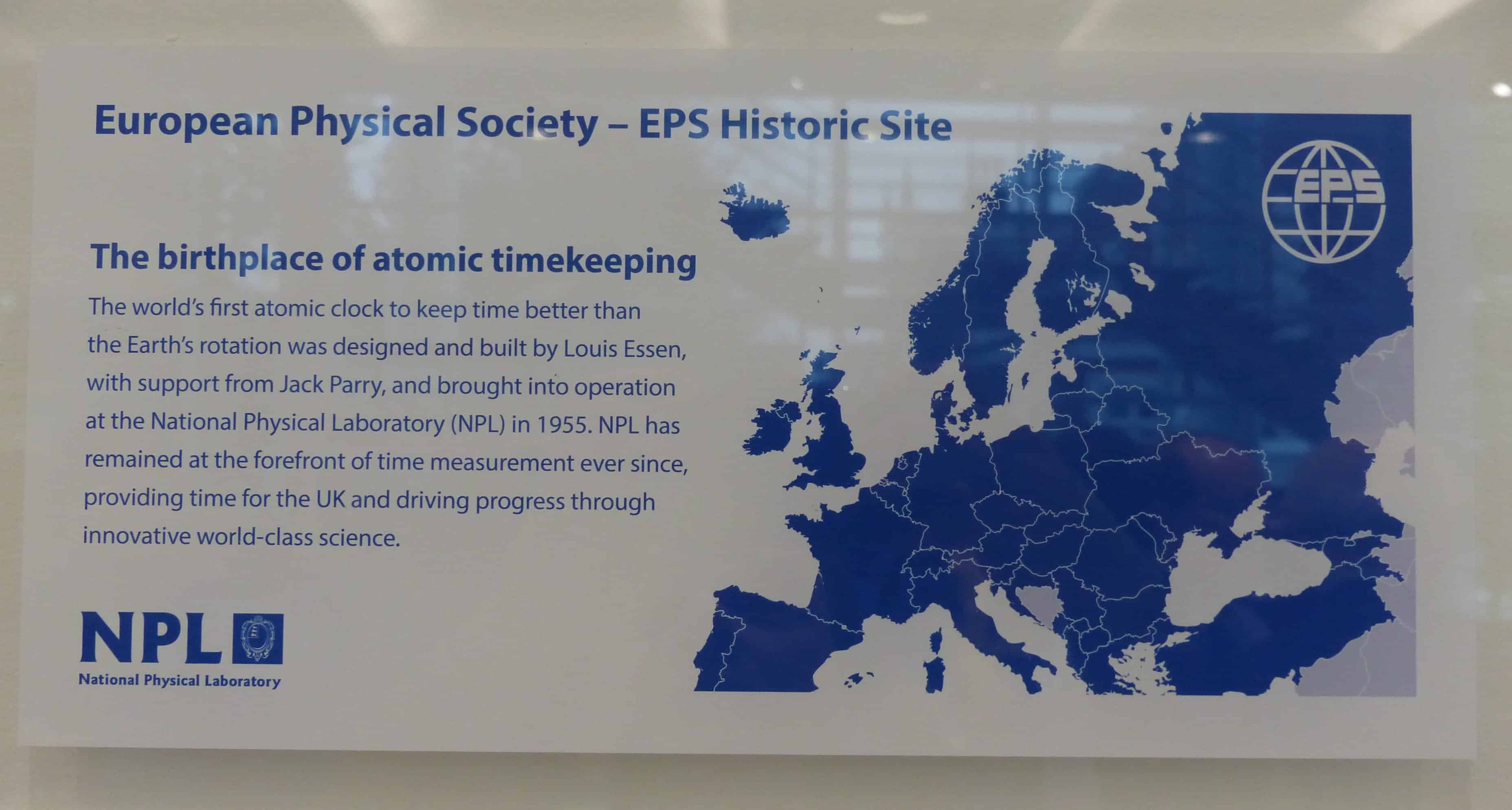
It was at NPL in 1955 that physicist Louis Essen fired up the world’s first atomic clock and as a result the lab has just been made a Historic Site by the European Physical Society (EPS). Below you can see a close-up of the plaque that was unveiled at NPL at a ceremony on Friday.

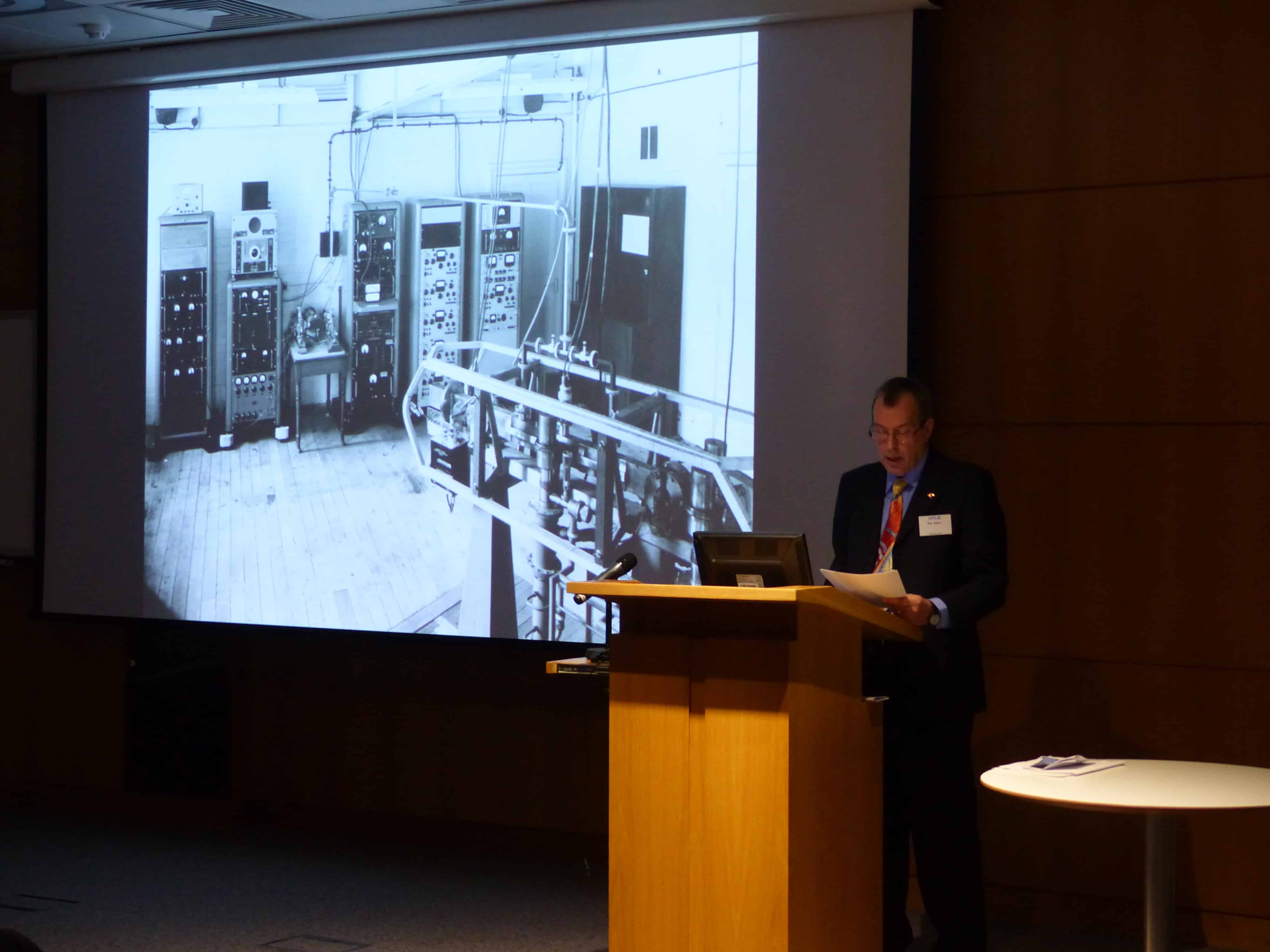
Essen’s clock was based on a beam of caesium atoms and was monitored by microwave technology inspired by Essen’s wartime work on radar. The clock was nicknamed the “Flying Bedstead” by engineers at the BBC and on 3 June, 1955,  the BBC time signal included input from Essen’s clock, making atomic time available worldwide for the first time.

The Flying Bedstead was more than a metre long and required banks of external electronics and vacuum pumps. However, two years later Essen and colleagues built a much smaller transportable atomic clock.  Then, in 1967, the second was redefined as an SI unit based on an atomic transition in caesium, thereby ending the ancient practice of defining time though astronomical observations.

EPS Historic Site plaque at the National Physical Laboratory

The plaque to Essen and the atomic clock was unveiled by John Dudley, president of the European Physical Society, and Peter Knight, who is a past president of the Institute of Physics and the Optical Society of America.

The ceremony was followed by talks by Ray Essen, Louis Essen’s son-in-law, and by the NPL’s Patrick Gill. After lunch I caught up with Gill and his colleague Helen Margolis to record a podcast about optical clocks, which look set to replace atomic clocks as international and national time standards. So stay tuned for much more about optical clocks here at physicsworld.com.

Ray Essen shows a photograph of the Flying Bedstead

When I was at NPL, the lab was preparing for its annual open house, which will be on 20 May. I attended an open house several years ago and it was a great day out. Visitors can wander into selected labs, marvel at the scientific equipment and best of all, have a good long chat with the researchers. So if you ever wondered what an atomic clock looks like, make your way to Teddington in May. More details can be found here and you must register first.

Between the lines

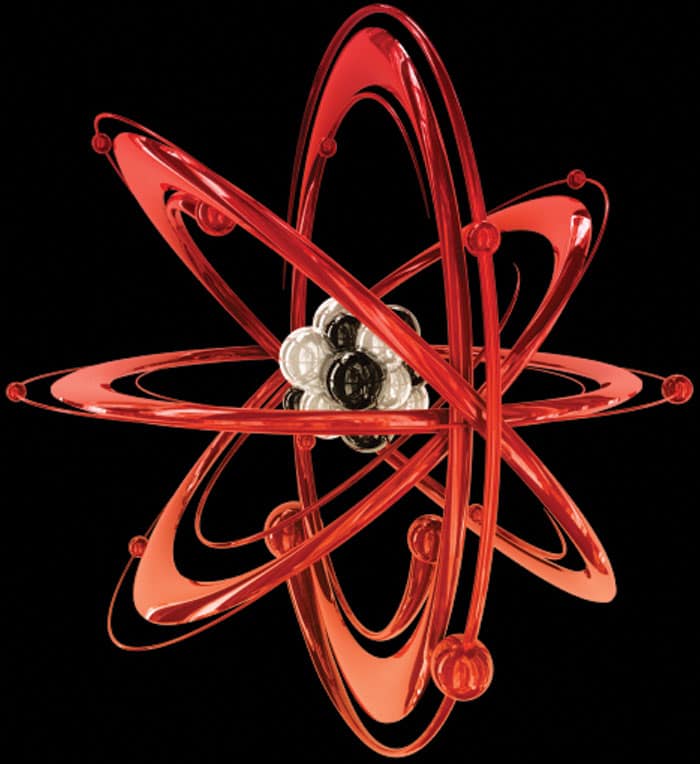
Blood-red Bohr model of the atom

Morally ambiguous science

Werner Heisenberg was not a Nazi, but his willing service to Hitler’s government as the head of Germany’s wartime atomic weapons project has proved a lasting stain on his character. Max Planck was the dean of pre-war German science and a man whose personal decency impressed all who knew him, yet he was notably quiet in the face of Nazi repression. The chemical physicist Peter Debye left Germany for the US in 1940, but his departure may have been driven by academic politics rather than moral principles. These ambiguities of character – along with many others – are explored thoroughly and thoughtfully in Philip Ball’s book Serving the Reich: the Struggle for the Soul of Physics Under Hitler. Ball focuses on Heisenberg, Planck and the lesser-known Debye because they are neither villains nor heroes. Unlike their fellow Nobel laureates Philipp Lenard and Johannes Stark, who dismissed relativity and quantum theory as a “Jewish conspiracy”, they did not allow ideology to influence their work; however, they did seem to regard their pursuit of scientific truth as a licence to ignore the momentous events taking place around them. The idea that scientists should “rise above politics” still has its adherents today, but in some of the book’s best passages, Ball calls it into question. The biggest problem with the behaviour of Heisenberg, Planck and Debye is not, he suggests, that they failed to actively resist the Nazis. After all, he writes, “it is a brave person who asserts without hesitation that he or she would have done better”. Instead, it is their failure even to engage with the idea that they, as scientists, bore some responsibility for the work they did and the regime under which they did it. Being an “apolitical scientist” is itself a political decision, Ball argues, and as his book demonstrates, it is not always the right one.

  • 2013 Bodley Head £20.00 320pp

One universe, one community

The roots of radio astronomy can be traced to the Second World War, when pioneers such as Edward “Taffy” Bowen, Bernard Lovell and Martin Ryle were all part of the British radar effort. In his book A Single Sky: How an International Community Forged the Science of Radio Astronomy, the science historian David Munn explores how the development of this then-new discipline was shaped by the attitudes of such early pioneers and their wartime experiences. The book’s central thesis (and the source of its striking title) is that the early radio astronomers were unusually communitarian by nature. Unlike the “fractious” world of science as a whole, Munn writes, “the radio astronomers saw a single sky, unifying both nations and disciplines”. One reason for this, he suggests, is the novelty of the field and its associated technologies. It is easy to forget that before 1945, the idea that a telescope could look like a radar dish rather than a supercharged version of something William Herschel might have used was little short of revolutionary. At the outset, astronomers and radar physicists had relatively little in common, but the technological demands of the new field forced them to collaborate very closely, and Munn argues that such close collaboration tended to foster a broad respect for people with different, but equally valuable, skills. The field’s interdisciplinary nature also encouraged a trans-national outlook, since the scarcity of scientists equipped with the required skills tended to mean people got hired irrespective of where they were from. (The decision by the US National Science Foundation to recruit an Australian, Joe Pawsey, to lead its new National Radio Astronomy Observatory in 1961 is a good example.) This international flavour, in turn, helped the nascent radio-astronomy community to buck the Cold War trend for yoking science to the needs of the military-industrial complex. These are all interesting ideas, but the academic and occasionally clunky writing style of A Single Sky means that readers will need a keen personal interest in radio astronomy to persevere with Munn’s analysis.

  • 2013 MIT Press £23.95/$34.00hb 256pp

The last word on nothing

The latest collection of material from the archives of New Scientist magazine isn’t about why penguins’ feet don’t freeze (2006) or whether polar bears get lonely (2008). Instead, it’s about nothing. Cosmological nothing, mathematical nothing, quantum nothing – whatever flavour of nothing you fancy, Nothing probably has it. The book features essays by 22 different scientists and science journalists on various aspects of nothingness, including the nothing that preceded the Big Bang and the nothing embodied in the mathematical concept of zero. Not all of the essays are about physics or mathematics, however. For example, one thread of essays concerns medications that contain “nothing” – placebos, in other words. Each essay is relatively short, which makes Nothing an excellent companion for those stray moments when you’d otherwise be doing, well, nothing.

  • 2013 Profile Books £7.99pb 256pp

Super Bowl, super-chilled leeches, a black hole cake and more

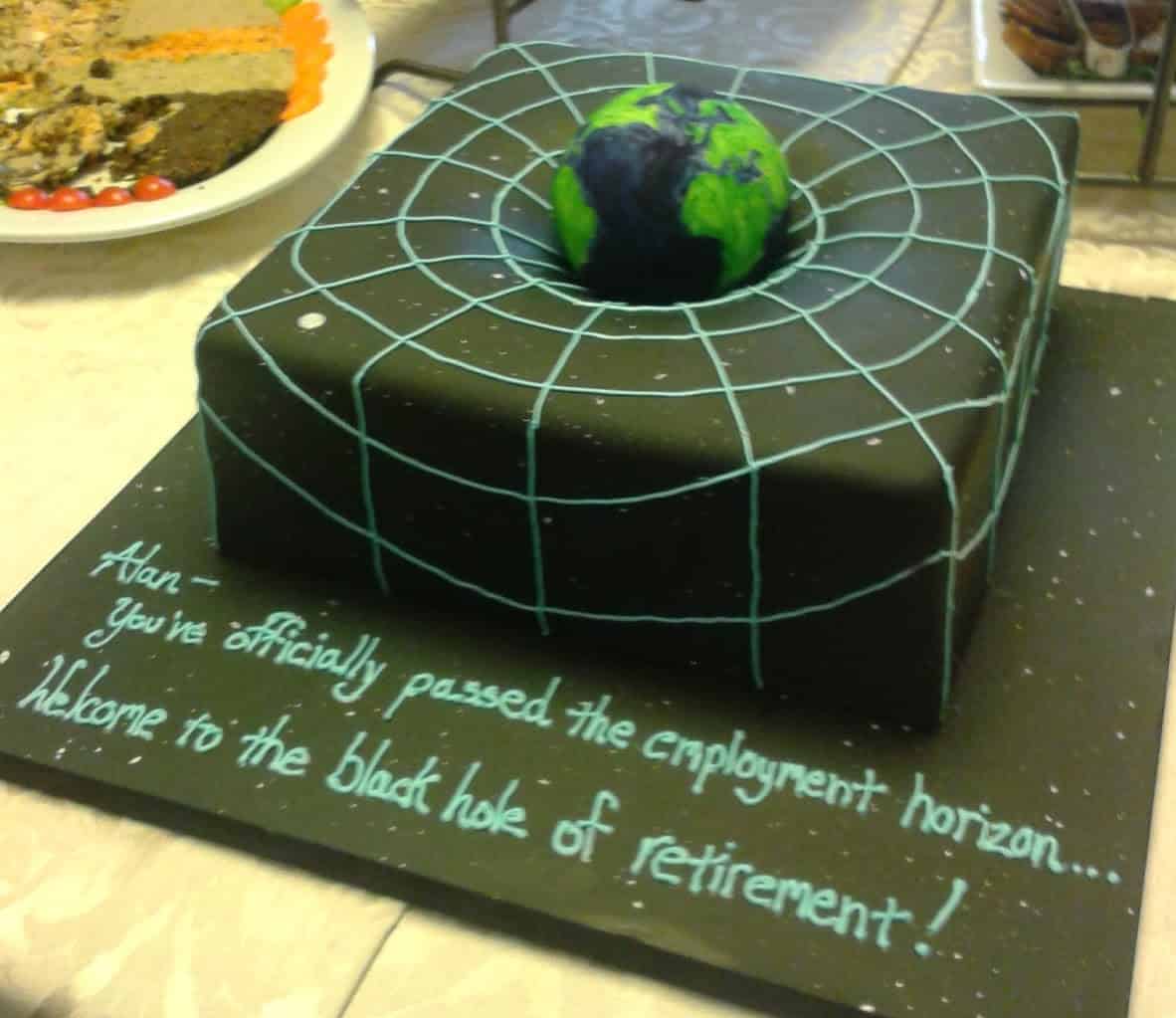
Picture of a black hole cake

Fire and ice will mix together in a sporting cauldron this Sunday. The Seattle Seahawks are taking on the Denver Broncos in the Super Bowl at the MetLife Stadium in New Jersey, and all weather forecasters agree that it’s going to be rather chilly. In fact, some have criticized the National Football League (NFL) for electing to play the game in a stadium without a roof, rather than opting to stage the match under cover. Bear in mind, the Super Bowl is the sporting event of the year in the US and people take it very seriously indeed. To address some of the concerns, The Huffington Post published this article to analyse how the mechanics of the game can change under cold conditions. The entertaining article considers everything from the reduced bounciness of the ball, to the increased propensity of helmets to break due to changes in material pliability.

If those big strong guys who will be competing on Sunday have their own fears about playing in the cold, then they should take inspiration from this East Asian leech. In a series of experiments that must have been a bit annoying for the leeches, a group of researchers in Japan showed that Ozobranchus jantseanus can survive in liquid nitrogen at –196 °C for up to 24 hours. The previous record was just one hour, held by water bears and the larvae of one type of drosophilid fly (just in case the question ever pops up in a pub quiz). The findings – described in this article in Popular Science – have left the scientists puzzled because this type of leech never normally experiences temperatures less than a few degrees below 0 °C. Personally, it makes me cold just thinking about it.

Cold temperatures are one thing us Brits love to moan about. Another favourite target is the country’s train system, particularly when it comes to issues of timeliness. Well, in the future this could become a thing of the past if a new idea outlined this week by the UK science minister comes to fruition. David Willetts has suggested that train services in Britain could be improved if signalling was monitored from space, using the new Galileo satellite system controlled by the European Space Agency, as described in this story in the Telegraph. Of course – being a Brit – Willetts couldn’t resist accompanying his exciting new idea with a good old moan. He’s complaining that EU regulation currently prevents this new technology from being implemented.

But we can’t end this week’s Red Folder blog on a negative note. So our final story involves black holes and cake; a black hole cake to be precise (see picture above). What’s not to like? The delicious dessert was made by PhysicsBuzz bloggers Quantum, Mathlete and Buzz to commemorate the retirement of their colleague Alan Chodos. Their “boss, friend and mentor” was stepping down after 14 years at the American Physical Society. If you’re reading this, Quantum/Mathlete/Buzz, feel free to send me a slice. You’ll find the address at the top of this page.

Sound follows one direction

A device that allows sound waves to pass in only one direction has been created by researchers in the US. The “one-way circulator” – or isolator – for sound waves shows that the fundamental symmetry with which acoustic waves travel through air between two points in space can be broken by a compact and simple device.

While there are ways in which one can restrict or allow regular flow in a certain direction – such as traffic in a one-way street – it is much more difficult to do so with light or sound waves. This is mainly thanks to the reciprocity theorem, which refers to the symmetric transmission of waves between two points in space: regardless of the direction in which they are travelling, identical waves passing through the same medium should behave in the same way. So, it is this reciprocity that needs to be overcome to develop a truly non-reciprocal or one-way system, such as an actual one-way mirror. Currently, one-way mirrors are not in fact non-reciprocal, instead they are partially reflective and partially transparent, working by being lit unevenly.

Resonant rings

To overcome the reciprocity problem, Andrea Alù of the University of Texas and colleagues have now built a device that allows the unidirectional flow of sound. Their device is based on an electronic circulator – the kind normally used in communication devices and radars. This type of circulator is a “non-reciprocal three-port device”, in which microwaves or radio signals are transmitted from one port to the next in a sequential way. If one of the ports is not in use, the circulator begins to act as an isolator, allowing signals to flow from one port to the other but not back.

In their experiment, the researchers used three small computer fans to circulate air at a specific velocity in an acoustic resonant-ring cavity. The ring was connected to three ports of the circulator and microphones were placed at the end of each. They researchers began by transmitting sound from one port. If the fans were switched off, the sound signal from the first port split symmetrically into the two receiving ports, as expected. However, when the fans were turned on and there was a moderate air flow in the ring (with its velocity tailored to the ring design), the team found that the transmission symmetry was broken.

In this case, the acoustic signal from the first port would flow entirely into the next, leaving the third port completely isolated. Similarly, when the signal was sent from the second port, it flowed into the third, leaving the first port isolated and so on. Indeed, signals flow from the first to the second, from the second to the third and from the third to the first port – but never in the opposite directions. “We were able to create one-way communication for sound traveling through air,” says Alù. “Imagine being able to listen without having to worry about being heard in return.”

The team observed up to a 40 dB non-reciprocal isolation of sound at audible frequencies. “It is just the right spin of fluid (air) coupled with the strong resonance of our ring cavity that makes our design powerful,” explains Alù. Simply put, the team found that, for a correct air velocity and cavity design, the circular movement causes a separation of certain resonant modes in the sound and a “giant non-reciprocity via modal interference” is induced. “These two combined mechanisms create strong non-reciprocity in a compact device. Sound waves are routed in one direction only – always contrary to the direction of the air flow,” says Alù.

Varying frequencies

Romain Fleury, a PhD student in Alù’s group, also points out that the “one-way road for sound”, or circulator, transmits waves in a linear and distortion-free way. The researchers believe that the basic design for their sound circulator is easily scalable to different acoustic frequencies and they have filed a provisional patent on the device. The team also says that successfully building a non-reciprocal sound circulator may lead to advances in noise control, new acoustic equipment for sonars and sound communication systems, sound isolators and improved compact components for acoustic imaging and sensing.

“More broadly, our work proves a new physical mechanism to break time-reversal symmetry and subsequently induce non-reciprocal transmission of waves, opening important possibilities beyond applications in acoustics,” says Alù. He also explains that the team’s research could help in the development of smaller and cheaper electronic circulators and other electronic components for wireless devices and may even be applied to designing one-way communication channels for light. The team is now working on a design for the sound circulator that does not require moving parts.

The research is published in Science.

The February 2014 issue of Physics World is out now

Physics World February 2014

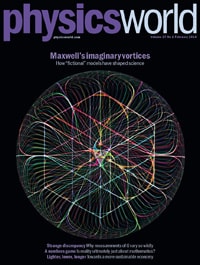
In this month’s cover feature, Margaret Morrison from the University of Toronto examines the use of  “fictional models” in science, including Maxwell’s model of electromagnetism, which included a piece of pure fiction in the form of an invisible, all-pervasive “aether” made up of elastic vortices separated by electric charge.

On a more practical note, this month’s issue examines strange discrepancies in experimental measurements of the gravitational constant, G, while our lead news and analysis piece tries to find out more about the US National Security Administration’s leaked initiative on quantum computers. There’s an abridged extract of cosmologist Max Tegmark‘s new book about the mathematical nature of the universe and don’t miss a great Lateral Thoughts about an unusual domestic mystery – why tiny spikes grow in the ice tray in your freezer.

If you’re a member of the Institute of Physics (IOP), you can access the new issue with the digital edition of the magazine. If you’re not yet in the IOP, you can join now to get full access to Physics World as well as many other member benefits.

For the record, here’s a run-down of highlights in the issue.

NSA keys into quantum computing – Leaked documents suggest that the US National Security Agency is developing quantum computers to crack cryptography codes, but what progress has the agency really made? Jon Cartwright investigates

The spot in the shadowRobert P Crease observes a simple demonstration that is at once a compelling educational tool and a dramatic lesson in science history

Lighter, lower, longer – “Winning the race for growth” is what drives and motivates many politicians, but Peter Goodhew argues that physicists can contribute to the debate by arguing that bigger is not always better

It’s all just mathematics – The world can be described using mathematical equations and numbers, but why does maths do it so well? In his new book Our Mathematical Universe, a section of which is abridged and edited in the new issue, Max Tegmark makes the radical proposal that our reality isn’t just described by mathematics – it is mathematics

Fictional models in science – When James Clerk Maxwell set out his famous equations 150 years ago, his model of electromagnetism included a piece of pure fiction: an invisible, all-pervasive “aether” made up of elastic vortices separated by electric charges. Margaret Morrison explores how this and other “fictional” models shape science

The lure of G – For over 200 years physicists have tried to pin down the value of the gravitational constant. Jon Cartwright finds out what’s been taking them so long

From Euclid to Einstein Patricia Fara reviews Magnificent Principia by Colin Pask

Alices in a nuclear WonderlandKate Brown reviews The Girls of Atomic City by Denise Kierman

A lasting legacyMichael Conti-Ramsden describes how a physics degree and the Great Exhibition of 1851 helped turbocharge a career based on solving practical problems in chemical engineering

Once a physicist – This month we talk to Dan Trueman, composer, Hardanger fiddle-player and a co-founder of the Princeton Laptop Orchestra

Lateral Thoughts: When ice grows up David Appell gets curious about spikes in his ice tray

Enjoy the issue – and let me know what you think by e-mailing me at pwld@iop.org.

UK splashes out £270m on quantum technology

Further details have emerged of a new £270m initiative being funded by the UK government to convert quantum-physics research into commercial products. The five-year initiative, which will include the creation of a network of quantum-technology centres, was one of a number of measures revealed by the government in its Autumn Statement in early December 2013 to boost the UK’s science base. The Chancellor of the Exchequer George Osborne says that the money was “additional investment” in research and that science was a “personal priority” of his.

The initiative, which will begin in 2015, will focus on areas such as chip-scale atomic clocks for improved GPS communication, quantum-enabled sensors, quantum communication and quantum computing. Some cash will go to existing university research groups, while about £30m per year will go to the Technology Strategy Board – the UK’s national innovation agency – to support immediate commercialization of technology. There will also be money for PhD students and postdocs, while some £4m will go on equipment for the new Advanced Metrology Laboratory being built at the National Physical Laboratory.

Behind-the-scenes negotiations

The quantum-physics initiative, which has involved careful behind-the-scenes negotiations between the UK physics community, government and industry, was formally put to Osborne last year by a group of physicists led by Peter Knight of Imperial College London. Knight, who is the immediate past president of the Institute of Physics, which publishes Physics World, says that the prospect of an extra £270m for quantum technology is “highly exciting”. However, he adds that he will be “keeping a close eye” to ensure the cash is not simply siphoned off from budgets earmarked for other scientific fields.

The detailed mechanism for distributing the funding among UK researchers is still being discussed, although it is likely to involve the UK’s research councils, the Royal Society and the Royal Academy of Engineering. However, Jeremy O’Brien of the University of Bristol, who also helped to get the initiative off the ground, says the country must properly co-ordinate the new investment. “Fragmentation into small chunks will be the enemy of progress and ultimately could hinder the creation of wealth,” he says.

Real potential

But participants are optimistic about what the initiative can achieve. “There is real potential for long-term transformational change in some information-related technologies, deriving from a complete re-conception of design principles underpinning their operation,” says Ian Walmsley of the University of Oxford.

Life on Mars?

You may remember the story of Walter Wagner, the Hawaii resident who set his sights on stopping CERN’s Large Hadron Collider (LHC).

Wagner, together with his colleague Luis Sancho, filed a federal lawsuit in the US District Court in Honolulu in 2008 to prevent the LHC from starting up. In the lawsuit, Wagner and Sancho claimed that if the LHC were switched on, then the Earth would eventually fall into a growing micro black hole, thus converting our planet into a medium-sized black hole, around which the Moon, artificial satellites and the International Space Station would orbit.

However, Wagner’s court battle ended in late August 2010 when a judge from Hawaii threw out the case, finding that Wagner had no standing before the court.

But now another science-themed lawsuit has been filed, not by Wagner and nothing to do with the LHC, but rather to force NASA to investigate a strange object that appeared on Mars.

In mid-January NASA released a photo taken from the Opportunity rover of a strange white-coloured object. The weird entity was not visible on 26 December 2013 but the object mysteriously appeared in an image taken of the same spot on 8 January (see above image).

Despite wild speculation on the Internet, NASA concluded a rather more mundane explanation for the object’s origin. “We have looked at it with our microscope. It is clearly a rock,” Steve Squyres, the principal investigator of the Mars exploration rovers, told reporters last week.

Yet that was not enough for some people, including Rhawn Joseph, who asserts that it is in fact a living organism. Not satisfied with NASA’s explanation, Joseph has now filed a lawsuit in California to make NASA examine the rock more closely.

According to the writ, Joseph is a “scientist and astrobiologist who has published major scientific discoveries in prestigious scientific journals beginning in the late 1970s”. He has also apparently attempted to contact NASA boss Charles Bolden as well as “10 other NASA administrators at NASA headquarters” to persuade them to examine the object in more detail, all of whom have ignored his requests.

So now he has turned to the courts. The 11-page writ, submitted on Monday, states that Joseph “immediately recognized [the] bowl-shape structure…as resembling a mushroom-like fungus, a composite organism consisting of colonies of lichen and cyanobacteria, and which on Earth is known as apothecium”.  Joseph claims that the life form was there the whole time, growing until it became visible.

He now wants NASA to take 100 “high-resolution close-up in-focus photos of the specimen at various angles, from all sides, and from above down into the bowl” and make these images accessible to the public.

Yet the demands go even further. If the object is indeed biological, then NASA must acknowledge that the discovery was made by Joseph and “must ensure that [Joseph] appears as first author on and has final editorial approval of the first six scientific articles published or submitted for publication by NASA employees that discuss and present this discovery”.

So any guesses how long it will be before Joseph’s writ follows that of Wagner’s?

Magnetic monopoles seen in the lab

An analogue of a long-sought-after particle comprising an isolated magnetic pole has been observed by physicists in the US and Finland. “Magnetic monopoles” were predicted by Paul Dirac in 1931 but have never been seen in nature. This latest work does not prove whether or not the unusual particles exist, rather it shows that a physical system described by the underlying mathematics can be created in the lab. The research could also help physicists to gain a better understanding of exotic materials such as superconductors, and even create materials with new and useful properties.

Magnetic poles are always seen in pairs, no matter how small the magnet. An ordinary bar magnet consists of both a north and a south pole; if the magnet is cut in two, then each of the resulting halves will also be bipolar. In fact, no matter how many times the magnet is divided, the north and south poles remain coupled – even as far down as individual atoms, which themselves act like tiny magnets. This is reflected in Maxell’s equations, which say that isolated positive and negative electric charges exist but isolated magnetic charges do not.

This changed when quantum mechanics was formulated in the early 20th century. Dirac showed that naturally occurring magnetic monopoles would require electric charge to come in discrete units. This discreteness is seen in nature but is not fully understood, and therefore the search for magnetic monopoles is an active field of research.

Searching high and low

So far, physicists have tried to create monopoles inside particle accelerators, but the monopole mass is generally considered too high to allow a sighting, even at CERN’s Large Hadron Collider. Another option was to search pristine environments, such as the Moon or Antarctic ice, for signs of the monopoles that grand unified theories predict should have been created as the universe cooled and its initial symmetry was broken. Here too, however, researchers have come up empty-handed.

The approach of David Hall and colleagues at Amherst College in Massachusetts and collaborators at Aalto University in Finland is to produce an analogue of what is known as a “Dirac monopole”, the generalized quantum-mechanical form of a magnetic monopole put forward by Dirac. Prior to 1931, nobody had been able to combine classical electromagnetism and quantum mechanics to allow the existence of magnetic monopoles, but Dirac was able to do this by considering what happens when a monopole interacts with an electron. He found that when a monopole passes through an electron cloud – the distribution in space of a single electron as described by quantum mechanics – it leaves a vortex in its wake. This is a line of zero electron density around which the density spirals: “Like water swirling as it goes down the drain,” says Hall.

Hall’s group has reproduced that vortex in a Bose–Einstein condensate of ultracold rubidium atoms. The condensate is a single matter wave and stands in for the electron cloud in Dirac’s formulation. To reproduce the monopole, the researchers applied a real, external magnetic field to the condensate to orient the constituent atoms in such a way that they create a “synthetic” magnetic field inside the condensate. There is a “one-to-one correspondence” between that synthetic field and the field that would be produced by a magnetic monopole, Hall explains. “You could draw exactly the same field lines in the synthetic field and the locus of the monopole is where those field lines spring from,” he says.

Polar vortex

To show that they really had produced a Dirac monopole, the researchers shone a laser beam through the condensate. The beam created a “shadowgraph”, in which the shadow cast by the atoms in the sample was pierced by a narrow strip of light. That strip, they concluded, was the vortex created by an isolated north pole (it being north rather than south simply for technical reasons). “What we see is remarkable,” says Hall, “because normally a vortex created inside a Bose–Einstein condensate goes from one side of the condensate to another. But here it ends in the bulk. That is the hallmark of the monopole.”

Will it help particle physicists find real monopoles? Probably not, but it should encourage them to keep looking
Peter Holdsworth, Ecole Normale Supérieure, Lyon

Peter Holdsworth, a condensed-matter physicist at the Ecole Normale Supérieure in Lyon, praises the work as “an exquisite application of nanotechnology, cold atoms, high-powered computing and clever theory”. He points out that the US–Finnish team has not proved the existence of magnetic monopoles, but he thinks the researchers have provided experimental confirmation of Dirac’s mathematics. “It is an important result and could lead to many other analogous results,” he says. “Will it help particle physicists to find real monopoles? Probably not, but it should encourage them to keep looking.”

Insight into natural monopoles

Hall is quick to acknowledge the limits of his group’s work. “Our monopoles wouldn’t be registered by a compass,” he says. “We haven’t been able to reproduce properties such as the mass of the particle in our experiment, but we have created an analogue of the magnetic part. That might provide some insight into natural monopoles.”

Hall argues that his group has come closer to imitating would-be natural magnetic monopoles than three other groups that reported results on materials known as spin ices in 2009. In that earlier work, the tetrahedra-shaped collections of ions that make up spin ices were observed under certain conditions to acquire net spin, so resembling either isolated north or south poles. Hall describes these experiments as “beautiful” but maintains that the connection to Dirac monopoles was fairly weak as the phenomenon in question was purely classical, as opposed to quantum.

Real magnetic charge

Holdsworth, who works on spin-ice physics, takes a different view. He argues that the spin-ice systems provide a strong parallel with natural monopoles because, he says, “the charge there really is magnetic and they really do produce magnetic fields”.

As far as applications are concerned, Hall believes that his group’s work could help physicists to perform quantum simulations of matter. This fast-growing field, he explains, aims to understand existing materials and ultimately create new ones, perhaps even room-temperature superconductors. Quantum simulations use ultracold atoms to represent electrons – the atoms jumping around an optical lattice just as electrons move between ions. “You need a synthetic electric or magnetic field to talk to those atoms as if they were electrons,” says Hall. “The synthetic fields that we are creating could be used for this.”

The research is reported in Nature.

Rise and fall of an electrical genius

The scientist and inventor Nikola Tesla was born in 1856 to Serbian parents living in the town of Smiljan, in what is now Croatia. Inspired by his mother, the young Tesla was an avid tinkerer who tried to build an airship when he was still a child. He also had an overly vivid imagination, and initially lived in the shadow of his older brother, Dane. After Dane was killed in an accident, seven-year-old Nikola was expected to follow in his father’s footsteps and become a priest of the Serbian Orthodox Church. A few years later, however, Tesla fell seriously ill with cholera, and on his apparent deathbed he extracted from his father permission to pursue a technical education. He quickly got better.

Unfortunately, Tesla’s subsequent history – his inventions of the two – phase electric motor and the Tesla coil (among other things), his long feud with Thomas Edison and his later slide into obscurity – is related unevenly in W Bernard Carlson’s new biography. Although Tesla: Inventor of the Electrical Age starts out reasonably well, telling the story of Tesla’s early life and early inventions, problems develop quickly.

The book’s first sign of trouble follows Tesla’s 1875 move to Graz, Austria. There, at the Joanneum Technical School, he received his first formal introduction to what was then known about electricity. It was in Graz that Tesla made his first attempts to invent an alternating-current (AC) motor, in contrast to the direct-current (DC) motors that were in use at the time. But Carlson’s accounts of the technical details of Tesla’s work are given in terms of Tesla’s understanding rather than a modern view, and they are often difficult to follow in detail.

After Graz, Tesla continued his education in Prague, followed by Budapest. There he acquired a sidekick, Antal Szigeti, and had his first big idea: a rotating magnetic field in an AC motor. He and Szigeti then went to Paris, where they joined the company started by Edison, and Tesla learned the difference between his mental image of an AC motor and the problems associated with the real thing. In 1884 he moved again, this time to New York, where he worked at the Edison Machine Works. He developed an arc-lighting system there, but Edison was more interested in incandescent lighting, and the two soon parted ways.

In the years that followed, Tesla invented a series of electrical devices, including a thermoelectric motor and a pyromagnetic generator. His work attracted the attention of wealthy financiers as well as technologists; Alfred S Brown, superintendent of Western Union’s New York Metropolitan District, backed him in this period, as did Charles F Peck, a lawyer from Englewood, New Jersey. With their help, Tesla developed the idea of a polyphase AC motor, which became his first big invention. He presented a lecture on his new motor to the American Institute of Electrical Engineers on 16 May 1888. It was a big hit, and afterwards he moved to Pittsburgh, where the entrepreneur and inventor George Westinghouse put him to work on improving his polyphase motor.

The Westinghouse Company built between 500 and 1000 Tesla motors, destined for use primarily in streetcars and mining machinery. Westinghouse also licensed Tesla’s US patents for a polyphase AC induction motor and built huge power stations to supply these motors with electricity. Edison, for his part, built DC power stations and championed the use of DC, but Tesla’s ideas were superior and won out in the end. It is curious that very little is said in this book about the epic struggle between Tesla’s AC ideas and Edison’s DC devices.

In any case, Tesla quit Westinghouse in 1889 and returned to New York, where Szigeti had been working all along. (As a side note, Szigeti may have been more than just Tesla’s friend and assistant; Tesla had long – standing friendships with several men, Szigeti included, and Carlson speculates, without reaching a firm conclusion, that he was homosexual.) In New York, Tesla undertook to repeat the experiments of Heinrich Hertz, which had confirmed James Clerk Maxwell’s prediction of electromagnetic waves. Fiddling with a Hertz-like apparatus for producing waves, he soon hit upon what became known as the Tesla coil – a machine that generated high-frequency, high-voltage signals at a low current. He began giving lectures in which he thrilled his public with high-power demonstrations of electrical effects. Remarkably, he was seldom injured during these spectacular shows.

The apex of Tesla’s career came in 1893, when the head of the effort to harness the power of Niagara Falls, Edward Dean Adams, awarded to Westinghouse the contract to build generators for the power plant. Adams’ decision was influenced by Tesla’s polyphase AC ideas, which he admired – albeit not enough to keep him from hedging his bets. Although Westinghouse got the power plant, its great rival, the Edison General Electric Company, was chosen to build the lines that would transmit the power to Buffalo, New York, 20 miles away.

“The success of the project at Niagara Falls,” Carlson writes, “cemented Tesla’s reputation as one of America’s leading inventors.” But after his Niagara triumph, Tesla’s long descent into obscurity began, and unfortunately Carlson’s book descends with him.

Tesla’s principal invention of this later period was a scheme to send information and power worldwide by means of waves in the Earth: not the radio waves of his rival Guglielmo Marconi, but underground standing waves generated by huge devices. However, Tesla was never quite able to finance the construction of these devices, and in the book we learn of his increasingly desperate attempts to raise funds to support this and other “inventions” – all of them apparently unsuccessful.

Carlson sees Tesla’s information-transmission “invention” as anticipating the World Wide Web, and says there are individuals even today investigating whether Tesla’s ideas might work. But as even Carlson admits, there is a “disjunction between what Tesla thought…and how the Earth actually functions”. Disjunction, indeed: this idea, like many of Tesla’s schemes, was pure fantasy.

Initially, Carlson is somewhat sceptical of Tesla’s wilder notions. In the end, though, he is dragged along by Tesla’s magic, and the second half of his book suffers for it, sliding off into the sort of nonsense that Tesla’s die-hard fans (and there are a lot of them out there) really love. This is a pity, because Tesla did have some very good ideas, especially early on. All told, this is not a very good book.

  • 2013 Princeton University Press £19.95/$29.95hb 520pp
Copyright © 2026 by IOP Publishing Ltd and individual contributors