Quantum Cheshire cat spotted in Grenoble

Three months ago we ran a news article about a “quantum Cheshire cat” experiment that was proposed by Yakir Aharonov of Tel Aviv University and colleagues. Now, an international team of physicists has created a quantum Cheshire cat using polarized neutrons at the Institut Laue-Langevin (ILL) in Grenoble, France.

The work was done by Yuji Hasegawa and colleagues at the Vienna University of Technology, ILL, the University of Cergy-Pontoise and Chapman University.

(more…)

Join CERN’s scavenger hunt

You may remember that late last year CERN teamed up with Google Street View to allow users to go on a virtual tour of the lab, including 12 km of the 27 km Large Hadron Collider (LHC) tunnel plus the caverns that house the ATLAS, CMS, LHCb and ALICE experiments.

This involved Google‘s Zurich team spending two weeks at CERN in 2011 photographing the LHC using a “Street View Trike” – a specially created camera-mounted bike.

Well, what we didn’t known then was that Stefan Lüders, CERN’s computer security officer, had decided to stash about 20 LEGO figurines around the CERN computing centre before the cameras rolled.

Lüders, who is a big LEGO fan, spent about an hour secreting the “minifigures”, which were hidden in some not-so-obvious places and in some cases were even camouflaged.

But now CERN has launched a competition, which will close on 31 January, inviting people to identify the locations of the minifigures.

“It is absolutely amazing to count the number of replies we received and are still receiving,” Lüders told physicsworld.com.

You still have time to get searching for those figurines to bag a prize. Sadly, the lucky winners won’t get to visit CERN, instead they will have to make do with their pick from the CERN holiday gift guide, which features an umbrella, tumbler and a CERN notebook.

Update 04/02/14: CERN has now released details of where the minifigures were hiding. Did you manage to find them all?

Mathematics and prejudice

Mathematics has been around for thousands of years, and this has given it plenty of opportunities to become very complicated. For example, seemingly disparate fields of mathematics have often, over time, become connected in surprising ways. In his book Love and Math, Edward Frenkel describes this process via an analogy with continents and the bridges that are built between them. This is very apt, since building a bridge between (say) North America and Europe would be very difficult, and much of the mathematics he writes about is also very difficult.

The book is partially Frenkel’s autobiography: it describes how he got involved with mathematics, the problems he faced as a Jew in the old Soviet Union and his love of the subject. In order to convey this history, he also explains a great deal of mathematics, and particularly that associated with the Langlands programme, which aims to unify the different branches of the field. This mathematics is sophisticated (I will briefly present some later), yet Frenkel manages to give even relatively inexperienced readers a sense of it. In particular, he conveys that this material is interesting and important. While I was reading the book, I was also working on a fun but frankly non-important problem in mathematics. The contrast was striking!

The book – which is written in the first person – begins by describing some elementary particle physics and group theory and explaining how they relate to each other. After this comes the author’s own tale. Frenkel was born in 1968 in what was then the Soviet Union, and he initially wanted to study physics. His mentor, Evgeny Evgenievich Petrov, converted him to mathematics, the subject in which he earned his PhD, but since his work is often related to physics it is not clear he really did switch. At such high levels it is hard (and not productive) to distinguish between the two.

As a young man, Frenkel was a brilliant mathematician, and if the Soviet Union had not practised a form of institutionalized antisemitism, he would have passed his exams and got into Moscow State University. But under the circumstances, such success was impossible no matter how well he performed. The examiners kept making the questions harder and harder, both in terms of their intellectual merit (he was still able to solve questions of this type) and in terms of stupid pedantics. As an example, Frenkel defined a circle as “the set of points equidistant from a point”, but his examiners deemed this answer wrong since it should be “the set of all points equidistant from a point”. Another way for Jews to be barred from school was to give them harder problems to solve. Often such problems had an easy solution that was hard to find, thus giving the appearance of fairness. (For more on this see “Jewish problems” by T Khovanova and A Radul, arXiv:1110.1556.)

Frenkel’s experience was far from unique, and in his book he describes the ways in which many Jewish mathematicians, physicists and other scientists dealt with this system. Some of them met quasi-secretly and still managed to get much done, and it is tempting to wonder whether oppression got their creative juices flowing. However, this is a fallacy. We only read about those who managed to do well, and I am sure that many brilliant students were blocked from making contributions. Their biographies are not written.

At the heart of the book is Frenkel’s description of the Langlands programme, which aims to build those “bridges” between different mathematical “continents”. Here is an example. Let p be a natural (or “counting”) number. If we restrict ourselves to the set of numbers {0,1,2…,p–1} then we can still add, subtract, and multiply if we “wrap around” back to the beginning. For example, if p = 13, then 12 + 4 = 3, which we denote as 12 + 4 ≡ 3 (mod 13). Also note that 6 + 7 ≡ 0 (mod 13), so we think of 7 as being –6 (mod 13). If p is a prime number, then we can also divide.

Now, let f(x,y) be a cubic polynomial in two variables with integer coefficients, such as f(x,y) = y3 + y – x3 – 2x2. If p is prime, we can ask how many pairs (a,b) with (a,b) included in the set {0,1,2…p–1} exist such that f(a,b) ≡ 0 (mod p). We denote this number as np. We can then form an infinite polynomial p(x) where np is the coefficient of xp. This infinite polynomial is then associated to a group of symmetries in the complex plane G called a modular form. The correspondence between f(x,y) and its modular form is one-to-one and it preserves some properties; that is, every cubic equation maps to a modular form and every modular form maps to a cubic equation. This is an important connection.

What the Langlands programme does is essentially to take the notion of equation and generalize it, and also to take the notion of modular form and generalize that. The programme then makes conjectures about how these very general objects are related. Frenkel illustrates this connection-building process with several nice examples until, on page 222, he has a chart that connects number theory, Riemann surfaces (geometry) and quantum physics. Quantum physics? How did that get in there? Through gauge theory – a complicated notion that Frenkel (wisely) does not try to explain. However, having read the book, I now want to find out what it is.

Frenkel claims that frequently, a branch of mathematics that was thought of as a pure abstraction ends up being applied to practical problems. I am often sceptical of such claims, since the (perhaps forgotten) origin of many mathematics problems is, in turn, some real-world application. However, the examples given here seem legitimate; to my eye, at least, number theory really does lack any apparent connection to the practicalities of quantum physics, yet the links are there. One is left with the impression that Frenkel and the other scholars who appear in the book (including Ed Witten, the only physicist to win a Field’s Medal) are seriously brilliant people who are doing seriously brilliant work.

You do not need to know much mathematics to read this book, but you do need to like it. Depending on your level, you will get lost at some point (for me, it was the definition of a “sheaf”). However, this is not a book to read to learn maths. It’s a book to read to be inspired to learn maths.

  • 2013 Basic Books $27.99 292pp

Between the lines: film special

The right stuff

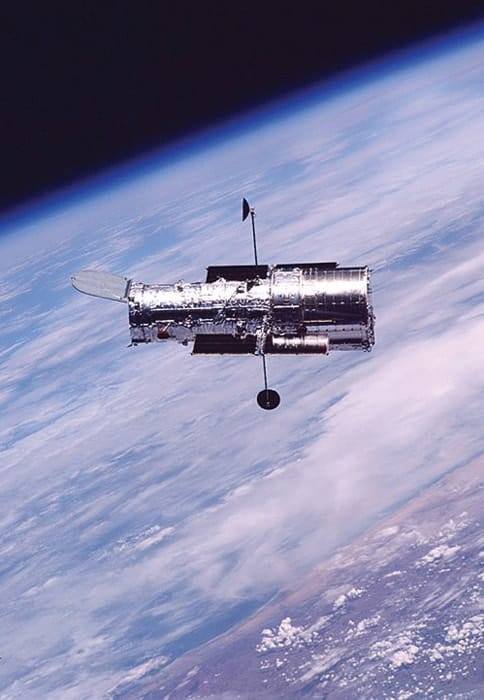
Photo of the Hubble Space Telescope

Physics World is arguably a little late to join the critical love-fest for Gravity. Alfonso Cuarón’s space-adventure film opened in the US in October 2013 and, despite achieving considerable box-office success on both sides of the Atlantic, its days in cinemas may well be numbered by the time this review is published. But if it is still showing in your area, and you haven’t yet seen it, take our better-late-than-never advice: go. In fact, go now. You can read the rest of this review later (it’s got spoilers anyway). As the film opens, its stars – Sandra Bullock as a scientist and first-time astronaut; George Clooney as an old-school space veteran – are performing a spacewalk as they carry out a routine upgrade to the Hubble Space Telescope. But after the briefest of introductory scenes, Houston informs them that they have a problem: a huge cloud of debris from a failed Russian satellite is hurtling towards them, punching holes in everything in its path. What follows is essentially an astronaut’s vision of hell, as Bullock’s character – cut adrift from her damaged shuttle and out of contact with Mission Control – struggles through fire, water and a pitiless shortage of air in her efforts to return to Earth. The special effects required to create such sequences are impressive but not perfect, and for many physicist viewers, part of the fun will come from spotting moments when astronauts or pieces of debris behave in unphysical ways. But we suggest saving such analysis for a second viewing. What makes Cuarón’s film great is not just its special effects, but the way he and the actors use sparse dialogue and a bleak, expansive setting to create a curiously intimate-seeming film. Bullock, in particular, is fantastic in her role as a scientific everywoman, and while it is hard to believe that the real-life NASA would send an astronaut into space who had crashed the Soyuz simulator every time, her personal journey is realistic and never overdone.


Inside the LHC

Particle Fever, a new documentary film by Mark Levinson and the theoretical physicist David Kaplan, lifts the lid on the inner workings of CERN as scientists there wrestle with the twin challenges of installing and running the Large Hadron Collider and using it to search for the Higgs boson. From a purely educational perspective, professional physicists are unlikely to learn much from this film about the theoretical and experimental science that underpins the work at CERN. However, the film does work well as a layman’s introduction to concepts such as multiverse theory, supersymmetry, the Standard Model and the cosmological constant – largely as a result of the deft use of smooth graphics, coupled with clear and concise explanations from the scientists involved and jaw-dropping footage of the collider itself. But education was never the main point of a film that, above all else, is most successful as a sometimes revealing portrait of the working lives of the men and women caught in the glare of the global media spotlight. By following the inside story of six scientists – including Fabiola Gianotti and Savas Dimopoulos as well as Kaplan himself – it also provides a unique insight into the dogged tenacity required to endure the triumphs and disappointments involved in such large-scale and high-publicity experiments. As Dimopoulos says, in particle physics “jumping from failure to failure with undiminished enthusiasm is the big secret to success”.


Hawking on film

Great books often get made into mediocre films, but every so often, the reverse is true. Such is the case with Hawking, a candid biopic of the University of Cambridge cosmologist that stands head and shoulders above its subject’s own recently published memoir (“In search of the real Stephen Hawking”). Hawking is credited as one of the film’s writers (the others are Ben Bowie and director Stephen Finnegan), and he provides much of its narration. Crucially, though, we also see footage from interviews with his sister Mary, his friends, students, nurses and even his ex-wife Jane. Their reminiscences combine to give us a much more complete picture of Hawking’s life and personality, and the camera’s sympathetic eye sees much that would be difficult to get across in words. It is one thing to read in Hawking’s memoir that his first electric wheelchair “gave [him] a considerable degree of independence”, but it is quite another to watch footage of him chasing his young son around the garden in it. It is also interesting to hear Peter Guzzardi, who edited Hawking’s bestselling popular book A Brief History of Time, say that he was “really disappointed” with its first draft. The fact that Hawking was both determined and willing to completely rewrite it – despite being interrupted by a major health crisis – says much about the man whom his friend and colleague Kip Thorne calls “the most stubborn person I’ve ever met”.

Now you see them, now you don’t…

I don’t know if they’re going to be dubbed “Alice” and “Bob”, but those names seem fairly appropriate for the two new figures – one male, one female – that make up the latest artwork from the German-born quantum-physicist-turned sculptor Julian Voss-Andreae.

Set to be installed at a new physics and nanotechnology building at the University of Minnesota in Minneapolis-St Paul, the work is officially titled Spannungsfeld – a German term that literally means “tension field” and which implies, according to Voss-Andreae, a “dynamic tension, often between polar opposites, that permeates everything in its vicinity”.

Each of the 3 m-high kneeling figures weighs about 1400 kg and will be installed on a 5000 kg granite plinth. They will be positioned about 20 m apart and gazing directly at each other. But rather like Voss-Andreae’s 2006 sculpture Quantum Man, his new work has been built so that both figures “disappear” when viewed side on. That’s because they’re actually created from 150 thin, polished steel slices connected by pins.

I haven’t seen the artwork myself, but Voss-Andreae promises that light shining through the sculpture will give the work a “surprising, almost otherworldly, quality”. When someone passes by the sculpture, a viewer on the other side sees “a blurry reflection of that person moving through the sculpture, even when the metal completely blocks any direct view of the passer-by”. Much of the light hitting the sculptures will “reflect off the slices’ clean, laser-cut edges, which shimmer as the viewer passes by”.

You can see Spannungsfeld for yourself when it’s installed next month and an official unveiling ceremony for the new building and the sculpture will take place in April. Meanwhile, you can learn more about Voss-Andreae’s work in this great article entitled “Quantum of culture” by Physics World columnist Robert P Crease.

Quantized vibrations are essential to photosynthesis, say physicists

Physicists in the UK claim to have shown unambiguously that the high efficiency of photosynthesis is driven at least partly by a purely quantum-mechanical phenomenon. Their work could lead to discoveries of other quantum processes in biology, or help in the development of new and better technologies for harvesting solar energy.

Arguably the most important chemical reaction on Earth, photosynthesis allows a plant to harness sunlight by converting carbon dioxide and water into energy-rich carbohydrates. For the most part, this takes place in chlorophyll molecules, which are arranged such that neighbouring molecules have different energy levels. When light shines on one of these molecules, an electron is momentarily excited before passing its energy over to a nearby molecule with a slightly lower energy level. In this way, energy can flow “downhill” from energy level to energy level, via different routes, until it reaches a reaction centre where actual photosynthesis occurs.

Scientists had previously assumed that the energy moves downhill in a random walk – an incoherent “hopping” between energy levels. But this mechanism does not explain how solar energy is transferred so quickly to a reaction centre, which allows photosynthesis to proceed with energy efficiencies of 95% or more. In recent years, various theoretical and experimental studies have suggested that quantum mechanics plays a role, by transporting energy in a wave-like manner. But for all the results, an explanation based on classical physics could never be ruled out, according to Alexandra Olaya-Castro and Edward O’Reilly of University College London (UCL) in the UK.

Quantized vibrations

Olaya-Castro and O’Reilly claim to have uncovered the first unambiguous evidence for quantum effects by doing a theoretical study of the vibrational motion of chromophores – colour-producing molecules such as chlorophyll. Drawing inspiration from the field of quantum optics, where specialist techniques have been developed for characterizing the quantum-mechanical nature of light, the researchers showed that the absorption of a photon of sunlight generates an electronic excitation, the energy of which matches a collective vibration of two chromophores. So long as this vibrational energy is greater than the surrounding thermal energy, the researchers say, then a quantum of energy can be exchanged from one chromophore to the other.

Olaya-Castro and O’Reilly knew that this energy exchange was purely a quantum effect when they tried to plot a probability distribution of fluctuations in the occupation of the vibrational mode and found that these variations were too small to allow a classical description. “This unambiguously demonstrated that the phenomenon described has no classical analogue,” says O’Reilly.

“I’m happy to see this paper published – it’s a breakthrough,” says Gregory Scholes, a chemist at the University of Toronto who has studied the quantum effects of photosynthesis. “There has been a lot of debate in the literature and at meetings lately about the interplay of vibrations – which [we] assumed to confer only classical effects – and electronic coherence in light harvesting. This new work takes the debate to a new level by showing that it is precisely this interplay that makes the system function quantum mechanically!”

“Non-trivial quantum effects”

Scholes adds that the UCL work “points the way” to experiments that directly detect the signatures of quantum effects. Moreoever, says Olaya-Castro, such quantum signatures might not only be found in photosynthesis: specific vibrational motions are also thought to be involved in other biological processes such as vision, smell and enzyme reactions. “Our results suggest that a careful inspection of the dynamics and fluctuations of these ‘good vibrations’ of molecules in their excited states could benchmark a common principle for non-trivial quantum effects in biology,” she adds.

The understanding of photosynthesis is particularly important, however, because of the need to develop methods of harnessing solar energy. “The research on quantum effects in biology has the potential to provide invaluable insights on how to achieve robust, quantum-enhanced energy transfer,” says Olaya-Castro.

The research is described in Nature Communications.

Physicists discover 3D versions of graphene

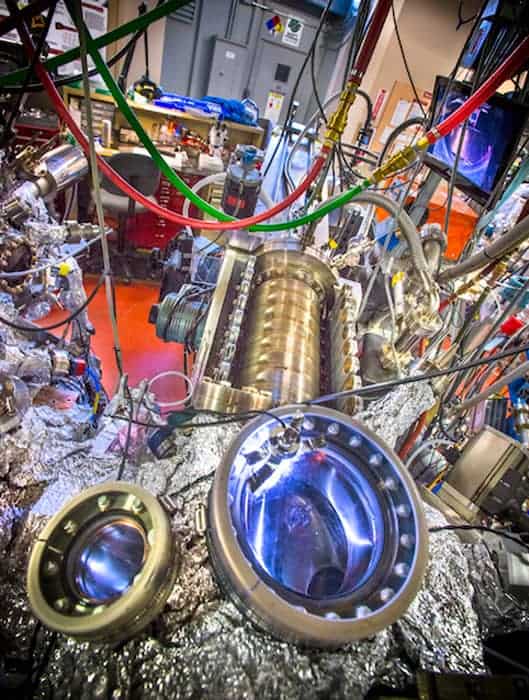
Photograph of the beamline at Berkeley Lab where Yulin Chen and colleagues did their ARPES measurements

Three-dimensional analogues of graphene have been created independently by three groups of researchers. Like graphene, which can be considered a 2D system, electrons travel as massless particles through the new solids. The materials could help physicists to gain a better understanding of topological insulators and might also be used to create better computer hard drives.

Graphene is a layer of carbon just one atom thick and since it was first isolated in 2004 its remarkable electronic and mechanical properties have been studied by physicists worldwide. As well as providing a laboratory for studying the behaviour of electrons that are confined to 2D, graphene has also been touted as a replacement for silicon in electronic devices.

Graphene is different from most crystalline materials because its electrons are governed not by the standard Schrödinger equation, but instead by the Dirac equation of relativistic quantum mechanics. Dubbed a Dirac semimetal, its electrons travel effectively as massless particles, which allows them to reach much higher speeds than ordinary electrons – as high as 106 m s–1. As a result, the electron mobility in graphene is about 200,000 cm2/Vs, compared with about 1400 cm2/Vs in silicon.

Dirac semimetal in 3D

In graphene, this massless electronic transport can only occur within the planes of carbon atoms, making it an inherently 2D effect. However, in 2012 Charles Kane and colleagues at the University of Pennsylvania calculated that, in principle, it should be possible to produce a 3D Dirac semimetal. The Pennsylvania researchers used an allotrope of bismuth oxide as their computational model.

Intriguingly, their analysis also showed that such a material would have the “protected surface states” that are characteristic of a curious state of matter called a topological insulator. The strange electronic properties of topological insulators arise because the shape – or topology – of the electron energy bands makes it impossible for electrons moving along the surface to backscatter. As a result, a material that is an insulator in the bulk can be an excellent conductor on its surface.

These surface states have an interesting feature that is not present in other materials. The conduction electrons travel on the surface such that spin-up electrons move in one direction and spin-down electrons in the opposite direction. This is of great interest to researchers who are trying to develop spintronics devices, which use the spin of the electron to process and store information.

Made in the lab

Now, three groups have independently produced topological semimetals in the lab. One team includes Yulin Chen and scientists at SLAC National Accelerator Laboratory and the Lawrence Berkeley National Laboratory in California, the University of Oxford and Beijing National Laboratory for Condensed Matter Physics and Institute of Physics. Chen and colleagues did their experiments on sodium bismuthate. The second group included Zahid Hasan and colleagues at Princeton University in New Jersey, as well as colleagues in Massachusetts, Taiwan and Singapore. This group looked at cadmium arsenide, as did the third independent team, which included Robert Cava and colleagues at Princeton along with physicists at the Institute for Solid State Research in Dresden and the University of Dresden in Germany.

We may be able to make hard drives from Dirac semimetals that are smaller, higher density and have lower energy consumption
Yulin Chen, University of Oxford

All three teams confirmed that the movement of the electrons in 3D was governed by the Dirac equation using angle-resolved photoemission spectroscopy (ARPES) – a technique that measures the energy and momentum of electrons in a solid. In systems described by the Schrödinger equation, the energy of an electron is proportional to the square of its momentum, whereas in the Dirac equation the two are linearly proportional. The signature of relativistic electron transport, therefore, is that the valence and the conduction bands touch at a single sharp point known as a Dirac cone, rather than in a parabola. Both groups detected the signature Dirac cone in all three directions in their materials.

Experimental confirmation of the existence of topological states has not yet been reported by the three groups and is the subject of further work.

Searching for other Dirac semimetals

Chen told physicsworld.com that his group will now attempt to look for other possible Dirac semimetals. “This kind of thing is not just one compound: it is a whole group of materials,” he says. “We are looking for even better Dirac semimetals, but we needed to find one first to convince ourselves that they do exist.”

Charles Kane believes the work’s primary importance is in fundamental research. “Every time you discover a new phase of matter, it opens the door to playing with it,” he says. “You can think of the Dirac semimetal as being a critical state: it’s just at the borderline between being many different things.” He is more sceptical that the work will have the short-term interest for engineers that graphene has because unlike graphene, which is one of the strongest known materials, the Dirac semimetals are difficult to make and study, and they have limited structural stability.

Chen agrees that the primary importance of the work is in fundamental physics, but he does see some engineering applications. As an example, he cites magnetic computer hard drives, which use a property called giant magnetoresistance whereby the resistance of certain materials changes significantly when subjected to a magnetic field. The best materials used in hard drives today have resistance changes of a few tens of per cent. “In a topological Dirac semimetal, this change can be several hundred or even thousand per cent,” he says. “That means we may be able to make hard drives from Dirac semimetals that are smaller, higher density and have lower energy consumption.”

The Chen group’s paper is published in Science. Preprints by the Hasan and Cava groups are available on arXiv.

Lights, camera, action at Daresbury Laboratory

Recently I was in Liverpool with the Physics World camera crew to film a series of videos, including a feature about the NA62 experiment based at CERN. On the way back to Bristol we spent the afternoon at the Daresbury Laboratory in Cheshire, where we made videos about two major facilities at that lab.

Today, we are premiering the video that we made about Daresbury’s SuperSTEM, which is the UK’s national facility for aberration-corrected scanning transmission electron microscopy (STEM).

SuperSTEM has played an important role in the characterization of graphene by taking the first lattice images of the material. Graphene was first isolated in 2004 by Andre Geim and Konstantin Novoselov at the nearby University of Manchester, which is a member of SuperSTEM along with the universities of Leeds, Liverpool, Glasgow and Oxford. Geim and Novoselov bagged the 2010 Nobel Prize for Physics for their efforts and graphene remains a hot topic in condensed-matter physics.

In the video, SuperSTEM’s Demie Kepaptsoglou explains how a STEM works and why the technique is a crucial tool for material scientists.  She talks about how a STEM is used to do atom-by-atom analysis of graphene. She also previews the capabilities of the next microscope to be installed at the facility. Called SuperSTEM III, the instrument will be one of the best in the world and should be up and running later this year.

The video is called “Scanning transmission electron microscopy explained“.

Stay tuned for our second video from Daresbury, which focuses on the Cockcroft Institute and its efforts to develop new accelerator technologies and applications.

Scanning transmission electron microscopy explained

This short film is about SuperSTEM, which is the UK’s national facility for aberration-corrected scanning transmission electron microscopy (STEM).

Located at the Daresbury Laboratory in Cheshire, SuperSTEM played an important role in the characterization of graphene by taking the first lattice images of the material. Graphene was first isolated in 2004 by Andre Geim and Konstantin Novoselov at the nearby University of Manchester, which is a member of SuperSTEM along with the universities of Leeds, Liverpool, Glasgow and Oxford. Geim and Novoselov bagged the 2010 Nobel Prize for Physics for their efforts and graphene remains a hot topic in condensed-matter physics.

In this film, SuperSTEM’s Demie Kepaptsoglou explains how a STEM works and why the technique is a crucial tool for material scientists. She talks about how a STEM is used to do atom-by-atom analysis of graphene. She also previews the capabilities of the next microscope to be installed at the facility. Called SuperSTEM III, the instrument will be one of the best in the world and should be up and running later this year.

CoGeNT gives further backing to annual dark-matter variation

A long-standing and controversial claim by the DAMA collaboration in Italy that it has observed dark matter has received fresh support from a US-based experiment. Like DAMA, the CoGeNT collaboration says that it continues to see a seasonal variation in the number of events registered in its detector. Such a variation would be expected if the Milky Way galaxy were shrouded in a “halo” of dark matter, but several other dark-matter searches have failed to see the effect.

Dark matter is thought to make up at least 80% of matter in the universe, yet it interacts only very weakly with ordinary atoms and molecules. While physicists can see its gravitational effects on large objects such as galaxies, dark-matter particles themselves have proved very elusive.

The DAMA detector is located deep underground at the Gran Sasso National Laboratory, where in 1998 the collaboration first claimed to have detected dark matter. Since then, the result has been reinforced with ever more data from the detector. The experiment is unlike most dark-matter searches, which look for individual collisions between incoming dark-matter particles and detector nuclei. Instead, DAMA looks for – and has found – an annual modulation in all of the events registered by its detector. The modulation is expected to arise because the solar system is believed to be ploughing through a dark-matter halo enveloping the Milky Way. In the northern summer, the tangential velocity of the Earth as it orbits the Sun is in the same direction as the motion of the solar system. As a result, the number of collisions detected by DAMA should peak in summer and drop in the winter.

Surprise confirmation

Other physicists do not dispute DAMA’s observation. However, some argue that the group, led by Rita Bernabei of University of Rome Tor Vergata, has not done enough to rule out the more mundane causes of that modulation. Juan Collar of the University of Chicago and colleagues built CoGeNT at the Soudan Underground Laboratory in Minnesota specifically to try and settle the issue. The team uses about 100 g of germanium as its detector medium. Although this produces far fewer data than DAMA, which uses 250 kg of sodium iodide, CoGeNT has a much improved capacity to detect the low-mass dark-matter particles capable of explaining the modulation. After running for 15 months, Collar and co-workers announced in 2011 that CoGeNT had, to their surprise, also seen the annual modulation in collisions.

Since then, CoGeNT has gathered more data and the team has just released an analysis of data collected up to April 2013. The study involves slicing those data up in two ways: by collision energy and by location within the detector. The idea is that for any annual modulation to be caused by weakly interacting massive particles (WIMPs) – the preferred candidate for dark matter – the modulation should only be seen in events taking place inside the bulk of the detector and having energies of less than about 2 keV. That was exactly what the researchers found.

Collar describes his group’s data analysis as “very basic”, calculating the statistical significance of the result to be a modest 2.2σ. This means that there is about a 2% chance of it being a statistical fluke. He argues, however, that the result becomes more interesting when compared with those of other groups, such as DAMA and CRESST, which is also based at Gran Sasso. The different results, he says, yield conflicting WIMP masses and interaction strengths only if WIMPs are assumed to move about randomly inside the galactic halo. However, if, as the latest results imply, some WIMPs behave differently – by streaming in a certain direction, for example – then the different sets of results overlap quite neatly, he explains.

Constraining the possibilities

Collar is careful not to overstate the importance of his group’s work, describing the new results as “not evidence” of dark matter but as “constraining the possibilities” of dark matter’s identity. He points out that his group’s annual modulation might yet be explained away by a currently unknown source of systematic error.

The CDMS collaboration, whose detector is also located in Soudan, has produced its own results with silicon detectors that were reported last year – three events that look like collisions of WIMPs with about the same low mass as those DAMA says it has seen – but with germanium detectors has found no sign of an annual modulation. Meanwhile, two xenon-based experiments – XENON at Gran Sasso and LUX at the Sanford underground lab in South Dakota in the US – have seen nothing at all.

Confusing and messy picture

Dan Hooper, a particle theorist at Fermilab near Chicago, says that the conflicting results present a “confusing and messy” picture, arguing that “it is hard to understand why LUX didn’t see more events than it has”, if the other experiments really are seeing WIMPs. However, it is possible, he points out, that LUX is simply not that sensitive to low-mass WIMPs. “Until the low-energy calibrations of liquid xenon are made in the presence of an electric field,” he says, “there is still a chance that some of these experiments might be seeing dark-matter particles.”

According to its co-spokesman Richard Gaitskell of Brown University in the US, LUX has published calibrations with an electric field that go below collision energies of 3 keV. Gaitskell says that “multiple experiments” are now working on calibrations at even lower energies and should make their results available in the first half of 2014.

In fact, Collar and a number of other physicists have built a small xenon detector at Fermilab in order to scrutinize LUX’s claimed exclusions. The detector, which uses a yttrium–beryllium neutron source to mimic the recoil of low-mass WIMPs, should produce results within a few weeks.

The next step for Collar will then be the assembly of a 4 kg successor to CoGeNT, called C4, which he hopes to have up and running by the end of 2014. He is also looking forward to results from the GAIA satellite, which was recently launched by the European Space Agency. Designed to chart the position and velocity of about 1% of the stars in the Milky Way, GAIA might, he says, reveal the existence of stars travelling towards Earth and so, in turn, provide independent confirmation of any streaming dark matter.

The results are described on arXiv.

More about the nature of dark matter can be gleaned from this video by Luke Davies of the University of Bristol.

Copyright © 2026 by IOP Publishing Ltd and individual contributors