Would you know exactly where to run and shelter in the event of nuclear fallout in your city? Would it be best to stay where you are or move, and for how long should you stay inside before venturing out into your post-apocalyptic world? If these questions have plagued your mind, you can now turn to a new model developed by Michael Dillon, an atmospheric scientist at the Lawrence Livermore National Laboratory in California, US. Dillon’s practical model outlines simple ideas and suggestions that the average person – without advanced equipment and know-how – could apply in the event of a low-level nuclear attack, which is the most plausible type likely to take place in today’s political climate. You can read all about about the model on both the io9 website and inScience magazine, and then map out your perfect route.
Physicists in Germany say they have taken an important step towards the creation of ultrafast computers that use light instead of electrical signals to process information. The team has created the first compact electronic device that can measure the absolute phase of extremely short light pulses. While the device is first expected to find use in laser labs, it could someday play an important role in systems that use ultrashort light pulses to process information.
The work was done by Ferenc Krausz and colleagues of the Max Planck Institute of Quantum Optics in Garching. In 2001 a team led by Krausz and colleagues generated and measured the first isolated light pulse lasting only attoseconds – just a billionth of a billionth of a second. Such pulses have since been used to study the motion of electrons inside atoms and they form the basis of the new and burgeoning field of “attosecond physics”.
While the technology used to create and characterize these pulses has improved over the past decade, it still involves the use of large and expensive pieces of equipment. This includes the techniques used to make absolute phase measurements, which are essential for understanding rapidly varying optical signals. Although there are many techniques for sensing relative changes in light phase, measuring its absolute value (relative to a standard) is a challenge for visible-light pulses. Currently, there are techniques available – attosecond streaking and stereo above threshold ionization (ATI) – but both methods require high-vacuum conditions and large amounts of physical space, making them unsuitable for deployment on a tiny device.
Insulator to conductor
The new work builds on research done in 2013, when the team showed that light can quickly turn an electrical insulator into an electrical conductor. When a metal–dielectric–metal junction was exposed to an extremely short pulse of intense light, the team was able to measure a current flowing through the electrodes. The researchers found that the strength and direction of the current could be controlled by altering the waveform of the pulse.
Now, the scientists have created a device that uses this effect to measure the absolute phase of very short pulses. The phase of a pulse is determined by using the device to track the sinusoidal variation of the electric field of light, which drives an oscillating current in the device at petahertz (1015) frequencies. “This raised the exciting prospect of using these exceedingly fast currents to actually measure optical fields through a direct electronic readout,” says team member Nicholas Karpowicz, also of the Max Planck Institute of Quantum Optics. The result is a device that can take rapid “snapshots” of the shape of the oscillating light field.
Femtosecond pulses
The measurements were made on light pulses lasting about a femtosecond (10−15). These pulses are used to generate attosecond (10−18) pulses in a process that requires precise knowledge of the absolute phase of the original femtosecond pulses.
One advantage of the detector is that it is more compact than the existing ones and does not need to be in vacuum. “[It is] easy to imagine it becoming a commercial device – a little black box – that other research groups can buy and use to measure the [light phase] from their lasers,” says John Tisch of Imperial College London, who did not take part in the research.
Others, however, point out that our understanding of the effect is still in its infancy. “The universal applicability and transferability of this observation to other dielectric materials or geometries is not yet known,” says Joachim Burgdörfer of the Institute for Theoretical Physics, Vienna University of Technology in Austria, who was not involved in the study.
More research needed
In principle, the device could be used to convert information encoded in light pulses into electronic data. “This may lead to the ability of processing signals at rates tens of thousands of times higher than today’s digital electronics are able to do – potentially increasing computing power by about the same factor, in the long run,” says Krausz. However, he cautions that it may take a very long time for this to happen, if at all. Indeed, speeding up electronics will require much more than just light-phase measurements. Another important challenge facing anyone wanting to create high-speed circuits is finding a way of essentially running the interaction in reverse. That is to cause the light field to change in response to electrical changes in the device: and for this to happen on the same extremely short timescale.
Although there is still some way to go before light-wave gadgets appear on the market, the research is “definitely a stepping-stone on the way” says Tisch. “In the future, such devices might be viewed in the same light as the first transistors from the 1940s, which though groundbreaking in their time, by today’s standards look like a school science-fair project,” he adds.
Mirror made from tiny polystyrene spheres. (Courtesy: Grzegorczyk et al., Phys. Rev. Lett.112 023902)
By Hamish Johnston
There are two fantastic papers in Physical Review Letters this week that made me smile. Both of them are about controlling macroscopic objects using waves. While there are practical applications for both techniques, I can’t help thinking that the authors did the work for the sheer joy of it.
Earlier this week, the UK’s Science Council – an umbrella group for learned societies and professional bodies – published a list of the country’s 100 leading practising scientists. The rationale behind the list is interesting: according to the Council’s press release, it’s meant to “highlight a collective blind spot” in our attitudes towards scientists, which tend to “reference dead people or to regard only academics and researchers as scientists”.
I gave a quiet cheer when I read this. As I’ve noted before, fully 96% of the UK’s science PhD graduates make their careers in something other than academic research, yet their contributions often go unrecognized. There are many reasons for this, including commercial confidentiality and poor visibility (almost every academic scientist has their own webpage; most industry scientists don’t) along with the aforementioned “blind spot”. But whatever the reasons, a list honouring non-academic scientists seems long overdue.
Unfortunately, I’m not sure the Science Council’s list fits that description.
A jellyfish-like flying machine that hovers and stabilizes itself with no feedback control has been unveiled by researchers in the US. This degree of self-control is unique among such flapping-wing “ornithopters”, and its developers hope that the prototype could be developed into a toy that brings joy to young and old alike.
Existing ornithopters are based on the flight of birds and insects. Some of these flying robots flap their wings back and forth horizontally, turning the wings over at the end of each stroke. Others fly like dragonflies: the broad surfaces of the wings are parallel to the ground during the down stroke and turn to slice through the air on the up stroke.
This latest flyer was designed and built by Leif Ristroph and Stephen Childress of New York University (NYU). While the two applied mathematicians did not set out to create a jellyfish, similarities soon become apparent. “It was only well into construction that we realized we were making a flying jellyfish,” explains Ristroph.
Inherently unstable
Made of carbon-fibre loops and Mylar film, the ornithopter is the latest result in the drive to develop small autonomous flying machines for a variety of uses ranging from environmental monitoring to military reconnaissance. Making a functional ornithopter has proved to be a challenge because flapping flight is inherently unstable – a problem that has been overcome by flying insects. As a result, the robots must continuously manage their flight, sensing small perturbations and compensating for them with changes in wing motion. “There are a couple of prototypes of robots that are stable even though they move their wings as an insect does,” Ristroph says. “The catch is that these robots need to have large sails or tails added to damp out any body rotations, and this undermines maneuverability.”
The ornithopter is 10 cm wide and has a mass of 2.1 g. It flaps its four downward-pointing wings in and out, bobbing like a jellyfish as it ascends and hovers. In response to a gust of air, it flies sideways for a short distance before spontaneously righting itself. While Ristroph admits he does not completely understand why this self-correction occurs, he says it is associated with two observed effects. One is that the centre of mass of the ornithopter must be at a precise vertical position, which depends on the length of the wings. If the centre of mass is either too high or too low, then the flyer flips over.
The second observation is that the ornithopter employs drag and a low centre of gravity to right itself. When the flyer is tilted, its downward jet of air turns sideways slightly, which causes a translation – it goes sideways. Instead of flipping over, the ornithopter slows down under increased drag, which allows the centre of mass near the bottom to rotate downward, thus righting the device.
Paper cones and pyramids
The initial concept for the flyer came from wind-tunnel experiments done at the Applied Math Lab at NYU. Childress and colleagues were experimenting with the movements of small paper objects in a vertical, oscillating current of air. They discovered that hollow cones and pyramids were the simplest shapes that could generate lift and right themselves in the up-and-down air currents.
Having studied insect flight as a PhD candidate at Cornell University, Ristroph had a keen interest in flight stability when he joined the faculty of NYU. Inspired by the air-tunnel experiments, Ristroph and Childress began to translate the passive lift seen in the wind tunnel into active lift using up-and-down wing movements. Ristroph tried a variety of aircraft designs, as a mathematician turned trial-and-error engineer. He built about 10 prototypes before he had a machine that could fly. “I gained a lot of respect for good engineering,” he says.
Currently, the device cannot be steered and remains tethered by wires to its power source. Next steps for the team include devising a way for the flyer to carry its power source and incorporating a way to steer it. The researchers also plan to study the air currents around the wings to learn why flexing wings generate up to twice as much lift as rigid ones.
Ristroph expects the major advances to come from others, particularly “real engineers” and hobbyists. In the future, the aircraft might also reach the hands of children. “I would be very pleased if someone were able to develop this little guy into a toy,” he says.
Many physicists have a high respect for string theory – in fact, the string theorist Ed Witten is often regarded as the greatest theorist alive. Yet critics, of whom there are many, call string theory an unscientific sham, arguing that it has no experimentally testable predictions and, barring a miracle, will have none for decades. For this reason, some physicists, such as Robert Ehrlich, have compared and contrasted the scientific status of string theory and intelligent design (Physics in Perspective8 83).
But in String Theory and the Scientific Method, Richard Dawid – a physicist and philosopher from the University of Vienna – confronts these contradictory feelings head-on. Dawid seeks to amend orthodox philosophy of science, arguing that physicists can be on solid ground when drawn to a theory for reasons other than mere testability. He makes three arguments, and in the style of orthodox philosophy of science gives them acronyms: there may be no alternatives to the theory (NAA, for No Alternatives Argument), the theory may bring unexpected coherence or clarity (UCA), and its research programme may be analogous to others that have succeeded (the Meta-Inductive Argument or MIA).
Dawid makes other claims, such as that string theory is a plausible candidate for a final theory. But it was his amendments that grabbed my attention, for they allow me to illustrate two different approaches to the philosophy of science.
The game of science
The orthodox or “Anglo-American” approach (so-called because it was developed by British and American philosophers) regards the scientific method as starting with facts, moving to a theoretical level that can make predictions, and then – through experimental verifications – delivering facts to start anew. In his classic book A Philosopher Looks at Science, John Kemeny illustrates this approach – also called the deductive-nomological (DN) model – with a football-goal-like diagram. Induction (turning data points into generalizations) is like a post that rises from up the field of play (or “world of facts”). The post connects with a crossbar (the theoretical realm), which leads to a prediction – the verification of which returns via the other goalpost to the ground. Science’s strength depends on its regular earthly contact. As science is endless, Kemeny says, “we may expect this cyclic process to continue indefinitely”.
This orthodox approach emphasizes prediction and verification, but marginalizes other aspects of science, such as how discoverers reason and the context of discovery. To use another sporting analogy, it views science as about scoring; it focuses on scoring strategies and not on such things as how the game evolves, the attitude of its players, or its social role. To be scientific is to adopt optimal scoring strategies.
A contrasting approach – some branches of which are called Science Studies, while others are dubbed Continental because they were inspired by Continental thinkers – views science as a process of making sense of the world, but with a broader perspective to sense-making than prediction and discovery. Here, the scientific process involves scientists using existing concepts to understand what they discover in the lab. Anything truly puzzling – a new kind of particle or dark energy, say – requires scientists to revise and transform the concepts they’ve inherited in the light of the new discovery and everything else they already know. Developing a new theory is thus not like picking and choosing a wallpaper, but an interpretive process. Science is less a matter of testing lucky theoretical guesses than a continual reinterpretation that makes explicit what scientists already understand, partly but imperfectly, in the light of new discoveries.
This alternative approach does not begin by formulating optimal scoring strategies but by understanding what is happening in actual games. It respects both the special character of science and its connection with everyday life. Scientists are people, not robots, so how does scientific engagement with the world differ from, or intensify, everyday experience? Why did human beings opt to play this particular game, and what stance does the game require of its players? This approach sees scoring strategies as springing from this game, rather than dictating it. To be scientific is to bring nature into better focus – and there’s much more to this process than confirming theories.
The critical point
Partisans of the two approaches are generally unsympathetic to each other. I’ve read Anglo-American philosophers declare that the alternative approaches are grounded in subjective fictions. Meanwhile, a Continental colleague refers to Anglo-American philosophy as “the Fox News Network of the philosophical world”, satisfied with staying inside its bubble where “scientific reasoning leading to confirmation” determines what’s real, and snickering at other views.
Dawid’s book is remarkable in that, probably inadvertently, it combines aspects of both approaches. His philosophical training is Anglo-American, which disposes him to try to formulate a revised form of “the scientific method” that’s similar to the old one, but with amendments. We might call his approach a “Modified Orthodox Response” (MOR) that does whatever tinkering is needed to keep the orthodox approach from being blatantly out of touch with scientific practice. Yet his heart is with those whose understanding of science is informed by a more robust and experiential sense of scientific practice. The physics game he’s playing is going on just fine – even though it is missing a goalpost and has a very long crossbar that vanishes off the horizon. He’s disturbed enough by the mismatch between what his philosophical tradition tells him and the physics that he knows to try to reinterpret the former. Dawid wants to amend the scoring strategies of physics, not by improving their logic, but by adapting them to what he knows as a player to be happening on the field.
Several years ago, I was teaching introductory physics lab courses at a small university. As is common at many universities, much of the equipment there was outdated, and the experiments – one of which actually included watching ice melt – left a lot to be desired in terms of igniting my students’ enthusiasm for the wonders of physics.
At the same time, as part of my own research on solar energy, I had just begun taking a serious look at the concept of appropriate technology (AT). This term comes from the world of economic development, and it refers to technology that can be easily and economically constructed using materials and techniques that are readily available to local crafts-people. In academic studies and early work by the World Health Organization (WHO), AT has been shown to play a central role in the alleviation of poverty in the developing world. Yet research and development on these technologies generally receives only modest support from institutions in richer countries. One reason for this lack of support is that the operation of many AT devices depends on relatively well-understood science. In fact, it depends on the sort of science that is accessible to pretty much anybody – including my introductory physics students.
This was my eureka moment. My budget for the labs was small, but since one of the key tenets of AT is that people living on $1 per day should be able to afford to use it, cost was not a barrier. I therefore designed a class project in which students had to develop an appropriate technology, build it and finally design a physics lab experiment around it. They worked in teams, brought the equipment (largely scavenged) to class and then traded experiments with their peers. We did several “round robin” sessions so that everyone got to investigate several physical phenomena. Some students who were interested in mechanical properties built a bicycle-powered table saw. Another group put together a vertical-axis flexible-blade windmill. Many students explored basic thermodynamics and heat transfer by constructing a plethora of individual-scale or village-scale solar-powered devices, such as water pasteurizers, dehydrators, ovens and stills.
This project-based assignment motivated students to learn physics by offering them a chance to make concrete contributions to sustainable development. And it worked: the sense of exploration and excitement in the room was palpable, and the class’s average scores on an exam after the project were significantly higher than the average achieved in exams before the project.
A history of the AT movement
I was not the first person to stumble on the idea of mixing physics and AT. In 1980 Peter Logan – an applied physicist then based at the Papua New Guinea University of Technology – suggested that physics could play a major role in sustainable development by contributing to the interdisciplinary field of appropriate technology. Logan’s paper (Physics in Technology11 187) followed a period of explosive growth in appropriate technology; in the 1960s and 1970s, groups such as the WHO made it part of their programme to eliminate poverty. Unfortunately, in the years that followed, the concept of AT went into decline as large development projects (such as dam building) generally became the internationally favoured solution to poverty. These monster projects had their own problems, since much of the funding ended up being “recycled” back to wealthy countries at the expense of poorer ones, but AT was viewed as too cumbersome and difficult to scale. How could you get water-pump designs that worked in Africa to remote villages in Peru where people were experiencing identical problems with their water supplies? If only there was some form of global, interconnected communication system for people to share good ideas!
Low-tech Open-source appropriate technology can be simple and elegant, such as this student-designed solar-powered water-purification cone. Contaminated water sitting in the black base is evaporated and condenses on the sides and then runs down to a clean water reservoir. (Designs printable on a RepRap are available at www.thingiverse.com/thing:119674). (CC-BY Matt Courchane)
In its early years, the AT effort was perhaps ahead of its time. Now, however, the Internet has made it relevant again. Reinvented as open-source appropriate technology (OSAT), the modern form of AT focuses on technologies that promote sustainable development and are designed in the same fashion as free and open-source software (FOSS). A typical FOSS program grants users the right to use, copy, study, change and improve its design, and it facilitates this by making its source code readily available (“open source”). The open-source paradigm normally also includes a viral component, such as requiring users to share improvements with the community under the same open/free terms that applied to the original program. These viral qualities help open-source technologies develop quickly, since they enable massive global teams to work together. Above all, the open-source movement treats its users as developers by encouraging contributions, recognizing good work through peer approval and helping superior code propagate through the software “ecosystem”.
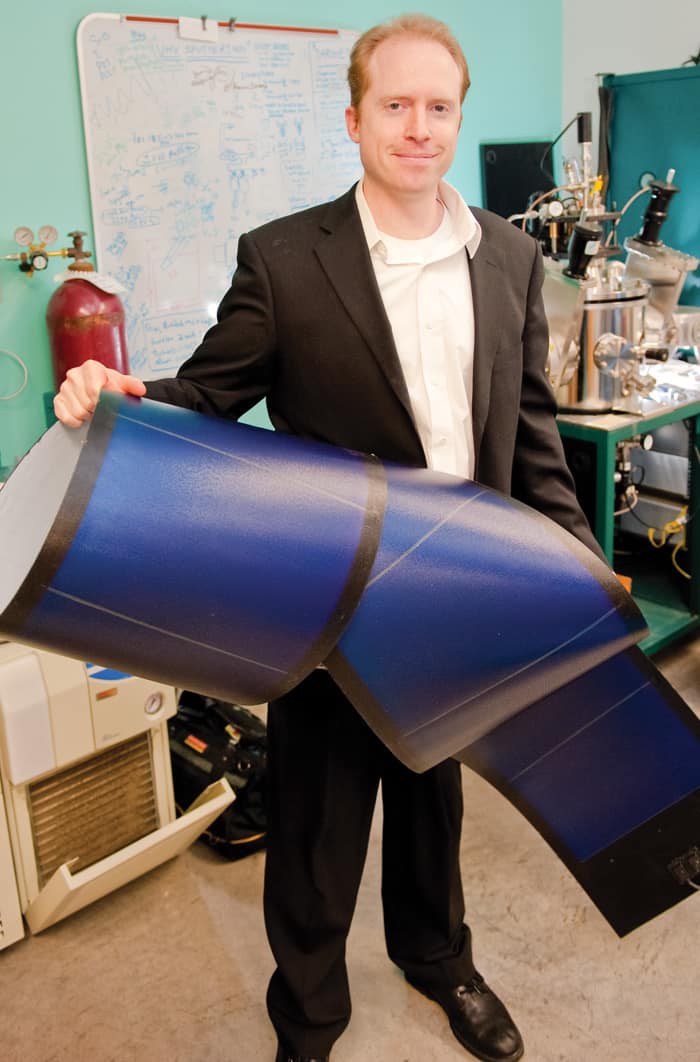
High-tech More complex up-to-date technology, such as this thin-film solar cell deposited on flexible stainless steel, can also be appropriate in some cases. Photovoltaic cells are a sustainable source of energy, capable of powering everything from the lights in a hut to major science centres. (Courtesy: Sarah Bird/Michigan Tech)
These same principles also apply to OSAT hardware. Such hardware can be simple and elegant, as with the treadle pump (see “A foot-powered water pump”) and a device that uses ultraviolet light from the Sun to purify water (see “Sunlight is the best disinfectant”). However, it can also encompass complex and state-of-the-art devices such as LEDs and photovoltaic cells on flexible substrates. In fact, even hi-tech devices such as mobile phones can sometimes be used in “appropriate” ways. For example, Bangladesh’s national “Village Phone” programme, which primarily targets women living in remote areas, works like an owner-operated payphone. To cover the initial costs of the phone, borrowers take out a $200 loan from the Grameen Bank, a Nobel Peace Prize-winning organization that specializes in this type of “microfinance”. They then subscribe to a related telecoms firm, Grameenphone, and are trained on how to operate the phone and how to develop a business by charging others – such as small farmers, who need to determine the best local city to take their produce to on a given day – to use it. With OSAT, the conflict is not between hi-tech and low-tech, but between appropriate tech and inappropriate tech. The most important feature of any OSAT device is that it must take into account any limitations imposed by the cultural, economic, educational and environmental resources of the local community.
Fully formed
One particularly interesting recent area of OSAT development is “distributed additive manufacturing”, which uses 3D printing to make everything from solar-distillation devices to hand-cranked generators. Broadly speaking, 3D printers work by taking in a filament of the working material (a popular one is a plastic called ABS, which is used in making LEGO bricks), heating it and then extruding it through a nozzle to produce a single 2D layer. By raising the printer’s vertical axis and repeating the process many times, it is possible to construct a 3D object layer by layer (see September 2013 pp25–29).
Although some commercial 3D printers cost thousands of pounds, there is an open-source 3D printer known as a RepRap – the name is short for “self-replicating rapid prototyper” – that can be built for less than £400 and is capable of printing around 50% of its own components. RepRaps use computer-aided designs that can be shared over the Internet as easily as photographs. Hundreds of RepRap-friendly designs for OSAT devices exist already, including “recyclebots” that turn waste plastic into 3D printer filament. It is also worth noting that components of many scientific instruments can be made using RepRaps – a fact that could reshape the landscape of science education and research in developed countries as well as developing ones (see “Open-source 3D-printed scientific equipment”).
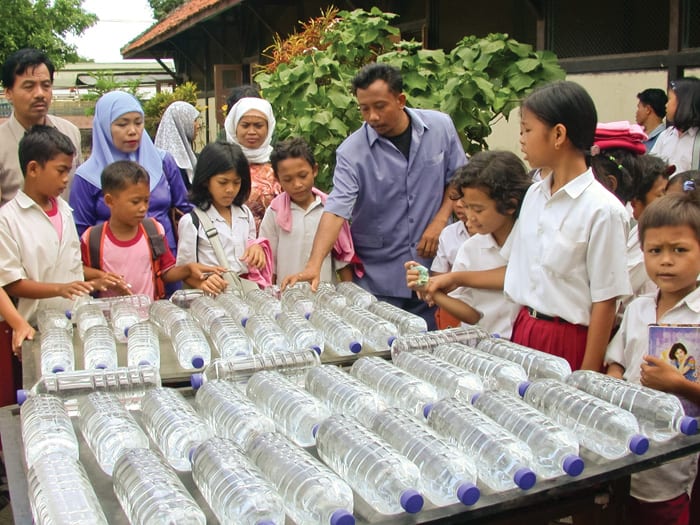
Sunlight is the best disinfectant SODIS is a simple, low-cost method of disinfecting drinking water using the Sun. When transparent soda bottles filled with biologically contaminated water are placed in sunlight for six hours the combination of solar heat and ultraviolet light sterilizes the water and makes it safe to drink. Here it is being used in Indonesia. (Courtesy: CC-BY SODIS Eawag)
There is plenty of research left to do in this area, including improving local availability of feedstock for polymers and other materials (including ceramics and metal); increasing the maximum size of printed parts; improving the material properties of the printed objects; and using renewable-energy systems to power the production. My collaborators and I have already started working on solar-powered 3D printers that fit in a suitcase. However, more work is still needed to extend existing 3D printing technology before a complete, village-level OSAT fabrication process will become a reality.
Getting involved
Physicists have a good track record of opening up science for the common good. We have been sharing our open-access e-prints on arXiv for more than 20 years, long before “open access” became a buzz-word. Given this background, I think it is time for physicists to take a serious look at OSAT.
If you are already doing research that could directly contribute to sustainable development, I suggest you start sharing your work on Appropedia. This advertising-free website works like Wikipedia – anyone is allowed to create and modify content directly from their Web browser – and it has become the primary site for collaborative solutions in sustainability, poverty reduction and international development. On it, you will find project examples, descriptions of best practice, “how tos”, ideas, designs, observations, experimental data, deployment logs and much more. Most of the projects on there have been created by development workers and students, and many of them would benefit from the analytical minds of physicists. In addition, Appropedia would welcome summaries of your latest results on technical topics related to the site’s mission. And of course, if you need field partners to help test some of your ideas, there are some perfect collaboration opportunities just waiting to happen.
But even if your research is not directly related to appropriate technology, you can still contribute to OSAT by making your own designs for customized lab equipment into open-source hardware. These contributions can include the bill of materials and instructions for operating equipment you have already made; or you can design new tools, which can be 3D printed. A good program for doing this is OpenSCAD – a free, open-source application that uses a script containing details of an object’s geometric parameters as its input. If you can already program a computer, you will be able to easily learn OpenSCAD. OpenSCAD is extremely powerful as it enables designs to be fully parametric, meaning that changes can be made simply by adjusting the value of user-defined variables. Another useful customizing tool can be found in the Thingiverse, one of many digital repositories of free printable designs. This repository includes an application that converts OpenSCAD scripts into easily manipulated designs that anyone can use.
By sharing equipment designs with the open-source community, you will help other groups lower their laboratory costs and make your equipment accessible to researchers in the developing world. Moreover, you will also benefit directly when members of the international open-source community hack your equipment to improve it and then share the new, enhanced design with everyone. With OSAT, we all win.
Open-source 3D-printed scientific equipment
Printable lab equipment A student at Michigan Tech tests a chemical oxygen demand analyser made from 3D-printed parts. (Courtesy: Michigan Tech)
A number of designs for scientific equipment are available online. For example, some of my work on solar water purification requires heat exchangers, which needed very expensive prototyping with laser welding. We were able to build a digitally controlled laser welding system, using printed parts and open-source plans, for less than the price of a single heat-exchanger prototype. We also used a script in OpenSCAD to make a chemical oxygen demand analyser (see “Printable lab equipment”). This analyser runs on a simple version of an open-source Arduino Uno microcontroller and all the black components were synthesized using a RepRap 3D printer. We have shown that it is as accurate as commercial models but costs two orders of magnitude less.
If your research takes place on the nanoscale, you might be interested to hear that the University of Münster in Germany has developed an open-source scanning tunnelling microscope for a fraction of the cost of commercial systems. If your work requires optics, you might consider using a RepRap to print components from the open-source optics library. This library contains free designs to build a research-grade Michelson interferometer or a hand-held spectrometer, along with many other tools. And physics teachers, take note: a basic optics lab set-up for an entire class costs only about £300 to print, compared with a retail cost of about £9000. I have documented dozens of other examples in my book The Open-Source Lab: How to Build Your Own Hardware and Reduce Research Costs (2014 Elsevier).
A new way of making ultrathin, flexible and transparent electronics has been unveiled by researchers in Switzerland. The technique involves fabricating micron-thick electronic devices on a conventional silicon wafer, which is later detached by soaking it in water. The free-floating devices can then be placed onto a variety of biological tissues, including human skin and even a single hair. The technology could be used to make “smart” contact lenses for monitoring the pressure in an eyeball or for creating flexible solar cells.
An important challenge for those wishing to incorporate electronics into biological systems is to make devices that are compatible with soft and flexible living tissue. Silicon – the material of choice in conventional electronics – is, unfortunately, strong and brittle, which makes it unsuitable for many biological applications. As a result, researchers have been busy developing devices based on more supple materials.
Carpenter’s glue
The new technique has been developed by Giovanni Salvatore and colleagues at the Swiss Federal Institute of Zurich (ETHZ), who have created transparent devices based on extremely thin and flexible transistors. The fabrication process begins with a conventional silicon wafer that is 2 inches (51 mm) in diameter. It is coated with two thin layers of two different water-soluble glues, one of which is polyvinyl acetate – the main component of the white glue used by schoolchildren and carpenters. A layer of parylene just 1 μm thick is then deposited on the top layer of glue.
Electronic components are subsequently fabricated on the surface of the parylene by depositing semiconductor, dielectric and conducting materials in appropriate patterns. The resulting circuits are so thin that they lie less than 200 nm above the surface of the parylene itself. Although the researchers used metal conductors in some circuits, these were not completely transparent. So to make fully transparent transistors, the team turned to indium tin oxide, which is both optically transparent and an electrical conductor.
Once the devices are built, the wafer is simply immersed in a dish of water. After about half an hour, the glue has dissolved and the film floats to the surface where it can be retrieved and cut into individual components.
Differential amplifier
One device made by the team is a differential amplifier with input and output electrodes, as well as an option to connect a power supply. The researchers operated the amplifier with the film both flat and bent; they found only a small degradation in performance in the latter configuration. In another study, a device comprising one thin-film transistor (TFT) was wrapped around a human hair, bending the TFT into a radius of curvature of just 50 μm. Despite the strain on the TFT, it was able to operate normally.
Wrapped around a hair These thin-film transistors work as normal, even when wrapped around human hairs. (Courtesy: G Salvatore et al.)
The team also integrated a strain gauge into one of its devices, which was transferred to the surface of a contact lens. According to Salvatore, such a device could be used to provide real-time information about the pressure in an eyeball. He and his colleagues argue that such a system could offer significant improvements in the diagnosis of glaucoma.
The researchers also showed that the flexible electronics could be stuck to a range of different surfaces, including human skin, a plant leaf and a number of different everyday materials, including textiles and rubber.
Internal power supplies
So far, all of the devices have been powered externally. But to be of practical use, devices need internal power supplies. Salvatore told physicsworld.com that the ETHZ group is now working on several different schemes for supplying energy to the devices. One option borrows from passive RFID tags, which are used to identify and track goods and even people. In the case of a contact-lens-mounted device, an radio-frequency (RF) signal is sent to the device and absorbed by a built-in antenna. This gives the sensor enough energy to read the strain gauge and then broadcast the result as an RF signal. The team is also exploring how solar energy could be used to power devices.
Earthquake lights – the rare, glowing phenomena that are occasionally seen before or during seismic events – may be closely associated with a specific type of geological fault. That is the conclusion of a new study by researchers in Canada and the US who have studied descriptions of the phenomenon that have been recorded over the past 400 years. The team suggests that the “subvertical” faults might act as channels that direct electrical charge to the surface, where it ionizes air to create the luminous effect.
The origins of earthquake lights have long been an intriguing mystery for seismologists and their existence was not confirmed until they were first captured on film in the 1960s. In this latest study, Robert Thériault of Quebec’s Ministry of Natural Resources and colleagues studied well-documented observations of the phenomena going back to the 1600s. To ensure only the best, authentic events were analysed, the team discarded reported luminosities with possible non-seismic origins. These included cases where the lights were accompanied by smoke issuing from the ground, or were suggestive of Moon or Sun halos. In total, the team included 65 events from the Americas and Europe in its study.
Among the sightings that were examined was a report of “streams of light” seen running along the ground 100 km north-west of San Francisco before the infamous 1906 earthquake, which destroyed 80% of the city. The study also includes the bright pink-purple globe of light that flew above Quebec’s St Lawrence River prior to the 1988 Saguenay earthquake.
Globes, illuminations and flames
The survey revealed that lights have occurred alongside earthquakes of a variety of magnitudes – between M 3.5 and 9.2. The majority (80%) were associated with earthquakes of magnitude greater than M 5.0, which corresponds to a medium-sized earthquake. The lights themselves also varied in shape and size. They have appeared as stationary or moving globes, atmospheric illuminations or in flame-like configurations issuing from the ground. Also variable was the distance from the earthquake epicentre to where the light was seen.
Unexpectedly, the team found that 97% of earthquake lights were associated with subvertical faults, which only cause about 5% of the Earth’s total seismic activity. Subvertical faults exist where a region of a tectonic plate is stretched, pulling it apart and causing faults in the form of vertical cracks – or rifts – to form in the crust. These “intraplate” regions are unlike the subduction zones that are associated with most earthquakes, where one plate is slipping below the other.
Streaks of light in Romania One of five photographs taken around 23 March 1977 near Brasov, Romania. This is about 100 km north-west from the epicentre of a M 7.2 earthquake and the lights are believed to be associated with a series of aftershocks. (Courtesy: Seismological Society of America)
Another important finding of the study is that the lights only seem to happen before or during an earthquake. When lights appear prior to an earthquake, Thériault and colleagues believe this indicates a relation between the lights and the rapid build-up of stress deep underground prior to fault rupture. When lights and earthquakes occur at the same time, the team believes the phenomenon is related to changes in stress that occur as transverse shear waves propagate through the crust.
This second explanation is backed up by a recent event included in the study. During a 2007 earthquake in Pisco, Peru, security cameras captured lights forming in the air at the same time as shear waves passed through the ground below.
Positive-charge carriers
The team believes that the lights are caused by the stress-induced creation of mobile carriers of positive charge within metamorphic and igneous rocks. Existing defects in the rocks’ mineral structure – described chemically as peroxy bonds – break preferentially when stressed, forming positive charges that can move throughout the rock. These charges are then directed towards the surface by the vertical rift structure.
“Rift settings are characterized by deeply penetrating subvertical faults, which is not the case for subduction-zone-related tectonic environments,” explains Thériault. “We believe that deeply penetrating vertical-to-subvertical faults may help in ‘channelizing’ the electronic-charge carriers towards the surface.” In contrast, the shallow inclination (at 30–45%) of subduction-related faults – along with their tendency to occur under the ocean – is believed to prevent the light-generating charges from reaching the surface.
In the past, the portentous nature of earthquake lights has occasionally served as a useful warning. In Italy’s 2009 L’Aquila earthquake, for example, a resident led his family to safety outside after seeing flashes of light inside his home a few hours before the earthquake hit. This recognition of impending danger, however, seems to be rare in history. “Hopefully, the publication of our research will help the general public to know more about what earthquake lights are all about,” Thériault comments, adding that “public awareness that such phenomena exist and can be related to an upcoming earthquake may ultimately save lives.”
Monitoring network
The researchers are now looking into the possibility of establishing a monitoring network capable of earthquake forecasting. This would use studies of earthquake lights and other parameters that are known to vary prior to earthquake episodes. These include air ionization, the electrical conductivity of soil, and electromagnetic emissions. Some or all of these phenomena could also be related to stress-induced electric-charge generation.
While some experts have welcomed the study, others have expressed concerns about its methodology. “While less than 5% of the world’s earthquakes do occur in intraplate tectonic settings, such events often occur in inhabited areas and therefore the probability of any earthquake-related phenomena being humanly observed is probably high. This study appears to fail to take this sampling bias into account,” explains Mamoru Kato, a geophysicist from Kyoto University. Kato concludes that the paper, while good as a review of documented earthquake light events, could be premature in its conclusions.
Physicists today are faced with a multitude of options when it comes to accessing and sharing information with each other. Research collaborations are becoming increasingly international, bringing both opportunities and challenges with communication. There are ever-growing numbers of ways of accessing journal papers. And it seems that every other day sees the arrival of some shiny new social-media site for sharing and discussing the latest developments.
IOP Publishing (which publishes physicsworld.com) has teamed up with the Research Information Network (RIN) to try to improve our understanding of how information practices are changing in the physical sciences. You can help shape that understanding by taking our short survey. If you need a little sweetener, you will also be given the chance to enter a prize draw where you can win a $500 bursary to attend the academic conference of your choice. All in, the survey should take you about 10–15 minutes.
I caught up with Ellen Collins, a social researcher at RIN, to find out a bit more about what the project is designed to achieve.
Why are you doing this study?
EC: It’s become something of a truism to say that scholarly communication is in a state of flux. There’s been a lot of research, writing and low-level panic among publishers and others as they try to understand their changing business. The digital environment has brought all kinds of new possibilities, for generating, sharing and finding information. Not everybody is sure how best to respond.
Who is RIN?
EC: RIN is a small independent research consultancy working on scholarly communications. We partner with publishers, research funders and universities to understand how scholars’ information needs are changing.
What type of survey is this?
EC: A lot of studies begin from the publisher’s point of view. They ask the researcher: what do you think about open access? Do you prefer to read in print or online? Which publisher services do you value most? Where do you discover the articles that you read?
The information these studies provide is useful, as far as it goes, but it doesn’t engage with the broader context that researchers inhabit. Understanding this is a really important part of a publisher’s job, if they are to stay relevant to the community that underpins their business.
What types of information are you hoping to get from the survey?
EC: Of course, we want to know about how you find and share information. But we also want to understand a bit about your wider work environment – for example, how you collaborate, or what kinds of data you usually produce.
What do you plan to do with the information?
EC: We’ll be sharing the findings publicly for anyone to use, and we hope they’ll improve understanding of how physicists work. There will be a publicly available report in the spring of this year.