Researchers in the UK, Japan and the Netherlands have fabricated the most functionally complex integrated quantum circuit ever from a single material, capable of generating photons and entangling them at the same time. The circuit consists of two photon sources on a silicon chip that interfere quantum mechanically. Its inventors say that it could be used in quantum information processing applications and in complex on-chip quantum optics experiments.
Quantum interference is at the heart of many quantum information processing algorithms and technologies. However, to observe this uniquely quantum-mechanical effect, the photons employed need to be indistinguishable – that is, they need to be identical in every possible way. They also need to be produced from identical photon sources, something that has proved difficult to do in the past.
A team of researchers led by Mark Thompson of the University of Bristol in the UK has now succeeded in overcoming this hurdle and has managed to realize two identical photon sources on a single silicon chip for the first time. “These sources produce entangled light – which we can control – and quantum mechanically interfere on the same chip,” explains Thompson.
Four-wave mixing
To generate the photons on their chip, the researchers began by injecting a strong infrared pump laser beam into it. The beam produces photon pairs via a nonlinear interaction with the silicon material in a process called spontaneous four-wave mixing.
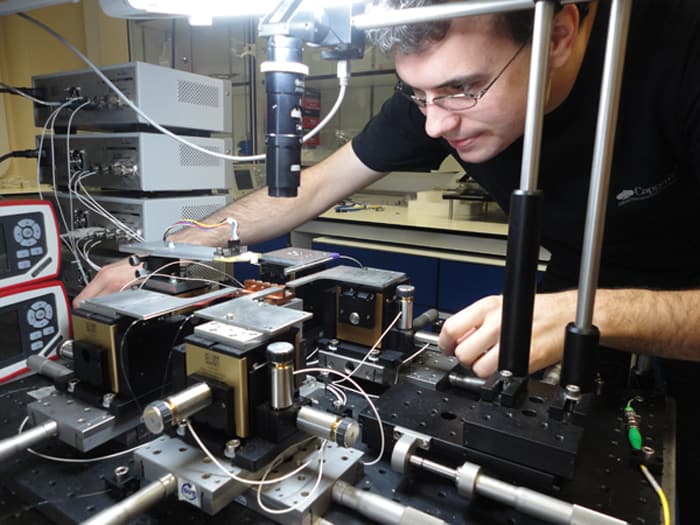
In the lab University of Bristol team member Damien Bonneau coupling light into the device. (Courtesy: M Thompson)
“We injected the beam into two regions on the chip (these regions subsequently become the two sources) and combined the quantum light produced using a beam-splitting element, also on the chip,” said Bristol team member Josh Silverstone. “We precisely controlled the path length travelled by the photons through one of the sources by changing the temperature of one of the two waveguides contained in the chip and observed quantum interference fringes.” These fringes are a signature pattern of two-photon quantum interference, he says.
A big advantage of silicon quantum photonics is that these structures can be fabricated using methods that are very similar to those used to make modern CMOS microelectronics, Thompson says. “Our particular circuits were made by Toshiba in Kawasaki, Japan, using standard silicon fabrication techniques, but any CMOS foundry could have been used. In the long term, we could even envisage quantum photons and standard electronics integrated on a single chip.”
Exceptionally well matched
Thanks to its circuit, the team was able to examine quantum interference between two on-chip photon sources for the first time. The sources show extremely high quantum interference, which implies that they are exceptionally well matched. “Such good matching is a prerequisite for building any larger scale quantum-optical system,” says Thompson.
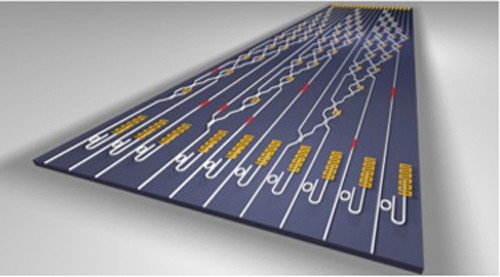
Future chip Vision of a near-term future chip, containing sources, circuits and detectors. (Courtesy: M Thompson)
The circuit made in this work could also be used to perform more complex on-chip quantum optics experiments than those possible in bulk or fibre optics. “There are even wider implications for the future, however, in that many photon pair sources might be combined on individual silicon chips and work together in a highly efficient way,” adds Thompson.
The team, which includes researchers from the University of Glasgow in Scotland and the Kavli Institute of Nanoscience at Delft University of Technology in the Netherlands, now plans to combine the elements needed to make fully integrated photonic quantum information systems on a single device. “So far, we have combined quantum sources with quantum circuits, but the next big challenge will be to include single photon detectors, and then scale up to the many hundreds of on-chip components required to perform complex quantum information processing tasks with photons,” reveals Thompson.
A hot topic this week. (Courtesy: Shutterstock/indigolotos)
By Hamish Johnston
Why do sausages usually split lengthwise when cooked? That’s the subject of a fantastic article on Gizmodo that applies physics and maths to answer this important culinary question. Full of diagrams, a dozen equations and an evocation of Pascal’s principle, the article concludes that the “hoop stress” on the casing, which tends to cause lengthwise splits, is double that of the stress in the perpendicular direction. The article was adapted from a piece by the blogger Nick Berry about why pipes usually split lengthwise when frozen.
Physicists in Germany have developed a technique for producing the first ever near-continuous beams of molecules slowed and cooled to a temperature of just one degree above absolute zero. The method, which involves running the molecules through a centrifuge, could help provide new insights into quantum states of matter and even allow physicists to work out if the electron has an electric dipole moment. The beams could also prove useful in studying chemical reactions that occur when molecules collide.
While physicists have enjoyed great success in chilling ensembles of some atoms down to nanokelvin temperatures, molecules have proved much more difficult to cool. What physicists normally do is to first create a very slow beam of cold molecules, which they can then trap and cool further. However, all the deceleration techniques developed so far create pulsed beams of slow molecules in which the beam is “on” for less than 1% of the time. While pulses are fine for some applications, most techniques for making ultracold molecular gases would benefit from a large continuous flux of cold molecules.
Molecular merry-go-round
Now, however, Sotir Chervenkov and colleagues at the Max Planck Institute for Quantum Optics in Garching, Germany, have come up with a clever way of slowing down molecules that yields a nearly continuous beam. Its fundamental principle is familiar to anyone who has been on a playground merry-go-round. If you start at the edge of the spinning platform and try to move to the centre, you are opposed by the centrifugal force pushing you outwards.
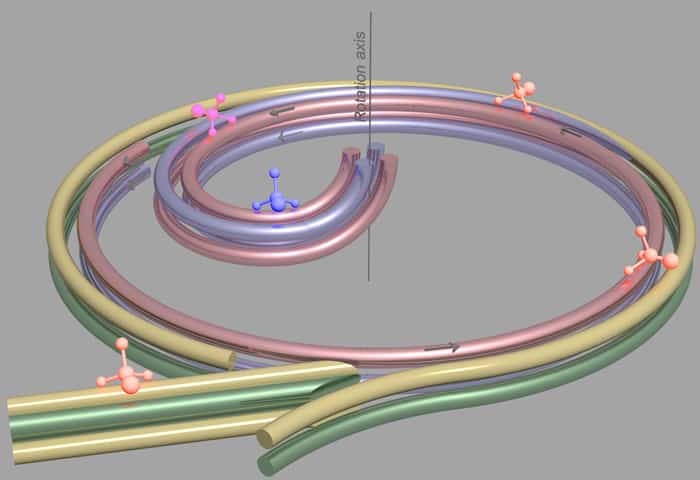
A molecular roundabout Diagram of the cooling centrifuge: the inner pink and blue electrodes are rotating anticlockwise while the outer green electrode is static. Molecules enter the turntable at bottom left and are guided between the rotating pink electrode and the static green electrode. Molecules at the upper left of the circle are guided into the spiral formed by the pink and blue electrodes. The slowed molecules exit the turntable via a 90% bend at the centre. (Courtesy: Sotir Chervenkov)
In the new system, molecules are injected into a spiral path that goes from the outer edge of a spinning turntable (diameter 40 cm) to its centre. The path is defined by a quadrupole arrangement of electrodes (see figure above). Initially moving at about 200 m s–1, the molecules are slowed by their battle against the centrifugal force and emerge from the centre of the turntable moving at about 20 m s–1. The researchers have so far created a range of continuous ultracold beams, including beams from fluoromethane.
An important feature of the device is that the flow is nearly continuous and only interrupted briefly at one point in the rotation cycle. Most of the emerging molecules have kinetic energies that correspond to a temperature of less than 1 K. This means that if the molecules were subsequently collected in a trap, the resulting gas would have a temperature below 1 K.
Further cooling
The centrifuge could be used to deliver abundant quantities of slow molecules, which could then be further cooled using methods such as evaporative cooling or the Sisyphus technique. The latter was unveiled in 2012 by a team a Garching led by Martin Zeppenfeld and is capable of creating molecular gases with temperatures as low as 30 mK.
“The centrifuge holds promise for delivering abundant samples of slow molecules, which could be further cooled down en route to achieving quantum-degenerate regimes with polar molecules,” explains Chervenkov. He also points out that the cold beams could be used to do experiments involving the low-energy collisions of molecules, which give important insights into the role of quantum tunnelling in chemical reactions.
Team member Gerhard Rempe adds that the technique could be applied to other cooling applications. “The universality of the centrifugal force might also enable one to slow down atoms that cannot be laser cooled, and possibly even cold neutrons,” he says.
Researchers in China are the first to study ball lightning using high-resolution spectroscopy. Their results lend support to an idea first advanced in 2000 that ball lightning is fuelled by burning minerals from soil.
Ball lightning is one of the strangest phenomena in atmospheric physics, with reports of glowing spheres or ellipsoids chasing cows, flying through windows or appearing in aeroplanes. While a growing amount of evidence points to its existence, ball lightning has never been properly explained. This is because its rarity and unpredictability make systematic field study impossible.
Indeed, accounts of ball lightning can vary dramatically. Most have the orb moving horizontally just above the ground at speeds of several metres per second, but others have described balls that move either up or down. The motion can be along either straight or meandering paths; the balls seem to vary in size between 1–100 cm; they endure for about 1–10 s before vanishing; and their colour can be white, orange, yellow, purple or green.
Reduction and oxidation
In 2000 John Abrahamson and James Dinniss of the University of Canterbury in New Zealand suggested that ball lightning is caused by lightning striking silicon-rich soil. If the earth gets hot enough to be vaporized, carbon from the soil reduces silicon from silica to its elemental form. In the oxygen-rich environment of the air, however, it rapidly oxidizes once more, emitting black-body radiation that we perceive as ball lightning.
Then in 2006, Eli Jerby and Vladimir Dikhtyar at Tel Aviv University produced some evidence to support this theory. They created levitating fireballs by irradiating solid materials such as silicon with high-power microwaves that melted and then vaporized material from the surface. However, there was no direct evidence that actual ball lightning occurs in this way.
Lucky strike
Then in 2012, Jianyong Cen, Ping Yuan and Simin Xue from Northwest Normal University in China had a stroke of luck. The team was recording thunderstorms in the country’s Qinghai Plateau with high-speed cameras with high spectral resolution in an attempt to determine the spectral characteristics of ordinary lightning. By pure chance, one of the lightning strikes that the researchers recorded was followed by the appearance of a glowing sphere about 5 m in size, moving at about 8.6 m s–1 and lasting just beyond 1.5 s. It started out a bright purple-white colour before gradually turning orange, white and finally red.
The entire event was captured on a digital video camera. The latter half was also recorded on a high-speed camera that records 3000 frames per second, but which unfortunately cannot operate continuously – the initial strike occurred during the instrument’s “off” phase.
Analysing the pictures taken, the researchers found clear emission lines from silicon, iron and calcium – the main components of soil. The researchers say this supports the idea that the energy source for ball lightning is a burning core of soil. Curiously, however, there was also an intensity fluctuation at about 100 Hz. The event occurred near some high-voltage power lines with a frequency of 50 Hz, and the authors suggest this intensity modulation could be related to this proximity.
Model development
Jerby told physicsworld.com that the spectroscopy result is a significant development. He believes that the atypically large size of the ball and the mysterious 100 Hz intensity fluctuation prevent the event being labelled ball lightning with certainty, although he believes it is “very likely”. Assuming this is the case, he says that “the optical and spectral characteristics reported in this paper are of great importance, as they provide significant experimental data for the development of more comprehensive ball-lightning models.”
Abrahamson agrees that the observed phenomenon is very likely to have been ball lightning, and believes the researchers “have done a good job and made the best of the opportunity that their unexpected observation gave them”. He added that, to his knowledge, “no other observer has been able to measure the optical spectra of ball lighting, let alone find the changes of this during its lifetime”. He is especially intrigued by the observation that the emission lines of nitrogen and oxygen oscillate rapidly with time, whereas those of silicon, iron and calcium change only slowly. “This argues for two different sources of radiance from the same ball,” he says.
The research will be published in a forthcoming issue of Physical Review Letters.
Astronomers in the US have unveiled a new way of measuring the mass of an exoplanet by studying several different parameters of the body’s atmosphere. The technique could provide important insights into distant Earth-like objects and also help scientists to work out if life exists on other worlds. Although the technique has so far only been tested on Jupiter-sized planets, the researchers say that the next generation of telescopes will allow it to be used on objects that resemble the Earth.
Over the past decade or so, astronomers have discovered more than 900 planets orbiting stars other than the Sun, along with a further 2300 that look like exoplanets but still need to be confirmed as such. Most known exoplanets are similar to Jupiter because it is much easier to detect these giant planets using existing telescopes. Several rocky Earth-like exoplanets have, however, also been found and astronomers expect many more to be discovered using the next generation of instruments.
Wobble measurements
An exoplanet’s chemical composition is expected to hold important clues about whether it could support life. This composition can be deduced from an exoplanet’s density, which can be calculated by measuring its mass and radius. The mass of an exoplanet can usually be determined from the fact that as the exoplanet orbits around its parent star, the latter wobbles towards and then away from the Earth. This movement can be measured by observing the Doppler shift of the starlight as its source moves. When combined with an independent estimate of the mass of the star, an upper limit for the mass of the planet can be established.
Although this technique works well with large Jupiter-sized planets or Earth-sized objects orbiting close to very bright stars, it fails for rocky planets in orbits similar to that of the Earth round the Sun. The latter are the very exoplanets where life is most likely to exist. Now, however, Julien de Wit and Sara Seager of the Massachusetts Institute of Technology (MIT) have come up with a new way of measuring the mass that that works on “transiting” exoplanets – those that periodically pass in front of their host star.
Transiting exoplanets block some of the starlight from reaching the Earth and so, by measuring this apparent stellar dimming, the orbital period of the exoplanet as well as its diameter relative to that of the host star can be determined. However, much more additional information is also available in a transiting measurement. In particular, as a planet passes in front of its star, a small amount of the starlight travels through the exoplanet’s atmosphere before reaching the Earth. Some of this light gets absorbed by the atmosphere and astronomers can already use the resulting absorption spectrum to gain important information about the chemical composition, density and temperature of the atmosphere.
Pressure drop
In this latest research, De Wit and Seager have extended this list to include information about the pressure of the atmosphere, and in particular how it changes as a function of the distance from the exoplanet’s surface. Calculations made by the pair reveal that the pressure gradient, density and temperature of the atmosphere are related to the mass of the planet by a relatively simple equation. Furthermore, the researchers have shown that the pressure gradient, density and temperature can all be measured independently from the transit spectrum, thus giving the mass.
A key innovation that makes the technique possible is a new way of measuring the pressure gradient by looking at how the transparency of the atmosphere changes a function of altitude.
The researchers tested their method by using it to calculate the mass of a recently discovered exoplanet that is about 63 light-years from Earth. Called HD 189733b, this “hot Jupiter” is in a tight orbit that revolves around its parent star in just 2.2 days. Because it is an ideal candidate for existing telescopes to study, the mass of HD 189733b is known to within about 5% – it is about 1.16 times the mass of Jupiter. The new technique yielded the same mass within a similar uncertainty range.
Unfortunately, the technique only works for gas giants and cannot yet be applied to Earth-like planets using existing telescopes such as Hubble. However, De Wit and Seager believe that once Hubble’s successor – the James Webb Space Telescope – comes online in 2018, the technique could then be used to study Earth-like planets because the data from the on-board spectrometers will be superior to that currently available. Planetary scientists believe that some Earth-sized exoplanets may have very different compositions from the Earth, which could have important consequences for the development of life on those worlds.
On Saturday 19 October 2013 the instruments and cooling systems on the European Space Agency’s Planck spacecraft were switched off, marking the end of the scientific part of the Planck mission, after more than four years of mapping the cosmic microwave background. A day later, in preparation for a final shutdown command, a piece of software was uploaded that would prevent the spacecraft systems from ever being switched on again so that the onboard transmitter would never cause interference with any future probes. At this point Planck had already been “parked” indefinitely in a “disposal” orbit, far from the Earth–Moon system, having been nudged off its perch at the 2nd Lagrangian Point (L2) in August 2013 by a complicated series of spacecraft manoeuvres. These preliminaries having been completed, on 24 October 2013, at 12.00 GMT, a final instruction was successfully transmitted that shut down Planck for good. The Planck spacecraft will continue to orbit silently in the Sun’s gravitational field for the foreseeable future.
But although this is the end of the Planck mission, it is by no means the end of the Planck era. Vast amounts of data still need to be fully analysed and key science results are still in the pipeline. The numerous maps, catalogues and other data products will be a priceless legacy to this generation of cosmologists, and no doubt many future generations. Nevertheless, this seems a good time to step back a little and try to form some sort of perspective on what the mission might mean for cosmology in the longer term. In this article, I’ll try to do this by reflecting on what Planck was actually all about, asking what we have really learned from it, pondering what its scientific legacy might be, and suggesting what might come after it.
What was Planck?
The serendipitous detection of the cosmic microwave background (CMB) radiation in the 1960s provided the first direct evidence that the universe began in a hot Big Bang and led to its discoverers, Arno Penzias and Robert Wilson, being awarded the Nobel Prize for Physics in 1978. In the early days of CMB science, however, all that was known about the radiation was that its temperature is about three degrees above absolute zero, that it is of roughly black-body form (consistent with having been produced in thermal equilibrium with matter), and that it is approximately uniform in all directions on the sky. Theorists realized that the current low temperature is the result of the expansion of the universe and that the black-body radiation had actually been produced at a much higher temperature, at a time when the universe was filled with a plasma of ionized material that scattered radiation very effectively and was therefore opaque.
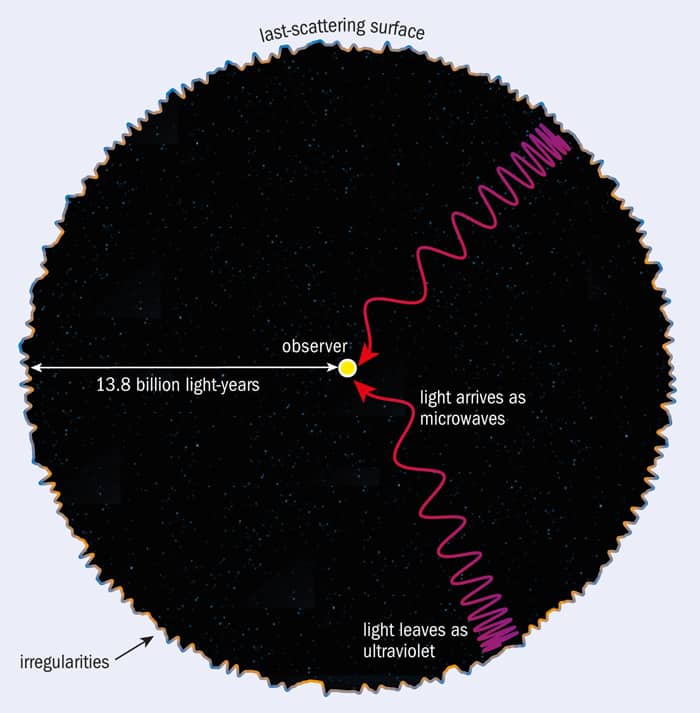
1 Gazing back in time Current cosmological theory tells us that about 380,000 years after the Big Bang, matter went from being an opaque plasma of ions and electrons to a transparent gas of atoms. This allowed the photons, which until then had been continually scattered, to travel through the now-transparent universe. Having existed at ultraviolet wavelengths when the temperature was 3000 K (purple), those photons reaching us now have microwave wavelengths corresponding to a temperature of 3 K (red), because over the 13.8bn years between then and now, the expansion of the universe has red-shifted the photons. The furthest back in time we can currently see is the location at which photons were no longer scattered in the opaque plasma, which is called the last scattering surface.
As the universe expanded and cooled, it would have undergone a relatively sharp transition when electrons and ions would have combined to form atoms, at which point the universe became transparent to radiation. This transition mirrors the behaviour of a star like the Sun, in which the matter temperature falls off with distance from its centre. Inside a star the matter is ionized and opaque; outside it is neutral and transparent. The sharp change in the optical properties of stellar matter happens at a temperature of a few thousand degrees, which is why stars have a well-defined surface temperature of that order. The CMB was produced when the entire universe was at a similar temperature to that of the surface of a star. Looking out over cosmological distances we see back to this epoch; we can’t see further because beyond the “last scattering surface”, the universe is opaque (figure 1).
Just as astrophysicists can probe the opaque interior structure of stars by studying oscillations in the surface layers – a technique called stellar seismology – so cosmologists can probe the physics of the early universe using variations in the temperature of the CMB across the sky produced by oscillations in the primordial plasma. These oscillations are of a similar form in both cases – acoustic waves (although the wavelength is much longer in the cosmological setting than in the case of a star).
The basic theoretical framework of the Big Bang assumes the Cosmological Principle – that the universe is homogenous and isotropic. Even the most cursory observation tells us, however, that the universe is not like that, but rather lumpy, which means that any satisfactory cosmological model must explain where all the lumps came from. Our basic explanation for the lumps has not changed since the late 1960s: small initial irregularities in the distribution of matter got progressively amplified by the action of gravity as the universe expanded, eventually forming the rich cosmic web of structure we see today. These initial perturbations should manifest themselves as the variations theorists expect to see in the temperature of the CMB.
The simplest way of thinking about the initial perturbations is to consider the name Big Bang. The existence of a “bang” requires there to be acoustic waves, which are variations in the density and pressure of the medium supporting them. In the absence of such variations there cannot really be a “bang”; a completely uniform universe would really have been born in a Big Silence. If our view of how cosmic structure forms is correct, these primordial acoustic waves must have existed, therefore the universe must have been born in a bang.
2 Increasing resolve Increasingly high-resolution maps of the cosmic microwave background since its discovery. The band across the centre of each map is not part of the microwave background, but is foreground contamination from our own galaxy, the Milky Way, which also emits at microwave frequencies. Blue regions are colder than average and red regions hotter. (Courtesy: NASA)
The predicted “ripples” in the temperature of the CMB were not discovered until the early 1990s, when their large-scale variation was detected by the Differential Microwave Radiometer instrument on the Cosmic Background Explorer (COBE), a discovery that led to the award of the Nobel Prize for Physics to John Mather and George Smoot in 2006. COBE only detected the low-frequency part of the “sound” of the Big Bang – those acoustic waves with physical wavelengths that correspond to patches of sky larger than 10° or so. However, it led to the development of many other studies, such as the balloon-borne Boomerang and Maxima experiments, which sought to obtain more information about the higher-frequency content so as to map the CMB sky with greater angular resolution. Then, starting in 2003, a team of researchers used data from the Wilkinson Microwave Anisotropy Probe (WMAP) to map the whole sky over a wider range of microwave frequencies, establishing in the process a nearly complete spectrum of the sound of the Big Bang (figure 2).
Although it was in its planning stages before WMAP, Planck can be seen as a natural successor to WMAP by being more sensitive and having an improved angular resolution, which enabled it to see even shorter-wavelength acoustic ripples than WMAP could. It also had a wider range of receivers that made it better able to distinguish between the true CMB and other sources of radiation from, for example, our own galaxy, that might pollute the cosmic signal.
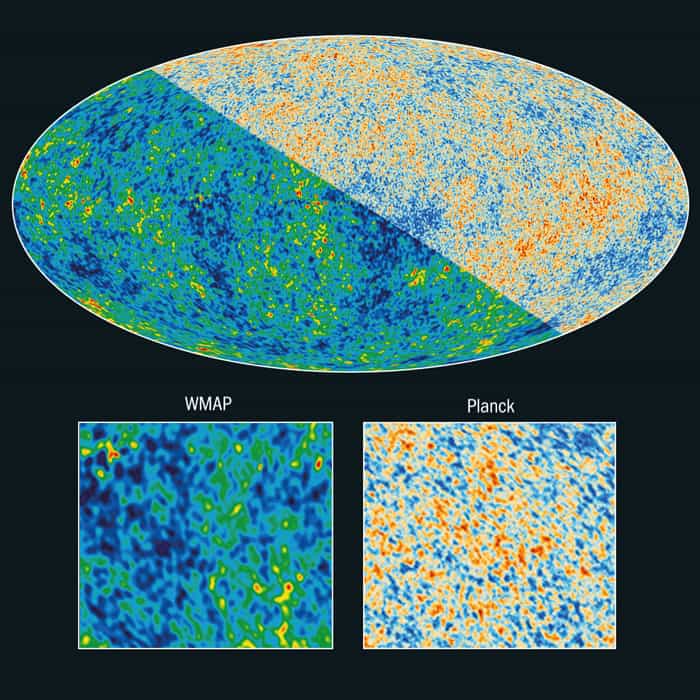
3 Resolving the ripples The map from Planck is much higher resolution than the WMAP image. There is more than an order of magnitude more information in the Planck map than its precursor. (Courtesy: NASA/ESA)
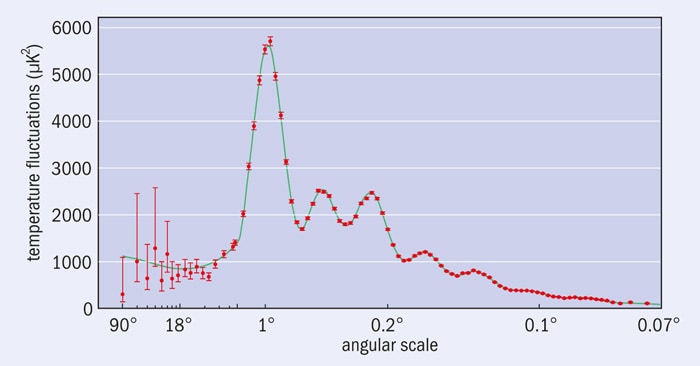
As it turned out, Planck was well up to the task of measuring the CMB spectrum over a huge dynamic range, providing results that were broadly compatible with WMAP but extending to much shorter wavelengths (figures 3 and 4).
So what are the main results from Planck? There are too many to discuss them all in detail – the science release in January 2013 resulted in more than 30 publications and different people will consider different things important. Here is a brief discussion of the three topics that interest me the most.
Cosmology by numbers
Cosmology is an unusual subject in many ways, not least because it appears to be done backwards compared with other branches of physics: instead of setting the initial conditions for an experiment and seeing how it develops, we have to infer how the great cosmic experiment that is our universe started from what we can observe it to have produced. The reason for this is that the Big Bang theory is incomplete. Based on our poor current understanding of how matter behaves at the high temperatures and densities we think occurred much earlier than the plasma phase, researchers are simply unable to predict from first principles precisely how the universe began. Indeed, the equations we use fall apart entirely at the very beginning because of the existence of an initial “singularity” at which the density and temperature become infinite.
4 Primordial pulse The power spectrum of the cosmic microwave background as seen by Planck. The plot shows the relative strength of the acoustic oscillations in the primordial plasma, i.e. how loud the Big Bang was as a function of wavelength of these waves, with long wavelengths on the left and short wavelengths to the right. The peaks occur at specific wavelengths in much the same way as they would in the sound spectrum produced by a musical instrument. In the cosmological context their position and amplitude depends on the matter content and geometry of the universe as specified by the various cosmological parameters described in the main text. (Adapted from arXiv:1303.5076)
This difficulty means that, although we can derive a system of equations, based on Einstein’s theory of general relativity, to describe the universe’s evolution in general terms, this system has a family of solutions corresponding to different initial conditions. We have no way of knowing which, if any, of these solutions corresponds to the universe we happen to live in. We are therefore unable to proceed by reason alone and are forced to seek observational clues.
Fortunately, it turns out that we can describe the entire family of possible Big Bang universes in a relatively simple way using a set of (dimensionless) parameters that, at least in principle, we can measure observationally. Many of these parameters can be determined more or less directly from the CMB. For example, the “matter” density is expressed via a parameter called Ωm, which includes both the ordinary baryonic matter from which atoms are made as well as neutrinos and the exotic dark matter that seems to be required by various astrophysical observations. We often need to consider these components separately but for the following discussion it suffices to lump them all together.
Another dimensionless parameter, called ΩΛ, describes a dark-energy component whose origin we don’t understand at all but which, in its simplest incarnation, is related to the cosmological constant term, Λ, introduced by Einstein into his general theory of relativity, way back in 1916.
In this theory of gravity, the matter and dark energy expressed by the previous two parameters determine the curvature of space–time, expressed by another parameter, k. This parameter governs not only the geometry of the universe but also its dynamical evolution. If the curvature is zero then space is “flat” (i.e. Euclidean); in this case Ωm + ΩΛ = 1 so that, in the absence of a cosmological constant, the density of matter Ωm = 1.
In a more general case, the curvature can be either positive (corresponding to a closed spatial geometry, such as a 3D version of the surface of a sphere) or negative (an “open” universe with a hyperbolic geometry such as that of a 3D “saddle”, which is admittedly rather hard to visualize).
Again looking at the case in which ΩΛ = 0, the future evolution of the universe is entirely determined by Ωm. If Ωm > 1 then its current expansion will decelerate, eventually halt and go into reverse; such a universe will recollapse in a Big Crunch. If Ωm < 1 the expansion will continue forever. A dark-energy or cosmological-constant contribution acts to accelerate the expansion of the universe, so models with a large value of ΩΛ typically experience runaway expansion in the future.
There are more parameters than these of course. There is also the Hubble constant, which describes the current expansion rate of the universe, and others relating to, for example, the densities of different types of matter. Minimal versions of the Big Bang model have about half a dozen free parameters, but extended versions have many more, not all of which are independent. I don’t have space to discuss all of them, however, so in the following I’ll just focus on these basic ones.
The existence of free parameters means that the theory is a bit of a moving target; they represent a barrier to direct testing of the theory because they can be tweaked to accommodate new measurements. However, the more precisely we can estimate their values the more we can reduce this wiggle room and subject the overarching framework to critical tests.
In 1994 George Ellis and I wrote a review article for Nature (370 609) in which we tried to weigh up all the available evidence about Ωm. This parameter basically measures the mean density of the universe and it is possible to estimate this in many ways, including galaxy clustering, galaxy and cluster dynamics, large-scale galaxy motions and gravitational lensing. Many of these techniques were in their infancy at the time but, based on the available evidence, we concluded that the value of Ωm was between about 0.2 and 0.4.
This verdict was somewhat controversial because of a theoretical predilection for a picture of the early universe, known as cosmic inflation, in which the expansion of the universe expands by an enormous factor, perhaps 1060, very soon after the Big Bang. This stretches the universe so that it is expected to appear very flat; k is driven towards zero to very high accuracy. At the time there wasn’t much direct evidence for a cosmological constant, and in the absence of this, a flat universe would require Ωm = 1. As it turns out, the subsequent development of these techniques has not changed our basic conclusion that Ωm = 0.2–0.4. The last 15 years or so have, however, seen two stunning observational developments that we did not foresee at all.
Beginning in the late 1990s, two major programmes, the Supernova Cosmology Project led by Saul Perlmutter and the High-z Supernova Search Team led by Adam Riess and Brian Schmidt, exploited the behaviour of a particular kind of exploding star, type Ia supernovae, to probe the geometry and dynamical evolution of the universe. The measurements indicate that distant high-redshift supernovae are systematically fainter than one would expect (based on extrapolation from similar nearby low-redshift sources) if the universe were decelerating. The results are sensitive to a complicated combination of Ωm and ΩΛ but they strongly favour accelerating-world models and thus suggest the presence of a non-zero cosmological constant, or some form of dark energy. The leaders of these supernova studies were awarded the Nobel Prize for Physics in 2012.
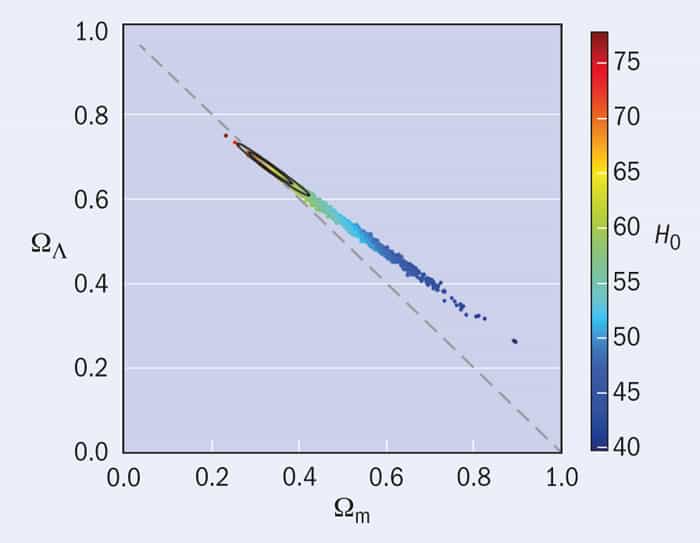
5 Composition of the cosmos Estimates of the matter-density parameter Ωm and the dark-energy parameter ΩΛ from Planck. Combining data sets such as these with results from other missions allows cosmologists to obtain values for these parameters, which describe the composition of the universe. The values also depend on the Hubble constant, H0 and must lie on the dashed grey line on which the two parameters sum to equal 1. The latest estimates, taking into account the Planck data, indicate that the universe is composed of 4.9% ordinary matter, 26.8% dark matter and 68.3% dark energy. (Adapted from arXiv:1303.5076)
The supernova searches were a fitting prelude to the stunning results that emerged from WMAP in 2003. The CMB is perhaps the ultimate vehicle for classical cosmology. When you look back to a period when the universe was only a few hundred thousand years old, you are looking across most of the observable universe. This enormous baseline makes it possible to carry out exquisitely accurate surveying. The observed spectrum of the temperature variations displays peaks and troughs that contain fantastically detailed information about the basic cosmological parameters described above (and many more). Earlier CMB experiments, especially WMAP, established a basic framework called the concordance cosmology. Planck not only confirmed this picture but made it much more precise, pinning down the free parameters to unprecedented accuracy (figure 5).
The increasing precision of cosmological-parameter estimates has tightened up the theoretical slack in the Big Bang model, but not without generating a certain amount of tension. Combining the CMB measurements with other data (such as the supernovae or measurements of large-scale structures) does seem to move the best-fit values slightly away from where they would sit if derived from the CMB alone. However, the statistical evidence for discordance among the parameters – for major departures from the standard Big Bang model – remains marginal, at least for the time being.
The confirmation and refinement of the concordance cosmology is a great achievement, on a par with the establishment of the Standard Model of particle physics. But there is more to cosmology than increasing the precision of cosmological-parameter estimates. We also need to ask if we can discover evidence of anything outside our standard view of the cosmos.
Non-Gaussianity
One important topic is the “non-Gaussianity” of the CMB, because the simplest theories of cosmological inflation predict the generation of small-amplitude irregularities in the early universe that imprint themselves upon the observed radiation pattern. These irregularities are essentially in the form of acoustic waves, so in a very real sense it is inflation that put the “bang” in Big Bang and was thereby responsible for creating galaxies and the large-scale structure of the universe. In the standard cosmological model, these acoustic waves form a statistically homogeneous and isotropic random field. Technically, this means that the perturbations have probability distributions that are invariant under translations and rotations in 3D space. Such fluctuations appear in inflationary cosmology in a manner essentially identical to the zero-point fluctuations that arise from the quantized harmonic oscillator problem and that are well known to be described by Gaussian statistics.
According to the theory of cosmological inflation, the dynamics of the early universe were dominated by a hypothetical scalar field called the inflaton. Assuming the fluctuations are small in amplitude, the scalar field evolves according to the same sort of dynamical equation that also describes, for example, a massive body falling through the air. Eventually such a body reaches a terminal velocity, which is defined by the balance between gravity and air resistance (drag) but is independent of how high and at what speed it started falling. The problem is that if you want to know where a body moving at terminal velocity started falling from, you’re stumped: all dynamical memory of the initial conditions is lost when terminal velocity is reached.
The problem for early-universe cosmologists is similar. In the context of cosmology there is a “slow-rolling” regime in the evolution of the inflaton field that is analogous to drag-limited motion of a falling body; in such a regime the universe enters a near-exponential phase of accelerated expansion, which causes it to inflate. In this phase the small-amplitude Gaussian quantum fluctuations in the scalar field become CMB fluctuations, which are Gaussian to a very high precision. If everything we measure is consistent with having been generated during a simple slow-rolling inflationary regime, then there is no way of recovering any information about what happened beforehand because nothing we can observe today will remember it. The early universe will remain a closed book forever. On the other hand, if inflationary dynamics were a bit more complicated (such as if there were multiple scalar fields rather than just a single inflaton) the fluctuations need not be so accurately Gaussian.
Before Planck, all statistical studies of CMB fluctuations had generated results consistent with Gaussian fluctuations. One of the most important things that the Planck collaboration has been looking for is evidence of non-Gaussianity that could be indicative of primordial physics more elaborate than that involved in the simplest inflationary models described by the slow-rolling solution.
Because we don’t know a priori whether any of these ideas are correct, we cosmologists encode the level of non-Gaussianity in a parameter called ƒNL and have designed sophisticated statistical tests to estimate it from observed data. By far the most precise measurements of this quantity have come from Planck; the value is ƒNL = 2.7 ± 5.8 which, within the error bars, is clearly consistent with zero. If this limit doesn’t look impressive, note that ƒNL is defined as a quadratic correction to an assumed Gaussian component. In essence we are modelling the CMB in the form a + bx + cx2, and we already know a (the mean temperature) and b (the amplitude of the Gaussian component) and want to measure the value of c (which is ƒNL), which represents the size of a non-Gaussian contribution. The typical temperature fluctuations seen on the CMB sky are about one part in 105 of the mean temperature (about 2.73 K); quadratic terms are therefore of an order 10−10, so the upper limit on the level of non-Gaussianity allowed by Planck really is minuscule; it is Gaussian to a few parts in a hundred thousand. This is one of the reasons why some people have described the best-fitting model emerging from Planck as the Maximally Boring universe.
Perhaps this is a signal that we are approaching the limit of what we can learn about inflation in particular, or even the early universe in general, using the traditional techniques of observational cosmology?
Cosmic anomalies
Although Planck seems to have closed the window on the possibility of probing the early universe using non-Gaussianity (by not finding any), it has left another window very firmly open. As well as providing the strong basis for the concordance cosmological model discussed above, the WMAP data also provided some tantalizing hints of anomalous behaviour in the CMB sky that can’t be accounted for by the standard cosmology.
One way of looking at how cosmology works is to think of it as an enormous exercise in data compression: Planck’s raw map of the CMB sky consists of millions of pixels each measured at nine different wavelengths. From this, one can extract the spectrum shown in figure 3, which consists of a few dozen data points plotted on a graph, and from the spectrum we can extract a handful of very precise parameter estimates. This data compression is possible because the data are assumed to be described by a statistically homogeneous and isotropic Gaussian random field, which means that the spectrum contains all the relevant information in the map. All other degrees of freedom in the data are irrelevant (or “non-informative”) for cosmology.
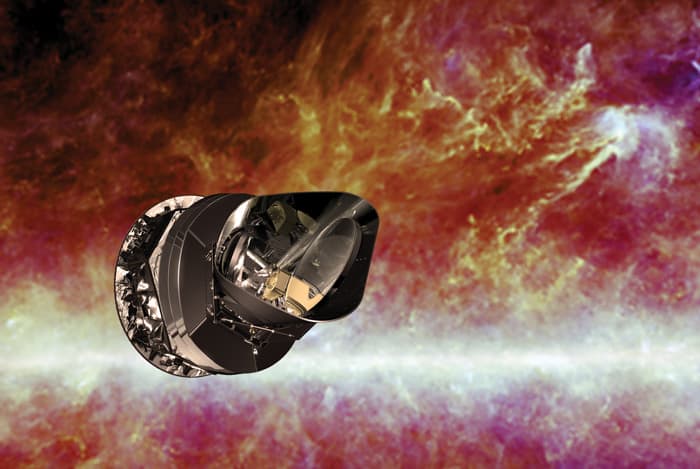
All-sky surveyor The Planck telescope may have been shut down but there is still plenty to learn from the data that it produced during its lifetime. (Courtesy: ESA)
This compression scheme only works, however, if the underlying assumption is correct. As I have explained, upper limits on the particular form of non-Gaussianity described by ƒNL are consistent with this assumption but there could be other departures that we don’t know how to characterize. These would be missed by the standard analysis pipeline, so it’s important to check the data rigorously with as many tools as possible to check we haven’t discarded any important clues.
The possible anomalies detected by WMAP included a curious “cold spot” that appears to be colder than one would expect on the basis of Gaussian statistics. WMAP also revealed an unexpected alignment between fluctuation patterns on large angular scales, chiefly between the quadrupole (90°) and octupole (45°) modes corresponding to the first two points on the left of figure 2. And finally, there was a marked asymmetry in statistical properties of the observed CMB between the hemispheres north and south of the ecliptic plane.
Opinions about these WMAP anomalies differ among cosmologists, with many thinking that they are just systematic artefacts of the experimental procedure but others convinced that they may provide clues to physics beyond the standard model (such as deviations from the cosmological principle). Intriguingly, all the anomalies found by WMAP are also present in the Planck data; there remains no consensus on their significance.
What next?
In summary, what Planck has done is to confirm and render more precise a standard view of cosmology that already existed rather than provide dramatic and revolutionary new insights. It has increased the precision of cosmological-parameter estimates and in so doing has given us a detailed quantitative description of the geometry, expansion rate and energy budget of the universe. It has provided strong evidence to support the simplest theory of cosmological inflation and also, by placing strong constraints on the level of primordial non-Gaussianity, excluded more exotic variants of the inflationary idea. It has also confirmed the existence of various anomalies found by WMAP though not really confirmed whether they provide significant evidence of physics beyond the standard model of cosmology.
So what comes next? The most obvious answer to that question is CMB polarization. The analyses of Planck data published so far focus exclusively on the variation in temperature (effectively the intensity) of the CMB across the sky. However, theory predicts that the radiation field should be partially polarized as a consequence of scattering from electrons in the primordial plasma. Measuring the polarization of the CMB is a formidable technical challenge, which explains why it will take the Planck collaboration much longer to analyse the data than in the case of the intensity alone, but promises rich rewards if it can be done. Among other things, the polarization of the radiation field depends in a particular way on the existence of primordial gravitational waves, a key prediction of inflationary theories.
The first polarization data from Planck will not be available until later this year at the earliest, but such is the importance of this aspect of the CMB that there are already missions planned as successors to Planck, such as one from the European Space Agency called PRISM.
Although we have learned a very great deal from Planck and other complementary studies, there is still a great deal about the state of the universe that we misunderstand at a fundamental level. In particular we want to know if dark matter and dark energy are real or just manifestations of something wrong with the applicability of general relativity on cosmological scales. Only time, and more data, will tell.
Infrared light could help split water into hydrogen and oxygen, despite the fact that infrared photons have less energy than is needed to drive the reaction. That is the claim of physicists in China, who have calculated that the reaction could proceed with the help of a bilayer catalyst that has a strong internal electric dipole. While making this catalyst in the lab would be very difficult, the researchers are now trying to come up with a more practical alternative. If they are successful, such catalysts would allow a far larger proportion of the solar spectrum to be used to generate hydrogen – perhaps making it a commercially viable source of hydrogen fuel.
In the 1970s some scientists envisaged that electricity generated by nuclear power stations could be used to create large quantities of hydrogen via the electrolysis of water. The hydrogen could then be used as a clean fuel for transportation or stored and then converted back into electricity to even out imbalances between electrical supply and demand. However, nuclear power has become unpopular in many countries following high-profile accidents and increased costs, and more than 90% of the world’s hydrogen is currently produced using fossil fuels.
An alternative method for making hydrogen is photochemical splitting, which was proposed in 1972 by the Japanese chemists Akira Fujishima and Kenichi Honda. Their scheme is usually realized in a suspension of catalyst particles in water. A particle absorbs a solar photon, which generates an electron–hole pair that stimulates the decomposition of water and liberates the hydrogen. In order to succeed, the band-gap energy associated with the creation of the electron–hole pair must be greater than 1.23 eV – which is the minimum needed to free-up the hydrogen. This corresponds to a near-infrared photon, so in theory photons with at least this energy (about 57% of photons from the Sun) can split water molecules.
Elusive band gaps
In the intervening years, researchers have tried to develop catalysts with band gaps hovering just above 1.23 eV but with little success. Today, several research groups are trying to develop catalysts that work under visible illumination, but these devices tend to be unstable under long-term irradiation. Worse still, traditional catalysts such as metal oxides have band gaps in the ultraviolet, which contains only 7% of the energy in the Sun’s rays.
Now, Jinlong Yang and colleagues at the University of Science and Technology of China in Hefei have set their sights on an even more ambitious goal: to make use of much more of the solar spectrum by developing a catalyst that works with infrared light well below the 1.23 eV threshold. While this might sound impossible from an energy point of view, catalysts often work by dividing a chemical process into several steps, each of which requires less energy than the overall process.
Using advanced computational algorithms based on density functional theory, the team designed an ultrathin catalyst comprising a bilayer of boron nitride functionalized with hydrogen atoms on the upper surface and fluorine atoms on the lower one. Fluorine has a very large electronegativity, which means that valence electrons would migrate to the lower surface of the bilayer to cause a potential difference of about 10 V between the top and bottom of the device (see figure above).
Migrating to opposite surfaces
The team calculates that the material has a band gap of just 0.85 eV, thereby allowing it to absorb infrared photons. The research suggests that when an electron–hole pair is created, the electron migrates to the top surface and the hole to the bottom surface, with the electron–hole pair thereby gaining 10 eV of energy. This is more than enough energy to split water and the researchers predict that hydrogen from water molecules would be reduced to hydrogen gas by the free electrons at the top surface, whereas oxygen from other water molecules would be oxidized to oxygen gas by the holes at the bottom.
There is a catch, however. The process leaves negative hydroxide ions bound to the top surface and positive hydrogen ions attached to the bottom. These ions would reduce the electric field across the catalyst, and photodecomposition would soon stop. The researchers suggest a pulsed electric field could remove the ions, but this would require additional energy and so would therefore reduce the efficiency of the process. However, any reduction in efficiency would be outweighed by the catalyst’s ability to exploit the energy of infrared photons.
Alternative structures
Creating the exact catalyst proposed by the team would be a challenging and costly process First it would involve making two boron-nitride monolayers. Then each monolayer would need to be functionalized separately and finally joined together back-to-back. Yang and colleagues are now working with experimentalists to try to develop alternative structures in the lab that yield the same results. “We are trying to find new materials that could be synthesized in bulk and then reduced down to the nanoscale,” says Yang. “These would then be easy to produce industrially.”
Hans Hilgenkamp, a physicist at the University of Twente in the Netherlands, is intrigued by the research but, in addition to the problem of needing to periodically remove ions from the surface to maintain the internal electric field, he sees another potential pitfall. The conduction and valence bands are on opposite surfaces of the structure. “In the new process,” he says, “you are not only exciting your electron to a higher energy level, but you are also moving it to a different position. I’m not sure how efficient this would be.”
The research will be described in an upcoming issue of Physical Review Letters.
Astronomers have discovered the first pulsar with two stars circling it. By watching the three objects orbit one another, observers will soon be able to perform the best-ever test of the “strong equivalence principle”, which is a key prediction of Albert Einstein’s general theory of relativity.
Like the Newtonian theory of gravity that came before it, Einstein’s general theory of relativity says that gravity does not discriminate: it accelerates all objects equally, no matter what their size, shape or composition. Apollo 15 astronaut Dave Scott demonstrated this so-called equivalence principle on the Moon in 1971 by dropping a hammer and a falcon’s feather, which hit the lunar surface simultaneously.
The strong equivalence principle of general relativity goes further, saying that gravity should accelerate all objects in the same way even if the objects hold themselves together with their own gravity. In other words, the gravitational self-energy that binds a planet or star together should have no effect on how it is accelerated. This is unlike theories that seek to topple general relatively and predict a small deviation related to gravitational self-energy called the Nordtvedt effect.
Three-body test
The most exacting test of the strong equivalence principle performed so far involves tracking the Earth and the Moon. As they orbit the Sun, both are continually falling through the solar gravitational field. Einstein’s theory says that the Earth and the Moon should behave the same, even though the Earth has greater self-gravity. Precise laser-ranging measurements of the distance between the two bodies back this up by revealing no evidence of the Nordtvedt effect.
“The problem with tests of the strong equivalence principle here in the solar system is that none of the objects is strongly self-gravitating,” says Scott Ransom of the National Radio Astronomy Observatory in Charlottesville, Virginia. In contrast, a pulsar is ideal. It arises when a massive star explodes and collapses; it is typically just 20 km across but about 50% more massive than the Sun, so its gravity strongly binds it together.
Now, Ransom and colleagues have discovered a pulsar named PSR J0337+1715 that will put Einstein to the test, thanks to the two stars that circle it. All pulsars spin fast, but this one, located 4200 light-years away in the constellation Taurus, spins especially quickly. It is a millisecond pulsar and each second it spins 365.953363096 times. Knowing its period to this incredible precision makes the pulsar an outstanding clock that astronomers can exploit.
Extraordinary and very rare
By recording when the pulsar’s pulses reach Earth, Ransom’s team discovered small delays caused by the gravitational tugs of two companion stars. Many millisecond pulsars have one stellar companion, which has dumped material onto the pulsar and spun it up to high speed. But astronomers have never before found a pulsar with two stellar companions. “It’s really in a pretty extraordinary and very rare system,” says Ransom.
Both companions are white dwarfs, which have weaker self-gravity than the pulsar. Both are larger than the Earth but less massive than the Sun. One white dwarf is much closer to the pulsar than Mercury is to the Sun and orbits it every 1.629401788 days. The other white dwarf is about as far out as the Earth is from the Sun, circling the pulsar and the inner white dwarf every 327.257541 days.
If I was going to hope, I would hope that we show that [the strong equivalence principle] is wrong
Scott Ransom, National Radio Astronomy Observatory
The pulsar and the inner white dwarf can be thought of as Scott’s hammer and the feather: both are falling through the gravitational field of the outer white dwarf. Although the pulsar has much greater self-gravity, Einstein says both it and the inner white dwarf should respond in exactly the same way.
By carefully monitoring delays in the pulsar’s pulses, Ransom and colleagues are currently tracking the exact positions of all three objects. “Very, very soon we are going to be able to make tests of the strong equivalence principle that are orders of magnitude better than anyone’s been able to do before,” says Ransom, who expects a verdict within a year. “If I was going to hope, I would hope that we show that it’s wrong. That would be a really great thing to move science forward.”
Not the final word in gravity
So far, Einstein’s theory has passed every test. “But general relativity is probably not the final word in gravity, since it doesn’t mesh well with quantum mechanics,” Ransom says. “So eventually, in some deep dark corner of parameter space, it’s probably going to fail. This could be it; we just don’t know yet.”
Clifford Will, a physicist at the University of Florida in Gainesville and author of the book Was Einstein Right?, calls the new pulsar the greatest test the strong equivalence principle has ever faced. “I hope Einstein prevails,” he says. “General relativity is so unbelievably simple by comparison [with alternative theories] that to me it just has the feeling that it has to be right, down to the quantum level.” Einstein formulated general relativity in 1915, and Will says a confirmation in 2015 “would be a great 100th birthday present for Einstein’s theory”.
An article in the Washington Post claims that the US National Security Agency (NSA) is funding research into how quantum computers could be used to crack cryptography systems. While the article claims to be based on leaked secret documents, the revelation doesn’t seem to surprise several of the physicists quoted in the piece.
Scott Aaronson of the Massachusetts Institute of Technology (MIT) says that it’s unlikely that the NSA project is much further ahead of public quantum-computing research. His MIT colleague Seth Lloyd adds that it could be five years or more before the NSA or anyone else creates a quantum computer capable of breaking cryptographic systems.
Interestingly, Lloyd alludes to a space-race-like rivalry between the US, EU and Switzerland that is driving the development of code-busting quantum computers.
In autumn this year a brand new experiment at CERN called NA62 will start taking data and it will have the exciting goal of seeking physics beyond the Standard Model. The physicists working on it are now in the final stages of installing their 270-m-long experiment on the Super Proton Synchrotron (SPS) – which itself has a circumference of 7 km and feeds protons into the Large Hadron Collider. The NA62 collaboration comprises about 150 physicists at 20 institutes worldwide and its primary aim is to make an extremely precise measurement of the probability that a positively charged kaon will decay to a positively charged pion plus a neutrino/antineutrino pair.
The decay probability might seem an arcane value to measure, but as collaboration member John Fry of the University of Liverpool in the UK explains, the decay itself is “one of the few ways open to us to actually challenge the Standard Model of particle physics”. Unfortunately, measuring the decay is far from easy. “This is a very rare process and the probability that it happens is about 1 in 10 billion,” explains CERN’s Giuseppe Ruggiero, who is physics co-ordinator of the NA62 experiment.
In this short film, Fry, Ruggiero and CERN colleagues Augusto Ceccucci and Ferdinand Hahn explain the objectives of NA62 and talk about the challenges of co-ordinating the design and construction of a large collaborative experiment at CERN.