In autumn this year a brand new experiment at CERN called NA62 will start taking data and it will have the exciting goal of seeking physics beyond the Standard Model. The physicists working on it are now in the final stages of installing their 270-m-long experiment on the Super Proton Synchrotron (SPS) – which itself has a circumference of 7 km and feeds protons into the Large Hadron Collider. The NA62 collaboration comprises about 150 physicists at 20 institutes worldwide and its primary aim is to make an extremely precise measurement of the probability that a positively charged kaon will decay to a positively charged pion plus a neutrino/antineutrino pair.
The decay probability might seem an arcane value to measure, but as collaboration member John Fry of the University of Liverpool in the UK explains, the decay itself is “one of the few ways open to us to actually challenge the Standard Model of particle physics”. Unfortunately, measuring the decay is far from easy. “This is a very rare process and the probability that it happens is about 1 in 10 billion,” explains CERN’s Giuseppe Ruggiero, who is physics co-ordinator of the NA62 experiment.
In this short film, Fry, Ruggiero and CERN colleagues Augusto Ceccucci and Ferdinand Hahn explain the objectives of NA62 and talk about the challenges of co-ordinating the design and construction of a large collaborative experiment at CERN.
If you’re a member of the Institute of Physics (IOP), it’s time to get stuck into the new issue of Physics World, which you can access free via the digital version of the magazine.
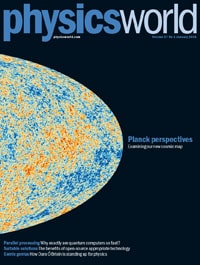
In this month’s cover feature, Peter Coles from the University of Sussex in the UK examines the implications of the data of the cosmic microwave background obtained by Europe’s Planck satellite.
There’s also a great article by science journalist Philip Ball, who looks at exactly why quantum computers are so fast – the speed is often put down to many calculations operating in parallel, but some theorists are not so sure. Meanwhile, Joshua Pearce from Michigan Technological University explains how physicists can contribute to open-source “appropriate technology” – devices that can be easily and cheaply built using materials and techniques available to people in developing nations.
The Lateral Thoughts column of humorous, off-beat or otherwise “lateral” essays has been part of Physics World ever since the magazine was launched in October 1988. In my previous post about the column’s history, I described some ways that Lateral Thoughts have changed since the early days (tl;dr version: loads of sexism, side order of class conflict). But in my trawl through the archive, I’ve also discovered that some things haven’t changed very much at all over the past quarter-century.
Take scientific conferences. In a Lateral Thought entitled “How to survive a conference”, the materials scientist Brian McEnaney advised speakers that “a scientific audience is like a pack of wild animals – they can smell fear at a hundred yards”. Reacting aggressively to audience members is not, however, recommended: “If some old duffer points out that your approach merely duplicates his classic work with Waffle and Wordmincer in 1952…it is completely the wrong response to leap off the podium and wrestle him to the floor.” Instead, McEnaney suggests replying “‘That is the traditional view of the subject, but recent work points in a completely different direction.’ Notice that you have not actually contradicted him, but you have managed to imply that he has not read the literature for 30 years.”
Reading this, I thought I must have been at the same conference. However, given that I was still in primary school when McEnaney’s article was published back in May 1989, that seems unlikely.
By January 1997, conference-based humour had evolved from “how to survive” to “how to succeed”. In his Lateral Thought on the subject, polymer scientist Phil Kline recommended that conference attendees “try to arrive at least half a day late…to convey the impression that you have just rushed in from another, infinitely more interesting conference at some exotic location overseas”. Then, at the conference dinner, Kline suggests “wheedl[ing] your way onto a table containing important people…who will order extra, expensive bottles of wine”. The idea that conference success can be found instead in such mundane activities as taking notes and sharing new results is, Kline concludes, “a dangerous heresy and is to be avoided at all costs”.
The scientific conference is not the only topic to have inspired multiple of our Lateral Thoughts authors. Several have explored the comedic potential of physical constants and scientific units, while the travails of marking (and taking) physics exams have proved fruitful ground for others. And, perhaps inevitably, there have been a few actual repetitions. For example, Alistair Armitage and Michael de Podesta have both written funny and fascinating essays about generating electricity from exercise bikes, while Denis Weaire and Matthew Flynn have been equally witty on the subject of socks that disappear in washing machines.
Interestingly, though, these “matched pairs” of essays reflect the times in which they were written. Armitage, writing in July 1996, is purely concerned with using exercise bikes to produce power. For De Podesta in January 2013, it’s all about going carbon-neutral. As for Weaire and Flynn, the former wrote his Lateral Thought on missing socks in June 1989; it seems plausible that his idea of getting wayward socks to form Cooper pairs was influenced by the then-recent discovery of high-temperature superconductivity. Flynn, in contrast, wrote his essay in May 1995, during the “second string revolution”. His theory is that missing socks may be quantum tunnelling into other washing machines via extra dimensions. I await with interest a 21st-century Lateral Thought that invokes dark energy to explain sock disappearance!
Lateral Thoughts is, in theory, a physics-humour column, yet some of the best essays we’ve published have been deadly serious. In the next post in the series, I’ll revisit a few of those. Meanwhile, if you’re feeling inspired, why not try writing your own Lateral Thought? Silly, serious or somewhere in-between, Physics World welcomes your ideas. All submissions must be 900–950 words long and may be e-mailed to pwld@iop.org.
Members of the Institute of Physics (IOP) can read Lateral Thoughts each month via the digital version of the magazine or by downloading the Physics World app via the App Store or Google Play. Not a member? You can join the Institute as an IOPimember for just £15, €20 or $25 a year. Being an IOPimember gives you a full year’s access to Physics World both online and through the apps.
This year will be a fallow one for the Large Hadron Collider (LHC). The accelerator and its experiments are still being upgraded and the 27-km-circumference collider is not due to restart until 2015. However, all is not quiet at the CERN particle-physics lab near Geneva: the accelerators that feed protons into the LHC – the Proton Synchrotron (PS) and the Super Proton Synchrotron (SPS) – will both be fired up in the second half of 2014, which means that lots of experiments at CERN should be taking data this year, including some that are entirely new.
One new experiment firing up is the rather prosaically named NA62, and physicists working on it are now in the final stages of installing their 270-m-long experiment on the SPS. The SPS itself has a circumference of 7 km and its experiments are in CERN’s “North Area”, from which NA62 takes part of its name (62 being simply an incremental experiment number). The NA62 collaboration is small by CERN standards but it still comprises about 150 physicists at 20 institutes worldwide. Their primary aim is to make an extremely precise measurement of the probability that a positively charged kaon will decay to a positively charged pion plus a neutrino/antineutrino pair.
The decay probability might seem an arcane value to measure, but as collaboration member John Fry of the University of Liverpool in the UK explains, the decay itself is “one of the few ways open to us to actually challenge the Standard Model of particle physics”. Unfortunately, measuring the decay is far from easy. “This is a very rare process and the probability that it happens is about one in 10 billion,” explains CERN’s Giuseppe Ruggiero, who is physics co-ordinator of NA62.
Tiny quantum fluctuations
Challenging the Standard Model is also what the experiments on the LHC are trying to do, but NA62 is taking a different approach. Instead of smashing protons together at high energies and looking for hints of new physics in the vast numbers of particles that fly off in all directions, NA62 is looking for evidence of tiny quantum fluctuations in a specific decay process. A kaon comprises an up quark and an anti-strange quark. The up quark is a “spectator” that does not take part in the decay, while the anti-strange quark is transformed into an anti-down quark. According to the Standard Model, this occurs via a quantum loop and the probability of the transition has been calculated to a high degree of precision.
However, hitherto unknown particles not predicted by the Standard Model could also contribute to the quantum loop. These particles could, for example, be “sparticles” that are predicted to exist by supersymmetric models of particle physics. Rather than revealing themselves in the final products of the decay, these particles would appear as quantum fluctuations and then contribute to the quantum loop before vanishing. These fluctuations could cause a significant deviation from the Standard Model decay rate – and measuring that discrepancy is the primary goal of NA62.
The NA62 experiment begins by smashing an intense beam of 400 GeV protons from the SPS into a beryllium target that is 40 cm long. This collision creates a mixed beam of about 800 million charged particles per second. Most of these particles are pions and protons, with just 6% being the kaons of interest.
Stamping kaons
The beam is then sent through a Cherenkov detector called KTAG, which identifies individual kaons by the Cherenkov radiation they create. Although all the particles in the beam have the same momentum, protons, pions and kaons have different masses and so are travelling at different velocities. They therefore create Cherenkov radiation at different angles, and by measuring these trajectories, KTAG can identify individual kaons and give each one a “time stamp” that allows a kaon to be followed through the rest of the experiment.
The kaons next encounter the Gigatracker, which is a silicon pixel detector that measures the momentum of each kaon to a high precision. This precision is needed to match the “mother” kaon to the “daughter” pion that it decays to. The kaons then drift through a 65 m section of the experiment where about 10% of them will decay. At this point the attention shifts to measuring the momentum of the daughter pions, which is done using a device dubbed the Straw Tracker. It has more than 7000 narrow drift tubes that are arranged into modules containing rows at right angles to each other.
Finally, a second Cherenkov detector called RICH measures the speed of each pion. This value allows the physicists to confirm that they were actually tracking a daughter pion rather than a daughter muon, which is produced in much greater numbers. There are in addition several other detectors that measure the decay products to ensure that only events associated with the desired decay channel are captured.
Beyond the Standard Model
The NA62 collaboration expects to see about two decay events in the eight weeks that it plans to run in late 2014. The experiment will then run continually for a further three years, which should yield a total of about 100 events. If the measured decay rate from that predicted by the Standard Model differs by a factor of two, NA62 will be able to measure this with a statistical uncertainty of 5σ, which is the gold standard of a discovery in particle physics. In other words, by the end of 2017, NA62 could discover physics beyond the Standard Model, something that its much bigger sister experiments on the LHC – ATLAS and CMS – have so far not managed to do.
In addition to its primary goal, NA62 will also be seeking evidence of “flavour violation” by looking for kaons that decay to final states that cannot occur in the Standard Model. The collaboration will also be making a very precise comparison of two similar kaon decay processes – one into an electron and neutrino and the other into a muon and neutrino. The ratio of the decay rates of these two processes is sensitive to physics beyond the Standard Model.
Soon we will be ready to ask our questions to nature
Augusto Ceccucci, CERN
“After years of construction everything is coming together, the software is coming together and the students are getting the physics programme ready and soon we will be ready to ask our questions to nature,” says Augusto Ceccucci of CERN who is spokesperson for NA62.
In the above video, Ceccucci and three colleagues talk about the physics of NA62 and how the experiment was planned and built.
A year of new start-ups
In addition to NA62, many other projects will also be starting up at CERN this year. They include new experiments studying the properties of antimatter, both of which will exploit CERN’s existing Antiproton Decelerator (AD). This facility fires protons from the Proton Synchrotron into a block of metal to create high-energy antiprotons, which are then slowed down before being used. CERN’s antiprotons should be available once again from 1 August and the AD’s four existing experiments – ACE, ALPHA, ASACUSA and ATRAP – are all expected to make use of them.
One of the new experiments on the AD is AEGIS, which is the first designed specifically to measure Earth’s gravitational pull on antimatter. This will be done by measuring the vertical distance a beam of antihydrogen atoms falls as it travels a set horizontal distance. Discovering even the tiniest of differences between the gravitational behaviour of matter and antimatter could shed light on mysteries such as why there is so little antimatter in the universe. But creating antihydrogen, which consists of an antiproton and a positron, is no mean feat and the AEGIS team will spend most of its time in 2014 fine-tuning its antihydrogen generator and its beam-creation set-up.
Running for the first time at the AD is an antiproton experiment called BASE, which aims to make the most precise measurement ever of the magnetic moment of the antiproton. By trapping a single antiproton using magnetic and electric fields, BASE physicists aim to improve the current experimental value of the magnetic moment by several orders of magnitude. By making the same measurements on protons, BASE could reveal a tiny difference in their values of their magnetic moments. Such a difference would imply that CPT symmetry – a fundamental symmetry of nature as far as we know – is violated and this would point to physics beyond the Standard Model.
Meanwhile, over at CERN’s Super Proton Synchrotron, existing experiments such as the Common Muon and Proton Apparatus for Structure and Spectroscopy (COMPASS) will be up and running in 2014.
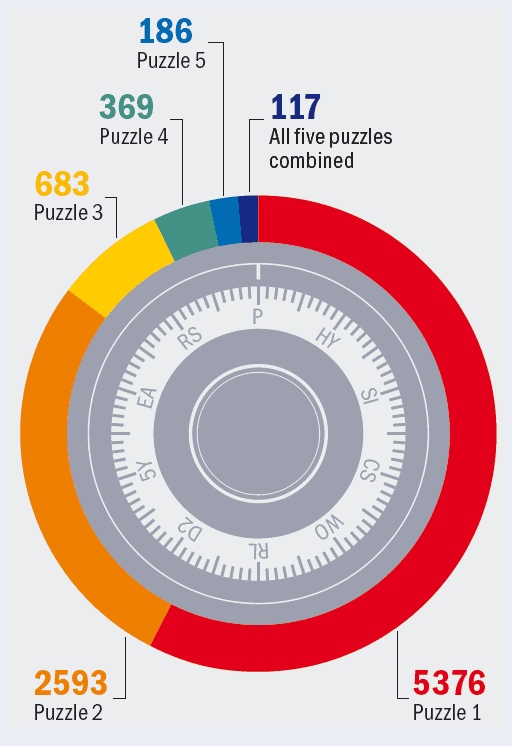
Infographic showing the number of correct answers submitted to the online answer-checking tool for each of Physics World’s five anniversary puzzles.
(Warning: spoilers below for those who haven’t yet tried the Physics World at 25 puzzles.)
October 2013 was Physics World’s 25th birthday. It was also the month in which, unusually for me, I compulsively checked the comments being posted on this blog. That’s because we published a series of five physics-themed puzzles as part of the celebrations, which left me both (a) excited to see if people would enjoy them, and (b) nervous that some loose cannon might reveal an answer and spoil the fun! (It didn’t calm my worries that the very first comment made on the very first puzzle – now deleted – was indeed the answer to the puzzle.)
With more than 1000 comments posted in total, the response to the puzzles was staggering. Commenters posted where they’d come in the rankings (“Hallelujah! #121. That was a tough slog.”), encouraged others to persevere (“Ted, I think you’re nearly there. You’re right about the first word”) and recipients of help were very grateful (“Thanks uszkanni! I’ve been going a bit mental on that one.”)
The infographic above-right shows the number of correct answers submitted to the online answer-checking tool for each of the puzzles, as of early December. We were very impressed with those numbers: not everyone at Physics World HQ was so successful.
Some commenters also debated whether there were mistakes in the puzzles or even more than one possible answer. “Please do better next time Louise,” someone warned me.
Unfortunately, as I couldn’t debate this without giving the game away, my lips were sealed! Today, however, we can announce not only the single-word answers to the puzzles, but also how you can arrive at these answers. Thanks again to Colin, Nick and Pete at the UK’s Government Communications Headquarters (GCHQ), who composed all the puzzles as well as the solutions below.
If you haven’t tried the puzzles yet, and would like to have a go before seeing the solutions, here are the links to each:
“The past is a foreign country; they do things differently there.”
I’ve been re-learning this lesson recently thanks to “Lateral Thoughts”, the column of humorous, off-beat or otherwise “lateral” essays that appears on the back page of Physics World each month. These articles are written by our readers and they have been part of the magazine ever since it was launched in October 1988. In fact, Lateral Thoughts is the only section of Physics World that has remained unaltered in its 25-year history.
Unaltered in its format, that is. But what about the actual content of the essays? Lateral Thoughts are not normally commissioned by members of the editorial team; instead, they’re selected from a pool of submissions sent in, unsolicited, by Physics World readers. Any shifts in style or subject matter should, therefore, tell us something about the way that the physics community has evolved over the years.
With this in mind, I began trawling through the archive of past Lateral Thoughts, looking for evidence of change. And boy, did I ever find it.
I began with the column’s earliest years, and one of the first things I noticed was the casual sexism on display in some essays. For example, one (male) author from this period bemoaned the fact that research publications do not contain “arousing centrefolds”. Another nonchalantly described “wives and daughters” of research fellows performing free clerical work in his department, while a third matter-of-factly noted that one of his colleagues at a major industrial firm had an X-rated screen-saver on his computer.
Several other articles also displayed a certain leering sensibility concerning the phrase “young ladies”. While reading through the archive, I cringed at references to “attractive young ladies in crowded trains”, “young lady” administrative assistants, and in one case even “physicists…going into parloured rooms with beautiful young ladies to see if anything exciting would happen”.
When people talk about a “chilly climate” for women in physics, I’m afraid this is the sort of thing they have in mind. The chill factor doesn’t even have to be obvious. Quite a few writers in the earliest years of Lateral Thoughts unthinkingly referred to physicists as “he”, thus displaying what one more enlightened essayist described as “the tendency for authors to implicitly – or even explicitly – write for male readers”.
But different attitudes to sexism weren’t the only dissimilarities I found. Perhaps the most striking illustration of how the world has changed came from an October 1989 article written by the Open University (OU) physicist Ray Mackintosh. “Sitting at the bar late one night…I asked one of my students what he would do when he had his degree,” Mackintosh began. “‘Oh, certainly, I’ll be sacked’, [the student] said…‘They’d never have a chap on the shop floor with a degree.’”
Mackintosh went on to describe several other examples of employer hostility towards OU students – most of whom were, then as now, squeezing their studies into evenings and weekends while holding down full-time jobs. “There are students afraid of letting their bosses, friends and even spouses know of their studies,” Mackintosh wrote. “The picture emerges of many firms with incompetent managements who are…vaguely terrified that the basis of their superior position would be undermined if shop-floor suggestions percolated upwards. Hence the insecurity about having graduates on the shop floor.”
Could a shop-floor worker be sacked for getting a degree in the UK today? Although I wouldn’t rule it out entirely, it certainly seems unlikely – and not just because there are fewer shop floors in Britain now than there were in 1989. The past is, truly, a foreign country.
I’ll be back in January with the next post in this series, which will highlight some amusing examples of how Lateral Thoughts haven’t changed over the years. In the meantime, if you’re feeling inspired, why not write your own Lateral Thought? Submissions must be 900–950 words long and may be e-mailed to pwld@iop.org.
Members of the Institute of Physics (IOP) can read Lateral Thoughts each month via the digital version of the magazine or by downloading the Physics World app via the App Store or Google Play. Not a member? You can join the Institute as an IOPimember for just £15, €20 or $25 a year. Being an IOPimember gives you a full year’s access to Physics World both online and through the apps.
A star glowing in the night. (Courtesy: ESA/Hubble)
By Hamish Johnston
Things are winding down for the holidays at Physics World and this afternoon the team will be enjoying our Christmas lunch at a local brewpub. Hopefully they will have a festive ale or two on tap! To brighten up this festive blog, we have chosen this stunning image of the variable star RS Puppis as our Christmas picture. It was taken by the Hubble Space Telescope and shows starlight reverberating through the foggy environment around the star.
So 2013 will go down as the year that the Nobel Prize for Physics went to Peter Higgs and François Englert for their theory of how some particles acquire mass. It was an award that had been widely expected, following the discovery of a particle that looks pretty much like the Higgs boson at CERN in 2012. But the prize was not without controversy – several other theorists missed out, while the announcement itself was unexpectedly delayed by an hour, hinting that the Swedish Academy of Sciences required the extra time to thrash out who exactly to honour.
But what of next year? What will be the key events in physics and who will have taken the accolades in 12 months’ time?
Over at CERN, physicists and engineers will still be basking in the glory of this year’s Nobel prize, but they will also be hard at work upgrading the Large Hadron Collider (LHC) and its main experiments ATLAS and CMS. The collider, which was turned off in February at the end of its first main run, is currently undergoing a refit that will let it smash protons together with a total energy of 13 TeV – almost double the previous value – when it switches back on in 2015.
But there will be lots of new activities at CERN too. The accelerators that feed protons into the LHC – the Proton Synchrotron (PS) and the Super Proton Synchrotron (SPS) – will both be fired up in the second half of 2014, enabling several entirely new experiments to come on line at the Geneva lab. One intriguing new project is NA62, so named because it is located in CERN’s “North Area” and 62 is the next number up. Like CERN’s main experiments, it will be seeking “new physics”, but it will use a very different approach. Instead of smashing protons together and scouring through the vast numbers of particles flying off in all directions, NA62 will instead search for tiny “quantum fluctuations” in one particular type of particle decay.
The experiment will involve precise measurements of how often a positively charged kaon decays into to a positively charged pion plus a neutrino/antineutrino pair. This decay might seem arcane but it is interesting because hitherto unknown particles not predicted by the Standard Model of particle physics – our current best understanding of the sub-atomic world – could take part in the process. The kaons will be created by firing protons from the SPS into a 40 cm-long beryllium target to create a beam of some 800 million charged particles every second. Most will be pions and protons, but about 6% of the particles will be the kaons of interest.
As the Standard Model predicts exactly how fast these kaons should decay, any difference between the measured and predicted decay rate would reveal the existence of new particles, such as “supersymmetric” particles that have been predicted by certain alternative models of particle physics. The only snag – and it is a big one – is that measuring the decay is far from easy, Being so rare, the probability of it happening is just about 1 in 10 billion. Keep an eye out for more details – and a special video – about NA62 in Physics World early next year
CERN peers into the antiworld
NA62 is not the only novel project starting up at CERN in 2014. The year will also see two new antimatter experiments, both exploiting CERN’s existing Antiproton Decelerator (AD). This facility fires protons from the PS into a block of metal to create high-energy antiprotons that are then slowed. Antiprotons should be on tap once again from August and one of the AD’s new experiments is AEGIS, which is the first specifically designed to measure the Earth’s gravitational pull on antimatter. It will measure the vertical distance that a beam of antihydrogen atoms falls as it travels a set horizontal distance – with even the tiniest deviation from how ordinary matter behaves possibly shedding light on the mystery of why the universe has so little antimatter.
Also getting into its stride at the AD is BASE, which will trap a single antiproton using magnetic and electric fields to make the most precise measurement ever of its magnetic moment. Researchers will also make the same measurements on protons, with any difference implying that charge–parity–time (CPT) symmetry has been violated, which would also point to physics beyond the Standard Model.
To the Moon, Mars and beyond
The MAVEN mission is one of many in space science in 2014. (Courtesy: NASA/Goddard)
Away from CERN, 2014 will see a series of fascinating missions in space science and astronomy bearing fruit. China’s Jade Rabbit rover, which landed on the Moon earlier this month, will spend the first part of the year surveying the lunar surface and its geological resources, including the make up of the Moon’s soil. Autumn will be even more intriguing, with NASA’s Mars Atmosphere and Volatile Evolution (MAVEN) mission going into orbit around the red planet on 22 September and the Indian Space Research Organisation’s Mangalyaan probe arriving just two days later.
US astronomers will also be hoping for good luck in July, which will see NASA finally launch a replacement for its $270m Orbiting Carbon Observatory (OCO). The mission originally failed shortly after take-off in February 2009, meaning that the agency’s attempts to produce maps of the Earth’s carbon sources and sinks lay in ruins. Such information is essential for environmental scientists to gain a better understanding of climate change. Dubbed OCO-2, the new craft is a replica of the original and is scheduled to take off on board a Delta II rocket.
As for the European Space Agency (ESA), it too has a busy year lined up. Initial data from its Gaia star-mapping mission will arrive, while the first of its Earth-observation Sentinel craft is due to take off in the spring, with a follow-up mission later in the year. Among other objectives, the craft will study sea ice in the Arctic and map land surfaces, including forests, water and soil. On 24 November, meanwhile, ESA’s Rosetta craft will rendezvous – after a journey that has lasted more than 10 years – with Comet 67P/Churyumov-Gerasimenko. If the docking is a success, it will be the first mission ever to orbit and land on a comet.
Beyond our solar system, we can expect the stream of new findings about extra-solar planets to continue, with hints – but no definite sightings – of Earth-like planets in the “goldilocks” zone continuing to appear. As far as studies of the whole universe are concerned, physicists will spend 2014 trawling through the reams of data taken by ESA’s Planck mission. Although it formally stopped observing the cosmic microwave background in October, Planck’s treasure trove of information is sure to reveal more secrets about the make up of the universe. Keep an eye out for a great feature article on the mission in the January issue of Physics World by Peter Coles of the University of Sussex.
We can also expect more hints about dark matter appearing in 2014, particularly from the Large Underground Xenon (LUX) detector, which lies 1500 m beneath the Black Hills at the Sanford Underground Research Facility in South Dakota, US. The LUX team revealed its first data in October this year and, although no positive signs of dark matter were seen, its members will spend 2014 refining their experiments for a future 300-day search for weakly interacting massive particles (WIMPs), which are a leading candidate for dark matter.
Graphene goes commercial
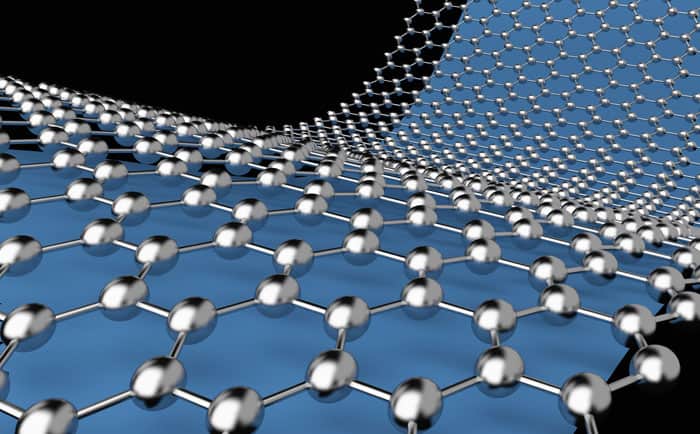
Bendable and flexible smartphones are still some way off, but we reckon graphene will be used in the touchscreen of at least one commercially available phone in 2014. (Courtesy: Shutterstock)
But next year, as every year, most physicists will be doing work that is much more down to Earth – from medical physics and optics to nanotechnology and semiconductors. In particular, 2014 will see a continuing stream of exciting results using graphene – the one-atom-thick sheet of carbon that is not only the strongest material ever discovered, but can also carry currents with a density one million times that of copper. Our prediction is that this material will be used for the first time in the touchscreen of a commercially available smartphone – either from Samsung or Apple.
The device will not look or feel too different to existing phones, as the graphene will merely replace the conventional indium-tin-oxide electrode. However, a phone with a graphene electrode in its touchscreen could kick-start the next transformation of the display industry, which will eventually see fully flexible and bendable screens made largely from graphene becoming the norm. We can therefore expect the further development of a “graphene ecosystem” during 2014, thanks to a “perfect storm” of companies making graphene of the right amount and quality, engineers designing products people want and researchers transferring their know-how from the research lab to the marketplace.
Another trend that looks set to blossom in 2014 will be the use of “Rydberg states” to create interactions between photons in a collection of atoms cooled to temperatures of near absolute zero. Such states were already used this year to create the first-ever “molecules” of light, and we can expect more breakthroughs of this type next year. A Rydberg state is created whenever a photon of laser light interacts with ultracold atoms to form a highly excited electron that is shared between 10 or more nearby atoms. But as other Rydberg states cannot be created nearby, any additional photon that comes along ends up interacting with the first.
Nobel dreams
So what of the people and personalities in physics? Our bet is that the Nobel Prize for Physics will go to work in the field of quantum computing and communication – with Anton Zeilinger being our pick for the award. This area has been so rich with results in recent years that surely its time has come to be honoured in this way. Yet it is still an embarrassment for physics that only two women have ever won a Nobel Prize for Physics – Marie Curie in 1903 and Marie Goeppert-Mayer in 1963 – and a third is unlikely to be added in 2014.
Surely the time has come for the archives to be opened up to scrutiny
While there is no question of any sexism among the Nobel Committee for Physics, its members can only choose from researchers who have been put forward for a prize. Unfortunately, we just do not know if those making the nominations are biased, given that the archives detailing each year’s award remain, by convention, closed for a period of 50 years. Surely the time has come for the archives to be opened up to scrutiny immediately after a Nobel prize is awarded?
Meanwhile, in December 2014 CERN’s Council will choose the next director-general to take over from Rolf-Dieter Heuer at the end of 2015. Heuer has been at the lab’s helm at a thrilling period in the lab’s history and his successor – whoever they may be – will have a hard act to follow. In addition to overseeing the start of the LHC, Heuer has been in charge as the SCOAP3 initiative has finally come to fruition, which from next year will allow particle physicists funded by it to make their work immediately free to read online upon publication in 10 participating journals. Costing about €5m a year, SCOAP3 will allow about 60% of all papers in particle physics to become “open access”.
The crystal ball
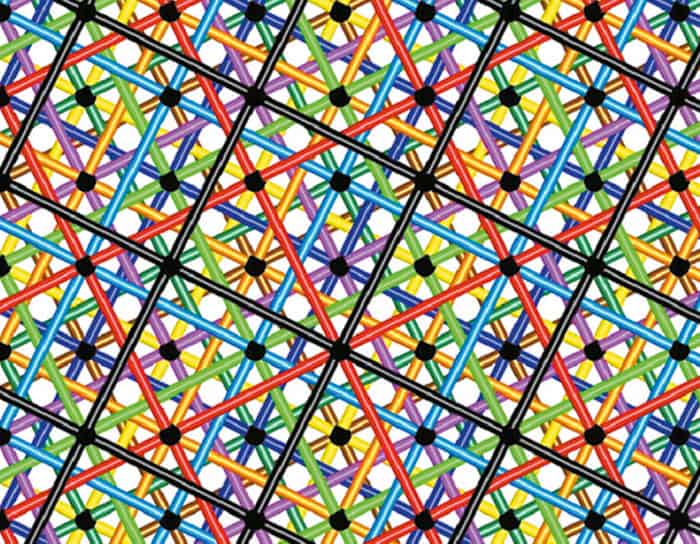
The world of crystals, such as the lattice nets above, will be celebrated around the globe in 2014 through the International Year of Crystallography. (Courtesy: IUCr)
Finally, physics would not be physics without a look back at past glories, and the most notable anniversary in 2014 will be the centenary of the German physicist Max von Laue winning the 1914 Nobel Prize for Physics for his discovery, two years earlier, of the diffraction of X-rays by crystals. X-ray diffraction is a hugely valuable experimental tool, enabling researchers to elucidate the structure of thousands of crystals, most famously the double-helix nature of DNA. To increase awareness of the field, 2014 has been designated the International Year of Crystallography by the United Nations Education, Scientific and Cultural Organisation (UNESCO) and the International Union of Crystallography. A full programme of events has been lined up, kicking off with an opening ceremony at UNESCO headquarters in Paris on 20–21 January.
Other anniversaries in 2014 include the 50th anniversary of the publication of Richard Feynman’s famous lectures on physics and the 50th anniversary of the idea of quarks – the tiny entities that make up protons, neutrons and some other sub-atomic particles. The concept was proposed, independently, by Murray Gell-Mann and George Zweig in an attempt to make sense of the “zoo” of particles that had been uncovered in the 1950s and early 1960s. Gell-Mann and Zweig saw quarks as just a mathematical explanation of particle masses, but physicists now regard them as real physical objects.
As for Physics World, which is published by the Institute of Physics (IOP), we have special issues coming up on innovations in physics teaching (March), the dark universe (July) and how to turn physics ideas from the lab and into real products (November). All IOP members can read the magazine online or through our apps, and, if you are not already an IOP member, do not forget to join to get instant access to every issue. We will also be publishing reports on Brazil (April) and India (December), as well as focus issues on nanotechnology (May), optics and lasers (June), vacuum technology (August) and big science (September). You can also expect to see an expanded audio and video programme, including more Google hangouts.
But the beauty of physics is that you never quite know what is round the corner. This year Physics World awarded its Breakthrough of the Year prize – now in its fifth year – to the IceCube South Pole Neutrino Observatory for making the first observations of high-energy cosmic neutrinos. As for who will win next year, it really is anybody’s guess.
Happy with our predictions? Annoyed at something we missed? Tell us what you think by commenting below.
The colourful ribbons in the micrograph pictured above show a new alloy developed by researchers in the US that, once deformed, will automatically return to its original shape when heated. “Shape-memory” alloys are reversible phase-change materials that can exist in two crystal-lattice structures: one that is more stable above a certain transition temperature and the other favoured at lower temperatures. The picture shows the meandering patterns of its domain boundaries that form and change as the metal morphs. The snaking boundaries led the researchers to jokingly christen the new structure “riverine”. While this is not the first such shape-memory metal, the latest material can go through 16,000 shape-shifting cycles without significant degradation – making it far more robust than existing materials.
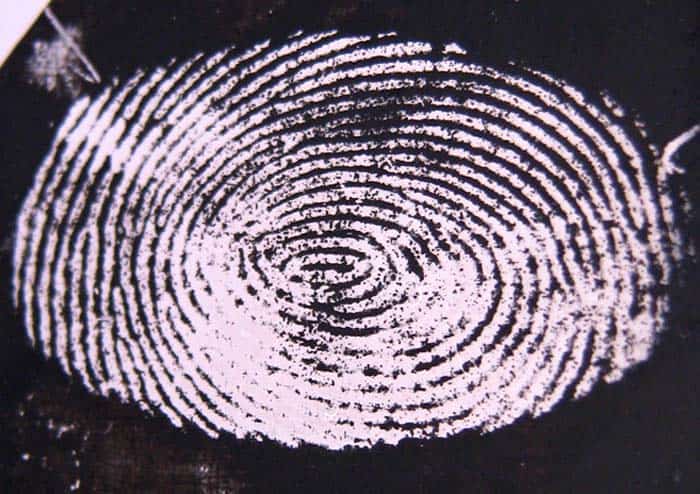
Bright hills and dark valleys Image of a fingerprint left on a stainless steel that has been enhanced by electrodeposition. The light regions are stainless steel that is protected by the sweat residue that was laid on top. The dark regions are the polymer in between the fingerprint sweat without the fluorescence switched on. (Courtesy: ILL)
The odds that two people will have identical fingerprints is about 64 billion to 1, which is why law-enforcement agencies rely on fingerprint evidence. But often, more than 90% of crime-scene fingerprint images are not of good enough quality to clearly identify an individual. In July this year, researchers in the UK and France developed a new and extremely sensitive method for visualizing fingerprints left on metal surfaces such as guns, knives and bullet casings. The technique utilizes colour-changing fluorescent films and can be used to complement existing forensic processes. Above is the image of a fingerprint left on stainless steel that has been enhanced by electrodeposition. The light regions are stainless steel that is protected by the sweat residue that was laid on top. The dark regions are the polymer in between the fingerprint sweat without the fluorescence switched on.
Ring of fire This picture from the NASA/ESA Hubble Space Telescope shows the most distant gravitational lens yet discovered. The light from the more-distant object is bent around the nearer object by its strong gravitational pull to form a ring of multiple images. The chance of finding such an exact alignment is small, suggesting that there may be more star-forming galaxies in the early universe than expected. (Courtesy: NASA/ESA/A van der Wel)
In case you were wondering why the image above is a bit blurry, you will have to forgive the Hubble Space Telescope – it is not easy to capture light that has travelled from when the universe was still young and only a fraction of its current age. The fiery ring you see above is the most distant gravitational lens seen to date and it is at a colossal distance of 9.4 billion light-years from us. The chance discovery was made by an international team of astronomers and it not only allowed the researchers to directly measure the mass of the distant galaxy that caused the lensing, but has also led to questions about the more distant object (which is an even more impressive 11 billion light-years away) the light from which was lensed. The magnified object is a type of dwarf galaxy that is thought to be rare. The chances that such a peculiar galaxy would be gravitationally lensed are small and its observation suggests that current theories have underestimated the number of such galaxies in the early universe.
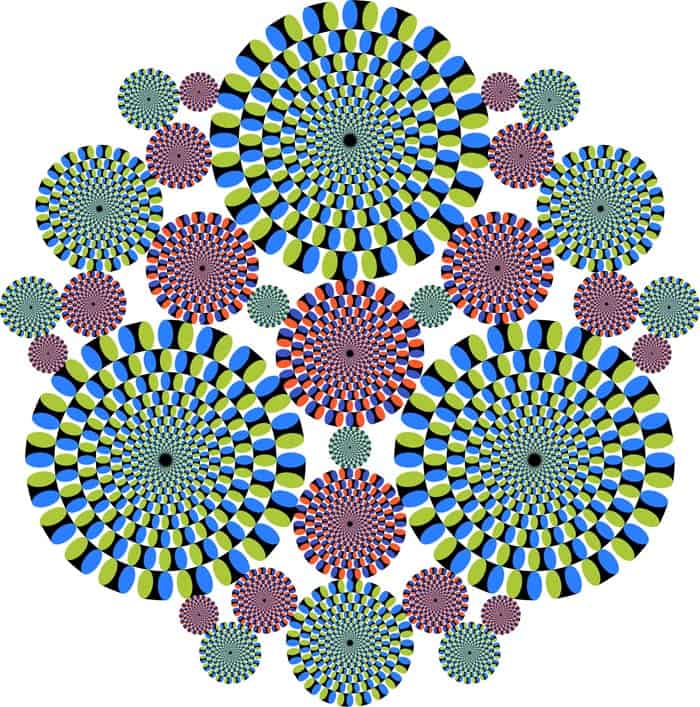
In sync Illustration of a 2D space-filling bearing configuration with 31 rotor discs. The researchers say they adapted this static illusory-motion image from the ‘Rotating Snakes’ visual illusion created by Akiyoshi Kitaoka, a professor at Ritsumeikan University, Kyoto, Japan. (Courtesy: N A M Araújo et al.)
The psychedelic illusory-motion illustration above had all of us at Physics World dizzy. The image, which is adapted from the “Rotating Snakes” visual illusion created by Akiyoshi Kitaoka, is a 2D space-filling bearing configuration with 31 rotor discs that was studied by a team of physicists based in Switzerland and Brazil. The researchers were investigating a “2D space-filling bearing”, which consists of a hierarchical distribution of successively smaller rotating 2D discs nestled into the spaces between larger ones. Surprisingly, the team found that such networks of rotating bearings can recover more easily from perturbations to their harmonious motion if the masses of the individual discs are proportional to their radii.
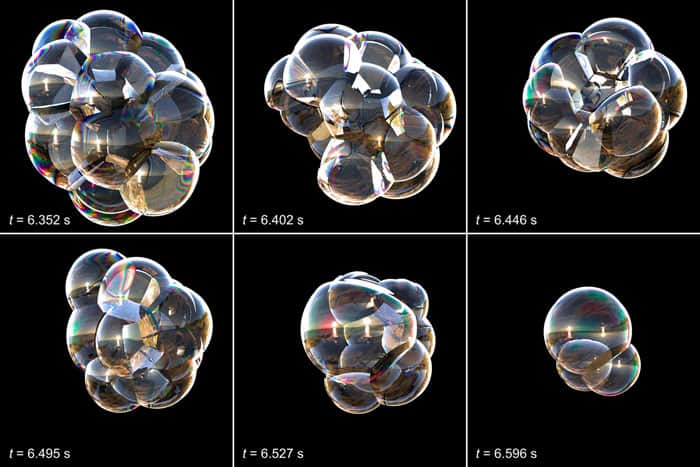
Bursting the bubbles Snapshots from a multiscale model of membrane rearrangement, drainage and rupture in a cluster of soap bubbles, shown using thin-film interference. (Courtesy: James Sethian and Robert Saye)
Two physicists in the US have been frothing with excitement at having created a new mathematical model to describe the complex evolution of foamy bubbles – something that has proved fiendishly difficult to model thanks to the hugely varying length and timescales involved. The researchers separated the various processes that determine the evolution of foam according to the different length and timescales at which they occur, and have created a model for bulk foam dynamics. The duo also developed a set of equations, which the researchers used to create a movie that simulates how light would reflect off a small foam sample as its bubbles rearrange. The image above consists of snapshots from the movie – the researchers picked a “beach scene” as a backdrop so that they could visualize how well their model replicates what would be seen in real life.
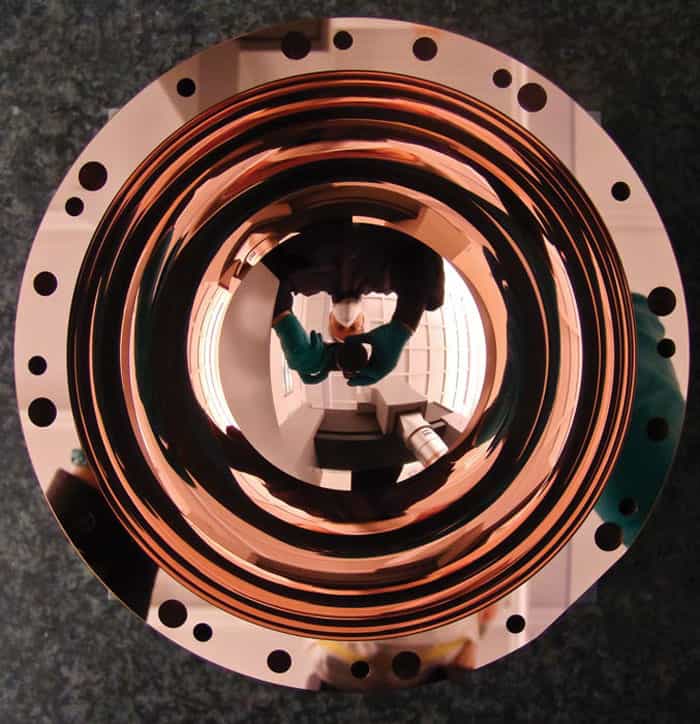
Mirror perfection A perfectly engineered hemisphere – one half of a nearly spherical resonator used to measure the Boltzmann constant. (Courtesy: Michael de Podesta/NPL)
2013 is the year when Oxford Dictionaries chose “selfie” as its word of the year. In light of that, we could not resist including this rather excellent selfie of researcher Michael de Podesta, from the National Physical Laboratory in the UK, who recounts the six-year experiment where he and his colleagues have made the most accurate measurement yet of the Boltzman constant – a result that will help redefine the kelvin. De Podesta’s image above – which shows him photographing himself in one half of a nearly spherical resonator used to measure the Boltzmann constant – even made the August cover of print edition of Physics World. In case you were wondering, the team’s new estimate of kB is 1.380 651 56 (98) × 10–23 J K–1, where the (98) represents the uncertainty in the last two digits.
Sounding out Testing the echolocation system in Lausanne Cathedral. (Courtesy: Ivan Dokmanicć)
A quick glance at the image above might leave you wondering where exactly the physics comes into play. But look close and you will notice the four microphones placed in the centre of the magnificent Lausanne Cathedral. This is part of the set-up of an international team of researchers that was studying how the shape of a room could be determined simply by making a sound and listening to the corresponding echoes. The team developed an algorithm that uses sound to work out the dimensions of any room with flat, protrusion-free walls. The system comprises a single loudspeaker to create the sound and four microphones placed anywhere in the room to capture the echoes. The algorithm examines the sounds recorded by the four microphones together and works out which come from the same wall. The size and shape of the room can then be calculated from the arrival time at each microphone of all the first-order echoes. In fact, the researchers’ algorithm worked so well that they were able to use it to determine the cathedral’s dimensions – a large space that has a domed ceiling and numerous protrusions such as pillars and large statues, and is in no way flat!
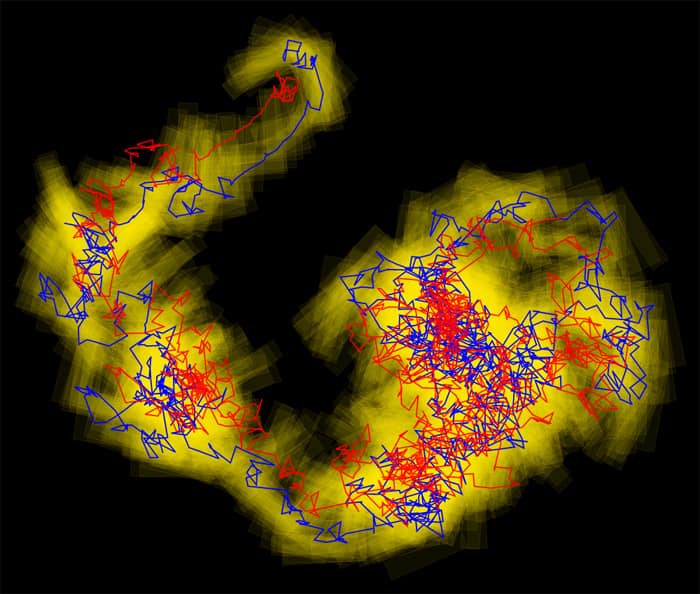
Brownian boomerangs A trajectory of a boomerang particle in water, starting from the top of the image, with the blue line tracking the point where the arms meet and the red line tracking the ‘centre of hydrodynamic stress’, a point along the axis bisecting the angle of the arms. The boomerang itself is shown in yellow. (Courtesy: A Chakrabarty et al. Phys. Rev. Lett.111 160603)
The bright and abstract colours you see above may seem like modern art, but the image actually shows tiny boomerang-shaped colloidal particles whizzing about in water. An international team of researchers found that particles that are clearly non-spherical – such as a boomerang-shaped particle – show a preferred direction of motion, at least initially. The researchers studied the boomerang’s Brownian motion using a video camera and their observations showed that, for the first minute, each of the boomerangs moved in the direction of a line bisecting its arms. The image above depicts the trajectory of a boomerang particle in water. Starting from the top of the image, the blue line tracks the point at the base of the boomerang where the arms meet and the red line tracks the “centre of hydrodynamic stress” – a point along the axis bisecting the angle of the arms. The boomerang itself is shown in yellow.
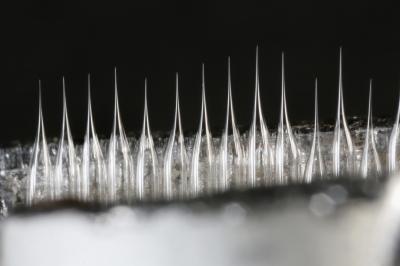
Making a point Image of the nanoscale capillary tubes. (Courtesy: Alain Herzog/EPFL)
From the Romans to the studio artists of today, glass blowing is as much an art form as it is a technical discipline. In the same spirit as this creative lineage, a group of researchers in Switzerland has invented a technique for creating nano-sized capillary tubes of bespoke sizes. In the image above you can see how the researchers alter the ends of ultrathin quartz tubes, from 200 nm to a few nanometres, by careful remoulding them using a scanning electron microscope. The technique could have industrial applications, including use in ultra-high-precision printers, as well as in medical applications.
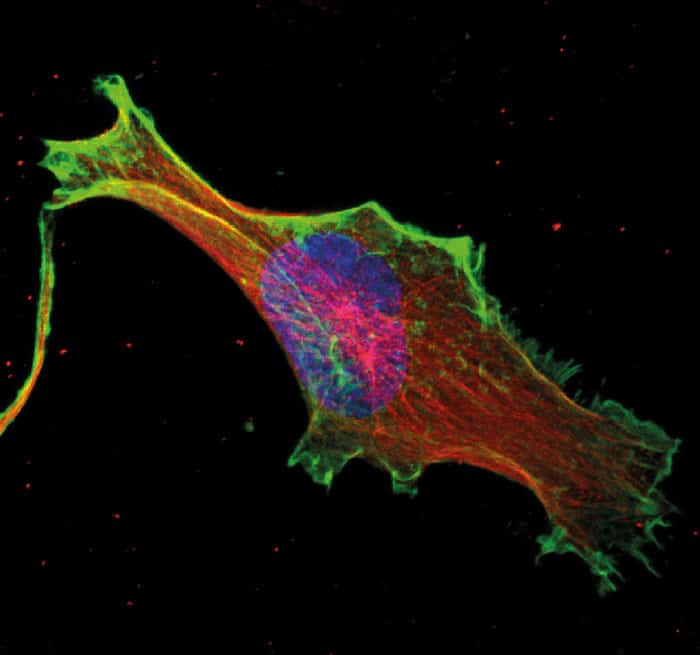
Probing cancer in 3D Image of a human cancer cell. (Courtesy: Denis Wirtz)
This year, our July magazine was a special issue that dealt with the “physics of cancer”, where we looked at the growing number of physicists who are looking at our fundamental understanding of cancer using physics. Cancer researchers used to look at cells under the microscope by mounting them onto glass slides – a 2D environment. But now that they realize that the physical environment significantly affects the behaviour of cancer cells, scientists are looking again at the properties of cancer cells, this time suspended in 3D gel-like environments that more closely resemble the physical environment within the human body. Previous studies have shown that cells move in 2D using protein clusters known as focal adhesions, and it had been widely assumed that the 2D results translate to 3D. However, this confocal-microscopy image from their lab shows a human cancer cell within a 3D matrix of collagen using an altogether different mechanism: several cell-membrane protrusions known as pseudopodia (green) probe their surroundings before selecting and pulling on a collagen fibre, a process repeated in quick succession that allows the cell to move through its 3D environment. You can see more images and find out about what else physicists are doing to tackle cancer by downloading a free PDF version of the magazine.
From the world’s smallest video to the science behind foaming beer bottles, physics has had its fair share of interesting stories this year. Here is our pick of the best from the physicsworld.com blog.
The satirical Onion magazine once famously duped China’s People’s Daily newspaper into thinking that NorthKorea’s leader had been voted the sexiestman alive in 2012, but in February it seems to have failed to foolpeople that a spoof of former US energysecretary Steven Chu was true. “Hungoverenergy secretary wakes up next to solarpanel” ran an Onion headline,reporting that after visiting a series of DCwatering holes, Chu woke up the followingmorning next to a giant solar panel he had “met” that evening. “Chu’s encounterwith the crystalline-silicon solar receptorwas his most regrettable dalliance since2009, when an extended fling with a90-foot wind turbine nearly ended hismarriage,” the Onion wrote. At least Chusaw the funny side of the story. In a poston his Facebook page he noted that theallegations had nothing to do with himstepping down as US energy secretary after four years in the role.“While I am not going to confirm ordeny the charges specifically,” he wrote,“I will say that clean, renewable solarpower is a growing source of US jobs andis becoming more affordable, so it’s nosurprise that lots of Americans are fallingin love with solar.”