Wrong turns and dead ends

Photo of a barrier at the end of a railway line

In his book Brilliant Blunders, Mario Livio offers a detailed and fascinating examination of major errors made by five great scientists – Charles Darwin, Linus Pauling, Lord Kelvin, Fred Hoyle and Albert Einstein – as they sought to understand the evolution of life on Earth, the evolution of the Earth itself and the evolution of the universe as a whole. The stories of how these blunders came about, and what happened next, are extremely well researched, and they shed a welcome, informative, entertaining and sometimes new light on science as a deeply human activity. They also pass my private test – that non-scientific friends and relatives should be able to read and enjoy them – with flying colours.

Livio’s stories do not, however, always support his contention that blunders “acted as catalysts for impressive breakthroughs”. In four of the five cases (Darwin is the exception, and Einstein is a partial exception), the scientist concerned simply dug his heels in, refused to accept that he had made an error and was overtaken by other scientists working along different lines. Far from catalysing progress, the errors were dead ends, and the views of their proponents became marginalized.

Pauling, for example, hung on to his abortive three-chain model for the structure of DNA and kept trying to rescue it with minor tweaks. Its obvious failings did not stimulate him to investigate substantive alternatives. Nor did Pauling’s model really catalyse Watson and Crick’s development of a two-chain model, except in the sense that it stimulated Watson’s competitive instinct. The catalysts that really mattered were Rosalind Franklin’s discovery of the “B” structure of DNA in the presence of a large amount of water, along with Crick’s understanding of what its X-ray diffraction pattern meant. As Livio points out, both were necessary. By 1951, he writes, a rival team of researchers at Leeds, Elwyn Beighton and William Astbury, “had excellent X-ray photographs of the B form [but] unfortunately, neither of them was familiar with how a helix would appear in X-ray photographs. Just like that, the Leeds lab missed a chance to play a significant role in the DNA story.”

The book is full of such informative sidelights on well-known stories. Fred Hoyle, for example, introduced the term “big bang” in a BBC radio broadcast, but according to Livio’s research, he used it as a term of description, not of disparagement as is commonly supposed. Hoyle hung on stubbornly, however, to his belief in a “steady-state” model of the universe, and a consequent need for the continuous creation of matter at a rate that precisely compensates for the dilution caused by observed cosmic expansion. As evidence in favour of a “big bang” theory continued to accumulate, Hoyle used increasingly complex logical convolutions to try to fit the new data to his theory. As a result, he was sidelined by the mainstream cosmological community, and his opinions were no longer taken seriously.

The story of Lord Kelvin’s calculation of the age of the Earth at around 100 million years, using Fourier’s new theory of heat transfer, is also well known, as is Kelvin’s ongoing argument with the biologist T H Huxley on the subject. Kelvin got it wrong mainly because he did not allow for convection in the Earth’s mantle. When his former pupil, John Perry, introduced this factor into the calculations, he found that the calculated age could be as much as three billion years, which was much more in line with the geological evidence being adduced by Huxley.

The discovery of radioactive elements such as radium suggested another possible means of heat production in the Earth’s core, but although their disintegration did not turn out to be a significant factor, radioactivity contributed to the debate in another way. Livio tells a nice story about an encounter between the Canadian geologist Frank Dawson Adams and Ernest Rutherford, who was, at the time, carrying a piece of black rock. “How old is the Earth supposed to be?” asked Rutherford. Adams answered that several methods had given an estimate of 100 million years. Rutherford commented quietly, “I know that this piece of pitchblende is 700 million years old,” and walked on.

Kelvin stuck to his guns and, as with Hoyle, his opinions on the subject became marginalized. Nevertheless, Livio has a case when he argues that Kelvin’s error (unlike Hoyle’s or Pauling’s) catalysed the advance of science, since it “completely transformed geochronology from vague speculation into an actual science, based on the laws of physics”.

Livio is an astrophysicist at the Space Telescope Science Institute in Maryland, US, and his insights and knowledge are particularly apparent in the chapters on his own field. His meticulous research reveals, for example, that Einstein is unlikely ever to have said that the assignment of a non-zero value to the cosmological constant was his “biggest blunder”. Most probably this widely quoted phrase was an invention of George Gamow, whose interaction with Einstein the author examines in some detail. Livio argues that, in any case, Einstein’s real blunder was in returning to his initial assignment of a value of zero, whereas the discovery that the expansion of the universe is accelerating now suggests that a non-zero value is necessary.

The biggest blunder of all was made by Charles Darwin, who failed to see that his mechanism of natural selection was incompatible with the contemporary belief that inheritance occurs by blending the characteristics derived from both parents. As the Scottish engineer Fleeming Jenkin quickly pointed out, such a mechanism would swamp any advantageous variation within a few generations. Only when Mendelian heredity, and its genetic basis, were discovered and accepted many years later was this problem resolved. Even so, Darwin’s proposed mechanism of natural selection prospered and survived.

The real message of this vastly entertaining book is that scientists often make major blunders when they try to reconcile new ideas with established paradigms. Scientific insight can be a fickle jade but, as Darwin’s example shows, it can be best (unwittingly or otherwise) sometimes to have the insight to ignore such paradigms. But then, you probably need to be a Darwin to get away with it.

  • 2013 Simon & Schuster £18.99/$26.00hb 352pp
Mystery of neutron-lifetime discrepancy deepens

A re-evaluation of a 2005 measurement of the lifetime of the neutron has deepened the mystery of why two different experimental techniques yield two different neutron lifetimes. After recalibrating a key part of their “beam” experiment, physicists in the US confirmed that their value for the neutron lifetime is 8 s longer than that determined by others who had done a “bottle” experiment. What is more, this latest result puts the statistical significance of the discrepancy at nearly 4σ, making it unlikely to be a random anomaly.

While neutrons in stable nuclei can exist for an eternity, a free neutron hangs around for about 15 min before it decays via the weak interaction to a proton, an electron and an antineutrino. A precise measurement of the neutron’s lifetime is important for calculating the rates at which lighter elements were formed immediately after the Big Bang in a process called nucleosynthesis. An extremely good lifetime measurement could also reveal new physics beyond the Standard Model of particle physics.

There are currently two experimental strategies for measuring the lifetime. The bottle method involves trapping neutrons in some kind of container and counting the proportion remaining after a fixed time. The beam method involves monitoring a beam of neutrons and measuring the number of the particles that decay to protons as it passes through a particular volume of space. The systematic errors that could occur in each experiment are different and therefore physicists would be confident in a lifetime value that both techniques agree on.

Bottle and beam disagree

But bottle and beam experiments do not agree. The beam method seems to give a lifetime about 8 s longer than the bottle method, and this discrepancy is significant when compared with the uncertainties of the experiments.

The beam-method measurement with the lowest uncertainty was made in 2005 by Jeff Nico and colleagues at the National Institute of Standards and Technology (NIST) in Gaithersburg, Maryland. The systematic error on this measurement was ±3.2 s, and this was dominated by the uncertainty in the number of neutrons in the beam. Counting neutrons requires a material that, on absorption of a neutron, produces a detectable signal. While a high-intensity neutron beam is needed to provide a reasonable number of neutron decays, absorbing the entire beam would overwhelm the neutron counter. Instead, the researchers used a thin layer of lithium-6 that absorbs only a small proportion of incident neutrons. Knowing this proportion exactly was vital to calculate the lifetime accurately.

New and improved calibration

In 2005 the NIST researchers estimated the absorption probability from the lithium-6 neutron-capture cross-section and the mass of the neutron absorber. Now, Nico has teamed up with Andrew Yue and others to calibrate the same absorber to an accuracy of within 0.05%. This was done by placing the device in a lower-intensity neutron beam and counting the number of neutrons it detected. Another detector called Alpha-Gamma was located downstream from the device, where it measured the entire remaining neutron flux. By comparing the two values, the team could work out almost exactly the proportion of neutrons that its detector had absorbed in the 2005 experiment.

This new information allowed the physicists to reduce the uncertainty of their original neutron-lifetime measurement from ±3.2s to ±1.9s. It also led to a small increase in the value of the lifetime. Consequently, the best available beam and bottle measurements now differ by 3.8σ, rather than the 2005 value of 2.9σ. The researchers are now planning to re-run the entire experiment to try to minimize the errors closer to those quoted for the bottle measurements.

Another decay branch?

The most precise lifetime measurement to date was also made in 2005 by Anatoli Serebrov and colleagues at the St Petersburg Nuclear Physics Institute in Russia. This experiment was done using the bottle method at the Institut Laue-Langevin ultracold neutron source in Grenoble, France. Serebrov points out that, in principle, the discrepancy in measured lifetimes could be explained by another branch of neutron decay that does not produce a proton. Although discovering such a decay channel would be exciting for physicists, Serebrov points out that current theories do not predict an additional decay.

Peter Geltenbort of the ILL is impressed with the latest results from NIST and looks forward to further refinements in both beam and bottle measurements. “Both experiments need to be repeated, and both need to come to an accuracy of below 1 s,” he says. “Then one can talk again about whether there is some completely new physics.” Forthcoming experiments using the bottle technique will be able to count protons emitted from the decaying neutrons as well as recording how many neutrons survive after a given time, he says: “This apparatus will allow you to measure the lifetime of the same ensemble of neutrons by two completely different methods.”

The research is published in Physical Review Letters.

Metamaterials offer route to room-temperature superconductivity

A new way of making high-temperature superconductors that is based on metamaterials has been proposed by physicists in the US. Their plan involves combining a low-temperature superconductor with a dielectric material to create a metamaterial that is a superconductor at much higher temperatures than its constituent materials. The team is now looking at testing its proposal in the lab and is hopeful that its work could offer a route to creating a superconductor that operates at room temperature.

Ever since the first high-temperature superconductor was discovered nearly 30 years ago, physicists have searched in vain for a material that remains a superconductor at room temperature. But despite a massive effort, physicists have not been able to create a superconductor that endures at temperatures higher than about 140 K, which is still 150 degrees below room temperature.

Now Vera Smolyaninova of Towson University and Igor Smolyaninov of the University of Maryland have proposed a new approach to creating a superconductor with a high critical temperature (Tc) – the temperature above which the material ceases to be superconducting. Their proposal involves creating man-made structures called metamaterials, which can be engineered to have electromagnetic properties that are not normally found in nature. This includes negative indices of refraction, which have been used to create devices such as invisibility cloaks and super lenses.

The pair’s proposal is inspired by a description of superconductivity that was derived in 1973 by the Russian physicist David Kirzhnits and colleagues. Kirzhnits’ approach is complementary to the conventional theory of superconductivity and it points out that the strength of the interaction between electrons in a superconductor is inversely proportional to the dielectric response (ε) of the material.

Maximum attraction

Conventional superconductivity arises when there is an attraction between electrons, causing them to form pairs. If a metamaterial can be engineered with a small and negative value of ε, it would have a larger attractive interaction between electrons and therefore stand a good chance of being a superconductor with a relatively high Tc.

In a preprint on the arXiv server, Smolyaninova and Smolyaninov argue that the ε-near-zero (ENZ) approach to designing metamaterials could offer a blueprint for creating a material with the appropriate value of ε. ENZ metamaterials are mixtures of metallic and dielectric components and in their proposal the metal is also a conventional superconductor – these are metals such as lead and mercury that have Tc values below 10 K.

The ENZ metamaterial proposed by the researchers involves making a superconductor with random “inclusions” of dielectric material. Smolyaninova told physicsworld.com that a possible candidate for the dielectric is the ferroelectric material strontium titanate, which can be made in nanoparticle form. The sizes of the inclusions and typical distances between them must be smaller than the correlation length between electron pairs in the superconductor – which is about 100 nm.

Hyperbolic design

Another design proposed by the team is a “hyperbolic” metamaterial in which the desired ε is engineered using alternating layers of metallic and dielectric materials. Indeed, the researchers point out that typical high-Tc superconductors do share some properties with hyperbolic metamaterials. Again, the metal would be a conventional superconductor.

“We are working on actual metamaterial designs and preparing actual experiments now,” Smolyaninova said. She adds that the ENZ design would be easier to implement than the hyperbolic metamaterial.

Smolyaninova is hopeful that metamaterial superconductors could be made with Tc values above the boiling temperature of liquid nitrogen (77 K). This would make them appropriate for use in systems that currently use high-Tc superconductors.

Improved earthquake early-warning system could be used worldwide

Geophysicists in the US have developed a new way of calculating the magnitude of an imminent earthquake by making better use of measurements of the compression waves produced early in the event. They say that the technique could be used to create a better early-warning system for earthquakes that could be used worldwide.

The majority of earthquake damage is caused by S-waves, which oscillate perpendicular to their direction of travel through the Earth, and by waves that occur on the surface. However, these are preceded by much faster-moving compression waves (called P-waves) that oscillate in the direction of travel and cause minimal damage. By making careful measurements of arriving P-waves, seismologists can get some idea of the strength of the impending earthquake. While this only gives officials tens of seconds to react, it is enough time to take some protective action such as slowing down high-speed trains, switching off gas mains and even warning the public to seek shelter.

Amplitude, period or both?

Current early-warning schemes make use of two properties of P-waves: the displacement amplitude of the P-wave’s vertical component (Pd) and maximum predominant period of the P-wave (τpmax). To understand how best to use these measurements, Huseyin Serdar Kuyuk and Richard Allen of the University of California, Berkeley looked at real-life data recorded from 1992 earthquakes processed by California’s real-time Earthquake Alarm Systems. They also looked at 174 earthquakes in California and Japan that have already been used in early-warning calibration studies. The earthquakes they studied varied in magnitude (M) from 0.2–8, with M = 8 being a major earthquake.

The team used these data to test five different methods for calculating Earthquake magnitude. The techniques use either Pd, τpmax or both to make their predictions. Some of the methods are already used in early-warning systems and one is a new technique developed by the researchers. The team found that its new technique – which is based on Pd measurements alone – gave the most accurate and robust estimate of earthquake magnitude. In contrast, methods that used τpmax did not do a good job of predicting the magnitudes of small earthquakes (M < 3). They were also less accurate than Pd-based techniques for larger magnitude events.

Global reach

Kuyuk and Allen’s technique differs from the others tested in that it was formulated using Pd data from earthquakes that happened around the world, rather than earthquakes occurring in just one region. This knowledge could potentially now be applied to improve the accuracy of earthquake early-warning networks worldwide.

“The results of this study should further improve the performance of the earthquake early-warning system currently being developed for the west coast of the US,” says Elizabeth Cochran of the US Geological Survey, who was not involved in this work. “Accurate magnitude estimates, for example knowing that an earthquake is a potentially damaging M = 6 earthquake rather than a more moderate M = 5, [are] critical for initiating appropriate actions by the public, companies and emergency personnel,” she adds.

Other experts express caution about not making use of information derived from τpmax. Mark Hildyard of the University of Leeds in the UK says that while some effort has been made recently to show that amplitude-based methods can outperform their period-based counterparts, he would like to see more effort put into improving techniques that make use of τpmax.

The work is described in Geophysical Review Letters.

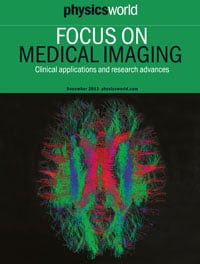
Physics World 2013 Focus on Medical Imaging is out now

By Tami Freeman

Imaging plays a major role in a vast range of medical applications – from scanning patients for signs of disease, to guiding radiation treatments, to studying small animals in the quest to develop new drugs. And, as you’ll read in this latest Physics World focus issue, it is even being used to investigate how neural networks develop in babies’ brains before and just after birth.

Created in collaboration with our sister website medicalphysicsweb.org, the new focus issue on medical imaging can be accessed free of charge in digital-magazine format.

Here’s a quick guide to what you can find in the focus issue on medical imaging:

• What goes on in babies’ brains? – How the latest magnetic-resonance-imaging techniques are being used to map brain connections in babies
• Nuclear-medicine techniques address small-animal imaging – Advances in high-performance molecular imaging
• OCT lines up for dermatology – Why the future is bright for optical coherence tomography in dermatology
• MRI enhances radiation treatment – Four research teams are working to create radiotherapy systems guided by magnetic resonance imaging
• Luminescence tracks oxygenation – Radiometric luminescence imaging could provide non-invasive monitoring of oxygen levels in tissues

There’s also a selection of research and industry news, as well as video interviews with some of the leading experts in the field.

(more…)

Postcard from Campinas – the site of Brazil's future synchrotron

Artist's impression of Brazil's Sirius synchrotron source.

By Susan Curtis in Campinas, Brazil

For the first time this week I woke to a brilliant blue sky, and below my hotel room I could see young Brazilians enjoying a quick game of football in the relative cool of the morning. Away from the traffic jams and unseasonably wet weather of the past few days, this seemed much more like the image of Brazil that’s projected to the outside world.

Today I was in Campinas, the third largest city in the state of São Paulo, some 100 km north-east of São Paulo itself. On the outskirts of the city is the National Center for Energy and Materials (CNPEM), home to Brazil’s synchrotron source as well as three national laboratories for nanotechnology, biosciences and ethanol production – which is a big deal for Brazil, since it offers a way to produce fuel from its abundant sugar cane.

(more…)

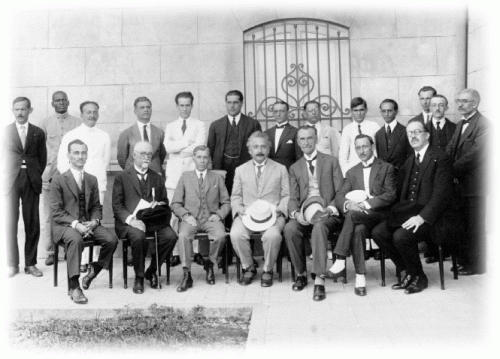
Postcard from Rio – following in Einstein's footsteps

By Matin Durrani in Rio de Janeiro

I don’t think I’ve ever talked to the head of a physics lab with a parrot screeching outside the window. But that was the case today when I visited the Brazil’s National Observatory – the country’s oldest scientific institution, founded in 1827 by Emperor Dom Pedro I just five years after the country won independence from Portugal.

The parrot was somewhere in the lush green trees directly outside the open windows of the director’s elegant first-floor office, which is currently occupied by the physicist Joao dos Anjos, who took over as head of the observatory earlier this year. (He also claimed his secretary had seen a ghost in the office recently, but that’s another story.)

After closing the windows’ shutters and switching on the air-conditioning, Dos Anjos explained how the observatory is now focused on three main activities – astronomy, geophysics and metrology. In fact, the observatory is still the official body in Brazil for setting time, which was one of its original missions, along with determining geographical locations and studying the country’s climate.

(more…)

Sun-skimming comets, the future of the Space Race, scientists on record and more

By Tushna Commissariat

This week, professional astronomers and enthusiasts all over the world pointed their telescopes (and satellites) at the comet ISON as it raced towards the Sun and had its closest encounter with our star yesterday. Of course, the big question was whether the “Sungrazing comet” would survive its close call. Now, it seems that no-one is quite sure – early on, it looked as if the comet faded rather dramatically, suggesting that its nucleus disintegrated, and then it disappeared completely as it made its way through the solar atmosphere, making scientists mourn its fiery death. But lo, today a very faint smudge of dust was seen again, and seems to be brightening up once more. For now, researchers are referring to ISON as “Schrödinger’s Comet” and we may have to wait a while to know for sure. Right now, it seems that some of the comet has survived, but just how much of it made it through and if it will be visible in the sky in December is unknown. In case you missed all the action yesterday, take a look at Phil Plait’s Bad Astronomy blog, where he was posting live updates on the comet and Karl Battams’s blog on NASA’s Comet ISON Observing Campaign site, where he explains what happens next.

(more…)

Quiz of the year 2013

By Margaret Harris

Physics World’s light-hearted quiz about the year in physics has occupied the back page of the December print edition every year since 2004 and this year, as we did last year, we’ve created an interactive online version. The 2013 quiz can be found here and although there’s no prize for getting a high score, you’ll be able to check your results once you’ve completed all of the 25 questions. Each question is based on an event or story that the magazine has reported on this year.

(more…)

The December 2013 issue of Physics World is out now

By Matin Durrani

PWDec13cover-200

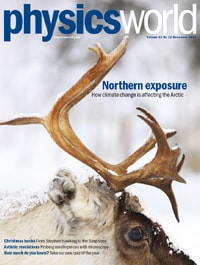
For anyone living or travelling beyond the Arctic Circle, it’s going to be pretty cold and dark right now, which means it’s hard to imagine what impact climate change could have on the flora and fauna of this remote region.

But as our cover story explains, a hardy band of researchers has spent the past three summers travelling to the far north-west of Finland to find out the effects of warming conditions on the area. Joining them in August for us was Liz Kalaugher, editor of environmentalresearchweb – a website produced by IOP Publishing to complement its open-access journal Environmental Research Letters. Her first-hand account of the trip was supported by a science-journalism fellowship from the European Geosciences Union.

If you’re a member of the Institute of Physics (IOP), you can  access the entire new issue free via the digital version of the magazine or by downloading the Physics World app onto your iPhone or iPad or Android device, available from the App Store and Google Play, respectively.

Elsewhere in the December issue, we have a feature by Martin Fischer from Duke University in the US on how the laser-based technique of pump-probe microscope has been used to map the distribution of lapis-lazuli pigment in Puccio Capanna’s 14th-century masterpiece  The Crucifixion.

(more…)

Copyright © 2026 by IOP Publishing Ltd and individual contributors