

In less than 100 seconds, Bruce Tromberg provides an introduction to the art of seeing beneath skin using light.
Watch more from our 100 Second Science video series.
In less than 100 seconds, Bruce Tromberg provides an introduction to the art of seeing beneath skin using light.
Watch more from our 100 Second Science video series.

By Matin Durrani
What would happen if the global positioning system (GPS) were suddenly to stop working or be switched off? A lot more than a few wrong turns during a car journey, that’s for sure.
With so much technology relying on GPS, which is owned and operated by the US, it’s vital that alternative global satellite-navigation systems enter service. Thankfully, Europe’s Galileo system, currently in production in the UK, will be fully operational by the end of the decade. It will also be more accurate than GPS, which could lead to a host of novel applications.
But what’s interesting for physicists is that Galileo would not be possible without advanced vacuum engineering and testing – as you can find out in our new focus issue of Physics World on vacuum technology.

“Twisted light” has been used by researchers in the UK to develop a new way of measuring the angular velocity of a remote spinning object. The team fired two beams of light carrying orbital angular momentum at a rotating surface and showed that the resulting interference pattern in the reflected light is related to the surface’s angular velocity. The researchers hope that the phenomenon can be used to develop systems to carry out a range of practical measurements, from monitoring industrial equipment to calculating rotation rates of astronomical objects.
The Doppler shift – a shift in the frequency of waves emitted or reflected by an object moving relative to the observer – is a well-understood phenomenon with numerous uses in science and engineering. These include determining the speed at which distant galaxies are approaching or receding and making it easier for the police to catch speeding motorists. It can also be used to study objects that are rotating when some of the object is rotating towards the observer and some is rotating away. However, it cannot be used to work out how fast an object is rotating about the axis pointing along the direct line of sight between the object, light source and observer.
This latest work was done using beams of light that carry orbital angular momentum. This involves the wavefronts of the light’s electric and magnetic fields rotating around the direction of the propagation vector. The fields trace out fusilli-like spirals and the faster the rotation, the greater the orbital angular momentum. This twisted light is of great interest to those working in the telecommunications industry and researchers have already shown that orbital angular momentum can be used to boost the amount of information that can be transmitted using light and other electromagnetic radiation.
The study was done by Martin Lavery and colleagues at the University of Glasgow, together with researchers at the University of Strathclyde. The team’s rotating surface is simple – a piece of aluminium foil stuck to a wheel that is spun by a motor taken from a remote-controlled car. The back of the foil (the matt side) is illuminated by two superposed light beams of the same frequency and intensity but with equal and opposite angular momenta.
The researchers found that when the light hit the rotating surface, the two beams are affected slightly differently. This is because although the angular momenta of the two beams are equal and opposite in the laboratory reference frame, the angular momenta relative to the spinning surface are different. The frequency of the scattered beam with orbital angular momentum in the same direction as the surface is raised slightly (blue-shifted), while the frequency of the beam with angular momentum in the opposite direction is lowered (red-shifted) by the same amount (see figure).
When the scattered light is detected, it is therefore a mixture of two slightly different frequencies, which move repeatedly in and out of phase. When the frequencies are in phase, this causes constructive interference; while when they are out of phase, the interference is destructive. This results in a regular pulsation in the light intensity that is detected. From the rate of this pulsation, the researchers can calculate the rotation rate of the spinning disc.
Lorenzo Marrucci, the leader of the Laboratory of Nonlinear Optical Spectroscopy at the University of Naples in Italy, is intrigued by the work. “I think it’s quite unexpected and might be surprising that you have this Doppler effect even though there is nothing that is moving closer or farther from the detector,” he says. “Of course, you can understand it with hindsight by reasoning about the effect, but without this work you would not expect it to occur.”
Bo Thidé, an expert in electromagnetic radiation from space at the Swedish Institute of Space Physics at Uppsala University in Sweden, is more sceptical. He says that while the beating between two reflected waves is a new observation, “the whole concept of the rotational Doppler shift is, as the researchers say, not new. It’s inherent in the laws of nature and there are many articles that have discussed it theoretically and described how you can perform this experiment.”
Lavery is keen to explore the possible applications of the technology in engineering, suggesting that, among other things, it could potentially help prevent turbulence from damaging wind turbines. “Up here on the west coast of Scotland, there was a big fire on a turbine last year,” he explains. “With this effect we would potentially be able to make a head-on measurement of the scatter coming back off the atmosphere and determine how fast that atmosphere is rotating. You could use that to make a feedback system that can follow the wind turbines and make sure they can cope with the amount of wind that’s coming onto them.”
Marrucci, meanwhile, is looking beyond windmills and believes that the phenomenon should be further investigated to see if it could be used to study spinning astronomical objects such as stars. “I would really like to see an analysis of whether or not there can be an application in astronomical settings, because if something like that should come out, that would be very interesting,” he says.
The research is published in Science.
In less than 100 seconds, Fulvio Scarano describes some of the key considerations when designing wind turbines.
Watch more from our 100 Second Science video series.

By James Dacey
Ask any old sea dog and they will tell you the same thing – mussels are resilient little blighters that’ll cling onto yer ship no matter how fast ye sail. The secret behind the ability of mussels to remain tightly attached to surfaces has now been uncovered by a group of researchers at Massachusetts Institute of Technology (MIT) in the US.
Whereas barnacles fix themselves tightly to the surfaces of rocks, mussels deploy a different form of adhesion. They dangle from surfaces by a series of fine filaments known as byssus threads made from a protein closely related to collagen – a major constituent of skin and bones. The biological explanation for this behaviour is that it allows the mussels to glide through the water increasing the amount of nutrients they can absorb.
An analysis of data from the LHCb experiment at the CERN particle-physics lab suggests that the B-meson could decay in a way not predicted by the Standard Model of particle physics, according to theoretical physicists in Spain and France. The researchers believe that the deviation from the Standard Model has been measured with a confidence of 4.5σ – which is approaching the gold standard of 5σ required for a discovery in particle physics.
One of seven experiments at the Large Hadron Collider (LHC), the LHCb experiment focuses on the physics of B-mesons – those particles containing the bottom (or beauty) quark – produced during proton collisions. One process of great interest is the decay of a B-meson into a kaon (K*) and two muons: B → K*μ+μ–. This is a relatively rare decay and according to the Standard Model it occurs only because of the subtle effects of heavier particles – W and Z bosons – that mediate the weak force. As a result, particles that are not described by the Standard Model may be contributing to the decay and so their effects could be measured by LHCb. Evidence that this decay happens in a manner that the Standard Model cannot explain could point the way to “new physics”.
Now, Sébastien Descotes-Genon of the University of Paris together with Joaquim Matias and Javier Virto of the Autonomous University of Barcelona have carefully studied the LHCb data associated with this decay and believe that the results are not as predicted by the Standard Model.
The team analysed the full set of parameters associated with the decay, including experimental measurements of the angular distribution of the K* and muons. The researchers calculated how these observables deviate from the predictions of the Standard Model. The analysis suggests that these deviations are not random but rather show a “coherent” pattern, which allows the researchers to pinpoint where the deviations originate. According to Matias, when all the observables are considered collectively, the results point to a 4.5σ deviation from the Standard Model predictions. This is close to the 5σ mark, which would be heralded as a discovery.
In a paper on the arXiv preprint server, the trio describes the coherent nature of the deviations as “pointing towards specific [new physics] models”. The next step, according to Matias, is for physicists to work out which of the various models of physics beyond the Standard Model best describes the results.
One possibility is the existence of a new particle called the Z′-boson, which would be similar to the existing Z-boson but more massive. Tim Gershon of the University of Warwick in the UK told physicsworld.com that he remains cautious. “I for one would not bet my house on this being a first sign of new physics, but it is certainly very interesting,” he says. Gershon, who is a member of the LHCb collaboration, points out that this recent work relies on data from the 2011 LHCb experimental run and that many more data from 2012 have yet to be analysed. “They will more than triple the size of the sample,” he says, adding that it could take up to a year to analyse the 2012 data.
A preprint of the research is available on arXiv.
A new nanothermometer that could be used to measure temperature variations in living cells has been created by researchers at Harvard University in the US. The device, which is based on diamond nanocrystals and is “injected” into the interior of cells using nanowires, can detect temperature fluctuations as small as 1.8 millikelvin over nanometre length scales. If further improved, it could be used to probe a range of temperature-sensitive phenomena in biological cells, and might even help in the development of “thermoblative” cancer treatments.
In their new work, the researchers, led by Mikhail Lukin of Harvard University, exploited nitrogen vacancy (NV) centres in diamond. NVs are defects that occur when two neighbouring carbon atoms are replaced by a nitrogen atom and an empty lattice site.
The ground state of an NV centre is split into two energy levels – low and high – and the energy difference between the two levels is known as the transition frequency. When diamond cools or warms, the NV transition frequency shifts accordingly. The new nanothermometry technique works by accurately measuring this shift – which can be detected using fluorescence spectroscopy – and then using this measurement to calculate the exact temperature of the nanodiamond. And since diamond is a good conductor of heat, it is likely to have the same temperature as its immediate surroundings – in this case a biological cell.
“Thanks to the small size of an individual NV centre, diamonds just a few tens of nanometres in size can be employed in the measurements,” explains team member Peter Maurer, who is a member of Lukin’s group. “This allows for a highly sensitive thermometer that is also compatible with the size of living cells, which themselves are microns in diameter.”
The device, which the researchers injected into biological cells during their experiments using nanowire “needles”, can detect temperature variations as small as 1.8 mK (in an ultra-pure bulk-diamond sample) and over distances as short as 200 nm.
In another set of experiments, Lukin and colleagues combined their nanodiamond thermometer with gold nanoparticles that had been excited with laser light and so acted as localized heat sources. This technique allowed the team to both monitor and control the temperature in a biological cell – in one particular case a single human embryonic fibroblast. The heat generated by the gold nanoparticles could also be used to destroy the cell, the researchers found. Indeed, they succeeded in calculating the exact amount of heat required to do this. “We believe that combining such ‘thermoblative’ therapy with our temperature nanosensor could be a powerful tool for selectively identifying and killing malignant tumour cells, for example, without damaging surrounding healthy tissue,” says team member Georg Kucsko.
“If we further improve the sensitivity of our device, we could use it to observe real-time nanoscale processes in biological cells,” he told physicsworld.com. “We might also use it to directly monitor and control biochemical reactions in these cells. And combining our nanothermometer with techniques such as ‘two-photon’ microscopy may even allow us to identify local tumour activity in vivo by being able to map thermogenesis at the single-cell level.” Thermogenesis – the way heat is produced in living organisms – is different in tumour cells compared with healthy ones and this difference is one of the hallmarks of a tumour.
The research is published in the journal Nature.

The Kepler spacecraft was launched in 2009 with the aim of finding Earth-like planets orbiting stars other than our Sun. Before an equipment failure cramped its style in April this year, it racked up thousands of new candidate planets – including many in the so-called “habitable zone”, where water could exist in liquid form. Future missions may tell us whether these habitable planets are actually inhabited, but for the moment these questions remain the stuff of science fiction. That’s where the authors of A Kepler’s Dozen come in. In this intriguing book, 13 science-fiction writers – including Kepler project scientist Steve Howell and a few other “moonlighting” astronomers – have applied their imaginations to the facts that Kepler has given us, producing stories based on “distant worlds that really exist”. Each story is inspired by a specific Keplerian planet and prefaced with a short description of what we know about it, including its mass, surface temperature and distance from its parent star. In some stories, such as Anna Paradox’s excellent “Tracking the glints”, the setting is more or less incidental but others stick fairly closely to their Keplerian inspirations. In “Turtle soup”, for example, the difference between the force of gravity on Earth and on Kepler-36b is an important element of the plot. In other tales, the action takes place on undiscovered-but-plausible moons that may be more conducive to life than the Keplerian planets they orbit. Indeed, one story, “The gloom of Tartarus”, features a moon of Kepler-34b that is arguably too habitable; in the imagination of author Gene Mederos it is populated by a rampant and vicious ecosystem of microscopic life that could literally eat an unprotected human being for breakfast. As in any collection, the quality of the writing varies, and the book’s mix of young-adult fiction and stories with more mature themes (including one, “Exposure at 35b”, about an erotic alien-human love affair) may raise a few eyebrows. But overall, A Kepler’s Dozen gets a lot of mileage out of its central conceit, and most sci-fi fans will find something to enjoy.
A book of advice written by an ant researcher may seem like an odd addition to a column of reviews in a physics magazine. However, in Letters to a Young Scientist, the eminent biologist Edward O Wilson has produced a rare thing: a scientific memoir that will interest not only his family and colleagues but also people from all disciplines who have never met the author and do not share his abiding intellectual passions. Wilson’s book is packed with stories from his own life, including tales of his boyhood in southern Alabama during the Second World War and research trips to far-flung parts of the tropical rainforest and the Australian outback. But these are no mere idle reminiscences. A disciplined writer with several previous bestsellers under his belt, Wilson has chosen his examples carefully by drawing out lessons from each and showing how they can be applied to the widest possible readership. For example, the rural Alabama backwater where Wilson came of age was abundantly supplied with bugs and insects but not with mathematics teachers. As a result, he did not take algebra until his first year at university and did not get around to calculus until he was 32 and a tenured professor at Harvard University. This experience taught him some humility but it also led him to realize that having a low degree of mathematical competence is not a barrier to success in many scientific fields. Particle physics and astrophysics are, he acknowledges, exceptions to this rule but even for such highly mathematical fields, “a strong mathematical background does not – repeat, does not – guarantee success in science”. In a later chapter, Wilson presses this point further, arguing that “the ideal scientist is smart only to an intermediate degree: bright enough to see what can be done but not so bright as to become bored doing it”. The world’s certified high-IQ geniuses are, he believes, more often found working as auditors or tax consultants than as scientists. Wilson’s advice on a scientist’s ideal work-life balance is similarly pithy. Academic researchers should expect to work 60-hour weeks, he writes, and should “take weekends off for rest and diversion, but no vacations. Real scientists do not take vacations.” You might not agree but scientists young and old will finish this book with plenty of things to ponder about their own scientific careers.
By Matin Durrani
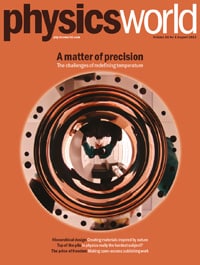
If you’re a member of the Institute of Physics, it’s time to get stuck into the August 2013 issue of Physics World, which has a great range of articles that are sure to pique your interest.
Michael de Podesta from the UK’s National Physical Laboratory describes attempts to redefine the SI unit of temperature in terms of the Boltzmann constant. We also examine how ambitious plans to pipe energy to Europe from massive solar-power plants in north Africa and the Middle East appear to have bitten the dust.
This month’s Critical Point column by Robert Crease examines a fascinating institution in the US that seeks to teach physics and engineering through project-based work based on the intriguing principle of “just-in-time” – rather than “just-in-case” – education. Finally, a feature by our own Michael Banks tackles the move to open-access publishing, which is fast becoming a reality.
“World wanderers, we have lost a wise elder. Hackers for right, we are one down. Parents all, we have lost a child. Let us weep.” So Tweeted the creator of the World Wide Web, Tim Berners-Lee at 4.57 p.m. on 12 January. Just a day earlier, Aaron Swartz – a 26-year-old Internet activist – had been found dead in his apartment in Brooklyn, New York, suspected of taking his own life.
Rather like Berners-Lee himself, Swartz was revered for being a prodigious computer programmer. When he was aged just 14, Swartz had co-authored an early version of the popular Internet tool RSS and later became the brains behind Reddit – a social and entertainment website that has become a locus of Internet activism.
Yet Swartz had another passion. In July 2008 he published his “guerilla open-access manifesto”, warning that science is “being locked up” by big business. “We need to take information, wherever it is stored, make our copies and share them with the world. We need to take stuff that’s out of copyright and add it to the archive,” declared Swartz. “We need to download scientific journals and upload them to file-sharing networks.”
It was this call to arms – and Swartz’s leadership in it – that landed him in trouble. On 6 January 2011 Swartz was indicted with two counts of wire fraud and 11 violations of the US computer fraud and abuse act. He allegedly broke into the Massachusetts Institute of Technology’s servers and downloaded some 4.8 million documents from JSTOR – a not-for-profit organization that licenses the right to digitize academic journals and books from publishers and then sells them to libraries to recoup its costs. The charges against Swartz carried a maximum penalty of up to 35 years in prison with a fine of more than $1m.
The response to Swartz’s suicide – suspected to have been brought on by this looming sentence – prompted renewed calls for more scientific research to be made “open access”, or free to read online. It fuelled a Twitter campaign, #pdftribute, calling on researchers to post PDFs of their work online for anyone to be able to read. The effect Swartz had on the open-access movement was underlined two months after his death when he was posthumously awarded the American Library Association’s James Madison Award for being an “outspoken advocate for public participation in government and [for] unrestricted access to peer-reviewed scholarly articles”.
It would be tempting, from Swartz’s death, to see open access as a polarized battle pitting the science-publishing industry against the individual, but open-access publishing is a much more subtle issue – and one that was in the limelight long before Swartz made the news. Back in December 2001, a group of 13 researchers put together the Budapest Open Access Initiative – a public statement of principles relating to open access that by July 2012 had been signed by some 5645 individuals and 630 organizations. Open access has grown slowly over the last decade and according to the Directory of Open Access Journals, there are now some 9000 open-access journals across all disciplines of science (although many publish few papers) of which around 90 are in physics.
The move to open access has so far not been a particularly smooth ride, but publishing research papers in this way appears to be here to stay. Within the last few years, the European Commission (EC), UK and US have all issued policies to further increase the number of papers that are open access, with funding councils also putting their support behind the movement. Yet while most would agree that open access helps to disseminate research, there has been much confusion around how best to implement open-access policies and many differences have emerged between funding agencies and nations.
Scientific publishing dates back to 1665 when the French Journal des sçavans and the Philosophical Transactions of the Royal Society first began to publish scientific research. Peer review forms the crux of how almost all journals operate. It involves a scientist submitting a paper to the journal, which has it refereed by one or more people not involved in the work, who judge whether the paper is scientifically credible and appropriate for the journal to which is has been submitted (see “The value publishers bring”). Traditionally, submitting papers is free of charge, with the publisher that owns the journal paying for its running costs by charging subscriptions, which are typically paid for by university libraries.
While most would agree that open access helps to disseminate research, there has been much confusion around how best to do it.
While this publishing model has served both scientists and publishers perfectly well for centuries, the growth of the Internet spurred a digital revolution that has shaken up the science-publishing industry. No longer bound by print, journal content started to appear online, and researchers began to come across journals to which their institution had no subscription. So while the abstract could be freely accessed, the main paper was, for them, stuck behind a paywall.
Along with that inconvenience, there was also a growing anger that large commercial publishers were making handsome returns. An analysis carried out in 2008 by Cambridge Economic Policy Associates estimated that profit margins in science publishing were around 20% for “society publishers” – those owned by professional bodies – but around 35% for commercial firms. With publishers raising journal subscriptions – in some cases well above the rate of inflation – the traditional model of publishing came under the spotlight. Researchers could not see why taxpayers should fund scientists to do research and then – through university library budgets – be charged to access that research they had already paid for. Given that researchers are not paid to carry out peer review either, many began to see publishers as a greedy and manipulative enemy.
Yet one reason for the rise in prices has been the 4% per year growth in the number of published papers since the 1960s. There are now hundreds of journals in physics alone and in 2010 a staggering 116,000 papers were published in physics, according to the Science Citation Index, part of Thomson Reuters’ Web of Science database. Moreover, researchers have come to rely on the publishing industry, needing to publish papers in properly peer-reviewed journals to further their careers and to ensure that their research is clearly communicated, can be easily discovered and is safely archived.
But many of the benefits of the publishing industry hold no truck with some researchers. In January 2012, for example, the University of Cambridge mathematician and Fields Medal winner Timothy Gowers created “The cost of knowledge” petition calling on researchers to boycott the Netherlands-based publisher Elsevier over its “exorbitantly high prices for subscriptions to individual journals”. The petition has since been signed by some 13,000 people. A month later 34 academics – including Gowers – penned a statement on the reasons behind the boycott, pointing to the decreasing costs of distribution and claiming that scientists now do most of the typesetting for their papers anyway (a fact disputed by publishers). “Elsevier and Springer as well as a number of other commercial publishers all exploit our volunteer labour to extract very large profits from the academic community,” the authors complained. “They supply some value in the process, but nothing like enough to justify their prices.”
Another vocal critic of the science-publishing industry has been astronomer Peter Coles from the University of Sussex. “Publishers want a much higher fee than [the real cost of publishing a paper on the Internet] because they want to maintain their eye-watering profit margins, despite the fact that the ‘service’ they provide has been rendered entirely obsolete by digital technologies,” Coles claimed on his blog In the Dark earlier this year. Yet publishers have been fighting back, pointing out that scientists often do not understand how the publishing industry operates and highlighting the many valuable – and expensive – functions they provide to the scientific community. In addition to the often complex process of managing peer review, these include everything from developing and maintaining IT systems to checking papers through plagiarism detection software – none of which comes cheap (see “The value publishers bring”).
Physics is often thought of as a pioneer in open-access publishing. After all, since 1991 physicists have been able to post their papers before they are sent to a journal for peer review on the free-to-access arXiv preprint server. The website’s $820,000 per year costs are mostly funded by Cornell University as well as the Simons Foundation – a private body based in New York that supports research in the basic sciences. Over the last 20 years arXiv has been a huge success, with the site now containing more than 770,000 papers, with some 7000 additional papers being added each month, compared with just 500 per month a decade ago.
While arXiv is widely used in certain fields of physics, it mostly contains preprints and accepted manuscripts but few final, published versions of papers. To increase the number of such final articles that can be publicly accessed at no charge, in September 2011 the UK government commissioned a report into the matter. Led by the sociologist Janet Finch, the report aimed to reach a consensus on an open-access policy among universities, libraries, researchers, learned societies and publishers – all of which were represented on the Finch panel.

After the report was published in June 2012, the UK government “widely accepted” its recommendations, which included favouring what is known as “gold” open access over “green”. Rather than it being free to publish a paper, gold involves an author paying an upfront article processing charge (APC) to the publisher to make the final version of the paper immediately available on an open-access basis and with the author having extensive rights of reuse. Green, meanwhile, refers to a published paper being initially placed behind a publisher’s paywall but where – after a certain embargo period of typically 12 months or more – the researcher is then allowed to place the accepted manuscript in a centralized free-to-access repository (see figure 1). According to analysis by Stevan Harnad of the University of Southampton, currently about 33% of all papers in physics are in some way free to read online, with the vast majority (32% of the total) being green (1% being gold). Based on the number of articles indexed by Thomson Reuters’ Web of Science database, this would amount to around 40,500 articles in physics being open access.
The Finch report also recommended that if a particular journal did not support gold publication, researchers would be required to place their accepted manuscripts in a free repository within six months of publication. If funding is not provided for gold publication, publishers could extend the embargo period before papers can be made freely available from six months to 12.
The UK government estimates that the costs of such a gold open-access policy – through paying for APCs – would amount to around 1% of the UK’s research budget, or £60m a year. These costs would be met by providing block grants to universities. After the Finch report was published, Research Councils UK (RCUK) – the umbrella organization for the UK’s seven research councils – quickly announced its policy, saying that any scientific paper that results from research wholly or partially funded by RCUK must be published either in an open-access journal or in a journal that allows accepted manuscripts to be deposited in a free repository. In the latter case, the paper must be put in the repository within six months and must include all changes resulting from peer review.
In March this year, however, confusion over the RCUK’s policy – which differed in some significant aspects from Finch’s recommendations – and how it would be implemented forced RCUK to amend its guidelines. The new policy, which came into effect in April, is more in line with the Finch recommendation and states that if gold open access is available from the publisher and the funds are available from the funder for the APC then the paper should be immediately made available via gold open access. However, if the gold open-access method is available from the publisher but the money is not available for the APC then the paper should be green with an embargo period of 12 months. If there is no gold open-access option via the publisher then the paper should be green open access with an embargo of only six months.
Such revisions – coupled with a hasty implementation of the policy – have led to much confusion in the UK community about open access in general and what it will mean for research budgets. Many are still unclear how exactly gold will be paid for, what will happen if the block grant to a university runs out, and – if they are part of a collaboration – who will foot the bill for the APC. “There is a danger that this level of confusion could turn people away from open access completely,” warns Alma Swan, director of European advocacy at the Scholarly Publishing and Academic Resources Coalition – an organization that aims to expand the dissemination of scholarly research and reduce financial pressures on libraries.
Peter Suber, director of Harvard University’s Office for Scholarly Communication who is also director of the Harvard Open Access Project – an initiative to foster open access – goes further, calling the UK policy a “mistake”. He claims that Finch recommended gold open access to secure the so-far successful business model for publishers that would be guaranteed a payment through the APC.
Suber suggests that while block grants may be intended to introduce price competition and keep APCs at a reasonable level, a problem may originate where there is not enough money to fully cover UK research following the gold route. “This will cause resentment and anger for people who can’t publish,” says Suber, although it will still be possible to publish free in conventional subscription-only journals. But Suber has two related concerns. “One is that policy-makers already think, ‘open access is good, therefore the RCUK policy is good’. The other is that researchers will soon think, ‘the RCUK policy is bad, therefore open access is bad’.” Such a view is shared by Concordia University physicist John Harnad, who is also director of the mathematical physics lab based at Centre de Recherches Mathématiques in Montreal. “This is not in the interests of science or scientists who now face a reduction in funding to pay publishers instead.” Harnad adds that the UK policy is a “really poor development” that is “off the tracks”.

However, Steven Hall, managing director of IOP Publishing, which publishes Physics World, disagrees that the Finch report was driven by publishers. Hall, who sat on the Finch panel, notes that funders were well represented on it and included the Wellcome Trust – a strong advocate of gold open access – and RCUK, which has long provided funding for gold open-access publication through its research grants. “Finch came down in favour of gold open access over green because gold provides immediate access to the version of record of a paper and usually with broad rights of reuse,” says Hall. “But green, which depends on the continuing sustainability of subscription publishing, gives delayed access to an intermediate version of the paper and without the same rights of reuse.”
Hall adds that the problem has been in the implementation, with RCUK “cherry-picking” the Finch recommendations and failing to consult adequately with universities and publishers. He also says there has been a lack of support from the UK government for “transitional costs” to cover the move to open access, leading to resistance from the universities that fear a large part of those costs will fall on them. “There is no reason why in the long run gold should be more costly than the current subscription model; in fact it may be less costly,” says Hall. “But during the transition, and as long as the UK is ahead of the rest of the world, there will be additional costs for the UK.”
While the UK is firmly favouring gold open access, the same cannot be said of other countries. In July 2012 the EC announced that from 2014 – the start of its seven-year “Horizon 2020” funding round – all research that is funded from the programme will either have to be accessible immediately via gold open access (with costs being eligible for reimbursement by the EC) or by researchers making their articles available via green no later than six months after publication. The EC also recommended that individual member states take a similar approach, with the goal that 60% of European publicly funded research articles be available under open access by 2016.
Hot on the heels of the EC’s announcement, in February the US Office of Science and Technology Policy (OSTP) advised all US funding agencies to make papers on research that they support freely available online with a 12-month embargo period as a guideline. This would be similar to a law passed in the US in 2008 that required all researchers funded by the National Institutes of Health (NIH) – mostly in the biomedical field – to submit final peer-reviewed journal manuscripts to the digital archive PubMed Central no later than 12 months after they had been accepted for publication. The new OSTP policy will apply to all federal agencies that spend more than $100m on external research and development. (A bill currently going through Congress could, if passed, extend the NIH green open-access policy to other funding bodies but cut the embargo period from 12 to six months.)
Physicist Paul Ginsparg from Cornell, who developed the arXiv preprint server, says it was “inevitable” that there would eventually be pressure to expand the NIH bill to other federal agencies. “If that effort does succeed in this round, then the remaining inconsistency of [the long embargo] applying only to agencies with budgets above $100m will also have to be dropped before too long,” he adds.

Suber supports the US and EU approach for green open access and even calls for them to go further in terms of a shorter embargo time – possibly with none at all. “There is still no evidence that green open access harms publishers,” he says. “Publishers themselves have been unable to point to any harm from green and that includes lost jobs.” Suber’s point is backed up by Harnad who points to the success of Ginsparg’s arXiv as an assurance that publishers will not be hurt by green open access, even with embargoes of six months or less. “arXiv coexists perfectly well with the publishing industry, and it hasn’t diminished publishers’ revenue,” says Harnad. “So I don’t think publishers are in danger from green.”
But one big question for green is how such repositories would work. Harnad, for example, believes that a repository like arXiv for peer-reviewed published research over a broad range of fields would better serve the community than individual institutional repositories. This would, for example, make it easier to search for papers than if they were held in one of many institutional-only repositories. But who would run and pay for them?
The open-access movement has also led to numerous new publishers setting up open-access journals and introducing new ways of publishing. This has spawned a wide variety of different models – and fees – for publishing research. PLOS ONE, for example, charges an APC of $1350 per article while newcomer PeerJ allows authors to publish an unlimited number of papers for a one-off fee of just $299. APC values vary according to the differing levels of copy-editing, peer review and rejection rates on offer. One journal, for example, may do light-touch peer review, have little copy-editing and reject very few papers, which means it can charge a lower APC. Another journal, meanwhile, may charge a higher APC because it has a distinctive brand and target audience, undertakes full copy-editing, practises full peer review and ensures only the best quality papers make it in.
Some researchers, however, seem not to be convinced that publishers are adding enough value to justify their subscription – and APC – costs. This has led some scientists to even consider setting up their own journals. In January, for example, a group of mathematicians, led by Tim Gowers, proposed “Episciences”, where researchers would organize the peer-review process themselves and then host the peer-reviewed research on arXiv. But whether this can be made to work remains to be seen.
If open access is ever to become truly widespread, then researchers themselves will need to embrace it
If open access is ever to become truly widespread – making it a default method of publishing – then researchers themselves will need to embrace it. After all, papers are the lifeblood of a scientist’s career – it is the currency they use to get promoted and further their career, enshrined in the epithet of “publish or perish”. Speaking at a meeting on open access at the Royal Society in February, chemist Tom Welton from Imperial College London spoke about a pilot scheme at the university whereby people in his department could access a pot of money to make their papers open access. When hardly anyone took up the funds, this led him to conclude that many are not interested in open access. “Open access will only happen if academics want it,” he said. “And researchers will only do it if it gives us prestige.”
Another word of caution at the Royal Society meeting came from optical physicist Miles Padgett from the University of Glasgow, who is also its dean of research. Although he says academics broadly support sustainable open access, in his view “very few” insist on publishing their papers in open-access journals. “Ideally we don’t want to start taking money away from core science to fund open access,” Padgett warns. “And we certainly don’t want to go down the route where a lack of funds means that we have to make a decision who can publish or not.”
Those views are echoed by Hall. “What we need is a shift away from arguments that open-access publishing is good and subscription publishing is bad, or vice versa, and more towards a discussion of what researchers want,” says Hall. “Do they want rigorous pre-publication peer review, copy-editing and publication in a journal aimed specifically at their research community, or light-touch peer review, no copy-editing and publication in a ‘database journal’ alongside papers in completely different disciplines?” Hall adds that it is likely that both types of publishing will have a role to play given the increasing numbers of papers that are published each year. “But it must be recognized that they have different costs, regardless of whether the underlying business model is subscription or open access.”
While researchers are still coming to terms with what open access will mean regarding how they publish, the elephant in the room could be “open data” – an issue that Swartz campaigned for. This would go much further than researchers just posting their finalized paper in a freely available online repository but also, via some mechanism, publishing their data, allowing other scientists to use it and publish their own work based on it.
Alma Swan goes further, predicting that the currency of the scientists’ output in the future will shift from papers to raw data. “Data needs to be put out there so scientists can use it,” she says. “It won’t be the paper but the data that gets you credit.” Yet requiring access to the underlying data will be much more contentious, as a result of various privacy and commercial issues. Ginsparg, for one, thinks that open data will remain a largely voluntary activity for now.
Few would doubt that open-access publishing is here to stay, with researchers and funders only beginning to understand the various open-access policies and what it will mean for their work and budgets. But with all the differences and confusion casting open access in a slightly bad light, it is now at least prominent in the minds of researchers. We are firmly on the path to open access, but it will continue to be a long and bumpy road.
One common complaint by researchers about publishers is that the scientists do the work but then have to pay to read or access the research they have published. Researchers question why these companies deserve to make money out of the work the sciences have carried out. In effect, scientific publishing is an industry where the scientists are both the suppliers and the consumers.
However, publishers point out that they provide a wide range of services between the point at which a paper is submitted for review and its use by another scientist. In particular, they facilitate peer review through their editorial systems and referee databases, and produce high-quality final published versions of articles as well as a range of post-publication services to help the paper be cited and discovered.
In the case of IOP Publishing, which is wholly owned by the Institute of Physics and publishes Physics World, the journals publication process is run by four distinct roles – the publishing administrator, the publishing editor, the production editor and the publisher. The administrator handles all correspondence with authors and referees. The publishing editor helps select the referees and, in consultation with the editorial board, makes decisions based on those reports, typically handling around 1000 submissions per year. (IOP Publishing is something of an exception in this regard as peer review at many other publishers is handled by external editors rather than the journal’s own staff). The production editor manages the copy-editing and laying out the content in the journal’s style, while the publisher works closely with the editorial board as well as on the strategy and development of the journal.
Ensuring that the peer-review process is fair, rigorous and fast is a time-consuming job. Editors closely monitor all aspects, including chasing referees for their reviews, managing the referee pool to ensure that reviewers are not over-used, and providing ongoing help and advice to new reviewers, with workshops held to educate new reviewers about the process. “Peer review is a service to authors designed ultimately to improve a paper regardless of whether it is accepted or rejected,” says Tim Smith, a senior publisher at IOP Publishing.
Publishers can add value elsewhere too. Editors and editorial boards can help to shape a particular field by publishing special issues or give focus to new burgeoning areas. Publishers maintain complex IT systems to ensure papers are properly archived and can be rapidly accessed and that they follow accepted standards for referencing material and searches for content. Publishers also do additional checks, including putting papers through plagiarism detection software such as CrossCheck. IOP Publishing was an early funder of CrossRef – a service that enables proper linking between papers and journals – and more recently has contributed funding for ORCID, which aims to provide every author with a unique ID so that there is no confusion between papers published by people with similar or identical names.
In the case of IOP Publishing, new services are being added such as “video abstracts” for papers, which let researchers submit a short video explaining in simple terms the significance of their new research. Editors will also identify specific papers for press release and other promotional activity, helping to improve the visibility and impact of an author’s work to a wider audience. Meanwhile, all profits from IOP Publishing go back to the Institute of Physics, where the money is used for a wide variety of activities to support the international physics community, such as educational projects, advising government and research funding bodies, as well as promoting physics careers, improving teacher training and supporting the international development of physics through schemes such as IOP for Africa.