Tides control the geysers of Enceladus


The water geysers of Enceladus spew the most material when the small moon ventures farthest from Saturn, planetary scientists in the US have found. This discovery confirms a prediction of a theory that says the geysers’ strength depends on Saturn’s tide.

Discovered by the German-born English astronomer William Herschel in 1789, eight years after he spotted the planet Uranus, Enceladus is the sixth largest of Saturn’s 62 known satellites. The small moon is 238,000 km from Saturn’s centre, about two-thirds of the distance from the Earth to the Moon. Because Saturn is so massive, though, its gravity forces Enceladus to circle it every 1.37 days.

With a diameter of just 500 km, Enceladus is only one-seventh the size of the Earth’s Moon so has far fewer radioactive elements, which heat the Earth’s interior. This makes it an unlikely world for geysers or any other geological activity.

Icy spray

In 1980 and 1981 NASA’s Voyager 1 and 2 spacecraft flew past the ringed planet and found Enceladus’s surface unusually smooth. This suggested that something was erasing its craters. Then in 2005 the Cassini spacecraft discovered water vapour around Enceladus. Cassini soon found the surprising source: geysers around the moon’s south pole shoot water vapour and ice particles hundreds of kilometres above the surface. Some of this material settles on the surface of the moon, covering its craters.

Now planetary scientist Matthew Hedman of Cornell University and his colleagues have examined 252 near-infrared images from Cassini. “The brightness of the plume varied quite a bit,” says Hedman, who found it four times brighter when Enceladus is farthest from Saturn than when closest. These observations agree with a prediction made in a paper published in 2007 by Terry Hurford of the Goddard Space Science Center in Maryland, who had calculated how Enceladus would respond to Saturn’s tide.

Tides arise when gravity pulls on an extended object. For example, lunar gravity tugs strongest on the side of the Earth facing the Moon, lifting the sea. Likewise, on the opposite side of the Earth, the Moon’s gravity pulls our planet’s centre out from under the sea, producing a high tide on the far side as well. Elsewhere, tides from Jupiter power the fiery moon Io, which sports active volcanoes, and melt ice beneath the surface of the moon Europa.

Tiger stripes

Saturnian tides are weakest when Enceladus is farthest from the ringed planet, yet that is when the geysers are strongest. “It’s the direction of the force rather than the magnitude that’s relevant,” Hedman says, noting that the geysers erupt through cracks that resemble the stripes of a tiger. “The tiger stripes are all oriented in one direction. According to the models, in part because of the particular orientation of the tiger stripes, the cracks are pulled open when Enceladus is furthest from the planet and slammed shut when it’s closest to the planet.” As a result, the moon vents the most material when most distant from Saturn.

“It’s quite a spectacular result,” says John Spencer, a planetary scientist at the Southwest Research Institute in Boulder, Colorado, who was not involved in the discovery. “They’ve got such a solid set of observations that it really looks very convincing.”

Beneath its icy crust, Spencer says, Enceladus probably has an ocean of liquid water that is kept warm by the tides. So does Europa. “But Europa’s ocean is locked beneath an ice shell that you would have to drill down through to directly sample that liquid,” Spencer says, “whereas on Enceladus all you have to do is fly through the plume, and we’ve been doing that for several years.”

Resonant moons

Enceladus owes its geysers not only to the tides of Saturn but also to a resonance with Dione, a moon that lies beyond it. Saturn’s strong tides ought to make Enceladus’s orbit a perfect circle, but Enceladus revolves around Saturn twice in the same time Dione does once, so Dione’s periodic gravitational tugs keep the path of Enceladus slightly elliptical. This causes the tidal force on the moon to vary continuously as the satellite orbits Saturn, supplying the small moon with heat. Nevertheless, Enceladus has a more circular orbit around Saturn than any planet in the solar system does around the Sun.

The same phenomenon happens around Jupiter. Io is in resonance with Europa and Europa with Ganymede, so Io and Europa have slightly elliptical paths that cause the tidal force they feel to change constantly.

Hedman and colleagues describe their observations in Nature 10.1038/nature12371.

Extending the ‘Goldilocks’ zone

Image comparing the inner planets of our Solar System to Kepler-62, a five-planet system about 1,200 light-years from Earth.

By Ian Randall

In the modish hunt for exoplanets, the holy grail is discovering such a body within the habitable zone of a star – offering a tantalizing potential for extraterrestrial life. If our solar system is anything to go by, we can expect most planets to form outside of the confines of this zone. What if, however, the habitable zone is really larger than we thought?

This is the idea put forward by Sean McMahon from the University of Aberdeen, Scotland, and colleagues in a recent paper – proposing that the existing definition of the habitable zone overlooks the potential for life to survive below the surface of terrestrial planets that currently lie outside the zone’s reach.

(more…)

Disorder boosts performance of tiny spectrometer


The disordered scattering of light in a special silicon crystal has been used to make a tiny “spectrometer on a chip”. According to its creators at Yale University in the US, the device can measure the wavelength of light with nanometre-scale resolution and is just microns in size. The team believes that the new technology could lead to the integration of spectrometers into lab-on-a-chip systems.

The lab-on-a-chip is a well-established concept that involves using silicon fabrication techniques to miniaturize and integrate analytical processes that are normally performed in a chemistry or medical laboratory. The benefits are most obvious in medicine, where these portable devices can deliver rapid diagnoses that would have previously required sending a sample to an external facility for analysis. Labs-on-a-chip can also be useful research tools, allowing for the rapid screening of candidate drug compounds for effectiveness and toxicity, for example.

Difficult to miniaturize

Spectroscopy is one of the key tools of analytical chemistry. It involves identifying a material using the specific set of light wavelengths that it emits, absorbs, reflects or transmits. Traditional spectrometers use a diffraction grating to spread the wavelengths out at slightly different angles so that the spectrum can be obtained using a position-sensitive detector. This is inherently difficult to miniaturize because the angular resolution and therefore the wavelength resolution of the instrument depends on how far the light travels after passing though the diffraction grating. The smaller you make the spectrometer, therefore, the less sensitive it becomes.

Several groups have designed spectrometers that evade this constraint by, for example, using resonant cavities to increase the optical path length beyond the physical size of the device. Other attempts rely on using different physical principles, such as the wavelength-dependent interaction of light with photonic crystals. These have had some success but they all have limitations, including manufacturing difficulties, low sensitivities or inability to deal with broadband spectra.

Highly nonlinear path

In the new research, physicists at Yale have produced a spectrometer that identifies the different wavelengths present by shining light into a semi-circular crystal of silicon studded with tiny holes. The light scatters repeatedly off the holes, travelling a complex, highly nonlinear path – much longer than the physical dimensions of the crystal – between entering the crystal and leaving at the outer edge. An array of waveguides attached to the outer edge delivers the light to a series of photodetectors, allowing the light intensity arriving at closely spaced points to be measured.

In general, the movement of light within the silicon crystal is effectively random and therefore so is the intensity distribution produced. However, the researchers verified that putting in the same wavelength always produced the same distribution and that when they changed the input by only a small amount the pattern changed only gradually. “There’s a correlation wavelength you can think of,” explains Yale’s Brandon Redding, “which is the change in wavelength you need before the intensity pattern changes noticeably. And so within that, different wavelengths produce pretty much the same pattern.” For larger differences in wavelength, the patterns produced by various wavelengths are effectively independent.

Catalogue of patterns

The team calibrated the spectrometer by looking at the intensity pattern at a series of known wavelengths separated by about this correlation width. Cataloguing the patterns produced by all wavelengths of interest allowed the researchers to calculate the wavelengths present in an arbitrary beam of light. To demonstrate this, they constructed a spectrometer with a radius of just 25 μm and calibrated it for wavelengths of 1500–1525 nm. They found that they could resolve spectral lines just 0.75 nm apart or accurately reconstruct a broadband spectrum of these wavelengths.

Allard Mosk, an expert in complex photonic systems at the MESA+ Institute for Nanotechnology of the University of Twente in the Netherlands, describes the work as “excellent”. “The present device does not significantly exceed the resolution, throughput or other specs of any existing device as yet,” he says, but adds that the technology shows great promise. He concludes, “I expect this result to give rise to the development of devices optimized with specific application areas in mind, as well as highly optimized devices that may exceed, for example, the spectral resolution of devices with a similar footprint.”

The Yale team leader Hui Cao also hopes that the idea will be developed commercially outside the research lab. “We are applied physicists,” she says, “We try to develop a novel device concept using a physics principle. We are hoping that somebody will take this over and try to develop it into a commercial product and we will be very happy to help.”

The research is described in Nature Photonics 10.1038/nphoton.2013.190.

Close encounters of the muon kind

Photo of g-2 magnet

By James Dacey

Don’t worry, the aliens haven’t landed. The people in this photo are watching with excitement shortly before this giant electromagnet completed its 5000 km journey on Friday to arrive at Fermi National Accelerator Laboratory just outside Chicago. The 15 m-wide ring that weighs more than 15,000 kg has been travelling for the past five weeks by land and sea from its previous home on Long Island in New York State.

The giant electromagnet has served as part of the Muon g-2 experiment at Brookhaven National Laboratory. This experiment – to describe it crudely – is designed to measure how muons wobble in a magnetic field, as many believe this will provide clues to new physics beyond the Standard Model. This experiment is now relocating to Fermilab, which offers a more intense and pure beam of muons than the Brookhaven lab.

(more…)

How to make zeptosecond X-ray pulses


A technique for producing radiation pulses that endure for less than one attosecond (10–18 s) has been proposed by researchers in Spain and the US. If the technique can be realized in the lab, then it could produce X-ray flashes brief enough to capture the movement of an atom’s inner electrons or perhaps even look directly at the movement of protons and neutrons during nuclear fission or fusion.

Ultrashort radiation pulses are the mainstay of pump–probe spectroscopy, which is used to study fast processes such as the motion of electrons taking part in chemical reactions. In this technique, a short and highly energetic laser pulse (the pump) provides the activation energy needed to kick-start a chemical reaction. A moment later, a second pulse (the probe) hits the reacting particles and is then detected. Through careful study of the detected pulse, the instantaneous state of the particles at the time of collision can be deduced. By varying the time delay between the pump and probe pulses, scientists can reconstruct the behaviour of electrons in atoms and molecules during a chemical reaction. In the future, the technique could be used to optimize the conditions for desired reactions or even to manipulate the reactions directly.

The shorter the pulses used, the faster the chemical processes that can be studied and manipulated. Pulses of a few hundred attoseconds can be produced by irradiating an atomic gas cloud with a powerful infrared laser. As the laser radiation is coherent, the electric field experienced by all the atoms in the cloud oscillates near-simultaneously. When the electric field of the radiation points in one direction, some of the negatively charged electrons are pulled a few nanometres away from the nuclei of their atoms. When the phase of the radiation changes and the electric field reverses, they are then pushed back towards the parent atoms. Some of these electrons collide with the nuclei and give up their kinetic energy in a sudden burst of broadband, coherent X-ray radiation.

Using wasted electrons

Many electrons, however, shoot straight past the nuclei without colliding and emitting radiation. Now, a new way to use these wasted electrons has been proposed by Carlos Hernández-García and colleagues at the University of Salamanca and the Centre for Pulsed Lasers, both in Spain, and the University of Colorado at Boulder in the US. What is more, the team has shown theoretically that these electrons could be used to produce sub-attosecond pulses.

The idea is that electrons that shoot straight past a nucleus the first time can be pulled back for a second time in the subsequent oscillation of the field. This gives the electrons a second opportunity to collide. The catch, however, is that these electrons produce X-rays at a slightly different frequency from those that collide the first time round.

When two adjacent notes on a musical instrument sound simultaneously, the resulting harmony produces a distressing sensation because the volume oscillates rapidly as the frequencies move in and out of phase. Similarly, the researchers’ model shows that the intensity of a pulse should fluctuate as the two X-ray frequencies move in and out of phase. The attosecond pulse could be split into a pulse train with each pulse lasting just a few hundred zeptoseconds (a zeptosecond is 10–21 s). “In the paper we show how to get 800 zs, but this is scalable,” says team member Tenio Popmintchev of the University of Colorado, “we don’t know yet how short we can go.”

Finding an appropriate laser

The team believes that the biggest obstacle to realizing this scheme in practice is the development of a suitable infrared laser – paradoxically, shorter pulses require a longer-wavelength driving laser. The scientists have received two research grants and are currently working to develop such a device.

Jon Marangos, an expert on laser–matter interactions at Imperial College London, believes that it should be possible to develop a suitable infrared laser and that an experiment to test the principle could be conducted using currently available equipment. He says that the work is one of several interesting, recent proposals to produce sub-attosecond pulses, notably one in March at the University of Strathclyde in Glasgow to do so using a free-electron laser, but that they all need to address a key issue: a pulse train would be problematic in experiments because there would be no way to attribute a signal to a specific pulse.

“You really need to work out a way of generating isolated attosecond pulses,” he says, “because then you can use them in a pump–probe experiment with no ambiguity about when the pump and the probe events occurred.”

The research described in Phys. Rev. Lett. 111 033002.

There is more about why ultrashort radiation pulses are used to study electron motion in the Physics World video “Can we see the motion of electrons on the atomic scale?”.

Nobel laureate Andre Geim profiled on BBC radio

By Hamish Johnston

I thoroughly enjoyed a recent BBC Radio 4 profile of Andre Geim of the University of Manchester, who shared the 2010 Nobel Prize for Physics. In the 13 minute broadcast, which is available for download, Geim and several admirers talk about the passion for doing quirky fundamental research that led to his co-discovery of graphene.

There is even the bold suggestion from one of Geim’s colleagues that there might be another Nobel in the Russian-born physicist.

LHCb and CMS see rare decay of the strange B meson

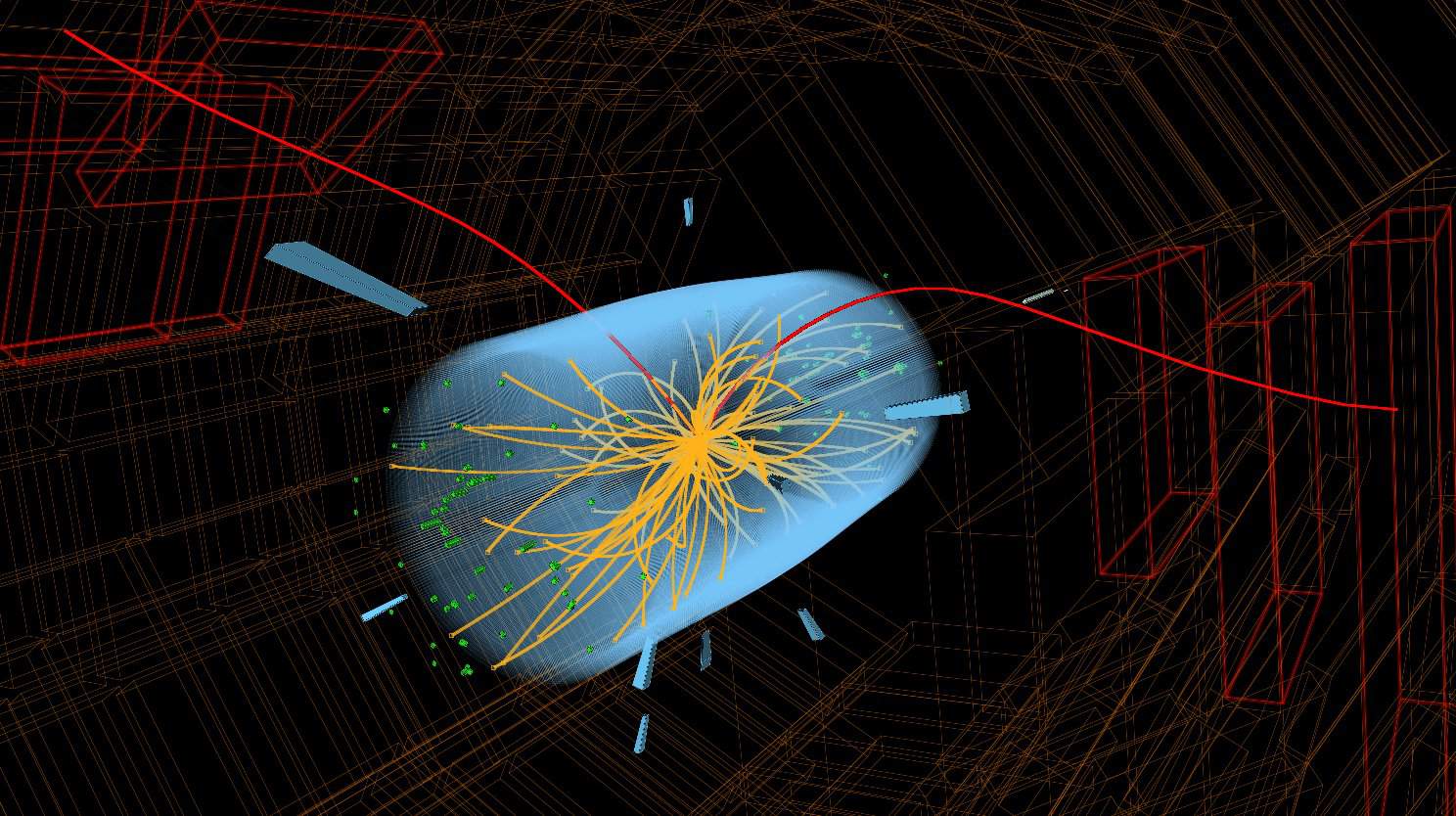
A strange B meson decay event as seen by CMS (Courtesy: CMS)

By Hamish Johnston

It’s a story with a hint of both “man bites dog” and “dog bites man” about it.

Physicists working on the CMS and LHCb experiments at CERN have independently seen an incredibly rare decay of a particle – a strange B meson decaying into two muons. The odds of this meson decaying in this particular way is about one in a billion, making the joint discovery a triumph of experimental particle physics. And it is officially a discovery. That’s because when data from the two experiments are combined the observation has a statistical significance of greater than 5σ, which is the gold standard in particle physics.

(more…)

Van Allen electrons are accelerated from within


The debate surrounding how ultra-relativistic electrons trapped in the Earth’s Van Allen radiation belts are accelerated has finally been settled. Recent data from NASA’s Van Allen Probes mission suggest that the electrons are accelerated locally through wave–particle interactions, rather than by radial transport of electrons from outside the belts. The study clearly distinguishes between the two types of acceleration. Knowing where the acceleration occurs is essential to making more accurate space-weather predictions, as changes in the radiation belts can cause satellites in geostationary orbits to malfunction or breakdown.

The Van Allen radiation belts are two concentric, doughnut-shaped rings that are made up of high-energy electrons that vary in intensity. The belts are confined within the Earth’s magnetosphere and extend from about 1000 to 60,000 km above the Earth’s surface. Although discovered by American physicist James Van Allen more than 50 years ago, the Van Allen belts are not yet fully understood. According to the lead researcher of the new study, Geoffrey Reeves at the Los Alamos National Laboratory, New Mexico in the US, previous observational data taken in the 1990s did not fit the conventional theories of the time, leading researchers to question and debate over what processes really control the intensity of the radiation belts.

Capricious processes

For example, it was thought that all solar storms intensified the radiation belts but a study that Reeves and others carried out in 2003 showed that only half the storms intensified the belts. More surprisingly, they found that about a quarter of storms depleted the belts, making them less intense. Reeves says that the Van Allen Probes mission, launched on 30 August 2012, was designed specifically to fly straight through the belts and to discover which processes control how intense the belts are and how they change.

Previous theories suggested that two possible mechanisms were driving the electrons in the belts – local acceleration or radial acceleration. In radial acceleration, the electrons were thought to be transported perpendicular to the Earth’s magnetic field, from areas of low magnetic strength far from Earth to areas of high magnetic strength nearer Earth. This would cause acceleration as electrons being transported would speed up as the magnetic field strength increases. On the other hand, the local acceleration theory purports that low-energy electrons gain energy in situ, from a source at the heart of the belts.

Reeves told physicsworld.com that previous satellite missions had provided tantalizing evidence for local acceleration, but there were always limitations. “Essentially, neither side of the argument could convince the other side that local acceleration did or did not happen,” he says. He goes on to explain that Van Allen Probes have three features that make the latest observations unique, including “the right instruments spanning a broad range of energies with amazing sensitivity, an equatorial orbit that cuts through the belts at different altitudes and two satellites that can unambiguously resolve whether something is changing in time or in space or both”.

Rapid rise

On 9 October 2012 Reeves and his team observed a rapid energy increase in the energies of electrons in the belts that lasted for about 12 hours. If the acceleration was due to radial transport, the effects would first be measured further away from Earth and be seen moving inward. Instead, their measurements revealed an increase in electron energy that started in the middle of the belts and gradually spread both inward and outward, implying a local acceleration source.

Thanks to solar processes that affect the Earth’s magnetosphere and the belts, there is a peak in intensity of the belts. The local acceleration is produced thanks to resonant interaction of radiation-belt electrons with naturally occurring electromagnetic waves. If an electromagnetic wave spirals around the magnetic field at the same speed as that of an electron, the wave gives the electron a series of well-timed pushes that increase the electron’s speed. Once the electrons are accelerated locally they spread out (diffuse) both inward and outward but when electrons diffuse outward they lose energy. “So, diffusion still happens but it is not the cause of the acceleration,” says Reeves.

Electrons with these mega-electronvolt energies can easily penetrate satellites and their electronics, causing them to malfunction or fail completely. Knowing where these super-energetic electrons come from and what gives them their energy is a key step in predicting hazards to satellites, says Reeves. He feels that “there’s tonnes more exciting stuff to look at with the Van Allen Probes data”, some of which will be things that the satellites were designed to look for and some completely unexpected.

The research is published in Science 10.1126/science.1237743.

‘Electronic skin’ lights up when touched


Researchers at the University of California at Berkeley have integrated three distinct electronic components to create touch-sensitive “electronic skin” or e-skin. The new technology combines semiconducting carbon-nanotube transistors, pressure-sensitive polymer sensors and organic light-emitting diodes (OLEDs) – which are integrated over large areas on a single plastic substrate. The result is a mechanically flexible sensor network that responds to a finger touch by immediately lighting up. And the harder it is touched, the brighter the light.

The researchers believe that the technology could help enhance the sense of touch in robots of the future and even find use in applications such as touchscreen wallpapers. Medical applications, such as “e-bandages” that monitor a patient’s health in real time, might also be possible.

Led by Ali Javey, the team made the new e-skin by first spin coating a polymer sheet just 25 µm thick on top of a silicon-wafer substrate and subsequently hardening the plastic by baking it in an oven at 300 °C. The electronic components were then vertically built on top of the plastic surface using conventional microfabrication processes. Once the electronics were stacked, the plastic backing layer was peeled away leaving a free-standing film with the sensor network embedded within it.

Active matrix

Each pixel in the active matrix of the device contains a nanotube transistor with its drain electrode connected to the anode of an OLED. A pressure-sensitive polymer is laminated on top of the OLED and it is in electrical contact with the cathode of the OLED at each pixel. The top surface of the polymer is made conducting by coating it with silver ink and acts as the ground contact. When the device is touched, current flows through the polymer layer and switches the OLED on.

“Our e-skin is the first flexible system that responds to pressure stimuli of varying intensities and provides a real-time response by emitting light through the integrated OLED display,” team member Chuan Wang says. “In the system, OLEDs are turned on only where the surface is touched and the intensity of the emitted light depends on the amount of pressure applied. This basically allows us to visualize the applied pressure.”

The e-skin can be laminated on a variety of surfaces, curved or otherwise, he adds. Potential applications include robot skin, interactive wallpaper and interactive in-vehicle dashboards. “I can also imagine things like e-bandages applied to a person’s arm that would continuously monitor blood pressure and pulse rates, for example, while providing real-time feedback.”

The Berkeley team is now busy integrating additional sensing capabilities – such as those that respond to thermal and light stimuli – into its e-skin system. “We are also experimenting with the possibility of having the whole system built using roll-to-roll printing processes for large-scale, low-cost fabrication of the sensor networks, reveals Wang.

The e-skin is described in Nature Materials 10.1038/nmat3711.

How to survive earthquakes and noisy neighbours

By Jon Cartwright

The past few years has seen a steady stream of proposals for cloaking objects, whether it’s from light, heat, water waves, magnetic fields or even time. Now, physicist Sang-Hoon Kim at the Mokpo National Maritime University in Korea is adding to this list, first off with a cloak that could protect buildings from earthquakes.

An earthquake cloak has been proposed before using – as is common in invisibility cloaks – elaborately structured “metamaterials” to guide seismic waves safely around a building. However, Kim, together with Mukunda Das at the Australian National University in Canberra, has put forward a different approach: a metamaterial barrier that dissipates seismic energy as sound and heat. The idea is that many buildings could hide in the “shadow zone” of the barrier. This could be a boon for city planners, who would not have to make cloaks for individual buildings. Kim and Das’s paper has been accepted for publication in Modern Physics Letters B and is available as a preprint entitled “Artificial seismic shadow zone by acoustic metamaterials“.

(more…)

Copyright © 2026 by IOP Publishing Ltd and individual contributors