B-mode polarization spotted in cosmic microwave background


The South Pole Telescope (SPT) has made the first detection of a subtle twist in light from the cosmic microwave background (CMB), known as B-mode polarization. The signal, the existence of which has been long predicted, paves the way for a definitive test of inflation – a key theory in the Big Bang model of the universe.

“While this effect was fully expected, its detection is a milestone event in the use of the CMB to probe our universe,” says Chuck Bennett, a leading expert in CMB observation based at Johns Hopkins University in Maryland, US, who was not involved with the study. “It is solid research and I believe the result.”

Often called the afterglow of the Big Bang, the CMB is thought to have originated some 380,000 years into the life of the universe when neutral atoms first formed and space became transparent to light. Roughly speaking, it consists of microwaves with a temperature of about three kelvin, but it also contains details that have helped to refine our understanding of the early universe. The most noticeable of these details are variations in temperature of about 100 μK, which reveal density fluctuations in the early universe – the seeds of the stars and galaxies that we see today.

Polarized by scattering

The CMB does not only contain variations in temperature, however. Its radiation was scattered towards us from the universe’s earliest atoms in the same way that blue light is scattered towards us from the atoms in the sky. And in the same way that the blue light from the sky is polarized – a fact you can check by wearing polarized sunglasses – so too is the light from the CMB polarized. Variations in CMB polarization were first detected in 2002 by the DASI interferometer in Antarctica and helped cosmologists understand the dynamics of the early universe.

These polarization variations were known as E-mode or gradient variations because they describe how the magnitude of polarization changes over the CMB. But there are even subtler variations known as B-mode variations, which describe the rotation or “curl” of CMB polarization. The majority of B-mode polarization is produced by galaxies acting as gravitational lenses, twisting the E-polarized light on its 14-billion-year journey from the other side of the observable universe. It is incredibly faint, producing temperature variations of about 0.4 μK and accounting for just one part in 10 million in the CMB temperature distribution. “B-mode polarization is very difficult to measure,” says Duncan Hanson, a member of the SPT team who is based at McGill University in Canada.

The SPT has managed to detect B-mode polarization largely thanks to improvements in detector technology. Although the detection will probably have little application, it opens new doors in experimental cosmology. With more precision, B-mode signals could help cosmologists place tougher constraints on neutrino masses, which cannot be predicted in the Standard Model of particle physics.

Gargantuan ripples

But the biggest prize would be using B-mode signals to uncover evidence of primordial gravitational waves – gargantuan ripples in space–time. Such ripples are predicted to have been generated in inflation, a brief period prior to the formation of the CMB when the universe is thought to have undergone rapid expansion and given birth to large-scale structures.

Although most cosmologists today believe in inflation, the theory lacks crucial details such as how it started and stopped and there has been no way to test it. A detection of primordial gravitational waves would be strong evidence for the existence of inflation, which was first proposed back in 1980 by the American physicist Alan Guth.

“This possibility of detecting B modes from gravitational waves is a remarkable enough possibility that it is driving numerous experimental efforts,” says cosmologist Arthur Kosowsky at the University of Pittsburgh in Pennsylvania, US. “SPT is the first to detect any B modes, [and now] several other experiments are in hot pursuit, so this is the first leg in what is shaping up to be an exciting race to the finish line over the next decade.”

Others are looking

Gravitational-wave B modes could be detected by the European Space Agency’s Planck observatory, which orbits the Earth, although the toughest competition will come from the BICEP telescope, which sits alongside the SPT, or the POLARBEAR or ACT telescopes in northern Chile. If the discovery is made by one of the ground-based telescopes it would continue the tradition of ground-based experimental cosmology firsts that began with the discovery of the CMB, made by the American astronomers Arno Penzias and Robert Wilson with the horn antenna at Bell Labs in Holmdel Township in New Jersey, US, in 1964.

“Results come out from space, and there’s lots of press and beautiful results, and the ground-based work tends to get forgotten,” says John Carlstrom, the principal investigator on the SPT team who is based at the University of Chicago in Illinois, US. “But the ground-based telescopes, balloons and short-duration flights are an extremely important part of the [experimental] program and have led the way consistently since the beginning. And they still do.”

The discovery is described in the preprint arXiv:1307.5830.
What is the lifetime of a photon?

The photon – the quantum of light or other electromagnetic radiation – is normally considered to have zero mass. But some theories allow photons to have a small rest mass and one consequence of that would be that photons could then decay into lighter elementary particles. So if such a decay were possible, what are the limits on the lifetime of a photon? That is the question asked by a physicist in Germany, who has calculated the lower limit for the lifetime of the photon to be three years in the photon’s frame of reference. This translates to about one billion billion (1018) years in our frame of reference.

An issue of mass

The idea that photons have a finite lifespan, and therefore mass, is difficult to imagine. Indeed, astronomers looking at distant cosmic objects regularly detect photons that are billions of years old. But some theories suggest that photons could have a non-zero rest mass, albeit a small one – the upper limit for the mass of the photon is constrained to 10–18 eV or 10–54 kg thanks to experiments with electric and magnetic fields. And with this small mass, a photon could decay into other lighter elementary particles, such as a pair of the lightest neutrino and an antineutrino, or even particles that are currently unknown and beyond the Standard Model of particle physics.

Now, Julian Heeck of the Max Planck Institute for Nuclear Physics in Heidelberg, Germany, has turned to cosmological observations for signs of this photon decay (Phys. Rev. Lett. 111 021801). He looked at the cosmic microwave background (CMB), a remnant of the Big Bang that came into being when the universe was very young – only about 380,000 years old.

Background glow

Before that time, matter and radiation were intrinsically linked. But as the universe underwent a period of extreme growth known as “inflation” and expanded, the hot plasma of electrons and light nuclei cooled enough to allow neutral atoms to form. This “decoupling” of matter and radiation suddenly allowed photons to travel freely across the universe. Over time, their wavelengths were stretched by the expansion of the universe to leave a faint glow of radiation in the microwave region of the spectrum – an emission of uniform, black-body thermal energy – in every direction that we can detect today.

More than 100 experiments have studied the CMB since it was first discovered, including NASA’s Cosmic Background Explorer (COBE) satellite, its Wilkinson Microwave Anisotropy Probe (WMAP) and more recently the European Space Agency’s Planck mission, all of which have made increasingly precise measurements of this radiation. In fact, the CMB spectrum is the most precisely measured black-body spectrum in nature.

A long lifetime

It is this spectrum that Heeck used as a constraint for his calculations – he used extremely accurate data from the COBE mission and compared it to his calculated spectrum, which included the photon decay.

If the photon has mass and is decaying into lighter particles, then the number density of photons in the CMB should decrease as the photons travel. But this in turn would mean that the CMB spectrum would no longer fit the near-perfect thermal curve that is observed. Heeck reasons that as the CMB is an almost a perfect black body, very few photons, if any, will have decayed during the 13.8-billion-year existence of the universe and so the CMB measurements can constrain the photon’s lifetime.

Using a combination of the mass and CMB constraints, Heeck calculates the photon’s lifetime within its own rest frame to be three years. But as these photons with tiny mass travel at nearly the speed of light, time dilatation must be accounted for to obtain their lifetime in our frame of reference, for visible light – and this was calculated to be 1018 or a billion billion years. Improving this limit might be difficult until new studies can probe the early universe further.

The research is published in Physical Review Letters.

Carbon map of Panama leads the way

Carbon map of Panama

By Madeleine Fowler, who is doing a work experience placement at Physics World

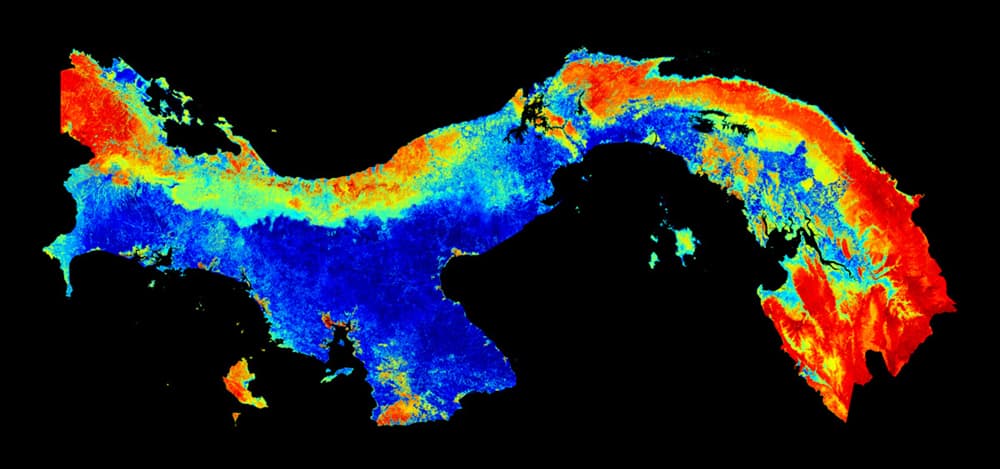
Panama is a country of diverse ecosystems and complex landscapes, with vegetation ranging from grasslands and scrublands to dense forests. This makes it the perfect location for scientists to experiment with different methods of measuring above-ground carbon density – carbon that is locked up in vegetation.

Scientists have now mapped the above-ground carbon density of the entire country, which is a first in the world of carbon mapping. Field data and satellite data were integrated with high-resolution airborne light detection and ranging (LiDAR) data.  This made it possible to create the first carbon map that could quantify carbon stocks in a local area as small as one hectare. What’s more, it can do this over millions of hectares.

(more…)

Never before have we felt so small

By Madeleine Fowler, who is doing a work experience placement at Physics World

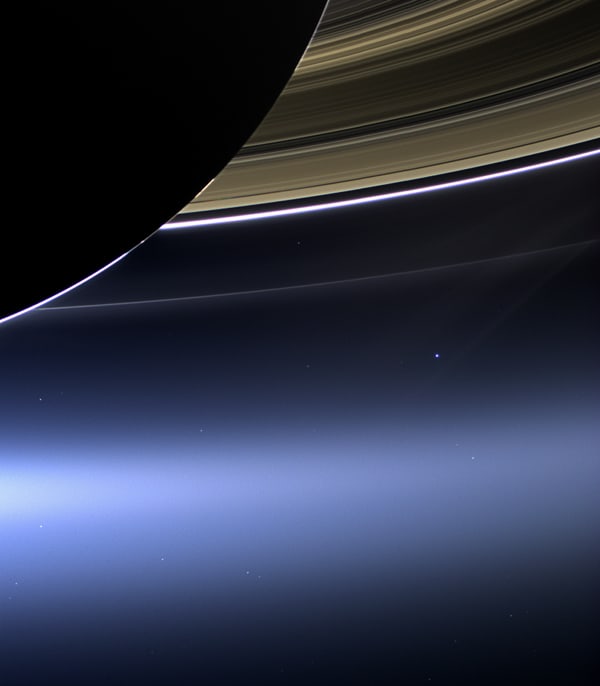
It is hard to believe while standing among 7 billion other people on this huge and diverse planet we call home that it is not the centre of the universe in the same way that it is the centre of our lives. From the point of view of an ordinary person such as myself, the stars and the other planets seem almost to rotate around us as we go about our everyday lives. But as we all know, this is not the case. In this photo of the Earth taken on 19 July by the Cassini Interplanetary Spacecraft, approximately 900 million miles away, the Earth and the Moon occupy less than one pixel of the photograph. So perhaps we are not quite as important as we thought. Not a big fish in a small pond, but a very small fish in an infinite pond.

(more…)

Square Kilometre Array precursor begins search of early universe


The most powerful low-frequency radio telescope in the southern hemisphere – the A$51m (£30m) Murchison Widefield Array (MWA) – has started its search for signals from the first billion years of the universe’s life, the last unexplored epoch. Located at the Murchison Radio-Astronomy Observatory in a remote, radio-quiet region of Western Australia, the MWA is the first of three Square Kilometre Array (SKA) precursor telescopes to be operational.

The MWA consists of 128 aperture arrays – each comprising 16 antennas – spread out across an area of seven square kilometres. It detects signals between 80 and 300 MHz and has an unparalleled field of view of thousands of square degrees that will enable it to rapidly image the entire southern sky. Developed by an international consortium of 13 institutions in four countries, the MWA’s launch is the culmination of nine years of preparation.

Hot topics in astrophysics

With no moving parts, the MWA can be controlled remotely and data that are gathered by the telescope will be transmitted 800 km via a dedicated optical-fibre data link for processing in Perth. In one of nine inaugural research programmes, the MWA will search for the radio signature of hydrogen emitted during the first billion years of the universe’s life. Known as the era of reionization, the first stars and galaxies formed during this time, but it remains largely unexplored. “This is one of the hottest topics in global astrophysics,” says Steven Tingay, director of the MWA and an astronomer at Curtin University in Perth.

In another project, Martin Bell, astronomer at the University of Sydney, is leading a survey that will use monthly snapshots to observe the dynamic behaviour of supermassive black holes in the southern sky and look out for new, previously undetected classes of objects. “We’ve never done anything as wide or as frequent as this. In some sense, we don’t really know what we’re going to find,” says Bell. The first results from the new telescope are expected by the end of the year.

Sharing data

The vast quantities of data produced by the MVA are being processed at the Pawsey Centre for supercomputing in Perth. According to Andreas Wicenec of the nearby University of Western Australia, 400 Mbyte/s of data are currently being processed by the centre. “The technical challenge isn’t just in saving the observations but how you then distribute them to astronomers from the MWA team in far-flung places,” says Wicenec.

Sharing is currently done via two links – one with MWA colleagues at the Massachusetts Institute of Technology in the US and the other with team members at the Victoria University of Wellington in New Zealand. A link to MWA collaborators in India is planned for the future. The Pawsey Centre will also provide computing facilities for another SKA precursor, the Australian Square Kilometre Array Pathfinder (ASKAP).

Physicists call for €5bn Neutrino Factory


An international group of physicists has called for the construction of the Neutrino Factory as the next high-intensity neutrino facility in Europe. Taking four years to prepare, the report was written by the EUROnu collaboration, which consists of 15 institutions. The report backs the Neutrino Factory – which is estimated to cost between €4.6bn and €6.5bn – rather than two less-expensive options: the €1.6bn Super-Beam experiment and the €2.3bn Beta Beam facility.

The Neutrino Factory will involve producing neutrinos by firing a high-power proton beam at a target to make pions, which are then captured and allowed to decay to muons. The muons are then accelerated and injected into a storage ring where they decay into neutrinos, which are sent some 2000 km to the Magnetized Iron Neutrino detector, which would be made from 100,000 tonnes of iron.

Long-distance oscillations

One possible scenario for the Neutrino Factory is to have the accelerator based at CERN with a detector in Finland, the UK or even the US. The primary aim of this experiment – and other existing and planned experiments that send neutrino beams over long distances – is to study neutrino oscillation. This is the process by which neutrinos of one flavour (muon neutrinos at the Neutrino Factory) can with time change into neutrinos of a different flavour. Making more precise measurements of neutrino oscillations could help solve several important mysteries of physics, including why there is much more matter than antimatter in the universe.

The EUROnu report concludes that the 10 GeV Neutrino Factory “clearly has the best physics performance” over the two other designs, adding that the better performance level “offsets the additional cost”. The report recommends construction “as soon as possible” and if funding can be found, then the facility could be operational between 2025 and 2030.

Enormous potential

Kenneth Long, an experimental particle physicist at Imperial College London and a member of EUROnu, says that the scientific impact of the Neutrino Factory is “potentially enormous” and has the capacity to solve some of the biggest challenges in physics, such as the nature of dark matter. However, he warns that the ultimate fate of the facility will lie in the hands of funding agencies. “The scale of investment would require an international agreement,” he says.

The Super-Beam experiment would have focused a beam of pions and then measured how they decay into neutrinos as they travel to a detector. Beta Beam was designed to produce beams of neutrinos, possibly at CERN, and then send them towards the proposed MEMPHYS water-Cerenkov detector that could be based at the Fréjus Underground Laboratory near the Swiss–Italian border. But Alain Blondel, a neutrino physicist at the University of Geneva who is not involved in the EUROnu collaboration, says the Super-Beam and Beta Beam have “serious difficulties or shortcomings”, while “the Neutrino Factory is a much more powerful, long-term facility”.

Long explains the fundamentals of neutrino physics in the video “Why do neutrinos change flavour?”.

Learning to adapt: an interview with Joshua Miele

The podcast is a follow-up to an interview with Joshua Miele published earlier this year as part of a series of articles about people who studied physics but went on to work in other fields. In it, you will hear Miele describe some more personal aspects of his work at California’s Smith-Kettlewell Eye Research Institute, as well as specific devices such as an audio-enhanced Braille periodic table and the events that inspired him to pursue a career in adaptive-devices research.

Listen to the podcast now to learn more about Miele and his work.

T2K discovery puts neutrino oscillation beyond doubt

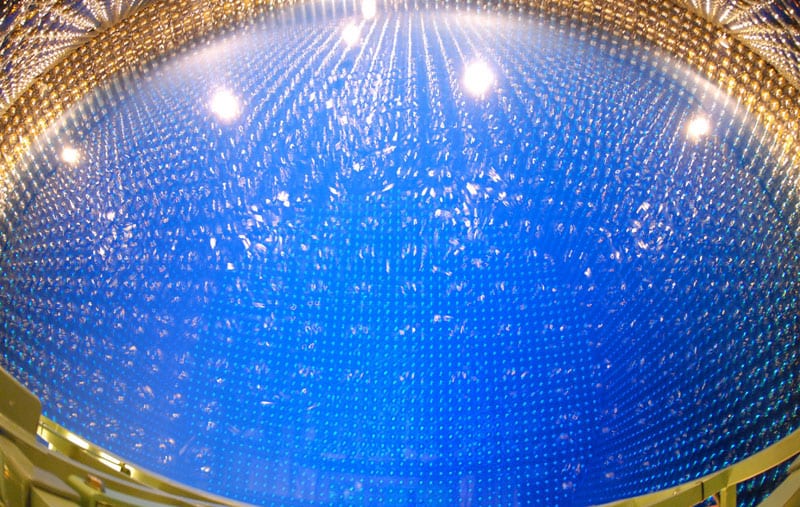
The SuperKamiokande detector lies 1 km underground in the Mozumi mine in the city of Hida. (Courtesy: Kamioka Observatory, Institute for Cosmic Ray Research, University of Tokyo)

By Hamish Johnston

Physicists working on the Tokai to Kamiokande (T2K) experiment have confirmed what many have suspected for nearly three decades – over time, a neutrino of one flavour will change into a neutrino of another flavour in a process called neutrino oscillation.

(more…)

Attractive force arises from black-body radiation, say physicists


Black-body radiation can give rise to a net attractive force between tiny objects. That is the claim made by physicists at the University of Innsbruck in Austria, who have calculated the strength of this new force between a speck of dust and a hydrogen atom. The team believes that in some situations the force could be more significant than gravity – which means that its presence could have important effects on the behaviour of clouds of gas and dust in space.

Pulling things with electromagnetic radiation – the so-called tractor beam – has long been a mainstay of science fiction. While physicists have enjoyed some luck creating specialized systems to achieve it, any system must overcome a fundamental challenge: a particle absorbing a photon is pushed, not pulled.

Incident radiation can affect an atom in two ways. If the photon has precisely the right energy, then it can promote an electron into an excited atomic state. As the atom absorbs the photon, it also absorbs its momentum. This pushes the atom away from the light source, causing radiation pressure. More subtly, the electric field of the light wave causes its energy levels to shift slightly – a process called the Stark effect. While some excited states are raised in energy, the ground state is generally lowered.

Attracted to radiation

Unless the atom has recently been excited by a photon, then the electrons will be in the ground state; so reducing its energy reduces the total energy of the atom. More intense radiation creates a stronger electromagnetic field and a larger Stark shift, so the natural tendency of atoms to minimize their energy creates an attractive force towards the source of the radiation. This force is used by optical tweezers to trap atoms at a laser focus.

Theoretical physicist Helmut Ritsch of the University of Innsbruck explains that the current work arose from a speculative discussion with his wife, biomedical physicist Monika-Ritsch Marte, who studies optical tweezers at the Medical University of Innsbruck. They pondered whether or not an attractive optical potential could be created using broadband light. “Most people would first say no,” he explains. The pair teamed up with PhD student Matthias Sonnleitner to study the case of black-body radiation – the most broadband light imaginable.

Stark contributions

The black-body radiation emitted by an object contains a continuous spectrum of frequencies, so the photon energies required to excite atoms will be present, and these photons create a repulsive force. However, the energies of most common atomic transitions, at least in the lighter elements that make up most of the universe, correspond to photon frequencies in the visible or ultraviolet region of the electromagnetic spectrum. Radiating black bodies with temperatures below about 6000 K – the temperature of the surface of the Sun – emit the vast majority of their radiation as infrared photons. Because these photons have an energy below that needed to excite the electronic transitions they are not absorbed and do not cause radiation pressure. They do, however, contribute to the attractive force created by the Stark effect. In most physically realistic cases, therefore, this attractive “black-body optical force” is greater than the radiation pressure.

The force decays rapidly with distance and therefore the researchers believe that it will be challenging to measure in the laboratory. Under specific astrophysical conditions, however, it may play a key role. It is likely to be most significant for objects that, while below the temperatures of thousands of Kelvin necessary for radiation pressure to become significant, are hot enough to radiate appreciably. Moreover, in particles that are very light, it could be more significant than gravity. For example, modelling of an interplanetary dust cloud of micrometre-sized particles at 100 K suggests that the black-body potential at its surface is more than 100 million times the potential caused by gravity.

Astrophysical feedback

Helmut Ritsch now hopes to explore the detailed implications of the model in various scenarios. “We have certainly got a lot of feedback from the astrophysics community,” he says. “They have suggested a few scenarios that we should look at.” He says, for example, that immediately after the first hydrogen formed in the early universe, there would still have been plenty of radiation free, so radiation-mediated binding between hydrogen could perhaps have altered the evolution of density fluctuations.

Miles Padgett, an optical physicist at the University of Glasgow, is enthusiastic. “I think it is lovely,” he says. “It is a new mechanism completely different from all the others that have been previously discussed in the optical-trapping community.” He believes that, under high vacuum and on a small scale, it may be possible to detect the force directly in the laboratory.

Theoretical atomic physicist Andrei Derevianko of the University of Nevada says that, in principle, the attractive effect of electromagnetic radiation had previously been known in theory and used in practice in specific cases but that spelling out the full implications may have a significant impact. “This whole subject of atom–light interactions is quite exotic,” he says, “It is not like standard science. You really have to come in and have somebody say that this could have astrophysical implications for the other community to become aware of it. Work like this builds bridges.”

The research is described in Physical Review Letters.

Watch the Physics World Hangout about the physics of cancer

By James Dacey

A little earlier today we hosted a Google+ Hangout about the July issue of Physics World – a special issue about an emerging new research field called the “physics of cancer”. In case you were unable to join us for the live event (or would like to enjoy it all over again), you can watch it again via this YouTube recording.

(more…)

Copyright © 2026 by IOP Publishing Ltd and individual contributors