GERDA puts new limit on neutrinoless double beta decay

The GERDA experiment at Gran Sasso (Courtesy: INFN)

By Hamish Johnston

This stylish chap is looking for an incredibly rare nuclear process called neutrinoless double beta decay. The picture was taken deep under a mountain at Italy’s Gran Sasso National Laboratory, which is about 160 km north-west of Rome. He is standing in a cavern containing the GERDA experiment, which has been searching for the rare decay since 2011.

GERDA hasn’t actually detected a decay event, but the collaboration claims to have measured the best value yet of the lower limit on its half-life in germanium-76. They researchers say that it’s about 2.1 × 1025 years – or 21 yottayears!

(more…)

‘Snow line’ of neighbouring star comes into view

An artist's illustration of the snow line around TW Hydrae

The carbon monoxide (CO) “snow line”, or the distance from a star beyond which CO can freeze, has been directly imaged for the first time by an international team of researchers. The snow line was observed in a protoplanetary disc around the star TW Hydrae and was imaged using the Atacama Large Millimeter/submillimeter Array (ALMA) in Chile. Knowing the locations of such snow lines could help astronomers better understand how planetary systems form and what the planets are composed of, according to the team.

Just as snow lines on Earth are typically seen at high elevations where falling temperatures turn atmospheric moisture to snow, stellar CO snow lines are thought to form in the far, cold reaches of protoplanetary discs that orbit young stars. Depending on the distance from the star, however, other more exotic molecules can freeze and turn to snow.

Freezing point

In addition to CO, other hydrogen compounds such as water, ammonia and methane also condense into solid ice grains at the snow line at a temperature of about 150 K. Water ice freezes first, followed by the other abundant gases that form a sort of frost on the dust grains that will ultimately be the building blocks of planets and comets in that system. The frost line for our solar system is at around 5 AU.

In the new study, Chunhua Qi, of the Harvard-Smithsonian Center for Astrophysics in Cambridge, Massachuttes, along with Karin Oberg, of Harvard University in the US, and colleagues used data from ALMA to study the protoplanetary disc that surrounds TW Hydrae, a young star 175 light-years from Earth. TW Hydrae was choosen because the researchers believe that its disc is comparable to the nebula from which our solar system arose.

“ALMA has given us the first real picture of a snow line around a young star, which is extremely exciting because of what it tells us about the very early period in the history of our solar system,” says Qi. He goes on to say that it is now possible to “see previously hidden details about the frozen outer reaches of another solar system, one that has much in common with our own when it was less than 10 million years old”.

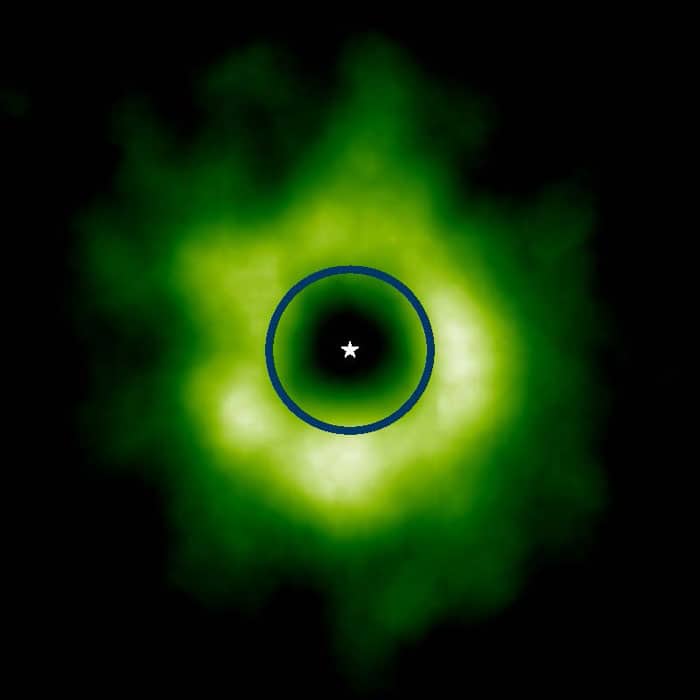
ALMA image showing CO snow region around TW Hydrae

Lifting the veil

But directly imaging a snow line is no easy task – to date, they have only been detected via their spectral signatures and so their precise location and extent could not be nailed down. The difficulty arises because the snow lines form almost exclusively within the narrow central plane of a protoplanetary disc. Above and below the plane, stellar radiation warms the gases and so they cannot freeze. However, the insulating effect of the concentrated dust and gas in the central plane of the disc allows temperatures to drop sufficiently for CO and other gases to cool and freeze, according to the team. And it is this radiation that veils the snow line, preventing astronomers from peering in.

To get round this problem, the researchers looked for a reactive ion – diazenylium (N2H+) – which only appears when CO freezes. That is because diazenylium is destroyed in the presence of CO gas and so would only appear in detectable amounts where the CO had frozen. Diazenylium shines brightly in the millimetre portion of the electromagnetic spectrum, which can be detected by radio telescope such as ALMA. According to the researchers, ALMA’s sensitivity and resolution allowed them to trace the presence and distribution of diazenylium around TW Hydrae, finding a defined boundary at about 30 AU from the parent star.

Diazenylium marks the spot

“Using this technique, we were able to create, in effect, a photonegative of the CO snow in the disc surrounding TW Hydrae,” says Oberg. “With this, we could see the CO snow line precisely where theory predicts it should be – the inner rim of the diazenylium ring.”

Current theories suggest that snow lines help dust grains overcome their normal tendency to collide and self-destruct by giving the grains a stickier outer coating. They also increase the number of solids available and may dramatically speed up the planet-formation process. There are multiple snow lines – such as a water snow line and the CO snow line – each thought to link to the formation of specific kinds of planets. In our solar system, the snow line is thought to separate the terrestrial planets from the jovian planets.

Oberg also points out that the CO snow line is particularly interesting because CO ice is needed to form methanol, which is considered a basic building block that forms more complex organic molecules that are essential for life. “Imaging of snow-line locations in large samples of discs will directly trace how planet formation varies between different systems. The snow line regulates the bulk compositions of planetesimals and planets formed in such systems,” says Qi. The researchers hope that future observations will reveal other snow lines and provide additional insights into the formation and evolution of planets.

The research is published in Science.

Explaining CERN, the Higgs and the LHC

By Matin Durrani

[brightcove videoID=phw.live/2013-07-18-balloon-vox/1 playerID=106573614001 height=268 width=390]


How well would you do if someone asked you to explain the Higgs boson or the Large Hadron Collider (LHC) at CERN?

If you’re a physicist, you’ll probably find it hard enough. But if you’ve never done any physics in your life, things must surely be trickier still, more so if a film crew from Physics World has shoved a camera up your nose.

These two short videos show the results of a straw poll of randomly selected visitors at last summer’s Bristol International Balloon Fiesta when we asked them to describe the Higgs boson and the LHC.

The reason we were at the fiesta is that we were making a separate film about a project by Bristol University physicist Dave Cussans where school students were measuring cosmic rays during a hot-air balloon flight – it being the centenary of Victor Hess’s discovery of these rays in a balloon flight in central Europe.

(more…)

Hang out with Physics World as we discuss the physics of cancer

By James Dacey

Tomorrow we will be hosting a Google Hangout about the July issue of Physics World – a special issue on an emergent field known as the “physics of cancer”.  If you have not read the issue already, it is available as a free PDF download.

I will be joined in the Hangout by Matin Durrani, the editor of Physics World, and Louise Mayor, the magazine’s features editor, and the three of us will be discussing the themes and issues raised by the magazine. We would also like to hear from you on this topic. So please send us your questions about the issue by posting a comment below this article.

You will be able to watch the Hangout live, on both the Physics World Google+ page and the Physics World YouTube channel. The Hangout will be taking place this Friday at 12.15 p.m. local time, which corresponds to the following times:

UTC 11:15

London (BST) 12.15 p.m.

New York (EDT) 7.15 a.m.

Mumbai (IST) 4.45 p.m.

Sydney (EST) 9.15 p.m.

5D ‘Superman memory crystal’ heralds unlimited lifetime data storage


Data written to a glass “memory crystal” could remain intact for a million years, according to scientists from the UK and the Netherlands who have demonstrated the technology for the first time. The data-storage technique uses a laser to alter the optical properties of fused quartz at the nanoscale. The researchers say it has the potential to store a staggering 360 terabytes of data (equivalent to 75,000 DVDs) on a standard-sized disc.

Longevity and capacity are the key factors to consider in terms of data storage, but existing options are limited. “At the moment, companies have to back up their archives every five to ten years because hard-drive memory has a relatively short lifespan,” explains Jingyu Zhang of the University of Southampton, UK, who led the team that demonstrated the new technique. Optical storage media such as DVDs are more stable, but with standard single-layer discs maxing out at 4.7 GB of data, they are an unwieldy option for vast digital archives.

Scientists have been pursuing the idea of glass as a medium for mass data storage since 1996, when it was first suggested that data could be written optically into transparent materials. By using a femtosecond laser to alter the physical structure of fused quartz, a “dot” with a different refractive index can be created to denote the binary digit one; zeros are indicated by the absence of a dot. Japanese electronics giant Hitachi succeeded in storing data using this method back in 2009, but Zhang’s team has taken the technology a step further, by recording information in 5D – the three dimensions of space that describe the physical location of the dot, and two additional dimensions that are encoded by the polarity and intensity of the beam that creates the dot.

Superhero memories

To demonstrate the new method, Zhang’s team wrote a 300 kB digital text file into fused quartz glass using a femtosecond laser that produced extremely short and intense pulses of light at a 200 kHz repetition rate. The pulses were sent through a spatial light modulator (SLM), which split the light into 256 separate beams to create a holographic image. A specially designed laser-imprinted half-wave plate matrix was built to control the polarization of the light without the need for moving parts. The laser-imprinted dots were arranged in three planes separated by a distance of five microns, on a sliver of fused quartz, and dubbed “Superman memory crystals” after the once-fanciful technology featured in the Superman films.

The data file was read using a standard optical microscope in conjunction with a polarizing filter, to measure the way that light transmission was altered by the dots. The read-out showed each dot as a blurred spot of varying intensity, in one of four colours to indicate polarity – a level of optical data encoding that represents a significant improvement over simple 3D systems such as conventional DVDs or even Hitachi’s, according to Zhang. “Consider that when you read a DVD, while you read one spot it’s actually one bit, but in our case, it’s many more bits – 10 bits,” he explains, adding that they “expect 10 times higher reading rates too”.

Outlasting the human race

The researchers claim that their memory crystals “[open] the era of unlimited lifetime data storage.” As well as providing unprecedented capacity and high-speed reading, fused quartz is exceptionally stable and can withstand temperatures up to 1000 °C. “We think it should potentially last a million years,” enthuses Zhang, meaning the stored data will likely outlast the human race.

Xiangping Li, a physicist working on multidimensional optical data storage at Swinburne University of Technology in Hawthorn, Australia, calls the work “quite innovative”, and suggests that the estimated storage capacity would be beefed up even more if the parameters used for the fourth or fifth dimensions were less closely intertwined. “[Currently] these parameters are not orthogonal to each other, so it will create significant crosstalk…it’s a grey scale,” he explains.

Zhang’s group is designing a simple scanning laser read-out device that will enable the reading technology to be brought cheaply into homes in the near future. The same cannot be said for the writing technology, however – there needs to be a significant breakthrough before we could be saving our personal music and photograph collections to memory crystal. National labs, cloud-computing clusters and other large data-generating enterprises, on the other hand, are obvious immediate candidates for early adoption. “Museums that want to preserve information, or places like the National Archives where they have huge numbers of documents, would really benefit,” says Zhang.

The researchers are looking to combine with industry partners to develop a higher-powered laser but, ahead of that, they plan to switch the SLM for another on the market that should increase their writing speed from kilobytes-per-second to megabytes-per-second, and are keeping a keen eye on the current development of an even better version that should offer them speeds of gigabytes-per-second.

The research was presented at the 2013 Conference on Lasers and Electro-Optics, held in San Jose.


How to write a physics book

By Hamish Johnston

John Inglesfield could live a life of leisure. Retired, he has homes in two very desirable locations – England’s Lake District and Aude in south-western France.

But alas, John is a physicist; so instead of lounging by the pool reading, he is busy writing a book. His chosen topic is the embedding method in condensed-matter physics and the book will published as an ebook by IOP Publishing, which also publishes physicsworld.com.

(more…)

Sensitive fingerprint technique developed with the help of neutrons


Researchers in the UK and France have developed a new and extremely sensitive method for visualizing fingerprints left on metal surfaces such as guns, knives and bullet casings. The technique utilizes colour-changing fluorescent films and the team says that it can be used to complement existing forensic processes.

The chance that two people will have identical fingerprints is about 64 billion to 1, which is why law-enforcement agencies rely on fingerprint evidence. Despite advances in detection since the 19th century, only about 10% of crime-scene fingerprint images are of sufficient quality to lead to the unambiguous identification of an individual that is good enough to satisfy a court.

Fingerprints are essentially deposits of sweat and natural oils. Traditional visualization techniques involve applying a coloured powder, chemical or biological reagent that adheres to or interacts with the residue and creates a visual contrast to the underlying surface. A major limitation of the technique is that these deposits can degrade with time or exposure to water or other materials.

Bare metal

Instead of focusing on the residue itself, Robert Hillman and colleagues at the University of Leicester, the Institut Laue-Langevin (ILL) and ISIS at the Rutherford Appleton Laboratory have decided to work with the bare surface between the ridges of a fingerprint. “Think of the deposits on the surface to be like little ‘hills’, we’ve decided to go for the bare metal at the bottom of the ‘valleys’,” explains Hillman.

Recently, the team has been experimenting with an electrochromic polymer that changes colour when an electrical voltage is applied. “We used electrochemistry to deposit a polymer from a monomer solution and subsequently we replaced the monomer deposition solution with a background electrolyte,” explains Hillman. The invisible residue left by a human finger does not conduct electricity, so it acts like a stencil. When the polymer is deposited on a fingerprint and the voltage is applied, the sticky deposit blocks the current, directing the film to the “valleys” in between the “hills”. The voltage changes the film’s colour, optimizing the visual contrast and essentially creating a negative image of the print.

Now, the researchers have taken their technique one step further by adding fluorescent molecules (fluorophores), which cause the film to emit light of a certain colour when exposed to ultraviolet light. This approach broadens the colour palette of the polymer films, says Hillman, and also allows more control in terms of tuning the colouration to get the best possible contrast with the underlying metal surface.

Neutron reflectivity

For the technique to work, the fluorophores must completely permeate the film without reaching the underlying metal surface, where their fluorescence deteriorates. To ensure that this happens, the researchers at the ILL and ISIS used a technique called neutron reflectively. This involves firing a neutron beam at the film and measuring the reflected neutrons. Neutron scattering can be sensitive to the specific isotopes present in the sample. To take advantage of this, selected parts of the system were labelled using the hydrogen isotope deuterium and the measurements were used to determine the ideal conditions for the introduction of the fluorophores.

The researchers say that the fingerprinting method is extremely sensitive and only tiny amounts of the residue are required to make it work – much less than is typical for conventional approaches. It is also well suited for use in combination with existing approaches, which often involve using a succession of reagents to try to reveal a print. If conventional reagents fail to reveal the pattern, then the bare surface regions should still be free for polymer deposition, according to Hillman.

Despite the advantages, the new technique is limited because it only works on metal samples, says Paul Kelly of the UK’s Loughborough University, who was not involved in the study. “It is certainly not a catch-all solution to fingerprint issues,” he says. But he adds that “the further enhancements discussed in this latest phase of the work certainly bode well for maximizing the prowess of the technique with respect to items such as knives and cartridge casings”.

Kelly says that while scientists can develop new fingerprinting techniques, “in the end, though, it’s down to forensic practitioners to assess their utility and applicability”.

‘Champion’ nanostructures could improve solar water-splitting cells


Researchers in Switzerland and Israel have succeeded in fabricating the most efficient metal-oxide photoanode to date for use in photoelectrochemical cells (PECs) – devices that produce hydrogen using sunlight in a process called “water splitting”. The novel feat, which involved accurately characterizing the iron-oxide nanostructures used in PECs, could help in the development of much more efficient solar cells in the future.

Solar water splitting, in which water is separated into oxygen and hydrogen using sunlight, could be a clean and renewable way to produce energy. Researchers are busy looking for efficient photoelectrode materials for use in this process. One such material is haematite (rust). Iron is cheap and abundant, and haematite has a high theoretical solar-to-hydrogen conversion efficiency of 14–17%. However, it is still unclear how defects in this material affect its ability to convert solar energy into hydrogen fuel and why some haematite electrodes appear to be more efficient than others.

In an effort to answer these questions, a team led by Michael Graetzel of the Ecole Polytechnique Fédérale de Lausanne and Avner Rothschild of the Israel Institute of Technology decided to investigate how structure is related to performance at the single-nanostructure level in haematite. In an individual, centimetre-sized water-splitting electrode there can be billions of individual nanostructures, explains team member Scott Warren. Until now, however, researchers have typically studied the structure and properties of these nanostructures in aggregate and neglected individual structures. “We have shown that there are important differences among the individual nanostructures in a single electrode – differences that determine whether a nanostructure is active for water splitting or entirely inactive,” says Warren.

New performance record for water splitting

By understanding these differences, the team then developed synthesis techniques that allowed it to make the most efficient haematite nanostructures for water splitting. The researchers used these “champion” nanostructures to fabricate photoelectrodes capable of generating a photocurrent of about 4 mA cm–2. This is the highest photocurrent ever achieved for haematite and, indeed, any metal-oxide photoanode, as well as a new performance record for water splitting, says Warren.

“Our approach involves looking at a single nanostructure and determining how its structure is unique,” explains Warren. “We then measure how current moves through that single nanostructure and sometimes find that no current passes through. This is because of structural defects that we identified in a transmission-electron-microscopy technique (TEM) developed in our lab [see images]. We can then begin to understand what aspects of a structure impact on current transport. It is this sort of information that was inaccessible to researchers in the past.”

In analogy to the best performing champion solar cells, the Swiss–Israeli team has shown that some nanostructures are great at water splitting and others less so. The distinguishing characteristic of the nanostructures identified in this study is that all of the haematite crystals within the nanostructure are orientated in the same direction – something that allows electrons to travel rapidly through the material.

The research could help make better batteries, solar and fuel cells, claims Warren, although there is still much work to be done. “While the haematite we looked at performs better than any other equivalent cheap and stable material, we still need to improve its performance,” he says. “Continuing to characterize the nanostructure of haematite in this way will help us identify defects and other bottlenecks hampering its solar water-splitting efficiency.”

The research is published in Nature Materials.

CERN teams up with EUROVISION to inspire the next Peter Higgs

By James Dacey

Illustration of children learning about science

I must confess that I was not aware of this partnership, and I must admit it’s not a partnership I would have seen coming. CERN has teamed up with the organization behind the Eurovision Song Contest, in awarding grants to two multimedia companies to develop content that can spark the scientific curiosity of “tweens”.

Okay, let’s back up a second and define a few terms in this equation. Tweens are described by CERN as children aged 8 to 12; not quite teenagers but no longer big babies either. My teacher friends will shoot me down in flames for this cod-pedology but I guess this age group is old enough to be excited by science but not yet old enough to start truly engaging with scientific concepts.

(more…)

Unexpected interactions between solitons detected


A new record for long-range, weak interactions between solitons has been reported by researchers in New Zealand. Two solitons in the same system were seen to affect each other through ultrasound waves as they travelled round a loop of fibre-optic cable. The consequences of this interaction, which caused the trailing soliton to be attracted or repelled by its leading partner, were only visible when the pulses had travelled more then one astronomical unit (AU).

Astronomical speeds

The researchers observed this effect in a 100-m-long loop of optical fibre. Two temporal-cavity solitons – particle-like pulses of light that retain their shape as they propagate – were sent round the loop, separated initially by one billionth of a second. By measuring the pulses with a photodetector and an oscilloscope, the team observed, in real time, the solitons slowly repelling or attracting each other. Before the effect became large enough to become noticeable the pulses had to travel a considerable length, namely 150 million kilometres, which is equivalent to the distance between the Earth and the Sun; this equates to a change in the gap between the looping solitons of one billionth of a billionth of a second for each trip round the optical circuit.

“To our knowledge, this is the weakest interaction ever observed between solitons,” says lead researcher Miro Erkintalo of the University of Auckland. He tells physicsworld.com that “the sheer fact that such a weak interaction can be observed in a noisy laboratory environment is simply spectacular”.

Along the fibre

As it progresses along the optical loop, the electric field of the first pulse deforms the fibre through which it travels, in a process known as electrostriction. This creates a small ultrasound wave in the soliton’s wake, the passage of which temporarily shifts the density of the fibre, changing its refractive index. When the second soliton passes through the sound wave, it therefore speeds up or slows compared with the first pulse. “The interaction is mediated by sound waves created by the solitons,” Erkintalo says, “so you could really say that the two are talking to each other!”

While short-range interactions were expected from previous theoretical studies, the discovery of these long-range interactions was a complete surprise for the researchers – who were originally looking at possible telecommunications applications. “The sexy thing about temporal-cavity solitons is that they can be used as bits in ultrafast all-optical memories,” says Erkintalo. Such memory systems have great potential to be faster and more energy efficient than current alternatives. The principle, however, has been difficult to realize.

Undesirable interactions?

The team set up the experiment to test whether bits of data could be preserved as long-lasting, discrete pulses of light, but instead the researchers observed the pulses influencing each other. “Initially, we desperately wanted to get rid of the effect because it was interfering with what we originally planned to do!” exclaims Erkintalo. In such a memory stream, interaction between optical bits would be undesirable because it would mess up the stored data.

The researchers discovered that the same long-range, sound-based interactions had been reported in previous studies. In this new case, however, the interactions were three to five orders of magnitude weaker than those previously reported, as well as having taken place over a much greater soliton separation – making this finding a significant record breaker.

“The work is a remarkable illustration of an extremely weak interaction between solitons,” says Andrey Gorbach, a physicist at the University of Bath who was not involved in this study. “In order to detect such interactions experimentally, the solitons had to cover a distance some billion times larger than [their] effective size. The fact that the solitons remain coherent over such astonishing distances emphasizes the extreme robustness of these objects.”

While the team is delighted to have found these unexpected interactions, the researchers are now working on trying to get rid of them. If they succeed, then this could pave the way to using solitons for the telecommunications purposes that the team originally set out to investigate. “We believe we can do this by modulating the beam holding the solitons,” comments Erkintalo. “[This] is what we are currently working on.”

The research is published in Nature Photonics.

Copyright © 2026 by IOP Publishing Ltd and individual contributors