Do you know what this is? Click on image for larger version. (Courtesy: Jean Barrette)
By Hamish Johnston
Last week I promised readers a genuine mystery – and here it is. Do you know what this piece of apparatus was used for?
It currently resides in the McPherson Collection of physics instruments at McGill University in Montreal and its purpose has long puzzled curator Jean Barrette – who I spoke to when I was in Canada recently.
The device looks like it is designed for bench-top use and Barrette believes that it was used to study gases. Inside the cylindrical section with the half-moon window there is another small cylindrical part that can move. The small cylindrical extension to the right of the main component is an electrode input to bring high voltage inside the chamber.
“Any idea on the purpose of the instrument would be greatly appreciated,” said Barrette.
There must be a physicsworld.com reader out there who knows what this is. Please let Jean and I know by leaving a comment below.
Positively charged gold nanoparticles can penetrate deep into cell membranes while negatively charged particles do not enter the cell wall at all, but instead prevent it breaking down under certain conditions. This new result, from researchers working in France, the US and Australia, could help design nanoparticles for biomedical applications such as drug delivery and anti-cancer treatments.
Gold nanoparticles make particularly good drug-delivery vehicles thanks to the fact that they can be loaded with molecules like anti-cancer dugs. Their surfaces can also be easily modified with antibodies to target specific receptors on tumour cells.
The particles can also be made biocompatible and generate heat when illuminated with light. This heat can then be used to locally destroy cancer cells without harming surrounding healthy tissue. Gold nanoparticles are ideal for such “photothermal therapy” because their optical properties can be tuned in the near-infrared part of the electromagnetic spectrum – the wavelengths at which light most deeply penetrates biological tissue.
Researchers now know that a variety of factors, such as a nanoparticle’s shape, size and surface charge, affect the way that it interacts with cells. In the new work, the researchers, who are based at the Institut Laue-Langevin in France, the University of Chicago in the US and the Australian Nuclear Science and Technology Organization, looked at how gold nanoparticles affect the structure of a cell membrane – the first barrier that any foreign body has to penetrate to enter a living organism.
Ideal model cell membrane
Real cell membranes are very complex structures and consist of an asymmetric lipid bilayer comprising several types of lipids with embedded proteins. Producing such complex structures in the lab is difficult so the researchers studied a simplified membrane made of just one kind of lipid (1,2 distearoyl-sn-glycero-3-phosphocholine). In the experiments, two double layers of lipid molecules made to “float” about 20–30 angstroms on top of each other were used.
The team working at the ILL employed a technique known as “neutron reflectometry”, which is able to characterize layered structures deposited on a flat surface at resolutions of just a fraction of a nanometre. Neutrons themselves are ideal for studying buried interfaces because they interact very weakly with matter as the neutrons themselves are uncharged. They can thus penetrate successive sample strata very easily.
Membrane interface structure
The scientists looked at how 2 nm diameter gold nanoparticles, which either had cationic or anionic groups added to their surface, interacted with the model cell membranes. They began by firing a beam of neutrons at the samples that hit the nanoparticle-surface group interface at a particular grazing angle. They then measured the intensity of the reflected radiation as a function of this angle – something that provided them with information about the structure of the interface in terms of thickness, roughness and density in the presence of the two differently charged nanoparticles.
“We found that the surface charge on a nanoparticle does indeed play a significant role in determining its interaction with the cell membranes we studied,” team member Giovanna Fragneto told physicsworld.com. “Cationic nanoparticles pass straight through the membrane, embedding themselves deeply within the floating bilayer and destabilizing the entire membrane structure enough to completely destroy the cell at higher concentrations. In contrast, anionic nanoparticles do not penetrate the lipid membrane at all but rather hinder membrane decomposition at given concentrations, helping it withstand extreme conditions such as elevated pH that would otherwise significantly destabilize it.”
“That these nanoparticles can attack outer cell walls is both concerning from a general health point of view but also potentially exciting in terms of future medical treatment,” added team member Marco Maccarini.
The team says that it would now like to look at mixtures of two or more different lipid molecules to make model membranes that even better resemble real ones.
“Understanding the interaction between nanoparticles and cell membranes has two-fold importance,” says team member Sabina Tatur. “On one hand, it will allow us to be more aware of potential risks for human health. And on the other, it will help us to develop nanoparticles that could be used for specific biotechnology applications, such as drug-delivery systems, cancer therapies and biosensing.”
Thomas Jennewein and his quantum receiver will soon hit the streets of Waterloo.
By Hamish Johnston
I’m back from my trip to Waterloo, Ontario – Canada’s “Quantum Valley” – but there is still so much to tell. The photograph above is of Thomas Jennewein of the Institute for Quantum Computing (IQC), who took me on a tour of his lab earlier this week.
Jennewein is standing next to a quantum receiver that he and his colleagues will soon be bolting to a pick-up truck and driving around Waterloo. The plan is to receive quantum communications from a light source that’s on the roof of one of IQC’s buildings. The ultimate goal of the research is to deploy quantum receivers (and transmitters) in space to create a global quantum-communication network.
Getting away from research for a while on a beach. (iStockphoto/David Franklin)
I’ve just started reading Letters to a Young Scientist, a new book by the eminent biologist Edward O Wilson. I picked it up as a possible subject for Physics World’s Between the Lines column of short book reviews because while Wilson is definitely not a physicist – he made his name studying the social systems of ant colonies – his book is written for scientists in all disciplines.
I haven’t finished it yet, but one bit of advice from the chapter “What it takes” grabbed my attention. After stating that academic scientists should expect to work 60-hour weeks, Wilson drops the real bombshell. “Real scientists do not take vacations,” he writes. “They take field trips or temporary research fellowships in other institutions.”
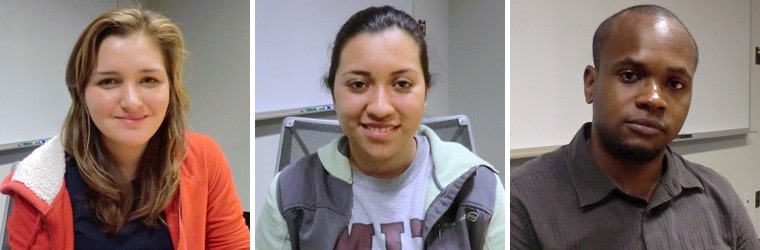
As a result of these efforts, under-represented minorities now make up 17% of undergraduate students in the physics department at the MIT – a proportion that is significantly higher than the national average in the US. In this audio clip, three different MIT students explain how they developed an interest in physics and what they believe are the main benefits of studying in a diverse environment.
Bertschinger believes that creating a diverse physics department is not only a moral obligation for the opportunities it offers people, but it also makes good “business sense”. He strongly rejects the idea that to promote diversity somehow reduces the quality of students and faculty members. “If we want our students and employees to achieve their best then we should create a climate in which they feel respected and well supported,” he says. Bertschinger describes MIT’s approach in this interview with Physics World journalist James Dacey.
You can find out more about what MIT is doing to promote diversity here. You can also find out what the Institute of Physics (which publishes Physics World) is doing to promote diversity in the UK physics community here.
An immense cloud of gas currently swooping around the centre of our galaxy could reveal a multitude of small black holes nestled close to its heart. Over the next 12 months, the G2 gas cloud will pass through the galactic centre where, according to the calculations of astrophysicists in the US, encounters with small black holes will produce bursts of radiation that could be detectable using space telescopes.
Since the 1970s astronomers have postulated that a throng of small black holes lurks incognito near Sagittarius A*, the supermassive black hole at the centre of the Milky Way. Through a process known as dynamical friction, the most massive objects in the galaxy slow down as they move through the interstellar medium, and so drift gradually towards the centre. Based on star formation and death rates, simulations predict a population of around 20,000 small-scale black holes in the innermost region of the galaxy, each with a mass several times that of our Sun. So goes the theory, anyway, but until now there has been no way of actually testing it.
Unique opportunity
The G2 cloud, which was first spotted heading for the galactic centre in 2011, presents a unique opportunity for scientists to finally catch a distant glimpse of one or more of these stellar-mass black holes. The cloud itself is three times the size of Pluto's orbit around the Sun (with a mass three times that of the Earth), whereas the black holes span only a few tens of kilometres each. As G2 encounters them, the gas will be spun, jostled and heated, causing it to emit X-rays, which could potentially be seen by telescopes such as NASA's NuSTAR and Chandra.
Imre Bartos, of Columbia University in New York City, and colleagues, looked at simulations depicting the number and distribution of stellar black holes, together with the predicted trajectory of the gas cloud, and calculated that G2 should encounter around 16 such objects on its journey. Next, they looked at how much radiation these encounters should produce, and the chances of existing instrumentation being able to spot their faint signals from 25,000 light-years away.
"Conservatively, most of the stellar-mass black holes would not be detectable. But it's not negligible at all," says Bartos, stressing that uncertainties linked to their limited information about the cloud's density and speed can cause the radiation value to change by a factor of a hundred.
More promising, perhaps, is the prospect of finding evidence for so-called intermediate-mass black holes. "We know [from observation] that there are black holes a few times the mass of the Sun. We also know about supermassive black holes that are millions-to-billions of times heavier than the Sun. But we don't have much evidence for anything between these two, which is puzzling," Bartos explains. If such intermediate-mass black holes exist anywhere in the galaxy, dynamical friction would jostle them towards the centre too, and their encounters with G2 would produce significantly more and brighter radiation than their smaller counterparts.
Holding out for a hint
The work brings a fresh perspective to discussions that have so far focussed on how G2 will interact with the beefy supermassive black hole at the centre of the Milky Way, the mass of which is four million times that of the Sun. "It's a very interesting idea, which we hadn't thought of at the time when we were writing our discovery paper," admits Stefan Gillessen of the Max Planck Institute for Extraterrestrial Physics in Garching, Germany – the man credited with first spotting G2 back in 2011.
Columbia University's Charles Hailey, co-leader of the data analysis team for the NuSTAR X-ray telescope, who was not involved in the research, says that, due to the uncertainties involved "it will take some good fortune for the numbers to conspire to produce X-ray fluxes observable by Chandra or NuSTAR." Even with the most favourable numbers, the signal risks being obscured by strong X-ray emission from G2's interaction with Sagittarius A*. For now, NuSTAR will take cues from the Chandra and Swift observatories, and will train its equipment on the galactic centre "immediately" in the event that either of these groups notice interesting activity from that direction.
And that could be any day now. G2's orbit traces a long and narrow ellipse over a period of a few hundred years, but its 2011 discovery was fortuitous; astronomers calculate that it will make its closest approach to Sagittarius A* in early 2014. "It's an extremely rare thing in astrophysics or astronomy," says Bartos. "We talk about timescales of billions of years and then here's something that has only just been observed that is about to get into the most interesting part within a year or two."
The problem of climate change essentially boils down to this: can we find a way of keeping the number of carbon dioxide (CO2) molecules in the atmosphere to four out of every 10,000 molecules of air – or will the figure rise to five or more? If only that extra molecule could be plucked from the air, the climate problem could be mostly solved without a drastic restructuring of the world's energy infrastructure. It may sound madly ambitious but that is just what a few scientists and engineers are planning to do, and hoping to make some money from it to boot.
Removing CO2 from the air is not an especially new idea. In fact, it is relatively simple and done on spacecraft and submarines all the time. But achieving "negative emissions" economically, at large scales, is a much harder and more urgent problem. Unless the energy used for the removal is carbon free, or sufficiently small, the benefits will simply not cover the costs. And therein lies the challenge.
Existing efforts to remove CO2 are based at power stations – which give off 40% of global CO2 emissions – and involve capturing the gas as it leaves the plant. But these techniques do nothing to counteract the 60% of global emissions that come from cars, buildings, ships, planes and other "point sources". The search is therefore on for new techniques that directly capture CO2 from the air. Facilities performing this "air capture" could be located anywhere, utilizing the atmosphere as a pipeline from billions of sources of CO2, however minute or mobile.
Despite doubts arising from theoretical studies of the cost of carbon capture, those getting their hands dirty think that CO2 could be removed directly from the air in massive quantities for perhaps as low as $100 per tonne. Once collected, the CO2 could then be pumped underground into geologic storage areas – a technique known as sequestration – where it would be trapped for potentially millions of years, with little leakage, doing no harm to planet or people. The gas could also be sold to oil companies, which routinely inject carbon dioxide into oil reservoirs to reduce the oil's viscosity, enabling easier extraction. Other customers could include large-scale flower growers, who fill their greenhouses with CO2 to keep plants warm.
The technology to do all of these things already exists, but in bits and pieces; the challenge is to put the various components together on a large scale, and to do so cheaply. One interesting initiative is the Virgin Earth Challenge, which was launched in 2007. Sponsored by Richard Branson, it offers $25m to whoever can demonstrate a sustainable and scalable design to permanently remove a billion tonnes of carbon from the air every year for 10 years. Some 2600 groups applied to the challenge and last November the finalists were picked – six from the US and one each from Denmark, Sweden, the Netherlands, Switzerland and Canada – who now have five years in which to win the prize.
One finalist is Carbon Engineering – a firm based in Calgary, Canada, that is financially backed by Bill Gates, the Canadian government and others. "We've made a huge amount of technical progress," says the company's chief executive David Keith, who is also a prominent climate scientist at Harvard University, "and we're understanding how we might make it work as a business."
According to climate expert James Hansen, there is certainly a need for such enterprises. As he wrote in 2007, the global surface warming that has already been (or is bound to be) created – coupled with the unceasing increase in carbon emissions, and the currently inadequate mitigation efforts (see "The carbon problem" below) – implies that "a feasible strategy for planetary rescue almost surely requires a means of extracting greenhouse gases from the air". If CO2 could be captured from ambient air more quickly than nature does it, the world might even be able to overshoot whatever warming threshold is deemed "dangerous" and later stabilize the climate gradually via net negative carbon emissions.
Chemical capture
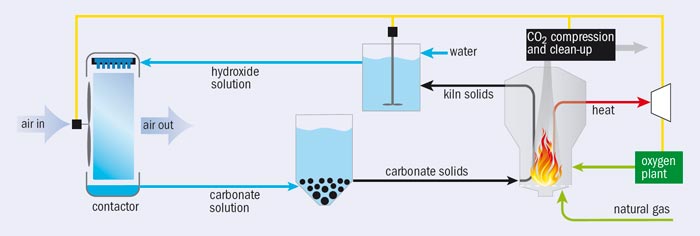
One of the most straightforward ways to remove CO2 from air is with a solid or liquid chemical compound that soaks up the gas. Known as "carbon dioxide scrubbing", it is a tried and tested technique that has been used at power plants, and Carbon Engineering and other similar companies have made it their method of choice because the process is simple, proven and continuous. Ambient air is first drawn through a scrubber or "contactor" where an alkali solution (such as aqueous lye) absorbs CO2 molecules and converts them into a carbonate salt. After the salt is heated in a kiln, the CO2 is then released and captured, before the residue is reacted with water and other compounds to produce the same liquid alkali, which is then fed back into the contactor to be reused. The net yield is concentrated CO2 gas (figure 1).
1 Chemical capture process Air capture of CO2 by a chemical process known as “scrubbing” occurs in two steps that complete an entire cycle. In the case of the firm Carbon Engineering, it first uses a fan to pull air over an aqueous hydroxide solution in the “contactor”. The hydroxide is typically sodium hydroxide (NaOH, also known as lye) or potassium hydroxide (KOH) and any CO2 in the air reacts with it to form water and a carbonate. A crystallizing device causes the carbonate to precipitate out of solution, leaving a solid carbonate. The solid carbonate is then sent to a hot kiln, powered by natural gas or a carbon-free energy source, where it is mixed with iron oxide and heated. The CO2 that is given off is combined with the CO2 produced by the natural gas, compressed, cleaned and sent to a high-pressure pipeline. The remaining solids are sent to a mixing tank, where they react with water to produce iron oxide as well as fresh, usable hydroxide, which is fed back into the contactor to be used in the initial step. The heating step generates all the electricity the plant requires (yellow).
Carbon Engineering has successfully built air-capture prototypes powered by natural gas, the CO2 from which is directly captured and combined with that extracted from air. Because atmospheric CO2 is well mixed, such plants could be sited where energy costs are lowest, environmental conditions such as temperature or humidity are most favourable, or where CO2 disposal is cheapest and most convenient. (In contrast, power plants are not necessarily located where CO2 sequestration is possible or most practical, often requiring that the gas be piped elsewhere.)
Scrubbing CO2 from the waste flues of power plants today costs $50–100 per tonne of CO2, a value that air-capture proponents dream of someday reaching. Once the CO2 is captured it is ready for sequestration or reuse, ideally at the same location. Pipelines and injection wells would have their own regulatory challenges, issues of public acceptance regarding impacts and leakage, and expense (see "Burying climate change for good"). The few sequestration projects that exist today, such as that at the Sleipner gas field in Norway, which has been running since 1996, all involve capturing CO2 from flue gases, but bury only about a million tonnes of CO2 per year.
Artificial leaves
Ambitious carbon-capture schemes are all very well and good, but there already exist amazing machines capable of removing CO2 from the air: plants and trees. Every year, land vegetation sucks up about 220 gigatonnes (220 × 109 tonnes) of CO2 in photosynthesis, although it is, of course, returned to the atmosphere when the plants and algae die and decompose. Vegetation is therefore not a net sink of CO2 – but there are clever ways to turn it into one.
Since carbon makes up about half the dry weight of a tree (depending on species), Ning Zeng, a climate scientist at the University of Maryland, suggested in 2008 how to temporarily solve part of mankind's carbon problem by using forests as "carbon scrubbers". This would involve actively managing them by collecting trees and woody debris, before anaerobically burying them deeper than five metres.
Zeng published another paper last year, which found that if wood was harvested from half the world's forested land and then buried underground, 2.8 gigatonnes of carbon would be trapped per year. (If this carbon was instead allowed to decompose it would release 10.3 gigatonnes of CO2 into the atmosphere.)
Working on it (Left) At the Sleipner gas field in Norway, CO2 is captured from its flues and sequestered beneath the ocean floor. (Centre) Scientists are working on extracting oils and other forms of fuel from CO2. (Right) Planting new trees is useful for CO2 absorption but the gas is later released when the trees decompose. (Courtesy: Statoil; Brian Bell/Science Photo Library; iStockphoto/alrisha)
Likewise, in a world stressed for agriculturally productive land, planting (or recovering) enough forest land looks out of the question, which is why some scientists are looking at making artificial leaves and artificial trees. These structures not only take CO2 out of the air as does conventional photosynthesis, but some also produce carbon-neutral liquid fuels in the process.
In photosynthesis, plants convert the energy of sunlight into stored energy in the form of carbohydrates, removing CO2 and producing oxygen and water in the process. Scientists are trying to do much the same thing, but with "leaves" made of silicon or polymers. Some implementations are sources of carbon-free energy, collecting sunlight that generates oxygen and hydrogen gas for fuel cells. But for Klaus Lackner, a physicist at Columbia University, the focus is to absorb CO2. His carousels of plastic filters are laced with a CO2-absorbing material; as they become saturated with CO2, they are rinsed with water in a vacuum chamber and the dissolved CO2 separates for collection.
Lackner's leaves are about 1000 times more efficient at absorbing CO2 than real leaves, per unit surface area, and need not be exposed to sunlight, so they can be closely spaced. However, they do not come cheap: a single tree, which can remove one tonne of CO2 a day, currently costs about $20,000. Kilimanjaro Energy, Lackner's company, plans to develop and commercialize this and other carbon-capture technologies, and is one of the Virgin Earth Challenge finalists.
Cost controversy
Accompanying these emerging air-capture technologies is the ultimate hope that they might be useful to help stop climate change, and perhaps even reverse its effects by returning the atmosphere and oceans to something like their pre-industrial state. A 2011 report by the American Physical Society (APS) entitled Direct Air Capture of CO2 with Chemicals, however, cast doubt on such ambitions. The APS report set out to explain the basic principles, technology and economics of air capture with chemicals to non-experts, and to encourage discussions among a broad audience of scientists and policy-makers.
One key figure in the report is that a typical sorbent would capture, per square metre over which air flows, only about 20 tonnes of CO2 per year. Since a 1000 MW coal-fired power plant emits about 6 megatonnes of CO2 annually, a 10 m high capture material would need to be 30 km long to adsorb the plant's entire emissions. The report also estimated that a direct air-capture system, built today, would cost at least $600 per tonne of CO2. Direct air capture, it concluded, "is not currently an economically viable approach to mitigating climate change".
Critics hit back, suggesting that these pessimistic predictions were premature at best, and even potentially misleading. Indeed, the report and its backlash from some respected scientists garnered a good deal of media attention, including a lengthy write-up in the New York Times. Mark Workman, a researcher at the Grantham Institute for Climate Change at Imperial College London, who recently co-authored an assessment of negative-emissions technologies, calls the report "controversial" and says "estimates of the cost of negative-emissions sequestration are often used to either negate or endorse the role of negative-emissions technologies in addressing climate change, and therefore often subject to political bias". The high cost estimates are motivated, he says, by "a desire to keep the focus solely on preventing climate change via mitigation".
The report does indeed state that it provides "no support for arguments in favour of procrastination in dealing with climate change that are based on the imminent availability of direct air capture as a compensating strategy". But Workman feels "the mitigation narrative isn't working" and sees negative-emissions technologies as an essential bridge. "We need to develop this line of research in order to buy time to introduce the low-carbon economy at rates at which energy-system technologies take to diffuse, which is up to 100 years, rather than being compressed into the next 30–40 years," he says.
Carbon Engineering research scientist Geoffrey Holmes, on the other hand, thinks that air-capture plants in reality will be more efficient than the model used as the basis for the report's predictions. "One crucial point," says Holmes, "and one opportunity that the APS authors missed in their system, is that our heat and power generation are integrated on-site, so when we use energy to capture CO2 from the air, we also generate all the electricity demand for our own plant, and we capture the CO2 created by the gas combustion to produce that energy." This avoids emitting new CO2 that would partially counteract the CO2 just captured.
Another way Carbon Engineering has lowered its costs is by designing its contactor structures around cooling tower technology – which is optimized to cheaply and efficiently ingest bulk quantities of air – rather than traditional gas scrubber technology. While the details are proprietary, their structure costs less than half of a similarly sized contactor considered in the APS report.
The company has now started work on a pilot plant near Alberta that aims to capture 500 tonnes of CO2 per year and test equipment and designs ready for a commercial-scale plant that is planned to capture 100,000 tonnes of CO2 annually. While Carbon Engineering's carbon-capture rate is slightly higher than the APS report's prediction, to achieve it they will need to use many stacked vents and contactors.
Carbon Engineering chief Keith sees the removal of CO2 as just one prong in the attack on climate change and, along with other entrepreneurs, is far more interested in the business opportunities. Keith sees the big prize as being direct fuel synthesis. Captured CO2 could be fed to algae to produce biofuels, or reacted with hydrogen molecules (obtained by splitting water using renewable energy) to produce high-energy-density carbon-neutral hydrocarbon fuels that could power cars, trains and planes that emit no net carbon pollution. Keith believes the price of such carbon-neutral liquid fuels might someday slash prices at the pump.
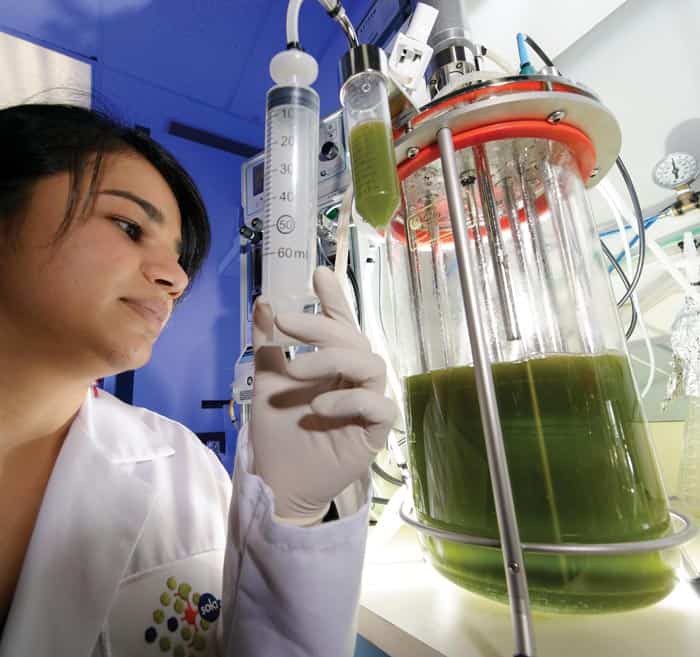
Green ideas Researchers are investigating how best to take advantage of the CO2-absorbing ability of certain types of algae.(Courtesy: Volker Steger/Science Photo Library)
There are certainly many other ideas for how CO2 might be removed from air faster than natural processes. For example, iron fertilization of ocean regions would create algal blooms that, when they die, take the carbon with them to the ocean floor. Another options is "accelerated weathering", which could fix a concentrated stream of CO2 as carbonate by reacting it with natural silicates, speeding up a process that in nature takes millennia. Reforested land, meanwhile, would remove about 50 kg of CO2 per square metre.
Race against nature
Should a climate emergency appear – perhaps a sharp acceleration in the melting of the Greenland or Antarctic ice sheets, or a steep rise in radiative forcings as rapidly thawing permafrost releases methane – the world may be willing to pay whatever it takes to remove CO2 from the air.
Our best guess is that the CO2 from the roughly 40% of emissions coming from power plants could be captured for about $50 per tonne. If air-capture technology drew down the remaining 60% from smaller sources for, say, $100 a tonne, the total cost would be more than $2 trillion to negate one year's emissions at current rates of about 30 gigatonnes of CO2 per year. This is equivalent to a hefty 4% of the world's total GDP.
While that figure is about twice as expensive as the (revised) estimate of the Stern Review – a report compiled for the British government in 2006 to assess the costs associated with mitigating climate change – air capture would have several advantages over currently envisioned mitigation schemes. Primarily, it would not require unilateral action across the entire planet or rebuilding an infrastructure the world has spent the last 150 years perfecting. Like carbon offsets, carbon could be captured by whomever can do it easiest and wherever they can do it cheapest. And it would eliminate the morality play that now accompanies the climate debate, where ends and means are often reversed as different factions use climate change as a cudgel in the fight for their individual causes.
As Keith wrote in Science in 2009, "Unless we can remove CO2 from the air faster than nature does, we will consign Earth to a warmer future for millennia, or commit ourselves to a sustained programme of climate engineering."
And those are options nobody wants.
The carbon problem
Despite all warnings, emissions of greenhouse gases are increasing exponentially – a predicament the seriousness of which many still do not appreciate. The CO2 emitted by the average Briton over just 80 minutes – about 1.3 kg – will ultimately trap a Hiroshima bomb's worth of heat: 63 terajoules. That heat will alter the Earth's climate and oceans for millennia – the CO2 content of the Earth's atmosphere will be about 10% higher 100,000 years from now than it would be without today's emissions.
But solving the problem by replacing our energy system is daunting indeed. With colleagues, Ken Caldeira of the Carnegie Institution for Science has calculated that the world needs to install roughly one large (900 MW) carbon-emissions-free power plant every day for the next 50 years to stabilize overall global surface warming at 2 °C. And if, as seems likely, the target is relaxed to something like 4 °C, the required number is still about one power plant every two days.
To date, mankind has emitted about 1400 gigatonnes of CO2 from burning fossil fuels, and another 600 gigatonnes from land-use changes such as deforestation. But there are still enormous amounts of economically viable fossil fuels left to extract and burn, of which 70% is in the form of coal; if we used it all it would unleash a further 3200 gigatonnes of CO2. In fact, burning all the fossil fuels on the planet would create at least 37,000 gigatonnes of CO2, and for every 1000 gigatonnes emitted, the climate response is about 0.4 °C of surface warming, plus or minus a third. Humans could easily create an inverse ice age if we wanted to – a mean global surface warming of 6–7 °C, or more.
Not content with shielding objects in space, physicists have come up with a new way of concealing events in time. The research involves punching a series of temporal holes into a stream of optical data at gigahertz frequencies using commercially available equipment, and could lead to applications in telecommunications and computing that involve hiding or dividing up information.
Spatial invisibility cloaks are shields made up of artificial "metamaterials" that bend light waves around an enclosed object as if neither the object nor the cloak were present – just as a stream of water would flow around a boulder. A number of such devices have been built and successfully demonstrated, and now physicists are turning their attention to "temporal cloaks", which hide events during specific periods of time.
Slow down and speed up
The basic idea is to take a portion of a travelling wave, speed up the front half and at the same time slow down the back half, so creating a gap in time at a specific point in space during which the wave does not pass. By then slowing down the front and speeding up the back of the wave, any event taking place during the temporal gap would be invisible to a person receiving the wave – the wave arriving as an undisturbed signal of constant intensity with no trace of the event.
In 2012 Alexander Gaeta and colleagues at Cornell University in the US reported having built the world's first temporal cloak. They did so by sending a beam of infrared light through a "time lens" that changes the colour of light as a function of time – the effect being to introduce a very sharp transition within the wave from blue to red. They then passed that light through an optical fibre, along which light of different wavelengths travels at different speeds, in order to introduce a time lag between the (faster) blue and (slower) red light, within which an event could be hidden. To restore the uniform wave and so cover up the evidence for such a lag, the light was then passed through a second fibre, which slowed down the blue and sped up the red light, and then through a second, opposing time lens.
Lensing time
The Cornell researchers showed that the signal associated with a light pulse from a second laser fired during the temporal gap was reduced by a factor of 10 as a result of introducing the gap, so demonstrating that their device could indeed cloak events. However, they were only able to do so at frequencies of up to tens of kilohertz, which is far below the gigahertz frequencies typical of today's broadband data transmission. According to Joseph Lukens of Purdue University in the US, the limiting factor is the very high rates at which the time lenses need to be switched if the incoming wave is to experience the necessary, almost instantaneous, change in frequency.
In the latest work, Lukens and his Purdue colleagues Andrew Weiner and Daniel Leaird overcome this problem by using a temporal version of a phenomenon known as the Talbot effect. First observed in 1836, the Talbot effect is the repetition of the image of a diffraction grating beyond the plane of the grating when crossed by a plane wave. It is caused by interference among all of the wave's diffracted components. The temporal version employed by the Purdue group involves sending a beam of infrared light through a "temporal" phase diffraction grating and then directing the resulting light along an optical fibre to disperse it. Lukens explains that the different frequencies "move through each other" and that their interference creates gaps in time. Crucially, no abrupt frequency change is needed in the incoming wave. "The hard work is done by the Talbot effect and not by constructing exotic time lenses," he adds.
Missing moments
Using ordinary phase modulators and a single continuous-wave laser, Lukens and co-workers were able to produce time gaps at frequencies of over 10 gigabits a second, even if the length of each gap was slightly shorter than those of the Cornell group (36 as opposed to 50 picoseconds (10–12 s)). Lukens speculates that in future the military could use this technology to prevent eavesdroppers intercepting secret messages, the idea being that the interceptor would be unaware of any data transmitted during the temporal gaps. More realistically, he says, it might be used to avoid conflicts between different signals in an optical routing system or to ensure separation between distinct channels in high-bandwidth Internet connections.
The next major hurdle for researchers of cloaking devices is to make a "space–time cloak", which would combine spatial and temporal capabilities in a single instrument. Such a device would allow events occurring in a particular volume of space and within a certain time interval to go unnoticed, and in theory might allow bank robbers to remain hidden from view while they remove the contents of a safe, even though they are under constant video surveillance. However, actually building a space–time cloak would be "very daunting", according to Lukens, and he does not "see that happening any time soon".
Martin McCall of Imperial College in London, whose group put forward the concept of the space–time cloak in 2011, agrees. Referring to its potential for use in optical routing systems, he says that the latest work "is certainly a step towards making that functionality a reality". He adds that their "original space–time cloaking concept is unlikely to assist in the ultimate bank heist, but I do think it opens possibilities towards making current devices work better".
European Parliament in Brussels. (iStockphoto/Franky De Meyer)
By Margaret Harris in Brussels
For an event built around celebrating Europe’s best scientific spin-out companies, the Academic Enterprise Awards got off to a downbeat start. “Europe is lacking growth, lacking jobs and lacking entrepreneurial appetite,” declared Joanna Drake, director of small and medium-sized enterprises (SMEs) within the European Commission. Such enterprises “have a difficult life, and this is getting worse, not improving” agreed the event’s second speaker, MEP Maria Da Graça Carvalho of Portugal. Then there was Roland Siegwart, vice-president for research and corporate relations at ETH Zurich. In a splendid bit of understatement, he lamented the fact that many bright scientists at his university “have a somewhat not awake entrepreneurial spirit”.
Today I am living the dream, at least for many theoretical physicists. I have my very own office at the Perimeter Institute (PI) for Theoretical Physics in Waterloo, Ontario. It comes complete with free coffee, a blackboard pre-loaded with equations and access to some of the world’s top physicists.
This morning I spoke to Daniel Gottesman, who if I am not mistaken was the first PI faculty member to work on quantum information after joining in 2002. His speciality is quantum error correction and we had a fantastic chat about the directions in which quantum computing could go in the future.