Life inside the Perimeter

Blackboards and equations galore at the PI

By Hamish Johnston in Canada’s Quantum Valley

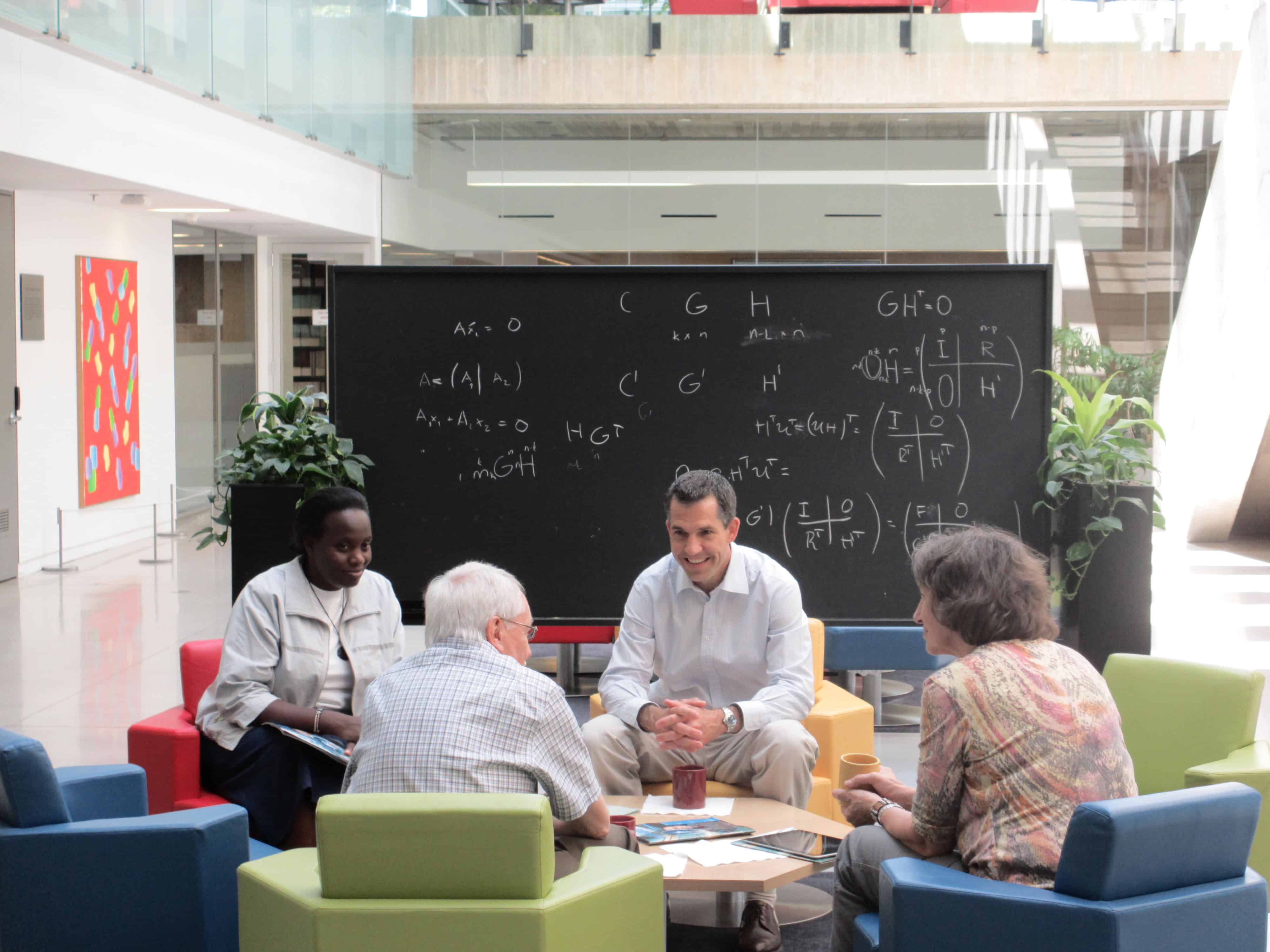
Today I am living the dream, at least for many theoretical physicists. I have my very own office at the Perimeter Institute (PI) for Theoretical Physics in Waterloo, Ontario. It comes complete with free coffee, a blackboard pre-loaded with equations and access to some of the world’s top physicists.

This morning I spoke to Daniel Gottesman, who if I am not mistaken was the first PI faculty member to work on quantum information after joining in 2002. His speciality is quantum error correction and we had a fantastic chat about the directions in which quantum computing could go in the future.

(more…)

Pulsars map the way for space missions

A method for navigating spacecraft autonomously using pulsars has been developed by a group of researchers in Germany. Although the idea of using pulsars for stellar navigation was first proposed in the 1970s, the team has, for the first time, discussed the type of pulsars best suited for such measurements and has determined which type of detector – a radio or an X-ray detector – would currently be most feasible and practical to use on-board satellites and other spacecraft.

Today, satellites and spacecraft that navigate through our solar system use a combination of technologies to triangulate their location at any time – these include a pre-determined orbit, radio signals sent from the craft to Earth-based tracking stations, as well as optical information from on-board cameras that look at the local environment. While the radio measurements made at the ground stations are highly accurate in terms of the distance and the radial velocity of the craft, it is the angular resolution of those measurements where large errors come in. This happens as a result of the very low angular resolution of the radio antennas from their seat on Earth such that accurate measurements are only available for a craft moving in a straight line away from the Earth. Unfortunately, as this is hardly ever the case, errors creep in. Indeed, the accuracy of such measurements also drops as the craft’s distance from the Earth increases – the farther away it is the longer it takes for a signal to be sent and received. A one-way signal to Voyager currently takes about 17 hours.

Pulsar pathway

To overcome these problems, astronomers are keen to develop an “autonomous navigation system” that would sit on-board the spacecraft in question, thereby avoiding the disadvantages of any Earth-bound communications, increasing distance uncertainties or signal weakening. The possibility of using pulsars – highly magnetized, rapidly rotating neutron stars that emit “pulses” of broadband electromagnetic radiation at very regular intervals – was first suggested in 1974 for radio pulsars. At the time, however, the technology had not developed and there were not enough pulsars identified to make the method feasible.

In this latest research, a team led by Werner Becker at the Max Planck Institute for Extraterrestrial Physics in Germany has described an approach that could lead to viable pulsar navigation. The team’s paper looks at the three basic types of pulsar – accretion-powered pulsars, magnetars and rotation-powered pulsars – and determined that only the rotation-powered are suitable for navigation. The rotation-powered pulsars are themselves divided into two types, namely field pulsars that have periods between 10 ms and several seconds, and millisecond pulsars that, as their name suggests, have periods of less than 20 ms. According to Becker and colleagues, it is the millisecond variety that is best suited for navigation purposes, thanks to their highly stable timing. Millisecond pulsars were first discovered in 1982 and initially studied only in the radio band, until Becker himself detected the first X-ray emission from a millisecond pulsar in 1993.

Exact position

“Only in very recent years have we developed the next generation of X-ray satellites and X-ray mirrors that are lightweight and highly compact, and these are the key to pulsar navigation,” Becker told physicsworld.com. Becker’s paper goes on to discuss how a “pulse” from a pulsar would be used as a navigational aid. The system is simple. As the initial position and velocity of the spacecraft is known thanks to planned orbital parameters, the process begins with a first observation of the arrival of individual photons from a pulsar pulse that are recorded. These are then corrected for the velocity of the moving craft to an inertial reference frame.

Becker explains that the best fixed point for this would be the solar system barycentre – the centre of mass for our entire planetary system. “In fact, even if future missions leave the solar system, we could still use the barycentre as it still would work as a reference point,” says Becker, though it would be necessary to correct for the sun’s motion in the galaxy . These measurements would then be used to build up a pulse profile that represents the timing signature of the pulsar, ultimately giving the pulse arrival time. Principally, a 3D position-fix could be derived from observations from three different pulsars located in different parts of the sky, but in reality more would be required. “I would say that about 10 millisecond pulsars would be best to get a good measurement, as you would want to check for errors, so some redundant information would actually be welcome,” says Becker.

X-ray versus radio

The study looks at one of the essential practical aspects of this navigation technique: whether radio antennas would be used to pick up radio emissions from the pulsars, or X-ray detectors would be preferred. They found that a phased array of radio antennas could easily be used, but they would cover an area of at least 150 m2 and weigh a minimum of 170 kg. The X-ray telescopes using the mirrors would be much more lightweight and compact, but the detectors run the risk of being destroyed if exposed to an exceedingly bright X-ray source. The researchers estimated an accuracy of ±5 km/s in the solar system and beyond using their method – a huge improvement on current techniques.

Flowchart that determines the navigator performance as a function of the technology parameters

Becker tells physicsworld.com that choosing a technique would depend on the specifications of each mission. “If you have a huge starship in the future using this method, then the radio array is preferable as we have more knowledge and accuracy when it comes to radio signals and the size and weight would not make a real difference,” he said. “But on a current mission, where that is a priority, a compact X-ray detector would be much better, so you would have to check your mission details such as the size, orbit and power consumption before deciding.” To help future missions do just this, the team has drawn up a flowchart (right) that determines the “navigator performance as a function of the technology parameters”.

The researchers also discuss current detector technologies such as silicon pore optics, silicon drift detectors and “active pixel sensors” that might be used in missions that would adopt the pulsar navigation. While Becker believes that the method will not be used in practice any earlier than 30 years from now, the need for an autonomous navigation system and a pulsar’s natural time-keeping abilities will undoubtedly lead to pulsar navigation in the future.

A pre-print of the work is available on arXiv.

Entering the quantum world

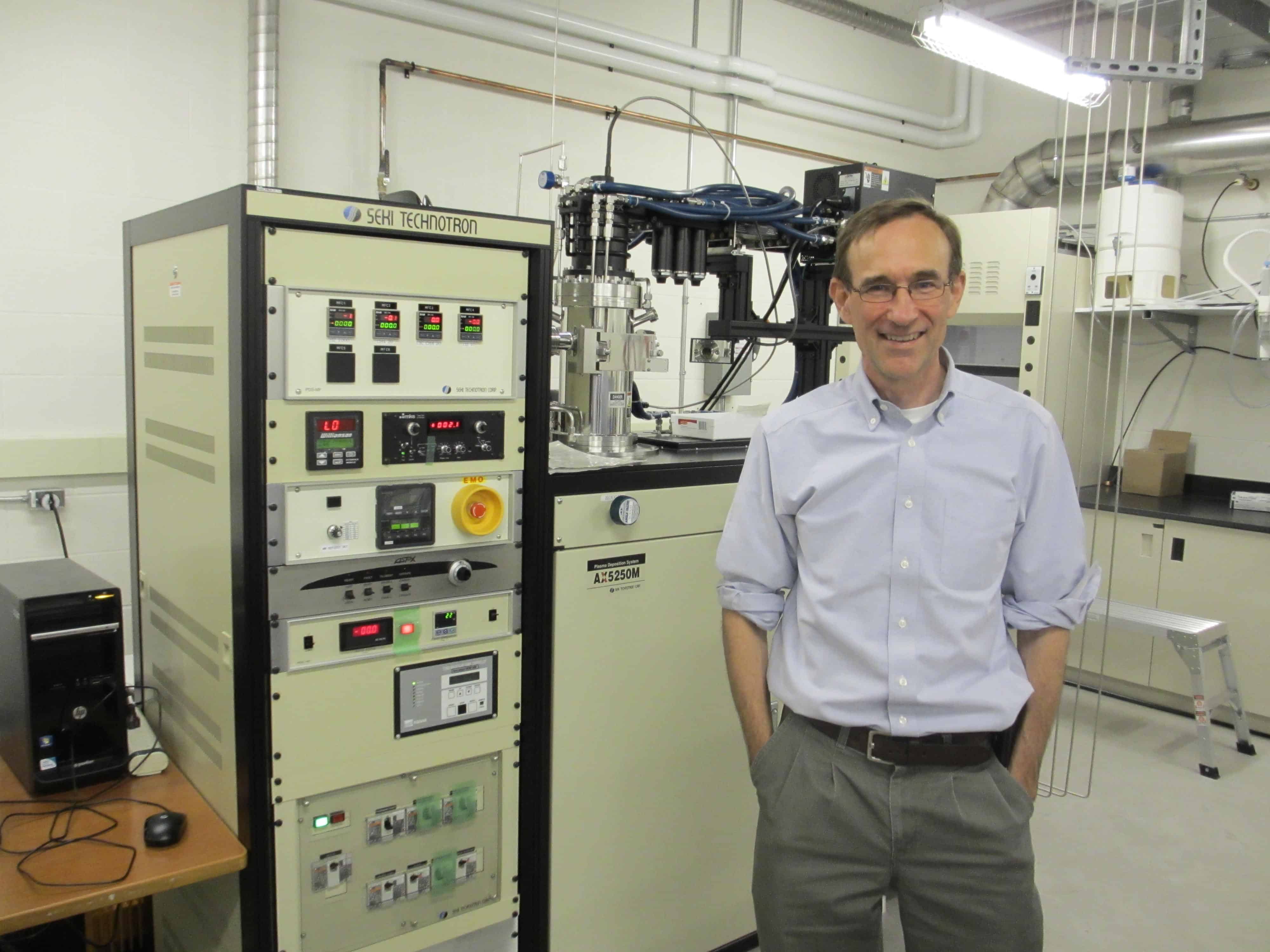
Not a black hole in sight: Raymond Laflamme in one of the IQC labs. The machine behind him makes diamonds for quantum computing experiments

By Hamish Johnston in Canada’s Quantum Valley

“We have entered the quantum world and we can control it” is how Raymond Laflamme characterizes the current quantum renaissance that is sweeping across many fields of physics. Laflamme is director of the Institute for Quantum Computing (IQC) at Canada’s University of Waterloo and he began his career at the University of Cambridge as a student of Stephen Hawking, working on cosmology.

(more…)

A 'unique' quantum research centre

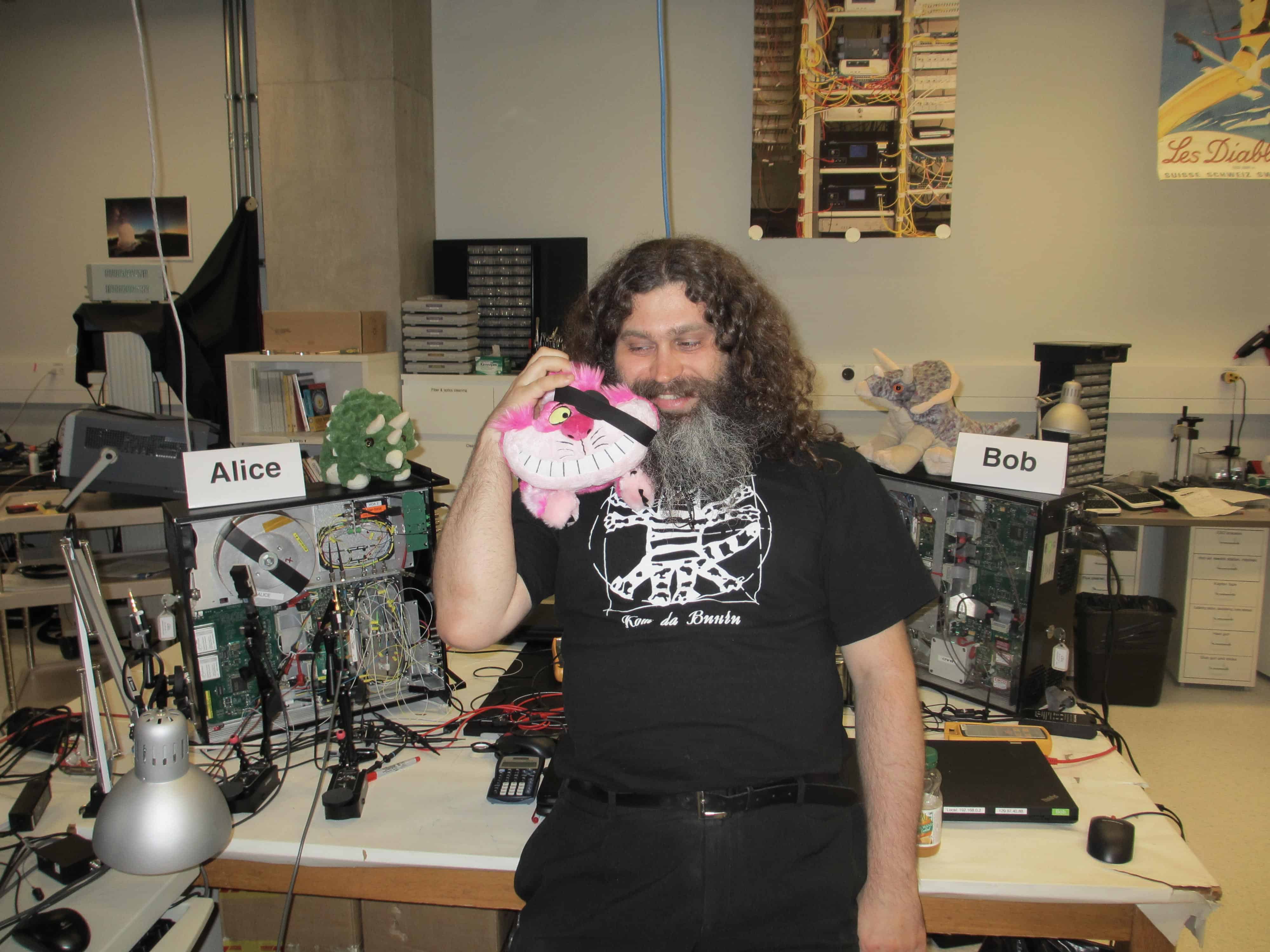
Vadim Makarov with a few old friends

By Hamish Johnston in Canada’s Quantum Valley

“There’s no place like this in the world,” said Vadim Makarov (above) as we walked up to his lab at the Institute for Quantum Computing (IQC) at Canada’s University of Waterloo. What’s unique about the place, according to Makarov and others I spoke to in Waterloo, is that it brings together a diverse group of researchers (physicists, computer scientists, mathematicians, engineers, etc) in one place to develop quantum-information technology.

(more…)

High-sticking in the Quantum Valley

Keep your stick on the ice! How to give a talk at PI

By Hamish Johnston in Canada’s Quantum Valley

I had a fantastic day today touring Canada’s “Quantum Valley”, which is what people are starting to call the region surrounding the University of Waterloo in Ontario. Waterloo is an hour’s drive west of Toronto and home to the Perimeter Institute for Theoretical Physics (PI) and the Institute for Quantum Computing (IQC). There is also a small but growing cluster of quantum technology start-ups that have spun out of the university.

(more…)

Do dark-matter discs envelop galaxies?


A new type of dark matter that could strongly interact with regular matter to form large discs that would overlap galaxies like our own has been postulated by a group of researchers in the US. There is believed to be at least four times as much dark matter in the universe as there is ordinary matter. But despite its great abundance, dark matter is generally thought to very weakly interact with conventional matter, causing it to form amorphous halos around galaxies that contrast with the richly structured galactic discs themselves. The new research suggests this view may be oversimplified, arguing that a substantial minority of dark matter might in fact interact strongly, and could be detected in cosmic-ray observations.

Dark complex

Much evidence has been accumulated to support the existence of dark matter, which, unlike normal matter, does not give off or absorb electromagnetic radiation. For example, the greater-than-expected rotational speeds of stars in the outer-lying regions of galaxies suggest that those galaxies contain more mass than can be accounted for simply by adding up all of the light.

However, scientists still do not know what dark matter actually is. They do know that much of dark matter interacts weakly with other matter and with itself. Among theorists’ leading candidates for dark matter are so-called weakly interacting massive particles (WIMPs) and axions, which rarely collide with one another. The existence of these particles is also suggested from work in other areas of physics – WIMPs being predicted by some forms of supersymmetry, while axions might explain why strong interactions obey charge–parity symmetry.

More than meets the eye

In the latest work, Lisa Randall and colleagues at Harvard University argue that such weakly interacting particles might not tell us the whole story. By considering the characteristics of the dark matter surrounding our own Milky Way galaxy, the researchers calculate that as much as 5% of that dark matter might not be weakly interacting. They also point out that this “double-disc dark matter” (DDDM), as they call it, would probably dissipate energy while retaining angular momentum from its motion about the galactic centre, causing it to form a thin disc just as ordinary galactic matter does. They work out that the dark and visible discs would have about the same mass, which would imply that the densities of DDDM and normal matter in the universe would be roughly equal.

“Our model isn’t proposed to solve any particular problems,” says group member Matthew Reece. “But we think it’s important to consider a wider range of possibilities for what dark matter might be. We are lucky to be living in a data-rich era, and we want to be sure that we’re not overlooking a dramatic discovery in all that data.”

According to the researchers, DDDM discs would contain the dark-matter equivalent of protons and electrons interacting via an analogue of electromagnetism, so creating dark atoms. The minimalistic model that they have considered in the current work, however, does not include analogues of the nuclear forces, so they have not predicted the DDDM spawning stars, as such. Reece says that he and his colleagues limited themselves to this simple model because it was relatively easy to analyse and work out how it could be tested, but explains that a more complex model, incorporating nuclear physics, could in principle be developed. In fact, he adds, “It doesn’t seem completely out of the question that there could be forms of life made of dark matter,” although he underlines that this speculative idea “isn’t very scientific since we don’t know a good way to test it”.

Detecting dark discs

The dark disc, on the other hand, might be detectable in the near future. Reece explains that evidence for its existence could come from the gravitational effect it has on the motion of the billion Milky Way stars that the European Space Agency’s upcoming Gaia mission will study. Alternatively, he and his colleagues write, annihilating DDDM particles would, given enough sensitivity, produce “strikingly different” signals from those of the ordinary dark matter that the space-based PAMELA, Fermi and AMS-02 detectors are looking out for.

Direct detection, however, would be more difficult. Physicists have built a number of experiments underground that look for any interaction between putative particles of ordinary dark matter and the material in the detectors. But as the Harvard team points out, these detectors would struggle to observe the DDDM variant since the dark disc that is home to this exotic material might not be aligned with our visible one. In addition, even if the two discs were aligned, their relative velocity would probably be too low to generate suitably energetic collisions within the detectors, the team says.

Daniel Hooper, an astrophysicist at Fermilab in the US, says that the Harvard group has put together “an interesting hypothesis” that he predicts “will receive a great deal of interest from many of us working on dark matter research”.

Meanwhile, Roberto Battiston, a physicist at the University of Trento in Italy and deputy spokesman of AMS-02, says that the peculiarly disc-shaped distribution of DDDM might be identifiable with his group’s experiment, if such a substance exists. But he cautions that there could be many competing theories to explain any dark-matter-like signal collected by the detector.

The research is published in Physical Review Letters.

Condensed-matter cosmology and spin wires

Waterloo, here I come (Courtesy: IQC)

By Hamish Johnston at the 2013 CAP Congress in Montreal

Yesterday morning I was back at the University of Montreal for more physics at the Canadian Association of Physicists Congress. I started off the morning with a bit of quantum cosmology and quantum gravity with a distinct hint of condensed-matter physics.

(more…)

Between the lines

Numbers

Statistically speaking

Particle physicists use statistics to distinguish new particles from meaningless blips. Climate physicists need it to turn incomplete data into robust models. And pretty much everyone in science wheels it out to calculate error bars. Despite its usefulness, however, the field of statistics has a reputation for being dull and confusing; as a former classmate of your reviewer’s put it, “If I had one day left to live, then I would live it in stats class, because that way, it would last longer.” In his book Naked Statistics: Stripping the Dread From the Data, author Charles Wheelan concedes that his subject could do with a bit of a boost. The statistical sexing-up begins with the book’s front cover (which depicts a cartoon character holding a suggestive and strategically placed bar graph) and continues with the kind of writing that made Wheelan’s previous book, Naked Economics, into a bestseller despite its “dismal science” subject. In addition to clarity, Wheelan’s favourite tactics for keeping the reader hooked include a nice line in silly examples and a ready spoonful of wit to make the statistical medicine go down. In the second chapter, for example, he tells a story about a bar patronized by Bill Gates, a talking parrot and 10 low-paid workers. The point of this anecdote is that mean values can be distorted by outliers; when Gates walks into the bar with the parrot on his shoulder, the average annual income of the patrons leaps from $35,000 to about $91m. (The parrot, Wheelan writes, “has nothing to do with the example, but it kind of spices things up”.) He keeps the tone light even as the book moves on to more complex topics, such as the “garbage in, garbage out” problem of doing statistics with bad data and the various biases that can lead people to form erroneous conclusions. At the heart of the book is the central limit theorem, a pillar of statistics that, crudely speaking, states that a random sample of a given population will resemble the population as a whole. That might not sound terribly earth-shattering, but Wheelan shows that if properly applied, the central limit theorem can do some amazingly useful things – such as detecting when someone’s been fiddling experimental data. The theorem also allows us to infer that while most physicists won’t learn much from the first few chapters of Naked Statistics, nearly everyone will get something out of it by the end – a pretty good result, whichever way you slice it.

  • 2013 W W Norton/Wiley £18.99/$26.95hb 320pp

A classy bunch of particles

Following the success of Brian Greene’s The Elegant Universe, the word “elegant” has been somewhat over-used in popular-science writing. However, there is no other word to describe Jeremy Bernstein‘s A Palette of Particles: this is an elegant book, elegant in its writing and in its packaging, the sort of book that ought to be read with freshly washed hands and a glass of something cold and sophisticated. Its subject, broadly speaking, is the history of particle physics, and it is organized into three sections. The first of these deals with the electron, proton, neutron and neutrino, which Bernstein describes as the “primary colours” on nature’s palette. Next up are more exotic particles such as the pion and muon, antiparticles, strange particles and quarks; these are the “secondary colours”. The final section is devoted to nature’s “pastels”, beginning with the relatively vibrant Higgs boson and shading away to shadowy objects such as tachyons and gravitons. Bernstein is both a physicist himself and a veteran observer of other physicists; in many cases, he met or was personally acquainted with the people he describes, including Wolfgang Pauli, Emilio Segré and Sheldon Glashow. Perhaps as a result of this familiarity, the book sometimes reads as though it was written not for its stated audience (“a general reader with an interest in science”), but for insiders who, like the author, are already familiar with the main characters and their histories. It is, if you like, a bedtime story for quantum connoisseurs rather than a bracing wake-up call for newcomers – and like the best bedtime stories, it offers plenty for readers to think about. In Bernstein’s view, “nature [is] something like those Russian dolls, except in this case I think there may be no limit. The deeper we probe, the more will be left to probe.”

  • 2013 Harvard University Press £14.95/$18.95hb 224pp

The race to find the electric dipole moment

The University of Montreal actually has an ivory tower!

By Hamish Johnston at the 2013 CAP Congress in Montreal

Yesterday I had lunch with Jeff Martin of the University of Winnipeg, who is a member of an international team that aims to measure the electric dipole moment (EDM) of the neutron at TRIUMF in Vancouver.

(more…)

Physicists design acoustically invisible walls

A rigid wall can be transformed from a total reflector of sound to an almost perfect transmitter by perforating it with tiny, regularly spaced holes covered by a thin elastic membrane, say researchers in Japan and South Korea. The discovery, an acoustic analogue to extraordinary optical transmission (EOT), could potentially be used in microscopes, noise filters, new types of windows, acoustic concentrators and many other applications.

EOT was discovered by Thomas Ebbesen of the University of Strasbourg and colleagues in 1998. It allows electromagnetic waves to pass almost unhindered through a lattice of sub-wavelength holes in a barrier that would otherwise be opaque in some metamaterials. In Ebbesen’s discovery, this was down to coupling between photons and electrons on the surface of the barrier.

Perfect transmissions

Following Ebbesen’s discovery, in 2006 a different team of researchers led by Nader Engheta at the University of Pennsylvania in Philadelphia discovered another mechanism that can lead to EOT. If the holes contain a material with a refractive index close to zero, the wavelength in the holes becomes extremely long, and thus the velocity becomes extremely large. The faster a wave travels, the more energy it carries, allowing the energy of the entire wavefront to squeeze through the tiny holes. Such materials are called epsilon-near-zero (ENZ) materials because the refractive index of a material depends on its permittivity – written as epsilon (ε) – a kind of electrical inertia that is representative of the resistance that is encountered when forming an electric field in a medium. An ENZ material offers almost no resistance to such displacement.

Same for sound

Now, Sam Lee of Yonsei University in Seoul, South Korea, Oliver Wright of Hokkaido University, Japan, and colleagues have produced an analogue of Engheta’s metamaterial for sound waves. Just as electromagnetic waves propagate as vibrations in a material’s electromagnetic field, sound waves travel as physical oscillations of the atoms. Sound waves cannot pass through a rigid barrier because the atoms cannot oscillate. Making tiny holes in the barrier will barely increase transmission. Lee explains that if, for example, the holes make up 3% of the volume of the barrier, “to ensure continuous volume flow across the barrier, the air in the holes has to move 30 times faster than the air outside the wall. The inertia of the air does not allow for the huge accelerations needed for motion of such amplitude.” To solve this problem, the researchers needed the air in the holes to have almost zero inertia – the acoustic equivalent of an ENZ material.

They achieved this, paradoxically, by covering the holes with a thin membrane of shop-bought kitchen cling film. With the tension tuned so that the membrane’s resonant frequency is the same as the frequency of the incident waves, the membrane’s resonance amplifies its oscillations. The resonance moves the air through the holes as though the air has no inertia, allowing it to move in response to even a small displacement and sucking almost all the energy of the incident waves through the barrier.

Invisible barriers

On the other side of the barrier, Huygens’ principle dictates that each hole produces spherical wavefronts. The separation between the holes is much less than the wavelength of the sound, which means the interference pattern of the waves reconstructs the plane wave in much less than one wavelength and the barrier is effectively invisible to the propagating waves.

The researchers tested their acoustic-metamaterial design by placing an acrylic barrier perforated with four small holes in a tube. Loudspeakers producing waves of a single frequency were placed at one end and the researchers measured the intensity of the waves on either side of the barrier. The results were remarkable – they found, for example, that with the barrier perforated by bare holes, only 9% of the waves’ energy was transmitted. With a membrane placed over the holes, this proportion jumped to 81%. The metamaterial worked just as well when placed at an oblique angle to the incident wavefronts.

Ebbese, who was not involved in this work, views the result as a significant contribution to acoustics with numerous potential uses. “They’re talking about transmission, but in the same way you can also block waves at other frequencies by adding this membrane,” he says, listing noise filters as one application where this could be useful.

Novel lenses

According to the team, its method can be used over a range of frequencies such that it would work equally well for ultrasound. This, the researchers say, could be exploited to concentrate acoustic energy through tiny holes, forming novel lenses. They are currently working on the potential application of the idea to near-field scanning acoustic microscopy, where the properties of an object are studied by the sound waves it reflects. The researchers believe the concentration of the radiation’s energy into tiny holes during the process of transmission could allow them to achieve both very high signal intensity and spatial resolution.

The research is to be published in Physical Review Letters.

Copyright © 2026 by IOP Publishing Ltd and individual contributors