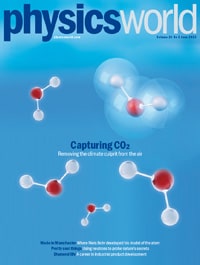
The June 2013 issue of Physics World is now out

By Matin Durrani

As physics has grown into a bigger, increasingly global and more connected endeavour, are there still any true physics hot spots? Are there any institutes, universities or regions that really are “the place to be”? Does good physics, in other words, depend more on who (or what) you know than where you are?

The importance of having the right people in the right location is well illustrated in this month’s issue of Physics World, in which science writer Brian Clegg looks at the role played by Manchester in the development by Niels Bohr of his model of the atomic nucleus 100 years ago.

What drew Bohr there were not so much the facilities at the University of Manchester’s physics department but rather its working environment and in particular the presence of the New Zealander Ernest Rutherford, with whom Bohr struck up a great rapport.

Our cover story this month concerns attempts to extract carbon dioxide from the air in the fight against climate change, while elsewhere in the issue we look at all the cool – and pretty fundamental – things you can do with ultracold neutrons.

(more…)

What happened to nuclear electrons?

By Hamish Johnston at the 2013 CAP Congress in Montreal

Sometimes I think that physicists can dwell too much in the past. Scientific papers, for example, often begin with a potted history of the field and it’s only in the second page that something new is mentioned.

(more…)

The first medical X-ray…

By Hamish Johnston at the 2013 CAP Congress in Montreal

Jean Barrette has one of the best jobs in the world as far as I am concerned. The retired nuclear physicist is curator of the McPherson Collection of physics instruments at McGill University here in Montreal.

This morning in the “History of Physics” session at the Canadian Association of Physicists (CAP) Congress, Jean gave a talk that featured many of the beautiful experiments – lots of brass and polished hardwood – in the collection.

The collection was made possible by the Canadian physicist Anna McPherson, who left a sizeable sum to the university when she died in 1979.

One of the highlights of the talk was what is surely the first-ever medical X-ray, which was taken in 1896 just six months after X-rays were first discovered. Taken at McGill, it shows a bullet lodged in the leg of a shooting victim.

During his talk, Jean asked for help in identifying a mysterious piece of apparatus in the collection that so far he had not been able to identify. Jean is going to send me a picture and I’ll post it in an upcoming blog entry.

Is creativity as important in science as it is in art?

By James Dacey

Science-inspired art

The worlds of art and science came together yesterday in central London in a celebration of creativity across disciplines. A symposium at Central Saint Martins College of Art and Design was held to recognize the first group of students to complete the Art and Science MA course – the first course of its kind in the UK. Students taking this course are given the chance to explore the “creative relationships between art and science and how to communicate them”.

(more…)

Physicists rethink celebrated Kelvin wake pattern for ships

Lord Kelvin may have been an accomplished sailor, but he might have missed a trick when he famously described the phenomenon of wakes fanning out at a constant angle of 19.47°, no matter the speed of the vessel. That is the claim of two French physicists, who have used satellite images and mathematical modelling to study narrower wakes associated with fast-moving boats.

Kelvin’s prediction is rooted in two key properties of gravity waves on the water surface: first, that those with large wavelengths travel faster than those with short wavelengths; and second, that the group velocity of a deep-water wave is exactly half its phase velocity. As a boat moves through calm water, it excites waves over a range of wavelengths, with the longest speeding away faster than the shortest and then dissipating. Constructive interference between the slower, shorter waves causes a pair of shock waves to form in a distinctive V-shape that emanates from the boat.

Kelvin showed that the angle that each arm of the V makes with the centre line is 19.47°, irrespective of how fast the boat is travelling. It is a universal pattern that even holds true for a duck traversing a pond.

But when Marc Rabaud of University of Paris-Sud in Orsay tried to demonstrate the phenomenon to a group of physics teachers at a local pool, he was stumped as to why his set-up produced much narrower wakes. A decade later, still puzzled, Rabaud and colleague Frédéric Moisy noticed that the photographs they used to illustrate Kelvin wakes to fluid-mechanics students were at odds with the theory they were trying to teach.

Kelvin or Mach angle?

Narrow wakes had been spotted before, of course, but scholars had come up with various ways of rationalizing their existence: the effects of shallow waters; superposing wave patterns; turbulence; and nonlinear interactions, to name a few. “But if you look at the pictures that apparently don’t work – they’re actually the most interesting ones because they really tell you something new,” says Moisy. He and Rabaud analysed images from Google Earth, using measurements of boats’ hull lengths and wake angles, as well as calculations of their velocities, to help them build a new mathematical model to describe narrow wakes.

What the researchers found was that at higher speeds, boats produce a smaller spectrum of wavelengths that tends towards the length of the boat itself. According to the duo, a boat cannot produce wavelengths longer than its hull, so as soon as the wake hits a limiting speed governed by this length, its waves all travel with equal speed through the water, much like sound waves through air. At this point, like the Mach cone associated with supersonic jets, the angle of the wake is suddenly governed solely by the speed of the boat – the faster it goes, the more its wake stretches and narrows.

Rabaud and Moisy’s numerical simulations were in strong agreement with their image analyses, which together allowed them to identify a Froude number (a relation between boat velocity and hull length) of roughly 0.5 as the transition point between the Kelvin and Mach regimes.

Reservations raised

Others in the field are sceptical. Yuming Liu, a marine hydrodynamicist at the Massachusetts Institute of Technology, has several misgivings about the work, including the fact that the numerical simulations consider only the “near field” region directly behind the ship, rather than the whole area over a distance of several wavelengths, which he says biases the results. Not only that, he is troubled by the researchers’ argument that a ship cannot excite waves longer than the hull. “You just can’t make an assumption like that,” he cautions.

Tarmo Soomere, a mathematician and wave expert at Tallinn University of Technology, agrees, saying that “the devil here could be the assumption” and worries – along with Liu – that the model has overlooked finite-depth effects that are well known to have a strong effect on wake angle. Rabaud and Moisy concede that most of their images necessarily come from shallower waters within a kilometre of shore, since Google Earth‘s resolution drops off sharply away from land. Yet they rule out a depth effect on wake angle within their data. “If we plot our data as a function of water depth, there is just a scatter of points with no correlation at all,” says Moisy.

Soomere cautions that photographic images can be deceptive, highlighting the steepest but not necessarily the highest wave components. “A much simpler explanation of their results is that a vessel wake consists of several components of different nature, and you never know which one of these is actually visible in an image,” he explains. “I deeply believe that the researchers have found a simple model for one of these components though…and this is truly fascinating.”

The research is published in Physical Review Letters.

Learning to adapt

What sparked your interest in physics?

Like many scientists of my generation, I grew up reading a lot of science fiction. In addition, my stepfather – a very strong figure in my life – is a geophysicist, so I was always surrounded by earth-science types. I studied biology and chemistry in high school, but I always had deeper questions, and it seemed like if you really wanted to answer them, you had to study physics.

What was it like for you to study physics at university?

Being a blind physics student is a lot more work than being a sighted physics student. For example, I had to have someone read my textbooks out loud so that I could copy them into Braille; I would copy verbatim all the equations and even many of the tables so that I had reference materials for the classes I was taking. But I was also lucky. I went to the University of California, Berkeley, which was the birthplace of the disability rights movement, and I think in part because of that movement, I had almost no negative experiences with my professors. They were almost always willing to work with me to find creative ways of helping me to progress in my studies.

You earned your PhD in psychoacoustics. Can you explain what that is?

Psychoacoustics is the science of how hearing works. There’s a very long tradition of crossover between the physics and psychology communities in this area because it lies at the interface between acoustics and brain function. It’s a broad field, covering both “mushy” topics like how someone feels about a piece of music and “hard” ones such as the responses of specific neurons to frequency changes and other acoustical variations. My focus was on something called auditory motion perception, which basically examines how you know about sounds in the environment that are moving from one place to another.

How did you get into adaptive-devices research?

When I was an undergraduate I worked at a software firm called Berkeley Systems. Physics World readers might remember it as the company that made screensavers popular – it did the famous “flying toasters” screensaver for the Macintosh computer (Mac) in the late 1980s and early 1990s – but it actually got started as a screen-reader company. People there invented a way of making Macs (which were the first consumer-level devices to have a graphical user interface) accessible to blind people via text-to-speech software and a set of keyboard commands for navigating around the screen. There had been concerns that once computing got away from the command-line interface, blind people would be locked out of computers and the jobs associated with them, so it was a real breakthrough that Berkeley Systems was able to create this fairly inexpensive little piece of software that made Macs completely accessible. I was in awe of that kind of innovation. I started out doing technical support, then technical writing and ultimately I did a lot of the interface design work for the accessibility software that was released for Microsoft Windows later in the 1990s.

What technological aid that is currently out of reach would you most like to see become a reality?

The thing that we don’t have right now is a 2D tactile display. Sighted people have computer screens that they can look at that show very high-resolution images and video. But for a blind person to get access to the information in a 2D image is very difficult. If I want to look at a chart or a graph, then I either need to print it out using a Braille printer or I need to come up with some kind of clever “sonification” technique, using sound to represent the information. Having a 2D, computer-controlled display that I could just feel would be an incredible innovation. I can’t tell you how many times people have thought they’ve invented it, only to realize later that they didn’t really understand some critical design requirements. What we need is something that’s robust, inexpensive and portable, with the ability to change the image quite rapidly. It’s a very difficult problem. We jokingly call it the “Holy Braille”, because it’s something we all want and it has eluded all the brightest minds for quite some time.

How has your physics background helped you?

There is a lot of physics in many of the things I do. For example, to understand tactile perception, you need to know about friction and kinematics. But I think it’s had a more of an impact on the way I think about problems than it has on my daily work. One of the things I learned as a physics student is that when you’re looking at a problem, the whole thing may be quite daunting, but even if there are parts of it that you don’t understand, there will almost always be parts that you do understand, and you can use them as points of entry. It’s a problem-solving technique that I use in my entire approach to life.

  • Learn more about the devices Miele and his group are developing at www.mielelab.org

Simulating lunar craters and the impacts that cause them

Remains of meteorites that hit the Moon at low velocities may be preserved within lunar craters, researchers in the US report. The team used computer simulations to show that nearly a quarter of craters may contain significant remnants of the projectiles that formed them, left behind as deposits in the craters’ central peaks.

The lunar surface is mainly made of the igneous rocks basalt and anorthosite. Recent spectroscopic observations of the Moon by lunar orbiters, however, have revealed the presence of deposits of unexpected compositions – such as magnesium-rich spinels and olivines – within a number of the larger lunar craters. One such crater containing these deposits is known as Copernicus and has a diameter of around 100 km.

Impacting projectiles

On the Earth, spinel is often associated with both intense metamorphism – formed in conditions of extreme temperature and pressure – and the rock peridotite, which dominates the make-up of the upper mantle. Given this, the spinel seen in impact craters on the Moon is often considered to have had its origins in the lunar mantle – having been brought up to the surface during crater formation. These minerals, however, are also common in many asteroids and meteorites, suggesting the possibility that rather than being vaporized on impact as previously assumed, significant deposits of impactors may be left in the craters they create.

The researchers tested this theory by running 2D simulations of meteorite impacts. A two-layer model was used to represent the Moon – with a dunite mantle overlain by a 30 km layer of granite, which represents a minimum estimate for the thickness of the lunar crust. In order to reproduce a crater similar to Copernicus, a 7 km diameter dunite projectile was selected – with impact velocities ranging from 6–16 km/s, based on previous estimates of velocities of lunar impactors originating from the main asteroid belt.

Simulated collisions

Even with its minimal estimate of the Moon’s crustal thickness, the team observed that mantle material was not unearthed in any of the simulated collisions. The maximum excavation depth was seen to be only 7 km – less than a quarter of the modelled crustal depth. With the projectiles, however, while the impactors at velocities above 14 km/s were seen to vaporize, those below 12 km/s left significant deposits behind. In small craters, such remnants were found dispersed in the impact ejecta and across the crater floor, ultimately forming the broken rocks that fill the final hole. Larger craters, however, underwent crater collapse, sweeping the majority of the projectile fragments back together.

“Much to our surprise, we discovered from [our] modelling…that much of the impacting projectile might not only survive the impact, but that its broken remnants become concentrated in the central peaks of craters large enough to produce such,” says the lead author of the paper published in Nature, Jay Melosh from Purdue University in the US. With around 25% of lunar craters predicted to be caused by impacts occurring at below 12 km/s, this result suggests that there could be a significant amount of projectile remnants preserved on the Moon’s surface – possibly even including remains from ejecta from the early Earth.

“Although the idea is interesting and appears to be physically plausible, I am not sure how significant it really is in creating the mineralogical signatures observed in lunar craters,” says Marc Norman, a research fellow at the Australian National University, who was not involved in the study. Norman comments that the preservation of meteorite debris on the Moon is quite rare, with only a few grains having been recognized so far. He also notes that large exposures of olivine have been observed around the rim of Copernicus, the crater that the team was emulating. Such geological evidence, he says, is more consistent with olivine excavated from the Moon’s crust than the impact deposit patterns predicted by this study.

A further issue with the reality at Copernicus is also presented by Erik Asphaug of Arizona State University in his “News and Views” letter associated with the paper in Nature. Asphaug suggests that the large volumes of melted rock in the crater indicate formation resulting from a high-velocity impactor – an origin that would, according to the team’s modelling, result in vaporization of the projectile, rather than the spinel deposits observed.

Melosh, however, states that there is still plenty of melt production from the anorthositic crust of the Moon with impactors colliding at 10 km/sec. “The olivine projectile is much more difficult to melt than the lunar crustal rocks,” he told physicsworld.com – and therefore Copernicus did not need a high-velocity impactor to explain its creation.

The work is published in Nature Geoscience.

South Korea – round-up

By Matin Durrani and Michael Banks

Sitting in the lounge at Incheon Airport in Seoul waiting for the flight back to London, we’ve decided to draw up a list of 10 random things that the two of us have picked up while on the Physics World editorial visit to Korea. The list is based on observations we’ve made or little nuggets that physicists in the country have told us during our week-long trip. The list is just a bit of fun, so here goes.

(more…)

Redefining the ampere with the help of graphene?

The world’s first single-electron graphene pump has been built by researchers at the UK National Physical Laboratory and the Cavendish Laboratory in Cambridge. The device could be used to redefine the standard unit of current, the ampere, in terms of the electron charge – a fundamental constant of nature.

The international system of units (SI) is made up of seven base units, which are the metre, kilogram, second, kelvin, ampere, mole and candela. The ampere, volt and ohm are the three fundamental units of electricity.

Although physicists have already come up with modern ways to represent the volt and ohm (through measurements of the Josephson voltage and quantum Hall resistance, respectively), there is no equivalent for the ampere. Indeed, today, the ampere is defined as the current which, when flowing through two parallel conductors one metre apart, exerts a certain force between the conductors. Directly realizing such a macroscopic definition of current is experimentally difficult, and the accuracy of the result also depends on other base units, such as the kilogram, which drifts with time.

Enter SEPs

Ideally, a new definition of the ampere would be based on an extremely accurate source of electric current, capable of delivering one electron at a time. A single-electron pump (SEP) could be ideal in this respect because it produces a flow of individual electrons by shuttling them into a quantum dot and emitting them precisely one at a time. A good SEP also pumps the electrons quickly, so a sufficiently large current is generated.

Until recently, two types of SEP were promising contenders: tunable barrier pumps made from semiconductors, which are fast, and so-called hybrid turnstiles made from superconductors, which can be mounted in parallel to make the output current larger. Although the most accurate, a third type of pump usually made from metallic islands is too slow for making a practical current standard, but the UK researchers have now improved its performance by making it from graphene, which is a semi-metal. Graphene is a sheet of carbon just one atom thick that has a honeycomb lattice structure.

Electron flow reaches gigahertz frequencies

“Our experiments have shown that graphene is ideal for pumping large currents and its 2D crystal structure is just what is needed to make electrons pass through the SEP quickly,” team leader Malcolm Connolly told physicsworld.com. The electron flow can reach near-gigahertz frequencies, very close to what is needed to create a current standard, he added.

The team at Cambridge began by peeling a layer of graphene from a piece of graphite using sticky tape. Next, the researchers made the SEP structure by covering some areas of the graphene sheet with a polymer mask and firing an atomic “sandblaster” at the material to “kick” the graphene away from the exposed areas. “One tricky aspect of producing an SEP is making the devices work at high-enough frequencies so that they generate large currents,” explains Connolly. “To this end, we carefully selected the geometry, substrate and pump housing so that the pulses, which pull and push electrons from a reservoir and through the pump, get to where they have to be on time.”

The team says that it still needs to optimize its SEP and make more accurate measurements of the electrical current using the NPL’s high-accuracy set-up. “We also need to work out how the error mechanisms – known to degrade the accuracy of this type of pump – will manifest themselves in graphene,” says Connolly. “Once this is clear, we can then start to mitigate the error mechanisms with modified device designs and concepts.”

Closing the ‘quantum metrological triangle’

If it proves accurate enough, the SEP could also help close the “quantum metrological triangle”, which relates current, voltage and resistance. Voltage can be measured using the AC Josephson effect, while resistance can be related through the quantum Hall effect. Both these relationships include the same two fundamental constants – Planck’s constant, h, and the charge on the electron, e. A metrological current pump would allow physicists to directly relate current to frequency, and thus test whether e and h are as universal as we think.

Besides redefining the ampere, the pump proves that single charges in graphene quantum dots can be manipulated at high frequency, which is an important step towards processing quantum information using single electron spins in graphene. “The carbon atoms making up graphene’s honeycomb lattice should cause less of a disturbance to the electron spin than heavier atoms, a fact that researchers are eager to exploit in these types of devices,” says Connolly.

The work is reported in Nature Nanotechnology.

South Korea – day seven

By Matin Durrani

The weather today in Seoul started off damp and cool as I made my way to the City Hall subway stop and then headed left down a little side street to the British Embassy. I was there to meet Gareth Davies, who is head of science and innovation at the embassy.

(more…)

Copyright © 2026 by IOP Publishing Ltd and individual contributors