Has CDMS glimpsed dark matter?

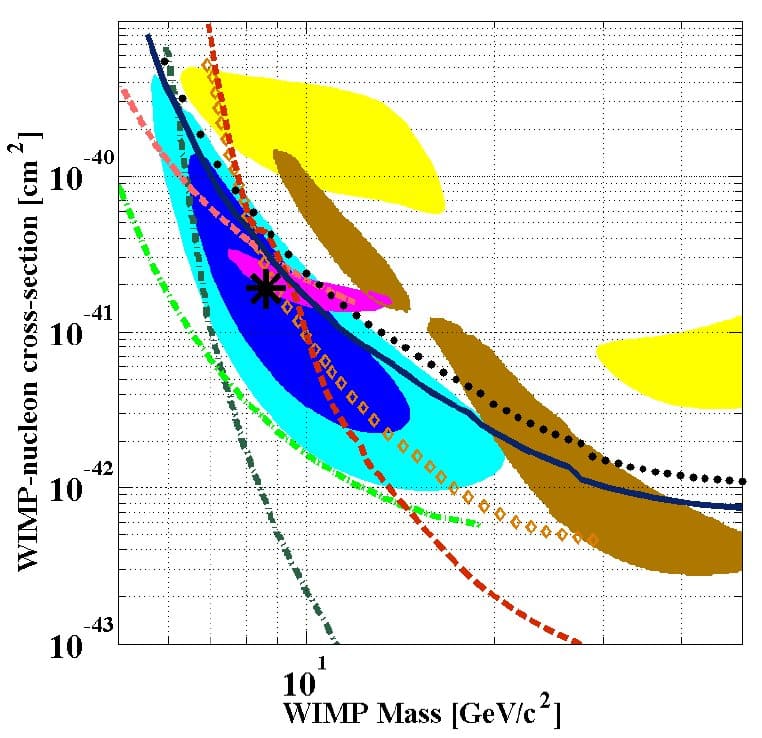
Dark matter search results. The best fit to the CDMS result is the located at the black asterisk. The Xenon exclusion region is to the left of the green dashed lines. (Courtesy: CDMS)

By Hamish Johnston

Physicists working on the Cryogenic Dark Matter Search (CDMS) may have spotted three dark-matter particles in data from a detector deep beneath the North Woods of Minnesota. The measurement has a statistical significance of about 3σ – which is a long way from the gold standard of 5σ that usually heralds the discovery of a new particle. That said, this result is the best evidence yet that dark matter could be detected directly as it passes through the Earth.

(more…)

Alice and Bob communicate without transferring a single photon

Researchers in Saudi Arabia and the US say that two people equipped with suitable optical devices should in principle be able to exchange information without transferring even a single photon.

The work is based on an idea put forward by Israeli physicists Avshalom Elitzur and Lev Vaidman in 1993 known as interaction-free measurements. This involves using light to detect the presence of an object without actually bouncing any photons off it. Elitzur and Vaidman argued that the wave–particle duality of light dictates that an object obstructing one of two paths inside an interferometer can destroy the interference pattern in that device, even though no photons actually come into contact with it – a hypothesis subsequently confirmed experimentally. Another team of researchers used the principle last year to create a quantum-mechanically encoded key for the encryption and decryption of secret messages.

In the latest work, a team of scientists from the King Abdulaziz City for Science and Technology (KACST) and Texas A&M University (TAMU) aimed to find out whether it was possible to use interaction-free measurements to communicate actual messages rather than simply keys. To do this they used the “quantum Zeno effect”, a phenomenon in which “a watched kettle never boils”. In other words, repeated measurements on a quantum system prevent that system from evolving because of a very high probability that when measured it collapses back into its initial state.

Diamond patterns

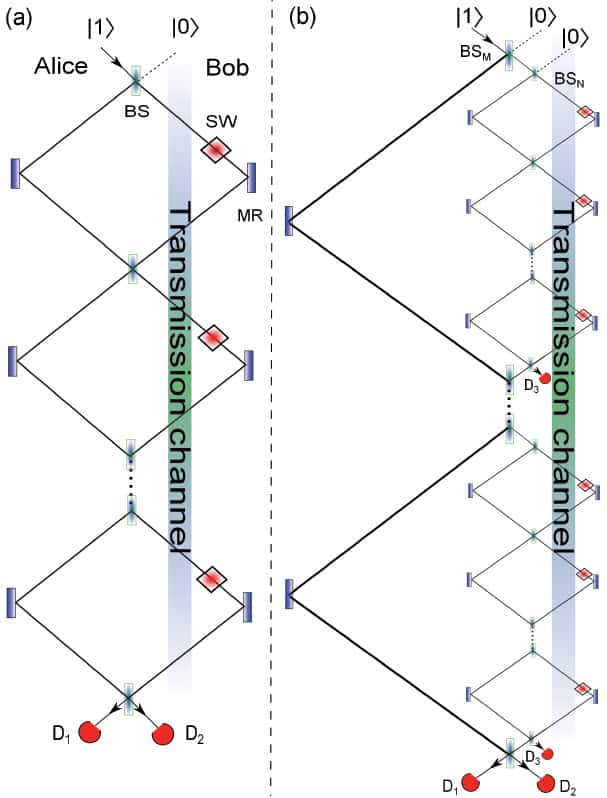
At the heart of the system designed by the KACST–TAMU team is a series of highly reflective beam splitters. The idea is that Alice directs a photon at the first beam splitter and Bob has a detector placed behind that device that he can switch on if he wishes to try and detect the photon. With the detector switched off the photon exists in a superposition of both reflecting off and travelling through the beam splitter, which allows it to interfere with itself after bouncing off two suitably positioned mirrors. But with the detector switched on, the photon’s wavefunction is forced to collapse and it follows just one of the two paths.

Illustration showing the diamond loop set-up

The second beam splitter is placed at the point where the two paths meet and Bob has a second detector behind that device. With a further two mirrors placed in exactly the same positions relative to the beam splitter and detector and the configuration then repeated, the result is a series of diamond-shaped loops.

Using this set-up Bob is able to tell Alice he has all of his detectors switched on without any photons passing between himself and Alice. With all of the detectors on, the Zeno effect comes into play and the photon’s wavefunction is continually collapsed to the same high-probability state – the reflected one – causing the photon to register a click in one of two output detectors on Alice’s side. Instead, when all of the detectors are off, the repeated self-interference of the wavefunction causes it to evolve and the final state instead triggers the second of Alice’s two detectors.

There is a snag, however. If Bob switches on just one of his more distant detectors, the photon’s wavefunction will have evolved to the point where it is now more likely than not to be found on Bob’s side of the apparatus. In other words, the chances are that he will detect it, defeating the object. To overcome this problem, the researchers inserted a secondary series of loops – each complete with beam splitter, detector and two mirrors – inside every one of the larger loops, leading to what is known as the “chained quantum Zeno effect”. The idea is that these secondary loops reset the wavefunction at the end of each large loop, such that there is never a significant probability of finding the photon in any of Bob’s detectors.

Infinite loops

If physical particles did not carry information between sender and receiver then what did?
Hatim Salih, King Abdulaziz City for Science and Technology

According to the researchers, an infinite number of both primary and secondary loops would guarantee that the photon always triggers the correct detector on Alice’s side and never finishes up in one of Bob’s detectors – so ensuring particle-free communication. Alternatively, they calculate that some 50 primary loops and more than 1000 secondary loops would be needed to trigger the correct detectors 95% of the time. Setting out such a vast number of optical devices with the precision needed to generate a high success rate is in practice impossible, the researchers say, but they were able to design a far more elegant alternative consisting of just one primary and one secondary loop that exploits the superposition of polarizations and which recreates the effect of multiple loops through very precise timing offsets. Team member Suhail Zubairy of Texas A&M University says that the efficiencies and stability of current laboratory technology should yield a success rate of some 70–80%.

Another of the team, Hatim Salih of KACST, says that the group’s approach could be used to carry out secure communications thanks to the absence of a physical signal. But given the method’s significant complexity, it might not appeal to commercial developers. Salih also points out that the team’s paper makes no claim as to how the information travels. “If physical particles did not carry information between sender and receiver then what did?” he adds.

Nicolas Gisin of the University of Geneva says that the work is “quite original, quite clever” and describes the non-physical communication as “very puzzling”. He says that a key challenge will be in quantifying precisely how many photons or fractions of photons are actually transferred from Bob to Alice.

The research is to be published in Physical Review Letters.

CMS in all its glory

By Hamish Johnston at CERN

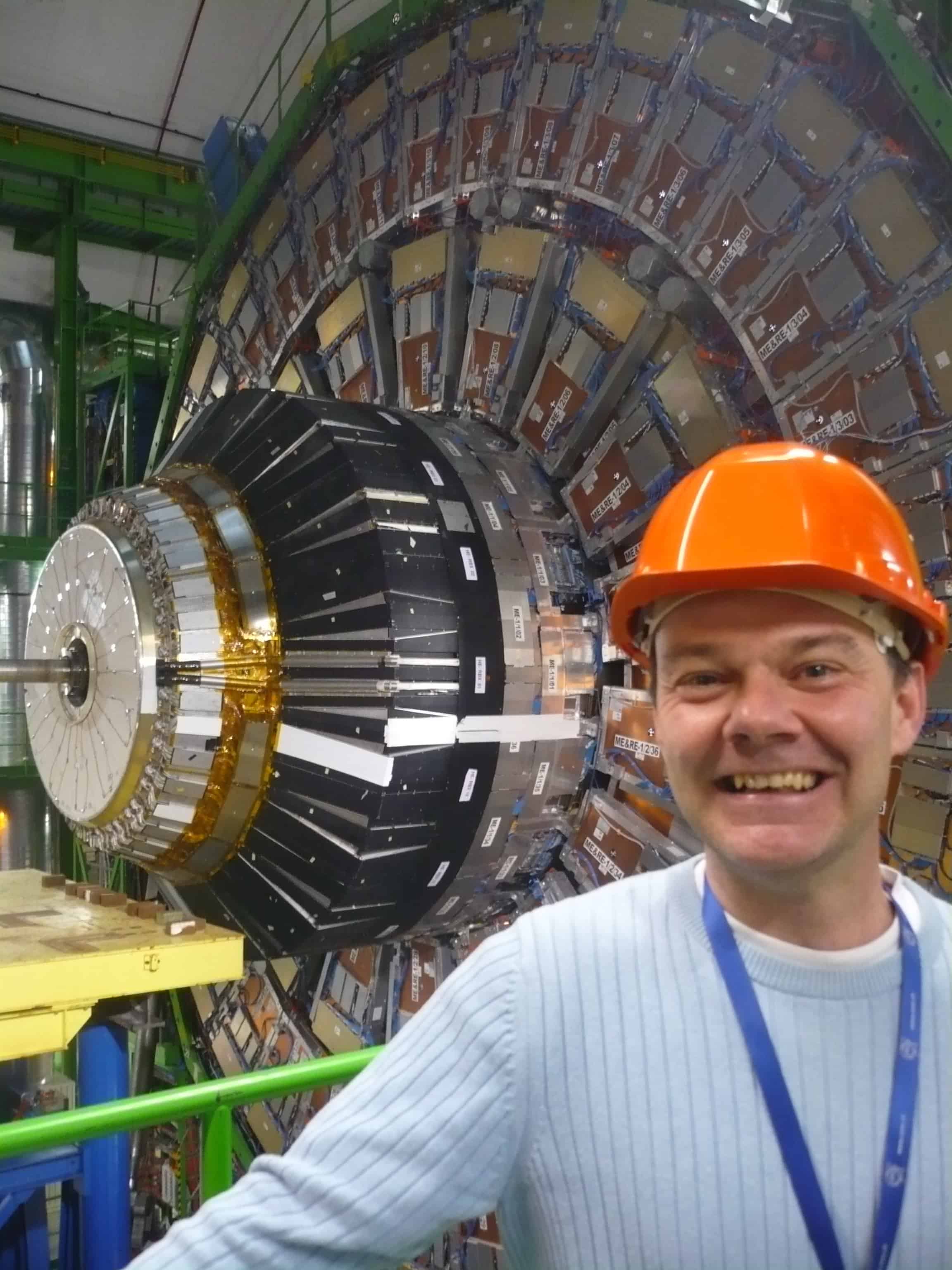
Today I had the immense good fortune of seeing the insides of the CMS detector at CERN.

The huge detector was pulled open and I could see all the various layers that are used to track the vast numbers of particles that are produced when protons collide at the Large Hadron Collider.

Unlike earlier photos of the detector that were taken when it was being built, the beamline is still intact as it passes through the CMS – a plain black conduit suspended many metres above the floor. You can see the beamline poking out from the centre of the detector in the photo on the right.

Imperial College’s Jim Virdee was our tour guide, and he told us how several military technologies from the former Soviet Union have been put to good use in the detector. These include brass shell casings that were melted down to make components for the detector.

Comparative current measurement more accurate than ever before

Researchers in the UK have produced the most accurate cryogenic current comparator – a device used for comparative measurement of current. The new instrument is more exact than previous designs and can, in principle, be operated without liquid helium.

From the picoamps of ionizing radiation delivered to cancerous tissue to the hundreds of amps traded by electricity suppliers, accurate measurement of electric current is vital to modern physics. The most accurate device to measure a direct current is a cryogenic current comparator (CCC). As the name implies, however, it can only operate at temperatures close to absolute zero, which can be problematic for laboratories without ready access to liquid helium.

Superconducting circuits

CCCs rely on superconducting materials and a quantum magnetic flux detector to measure current ratios. To measure an unknown electric current, two wires are passed through a tube of superconductor. An adjustable current is passed in the opposite direction to the current being measured, down one of the two wires. The current induced on the inside wall of the superconductor is equal and opposite to the difference between the currents. This current in turn completes a circuit with an equal and opposite current on the outside wall – a current used to induce a magnetic field measured by a superconducting quantum interference device (SQUID). When the SQUID measures zero magnetic field, there is no current in the superconductor, meaning the current in both wires is the same. Vastly different currents can be compared by adjusting the number of times that each current-carrying wire passes through the superconducting tube – so a current in amps can be compared to a current in picoamps, for example.

The cryogenic current comparator was first developed as a scientific instrument by Jonathan Williams and colleagues at the National Physical Laboratory (NPL), Teddington, UK, based on a German proposal. The first designs required a constant supply of liquid helium. This is manageable, if expensive, in physics laboratories in the developed world, but severely limits the commercial application of such devices in industry or in laboratories in developing countries.

Continuous cooling

More recently, mechanical refrigerators have been developed that cool to cryogenic temperatures using only electrical power. These are widely used in hospital MRI scanners to prevent the liquid helium boiling off. The new work has been carried out by scientists at the NPL along with colleagues at Cryogenic Ltd, a company based in London. The problem with the refrigerator, explains Cryogenic Ltd director Jeremy Good, is that the cooling is not continuous. “It’s a mechanical cooler,” he says, “It has a piston that moves up and down in a cylinder and provides refrigeration. But the end of the refrigerator goes up and down by about 0.6 K with a frequency of 1–2 Hz.” This would have a catastrophic effect on the accuracy of a measurement as SQUIDs and other components of a CCC are extremely sensitive to temperature and pressure.

Cryogenic has now developed a device to transmit the net cooling power of these mechanical refrigerators to the CCC while filtering out the oscillations and it hopes it will be possible to install a CCC that requires no input of liquid helium. “We think we can do it, but it is not proven,” says Good. Williams, who heads the electrical measurement side of the project at NPL, explains, “There isn’t a technical limit in terms of cooling power or anything like that. It’s just marrying the two components [the mechanical refrigerator and the CCC] together and making sure they’re compatible.”

The researchers point to two potential uses of a “dry” CCC in medicine and chemistry. The dose of ionizing radiation given to a cancer patient is sometimes calibrated by measuring the tiny electric current produced by the beam in an ionization chamber. At the other end of the scale, the drive towards renewable energy requires hundreds of amps of current to be transferred between countries. “They want to share power coming from Scotland, where you’ve got wind turbines, with Spain, which is solar,” says Williams, “and to shift this power around Europe they’re putting quite a lot of investment into DC links.”

Physics World and friends triumph at Big Science Pub Quiz

By Hamish Johnston

Last night a crack team of Physics World journalists plus scientists from Imperial College London cleaned up at the Big Science Pub Quiz. We won by racking up an impressive 31 points in the main competition and also triumphed in the build-it-from-tin-foil round. Team member Margaret Harris also bagged the first shout-out round by identifying the Higgs boson from cryptic clues – her reward was a plush toy Higgs boson.

(more…)

Silicon atoms seen ‘dancing’ in graphene

Researchers in the US have succeeded in directly visualizing the back-and-forth movement of silicon atoms that are clustered in graphene pores. Being able to analyse small clusters in this way could improve our understanding of how different atomic configurations determine a material’s properties. The ability to engineer clusters with specific properties could lead to new devices for electronics and optoelectronics. Also, a better understanding of how pores behave in graphene could lead to practical applications such as water desalination.

Working at the Oak Ridge National Lab (ORNL), the team achieved its feat by using graphene to trap groups of silicon clusters, each comprising six atoms. Graphene is a sheet of carbon just one atom thick that has a honeycomb lattice structure. The clusters were pinned in place by nanopores in the graphene, which allowed them to be directly imaged with a low-voltage (60 kV) aberration-corrected scanning transmission electron microscope (STEM).

Single-atom sensitivity

“The advantage of using an STEM compared with other microscopy techniques is that we can obtain crystallographic information about the sample – that is, atomic positions,” explains Oak Ridge’s Juan-Carlos Idrobo. “We can also chemically identify the elements present in the sample, either via imaging quantification or by spectrum imaging using electron energy loss spectroscopy (EELS). Another good advantage of STEM experiments is that they are sensitive to single atoms, something that has allowed us to directly count how many atoms were in the silicon cluster that we studied.”

This is not the first time that scientists have been able to look at clusters of silicon in the lab; but according to team member Jaekwang Lee, previous observations were indirect. Furthermore, it had not been possible to identify the exact 3D atomic structure of the clusters.

Not kicked out

One important observation made by the ORNL researchers is that one of the silicon atoms in the cluster changed its position within the structure, moving back and forth between two specific sites. “What was observed before in STEM imaging was that the atoms just get ‘kicked out’ of the sample by the high energy of the electron beam, but we spotted a silicon atom that stayed within the cluster and ‘danced’ around,” Idrobo says.

Using first-principles calculations, the team was also able to map the energies of the silicon cluster when it interacted with the electron beam and to calculate how much energy was required for an individual silicon atom within a cluster to switch back and forth between different positions.

“Capturing atomic clusters inside graphene nanopores may lead to applications in a range of areas, including electronics and optoelectronics, and catalysis,” adds Idrobo.

Studying catalysts

Looking to the future, one simple new experiment would be to pattern the graphene with pores of specific sizes and then embed clusters with different functionalities, Idrobo says. For example, clusters known to be catalytically active could be pinned in the graphene pores so that the researchers could directly study their atomic and electronic structures using the STEM.

The team is also looking at how the interaction between the clusters and the graphene could be used to develop graphene-based technologies. “Since silicon clusters are stable when embedded in graphene pores, we have decided to turn this finding on its head and are now investigating which elements are able to stabilize these pores,” explains Idrobo. “Stable pores with specific diameters could be used as very efficient molecular filters and might even be used in the future to desalinate water.”

The findings are detailed in Nature Communications.

What is the best way to measure a researcher's contribution to science?

By James Dacey

In an opinion article just published on this website, the historian and philosopher Robert Crease discusses the pitfalls when trying to measure the “value” of artefacts in culture and society. The article was inspired by an appearance Crease made at a group debate at the Museum of Modern Art (MoMA) in New York City. The panel were trying to identify ways to measure the museum’s impact on culture and the wider economy.

Crease refers to something known as Goodhart’s law, which he explains as follows.

“Named after the British economist Charles Goodhart, who devised it in 1975, the law essentially says that once a measure is chosen for making policy decisions, it begins to lose value as a measure. Goodhart applied it to banking policy, but in other fields, too, measurement can distort not only the practice being measured, but also perception of the goal.”

(more…)

Work on whispers gives physicists something to shout about

Biophysicists have long been amazed by the ear’s extraordinary ability to pick up extremely soft sounds. Although it is known that the thousands of hair cells in the inner ear convert mechanical vibrations produced by incoming sound waves into electric signals that the brain can then process, exactly how the ear achieves its exquisite detection sensitivity remains a mystery. Now, experiments done by physicists in the US suggest that spontaneous vibrations that are known to occur in these hair cells could synchronize with weak incoming sound signals, thereby allowing their detection. The researchers also suggest that the vibrations respond to incoming sound via changes in their phase, and this too could contribute to the sensitivity.

Low-threshold dynamics

The inner ear of humans and other vertebrates contain thousands of “hair cells”, each of which contains bundles of 30 to 50 stereocilia. These stereocilia are hair-like projections that jut from the top surface of the cells and are immersed in a fluid substance. However, the precise nature of how this system works is not really understood, according to Yuttana Roongthumskul of the University of California, Los Angeles (UCLA). Roongthumskul and colleagues are trying to figure out how the bundles respond to a signal with a very low threshold.

To do this, the researchers are studying samples of the hair bundles from a bullfrog in vitro. Roongthumskul explains that frog bundles are used because they are much more robust than samples from mammals. “To test this in a mammal is quite hard as the sample is quite hard to dissect…the hair cells are such that the hair bundles and the cell body need to be stored in different solutions in a two-compartment chamber, which is a difficult set-up to maintain,” he explains. Unlike mammals, frogs do not possess a cochlea – the bundles themselves perform the cochlear function – but the hearing systems are comparable and equally sensitive.

Spontaneously oscillating

When the team looked at the bundles in vitro, they confirmed previous observations that the bundles oscillate spontaneously – something that is also expected to occur in the ears of live frogs. “These spontaneous oscillations have never been observed in vivo, but we know there is something active in the inner ear that generates a sound,” says Roongthumskul, who is a graduate student in the Bozovic Lab at UCLA. He explains that the spontaneously oscillating bundles might synchronize with a weak incoming signal to create a kind of active amplification that allows the sound to be picked up.

The team also studied the varying phase dynamics of the bundle’s response to the sound. This involved stimulating a bundle while recording the phase of its spontaneous oscillations. The researchers used a high-speed camera to measure the degree of synchronization between the oscillations and an input sound signal. “We saw that when the stimulation was very strong, the oscillations and our signal showed a constant phase difference: they were always ‘phase-locked’. But for a weaker signal, we saw ‘phase slips’: intermittently there is synchronization, then it is lost for a while, and then it is synchronized again,” explains Roongthumskul.

These observations suggest that the phase dynamics follow predictions based on a different set of equations than previously thought. The new equations predict that once a stimulus is applied, the response is very quick and sensitive. This advantage could point to the mechanism that allows for the detection of extremely soft sounds.

Although Roongthumskul cautions that the spontaneous oscillations have not been seen in living ears – it is very hard to image the bundles while they are within the ear – he says that the new results should give a better understanding of the dynamics of hearing. He also admits that much more work is needed. “What we don’t understand is how we can hear 0 dB sounds, especially as some of these sounds cause vibrations that are less than the thermal fluctuations or the background noise in the ear itself,” he says.

The results are published in Physical Review Letters.

Networked environments of the future

Researchers at Massachusetts Institute of Technology (MIT) are developing a revolutionary new computer interface that they refer to as a “responsive environment”. The group at MIT’s Media Lab has built a system called DoppelLab that is designed to create visualize and sonic environments based on data collected from networked sensors. In this video, the group’s leader Joe Paradiso introduces the project and lays out his vision of a future world where people and their environments are truly connected.

Measuring culture

Last February I was a panellist at a discussion on “Culture and metrics” at the Museum of Modern Art (MoMA) in New York City. The event was organized by Paola Antonelli, the museum’s senior curator of architecture and design and director of its new R&D department, which she founded last July. One of her goals is to identify ways to measure the museum’s impact on culture and the wider economy.

Antonelli, who originally studied economics before completing a Master’s in architecture, told me her idea for the department germinated after the 2008 financial crisis. “I had a chip on my shoulder,” she said. The crisis, in Antonelli’s view, revealed that traditional economic strategies were promoting investments that had a chaotic and even negative impact. Cultural institutions, on the other hand, offered “a slower but more dependable and effective key to long-term growth”. She felt sure that “more faith, attention and money would soon flow into cultural institutions”.

It didn’t happen. Disappointed, Antonelli sought to demonstrate to politicians and other prospective sponsors that cultural institutions exert a genuine and positive impact on growth. To do so, she recalled Lord Kelvin’s dictum: “When you can measure what you are speaking about, and express it in numbers, you know something about it; but when you cannot express it in numbers, your knowledge is of a meagre and unsatisfactory kind; it may be the beginning of knowledge, but you have scarcely, in your thoughts, advanced to the stage of science, whatever the matter may be.”

Measuring muddles

The traditional quantitative measures of museum productivity – foot traffic, membership size, number of exhibitions and so on – do not quite capture the spectrum of a museum’s influence. Antonelli therefore organized February’s panel to explore ways of demonstrating a more complete and long-term impact. About 200 people attended the event, which raised probing issues about measurement. One panellist was Kate Levin, the commissioner of New York City’s Department of Cultural Affairs, who presented statistics that impressively confirmed the importance of culture to city life. Her department estimated, for example, that The Gates – an environmental artwork erected by Christo and Jeanne-Claude in New York’s Central Park in 2005 – had attracted four million visitors and resulted in an estimated $254m economic boon for the city. She cited last year’s World Cities Culture Report, which concluded: “What links world cities to one another is trade, commerce and finance. What makes them different from one another is culture.”

Andrew Ross, a social and cultural analyst at New York University, mentioned factors that cause economists using traditional methods to underestimate the value of the arts. One is “cost disease” – the fact that productivity does not behave in the arts as it typically does in manufacturing. It takes, for example, the same number of people to perform a quartet today as in Beethoven’s time, though musicians’ real wages have increased. Another factor is “psychic income” – the willingness of artists to accept low wages in return for intangible benefits such as exposure.

I cited a distinction (originally presented in my 2011 book World in the Balance) between measurement against standards – what the SI is about – and measurement against ideals. The first is procedural and conventional, while the second is experiential and involves goals such as justice and education. The irony, I said, is that just when civilization is on the verge of perfecting measurement against standards with the “New SI” (which replaces artefact standards, such as the kilogram in Paris, with natural constants), measurement against ideals is more controversial than ever. We often pretend we can turn measurements against ideals into measurements against standards – by representing justice as a blindfolded woman holding scales, for instance. But this is metaphorical wish fulfilment: what could go in that pan? Small wonder that when we try to measure goals quantitatively it can give rise to front-page fights.

One obstacle to measuring against ideals is Goodhart’s law, a kind of Heisenberg uncertainty principle for culture. Named after the British economist Charles Goodhart, who devised it in 1975, the law essentially says that once a measure is chosen for making policy decisions, it begins to lose value as a measure. Goodhart applied it to banking policy, but in other fields, too, measurement can distort not only the practice being measured, but also perception of the goal. As soon as you measure intelligence, say, with standardized tests, schools begin to teach to the test – and you begin to view intelligence as a child’s ability to be taught to the test. If you measure researchers’ quality by the number of papers they produce, they start churning out unnecessary numbers of low-quality papers.

The critical point

Goodhart’s law tempts us to regard quantifying cultural impact as hopeless. We may recall with nostalgia the physicist Robert R Wilson’s famous testimony before Congress in 1969, when he was challenged to justify Fermilab’s new accelerator if it had no practical value even for defending the country. Wilson refused to manufacture a fake utilitarian reason and defended the device on cultural grounds. “[It] has nothing to do directly with defending our country,” he said, “except to help make it worth defending.”

But in today’s world, MoMA’s panellists agreed, Kelvin’s dictum prevails. Politicians, policy-makers and sponsors are measurement-driven, even with cultural matters. We therefore have to be more ingenious in devising metrics for cultural institutions. But to circumvent Goodhart’s law, we also have to recall that measurement involves not only an “it” – something measured – but also a “who” – the measurer. In measuring against an ideal, the measurer must not be anonymous; we have to be clear who is measuring and why.

As Antonelli put it: “The problem of measuring cultural impact cannot be resolved by numbers alone.”


Copyright © 2026 by IOP Publishing Ltd and individual contributors