It may have become a household name in recent years, but for many the Large Hadron Collider is still a mysterious behemoth lurking somewhere beneath Switzerland. Or is it France?
A new exhibition will seek to bring the technology and the sense of scientific discovery of the LHC to those who have not made the trip to the facility itself. Collider: step inside the world’s greatest experiment will open on 13 November at the Science Museum in London, and run for six months.
The third and final loophole in an important test of the quantum nature of the photon has been closed by an international team of physicists. The researchers have shut what is called the “fair sampling” loophole, which says that classical – rather than quantum – effects could be responsible for measured correlations between entangled pairs of photons. The photon is now the first system in which the violation of “Bell’s inequality” has been unambiguously established. While few physicists will be surprised that all three loopholes have now been closed, doing so could be an important step towards developing failsafe quantum cryptography.
The loophole-closure experiment has been carried out by Anton Zeilinger, Marissa Giustina and colleagues at the University of Vienna, the Austrian Academy of Sciences, the Max Planck Institute of Quantum Optics and the German and US national standards labs (PTB and NIST). It involved two observers, dubbed Alice and Bob, and a source that created pairs of photons that are entangled in terms of their polarization – a quantum-mechanical concept that results in a correlation between the polarizations that is much stronger than allowed by classical physics.
What this means is that if Alice measures the polarization of a succession of photons, she obtains a random result. But while Bob’s measurements also appear random, his results are correlated when compared on a photon-by-photon basis. In other words, when Alice’s photon is vertically polarized, for example, Bob’s is much more likely to have the same polarization.
In 1964 the Northern Irish physicist John Bell famously calculated an upper limit on how strong these correlations could be if they were caused by classical physics alone – what has become known as Bell’s inequality. Correlations stronger than this limit, he reasoned, could only occur if the photons were entangled as defined by quantum mechanics. But while many experiments have confirmed that Bell’s inequality is indeed violated, these experiments – which use photon, ions and other entangled particles – are plagued by loopholes. A sceptic could therefore argue that the violation occurs because of some unforeseen effect of classical physics, rather than being a quantum effect.
Shut that loophole
There are three main loopholes. The first is the “locality loophole”, whereby information about the measurements can somehow be exchanged between Alice and Bob’s detectors. The second is the “freedom-of-choice” loophole, whereby the source of the entangled particles can somehow communicate classically with the detectors and affect how the measurements are made.
Both loopholes were closed simultaneously for photons in an experiment done in 2010 by a team led by Zeilinger after the researchers transmitted the photons distances of up to 144 km between two of the Canary Islands. That work meant that any clandestine communications between detectors and the source were impossible because it would have to happen at speeds faster than that of light.
As for the third major challenge to Bell’s violation – the so-called “fair-sampling” loophole – it argues that a classical explanation is possible if the experiment detects only some of the photon pairs, rather than measuring every one of them. If this process somehow favoured correlated pairs over uncorrelated pairs, an apparent violation would be measured. This loophole was closed over a decade ago for entangled pairs of ions, but it is extremely difficult to detect each and every photon in an experiment.
Fortunately, about 20 years ago Philippe Eberhard of the Lawrence Berkeley Laboratory in the US created a new type of inequality that takes undetected events into account. This interpretation requires that only 67% of all entangled photons be measured. But even to achieve this lower threshold, the team had to make significant improvements to the equipment used to create and detect entangled photons. The pairs were made using “spontaneous parametric down-conversion”, whereby a higher energy photon is fired into a special crystal to produce a pair of lower-energy polarization-entangled photons.
These pairs are separated using an optical system and directed at two separate photon detectors that play the role of Alice and Bob. To ensure that the detection efficiency is very high the team used superconducting transition-edge sensors (TESs) to detect the light. When a photon is absorbed by a TES the extra energy heats the superconductor so that it reverts to its normal state. This is characterized by a large increase in its electrical resistance, which can be detected.
The final catch
The team carried out a series of experiments each lasting about five minutes and involving about 24 million entangled pairs, which were captured with a detection rate of 75%. The data revealed a staggering 69σ violation of Eberhard’s inequality – effectively shutting the door on the fair-sampling loophole.
There is one catch, however. To ensure that more than 67% of the pairs were detected, the experiment was done in the lab with Alice, Bob and the source near to each other. As a result, this particular experiment did not simultaneously rule out the other two loopholes. According to Giustina, closing all three in a Canary Islands experiment would be extremely difficult.
While this latest experiment is unlikely to change how most physicists think of quantum mechanics – most have no doubts regarding entanglement and other quantum effects – the ability to create systems in which all three loopholes can be closed could have important implications for the development of quantum cryptography. This is because cryptography relies on entanglement and therefore a loophole in a system could be exploited by quantum hackers.
Heat normally flows from hot to cold, but now physicists in Japan and Germany have shown that spin waves can reverse the flow. The team fired microwaves at one end of a crystal, which instead of heating up, stayed cool. Meanwhile, some distance away at the other end of the crystal, the temperature rose – with heat being transported from the cool end to the hot end by spin waves. The team believes that the results could lead to the development of new devices that use heat and spin to store and process information.
Spin caloritronics is an emerging branch of spintronics dealing with the interaction between heat, charge and spin. Interest has been stimulated by recent discoveries. In 2008, for example, researchers led by Kenichi Uchida, then at Keio University in Japan, reported that placing a metallic magnet in a temperature gradient could produce a pure “spin current” – a flow of electron spins without bulk movement of electrons.
Spin-wave conveyer
In this latest work researchers in the same group – now based at the Institute for Materials Research at Tohuku University – have demonstrated the converse effect in a crystal of yttrium-iron garnet. The material was placed in a magnetic field and a spin current was made to flow across it. Microwaves were fired at the bottom of the sample. These would normally excite thermal oscillations, which would increase the temperature on the bottom of the crystal. However, when the microwaves are within a specific range of frequencies, most of the energy is converted into oscillations of the aligned spins of the surface layer called Damon–Eshbach waves. The team found that these spin waves are capable of carrying much of the absorbed energy from one end of the crystal to the other.
However, these waves occur on both the top and bottom of the crystal, and the waves on the top travel in the opposite direction. As a result, energy that travels out along the bottom surface of the crystal would normally be brought straight back along the top – preventing heat from moving in just one direction. To stop this from happening, the researchers had to ensure that the spin waves “dumped” most of their energy at the other end as heat – and returned to the microwave-heated region with very little energy. This is much like a baggage conveyor with the handlers at one end and the freshly disembarked passengers at the other – a few unclaimed bags come back to the handlers, but the net flow of baggage is in one direction.
The thick of it
The researchers made such a conveyer by using a relatively thick crystal. In such samples the spin waves struggle to move through the bulk to get from the bottom to the top of the crystal. Most of the spin-wave energy is lost to the crystal lattice as phonons, making the opposite end hotter than the end bombarded by microwaves. Yttrium-iron garnet is a poor thermal conductor, so phonons diffuse only slowly away from where they are created, which further enhances the effect.
“In our results,” says lead author Toshu An, “we take the place of heat generation far from the actual heat source. We think that could be used to push away the heat generation and keep a device cool.”
Electrical and computer engineer Daniel Stancil at North Carolina State University says most experiments with spin waves (such as those in information theory) are done with thin films to prevent losses to lattice phonons. “Ostensibly every experiment to absorb end reflections will have some element of heating up the end, but I don’t think anyone’s thought to look at it that way,” he says. “This is, I think, a novel mechanism for moving energy from one point to another and then heating up the far end.” He is sceptical about short-term applications, however. “If I had a transistor or some circuit that was generating a lot of heat,” he says, “it’s not at all clear to me how you would put something else on there that would take that heat, turn it into spin waves and propagate it away.”
Transistors made from single-atom layers of semiconductor emit light when stimulated by an electrical current, according to new work by researchers in the UK, US and Germany. The discovery that 2D layers of molybdenite (MoS2) produce light suggests that it should be possible to build light sources and other photonic elements from layered 2D semiconductors such as molybdenite for use in future optoelectronics applications.
Molybdenite comprises 2D atomic layers that easily slip past each other, which is why the material is commonly used as a lubricant. As such it resembles graphite, which is made of 2D layers of carbon called graphene. Like graphene, molybdenite is a semiconductor with properties that could have significant technological relevance. However, unlike graphene (which has no band gap) and silicon, molybdenite is a direct band-gap semiconductor, which means that it should be very efficient at converting electrical energy into light and vice versa. As a result, the material could be used in devices such as LEDs, solar cells and photodetectors.
More useful properties
The fact that molybdenite has a band gap means that it could be better suited for making transistors than graphene – and the material also appears to have a high charge mobility that could be on par with state-of-the-art silicon. It should be compatible with a variety of substrates – even transparent or plastic ones. Finally, single-layer molybdenite is only about 0.65 nm thick, which means that very thin transistors could be made from it. However, the first molybdenite transistor was made in 2011 and researchers are just beginning to explore the properties of this semiconductor.
Now, a team of researchers led by Phaedon Avouris and Mathias Steiner of IBM’s Thomas J Watson Research Center in Yorktown Heights, New York, has shown that 2D molybdenite emits light when excited with an electrical current. Such band-gap-related light emission in 2D semiconductors is one of the most important and intensely researched topics in nanoscale science and technology, says Steiner, and the result confirms that it is possible to build light sources and other photonic elements from 2D semiconductors such as molybdenite.
Visible light emission
The team, which includes scientists Andrea Ferrari from the University of Cambridge in the UK and Ralph Krupke at the Karlsruhe Institute of Technology in Germany, obtained its results by passing an electrical current through a transistor containing single-layer molybdenite as the channel material. “By then using an optical microscope, we were able to detect light emission in the visible spectral range through the transparent substrate underneath the transistor,” says Steiner.
There is still much work to do, however, before real-world molybdenite optoelectronics become truly competitive with silicon, he adds. This is because the efficiency of the light emitted from the material is still relatively low. “Future research needs to address device design and explore novel gating techniques to improve light-emission yields and better control charge-carrier injection and extraction,” team member Ravi Shankar Sundaram says. “This might be done by using highly efficient gates to create electrostatic p–n junctions in the molybdenite channel, or by strongly doping the material with polymer electrolytes, for example.”
Are you suffering from particle-collider withdrawal symptoms now that the LHC has begun its long shutdown? If so, you will be pleased to learn that you can focus your attention elsewhere.
The International Linear Collider Collaboration has posted an updated version of its 2013 Technical Design Report on the arXiv preprint server. It’s a short and sweet overview of the collider’s design, including “detailed descriptions of the accelerator baseline design for a 500 GeV e+e llinear collider, the R&D program that has demonstrated its feasibility, the physics goals and expected sensitivities, and the description of the ILD and SiD detectors and their capabilities”.
Researchers in the US have analysed ash interactions from volcano plumes in a variety of conditions and identified two aggregation regimes – dry and wet – in which particle adhesion is controlled by electrostatic and hydrodynamic forces, respectively. This research – part of a larger investigation into the prediction of eruptive ash dispersal – may act to refine current models of volcanic-plume behaviour. The ability to model the behaviour of the eruptive columns created by explosive volcanoes is much sought after to better understand and predict ash-based hazards.
Volcanic plumes – the kilometres-high columns of hot, upthrust ash created in volcanic eruptions – are among the most dangerous by-products of volcanism, and can have wide-reaching hazardous effects. Columns can collapse under their own weight, forming pyroclastic flows – devastating surges of gas and rock that can reach speeds in excess of 700 km per hour – which can burn and flatten objects in their path. In addition, the ash clouds themselves can pose a serious threat to aircraft, even at hundreds of kilometres away from the eruption site – with ash able to clog up engines and scratch cockpit windows until they become opaque.
Obscure models
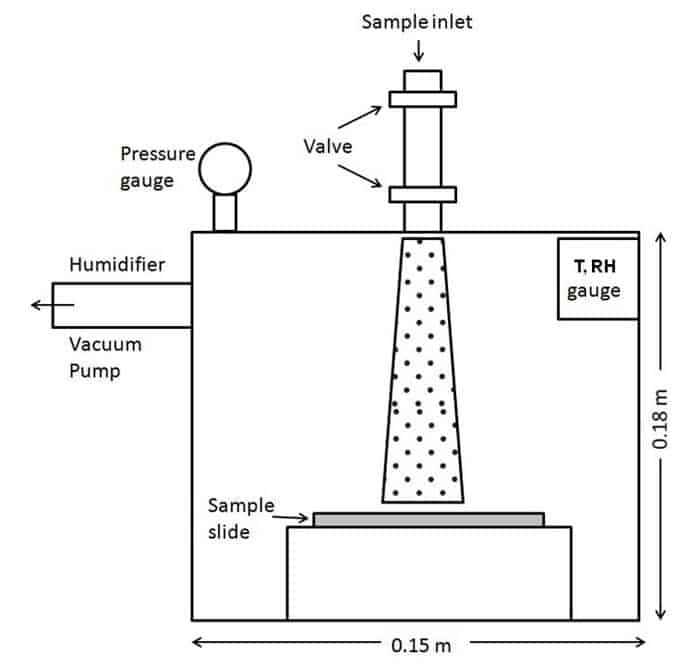
Despite being well documented in present day events and past volcanic deposits, the processes of ash aggregation are a major source of uncertainty in current models of eruptive-column behaviour. To model ash behaviour in conditions similar to those found in volcanic plumes, the researchers, based at Georgia Institute of Technology, assembled a controlled atmospheric chamber with dimensions of 15 × 18 × 15 cm. Ash particles were released at the top of the chamber and allowed to collide with a fixed sample – a single layer of ash glued to a glass slide – beneath. These collisions were then observed by means of a high-speed camera.
Collision velocities and kinetic energies of the falling particles before and after impact were estimated, along with the ratio of collisions that resulted in the ash particles adhering to each other. Using two samples of real volcanic ash with different compositions – and one silica-based ash proxy – researchers tested the effect that atmospheric pressures, residence times (how long the ash particles remain in the atmosphere) and humidity had on the ash aggregation.
Experimental set-up: The atmospheric chamber used by the researchers. (Courtesy: Telling et al.)
“This study examines the aggregation potential of volcanic ash, or how likely it is for two colliding ash particles to stick together,” explains paper author Jennifer Telling, a geophysicist at Georgia Institute of Technology. “Using the data collected in laboratory experiments, we derive a series of equations to describe the aggregation potential of wet and dry ash particles,” she says. The team observed that while the kinetic energy of the colliding ash particles was the major factor in determining whether or not the particles remained stuck together on impact, humidity also played a significant role. Higher relative humidity (greater than 71%) and long residence times allow the target ash particles to adsorb a larger surrounding film of water from the atmosphere, which acts to hydrodynamically slow down the particles as they impact, thus increasing the likelihood that they stick together. In drier atmospheric regimes, electrostatic forces were seen to be the main force acting to retard the colliding ash particles.
“[This research] is an important contribution to our knowledge of the process of ash aggregation,” says Michael Sheridan, a volcanologist at the University at Buffalo, who was not involved in the study. He comments that total grain-size distribution is a vital parameter in estimating the dispersal of volcanic ash, but that many previous models assume particle sizes remain fixed during transport and deposition. “It is well known that many processes can affect the surface properties of particles between the time of eruption and their arrival at the Earth’s surface,” he adds. “The aggradation model presented here must be seriously considered in future models of dispersion of volcanic ash in an eruptive plume.”
Real-life events
To test the robustness of their modelling, the researchers plan to run a large-scale volcanic simulation. By emulating a specific, real-life eruption event, the output of their numerical models can be compared with the corresponding volcanic deposits in the field to see whether incorporating these new aggregation relationships can improve our predictions.
Explaining that this study represents an important step in the development of plume-dispersal models, Mark Woodhouse of the University of Bristol, who was not involved in this research, told physicsworld.com that “a comparison of predictions of ash-transport models utilizing the products of this research with observations of deposits and ash clouds from volcanic eruptions will be a stringent test of the work”.
Given the dangers and large-scale impacts of eruption columns, the ability to accurately predict the movement and duration of such volcanic-ash plumes could be of great benefit for both hazard mitigation and also to the airline industry. “The models used to predict ash-dispersal patterns are extremely complex,” explains Telling. “We hope that by examining the conditions under which ash can aggregate and its actual potential to stick together, our research can improve the predictive capability of large-scale volcanic simulations,” she says.
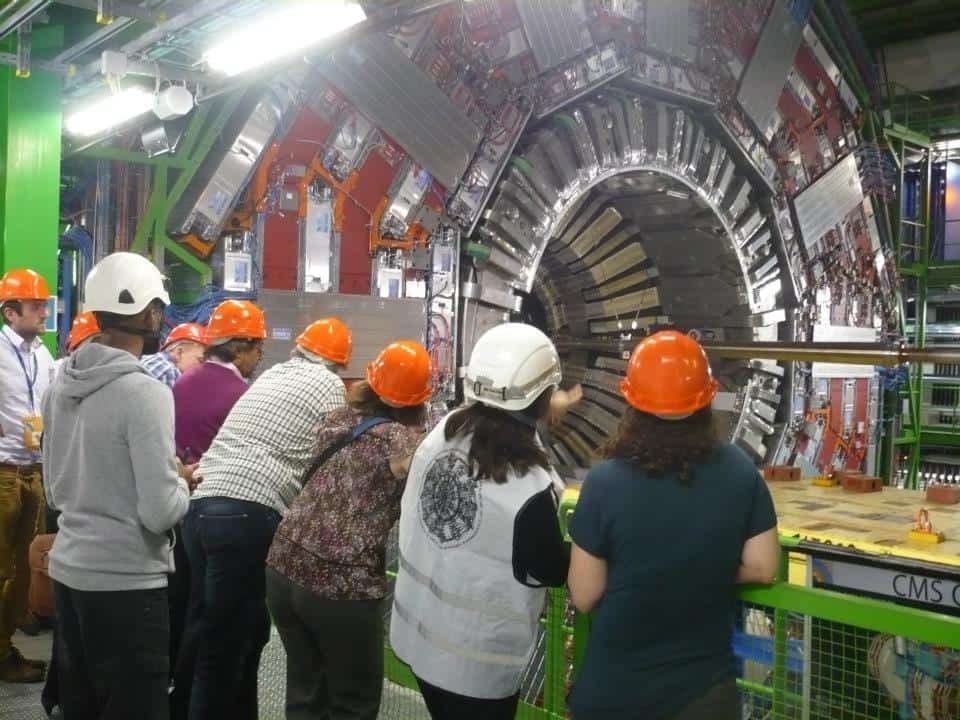
My colleague, Hamish Johnston, has just returned from a trip to CERN, where he was granted access to the insides of the Large Hadron Colider (LHC), which is currently being upgraded. He has shared some great photos from his trip on the Physics World Facebook page, including some snaps of the interior of the detector experiments.
In this short film you are introduced a novel type of eye test, which requires nothing more than a small eyepiece that clips onto a smartphone. The device’s developers at Massachusetts Institute of Technology (MIT) have started trialling the gadget, and believe that it can become a standard part of the doctor’s toolbox in the developing world. The World Health Organization estimates that about 119 million people around the world remain visually impaired because of a lack of adequate medical facilities. About 90% of those people are in developing countries.
If you enjoyed this, you can watch this film about how researchers at MIT’s Media Lab are creating electronic environments where people interact with their surroundings in futuristic ways.
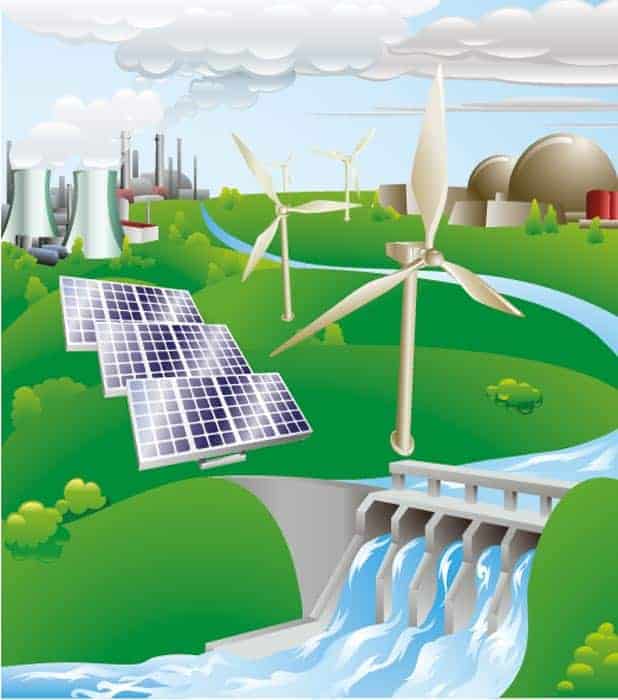
Choices, choices: Muller’s book looks at the main energy options for the future of mankind. (Courtesy: iStockphoto/Christos Georghiou)
When I was asked to review Richard Muller’s Energy for Future Presidents: the Science Behind the Headlines, I was intrigued for two reasons. First, I realized that this book – unlike many that deal with energy – covers the whole range of technologies. I have long thought that such a book would be a useful addition to the literature, and I have occasionally thought about writing one myself. So far, the sheer magnitude of the challenge has been enough to deter me.
Second, the book, which was published before the November 2012 US elections, is purported to be a message to whoever was elected president. The idea of directing such a book at a sitting president reminded me of an incident very early in my career, when, as a junior analyst in a firm doing consulting for the US Air Force, I completed my first major report. The recipient of the report was to be a general, and I was told in no uncertain terms that I had to reduce my 50 pages of findings to two pages, because the general was not going to read my whole report. Somehow, I got over the heartbreak that the rest of my words would go unread, but as I picked up this book, I had to wonder: if the general would read only a two-page executive summary, how much would the president read?
The artifice that the author was writing to an actual president wore thin after a while. My guess is that at best, the president might possibly read Muller’s short summary of the issues in the final chapter. However, for those who are likely to read the book, Muller’s presentation provides a very useful compendium of facts about each of the potential technologies in our energy future, and an overview of the key issues involved. In addition, it has some helpful “big picture” suggestions for avoiding various kinds of fads, biases and truisms.
On the whole, I found Muller’s positions on issues fair and balanced. I did disagree with some points, but those points were very specific, and the fact that two reasonable people can disagree on such points should not be surprising. It certainly doesn’t negate the overall value of the book.
Since my own background is in the nuclear field, which is often a lightning rod for debate, I looked particularly critically at what Muller had to say about nuclear power. I found myself in agreement on just about every point. While he acknowledges all the difficulties and issues associated with nuclear power, including the March 2011 Fukushima incident, he makes a strong case that the benefits outweigh the risks. He recommends the continued use of nuclear power, and the aggressive development of more nuclear power stations.
The only puzzle to me is that, after correctly stating in the body of the book that the proposed nuclear-waste repository at Yucca Mountain, Nevada, was never completed, in the summary, he writes about the desirability of reopening the repository and putting more waste into it. Since Yucca Mountain was never finished and never accepted a molecule of waste, I was troubled by the error. I cannot tell if there might be similar errors in discussions of technologies with which I am less familiar.
Still, Muller has clearly looked at the big picture, so it was interesting to read his thoughts on some of these other technologies, and to see how he views them from a global perspective. Take, for example, his thoughts on the role of developing countries in reducing emissions. He – quite rightly, in my view – points out that the world will not achieve anything if developing countries are given a free pass. Instead, we will simply end up replacing emissions from developed countries with emissions from developing countries – and perhaps even end up with more emissions.
Muller also notes that it is in the interest of developed countries to provide financial support for emissions-reduction measures in developing countries. In the current economic climate, that idea may get short shrift, but it seems to me that there are some potential win–win strategies that could reduce emissions overall, while perhaps fostering industries and jobs in the donor countries. On the other hand, Muller’s implication that emissions targets should be based only on total emissions per country is arguable. Clearly, the issue of how such comparisons should be made is complex, but giving no consideration to the size of the population or the gross national product seems unrealistic.
One observation that particularly intrigued me was that the costs and benefits of technologies sometimes differ between developed and developing countries. For example, even if the price of solar cells decreases significantly, solar power will probably remain fairly expensive in the developed world because of the high cost of labour to install the systems. On the other hand, in the developing world, labour is cheaper, so installation costs should be less and solar power could be more economical. This argument, of course, doesn’t address the need for back-up power and/or storage in either case; it simply compares the solar component.
Although I found most of Muller’s assessments of different technologies to be reasonable, in one or two cases, he did not provide sufficient logic for his positions. For example, while he gives some arguments for why we might be able to mine methane hydrates from the oceans, he dismisses the negative assessments of experts in this field without providing a clear explanation as to why the experts are sceptical. Also, although the energy policy discussion in his final chapter provides good summaries of the issues for some energy technologies, he does not address others at all. This seems strange, to say the least. If the likes of smart grid, photovoltaics, wind, batteries, biofuel, fuel cells and flywheels make Muller’s list of technologies that are either important for our future or have breakthrough potential, why does he omit them from his discussion of policy?
I also have a few nits to pick. One comes from the chapter on nuclear power, which is titled “The coming explosion of nuclear power”. I get the joke, and Muller does make a point of explaining why reactors cannot explode, but given the sensitivity of this issue, I would have preferred another title. I also would have liked to see better graphics in a book like this. The figures are mostly pretty small. Some are clearly black-and-white renditions of material that was originally in colour, and a colour version would have conveyed the desired information much more clearly and vividly. I realize from my own book that graphics are a big expense. However, a book intended for the president of the United States surely merits better!
Overall, though, the book is an interesting read. Because of the breadth of its coverage, almost every-one, whether in the energy field or not, should be able to learn something from it. Even if the president doesn’t read it, one hopes that its insights will inform the views of his energy advisers.
Scientists in the US say they have found a dramatic new electrical-discharge mechanism that could explain how thunderstorms can produce flashes of gamma radiation. Called “dark lightning”, the effect is silent, invisible to the eye and a potential threat to aeroplane passengers – at least according to the researchers’ models. This is because such lightning has the potential to produce intense terrestrial gamma-ray flashes (TGFs) and could deliver a radiation dose equal to a full-body X-ray-tomography (CT) scan to nearby air travellers.
TGFs are extremely bright pulses of gamma rays emanating from the Earth’s atmosphere. They last just a few tenths of a millisecond but are capable of temporarily blinding satellite-based instruments located hundreds of kilometres away. Scientists have known about TGFs since the early 1990s, when they were discovered by accident by instruments designed to measure gamma rays from distant astrophysical sources such as supernovae and black holes.
‘Garden-variety thunderstorms’
For a long time, no one could work out where TGFs were coming from. “It was logical to think that if we can see them from space, they must come from the top of the atmosphere,” explains physicist and lightning expert Joseph Dwyer of the Florida Institute of Technology, who led this latest work. It turns out that was wrong: “We now know that they come from deep within the atmosphere, from garden-variety thunderstorms,” he explains.
All types of thunderstorm, large or small, appear to produce TGFs, with an approximate frequency of one for every thousand bolts of conventional lightning. But until very recently, it was not at all clear how they were doing it. Now Dwyer and colleagues have come up with a physics-based model that offers an explanation and quantifies the potential threat that TGFs pose to aircraft, which routinely fly at similar altitudes.
Floating-particle accelerator
In a storm cloud, rapidly rising swells of hot air force ice and water particles to rub against one another, producing swathes of ions and establishing a huge potential difference between the top (positively charged) and middle of the cloud (negatively charged). Lightning is thought to occur when the insulating layer of air between the two charge centres suddenly breaks down. But as the storm charges up, the strong electric field also transforms the cloud into a giant floating-particle accelerator. Electrons accelerated to almost the speed of light crash into air molecules, producing yet more fast-moving electrons in an avalanche effect.
At relativistic speeds, the electrons emit Bremsstrahlung gamma rays, some of which disintegrate into an electron and a positron. The newly created electrons join the rest in surging upwards and producing gamma rays, while the positrons plunge downwards towards the negative centre of the storm cloud, glancing off air molecules as they go and initiating countless more cascades of electrons. “You create this feedback loop: the positrons make the electrons, the electrons make the positrons,” explains Dwyer. “So you get sort of an avalanche of avalanches.”
Explosive yet invisible
The explosive cascade produces around 1017 electrons in just a few tenths of a millisecond – spewing out gamma rays all the while – at which point the number of charged particles is so great that the thunderstorm’s electrical field collapses and it discharges rapidly and invisibly. The electrical currents produced by these beams of high-energy electrons are comparable to those produced by conventional lightning – tens of thousands of amps in magnitude.
The Florida Tech model shows promise because not only does it predict TGFs with the same frequency and pulse structure as those observed by satellites, it also predicts that TGFs should have large radio bursts associated with them – a phenomenon routinely measured by terrestrial lightning-measurement networks.
The team used its model to calculate the radiation dose to a person aboard a plane in a storm. It found that near the top of a storm, the dose is equal to about 10 chest X-rays – the dose we receive from natural background sources over the course of a year. But nearer the centre of the storm, the dose could be “about 10 times larger, comparable to some of the largest doses received during medical procedures and roughly equal to a full-body CT scan,” according to Dwyer.
Sizable dose of radiation
“On rare occasions…it may be possible that hundreds of people, without knowing it, may be simultaneously receiving a sizable dose of radiation from dark lightning,” says Dwyer, but stresses that the risk is not one to be overly concerned about – pilots already do their utmost to avoid and circumnavigate thunderstorms. “You’d have to be inside the thunderstorm [to be at risk], and not only inside but in the worst part of the storm at precisely the wrong time.”
“This sort of research is obviously relevant, as these are phenomena occurring just above us,” says Nikolai Østgaard, a physicist from the University of Bergen, Norway, who was not involved in the research. “But we need more observations…All measurements from space of these TGFs have been made by instruments designed for other purposes, but now there are several planned missions especially designed to detect TGFs and optical lighting.”
David Smith, of the University of California, Santa Cruz, finds the theoretical work “compelling and beautiful”. But, he cautions, “There are competing ideas for how TGFs are produced, that haven’t been ruled out, and in these models the TGF is never ‘dark’ – it requires an ordinary lighting flash to take place, and follows it closely.” Smith is soon set to team up with Dwyer and colleagues to fly the ADELE gamma-ray detector around hurricanes on the unmanned Global Hawk aircraft.
The research was described on 10 April at a meeting of the European Geosciences Union in Vienna, Austria.