Researchers in the UK, China and Germany have come up with a new and useful way to couple light to the surface of a metamaterial. The technique is the first to ensure that the coupling occurs in a single direction and could lead to integrated plasmonic circuits that could be controlled using an electric current.
The coupling involves surface plasmon polaritons (SPPs), which are particle-like quantum phenomena that arise from the interaction of light with a metal’s conduction electrons. These quasiparticles are part light and part collective electron wave and are strongly confined at the surface of a metal. SPPs are excited when they interact with light but the problem is that they are then free to propagate in many different directions along the metal surface and cannot be controlled easily. This limits the range of applications possible for these structures.
Now, a team led by Shuang Zhang of the University of Birmingham has shown that SPPs can, indeed, be excited along a single direction on a metal surface provided that the surface is suitably structured first. In this case, they used a “metasurface”, which is a metal film with nanometre-sized rectangular holes carefully orientated in a certain way. More importantly, and for the first time, the researchers have confirmed that the direction in which the SPPs travel along the metal surface can be switched by simply flipping the helicity (or circular polarization direction) of the incoming light from left to right and vice versa.
SPP-excitation symmetry breaking
The tiny holes in the metal surface locally excite the SPPs with a certain phase delay, explains Zhang, and this delay depends on the orientation of the apertures. “When the apertures were pointing in a certain direction, we found that we could create a phase gradient for circularly polarized light incident on the metal surface,” he says.
“This phase gradient breaks the symmetry of the SPPs’ excitation along two opposite directions, which meant that we could then excite the SPPs along a single direction at a specific wavelength.
“More interestingly still, we found that we could reverse the phase gradient as we flipped the circular polarization state of the input light, and thus reverse the direction in which the SPPs propagated,” he says.
Bright idea
Because the researchers can control the direction of the SPP propagation by simply varying the polarization state of the incident light, they had the bright idea of dotting the metal surface with so-called polarization modulators to construct a compact, electrically controllable plasmonic circuit. Happily, the polarization state of light can easily be controlled using well established electro-optical techniques.
The team would now like to optimize the structures it has made and improve coupling between the SPPs and incoming light. “We will also look at how we can electrically control SPP excitation by incorporating liquid-crystal devices onto our metasurface,” reveals team member Thomas Zentgraf of the University of Paderborn. “In this way, we should be able to design more complex plasmonic circuits with enhanced functionalities.”
Physicists in Germany are the first to transmit quantum information from a flying aircraft to a ground station. The sender and receiver were separated by about 20 km and the aircraft was travelling at nearly 300 km/h. The team says that its demonstration shows that it should be possible to exchange quantum information between ground stations and satellites – something that could lead to wider use of quantum cryptography.
In the last decade or so, quantum cryptography has gone from theory to a commercial reality, with systems available from several companies. The most popular quantum-cryptography technique is quantum key distribution (QKD), which allows two parties to exchange an encryption key secure in the knowledge that the key has not been read by an eavesdropper. This guarantee is possible because the key is transmitted in terms of quantum bits (qubits) of information. If intercepted and read, such qubits are changed irrevocably, thus revealing the actions of the eavesdropper.
Light is the key
Optical photons are ideal for distributing quantum keys because they can travel long distances through an optical fibre or air without significant degradation. Indeed, physicists have already managed to send quantum keys across distances of 144 km through the atmosphere between two fixed ground stations. Even greater distances have been achieved using optical fibre.
Now, Sebastian Nauerth and colleagues at Ludwig-Maximilians University in Munich and the German Aerospace Centre in Wessling have transmitted quantum information from a moving aircraft to a ground station. This was done using a Dornier 228 turboprop aircraft and an optical ground station in Wessling. Both are normally used by German aerospace researchers to investigate laser-based, air-to-ground communication.
The team modified the transmitting equipment onboard the aircraft so that it emits pulses containing just one photon each. To boost the number of signal photons that reach the ground station, the angular divergence of the transmitter was reduced from 2.6 mrad to 180 µrad. However, even with this tight aperture the pulses diverged to a diameter of 3.4 m after travelling 20 km.
Pointing in the right direction
To compensate for mechanical vibrations and other noise, the link was stabilized using fine pointing assemblies (FPAs) – which are used to stabilize conventional laser-communications systems. An FPA at one station detects light from a beacon at the other station and ensures that the transmitter (or receiver) remains pointed in the right direction – despite the motion of the aircraft.
Quantum information is encoded in the polarization state of the transmitted photons. When both transmitter and receiver are land-based, the direction of polarization is fixed. An aircraft however, can rotate relative to the receiver – causing the polarization measured by the receiver to vary. To correct for this, the team developed a motorized polarization controller.
After sunset
Quantum transmissions were performed shortly after sunset as the aircraft followed a nearly circular path about 20 km away from the ground station at Wessling. The team managed to send quantum keys from air to ground at a bit rate of about 145 bit/s. As well as showing that air-to-ground QKD can be achieved in spite of the noise introduced by turbulence and engine vibrations, the experiment also establishes that existing laser communications systems can be adapted for quantum cryptography.
“This demonstrates that quantum cryptography can be implemented as an extension to existing systems,” says Nauerth.
While engine vibrations are not a problem for satellites, the team says that other challenges overcome by the research such as tracking a fast-moving transmitter across the sky bring satellite-based QKD closer to reality.
The first science results from the Alpha Magnetic Spectrometer (AMS) present a mixed bag for both scientists and journalists. On the one hand, they show that the machinery of this high-profile $1.5bn mission is actually working. And as my colleague Michael Banks reported earlier today, the excess of positrons, confirming previous measurements, represent an important step in the hunt for dark matter. But on the other hand, this was not a moment to break out the champagne at the celebration of new physics. In reality, it was an important step in testing the precision of the instrument, as well as a reminder that we all need to be patient while we wait for more data.
Given the scale and scope of the AMS mission, it is not surprising that the scientists involved in analysing these first results are keen to share their excitement with the general public. One way they have been doing this is by talking to the media and speculating about the significance of the findings. I find it really interesting to look at how the results have been covered in the headlines of the mainstream media. The BBC ran with “Alpha Magnetic Spectrometer zeroes in on dark matter”. Over the pond, the New York Times went for “Tantalizing New Clues Into the Mysteries of Dark Matter”, adopting the classic science-writing metaphor of a detective story. Both parties presented these early results as an exciting development in a gripping plot to uncover one of the long-standing mysteries of the cosmos.
An international team of scientists has demonstrated for the first time that a special kind of wave structure – a dark soliton – can be produced in water. Like the bright soliton – which is thought to be responsible for amplifying ocean waves to “rogue wave” proportions – the dark soliton is a localized surface “wave envelope” that causes a temporary decrease in wave amplitude.
Unlike typical ocean waves, which are always evolving as they ebb and flow, solitons maintain a constant shape and size as they propagate. They typically travel slower than background waves, which get modulated as they pass through the soliton and return to their original amplitude as they re-emerge.
The terms bright and dark soliton are borrowed from optics, where they manifest as bright spots and dark shadows in optical fibres. And yet it was in water that solitons were first observed, in the 1830s. The discovery in the 1960s and 1970s of bright solitons on the surface of deep ocean waters initially stunned oceanographers, but many experiments have been done to explore and confirm the phenomenon since then, including those that pegged bright solitons as the culprit for seeding rogue waves at sea. Solitons of both the bright and dark persuasions have now been spotted in fibre optics, plasmas, Bose–Einstein condensates and elsewhere. But in all this time, a dark soliton had never been seen in water until now.
Predictions play out
Amin Chabchoub, a mathematician at Imperial College London, and colleagues applied the nonlinear Schrödinger (NLS) equation – the widely accepted model for describing evolving water waves – which has a large family of soliton solutions. There are two forms of the equation: a focusing case, which produces bright solitons and only applies in deep water, and a defocusing case, which governs waves in shallow water and leads to dark-soliton solutions. For this to be the case, kh (the wavenumber multiplied by the water depth) must be less than 1.363.
Chabchoub’s team used a 17-m-long wave tank, filled to a depth of 40 cm. With a computer-controlled paddle at one end of the tank, the researchers generated a steady sine wave with an amplitude of 4 cm and a precise initial surface elevation, according to the defocusing NLS equation. Conductive wave gauges placed at intervals along the tank monitored wave propagation.
As predicted, the researchers witnessed the background waves’ amplitudes falling to zero as they passed through the soliton, only to bounce back to their initial magnitude upon exiting the structure. Not only that, the team’s theoretical predictions about how the width of the soliton – that is, the number of background waves under its influence at any given time – ought to vary with various factors (e.g. deeper water, wider soliton) were also borne out spectacularly well in the data. “We can really say then that they’re really dark solitons, not only from their shape but also that they have these characteristics which are provided by theory,” says Chabchoub.
“New way of thinking”
“This is an exciting result,” says Roger Grimshaw of Loughborough University, who was not involved in the research. “While both versions of the NLS were known to be valid for optics, this is the first time that the same has been shown for water waves. This opens the door to a new way of thinking about nonlinear waves in shallow water, although it is likely that this is only for a limited range of kh.”
The widely accepted model for nonlinear, shallow water waves, where kh approaches zero, is the Korteweg–de Vries (KdV) equation, which has soliton solutions that differ strongly from those described by the NLS equation. “The experiments in this paper are for small, but finite kh – 1.2, 1.0. I doubt that the dark soliton will be found if kh is decreased too much below these values,” says Grimshaw.
Chabchoub says the group’s next priority is to investigate interactions between solitons. “What happens if you collide these guys?” he asks, “or if a dark and bright soliton meet?” It is a line of research that may eventually help engineers design technologies that better mediate destructive waves at the shore. “If there’s a huge wave coming, maybe we can stabilize it or act against it. We don’t know yet,” says Chabchoub. He points out that the team “needs to do numerical simulations to investigate whether these coherent structures could have an influence on tsunamis or on the propagation of high waves, which can be dangerous near shore”.
The international team running the $1.5bn Alpha Magnetic Spectrometer (AMS) has announced it has seen an excess of positrons at high energies that could point the way towards a possible detection of dark matter. Speaking at CERN yesterday, AMS principal investigator Samuel Ting presented the first results from the space-based observatory, adding that the positron excess may originate from dark matter or could be from a more benign source, such as pulsars.
The AMS sits on the International Space Station (ISS) and is designed to study high-energy particles – or cosmic rays – before they have a chance to interact with the Earth’s atmosphere. Weighing 7.5 tonnes, the AMS detector uses a 0.15 T cylindrical magnet 1 m in diameter and 1 m in height to sort incoming particles according to their momentum and charge. The direction of bend of the particle tracks through the magnet’s bore depends on whether the particles are matter or antimatter, while the gradient of the bend is determined by their speed. This allows the detector to distinguish between vast numbers of different types of cosmic-ray particles.
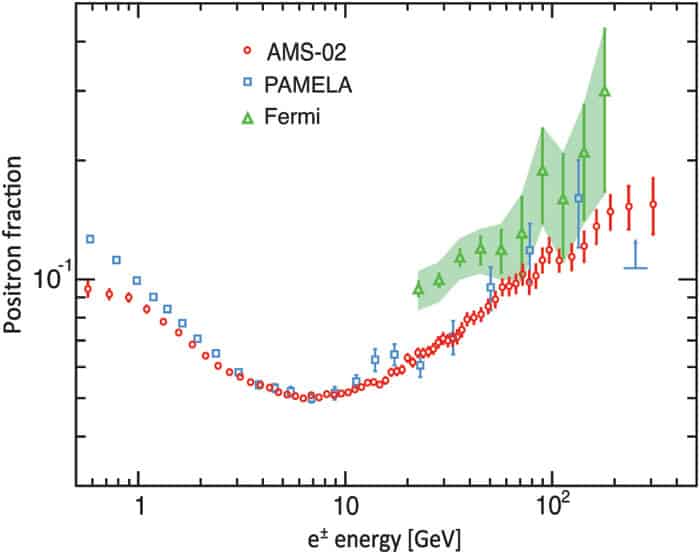
The AMS searches for an excess of charged particles such as positrons in an energy range from 500 MeV to 1 TeV. It studies the ratio of positrons to electrons – “the positron fraction” – over this entire range looking for any excess that could point to the evidence of dark-matter annihilation. This could be caused, for example, by the presence of WIMPs – leading candidates for dark matter – or other candidate particles that are colliding with each other and emitting the charged particles.
Excess events
In 2008 the Italian-led Payload for Antimatter Matter Exploration and Light-nuclei Astrophysics (PAMELA) mission gathered tentative evidence of an excess of positrons at energies of up to 100 GeV – positrons that could have been produced by the annihilation of dark-matter particles. According to standard theory, the positron fraction should fall off with increasing energy. The PAMELA results, however, were not watertight, mainly because of the possibility that the mission was confusing positrons with the far larger numbers of protons reaching its detectors.
Then in 2011 NASA’s Fermi Gamma-Ray Space Telescope supported PAMELA’s findings and confirmed a larger-than-expected rate of high-energy positrons reaching the Earth from outer space. Although Fermi is a gamma-ray telescope, the probe works by detecting electron–positron pairs and so is also well suited to studying cosmic rays.
Detecting antimatter
Presenting the results to a packed auditorium at CERN yesterday, Ting says that the AMS has so far collected around 18 months’ worth of data – around 10% of the amount it expects to collect over its 20-year lifetime. The AMS has collected 25 billion events to date, of which 6.8 million were identified as electrons and positrons. Of these 6.8 million events, around 400,000 are positrons with energies between 0.5 GeV and 350 GeV – the largest number of antimatter particles directly measured and analysed from space.
The positron fraction as measured by the AMS shows a decrease from 1 to 10 GeV but then increases from 10 to 250 GeV. Ting, who works at the Massachusetts Institute of Technology, adds that the data also indicate no sharp peaks or significant variation over time, or any preferred incoming direction. Assuming an isotropic distribution of dark-matter particles, the results are consistent with positrons originating from the annihilation of WIMPs in space.
Signs of dark matter? The positron fraction as measured by the AMS (red circles) from 1 to 350 GeV. (Courtesy: Phys. Rev. Lett.110 141102)
“The results show how precise our detector is in measuring very weak effects, like the behaviour of the positron ratio at high energy,” AMS deputy spokesperson Roberto Battiston from the University of Trento in Italy told physicsworld.com. “Collecting more statistics at higher energy will likely shed light on the origin of the source of positron excess.”
“It is quite impressive and the agreement with the earlier PAMELA results is excellent – a tribute to the hard work of the PAMELA team that had a much smaller instrument with a less intense magnetic field in a different orbit around the Earth,” says astrophysicist John Wefel from Louisiana State University.
‘Beautiful results’
However, the AMS measurements cannot yet rule out alternative explanations, such as the positrons originating from pulsars. Supersymmetry theories predict a cut-off at higher energies above the mass range of dark-matter particles, and this has not yet been observed.
“Astrophysics is very good at making positrons and the rise could be due to astrophysics we don’t yet understand, rather than dark matter annihilations,” says Michael Turner from the University of Chicago. Turner, who calls the AMS results “beautiful”, adds that the WIMP hypothesis fits the data, “but as Carl Sagan taught, extraordinary claims require extraordinary evidence and we are not there yet”.
Ting adds that over the next few years, the collaboration will further refine the measurement and attempt to clarify the behaviour of the positron fraction at energies above 250 GeV. Indeed, the positron fraction already indicates a levelling off above 250 GeV, hinting that a drop off could be in sight. “We have a feeling what is happening, but it is too early to discuss this,” says Ting.
“As to the question uppermost in everyone’s mind – do the measurements indicate dark matter? – unfortunately the answer is yes, no and maybe,” adds Wefel. “Whether [the levelling off] is physics or statistics or instrumental cannot be determined without more data. We just have to stay tuned and be patient.”
The rocky road to the ISS
Ting, who shared the 1976 Nobel Prize for Physics with Burton Richter for the discovery of the J/ψ particle, has built up a collaboration of some 600 physicists from 60 institutes in 16 countries who work on the AMS.
The AMS was first proposed by Ting in the 1990s after he failed to get support for a couple of ground-based particle experiments – a detector for the ultimately doomed Superconducting Super Collider and an upgrade of the L3 experiment at CERN near Geneva.
Ting’s idea to put a detector in space was fortuitous, given that the then administrator of NASA, Dan Goldin, was keen to give the ISS some scientific credibility. In 1995, following a positive review of the AMS by the US Department of Energy, Ting secured a space-shuttle flight from Goldin and then set about obtaining funding from mainly European governments. The AMS team concluded that the detector was simply too heavy and too power hungry to be put into orbit on its own dedicated satellite.
However, the AMS was delayed following the Columbia Space Shuttle disaster in 2003, with NASA deciding that all subsequent space-shuttle flights should be devoted to completing the ISS. In 2008 Congress then approved legislation for an additional, dedicated flight to take the AMS to the ISS. The AMS was finally lifted into orbit on board the Space Shuttle Endeavour in May 2011.
Jim Al Khalili joins the ranks of physicsfocus bloggers.
By Hamish Johnston
The Institute of Physics has just launched a new blog called physicsfocus that is described as “an online space for the physics community to read about and comment on issues that concern them”.