What is the most common problem with academic presentations?

Whether you love giving them or loathe the entire experience, everyone has to deliver a presentation at some point during an academic career – be they student or professional researcher. It might be the presentation of your results to supervisors and peers. Or it might be an outreach talk to explain your research to people who have probably never heard of you or your very interesting academic niche. There is no magic formula to giving a successful presentation, but instinctively I think we all know when it’s gone well. Likewise, I think we all know when we could have spent a bit more time whipping those slides into shape, or when we perhaps should have put a bit more thought into the appropriateness of that risqué joke.

In an interesting article that appeared in the March issue of Physics World, writer and broadcaster Sharon Ann Holgate examines how lessons from sports psychology can help academics win over their audiences when it matters. She writes about the need to “build up” to the event of giving a talk, in the same way that an athlete would prepare for a competition. Holgate writes about the need to make manageable changes to a talk, and of practicing in front of relatives and peers. She also emphasizes the importance of imagining the delivery of a successful talk. She lays out a framework called PETTLEP, developed by the sports psychologist David Smith. PETTLEP includes elements such as imagining your physical sensations as you give the talk, the environment in which you are giving the talk, the tasks required, etc. You can read the full article here.

In this week’s Facebook poll, we want you to respond to the following question:

What is the most common problem with academic presentations?

Too long
Dodgy slides
Pitched at the wrong level
Failure to engage the audience
Use of Comic Sans typeface

Please cast your vote by visiting our Facebook page. If you want to select something else as a choice, please can you post a comment on the poll to let us know what you have in mind.

In last week’s poll we asked you whether you think more leading scientists should engage in public service. The question was inspired by a new docudrama aired on UK television last week about the role Richard Feynman played in the investigation into the causes of the Challenger disaster. Depicting the events of the real investigation, Feynman’s analytical approach helps the inquiry get to the bottom of the technical and bureaucratic errors in this dark chapter in NASA’s history.

Perhaps enthused by Feynman’s  brilliance, 93% of respondents voted that “yes”, more leading should get involved with public service. While the remaining 7% believe that “no” they should not.

The poll also led to an interesting discussion on our Facebook page. For instance, one follower, Antoine de Saint-Exupéry, wrote “I admire those that have the skills and motivation to do so and they should certainly be supported. I do not, however, feel that there is necessarily a need for more leading scientists to do so.” Meanwhile, another participant, Jonathan Shimwell, was more cautious. “I really like engagement, but when it is done badly, it can have negative effects. Pressuring people to do outreach, particularly those who don’t want to be included, probably increases the likelihood of bad outreach,” he wrote.

Thanks for all your participation and we hope to hear from you again this week.
Ultrathin ‘metascreen’ forms latest invisibility cloak

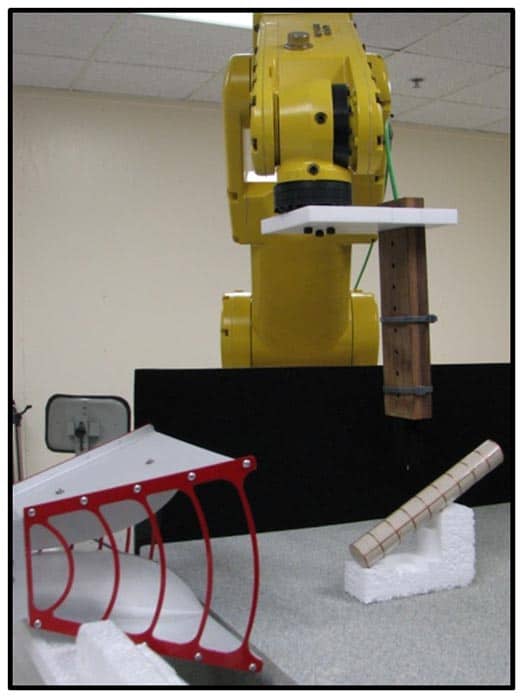
the experimental set-up

The first “mantle” invisibility cloak – in which a very thin “metascreen” cancels light scattering off an object, making it invisible – has been built by a team of researchers in the US. The cloak is just microns thick and can hide 3D objects from microwaves in their natural environment, in all directions and from all of the observers’ positions. The team claims that its device should be easier to produce than traditional cloaks that are based on the bulk properties of the metamaterial being used.

Traditional invisibility cloaks surround the object to be cloaked with a layer of bulk metamaterial, the refractive index of which is specifically tailored to guide electromagnetic waves around the outside of the cloaked object, thus making it appear to an observer that they are looking at empty space. While in theory these cloaks are amazing, they are problematic in practice. The permittivity and permeability of the metamaterials need to be highly anisotropic to allow the refractive index to vary in the required manner. To accommodate the anisotropy required, the cloak needs to be of comparable thickness to the object being cloaked. This restricts the movement of the object inside. The cloaks will often only work for a narrow range of wavelengths. Manufacturing tolerances are usually very low, so producing such cloaks is difficult. Alternative designs have been proposed to get round some of these problems, but these too have their own limitations.

Mantle cloaking

The mantle cloak, which was first proposed by electrical engineer Andrea Alù of the University of Texas at Austin in 2009, relies not on a bulk metamaterial but on an extremely thin “metascreen” that, when struck by incident electromagnetic radiation, produces an electromagnetic field in antiphase to the radiation scattered from the incident object, so making the object invisible – that is, the phase difference between the scattered fields from the cloak and the object being cloaked interfere and cancel each other out. The cloak, Alù claims, would be able to work over a broader range of wavelengths than many of the traditional cloaks using bulk metamaterials. In fact, the thinner the cloak could be made, the broader the bandwidth of radiation over which it would work.

The latest work from Alù and colleagues is an experimental realization of that original proposal. The researchers have used a 66 μm-thick flexible polycarbonate film covered with a fishnet design of 20 μm-thick copper strips to produce the required antiphase scattering to render an 18 cm cylindrical rod invisible to microwaves, provided the illuminated object is in a uniform electric and magnetic field. The cloak showed optimal functionality when the microwaves were at a frequency of 3.6 GHz and over a moderately broad bandwidth. Since the scattering of both the electric and magnetic fields is cancelled, there is no requirement for the object not to interact with one field or for the waves to be polarized in a particular direction. In principle, Alù suggests, the surface could be atomically thin.

Complex object

John Pendry of Imperial College London finds the research interesting. However, he cautions that the researchers have only cancelled the scattering of the electric and magnetic fields to the first order, and higher-order coefficients will become important in certain situations, such as when the light source is very close to the object and the illuminating wavefronts are radial rather than planar, or if the object is much larger than the wavelength of the incident light. Nevertheless, Pendry says that “Whereas a full cloak is a complex object, if you’re trying to cancel the scattering in just two dipole channels, it’s a much simpler design process, and this enables them to do the cloaking with a much thinner object than you could do otherwise.”

The researchers are now hoping to extend the cloak to try to find one that works at visible frequencies, and they also want to look at applications of the technology. “We have proposed using this technology for the next generation of optical nanodevices, for optical computing, switching, biomarkers and energy absorbers,” explains Alù. “For sensing, we suggest that we may be able to realize optimal sensors that receive signals without perturbing the measurements, by cancelling any interference between the sensor and the set-up that is being sensed.”

The research is published in New Journal of Physics.

A physics primer, with equations

The mantra for popular-science books is to minimize the use of equations. In The Theoretical Minimum: What You Need to Know to Start Doing Physics, authors Leonard Susskind and George Hrabovsky have taken the opposite approach by producing a physics book for the educated general public that emphasizes the mathematics needed to solve physics problems.

When I first heard about the premise of the book, I was intrigued. Is there a group of people who want to solve physics and mathematics problems, and not simply read about the gee-whiz physics that is the standard fare of most popular-science books? To my surprise, apparently there is. The Theoretical Minimum is the product of a series of lectures that Susskind presented for the general public in the Stanford area – all of which can be found video-recorded on the Web – and these lectures attracted a large following of people who were, in Susskind’s words “hungry to learn physics”. Indeed, Hrabovsky himself was one of those people. Now president of the Madison Area Science and Technology organization, which is devoted to research and education, Hrabovsky has no formal scientific training but taught himself physics and mathematics – presumably through courses and books similar to The Theoretical Minimum.

This thirst for academic learning outside of a conventional university degree reminded me of the recent and rapid growth of so-called massive open online courses, or MOOCs: open-access (i.e. free) university courses that give people of any age or background the chance to learn about a subject that interests them, at their own pace (see p9 of the print edition). Like MOOCs, The Theoretical Minimum allows knowledge-lovers to get their teeth into the kind of physics and mathematics problems that one would normally face during a university degree. As Susskind puts it, it is intended for “people who once wanted to study physics, but life got in the way”.

The book is written in the form of 11 short lectures that cover classical mechanics, plus a final chapter on electromagnetism. Though replete with equations, it remains very readable. Abstract concepts are well explained, usually in a couple of different ways to give the reader a good conceptual overview of the principle at hand. For example, one does not need to understand every detail of a given equation in order to comprehend its power and its use, since these are explained in the text. In addition, each lecture includes several exercises, allowing readers to put their problem-solving skills into practice. (Solutions to the exercises are posted on the Web.) The first three chapters include mathematical interludes on trigonometry, vector notation, differentiation and integration. These discussions are complete, and would serve as a good reminder for someone who is already familiar with calculus; however, they are also rather terse, and would likely be too advanced for someone who wishes to learn it for the first time.

I found it satisfying to finally gain a basic understanding of Lagrangian and Hamiltonian mechanics

Is this really just the minimum you need to know to start doing physics? To me, the answer is an emphatic “no”: this book covers far more than the minimum. The first five chapters cover the core classical mechanics principles of motion and dynamics, including conservation of energy and momentum, while the material covered in the second half of the book (chapters 6–12) is usually considered “advanced classical mechanics”. This material – which includes Lagrangian and Hamiltonian mechanics and their applications to electric and magnetic forces – is often not taught at undergraduate level in the UK since it is not part of the Core of Physics syllabus issued by the Institute of Physics. Indeed, I did not cover these subjects during my undergraduate physics degree at the University of Oxford. As such, I can attest to the readability of the book: I was able to understand what an equation that I had never seen before represents, without having to pick apart and understand every term that makes it up. In fact, I found it satisfying to finally gain a basic understanding of Lagrangian and Hamiltonian mechanics, since I had sometimes wished we had covered these subjects in my degree. I even felt like I had been partially duped during my degree after reading Susskind’s comment that the Euler–Lagrange equations comprise “all of classical physics in a nutshell”!

There is, however, a flip side to my satisfaction at filling in some holes left by my undergraduate degree: I found myself wondering how much someone who has not had formal mathematics or physics training would really get out of The Theoretical Minimum. The concepts presented in it are not only advanced, but also abstract and unintuitive, and I would imagine they would be quite daunting to someone new to the subject. At the very least, they would leave newcomers scratching their heads. The book is really about explaining mathematics and abstract physics and does very little to relate these concepts back to everyday life. In addition, in many instances I thought that the explanation would benefit from a diagram or two. Susskind is one of the fathers of string theory, arguably one of the most abstract and theoretical areas of physics. However, the rest of us are not: we need a more tangible way to learn.

In summary, although this book probably offers more than many readers will have bargained for, it does provide a clear description of advanced classical physics concepts, and gives readers who want a challenge the opportunity to exercise their brain in new ways. Thanks to the breadth of accompanying information (for example, exercises and video-recorded lectures on the Web), it also enables them to learn at their own pace, and hopefully most will get some fun and satisfaction from it. If members of the general public really are pulling for these types of courses, ones that offer rigour and a challenge, I enthusiastically encourage them.

  • 2013 Basic Books £20.00/$26.99hb 256pp

Amino acids allow bacterial ‘nanowires’ to conduct electricity

A team of researchers in the US claims to have found clear evidence of a microbe that conducts electricity along protein filaments, just like a metal. By showing that aromatic amino acids are critical to both the electrical and respiratory activities of Geobacter sulfurreducens, the group claims to have unequivocal proof that the bacteria funnel electrons up and down “microbial nanowires” using the exact the same principles as the synthetic organic materials used in electronics.

Geobacter is found in anaerobic soils and sediments the world over. Since its discovery in 1987, it has attracted special attention because of its handy ability to “breathe” pollutants such as iron oxide in mud and wastewater in the way that we breathe oxygen, purifying the source in the process.

Electron transfer is at the heart of all respiration. In order to survive in oxygen-starved environments, Geobacter expels electrons along the fine hair-like filaments it secretes, called pili. “This is unusual because it is using something outside the cell, whereas all other electron acceptors that life uses are typically brought inside the cell,” explains the new study’s lead author, microbiologist Derek Lovley of the University of Massachusetts Amherst in the US.

Biological bombshell

Discovered by Lovley and colleagues in 2005, the pili are only about 5 nm wide but can be up to 20,000 nm in length – many times longer than the bacterial cell itself. In 2011 Lovley’s team went on to show that the pili exhibit metallic-like conductivity, whereby they transport electrons along continuous structures over centimetre distances thousands of times the length of the cell, earning them the nickname “nanowires”.

Physicists tended to take this news in their stride, says Lovley, but the same cannot be said for biologists. “For [us], Geobacter‘s behaviour represented a paradigm shift. It goes against all that we are taught about biological electron transfer, which usually involves electrons hopping [or tunnelling] from one molecule to another,” he explains. It did not help that precisely how the pili were achieving this remarkable feat remained a mystery.

Genetic tweaks

To better understand how this metallic-like conductivity worked, the team looked for inspiration from synthetic organic polymers, the conductivity of which is derived from the overlapping pi–pi orbitals of aromatic compound structures. These ringed structures share electrons suspended in a cloud, which allows the overlapping electrons to flow – a concept that led Lovley to hypothesize that perhaps the aromatic amino acids present in the pili had something to do with their unique properties.

Using genetic-manipulation techniques, the researchers switched the suspect aromatic amino acids in key regions of the Geobacter‘s genome with a non-aromatic amino acid – alanine. The new strain of Geobacter looked identical to the old one under a microscope, but its pili were pitifully poor when it came to electrical conductivity. “It was like pulling the copper out of an extension cord – it still looks the same but it cannot conduct electricity anymore,” Lovley explains.

Critically, the cells were also severely hampered in their ability to dump electrons onto iron oxide in the standard respiration process, implying that conductive pili are central to the biological functioning of the cell. “From my perspective, this is huge,” says Lovley, adding that it “really takes away any conjecture that this might not be important in the biological process”.

Nanowires versus biofilms

And yet, resistance to the idea remains. In 2012 Moh El-Naggar, a physicist from the University of Southern California, and colleagues published results outlining why the Amherst group’s basic hypothesis is physically impossible. Others within the field query the experimental methods used to draw the initial conclusions about the pili’s metallic-like conductivity – including US Naval Research Laboratory researcher Leonard Tender, who published a list of reasons, also in 2012, on why he believes the experiments were flawed. Another researcher, who wishes to remain anonymous, says “Trying to be as objective as possible, I cannot think of anybody in the field who accepts the Lovley group’s hypothesis.”

A particular point of contention is whether the electron-shifting properties of pili can be localized to them alone, or whether the greater “biofilm” that their linked networks form part of – along with the bacterial cells themselves and other extracellular secreted materials such as proteins and polysaccharides – is really responsible.

Compelling evidence

With this latest paper, the tide of opinion might finally be turning in Lovley’s favour though. Christian Pfeffer, from Aarhus University in Denmark – part of a Danish–American team that recently discovered conductive cable-like multicellular bacterial filaments in marine sediments – thinks the study “adds a vital component” to current understanding of Geobacter‘s conductive properties. “I am excited to see whether the ongoing structural studies will soon lead to a model of the actual electron transport, which would also greatly inspire research on other microbial long-distance electron-transport systems,” he says.

Harry Gray of the California Institute of Technology – one of the world’s premier experts on how electrons move in biological systems – says he is “fascinated” by the Geobacter system. “It is clear that electron transport over these very long distances cannot be explained by single-step tunnelling,” he says.

Clearly, the idea that bacteria might conduct electricity like a metal is deeply divisive, but the Amherst group is undeterred. “In biology, it has been a controversial idea ever since we proposed it, which is why we are just keeping after it and trying to learn more,” says Lovley. Next on the researchers’ agenda is an attempt to elucidate the physical structure of the pili, in the hope that this might eventually allow scientists to synthesize similar materials instead of having to grow Geobacter, which is used in bioremediation and microbial fuel cells among other things, in the lab.

The study is published in the open access journal mBio.

Fighting cancer with mathematics

At Massachusetts General Hospital (MGH) in Boston, the doctors administering proton therapy to cancer patients are striving for more effective ways of drawing up treatment plans. For help, they are looking to mathematics in a new approach called multicriteria treatment planning. In this short film, Physics World visits the MGH to meet the researchers and doctors who are pioneering this new initiative.

Glass-blowing at the nanoscale

By James Dacey

From the Romans to the studio artists of today, glass blowing is as much an art form as it is a technical discipline. In the same spirit as this creative lineage, a group of researchers in Switzerland has invented a technique for creating nano-sized capillary tubes of bespoke sizes.

(more…)

The joke’s on Chu

Steven Chu

By Michael Banks

With Steven Chu nearing towards his final days in office as US energy secretary we couldn’t help but highlight a recent spoof of the Nobel laureate in the satirical The Onion magazine.

The Onion may have recently duped China’s People’s Daily newspaper into thinking that North Korea’s leader had been voted the sexiest man alive in 2012, but the magazine failed to fool people that the spoof of Chu was true.

(more…)

Why water prefers the single life

The idea that liquid water can exist in two different forms has been controversial since it was first raised more than 20 years ago. But now the existence of the “liquid–liquid phase transition” in water has been emphatically challenged by two researchers at the University of California at Berkeley, who say that their extensive search for it in computer simulations has revealed no such thing. Instead, they say, the earlier claims stemmed from the common problem of interpreting simulations before they have reached their equilibrium state.

The possibility that liquid water has two different phases dates back to 1992 when Gene Stanley at Boston University and colleagues investigated the metastable region of deeply supercooled water. Using computer simulations rather than experiments, which are hard to do as the water tends to freeze to ice, Stanley and colleagues found that below about –75 °C and at pressures of several thousand atmospheres, metastable liquid water can spontaneously separate into two forms. The phase boundary between them ends in a critical point, where the two types of water become indistinguishable.

Order in chaos?

The idea that a liquid – essentially a dense jumble of disordered molecules – could have two different forms was surprising as it is hard to see how there can be two distinct kinds of disorder. Water molecules, however, are different, as they link into a constantly changing 3D network via hydrogen bonds. Each molecule has (on average) four near neighbours in a tetrahedral arrangement, making the local structure of the liquid relatively orderly. However, the hydrogen bonds tend to hold the molecules “at arm’s length”, keeping them further apart than they would otherwise be. In ice this creates a rather open crystal structure, but in liquid water many of the hydrogen bonds are deformed or broken, allowing the molecules to come closer.

Stanley and colleagues saw the liquid–liquid transition as a reflection of two opposing tendencies: on the one hand, the molecules want to maintain a fairly open structure through hydrogen bonding, but on the other hand they achieve denser, random packing when bonds are broken. One of the putative metastable forms of water was therefore a “low-density liquid” (LDL) and the other a “high-density liquid” (HDL).

Our calculations are completely inconsistent with David Chandler’s – we clearly see two, not one, liquid phases
Pablo Debenedetti, Princeton University

Several other liquid–liquid transitions have also since been found, both in simulations and in some experiments in liquids that have a similar tetrahedral coordination to water, such as silicon and phosphorus. Indeed, Stanley has suggested that many of water’s famous anomalies – for example, the fact that its density peaks at 4 °C – are an echo of the two distinct liquid phases far inside the metastable region.

No distinctions

But now David Limmer and David Chandler at Berkeley claim their computer simulations show only one liquid phase in the metastable region, which eventually freezes to ice. Their suggestion has been provoking vigorous debate ever since their first paper on the matter was published in 2011. The new work is more exhaustive, but still finds no evidence for the liquid–liquid state.

So why have others seen the transition? Limmer and Chandler say that, in a simulation, it is not enough to wait for the density of the system to settle down to a steady state, which might be taken as a sign that the system has reached its equilibrium state. They say one needs to wait long enough for equilibration of a second parameter, which distinguishes an amorphous phase from a crystalline one. But the latter, they say, can take thousands of times longer to equilibrate than the density because it involves the reorientation of large domains during the transition from liquid to ice.

“On the way to crystallization, [the second parameter] changes imperceptibly on a timescale where the density will fluctuate many times between the higher-density liquid and the lower-density partially formed crystal,” Chandler explains. “The error others have made has been in thinking that those density fluctuations represent transitions between distinct liquid phases.” Stanley, though, is not persuaded. “All simulations of realistic water potentials are consistent with the liquid–liquid transition hypothesis,” he says.

Vigorous debate

Pablo Debenedetti, a chemical physicist at Princeton University, New Jersey, also remains convinced that the liquid–liquid transition is real, and has recently reported simulations showing the two liquid phases using one of the same water potentials for which Limmer and Chandler report only a single phase. Stanley thinks that the Berkeley duo looked only outside the region of the phase diagram where the two liquids are metastable. Chandler, however, denies this claim. “Of course we look in the same regions of phase space,” he says.

Debenedetti presented further results favouring the transition at the American Physical Society meeting in Baltimore last week. “I provided clear computational evidence of two coexisting metastable liquid phases and a stable crystal, all at the same temperature and pressure,” he says. “Our calculations are completely inconsistent with David Chandler’s – we clearly see two, not one, liquid phases.”

Stanley also points out that “liquid–liquid transitions are unambiguously present in systems other than water.” But while Chandler agrees that “the transition for phosphorus appears to be the real thing, and I believe liquid sulphur does something similar,” he also says that “this phenomenon is nothing like the putative liquid–liquid transition in water, which cannot be directly observed.”

At this point the argument seems to be approaching stalemate. “There is clearly need for an independent assessment of this topic,” says Chandler.

Venus’ vicious vortex revealed

By James Dacey

The southern polar vortex of Venus

The planet Venus may be named after the Roman god of love and beauty, but from what we know about our neighbouring planet, it appears to specialize in a particularly fiery sort of romance. It has a surface dominated by volcanism, and an atmosphere roiled by a runaway greenhouse effect, where sulphuric acid rains down amid a blitzkrieg of lightning strikes. It makes me think that the miserable sort of weather we’ve being experiencing in the UK of late is perhaps not so bad after all.

(more…)

Earth is closer to the edge of Sun’s habitable zone

The Earth could be closer than previously thought to the inner edge of the Sun’s habitable zone, according to a new study by planetary scientists in the US and France. The research also suggests that if our planet moved out of the habitable zone, it could lead to a “moist greenhouse” climate that could kick-start further drastic changes to the atmosphere.

A star’s habitable zone is the set of orbits within which a planet could have liquid water on its surface – and being within this zone is considered to be an important prerequisite for the development of life.

The current consensus is that the Sun’s habitable zone begins at about 0.95 astronomical units (AU), a comfortable distance from the Earth’s orbit at 1 AU. However, this latest work by James Kasting and colleagues at Penn State University, NASA and the University of Bordeaux suggests that that inner edge of the zone is much further out at 0.99 AU.

Lost oceans

“Our new climate model predicts that we are closer to the moist-greenhouse scenario than we had thought,” says Kasting. In this scenario, the stratosphere becomes wet and fully saturated as the Earth’s surface warms. This results in the dissociation of water molecules and the release of hydrogen into space. Depending on the levels of atmospheric saturation, the oceans would be completely lost over timescales as long as several billion years. This, say the scientists, would result in our climate changing to resemble a Venus-styled runaway greenhouse.

Penn State’s Ramses Ramirez points out that the atmosphere currently has an average surface relative humidity of 77%, which gradually decreases to 10% or less above an altitude of 10 km – so the atmosphere is far from fully saturated. However, there are two ways that the Earth’s atmosphere could move in that direction.

Slipping over the edge

One is that the Earth’s orbit changes and it slips across the 0.99 AU inner edge. The second is that the Earth remains at 1 AU but rising temperatures caused by greenhouse gases such as water vapour and carbon dioxide lead to a moist greenhouse. Indeed, the researchers are now calculating how much carbon dioxide would be needed for the second scenario to occur.

Scientists believe that a moist greenhouse would begin when the global average temperature reaches 340 K – whereas the current average is 288 K. Kasting says that under really pessimistic assumptions – a 10-fold to 20-fold increase in atmospheric carbon dioxide – it could be possible for the average temperature to reach 340 K. However, he points out that even if humans continue to burn fossil fuels at a very high rate, a catastrophic moist greenhouse would not kick in until at least 2300.

Other researchers, however, point out that the Earth has been much hotter in the past and such a transition did not occur. Dorian Abbot, a climate scientist at the University of Chicago, points out that average temperatures were about 10–15 K warmer during the Cretaceous period. “As far as we know, Earth has never been in a moist-greenhouse state,” says Abbot. “We certainly did not lose our entire oceans.”

Signatures of moist greenhouse by 2100?

Ravi Kopparapu at Penn State says that if current IPCC temperature projections of a 4 K increase by the end of this century are correct – which assumes a rapidly growing and fossil-fuel intensive global economy – our descendants could start seeing the signatures of a moist greenhouse by 2100.

Kopparapu argues that once the atmosphere makes the transition to a moist greenhouse, the only option would be global geoengineering to reverse the process. In such a moist-greenhouse scenario, not only are the ozone layers and ice caps destroyed, but the oceans would begin evaporating into the atmosphere’s upper stratosphere.

Ramirez admits that there are two major caveats associated with the work. The first is the assumption that the modelled atmospheres are already fully saturated. This means that the atmosphere holds as much water vapour as it possibly can at a given temperature. The second is that the models do not incorporate cloud feedback, which could be important.

“Sobering” results

Despite these caveats, Kasting still thinks that the results are sobering. “If you are this close to [the] inner edge of the habitable zone, it is not as difficult to push yourself over…[and] that is catastrophic,” he says.

However, Colin Goldblatt, a planetary scientist at the University of Victoria in Canada, cautions against taking the concept of a habitable zone too literally. “I can put a planet at 0.9 AU and that planet will be perfectly habitable,” says Goldblatt. “It might not be where Kasting would like to retire, but things will live there.”

The research is described in The Astrophysical Journal.

Copyright © 2026 by IOP Publishing Ltd and individual contributors