Quantum refrigerator is efficient and reusable

The quantum fridge

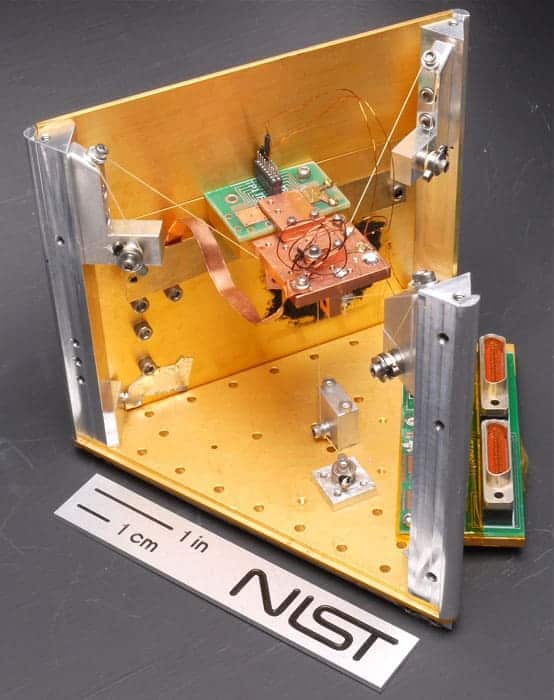
Physicists in the US have built a new solid-state refrigerator that provides continuous cooling of objects to temperatures below 300 mK. The device has no moving parts and uses 48 tiny quantum-tunnelling junctions to cool a copper plate a million times heavier than the refrigerating elements themselves. The team believes that the device could be further optimized and could find use in refrigeration applications where conventional cryogenics are difficult to implement – such as cooling detectors on space missions.

Temperatures below about 300 mK are integral to many areas of modern physics research from quantum computers to dark-matter detection. However, temperatures below about 300 mK cannot be reached by simply cooling with liquid helium. Conventional cooling to millikelvin temperatures is done using a dilution refrigerator, which involves pumping helium isotopes. While extremely effective, dilution refrigerators can be difficult to implement in specialized applications such as cooling detectors in space. An alternative technique is adiabatic demagnetization, which is also unwieldy because it involves placing the sample in a powerful magnetic field that is repeatedly turned on and off.

Researchers have for years been seeking a viable solid-state cryogenic refrigerator – ideally a system that can cool objects the size of a computer chip to below 300 mK simply by running electric current through it. Various proposals have been advanced and success has been achieved in cooling small objects less than 1 mm in size. In 2005 Joel Ullom’s team at the National Institute for Standards and Technology (NIST) in Boulder, Colorado, unveiled a cooler based on quantum tunnelling that can chill objects much larger than the refrigerating elements – which were extremely small. However, the object to be cooled had to be integrated onto a cold membrane at the time of manufacture, so the refrigerator was not reusable.

A ‘true’ refrigerator

Now Ullom and colleagues have created a new solid-state refrigerator and used it to cool a removable copper stage sized 2.5 cm from 290 mK to 256 mK over the course of 18 hours. The stage was thermally connected to a membrane, while remaining electrically isolated.

Ullom explains that the electrical isolation is important: “This is why we consider the device to be a true refrigerator,” he says. “Just as it would be very awkward if your household refrigerator had current running through whatever you put in it, so too it would be awkward if there was current running through your payload from the refrigeration process.”

Thermal isolation

The membrane, conversely, was electrically (but not thermally) connected to the power supply using thin superconducting wires. This isolation means that the device can be connected to a standard power supply or even a 9 V battery.

Attached to the membrane are a series of junctions, each comprising a 30-nm-thick layer of normal conductor and a 300-nm-thick layer of superconductor, separated by a very thin 1 nm layer of insulator. The circulating current creates a potential difference across these junctions. The hotter, more energetic electrons are more likely to tunnel across the insulating gap from the normal conductor to the superconductor on the outside. As a result, these hotter electrons are preferentially removed from the system, cooling the stage.

“It’s almost like the way you cool a cup of coffee by blowing on it,” says NIST researcher Peter Lowell. “You remove some of the hottest particles, which cools down the cup of coffee.”

‘Very impressive’

Hervé Courtois at the Néel Institute in Grenoble, France, describes the device as “very impressive”, although he stresses that “in terms of physics, there is nothing new”. He explains, “The point is that they can couple the electronic cooler and this copper stage, which could be anything. It could be a detector for astronomy or any kind of thermometer.”

Courtois cautions, however, that the device will need to get to colder temperatures before it can replace more complex refrigerators in devices such as the Planck Cosmic Microwave Background detectors. “I think the next step is to start from 300 mK and go down to 100 mk,” he says. “For me this 10% temperature reduction is a very nice demonstration but it’s not really useful. I think they can manage to get down further, but the demonstration is still to be made.”

The researchers’ thoughts lie in the same direction. “We would like to cool from 300 mK down to 100 mK,” says Ullom, “and we are also looking at a refrigerator that could start at 100 mK and maybe reach the low tens of millikelvin. That’s a temperature range that is very difficult to access presently.”

Leonid Kuzmin from Chalmers University, Sweden, is more sceptical that they will be able to get down much further, as he points out that the thermal conductance will decrease as the fourth power as the temperature goes down. As a result, Kuzmin thinks it is unrealistic to expect cooling to near 100 mK after only incremental improvements to the NIST device.

First weak measurements made on optical polarization states

Physicists in Canada and the US claim to be the first to make a direct measurement of the polarization quantum state of light – a feat that at first glance appears to defy Heisenberg’s uncertainty principle. The technique, which relies on a process known as weak measurement, could help in fundamental studies on quantum mechanics or in the development of quantum computing.

In quantum mechanics, it is normally considered impossible to know everything about a system at one time. Measure the position of a particle accurately, for instance, and the particle’s momentum will suddenly become very ill defined. Physicists call pairs of variables such as position and momentum “conjugate”: they are innately connected, such that the measurement of one essentially destroys information about the other.

On the face of it, this phenomenon – which is enshrined in Heisenberg’s famous uncertainty principle – restricts the information that physicists can gain from studying quantum systems. But in the last 20 years, new techniques have been developed to get a better handle on uncertainty and the exact limit it presents. Known as weak measurements, they involve taking tiny “peeks” at quantum systems, so that information can be gained bit by bit, without greatly affecting the system itself.

Reconstructing the wavefunction

In 2011 physicists at the National Research Council (NRC) in Ottawa, Canada, claimed that they could use weak measurement to directly reconstruct a system’s wavefunction, which describes how a quantum system evolves over time. Before weak measurement, wavefunctions had only been measured indirectly in a technique known as quantum tomography. This latter technique involves making many different conventional measurements on equivalent quantum systems – single photons emerging from the same source, for example. This information is then processed to create a map of the quantum state.

The NRC group’s technique involved making a “weak” measurement of the position of a photon followed by a “strong” conventional measurement of its momentum. By repeating the process many times, the information gained from the weak measurements ramped up until the researchers had effectively got the same amount of information from doing two strong measurements. As a result, they were able to reconstruct the wavefunction in a single sitting.

“Not just a fluke”

Robert Boyd and colleagues at the University of Ottawa and University of Rochester have built on the NRC work by applying weak measurement to the polarization states of light. “It demonstrates a second example of a situation in which direct measurement can be used to determine a quantum wavefunction,” says Boyd. “It shows that the earlier result was not just a fluke.”

The polarization of light can be described using different orthogonal bases, including horizontal–vertical and diagonal–antidiagonal. As with position and momentum, these bases are conjugate – a measurement of the horizontal–vertical polarization, for example, should destroy information about the diagonal–antidiagonal polarization and vice versa.

The team used birefingent crystals to make its measurements. When a beam of light passes through such a crystal, the light is deflected according to its polarization – with the amount of deflection depending on the thickness of the crystal. Boyd and colleagues used a thin birefingent crystal to perform a weak measurement of the horizontal–vertical polarization, and then a thick crystal to perform a strong measurement of the diagonal–antidiagonal polarization. By performing this process many times for identical photons in a stream, they could gradually build up a complete knowledge of both polarizations. Then, having inferred the value of the third, left-or-right, polarization, they could reconstruct the polarization state in full.

Jeff Lundeen, a member of the NRC group that measured the spatial wavefunction in 2011, believes the latest study is important because polarization is a discrete, “two-level” variable – as opposed to position and momentum, which are continuous. It is the two-level nature of polarization – equivalent to a binary one and zero – that lends it to quantum computing, where it forms the basis of quantum bits of information, or qubits. The techniques of Boyd and colleagues will therefore be of great interest to those developing quantum computing, Lundeen says.

Bona fide quantum state

Howard Wiseman at Griffith University in Brisbane, Australia, calls the result a “generalization” of the 2011 result. However, he points out that by forcing a system to divulge its wavefunction directly, the researchers may be losing some of the “mathematical requirements” that a bona fide quantum state should exhibit. “Given that experiments are prone to error, it remains to be seen how useful this technique will be,” he says.

Boyd’s group is now building on its technique. The researchers would like to understand how a quantum wavefunction becomes distorted, such as when a photon passes through turbulence in the Earth’s atmosphere. “Such measurements are needed for the implementation of quantum communications,” Boyd says.

The results are published in Nature Photonics.

Quantum frontiers – free PDF download

If you’re a member of the Institute of Physics, you’ll have had access for almost a week now to the March 2013 special issue of Physics World on quantum physics – either in print or through our digital issue, which you can access online or via our apps for smartphones and tablets (free from the App Store and Google Play).

But as we know how fascinating so many of you find the quantum world – with all that talk of quantum entanglement, Schrödinger’s cat and spooky action at a distance – we felt we wanted to share the issue more widely. So from today we’re making the issue available as a free downloadable PDF.

Of course, the PDF doesn’t have all the goodies of the digital issue, which this month includes some exclusive quantum-related audio and video content. But there’s still plenty to get stuck into, including a look at the fascinating new paradigm of “weak measurement”, the application of quantum physics to biology, the use of cold atoms to simulate the quantum world, and the use of entanglement for completely secure satellite communication.

Two other articles examine the impact of quantum physics on popular culture and among the physics community itself.

And by downloading the PDF you get to look more closely at our specially commissioned Alice and Bob cover.

Remember that if you want to read Physics World every month, you can join the Institute of Physics as an IOPimember quickly and easily online by visiting the Institute’s website. IOPimembership includes an annual digital subscription to Physics World.

Islands in a Martian stream

Image of an ancient Martian river channel that has been buried by volcanic material

By Hamish Johnston

A very long time ago, a large amount of water is thought to have flowed on the surface of Mars – and the above image shows what scientists think is an ancient Martian river channel that has been buried by volcanic material.

(more…)

The Finkbeiner test

By Margaret Harris

Here’s a little game for you to play the next time you read a profile of a woman in science. As you read the article, count the number of times it mentions:

The fact that she is a woman
Her husband’s job
Her childcare arrangements
How she acts as a “nurturing figure” towards junior scientists
How she was taken aback by the competitiveness of her field
That she’s a “role model” for other women
How she’s the “first woman to…”

If the article’s total score is anything other than zero, then it fails the Finkbeiner test.

(more…)

Tomography reveals nanocrystal superlattice

Researchers in the Netherlands have used electron tomography to obtain images of nanocrystal superlattices. This new use of an established imaging technique looks set to provide researchers with important 3D structural information about these technologically important materials.

Often called artificial solids, nanocrystal superlattices can be engineered to have a range of electronic, photonic and other desirable physical properties that could have technological applications. However, researchers still lack the right tools to image the 3D structures of these materials properly. Without such detailed information, the fundamental physical properties of these materials cannot be completely understood.

Now, a team from Utrecht University has used electron tomography to fully resolve the structure of a new nanocrystal solid, [PbSe]6[CdSe]19. The technique involves rotating the sample while obtaining 2D images in a transmission electron microscope (TEM). In this way, a series of 2D transmission images of the nanocrystals are obtained under different angles.

Reconstructed 3D image

“By projecting this transmission information along the angle under which it was obtained, we can reconstruct the 3D object from the initial 2D image data,” explains team member Mark Boneschanscher. “The technique provides us with a 3D image containing the detail we require and we can then use computer-assisted image analysis to extract the lattice coordinates of the nanocrystals within this 3D image.”

Electron tomography can provide information normally not accessible with a conventional TEM, which only produces a 2D transmission image of an object. This means that information about the third dimension (or that along the Z-axis of the TEM’s electron beam) is completely lost. Electron tomography, on the other hand, allows for full 3D characterization, Boneschanscher explained.

Local defects

“Using this 3D information, we can observe local defects in the nanocrystal structures – even if these cannot be observed in the conventional TEM images,” he adds. “Indeed, we were able to show that three totally different TEM images originated from one and the same crystal structure: a transmission image of the crystal along the c-axis; a transmission image from a crystallite with a planar defect; and a transmission image of a crystallite grown with the c-axis at an angle of 43° with respect to the TEM grid.”

The team says that electron tomography and computer-assisted image analysis could set a new precedent for studying nanocrystals and superlattices. The researchers now plan to undertake a more quantitative in-depth study of their nanocrystal solids to understand better how quantum-mechanical coupling between nanocrystals and defects affects the opto-electrical properties of these materials.

“With electron tomography as a tool to fully resolve the structure of these superlattices at our disposal, we will now be able to understand the link between structure and opto-electrical properties in much more detail,” says Boneschanscher. “We are currently measuring the local electronic properties of other nanocrystal solids using scanning-tunnelling microscopy, and know that some of our colleagues are trying to connect leads to these materials with the aim of making real devices out of them.”

More details of the work can be found in Nano Letters.

LHCb nails D-meson ‘flipping’ from matter to antimatter

The first definitive observations from a single measurement of D-mesons “flipping” or oscillating from matter to antimatter have been made by researchers on the LHCb experiment at CERN, Geneva. Previous experiments have seen evidence for the same oscillations but the individual results were not statistically significant, whereas the new LHCb result is, at 9.1σ, considerably better than the 5σ “gold standard” for a discovery in particle physics. The oscillation was predicted by the Standard Model of particle physics for four types of mesons – all of which have now been experimentally observed. This new result could lead to more detailed studies of charge–parity (CP) violation in charm mesons.

Charmed mix

One of the seven experiments at the Large Hadron Collider (LHC) at CERN, the LHCb is a b-physics experiment designed to study the physics of B-mesons – particles that contain a bottom quark or an antibottom quark. But particle collisions taking place in such experiments also produce other mesons, including the D0 – a neutral meson that consists of a charm quark and an anti-up quark. A D0 can oscillate into its antiparticle state – the anti-D0, which consists of an anti-charm quark and an up quark.

The weak interaction – one of the four fundamental forces of nature – allows for quarks to change their type or “flavour”. But neutral mesons undergo a type of second-order weak interaction – they can oscillate between their particle and antiparticle states. To dig a little deeper, inherent quantum-mechanical effects and weak interactions allow the usually degenerate D0 and anti-D0 mesons to “mix” with each other, resulting in two new superimposed eigenstates that differ slightly from the physical states of the meson and the antimeson. This mixing occurs becuase of two specific mixing parameters – that is, the two eigenstates have slightly different masses and lifetimes. It is these differences that allow for the oscillations from D0 to anti-D0 (also referred to as “charm mixing”) to take place, with a frequency related to the mass difference.

The LHCb collaboration observed the oscillations by studying the time-dependent ratio of the rate at which D0 decays into a kaon and an antipion over D0 decaying into an antikaon and a pion. The researchers determine the flavour of the D0 or anti-D0 particle at production and then once more when the particles decay, allowing them to detect the oscillation or charm mixing.

High statistics

“We can tell if the meson was produced from a D0 or anti-D0. We then look at the ratio – if mixing has occurred, then the ratio increases over time. If no mixing has taken place, the ratio remains constant,” explains Angelo Di Canto of the University of Heidelberg in Germany, who is part of the LHCb collaboration.

Di Canto explains that the LHCb apparatus has “dedicated parts that allow it to look for these [meson-decay] events and supress all the background events that mimic the states we look for”. He also points out that the number of data acquired by the LHCb is very large and that many events have been observed. As there is only a short time during which the rather slow oscillations have an effect before the particles decay, sufficiently high measurement statistics are essential for a clear result.

Violated oscillations

In late 2011 the LHCb team also found the first hints of direct CP violation in the D0 system, with an asymmetry value of approximately –0.82% – a 3.5σ result – with the data from the first year the LHC was operational. To look for further hints of CP violation, the team is now analysing its full data sample (three times the number used in the D0-mixing paper) to search for CP violation in charm mixing. “If there is a CP violation in the mixing, then there would be an increased probability of D0 to anti-D0 flips as compared with anti-D0 to D0 flips, or vice versa,” says Di Canto.

He explains that in the coming months, the researchers will split the data into the two oscillations and compare the mixing parameters in both, making sure that their results are purged of all systematic effects. Although this will result in the most precise measurement of CP violation in charm mixing so far, more statistically significant data will have to be taken after the LHCb experiment is upgraded before the team can pin down the parameters with ultimate precision. Also, since theoretically the mixing parameters are difficult to calculate, much more accurate predictions are needed before a discovery that lies beyond the Standard Model can be unambiguously identified in the experimental measurements, according to Di Canto.

“In my view, the importance of this result is that it demonstrates the capability of LHCb to make high-precision measurements in the charm sector. The results on charm-mixing parameters are about a factor of two more precise than those from any previous experiment,” says Tim Gershon of the University of Warwick in the UK, who is also the physics co-ordinator of the LHCb experiment.

Meanwhile, Di Canto says that although the Standard Model has “predicted the oscillations beautifully…it is important to keep understanding all the details of this intriguing phenomenon”.

The research is published in Physical Review Letters.

The life of which 20th-century physicist would make the most gripping basis for a children’s novel?

Today is World Book Day, a celebration of the stories, the characters, the authors and above all the joy of whiling away the hours with a great book. The main aim of the day – which is organized by UNESCO and marked in more than 100 countries – is to encourage children and young people to develop a passion for reading.

Children’s novels have brought us some truly memorable characters over the years, from the classics such as Snow White and Peter Pan, to the more contemporary such as Harry Potter and Lyra Belacqua. The most captivating characters are often the ones we can identify with. We live and breathe their adventures, and we feel their emotional reactions to the unfolding drama. But at the same time, these characters are not the same as us; they are far larger than that. They possess qualities that we can only imagine we had – be it searing intelligence, staggering courage or even magical powers.

The authors who dream up these weird and wonderful characters can sometimes seem to possess their own magical powers of creativity and imagination. But time and again when writers talk about their creations, you hear them say that their inspiration comes from their personal relationships or encounters with intriguing people in the real world. We all know of people who seem to be larger than life, and the world of physics in no exception. This line of thought has been the source of inspiration for this week’s Facebook poll.

(more…)

Cryogenics through the ages on BBC radio

By Hamish Johnston

Physicists have long been interested in how nature behaves under very cold conditions, and about 200 years ago the race began to realize the lowest temperature ever. Along the way, many new and amazing states of matter have been discovered, including superconductors, superfluids and Bose–Einstein condensates. More recently, access to extremely low temperatures has contributed to the current renaissance in the study of fundamental quantum mechanics and the development of quantum computers.

In his latest radio programme, the BBC’s resident polymath Melvyn Bragg looks at this race to the bottom, which really heated up in the late 19th century when physicists and chemists were feverishly liquidizing a wide range of gases include those cryogenic favourites nitrogen – and a little later in 1908 – helium.

(more…)

Is Schrödinger’s cat dead or alive?

In less than 100 seconds, Martin Archer gives his take on this famous thought experiment of quantum mechanics.

Copyright © 2026 by IOP Publishing Ltd and individual contributors