You spin me right round

By Tushna Commissariat

It’s not often that we come across a mention of an astronomical event measured in Earth years, let alone months or hours. So suffice to say I was pretty surprised by a recent XMM-Newton finding that talked about a star orbiting a black hole at the furious rate of once every 2.4 hours! Further investigation revealed that this has only broken the previous record by an hour, but these extremely short orbits still have me rather amazed. Certain short orbital period binary stars or pulsars do have even shorter periods of less than an hour, but this star orbits a stellar-mass black hole (it’s about three times more massive than the Sun) that is roughly a million kilometres away from it. The video below, courtesy of the European Space Agency (ESA), is an animation showing one complete orbit of the star.

(more…)

Physicists bang the drum for quantum memory

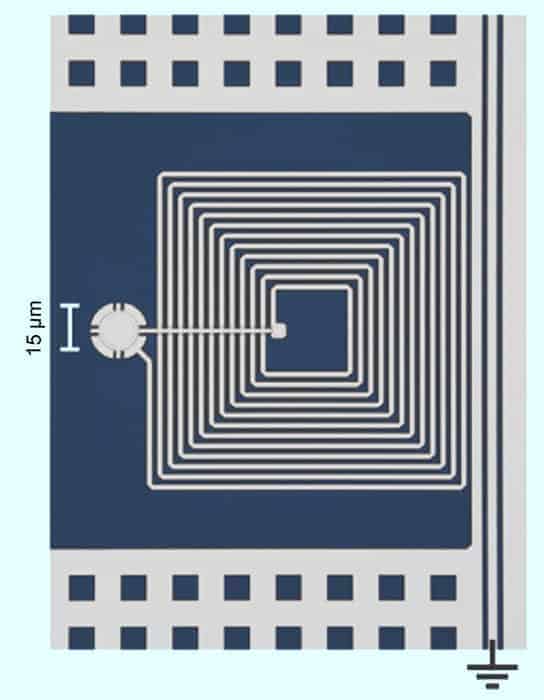
Drum circuit used to store quantum information

Physicists in the US say they are the first to store – and then retrieve – quantum information in a mechanical oscillator. Their device consists of an extremely thin disc of aluminium that is connected to a microwave circuit. Quantum information encoded in a microwave signal is transferred to the disc, which vibrates much like a drumhead. This information can then be retrieved by converting the mechanical oscillations back into microwaves.

Built by Konrad Lehnert and colleagues at the National Institute of Standards and Technology in Boulder and the neighbouring University of Colorado, the team says the device can store quantum information for long enough to make it a potential candidate for a future quantum computer. Such machines could, in principle, outperform conventional computers at certain tasks, but require quantum bits (or qubits) that can store and transfer quantum information without it being destroyed by interacting with the outside world.

Cool stuff

Like many attempts to make “quantum memory”, the qubits built by Lehnert and colleagues are “mesoscopic” objects – small enough to behave as quantum systems, yet large enough to fabricate on a chip and connect to other qubits. Weighing just 48 pg, their drumhead is a circular sheet of aluminium 15 μm in diameter and 100 nm thick. The entire device was chilled to 25 mK and the drum itself is put into its lowest-energy vibrational state (its ground state) using a microwave cooling technique.

Quantum information is first encoded in the amplitude and phase of a microwave pulse. This pulse is then sent along a waveguide that sits next to a spiral-like resonant circuit that includes the drum (see figure; click to enlarge). The circuit is designed such that the pulse is completely absorbed by the circuit and the microwave energy is converted to vibrational energy stored in the drum. “At the end of the process, the mechanical oscillator quivers with a particular amplitude and phase, which is the amplitude and phase that the microwave signal had before it was absorbed,” explains Lehnert.

Towards improved efficiency

This absorption process is controlled using a second microwave signal, with the presence or absence of this “transfer field” determining whether the pulse can move from the waveguide to the resonant circuit and vice versa. To read out the quantum information, the transfer field is adjusted so that the vibration of the drum is converted back to a microwave pulse, which can then jump into the waveguide and be measured by Lehnert and colleagues.

In a typical experiment the team was able to store quantum information for about 25 μs without it degrading significantly. The team was also able to successfully store and retrieve the pulses in about 65% of attempts. According to Lehnert, this inefficiency arises because the microwave circuit is not perfect and some of the microwave signal is lost. But he is confident that smaller circuits will improve the performance. “We believe the prospects for improving this number are quite good, as other researchers have recently demonstrated microwave circuits with loss about 100 times smaller than we achieved,” says Lehnert.

Lehnert told physicsworld.com that his team’s drums could be used in conjunction with superconducting qubits, which also operate at low temperatures and microwave frequencies. While mechanical oscillators cannot easily be connected with each other to create logic devices, they could be used to store quantum information that is then processed in superconducting devices. In particular, Lehnert points out that the linear nature of the device means that it could be used to store more than one qubit at the same time.

Optical boost

Another possible application in quantum information is using mechanical oscillators as quantum transducers, which convert quantum information from one form to another. “We are working on using mechanical oscillators to convert quantum information encoded in microwave electrical signals into information encoded as an optical field [light],” Lehnert says.

Converting qubits from microwave to optical signals could play an important role in large-scale quantum information systems of the future. Although microwaves are very well suited for transferring quantum information in small ultracold devices, they cannot carry information over large distances. Optical signals, on the other hand, can travel tens or even hundreds of kilometres without losing their quantum nature.

The research is described in Nature.

Spot-on the Standard Model

By Hamish Johnston

“Beyond any reasonable doubt, it is a Higgs boson, and here we examine the extent to which its couplings resemble those of the single Higgs boson of the Standard Model.”

That’s taken from the abstract of a new paper by John Ellis and Tevong You of King’s College London. Ellis, of course, has been associated with CERN for decades and if he says it’s a Higgs that’s good enough for me!

(more…)

Nanoparticle coatings determine how superlattices grow

Researchers in the US and Germany have gained important insights into how molecular coatings affect how nanometre-sized particles organize themselves into regular “superlattices”. By combining new X-ray techniques with thermodynamic analysis, the team has worked out why the same nanoparticles can assemble into several distinct structures. The scientists hope that their insights could lead to new designer materials.

Over the past decade or so, man-made metamaterials have been created to have desirable properties not found in natural materials. These include nanoparticle superlattices – regular arrays of nanometre-sized structures – that show promise for a range of technology applications, such as photovoltaics, light-emitting diodes and thermoelectrics. However, before these properties can be exploited commercially, researchers must first gain a better understanding of how the tiny nanoparticles come together via complex nucleation and other processes.

Intricate steps

In the early stages of nucleation, nanoparticles aggregate randomly and form an amorphous structure with limited short-range ordering. The particles then minimize the total free energy in the structure by crystallizing into a long-range ordered superlattice. The nanoparticles appear to behave like hard spheres, packing together to form a fairly simple superlattice phase. However, they also appear to go through various quite intricate nucleation and growth steps that involve multiple nanoparticle interactions with surrounding solvents and surface-capping ligands, which are molecules that attach to the surface of the nanoparticles.

To better understand these mechanisms, the US–Germany team decided to look at how oleic-acid-capped lead-sulphide nanoparticles just 3.5 nm in size assemble in solution under a variety of experimental conditions and different temperatures and pressures. The changes to atomic structure occurring at the nanoparticle cores and at the capped ligands can be followed from the same volume of sample using both high-resolution synchrotron small-angle X-ray scattering (SAXS) and wide-angle X-ray scattering (WAXS) – new techniques developed by the researchers themselves.

Trio of polymorphs

The results show that the nanoparticles nucleate in three main superlattice structural phases or polymorphs. These are amorphous, body-centred-cubic (bcc) and face-centred-cubic (fcc) phases. The type of superlattice formed can be controlled by changing the distance between the nanoparticles without changing their size. For example, when the inter-nanoparticle distance is increased, the particles pack together in a slightly looser but more ordered way while the capping molecules rearrange and change structure, modifying the overall surface energy.

“Our analyses have shown that the nanoparticles appear to either maximize entropy or minimize the enthalpy in the structure to reduce the total free energy through multiple interactions with the surface molecules,” explains team leader Zhongwu Wang. “These findings will hopefully inspire both experimentalists and theorists to consider the importance of surface-capping molecules when modelling these superlattice structures. From an applications point of view, our phase diagrams could offer a guide to material fabrication and help make ‘designer’ solids with specific structures, inter-nanoparticle distances and sizes.”

The researchers now plan to look at binary nanoparticles and other more complex nanostructures. “Using techniques only available in our labs at the Cornell High Energy Synchrotron Source (CHESS), we aim to build a series of structure–property relation diagrams of confined nanoparticles with different sizes and shapes,” Wang told physicsworld.com.

The current work is presented in Nano Letters.

The valley of death

By Margaret Harris at the APS March Meeting in Baltimore

In industry, the gap between making a scientific discovery and turning it into a practical product is often termed the “valley of death”.  Many an idea that seemed promising in the laboratory has failed to become a real application for want of funding, industrial know-how or, usually, some combination of the two.

The Industrial Physics thread of this year’s APS March Meeting – which my colleague Louise Mayor and I are attending this week on behalf of Physics World – includes a number of talks about the “valley of death” problem, and the one that kicked off yesterday’s session really brought home the importance of addressing it.  The speaker, Robert Colwell, directs the Microsystems Technology Office at the Defense Advanced Research Projects Agency. Better known by its acronym – DARPA – the agency is part of the US Department of Defense, and one of the products that physicists in Colwell’s office have developed is a “blast gauge” for soldiers deployed in Iraq and Afghanistan.

(more…)

Micro black holes could form at lower-than-expected energies

New simulations of head-on collisions of particles travelling at nearly the speed of light show that black-hole formation can occur at lower collision energies than expected, according to a team of researchers in the US. The researchers attribute this to a “gravitational focusing effect” whereby the two colliding particles act like gravitational lenses, focusing the energy of the collision into two distinct light-trapping regions that eventually collapse into a single black hole. Although the work shows that black holes can form at lower collision energies than expected, the team says that the result has no impact on real particle collisions taking place at the Large Hadron Collider (LHC) at CERN.

From 2008 onwards, when the LHC was first scheduled to be switched on, there were rumours about what the experiment might create – extra dimensions, sparticles and strangelets, vacuum bubbles and, of course, planet-destroying black holes. Although the experiment ran seamlessly from November 2009 for more than two years and scientists found no evidence whatsoever for the formation of micro black holes, the fascination with black-hole formation and evaporation continues – among researchers and the media.

Planck scales and beyond

Frans Pretorius and William East of Princeton University in the US want to better understand the dynamics of particle collisions at the super-Planck scale.

Planck units are a system of units comprised of the simplest algebraic combinations of the fundamental constants of nature – the speed of light c, Newton’s constant G, Planck’s constant h and so on. For example, a combination of the constants to form a unit of Planck energy (Ep) is about 2 × 109 J. Pretorius explains that a super-Planck-scale collision is a collision between two fundamental particles where the total energy (rest energy (Er) plus the kinetic energy) exceeds Ep. At the Planck scale, quantum-gravity effects are expected to start playing a role in the interaction. However, at energies greater than Ep (and no-one knows exactly how much greater), classical gravity dominates the interaction.

So the researchers wanted a completely classical calculation, and this, explains Pretorius, is the “crucial ingredient in the argument that super-Planck-scale collisions form black holes, regardless of any non-gravitational interactions between the particles”. He goes on to explain that this is important, as currently we do not know exactly what quantum-gravity interactions occur at the Planck scale. According to Pretorius, the new results suggest that for energies sufficiently above the Planck scale it does not matter – a black hole will form around the interaction, hiding all quantum effects, at least temporarily.

Critical energies

While considering the super-Planck-scale regime, the researchers look at specific “gamma” (γ) values in the collisions. Pretorius explains to physicsworld.com that γ is a measure of the kinetic energy of the interaction; that is, if the rest energy of one of the colliding particles of mass m is Er = mc2, then the total energy of the particle in motion is Et = γ × Er. So, when two particles of mass m collide, each moving with velocity v towards each other in the reference frame of the lab, the total energy of the collision is 2 × γ × Er.

According to the researchers, the critical γ depends on the particular model of a particle, and in their simulations, the particles of choice are “fluid stars” – a hypothetical and perfect “star” or particle that Pretorius describes as a “classical model of a fermionic star”. They used the fluid star because its γ value is high enough that the total collision energy would allow for a black hole to form. “Since our calculation is purely classical, so no h, this serves as the proxy of the Planck energy,” says Pretorius.

A previous estimate for black-hole formation – known as the “Hoop Conjecture” and developed by Kip Thorne in 1994 – says that an object compressed in a highly spherical manner will “form a black hole around itself when and only when its circumference in all directions becomes less than the critical circumference”. This “critical circumference” is directly related to the Schwarzschild radius (rs) of the object. But in the case of their collisions with super-Planck-scale fluid stars, Pretorius and East found that black-hole formation “actually begins at a fraction of about one-third of this [Hoop Conjecture estimate] energy”.

Simulating colliding stars

In terms of the actual simulations, the researchers begin with the two model particles – the fluid stars – moving towards each other at high velocity. When they first collide, they are in a sense at such high velocities that the particles just smash through each other. “However, the gravitational field of each is so strong because of the extra energy coming from the large gammas, that the gravitational force, which is attractive, strongly focuses each particle towards the collision axis,” says Pretorius. The “fluid” material compresses because of this focusing, and eventually by so much that each particle collapses to form a black hole. “We measure this in the simulation by the apparent horizons, which baring technical details are essentially the event horizons of the black holes. These initially two separate horizons then merge to form a larger black hole,” he says.

You can see the simulations here – the first video is for γ = 8, which is strong enough to produce some lensing but not enough to form any black holes. The second is for γ = 10 and the black holes are formed.

Black-hole death?

Pretorius and East are clear that their simulation results have no real bearing on safety issues at any high-energy experiments. They say that even if such black holes are formed, they would still be completely benign given what we know about them. According to the team, the results might give researchers a better idea of the energies at which black holes might start to form. “Though the key question is what the true Planck scale is,” muses Pretorius. The units he mentioned above suggest that the Planck energy is 1016 TeV in LHC-like terms, so about 15 orders of magnitude above LHC energies. If this is the case, it is not even remotely possible for the LHC to form black holes, even with the factor of one-third decrease in the threshold energy. “However, if there are extra, small dimensions, as string theory predicts, then the true Planck scale could be lower. There are no firm predictions on how much lower, so this is a highly speculative scenario. If black holes were formed, it would strongly indicate that there are extra dimensions, which would be a very profound discovery,” says Pretorius.

The research is published in Physical Review Letters.

BBC celebrates Richard Feynman

By Hamish Johnston

The BBC and the Open University have teamed up to produce two television programmes about Richard Feynman – the Nobel-prize-winning scientist who died 25 years ago.

Outside of the physics community, Feynman is probably best known for his diligent and outspoken role in the investigation into the causes of the Challenger disaster.

Like many of my generation, I can remember exactly where I was when the Space Shuttle Challenger exploded shortly after take-off on 28 January 1986: it was a snowy Tuesday in Guelph, Ontario, and for some reason I was still at home at 11.39 a.m. when the accident occurred.

(more…)

Which astronomical objects do you find the most fascinating?

By Tushna Commissariat

Artist's impression of a quasar

This week marks 50 years since astronomer Maarten Schmidt’s discovery of the quasar, using the giant Palomar Observatory telescope. Quasars or quasi-stellar objects are a kind of active galactic nucleus that astronomers believe are powered by supermassive black holes and are scattered throughout the universe. They have always fascinated me, being some of the brightest, most distant and highly red-shifted astronomical objects in our universe. Over the years, thousands of quasars have been identified and they have dramatically influenced our ideas about the scale of the observable universe and have helped astronomers shed some light on the early universe.

In fact, just this week an international team of researchers announced the discovery of an extremely rare triple quasar system – only the second one observed to date. These systems are considered to be extremely rare and are difficult to spot. By combining multiple telescope observations and advanced modelling, the team – led by Emanuele Farina of the University of Insubria in Como, Italy – was able to discover the triplet quasar, called QQQ J1519+0627. The researchers say that light from the quasars has travelled nine billion light-years to reach us, meaning that it was emitted when the universe was only a third of its current age. Advanced analysis confirmed that what the team found was indeed three distinct sources of quasar energy and that the phenomenon is extremely rare.

So in light of these exciting findings, in this week’s Facebook poll we are asking you to pick your favourite astronomical objects.

(more…)

It’s official, it’s a Higgs

By Hamish Johnston

It seems like only yesterday that the particle-physics blogosphere was on fire with rumours, speculation and even a bit of real information about the hunt for Higgs boson at the Large Hadron Collider (LHC).

How things have changed since a Higgs-like particle was identified in July last year. Since then, further analysis has revealed that the particle is even more Higgs-like – and today CERN has officially said that the particle is “a Higgs boson”.

(more…)

Feynman’s double-slit experiment gets a makeover

Physicists in the US and Canada say that they have done the best job yet of realizing Richard Feynman’s famous thought experiment about how single electrons pass through two slits. Although the researchers are not the first to recreate the experiment in the lab, they say that their incarnation best captures the essence of the original exercise.

Feynman originally outlined his thought experiment in volume three of his famous series The Feynman Lectures on Physics as a way of illustrating wave–particle duality in quantum mechanics. In the book, he invites the reader to imagine firing individual electrons through two slits and then marking the position where each electron strikes a screen behind the slits.

After many electrons have passed through the slits, the marks on the screen will comprise a diffraction pattern – illustrating the wave-like behaviour of each electron. But if one were to cover up one of the slits so that each electron could only pass through the other slit, the diffraction pattern would not appear – showing that each electron does indeed travel through both slits.

Potted history

When the third volume of The Feynman Lectures on Physics was published in 1965, physicists already knew that firing a beam of electrons at a double slit results in a diffraction pattern because the experiment had been performed in 1961 by Claus Jönsson at the University of Tübingen in Germany. But while Jönsson’s work clearly illustrated that a beam of electrons can behave as a wave, it did not establish a crucial point of Feynman’s experiment – that an individual electron itself can behave like a wave.

Single-electron double-slit diffraction was first demonstrated in 1974 by Giulio Pozzi and colleagues at the University of Bologna in Italy, who passed single electrons through a biprism – an electron optical device that serves the same function as a double slit – and observed the build-up of a diffraction pattern. A similar experiment was also carried out in 1989 by Akira Tonomura and colleagues at Hitachi’s research lab in Japan.

The first single-electron experiment to use an actual double slit was reported in 2008 by Pozzi and colleagues. The Italian team also conducted the experiment with one slit plugged, which – as expected – did not lead to the creation of a double-slit diffraction pattern. The team also performed another experiment in 2012, in which the arrivals of individual electrons from a double slit were recorded one at a time.

True to Feynman’s methodology

Herman Batelaan of the University of Nebraska-Lincoln, together with colleagues there and at the Perimeter Institute for Theoretical Physics in Waterloo, Canada, now say that they have created a double-slit experiment that follows the precise methodology of Feynman’s thought experiment.

The work originally began as an undergraduate research project at Nebraska and gained momentum when the Perimeter’s Damian Pope found out that Batelaan and colleagues were working on a realization of the experiment. Pope, who is involved in outreach work at Perimeter, had been keen on making a film about the thought experiment.

The team created a double slit in a gold-coated silicon membrane, in which each slit is 62 nm wide and 4 μm long with a slit separation of 272 nm. To block one slit at a time, a tiny mask controlled by a piezoelectric actuator was slide back and forth across the double slits.

The electrons were created at a tungsten filament and accelerated across 600 V and collimated into a beam. After passing through the double slit, they were detected using a multichannel plate.

One electron per second

The intensity of the electron source was set so low that only about one electron per second was detected – which ensured that only one electron at a time would ever pass through the slits. At this rate it took about two hours for a pattern to build up on the detector – a process that was recorded in real time (see video below). Measurements were repeated with the mask in a series of positions: first blocking both slits, then one slit, then none and then the opposite slit. As expected, the double-slit pattern was seen when the electrons had access to both slits, but not seen when one slit was blocked.

Batelaan told physicsworld.com that the experiment is particularly important from an outreach perspective because unlike the biprism experiments of the past, it actually uses a physical double slit and is therefore more accessible to the public. Young’s double-slit experiment with single electrons was voted the “most beautiful experiment in physics” by Physics World readers in 2002.

The experiment is described in the New Journal of Physics.

  • To read more about the quantum world, you can download a free PDF of the March 2013 special issue of Physics World on quantum physics via this link.
Copyright © 2026 by IOP Publishing Ltd and individual contributors