

edX is a major digital education initiative launched in 2012 by Harvard University and the Massachusetts Institute of Technology (MIT). The programme is designed to offer free online learning in the form of “MOOCs”, or massive open online courses. Harvard and MIT both invested $30m in edX early last year and were subsequently joined in the initiative by the University of California, Berkeley, the University of Texas System, Wellesley College and Georgetown University. edX has recently announced that it has just doubled its number of university partners to 12, including its first members from outside the US. In this interview with Physics World, edX president Anant Agarwal explains why he is so confident that the initiative can transform online learning.
The March 2013 issue of Physics World is out now
By Matin Durrani
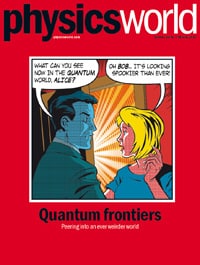
If you’re a member of the Institute of Physics, it’s time to get stuck into the March 2013 issue of Physics World, which is a special issue devoted to some of the most interesting cutting-edge work at the frontiers of quantum physics.
Among the highlights are a look at the fascinating new paradigm of “weak measurement”, the application of quantum physics to biology, the use of cold atoms to simulate the quantum world, and the use of entanglement for completely secure satellite communication. Two other articles examine the impact of quantum physics on popular culture and among the physics community itself.
The issue also contains some great multimedia, including the latest in our 100 Second Science video series where physicists at Imperial College London answer key questions in quantum physics in 100 seconds or less.
And if you’re wondering about the cover – it was specially commissioned by us in the style of pop artist Roy Lichtenstein, and shows Alice and Bob (the names given by convention to those sending and receiving quantum signals) peering into an ever weirder quantum world. The illustration echoes a similar image that graced the cover of our last special issue on quantum physics exactly 15 years ago this month. That one was also commissioned by us and was voted in 2008 by Physics World readers as one of their favourite covers of all time.
Nanotube transistors detect cancer biomarkers
Carbon-nanotube transistors could be used to detect minute quantities of disease biomarkers, such as the proteins implicated in prostate cancer, according to new experiments by researchers in the US. The technique could rival conventional methods when it comes to sensitivity, cost and speed.
Conventional techniques to detect proteins are typically based on some form of “immunoassay”, with the most famous of these being enzyme-linked immunosorbent assay (ELISA). This technique involves introducing an enzyme-modified antibody protein to an unknown amount of target molecule or protein, known as an antigen, and allowing them to bind together. Unreacted antibodies are washed away, leaving behind only antibody–antigen pairs.
The reaction can usually be detected by a colour change in the solution or by a fluorescent signal. The degree of colour change or fluorescence depends upon the number of enzyme-modified antibodies present, which in turn depends on the initial concentration of antigen in the sample.
Although such tests are routinely used in hospitals and clinics, they are quite long, taking several days or even weeks to complete. They are also costly, complicated to perform and can only detect single proteins at a time.
Nanos-sensors and markers
“Our new nanotube sensors are relatively simple compared to these ELISA tests,” team member Mitchell Lerner, at the University of Pennsylvania, told physicsworld.com. “Detection occurs in just minutes, not days, and even at the laboratory scale, the cost of an array of 2000 such sensors is roughly $50 or 2.5 cents per sensor.”
More importantly still, the sensors are much more sensitive to the target proteins in question. Indeed the Pennsylvania researchers showed that they could detect a prostate-cancer biomarker called osteopontin (OPN) at 1 pg/mL, which is roughly 1000 times lower than that possible with clinical ELISA measurements.

The team, which is led by A T Charlie Johnson of Penn’s Department of Physics and Astronomy, made its nanotube sensors by attaching OPN-binding antibodies to carbon-nanotube transistors on a silicon chip. Many proteins in the body bind very strongly to specific target molecules or proteins, and OPN is no exception. When the chip is immersed in a test sample, the OPN binds to the antibodies, something that changes the electronic characteristics of the transistor. Measuring the voltage and current through each device thus allows the researchers to accurately measure how much OPN there is in the sample.
Strongly bound
The technique could also be used to detect a host of other diseases by replacing the OPN-binding antibody with surface functional groups sensitive to different biomarkers, says Lerner. One biomarker that the researchers have already succeeded in detecting is that implicated in Lyme disease. They have also managed to detect salmonella bacteria using their technique.
“Our sensors could be used as point-of-care diagnostic tools that allow doctors to obtain test results in real time for a variety of diseases,” Lerner adds. “And by integrating many proteins onto a single chip, we could look for hundreds of disease biomarker proteins simultaneously in a single small-volume sample.”
The team says that it is now busy improving its devices. Protein attachment chemistry is quite complex and sometimes limits how well nanotubes actually conduct current, with some devices stopping functioning altogether. “We are also trying out new sensing experiments using human serum, possibly from actual patient samples,” reveals Lerner. “If these tests give good results, it would certainly be a huge step forward in taking the technology from the research lab to a hospital.”
The work is reported in three papers, which are available to read on arXiv.
From Mars to the multiverse
By Matin Durrani
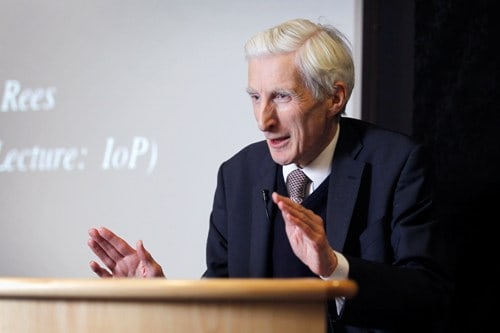
I travelled to London last night to hear the celebrated astronomer Martin Rees give an entertaining and thought-provoking lecture to more than 100 people at the Institute of Physics as the winner of the 2012 Isaac Newton medal – the Institute’s top award.
Having written more than 500 papers on everything from black holes and gamma-ray bursts to quasars and the dynamics of gas clouds, Rees’s bulging CV also includes spells as president of both the Royal Society and of the Royal Astronomical Society, which I guess makes him a worthy winner of the prize. (I should add that although the Institute publishes Physics World, I was not involved in selecting Rees for the award.)
Between the lines
On beyond zero
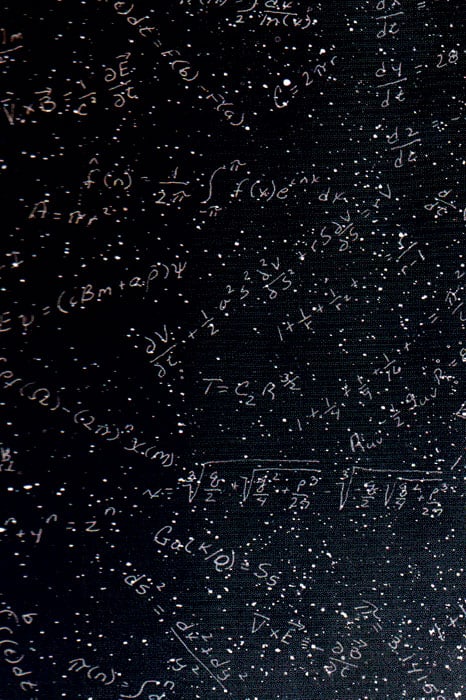
The Universe in Zero Words sounds like the title of a coffee-table book of astronomy photos. The image on its cover – a photograph of the Milky Way – does little to suggest otherwise. But the book Dana Mackenzie has actually written is a very different beast indeed. A closer look at that star-spangled cover reveals a host of equations scattered through the night sky, and inside it is an elegantly illustrated history of mathematical thought, rather than a series of nebula photos. Mackenzie’s chronicle is impressive in its scope, running all the way from 1 + 1 = 2 (an expression with some surprisingly interesting properties) through to 20th-century revelations such as Lorenz’s equations of chaos theory and the realization that some infinities are bigger than others. Understandably, Mackenzie, a mathematician-turned-writer, uses rather more than zero words to describe these discoveries: the book is divided into 24 semi-independent essays, each nominally based on a single equation or group of equations. Most of these expressions will be familiar to physicists, but there are also a few oddities, such as the Chern–Gauss–Bonnet equation, and even “old favourites” such as Maxwell’s equations are often presented with a fresh twist. This tendency is apparent from the first few essays, which frequently give credit to ancient mathematicians who lived outside the Greco-Roman world of Euclid and Archimedes. In particular, an account of Liu Hui, a Chinese mathematician and commentator from the third century AD, enlivens the essay on the “Pythagorean” theorem – which, as Mackenzie makes clear, was not Pythagoras’ invention, having been known to the Babylonians for more than a millennium before Pythagoras started teaching in the 6th century BC. This cross-cultural focus is particularly appropriate given the book’s title, which refers to the Platonist idea that numbers and equations express truths about the universe that are independent of words, language or culture. What was that old proverb about books and covers, again?
- 2012 Princeton University Press £19.95/$27.95hb 224pp
Proof positive
Prove that a parallelogram with equal diagonals must be a rectangle. Show that the surface area of a sphere is exactly two-thirds that of its (closed) cylinder. Derive the equation for a hyperbola. If these instructions induce puzzlement, a vague sense of “I used to know how to do that” or even a barely suppressed twinge of panic, then Measurement deserves a place on your shelf. Written by Paul Lockhart, a New York-based mathematics teacher and education advocate, the book aims not only to teach mathematics, but also to instil in readers a genuine appreciation for the subject and an understanding of why it is beautiful and worth learning. In his introduction, Lockhart admits that this will not be an easy process; mathematics, he writes, is like a jungle, and “the jungle does not give up its secrets easily…I don’t know of any human activity as demanding of one’s imagination, intuition and ingenuity”. On the other hand, mathematics is also “full of enchanting mysteries”, many of which are accessible even to novices – provided they are willing to play around with ideas and also develop a high tolerance for getting stuck. To help readers build their mathematical muscles, Lockhart has peppered his book with questions and puzzles like the ones that opened this review. The solutions to some of them are worked out (or at least worked around) in the text, but most are left as an exercise for the reader, without further comment or explanation from Lockhart. In a formal textbook, such an approach would be frustrating – especially for students with problem sets due every week, who seldom have the luxury of letting it “take hours or even days for a new idea to sink in”, as Lockhart advises. In the more relaxed and playful context of Measurement, however, it seems to work, and readers who try some of the easier puzzles will soon find themselves ready for more challenging fare. And if you do get stuck, Lockhart advises you to start working on another problem, as “it’s much better to have five or six walls to bang your head against” than only one.
- 2012 Harvard University Press £20.00/$29.95hb 416pp
Einstein the inventor
Albert Einstein’s early career as a clerk in the Swiss Patent Office is sometimes perceived as an aberration. Having failed to get a job as a teacher, or to have his true talents properly appreciated by the physics establishment, the story goes that he took this rather boring job only because he needed to eat, or because it allowed him time to construct a gedankenexperiment or two in periods of idleness. There is some truth to this: although Einstein later looked back on the patent office with fondness (calling it “that worldly cloister where I concocted my finest ideas”) he left his job there as soon as he reasonably could, after obtaining an academic post at the University of Zurich. Yet Einstein’s experiences of the patent office never really left him. Even after his theoretical work made him the world’s most famous scientist, he maintained an avid interest in technology and practical inventions. These inventions – along with his musings and expert opinions on other people’s gadgets – are the subject of The Practical Einstein: Experiments, Patents, Inventions by József Illy, a visiting historian at the California Institute of Technology. In this slender book readers will find some fascinating anecdotes about Einstein’s lesser-known scientific results, including a refrigerator he invented with Leó Szilárd and a paper he wrote on the meanderings of rivers. Not all of these efforts were successful. For example, an experiment he conducted on molecular currents in 1915 produced a result that, in Illy’s understated words, “did not stand the test of time”. Similarly, Einstein’s career as an impartial witness for patent disputes – which began after he had moved into academia – was marked by a number of lost cases and bungled court appearances. Even the successful and innovative Einstein–Szilárd refrigerators were preceded by Einstein’s abortive efforts to develop an “ice machine” with his chemist colleague Walther Nernst. The Practical Einstein reads more like a series of stories than a narrative, but Illy does deserve credit for gathering the often incomplete records of Einstein’s practical side into one book.
- 2012 Johns Hopkins University Press £31.50/$60.00hb 216pp
New radiation ring spotted in Van Allen belt
A previously unseen ring of radiation formed within the Earth’s Van Allen belt in September of 2012 and then vanished a month later. That is the finding of a team of researchers in the US, which analysed the first data available from the twin spacecraft of NASA’s Van Allen Probes mission. The anomalous ring – made up of high-energy electrons – stayed largely unchanged, until it was disrupted and “virtually annihilated” by a powerful interplanetary shock wave. The new findings show how we need a better understanding of the underlying mechanisms of the Van Allen belts.
Ring of fire
Discovered by US physicist James van Allen more than 50 years ago, the Van Allen radiation belts are two concentric, “doughnut-shaped” rings that encircle our planet. They are held in place by the Earth’s magnetic field and are filled with high-energy particles. The outer ring is mainly made up of MeV electrons that vary in intensity over a timescale of hours to days, depending on the solar wind. The inner ring consists of a mix of high-energy electrons and extremely energetic protons.
The belts are confined within the Earth’s magnetosphere and extend from an altitude of about 1000 to 60,000 km above the Earth’s surface. They tend to swell and shrink over time as they are a driven by solar wind and cosmic rays. The high amounts of radiation within the belts make them a threat to satellites in geostationary orbit, which must carry sufficient shielding if their orbit lies within the belts.
Probing plasmas
To better study the Van Allen belts, NASA launched the Van Allen Probes (formerly known as the Radiation Belt Storm Probes) mission on 30 August 2012 to investigate both rings. It comprises two spacecraft that are kitted out with energetic particle, plasma and magnetic-field instruments, plus plasma-wave sensors to investigate both rings. The mission’s aims included understanding how particles are accelerated, transported and lost from the belts as well as determining how extreme space weather affects the region.
Unexpected ring
When Dan Baker from the University of Colorado and colleagues analysed the first data from the mission, however, they found the completely unexpected and surprising new “electro storage ring” nestled between the two known rings, which appeared after 2 September last year. According to a paper published in the journal Science, the “distinctive ring of highly relativistic electrons persisted, changing only gradually” until it abruptly disappeared on 1 October. While the inner ring of the Van Allen belt and the new ring showed very little change over the four weeks, the more distant part of the outer Van Allen belt seemed to be changing significantly throughout the same period. In the end, at the death of the new ring, almost the entire outer-zone electron population was diminished, according to sensors on board the probes.
Baker explains that the researchers have no idea whether the formation of this third ring is cyclic or occurs only very rarely. “This is one of the things we really want to study carefully with the Van Allen Probes over long time periods. We have not seen a recurrence in recent months,” he says. The interplanetary shock wave, which is thought to have demolished the new ring, is a disturbance moving ahead of a “coronal mass ejection” event from the Sun’s surface, which impacted the Earth’s magnetosphere. “It produced a sudden increase in solar wind speed, density and magnetic-field strength,” explains Baker. “We will be fascinated to see if this kind of event occurs again. We have not seen it in the last five months.”
According to the researchers, previous studies have shown that the outer-zone electron populations are much more susceptible to space weather and would show a direct response to changes in the solar wind, the interplanetary magnetic field and geomagnetic activity. Indeed, they claim that the formation of the new “storage ring” itself could have its origins in another loss of outer-belt electrons that occurred on 3 September that was caused by a previous shock wave detected as a sharp increase in solar wind speed and an abrupt change in the interplanetary magnetic field.
According to Baker, this surprising finding “shows that some of our most ‘treasured’ beliefs about the radiation belt structure and dynamics have to be reconsidered at a fundamental level. We will have to see what this means for future spacecraft operations, etc.”
Who would get your vote for best onscreen portrayal of a physical scientist?
It’s film awards season, as Hollywood megastars such as Daniel Day-Lewis and Jennifer Lawrence have been showered in praise by the industry for their performances in some of the year’s biggest blockbusters. Personally, I had a funny inkling that Django Unchained might pull off a surprise victory in the Best Picture category at the Oscars, but the powers that be decided that it wasn’t to be.
One thing I did notice among the Oscar winners is that science fiction and fantasy were not particularly well represented. The excellent Life of Pi did win a swath of prizes, including best director and best visual effects, though at its heart it is more a story about soul-searching and why attempting to ship zoo animals halfway across the world is a risky business.
In this week’s Facebook poll we want to give you the chance to vote for an alternative prize. We want to know which actor you believe put in the best performance when playing an onscreen physical scientist. We’ve considered films and TV programmes throughout the history of cinema and broadcasting, and we’ve drawn up a shortlist. We are more concerned with the acting performance, rather than which you believe is the best character or the best film – though I’m sure that these aspects are connected in most cases. So please give your response to the following question.
Who would get your vote for best onscreen portrayal of a physical scientist?
Christopher Lloyd as Doc Brown
Peter Sellers as Dr Strangelove
Jim Parsons as Sheldon Cooper
Jodie Foster as Eleanor Arroway
Jeff Goldblum as Ian Malcolm
Somebody else
Let us know by visiting our Facebook page and if you think the prize should go to somebody else, then please let us know by posting a comment either on Facebook or this blog entry.
In last week’s poll we responded to the news that the Nobel laureate Steven Chu will be stepping down from the role of US energy secretary. We asked whether you believe he has been a good energy secretary. Some 82% of respondents believe that he has been successful. I guess that goes down as a ringing endorsement from our Facebook fans. Thank you for all your participation and we hope to hear from you again in this week’s poll.
NASA targets nanotechnology for space exploration
Meyya Meyyappan is the director of the Center for Nanotechnology at NASA Ames Research Center. In this video interview with Physics World, Meyyappan explains why NASA is placing so much faith in nanotechnology for the future of its space-exploration programme. Among the themes discussed, Meyyappan describes the imperative for space devices to be as light as possible, and the need for speculative science to adapt to the project-driven focus of NASA missions.
Wind turbines’ effect on the wind underestimated

How much energy could be generated worldwide using wind turbines? That’s the sort of back-of-the-envelope calculation that physicists love.
Estimates by scientists had put the generation rate at somewhere between 56 and 400 TW. To put that into perspective, a typical nuclear or fossil-fuel power plant churns out about 1 GW.
However, these calculations don’t tend to consider the impact of huge wind farms on the wind itself. Now, David Keith of Harvard University and Amanda Adams of the University of North Carolina have used a “mesoscale” weather model to do just that.
Their conclusion is that previous estimates of global wind capacity could be as much as 10 times too high.
I suppose this shouldn’t come as a surprise – if you extract vast amounts of energy from wind, you should expect some sort of modification to how the wind blows.
While current turbine deployments are nowhere near the size where we need to worry about how they affect wind and weather, some experts are calling for a future global wind-power total of about 10 TW. According to Keith, once global capacity exceeds a few terawatts, the effects on climate become significant and therefore must be considered in any large-scale deployment plan.
Thinking big about the future
NASA is often linked to its glorious past – especially the Apollo missions to the Moon in the 1960s. But despite the agency’s world-leading achievements in exploring the solar system and building the International Space Station, its recent history has not been so pioneering, with public support for the agency diminishing over the past decade. Backing is crucial for big missions – such as the James Webb Space Telescope – that have the potential to captivate the public and boost support for the agency’s goals.
Such a sorry state of affairs has not been helped by NASA’s declining budget over the past decade. In 2003 cash for the space agency was $19bn (in 2012 dollars), while the proposed budget for 2013 will leave it with just $17.4bn. Cuts to NASA’s science R&D budget have been even more drastic, plummeting from $6.6bn in 2003 to just $1.6bn in 2013 – a decline of more than 75%. With prospects bleak for any federal agency budget increases in the coming years, NASA is now at a turning point. It can either reinvent itself and engage the public in space exploration, or become obsolete.
One way of helping NASA continue to be relevant would be increased funding in new technology R&D linked to a publicly supported and clearly defined mission. In our view, that mission is for NASA to concentrate its efforts beyond the Earth’s orbit. Unfortunately, current technology cannot meet the challenges of deep-space travel to Mars and beyond. So to include humans in such endeavours, NASA needs new advanced-materials technologies – and one area of science that could greatly improve spaceflight and spacecraft with NASA support is nanotechnology.
The nano revolution
Lightweight nanoscale materials, such as carbon nanotubes and graphene, have already proven to be particularly valuable in developing nanoscale circuits, detectors and novel materials thanks to their strength and thermal robustness. They are also important in areas such as radiation shielding and power systems. Research in nanotechnology is also being applied to other areas, including medicine and the development of new power and energy applications.
Since the early 1990s research in nanotechnology at NASA has yielded more than 1000 publications and more than a dozen patents utilizing it. As well as doing research in NASA centres, the agency also gave grants to universities to carry out research in nanotechnology. But despite helping to build the foundation for US advances in nanotechnology, NASA’s efforts have declined in the wake of US President George W Bush’s “vision for space exploration” in 2004. His plan did not come with additional funding, forcing NASA to cannibalize its R&D budget to support nearer-term programmatic needs such as the development of the constellation vehicle. This resulted in major cuts to nanotechnology research.
Unlike other federal agencies in the National Nanotechnology Initiative (NNI) – a programme that co-ordinates nanotechnology research – NASA reduced its contribution to the NNI from $43.8m in 2003 to just $17m in 2011. This resulted in the space agency’s NNI investment in nanotechnology being less than 1% of the $1.8bn spent in 2011 on the field by the federal government. It also led to many of the university-led nanotechnology projects being cut.
Investing in long-term basic and applied R&D must be a key component in NASA’s mission and would help provide more fiscal stability for R&D during changing political climates. To move forward, we believe NASA needs to do three things. First it needs a defined destination in space, such as the Moon or Mars, which will allow the agency to focus its efforts. Second, it needs to give a reasonable deadline – say within a decade – to make such a destination achievable. Third, the agency needs a multi-year budget commitment that can be supported across different administrations.
Keeping ahead
While the above recommendations are largely political, NASA can start to make such changes on its own. For example, it should incentivize idea-sharing and collaboration between its centres as well as with universities. Currently there is often unnecessary and unneeded competition between and sometimes within centres, which creates a poor climate for R&D. In addition, the recent planning process to guide the future of R&D at NASA contained little incentive for scientists to propose specific and realistic plans for multi-year activities. It also failed to demonstrate how NASA can interact best with academic and commercial collaborators. Instead, NASA developed a useful wishlist of potential technologies and advanced materials.
Another problem is that many grants or contracts are re-evaluated yearly, making it difficult to effectively engage academic scientists and engineers, who require longer-term support. These need to be extended to three or five years so that they are in line with other science agencies such as the National Science Foundation.
A failure to make changes, especially in a political climate of flat or reduced funding, poses substantial risk that the US will lose its leadership role in space to other countries – notably China, France, Germany, Israel and Japan – that may make more effective use of their R&D investments. Nanotechnology can revolutionize many areas of science that will be critical to NASA’s future and many of the agency’s pioneers in advanced materials remain ready and willing to continue the advancement of these technologies. NASA needs a bolder plan that includes a destination, a deadline and funding – and the requisite R&D – so that it can recapture its place at the forefront of research.
Copyright © 2026 by IOP Publishing Ltd and individual contributors