HALHF is going all in on plasma acceleration

Big science is all about big-money bets. What’s more, payback on those research investments – sometimes running to billions of euros in capital spend – will usually only be realized decades down the line. With the stakes so high, funding agencies and governments are understandably keen to shorten the odds in their favour and ensure every bet’s a winner.

Take the long-running debate within the international particle-physics community regarding a “next energy frontier” particle collider. The end-game: to build on the fundamental physics discoveries made by CERN’s Large Hadron Collider (LHC) and the anticipated breakthroughs resulting from its imminent upgrade – the High-Luminosity LHC – which is due to enter operation in 2030.

The collective conversation here is a case study in consensus meets divergence. On the one hand, there’s general agreement that any post-LHC big-science facility should be an electron–positron “Higgs factory”, in which electrons and positrons are smashed together at high energies to deepen our understanding of the Higgs boson. Discovered in 2012, the Higgs boson is the newest addition to the family of elementary particles that make up the Standard Model of particle physics.

“It’s widely accepted that an electron–positron Higgs factory, with its ‘exceptionally clean’ experimental conditions, will reveal the new physics that we know must exist beyond the Standard Model,” explains Richard D’Arcy, associate professor of particle-accelerator physics in the John Adams Institute at the University of Oxford, UK.

Collision course

In contrast, there are several mature and competing concepts for the implementation and operation of such a Higgs factory. Chief among them: the International Linear Collider (ILC) and the Compact Linear Collider (CLIC); also the Circular Electron–Positron Collider (CEPC) and the Future Circular Collider (FCC-ee).

All these proposals exploit existing accelerator technologies based on superconducting and/or normal-conducting RF cavities (metallic chambers in which charged particles injected into an electromagnetic field receive an electrical impulse to accelerate them).

However, each blueprint comes with downsides, whether that’s prohibitive construction costs, sprawling land use and facility footprint, or eye-watering operational costs and energy budgets (or a combination thereof).

Opportunity knocks, it seems, for disruptive accelerator innovation that could unlock the door to a cut-price Higgs factory. One candidate technology that has seen significant advances over the past decade is plasma-wakefield acceleration (PWFA), which exploits laser- or particle-beam-driven intense “plasma waves” as the accelerating medium, yielding electric fields up to three orders of magnitude greater than in classical accelerators. Those ultra-high accelerating gradients, in turn, promise a significant reduction in the size, cost and carbon footprint of next-generation accelerator facilities.

New thinking, new physics

The Hybrid Asymmetric Linear Higgs Factory (HALHF) project is one of several international initiatives seeking to turn the game-changing potential of PWFA into a mainstream platform technology for future particle accelerators. HALHF researchers, for their part, are developing a linear-collider concept based on proven RF cavities and novel PWFA modules – a hybrid acceleration scheme that, they hope, will leverage the benefits of both.

Their concept is now taking form. Earlier in the spring, the HALHF project notched up a significant experimental milestone with the introduction of PWFA infrastructure into a test facility called CLARA (Compact Linear Accelerator for Research and Applications) at STFC Daresbury Laboratory in the UK. For context, CLARA hosts one of the world’s brightest medium-energy electron beams and is designed specifically to support the development of next-generation accelerator technologies.

Physicist Richard D’Arcy

Initial HALHF@CLARA experiments were carried out over a five-week period by a team of scientists from the universities of Oxford, Oslo and Manchester working with colleagues from the German accelerator laboratory DESY and Daresbury’s Accelerator Science and Technology Centre (ASTeC). Along the way, the researchers successfully integrated PWFA modules into CLARA and subsequently used them to drive plasma wakes with >GV/m gradients and then focus CLARA electron beams with >100 T/m fields.

“These results are foundational for future HALHF@CLARA experiments,” claims D’Arcy, who also leads the PWFA group at Oxford and is one of the principal investigators on the HALHF project. “They are also impressive in their own right, representing the first time beam-driven plasma acceleration has taken place in the UK.”

During this Phase 0 experimental run at CLARA, the HALHF team prioritized three key performance metrics: very high field strengths (orders of magnitude higher than what is possible with traditional accelerator technology); maintaining beam quality as the electrons pass through those very high field gradients; and, finally, minimizing (or even reducing) the energy spread of the electron bunches (which also maintains beam quality and ensures the PWFA set-up remains super-compact).

“By ticking off those three boxes,” says D’Arcy, “we have established a solid platform on which to build the next level of experiments. That’s when things will start to get really exciting.”

Progressions of power

Follow-on experimental runs, which are scheduled to get under way at CLARA later this year, will inevitably begin to tackle two outstanding challenges in plasma acceleration: pushing on to very high energies (which require the staging of PWFA modules in series) and attaining competitive luminosity (by operating the plasma modules thousands of times per second). “CLARA offers a unique opportunity to make substantial advances in both areas owing to its novel architecture and modular environment,” D’Arcy adds.

In the meantime, the HALHF collaboration has submitted its contribution to the European Particle Physics Strategy Update 2026 – part of a concerted push to raise the profile of the research community working on plasma acceleration. The priorities for that community are clear: to increase resources and funding, coordinate development activity on an international level, and take the next steps to further the PWFA concept towards practical and at-scale realization.

“We want to show particle physicists that PWFA isn’t some flash in the pan,” concludes D’Arcy. “This is an enabling technology that really has legs.”
Soot from rocket launches is polluting Earth’s upper atmosphere

Black carbon particles released by rocket launches remain in the upper atmosphere for much longer than sooty particles produced by sources on the ground. This finding, which comes from a study led by researchers at University College London (UCL), UK, suggests that the soot created in deploying “megaconstellations” containing hundreds or thousands of satellites could have poorly understood and potentially serious consequences for the Earth’s climate.

“Rocket launches are a unique source of pollution, injecting harmful chemicals directly into the upper layers of the atmosphere and contaminating Earth’s last remaining relatively pristine environment,” says the study’s lead author, UCL atmospheric chemist Connor Barker.

The number of rockets being launched into space has increased dramatically since 2019, and the trend shows few signs of stopping. This year has already seen more launches than the whole of 2020, and space industry experts believe the eventual total could surpass 2025’s figure of 329. The increase has primarily been driven by the Falcon 9 rockets launched by the US firm SpaceX, though China also logged a record 92 launch attempts in 2025.

“An unregulated geoengineering experiment”

In the new work, Barker and colleagues analysed data from rocket launches and satellite re-entries from 2020 to 2022. Their results, which they detail in Earth’s Future, show that the soot particles lingering in the upper atmosphere are 540 times more effective at altering climate than ground-based soot emissions from sources such as cars and power plants.

“Space industry pollution is like an unregulated geoengineering experiment,” says Barker. Soot particles from burning kerosene in rocket fuel absorb sunlight, he explains, which prevents it from reaching the Earth’s surface. The result is a small cooling effect, which might sound like a good thing in the context of rising global temperatures. However, Barker stresses that this cooling is minimal compared to the global warming caused by other human-generated emissions, while the particles themselves could have “many other serious unintended consequences”.

Predictions likely to underestimate future impact

As well as quantifying recent space industry emissions, the researchers make predictions about future ones. According to their calculations, by 2029 the space industry will be releasing about 870 tonnes of soot into the atmosphere each year. By way of comparison, Baker notes that according to the latest UK government figures, the annual emissions of the country’s entire passenger car fleet amounted to just 728 tonnes.

The team based its predictions on projections of data from 2020-2022, which is considered the beginning of the megaconstellation satellite era. Because of this, Barker cautions that they are likely to be underestimates, making the problem even more urgent. “It is critical that we understand the environmental impacts of satellite megaconstellations now while their impact is small, before any unforeseen consequences are difficult to reverse or repair,” he tells Physics World.

While scientists have made great progress in the last few years, Baker says that are still large uncertainties in our emission estimates for the industry and our understanding of how they affect the atmosphere. “We hope that this work spurs further research to measure space industry emissions and highlights the need to regulate the geoengineering impacts of the space industry,” he says.

Team leader Eloise Marais, a professor of atmospheric chemistry and air quality at UCL, echoes this sentiment. “So far, there has been limited effort to effectively regulate this type of pollution,” she says.

The researchers are now working on an emissions tracker to visualize these emissions across the entire space age. “We are also using satellite imagery to remotely detect and quantify rocket launch emissions,” Barker reveals.

Asymmetric weather pattern reveals exoplanet’s true atmosphere

Thanks to new “transit” observations of the hot Jupiter exoplanet WASP-94A b using the James Webb Space Telescope (JWST), researchers at Johns Hopkins University in the US have discovered a striking weather pattern on this distant world. Their work could help provide a clearer picture of the atmospheres on exoplanets, which has been very limited until now.

When an exoplanet passes in front of (or transits) its host star, some of the light from that star passes through the planet’s atmosphere. By detecting this light using telescopes, either ground-based or in space, astronomers are able to obtain the exoplanet’s atmospheric light spectrum.

A team led by Sagnick Mukherjee and David Sing has now analysed data on WASP-94A b from the space-based JWST and have found that the mornings on this exoplanet are extremely cloudy – with water absorption features in the spectrum – while its evenings are very clear. Clouds likely form on the planet’s colder, permanent nightside where temperatures are low enough for minerals to condense. Winds then carry those clouds towards the morning limb (the leading edge of the atmosphere), explains Mukherjee.

“As these cloud particles are dragged farther toward the hotter dayside, the clouds evaporate or sink deeper, leaving the evening side much clearer,” he says. “This is a clear discovery of a planet-wide cloud cycle in action on a distant exoplanet.”

Part of a broader survey

The researchers, who detail their findings in Science, decided to study WASP-94A b as part of a broader survey of exoplanet atmospheres with the JWST called the “Grand Tour Program”. The goal of this project, says Mukherjee, is to better understand the composition of these exoplanets and the physical processes at play in their atmospheres.

One of the main difficulties encountered during such observations is how small the signals that we are trying to look at are, he explains. However, in this case, the asymmetry between the morning and evening side of the planet was rather dramatic, which made it possible to separately probe the two.

Until now, researchers only had access to a single averaged spectrum of WASP-94A b – and indeed most other exoplanets studied over the last decade –from observations made by the Hubble telescope, for example. The chemical composition of the exoplanet’s atmosphere was therefore highly biased, says Mukherjee, and it was thought that the levels of oxygen and carbon there were hundreds of times higher than on the Sun. “This finding baffled us because this result could not be explained by planet formation theories. The new data show that WASP-94A b only contains only about five times as much oxygen and carbon.”

“Being able to resolve the cloudy morning and clear evening separately therefore gives us a much cleaner view of what the atmosphere is actually made of,” Mukherjee tells Physics World. “And this is not just relevant to hot-Jupiters like WASP-94A b, but might be extended to all exoplanet atmospheres that we are trying to understand using the transit method.”

“One of the most exciting aspects”

For Mukherjee, this is one of the most exciting aspects of the JWST era. “We are taking a step beyond simply detecting the atmospheres of distant planets and are now beginning to map their weather, chemistry, and three-dimensional structure in extraordinary detail.”

Indeed, using WASP-94A b as a benchmark, the Johns Hopkins team has already studied eight other hot gas giants and discovered the same distinctive cloud cycle on two other worlds: WASP-39 b and WASP-17 b. “Inspired by these observations, our collaboration, co-led by David Sing, myself and our colleague Guangwei Fu, is about to receive more than 180 hours of new JWST data to understand weather on diverse exoplanets and measure how their weather and cloud-coverage vary with planet temperature and gravity,” reveals Mukherjee.

Ask me anything: Mary Bishai – ‘For a self-professed nerd like me, doing big science is heaven’

Born and raised in Egypt, Mary Bishai studied physics at the University of Colorado, Boulder, US, before doing a master’s and PhD, also in physics, at Purdue University. After a postdoc at Fermilab, she joined Brookhaven National Laboratory in 2004, where she is now a distinguished scientist. Bishai served as co-spokesperson for the Deep Underground Neutrino Experiment (DUNE) from 2023 to 2025 and, over the years, has collaborated on many other leading particle-physics projects, including MicroBooNE, the Daya Bay neutrino experiment, the Main Injector Neutrino Oscillation Search, the CDF experiment at Fermilab, and the CLEO experiment at Cornell University. In 2026 she was elected fellow of the American Association for the Advancement of Science.

What skills do you use every day in your job?

I enjoy brainstorming. If I am having a mental block or get stuck in a technical or personal interaction issue, I walk down the hall to chat with a colleague about their work – even if it isn’t related to my own problem. This serves two purposes. First, it helps ameliorate the feelings of loneliness and frustration to discuss your challenges with others. Second, a surefire cure for any mental block is to divert your attention to a different topic. Another essential skill is to try to play devil’s advocate with myself and colleagues. My team finds this infuriating sometimes, but it’s vital – you need to be your toughest critic.

What do you like best and least about your job?

For a self-professed nerd like me, doing big science is heaven. I get to geek out on a broad set of technical and scientific challenges and work with lots of really cool experts from a variety of disciplines. Recently, for example, as part of DUNE, I’ve been looking at designs for the infrastructure that houses the Long Baseline Neutrino Facility. Located at Fermilab near Chicago, it will send the world’s most powerful beam of neutrinos to a detector in an underground lab 1300 km away in South Dakota.

In any given week, I might find myself discussing the mechanical engineering of detectors or learning about the civil engineering required for large-scale facilities. I might be discovering fascinating details about the hydrogeology of the Fermilab site, exploring the design of focusing magnets, or studying the results of simulations of high-energy particle interactions in materials.

I could also find myself in a meeting of the artificial intelligence (AI) expert team, learning new AI approaches, such as improving the search for neutrinos from supernovae using our detectors. Wandering the hallways, I might bump into a colleague from Brookhaven’s chemistry division and get chatting about new detector materials. I also work with theorists on new ideas for physics at DUNE.

I’m happiest trying to connect the dots between physics goals and technical and engineering disciplines, coming up with multidisciplinary design solutions to realize these massive science projects

I trained as an experimental particle physicist, but I’m happiest trying to connect the dots between physics goals and technical and engineering disciplines, coming up with multidisciplinary design solutions to realize these massive science projects. Best of all is when I ask a question in an area I’m not an expert in – say civil engineering – and someone replies: “Hmm, we hadn’t thought about that.”

My least favourite part of the job is that it can be very challenging to deal with large international collaborations of scientists and engineers over the very long time scales of large-scale projects. You need a lot of emotional resilience, stamina and patience to keep going for the decades it takes to get these large-scale projects to fruition. Burn out and despondency are downsides; keeping yourself and your team going is very difficult.  

What do you know today that you wish you knew when you were starting out in your career?

Always be honest to the science. If it looks like something you put a lot of effort into is a dead end, drop it; don’t wait until someone tells you to stop. There will be a lot of dead ends before you find the right direction. When an approach fails, it means you have a new intellectual challenge – and that’s the fun part. Don’t be afraid to challenge established dogma and groupthink, even if it means difficult discussions with your colleagues no matter how senior. And most importantly, don’t keep pushing when you are burning out. It’s okay to step back and slow down for a while.

Sunlight can produce correlated pairs of photons

Producing pairs of correlated or entangled photons usually requires a complex laser system. Now, however, researchers at China’s Xiamen University have shown that these crucial ingredients in quantum optics experiments can come from a far more basic source: sunlight. The discovery could simplify optical systems that rely on a process known as spontaneous parametric down-conversion (SPDC), allowing the technology to be deployed in space and other locations with limited or no access to electricity.

SPDC occurs when a short-wavelength photon passes through a nonlinear crystal and gets converted into twin photons with a longer wavelength. Traditionally, the initiating (pump) photon in this paired-photon source comes from a coherent laser. However, recent research suggested that fully coherent light sources might not be strictly necessary, and that partially coherent sources might also be able to drive SPDC.

A Sun-tracking system

In the new work, researchers led by Wuhong Zhang and Lixiang Chen took this idea even further. Could sunlight – which is inherently incoherent – also drive SPDC?

In principle, Zhang and Chen suspected the answer was “yes”. After all, a ray of sunlight, like a laser beam, is just a stream of photons. The problem is that unlike photons from a laser, the brightness and incidence angle of solar photons is constantly changing. This makes it difficult to collect enough pump photons to produce correlated photon pairs at high rates.

To overcome this problem, the researchers installed a Sun-tracking system on the roof of their laboratory building. This was essentially a telescope mount that moves with the Sun to collect light continuously throughout the day. They then worked out how to efficiently couple this collected sunlight into a multi-mode fibre and transmit it into their laboratory. There, they used the light to pump a nonlinear crystal made of periodically poled potassium titanyl phosphate (PPKTP). Within this crystal, the SPDC process converted pump photons into correlated photon pairs, demonstrating that it is indeed possible to use sunlight to generate photon pairs with strong position correlations.

The team faced numerous challenges along the way. The low spatial coherence and temporal instability of sunlight needed to be mitigated, and the coupling into the fibre needed to be very efficient. However, Chen notes that sunlight does have one advantage over traditional laser sources. “Sunlight is inherently broadband in its spectrum, so it can precisely provide any favourable wavelength,” he says. “This means it could be adapted to diverse application scenarios.”

Towards laser-free and electricity-independent SPDC light sources

According to Zhang, the team’s work shows that laser-free and electricity-independent SPDC light sources are possible. Potential applications could include correlation-enhanced sensing in remote areas and space-based quantum key distribution and teleportation, and he tells Physics World that one of the team’s next goals is to test the system in outdoor environments.

Chen adds that the system, which is described in Advanced Photonics, could also become a platform for fundamental studies of how the coherence of light affects the photon-splitting process in SPDC. He and his colleagues are now focusing on improving the efficiency of their sunlight collection system; optimizing the design of their nonlinear crystal so that it is better adapted to the Sun’s broadband spectrum; and implementing advanced image reconstruction techniques such as compressed sensing. “We think that introducing AI technologies such as artificial neural networks and deep learning into such imaging systems will be a key priority in going forward,” Chen says. “They will inform us on how to exploit sunlight more efficiently to implement various advanced quantum information protocols.”

Quiz of the week: the last major galactic merger of the Milky Way created what feature?

Fancy some more? Check out our puzzles page.

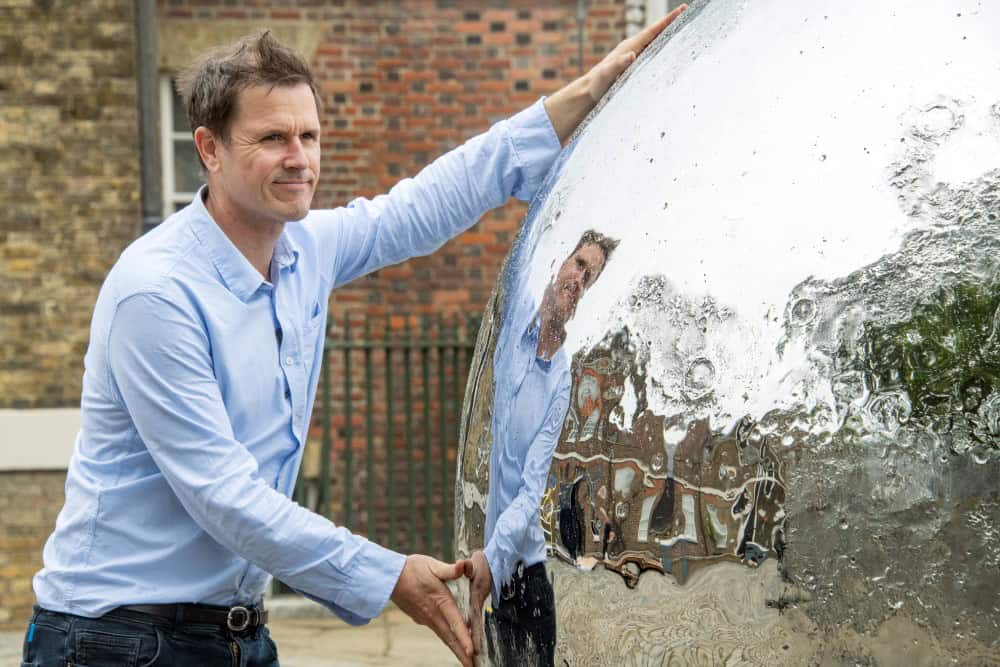
Stunning Moon sculpture unveiled at Royal Observatory Greenwich

A spectacular new lunar art installation has been installed at the Royal Observatory Greenwich.

Dubbed Mirror Moon it has been created by British artist Luke Jerram and is open for public display today at the observatory.

The artwork is 2 m in diameter and is made of stainless steel. It uses accurate topographic data collected from NASA missions to map the features of the Moon onto the mirrored steel surface.

This includes craters, valleys, mountains and smooth lava fields as well as details from the heavily cratered far side of the Moon.

The installation opens as the NASA Artemis crewed missions foster a renewed interest in the Moon. A crewed lunar landing – Artemis IV – is currently set for 2028.

The Royal Observatory Greenwich is the home of Greenwich Mean Time and the Prime Meridian, and since its founding in 1675 astronomers have used the observatory to study the Moon.

Luke Jerram with Mirror Moon

Jerram is best known for his large-scale public engagement artworks including Museum of the Moon and the Earth artwork Gaia, both of which have been displayed internationally.

Jerram says that the observatory has been an “inspiration” for his work as an artist.

“I hope Mirror Moon will inspire generations of visitors to have an interest in contemporary science, art and the wonder of the night’s sky,” he adds.

To mark the installation, Royal Museums Greenwich are selling 20 limited-edition mini versions of the artwork for £2000 each.

Each one is hand signed and numbered by Jerram and includes a presentation box, bespoke display stand and certificate of authenticity.

Novel gravitational-wave model sheds light on dark matter

Physicists have developed a model that predicts how gravitational-wave emission changes when a binary black hole system moves through dark matter. Gravitational waves are ripples in spacetime generated by compact objects spiralling together in a cosmic dance that ends in a violent collision. In the presence of dark matter, these waves may carry an imprint of the surrounding environment. Despite making up over 80% of all matter, dark matter does not interact with the electromagnetic force, and its existence has been surmised only by its gravitational interactions, leaving its precise nature a mystery. Gravitational waves may provide a new way to probe the characteristics of dark matter.

One proposed dark-matter candidate is the light scalar boson, an extremely small particle orders of magnitude lighter than an electron, that can exhibit coherent wave-like behaviour. In the presence of spinning black holes, a process called superradiance can transfer rotational energy into the surrounding field of ultralight boson particles, amplifying the dark matter into a dense cloud around the black hole. These clouds can modify the dynamics of black hole binaries, encoding observable signatures into the gravitational-wave signals that they emit.

To understand what these signatures may look like, an international team of researchers developed a model for gravitational-wave emission from a binary black hole system moving through dark matter. Developing their model required meticulous numerical relativity simulations, but ensuring their results were accurate and reliable proved to be a challenge.

“The hardest part was making sure we truly understood what the simulations were telling us. The danger in numerics is fooling yourself,” explains Josu Aurrekoetxea of Massachusetts Institute of Technology. “You run a simulation, you see an effect, and you have to ask – is that dark matter, or is that my code?”

Working with Katy Clough of Queen Mary University of London and Pedro Ferreira of the University of Oxford, Aurrekoetxea spent several years developing these simulations, before joining forces with Soumen Roy of Université Catholique de Louvain and Rodrigo Vicente of the University of Amsterdam, whose expertise in analytical modelling and data analysis helped the team construct and validate the novel waveform model.

Most work in the field of gravitational waves and dark matter focuses on observations with future space-based detectors such as the Laser Interferometer Space Antenna. “Our motivation was to ask what could already be learned about specific dark-matter models using the LVK [LIGOVirgoKAGRA] gravitational-wave data available today,” says Vicente. “We were surprised to find that some of the more extreme models can already begin to be tested with signals observed by current experiments.”

Searching for these dark-matter imprints, they applied their model to 28 publicly available signals observed by the LVK collaboration, a global gravitational-wave detector network that has observed signals from hundreds of mergers. For each event, the team compared the signal to their predictive dark matter-modulated waveform and the standard waveform for black holes merging in a vacuum.

After rigorous testing, the researchers found that 27 of the 28 events were consistent with gravitational-wave signals expected from binary black holes evolving in empty space. One event, GW190728, showed a slight preference for the dark-matter model, indicating that its signal contains properties consistent with modulations from the presence of dark matter. However, the statistical evidence is not strong enough to claim a confident detection of a dark-matter imprint.

Although only one event demonstrated a preference for the predictive dark-matter model and no definitive claim of a dark-matter signature could be made, the researchers have demonstrated a novel method to probe and characterize dark matter through signatures encoded in gravitational-wave signals.

“Our findings from GW190728 suggest that, if this interpretation is correct and we are seeing a genuine environmental signature, similar effects may appear in future LVK events,” says Roy. Therefore, the next step for the researchers is to extend their analysis to LVK’s fourth observing run. Roy also says that if they can estimate the number and types of events that should carry dark-matter imprints, they can combine multiple signals to test their hypothesis more robustly.

“It has become clear that gravitational waves have tremendous potential to help us understand how matter behaves in the extreme gravitational fields surrounding black holes. This is particularly relevant for dark matter, which may interact only through gravity,” says Vicente. And as more gravitational-wave signals are observed, they provide a promising channel to uncover the elusive nature of dark matter.

The research is described in Physical Review Letters.

The discovery of mesoporous carbon support with characteristic porosity and the art of mastering its use

Want to learn more on this subject?

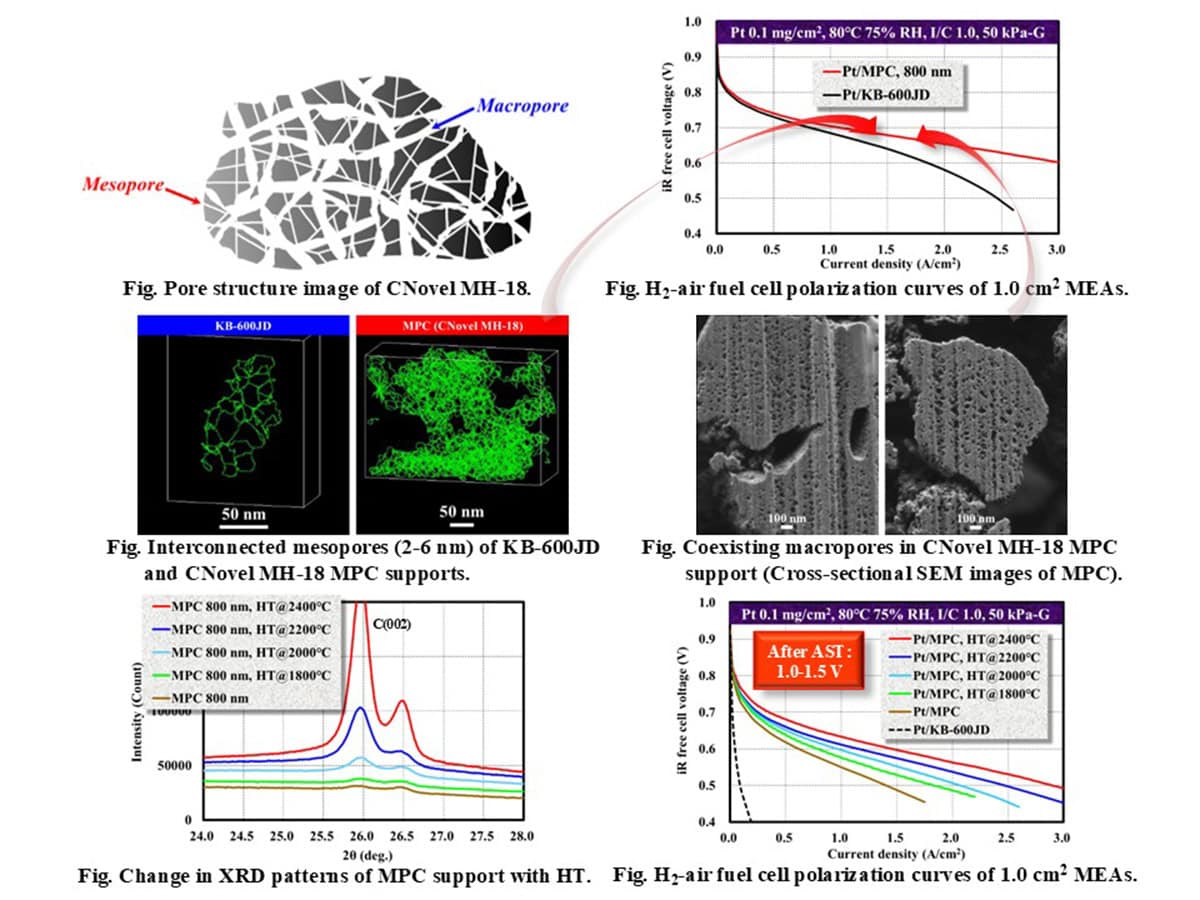
In 2020, Toyota Motor Corporation launched the FC-EV of MIRAI-II adopting mesoporous carbon of nano-dendrite (MCND) support for the PtCo alloy catalyst NPs to suppress ionomer poisoning.  Concurrently, we began using the CNovel® MH-18 mesoporous carbon (MPC) support mass-produced by TOYO TANSO, Osaka, Japan.  The characteristics of the MPC support were entirely different from those of the conventional Ketjen Black EC-600JD (KB-600JD) porous carbon support.

The MPC support has a primary particle size of approximately 2 μm (KB-600JD: 40–50 nm) and consists of isolated particles lacking the chain-like structure seen in KB-600JD.  Thanks to very unique porosity of the MPC support, that is, the coexistence of highly interconnected mesopores (2–6 nm) and macropores, allows oxygen molecules to access the Pt catalyst NPs from all directions within the MPC support, resulting in higher cell voltages compared to the Pt/KB-600JD catalyst at high current density regions.

The MPC support was ground to approximately 800 nm using a bead mill.  Since the grinding generates new surfaces on the MPC support, the ground MPC support was heat treated in an Ar atmosphere at temperatures ranging from 1800°C to 2400°C to improve the durability of the MPC support.  The durability of the Pt/MPC (800 nm) catalyst was evaluated using a triangular-wave potential cycle of 1.0–1.5 V vs RHE in MEAs.  The Pt/MPC (800 nm) catalyst using the freshly milled MPC support exhibited higher durability than the Pt/KB-600JD catalyst.  This is because although new surfaces were formed by bead milling, the purchased MPC (2 µm) was heat treated at 1800°C under an Ar atmosphere during TOYO TANSO’s final manufacturing process.

The durability of the Pt/MPC (800 nm) catalyst increased with rising the heat-treatment temperature, and the catalyst using MPC support (800 nm) heat-treated at 2400°C exhibited the highest durability under a triangular-wave potential cycle of 1.0–1.5 V vs RHE.

XRD and HR-TEM analyses revealed that the carbon (002) plane grew further upon the heat treatment.  The N2 gas adsorption/desorption isotherms measured at 77 K for the MPC supports indicated that porosity of the MPC support decreased with increasing the heat-treatment temperature, and the surface area of the freshly milled MPC support, 1338 m2/g, decreased to 351 m2/g after the heat treatment at 2400°C.  Considering the durability and the porosity retention of the MPC support (800 nm), a heat-treatment temperature in the range of 2000°C–2200°C is considered suitable.

Want to learn more on this subject?

Hideo Daimon completed his MSc in chemistry at the Faculty of Science, Kwansei Gakuin University, in 1984, he joined the research and development department at Hitachi Maxell, Ltd.  At Hitachi Maxell, he conducted research on magnetic materials prepared via chemical routes; friction and wear of thin-film magnetic recording media, protective coatings and lubricants for the thin-film media, and electrodeposition and electroless plating of Ni and Ni-P films.

In 2000, he began synthesizing PtFe, PtRu and Pt nanoparticles for use in fuel cells. Daimon moved to Doshisha University in 2010, where he has been researching Pt and Pt-based catalysts used in cathodes for PEFCs, including Au@Pt- and Pd@Pt core-shell structured catalysts, as well as PtCo alloy catalysts.  Currently, he is engaged in research on mesoporous carbon supports to enhance the cell performance and durability of PEFCs applied to FCEVs.

ecs-biologic-high-current-hitachi-high-tech-logo

‘Galactic archaeologists’ share the 2026 Kavli Prize in Astrophysics

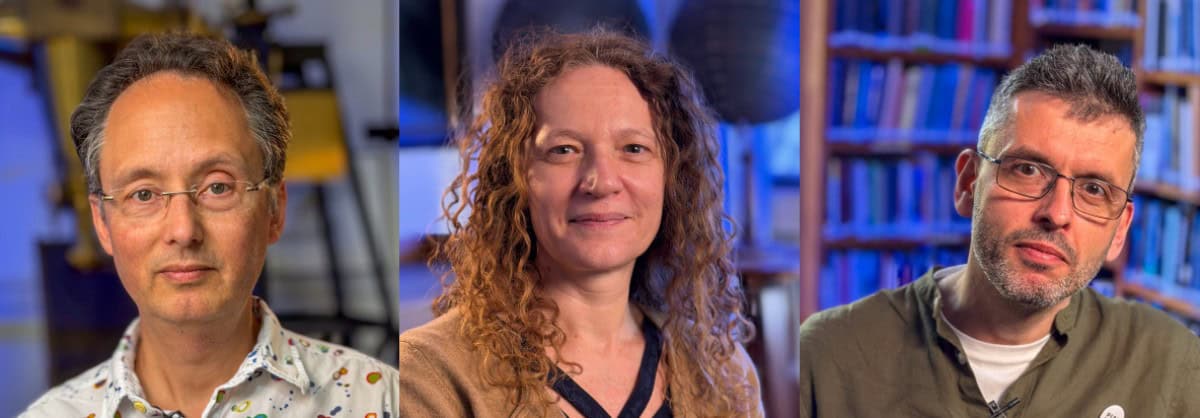
The 2026 Kavli Prize in Astrophysics is awarded to Vasily Belokurov, Amina Helmi and Rodrigo Ibata, “for uncovering the fossil evidence of past mergers proving that the Milky Way galaxy was built through hierarchical accretion”.

Belokurov is at the UK’s University of Cambridge; Helmi is at the Kapteyn Astronomical Institute at the Netherlands’ University of Groningen; and Ibata is at France’s University of Strasbourg.

Photo of the three Kavli laureates

This episode of the Physics World Weekly podcast features an interview with Helmi and Per Barth Lilje, who is chair of the Kavli Astrophysics Prize committee and is based at Norway’s University of Oslo.

In a wide-ranging conversation, we explore the history of the Milky Way and why the work of the Kavli laureates provides crucial evidence that our galaxy was formed by the merger of smaller dwarf galaxies. We talk about what hierarchical accretion tells us about dark matter and the Standard Model of cosmology – and we look forward to the future of the Milky Way.

  • Belokurov, Helmi and Ibata share the $1m prize money equally. The prize will be awarded in Oslo in September

This podcast is sponsored by The Kavli Prize.

Copyright © 2026 by IOP Publishing Ltd and individual contributors