The first results from NASA’s Gravity Recovery and Interior Laboratory (GRAIL) mission have been released. The new high-resolution gravity data reveal surface structures that were not previously seen. The data have also shown that the lunar crust is less dense and more fractured by massive impacts than had previously been thought. The mission has also spotted subsurface dykes buried deep within the lunar surface – these suggest that the Moon experienced a period of expansion while it was still forming. Furthermore, the GRAIL data have been used to create the highest resolution gravity map of a celestial body other than Earth.
Launched in September 2011 from Cape Canaveral in the US, the main aim of the $495m mission is to accurately map the gravity of the Moon using twin spacecraft named Ebb and Flow. GRAIL entered lunar orbit in December 2011 and its prime-mission science phase stretched from 1 March to 29 May this year, during which its twin spacecraft were in tandem orbits around the Moon at an average altitude of 55 km.
Far side of the Moon
The Moon is an ancient, airless, waterless body that is untouched by erosion – this means that its surface and interior preserve a record of what was going on in the young solar system. However, it has been difficult to study the Moon’s gravity and interior in its entirety because only one hemisphere ever faces the Earth. To overcome this, the GRAIL mission involves the continuous monitoring of tiny changes in the distance between two spacecraft as they orbit the Moon. These changes are caused by perturbations in the Moon’s gravitational field, which are related to topographic features and changes in density below the lunar surface. From these measurements, the researchers stitched together a high-resolution gravity map that shows that the Moon’s internal gravitational field is consistent with an extremely fractured crust.
Three papers based on the new data have been published in the journal Science by the international team of GRAIL researchers. In the first paper, head of the GRAIL mission Maria Zuber, of the Massachusetts Institute of Technology, and colleagues focus on the overall gravity map of the Moon and point out previously unseen tectonic structures. These include volcanic landforms, basin rings and crater peaks. Surprisingly, the team also found evidence that beneath the surface the lunar crust is almost completely pulverized. This suggests that during the first billion years of its life, the Moon may have endured much more fracturing from massive impacts than previously thought. This would also apply to the Earth and other terrestrial planets, and could have an important effect on planetary evolution.
To find the gravitational field for the Moon’s interior alone, Zuber’s team used topographic measurements from a laser altimeter aboard the Lunar Reconnaissance Orbiter (LRO), a separate spacecraft in orbit around the Moon. The scientists calculated the gravitational field that they expected the Moon’s topography to produce and then subtracted that field from the field measured by GRAIL. The team found that most of the local variations in the Moon’s gravity are caused by surface features, such as crater rims and mountains.
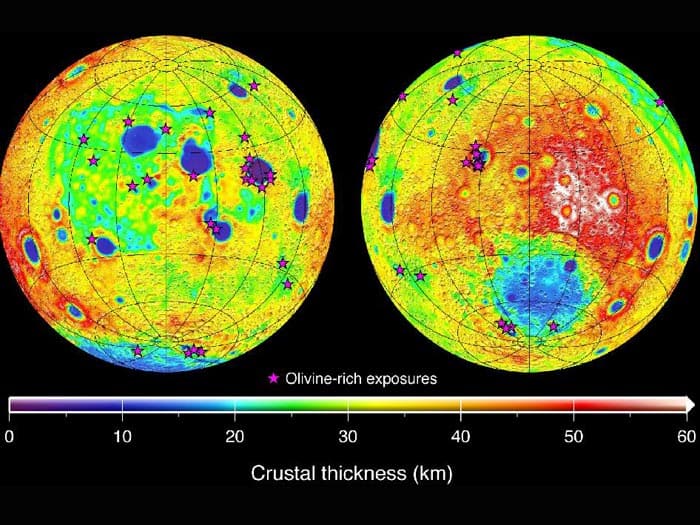
In the second paper, Mark Wieczorek, of the Institut de Physique du Globe de Paris, and colleagues show that the density of the Moon’s upper crust is less than previously thought and probably more porous. In most places on the Moon, they researchers found that the crust ranges in thickness from 34–43 km. However, the team also found that the crust beneath some major basins is now almost non-existent, indicating that early impacts may have excavated the lunar mantle.
Expanding theories
In the third paper, Jeffrey Andrews-Hanna, of the Colorado School of Mines, and colleagues report that the lunar crust appears to be riddled by igneous dykes. These are large sheets of cooled magma – hundreds of kilometres across – that seeped into the crustal fractures. The team believes that the dykes may have formed during a period of expansion early in the Moon’s history. According to Zuber, such fractures could affect the way a planetary body loses heat, while providing a pathway for the transport of fluids in its interior.
The researchers also point out that both GRAIL spacecraft have performed better than expected – the spacecraft are 200 km apart and they need to accurately measure the changes in the distance between them to within a few tenths of a micron per second. Instead, the spacecraft have outperformed and can resolve changes in distance to several hundredths of a micron per second.
Currently, GRAIL is on its extended mission for another three months, for which the team has a new set of objectives. The spacecraft have been lowered to half their original altitude; being closer to the Moon’s surface will greatly increase the resolution of collected data. The researchers are keen to see what new results the data will reveal.
“Nothing” is a tricky concept. Consider Descartes’ peculiar argument against the possibility of a vacuum: “If someone asks what would happen if God were to take away every single body contained in a vessel, without allowing any other body to take the place of what had been removed, the answer must be that the sides of the vessel would, in that case, have to be in contact. For when there is nothing between two bodies, they must necessarily touch each other.” Descartes, like many others, has confused the concept of a vacuum with that of nothing: a vacuum is empty space, but the empty space in the bell jar is still something. It has properties such as size and shape even if it fails to contain matter.
The distinction between a vacuum and nothing plays a central role in both Jim Holt’s Why Does the World Exist? An Existential Detective Story and Lawrence Krauss’s A Universe From Nothing: Why There is Something Rather than Nothing. By their titles, one might expect Krauss’s book to answer Holt’s question. But both authors tend to run together two distinct questions. One – Holt’s main quarry – is “Why is there something rather than nothing?” In Krauss’s book, the question that predominates is “How can something come from nothing?”
The predilection to regard these two questions as equivalent is puzzling, for no-one would confuse the question “Why is the universe matter rather than antimatter?” with the question “How can matter come from antimatter?”. The fact that “nothing” means different things in the two questions makes the muddle more severe. The nothing in Holt’s question is a state of universal and total absence: no matter, no fields, no laws, no space, no time, ever. The nothing in Krauss’s question is a different beast: for most of his book, “nothing” means a vacuum state in some physical theory.
Holt is a journalist with a background in philosophy, and his question is philosophical, so he consults philosophers. Adolf Grünbaum argues that there is no problem: the felt need for an explanation arises from an unjustifiable conviction that nothingness is somehow more probable or expectable than the existence of something. Absent any principle for preferring nothing over something, no explanation is required. Holt finds no flaw in Grünbaum’s argument, but it still does not feel right to him, so he presses on with other philosophers, physicists, theologians and even the novelist John Updike. It makes for an amusing and stimulating, if somewhat picaresque, tale; one recurring motif is that Holt imbibes significant quantities of alcohol while his interlocutors prefer caffeinated beverages.
Holt’s other interviewees include the theologian Richard Swinburne, who opines that the physical world exists because God made it and punts on the question of why God exists. Philosopher Derek Parfit focuses on the form that an explanation might take, considering how some property of the universe might account for its existence. Parfit calls such a property a “selector”. For the speculative cosmologist John Leslie, the selector is goodness: Leslie suggests that the universe exists because it is good, and hence ought to exist. One might also imagine other properties playing the explanatory role, such as simplicity or variety, but Parfit’s idea is that if there is a selector, we can get evidence for what it is by seeing which property (if any) the universe maximally exemplifies. This idea leads Holt, by a somewhat convoluted argument, to suggest that the relevant property might be mediocrity.
The physicists that Holt consults tend to be more on Grünbaum’s side. Steven Weinberg and David Deutsch both recognize the hopelessness of the explanatory regress: anything one invokes to explain the totality of existence must itself be something that exists. One can react to this by saying that we are always stuck with a mystery – or, as Grünbaum would prefer, by saying that there is nothing mysterious since no answerable question is left unanswered.
In his book, Krauss approaches the subject of nothingness as a cosmologist, and his question offers rather more for physicists to investigate. Suppose there is a certain physical state, not of the whole of existence but rather of just a part, that deserves the name “vacuum state”. The current universe, filled with stars and dark matter and radiation, is certainly not in that state. But the laws of physics might allow the current universe to evolve from the vacuum state. If that happened, and if we call the vacuum state “nothing”, then one can say that physics explains how something came from nothing.
If we call a vacuum state “nothing”, one can say physics explains how something came from nothing
Despite its title, however, the majority of Krauss’s book does not discuss this possibility. Rather, it summarizes our current cosmological picture of the history and fate of the observable part of the universe. We have strong evidence, for example, that the visible part of the universe currently consists of about 70% dark energy, 25% unknown dark matter, 4% invisible known matter and only 1% visible known matter. Observations indicate that the dark energy is causing the universe to expand at a quickening pace, and we can speculate where that will lead.
Krauss explains the evidence clearly and accessibly, and offers an important story about the triumphs of modern cosmology. But by itself, it does nothing to address either of our two questions, and Krauss does not really confront Holt’s question at all. He does devote some effort to arguing that the vacuum state can properly be called “nothing”, so that the current universe arising from a vacuum would be an instance of “something from nothing”. But that is not the same thing.
Let’s break down the issue into three parts. First, what can we reasonably surmise about the state from which the current universe arose? Second, by what right (if any) should such a state be called a vacuum state? Third, even if the current state arose from a vacuum state, why should we think that that would end our explanatory regress?
Unlike the detailed claims of modern cosmology mentioned above, the nature of the pre-inflationary state of the universe is a matter of conjecture. Was there any state that preceded our Big Bang, and if so was there anything before that? Does the very temporal notion of “before” break down, and if so, why say that the current state came from some other one? Does the regress in time go on forever or come to an end with an initial state? We have no clear answers to any of these questions, although various inflationary scenarios and hints from string theory provide fodder for speculation.
Krauss’s main argument for calling the initial state “nothing” arises from considerations of energy. He argues that according to a certain way of quantifying the total energy content of the universe, including the gravitational energy, the entire current universe might have zero energy. Wouldn’t that mean that we could get the universe “free”: something from nothing?
Well, no. As Krauss acknowledges, the calculation of total energy in Newtonian gravitational theory uses an arbitrary choice of gauge for the gravitational potential energy. The amount of potential energy can be changed at will without affecting the physics, and can in particular take negative values by choosing one particular state as the “zero potential energy” state. Given this freedom, one can make a choice that sets the total energy to zero, but one can also just as legitimately set it to any value one wishes.
Shouldn’t we be using the general theory of relativity rather than Newtonian gravity in any case? Perhaps, but as Krauss also admits, there is no accepted method for ascribing a gravitational potential energy in the general theory, much less a precise value of negative energy. Krauss does argue that we have good reason to think that the current universe is (nearly) flat, but this is not the same as “zero energy”.
Suppose all this could work out, and we came to see our universe as arising from some sort of quantum vacuum. We would still have the same question: why did things start out that way? Physicists invoke their own selector here, and it is neither goodness nor zero energy: it is symmetry. The “false vacuum” of inflationary theory (which Krauss mentions but does not explain) is not special because of its moral or its energetic properties: it is special because of its symmetries. Physicists apparently regard these symmetries as making the state “to be expected” or “not in need of further explanation”. Why this should be so is a question that neither of our authors manages to confront.
George Dyson has written a fascinating but flawed history of the computer. The son of the distinguished physicist Freeman Dyson, he was born in 1953 and as a child was witness to the world of computing unfolding at the Institute for Advanced Study (IAS) in Princeton, New Jersey, where his father was a professor. In Turing’s Cathedral: the Origins of the Digital Universe, he revisits the scene of his childhood in order to set local events in the context of global computer development. The impression is of a child not quite making sense of the grown-up world (rather like the children in To Kill a Mockingbird).
The most glaring flaw in the book is that Dyson claims that the IAS computer was the first practical computer that ushered in the dawn of the computer age. Fact: the first practical computer was the EDSAC, completed at the University of Cambridge in May 1949; the IAS computer first worked some 18 months later, and several other computers came on stream between these dates. This error is a great shame because there is in this book an important story that deserves to be told – and Dyson has told it well – but the book’s credibility is undermined by this petty claim about the priority of the IAS computer over other machines, and a sprinkling of other historical infelicities. Otherwise, the book is meticulously researched: Dyson has made extensive use of the Princeton University archives, visited numerous other archives, and interviewed several of the participants – now mostly in their 80s. He has also raided the Princeton archives for a superb set of photographs.
The central figure in the book is John von Neumann. During the Second World War, Von Neumann was a consultant to the Manhattan Project at Los Alamos, and was heavily involved in the intensive mathematical calculations needed to design the atomic bomb. In 1944 this need for calculating power led him to the ENIAC, a clumsy electronic behemoth built by the University of Pennsylvania for the US Army’s Ballistics Research Laboratory. Von Neumann collaborated with the designers of the ENIAC to produce a more effective design, which we now know as the stored-program computer – the blueprint for the post-war computer revolution.
Prior to his involvement with the ENIAC team, Von Neumann had become aware of Alan Turing’s theoretical work on computing, which Turing had carried out in 1936 at Cambridge before becoming a research student at Princeton University. Von Neumann was the only member of the ENIAC group who was aware of Turing’s work and the degree to which it influenced the stored-program computer is uncertain. Dyson has no such uncertainties, hence the title of the book.
After the war Von Neumann established a project to build a computer at the IAS. The IAS, the epicentre of theoretical science, was decidedly sniffy about hosting a bunch of engineers and their machinery. But the development was allowed to go ahead, tucked out of sight in the basement of the mathematics department, next to the men’s toilets. Dyson gives an excellent account of the academic politics and the engineering heroics that brought the computer into existence.
Although the IAS computer was not the first, it was probably the most influential computer design of its era. Moreover, at least as important as the computer itself were the seminal reports produced by Von Neumann and his colleague Herman Goldstine between 1946 and 1948 that were eagerly devoured around the world. The IAS computer (which Dyson incorrectly calls the MANIAC; in fact it was never named) had numerous clones, including the (real) MANIAC at Los Alamos, the JOHNNIAC at the RAND Corporation, ORACLE at Oak Ridge, SILLIAC at the University of Sydney, the WEIZAC in Israel and a dozen more. Further, Von Neumann was a consultant to IBM, which based its first mainframe computers on the IAS design. But this was a time of simultaneous invention, and had the IAS computer not been built we would be in much the same place today.
In the post-war period, Von Neumann earned a reputation as one of the most hawkish of scientists, becoming a member of the Atomic Energy Commission and an advocate for the H-bomb. The MANIAC computer was built primarily for nuclear-weapons calculations, and it was at Los Alamos that Von Neumann and Stanislaw Ulam invented the famed Monte Carlo method. When conventional computer methods were too slow or intractable, the Monte Carlo method could be used to evaluate a system at random points. The result was a kind of scatter diagram that approximated the result – the more points evaluated, the greater the precision. The Monte Carlo method was soon applied across the sciences. Von Neumann went on to apply similar techniques to numerical weather prediction, presaging today’s massive use of high-performance computers for meteorological forecasting.
Dyson’s odyssey into the origins of computing takes in Von Neumann’s last brilliant foray into the theory of self-reproducing automata. Like Turing, Von Neumann was fascinated by the computer’s potential for autonomous behaviour. Whereas Turing speculated on the ability of a computer to think, Von Neumann pondered on the power of machines to reproduce themselves. He devised minimal (and entirely theoretical) cellular automata that could asexually reproduce themselves. As it happened, neither of them outlived the 1950s. Turing, as is well known, committed suicide in 1954. Von Neumann died of cancer in 1956; he was a witness to the 1946 Bikini nuclear tests, and the cancer may not have been unconnected. Both Turing’s and Von Neumann’s speculations of the 1950s remain distant but not-forgotten prospects.
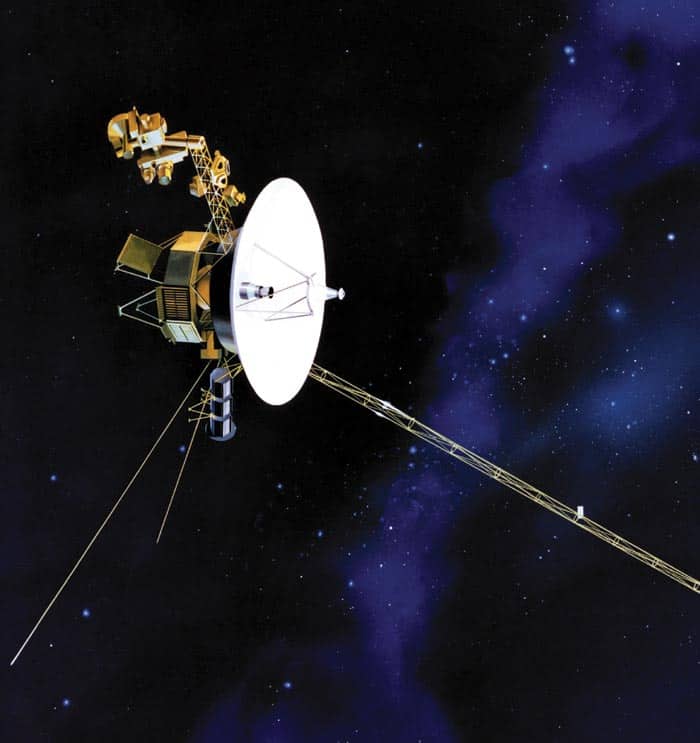
In the summer of 1977, as the strains of David Soul, Abba and Hot Chocolate wafted from their transistor radios, most physics students were busy cramming an extra pair of flares into their rucksacks in preparation for a trip on the highways of North America or the railways of Europe. Few would have been aware that two Voyager spacecraft were about to be launched on journeys of their own, on 20 August and 5 September 1977 respectively, towards the gas giants of our solar system. Yet even avid followers of the development of these pioneering planetary probes could not have possibly guessed that the Voyager mission of exploration would continue, unabated, for the duration of their professional careers.
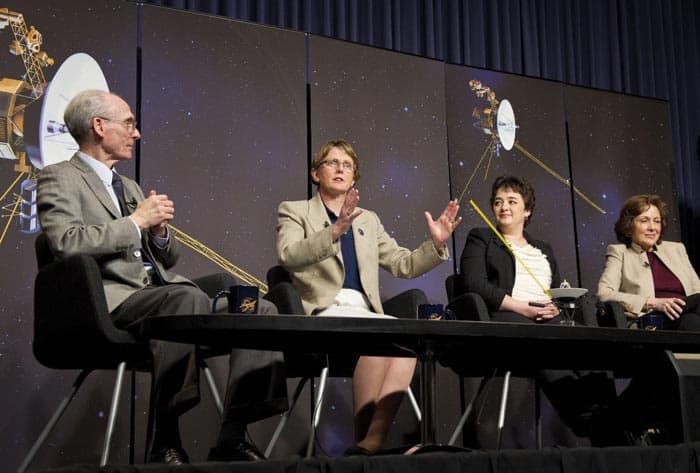
One of those young physicists was Linda Spilker, who had graduated earlier that year and applied for a job at the Jet Propulsion Laboratory (JPL) in Pasadena, a peaceful and relatively green suburb of the Los Angeles conurbation. “My interview went well and I was offered a job,” recalls Spilker. “I had a choice between working on the Viking extended mission or on a new mission called Voyager. Having never heard of Voyager, I asked ‘Where is Voyager going?’ ” When she heard the craft were going to Jupiter, Saturn and maybe on to Uranus and Neptune, she immediately replied: “Sign me up!”
The JPL project scientist for Voyager at the time – and the man still most likely to be identified with the mission – was Edward Stone. Stone had joined the California Institute of Technology (Caltech), which operates JPL under contract to NASA, in 1964 to help establish a research programme in space physics. Today, he is a professor of physics at Caltech and – as testament to his long-standing contribution to the mission – remains the Voyager chief scientist at JPL. As for Spilker, she worked on Voyager from early 1977 until it flew past Neptune in 1989 and is now the project scientist for the Cassini mission to Saturn, with which she has been involved since 1988.
A cursory glance at the career timelines of these two scientists suggests that long-term NASA missions retain the concept of a “job for life” familiar to workers of the 1970s. But given that planetary missions are years in the planning and the resulting spacecraft then take years to reach their targets, what is it that keeps planetary scientists focused on the task and sufficiently interested to devote a good portion of their careers to what is basically a hi-tech form of data collection?
Grand ambitions
The 1970s were heady days in space exploration for NASA, with the Apollo lunar programme taking most of the limelight at the beginning of the decade. But scientists were already looking further afield. Spacecraft fly-bys of Venus and Mars had been successfully conducted as early as 1962 and 1965, by Mariner 2 and 4 respectively, and preparations were under way for the Mars-Viking landing mission. Next in line were the gas giants.
Old timers and young guns
As a “first feel” beyond the asteroid belt, which encloses the inner four planets (Mercury, Venus, Earth and Mars), a pair of 250 kg spacecraft called Pioneer 10 and 11 were launched towards Jupiter in 1972 and 1973, and they conducted fly-by missions in 1973 and 1974, respectively. A combination of powerful rockets, favourable launch windows and relatively lightweight spacecraft produced uncharacteristically fast journey times, which gave the misleading impression that solar system exploration could be done on the timescale of a typical PhD.
Meanwhile, funding was becoming an issue and an extravagant “Grand Tour” mission to Jupiter, Saturn, Uranus, Neptune and beyond – planned as a result of a fortuitous alignment of the planets – was shelved. However, all was not lost. As Stone explains, “When NASA decided in early 1972 that the budget would not support such a mission, JPL proposed ‘Mariner Jupiter Saturn 1977’, a much lower-cost four-year journey to Jupiter and Saturn”. The mission was later renamed Voyager and in 1977 the sister probes were launched to Jupiter and beyond.
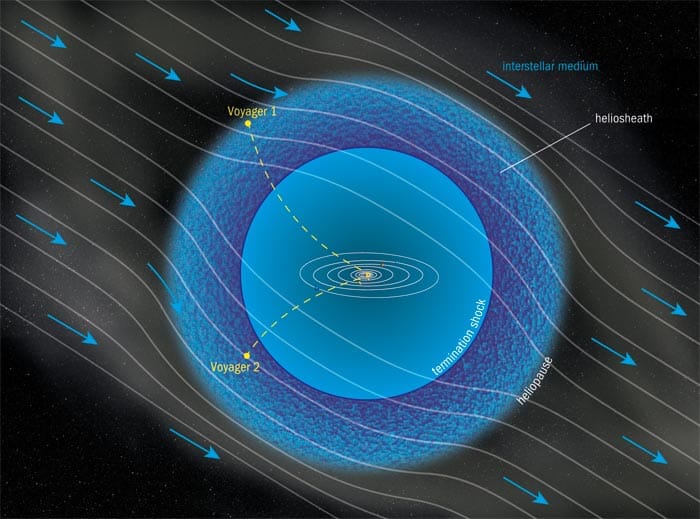
Following fly-bys of Saturn in 1980 and 1981, Voyager 1 was targeted out of the plane of the solar system and veered off towards its edge, while Voyager 2 continued the tour to Uranus (in 1986) and Neptune (in 1989, some 12 years after launch). According to Stone, the possibility of exploring beyond the planets was part of the scientific planning for the Grand Tour. By 1970 astronomers had realized that the supersonic expansion of the solar corona, known as the solar wind, creates a giant plasma bubble around the Sun. Called the heliosphere, the bubble envelops all of the planets and serves as a shield against the interstellar wind, impeding the entry of cosmic rays from outside. “A mission to interstellar space would provide the first opportunity to directly determine what is outside pressing to get in,” says Stone, explaining the reasoning for splitting the Voyager mission.
Voyager 1 officially began the Voyager Interstellar Mission on 1 January 1990, passing the long-defunct Pioneer 10 to become mankind’s most distant artefact on 17 February 1998.
Knowing the unknown
At a fundamental level, the motivation behind these planetary missions is part of humankind’s unending quest to know the unknown. Stone characterizes this quest by dividing what Star Trek termed “the final frontier” into three: expanding our knowledge of all that is around us (the knowledge frontier); developing new systems to observe the solar system (the technology frontier); and actually sending those craft to new places (the physical frontier). “Expanding these three frontiers of space often involves long journeys that are not without risk,” says Stone, “but the opportunities to learn about the diversity of objects in the solar system are unequalled.” Stone’s analysis is thoughtful, but fails to explain why some scientists dedicate much of their professional lives to a long-term mission such as Voyager.
Spilker says her 12-year stint on Voyager was fuelled by a sense of “being an explorer, of seeing worlds and vistas that no-one had seen before”. For her, the thrill lay in witnessing volcanoes on Io and geysers on Triton, plotting the structure in Saturn’s rings and being the first to see the Uranian satellites and rings up close. “Each fly-by left me with a sense of wanting to see more,” she says.
Worlds and vistas
Planetary scientists are apt to use phrases such as “we are now at Jupiter”. Of course, they mean their spacecraft and its scientific instruments are at Jupiter, but there is more to it than that. They seem to transport themselves to the planet in question, vicariously enjoying the view from imaging telescopes on board the spacecraft. However, they have to be patient. Although Spilker stayed with Voyager until the Neptune encounter in 1989, she had already become involved with planning the Cassini mission to Saturn, a liaison that continues to this day. While the pace of Voyager’s progress through the solar system had not exactly been brisk, it had not prepared her for the protracted timescale of Cassini. “One of the negatives of working on Cassini was that I had to wait much longer for, first, the launch in 1997, then the long trip to Saturn, before going into orbit and getting science data in 2004,” she says.
The reason for Cassini’s lengthy seven-year cruise to Saturn is one of basic physics: specifically, the relationship between mass, velocity and inertia. In the two decades since Voyager was launched, spacecraft had developed significantly in terms of complexity, and thus mass, in order to encompass the enhanced expectations of space scientists. Cassini carried the European Space Agency’s Huygens probe, which was dropped onto Saturn’s Moon Titan, bringing the total launch mass to some 5600 kg – eight times that of Voyager. Not only did this mass have to be accelerated out of Earth’s gravity well, but it also had to be decelerated at Saturn, which required additional onboard propellant and hence yet more mass. The solution was to fly a gravitational-assist or “sling-shot” trajectory that exchanged momentum first with Venus and then Jupiter to provide propulsion without expending propellant. In the event, Cassini performed gravity-assist fly-bys of Venus in 1998 and 1999, of Earth in 1999 and of Jupiter in 2000, finally arriving in orbit around Saturn in July 2004. When the Huygens probe eventually parachuted through Titan’s atmosphere to land on its alien surface, it produced some fascinating science (see “Tuning into Titan” February 2006 pp20–23).
All in the family
Despite the wait, Spilker is positive about being involved in long-term missions. “It was exhilarating to be part of designing the next Saturn mission from the ground up, seeing the instrument teams selected, the spacecraft built and then launched,” she says. Equally important, however, is the “sense of family” that develops during the years of working on long-term missions. “This strong connection to the Voyager family (and now the Cassini family) is one of the things that made me want to stay for the long haul with both missions,” says Spilker. “Even though I have moved to Cassini, I still root for Voyager to reach the edge of the solar system and read about its latest accomplishments with a great deal of pride and pleasure.”
This sense of family is further illustrated by a tendency to anthropomorphize the spacecraft. Spilker remembers the time a spacecraft automatically switched itself into “safe mode” because its onboard computer detected an anomaly. “I started rooting for it to recover…I worried about the health of Voyager as though it was a friend or even one of my children.”
Far out
But what about keeping up with one’s real family? Balancing a profession and a family can be challenging at the best of times. “Personally, I had to interweave my personal life with my professional life,” admits Spilker, which affected the timing of starting a family. “When I tell my daughters that their births are based on the alignment of the planets, I mean that! There was a five-year window between the Voyager Saturn fly-by in 1981 and the Uranus fly-by in 1986 when I had both of my daughters. Other Voyager moms made similar choices.”
Still, in common with many professions, space science can mean long hours away from the family and outside life. “Working on planetary missions provides a cadence for your life that is driven by the needs of the mission,” says Spilker. “When a mission is active – such as during a planetary fly-by, planetary orbit insertion or roving on the surface of a world – activities outside JPL become secondary for a time and the focus is on the success of the mission.”
On the other hand, Spilker was able to share the excitement of her job during family visits and “take your daughters to work days”. And just like any other group of mothers, the Voyager parents took their children to the same schools, attended the same daycare and often compared notes about raising a family.
Apart from having children, what do space scientists do to occupy themselves during the long hiatus of the cruise phase? According to Stone, for Voyager this was not as much of an issue as first appears. “With six encounters in the first 12 years, the 11 science teams were kept very busy analysing data from each encounter while also planning the observational sequence for the next.” He concedes, however, that when Voyager 1 began heading for interstellar space in 1990, the pace of discovery changed.
In fact, most space scientists are involved with more than one mission at a time, to an extent dependent on the mission phase. For example, during the 40 years of Stone’s association with Voyager, he has also participated in missions such as Galileo (to Jupiter), SAMPEX (studying the Earth’s magnetosphere), ACE (looking at energetic matter from the solar wind and interplanetary space) and STEREO (studying the Sun), the latter two of which are still operational.
Moreover, the results from one mission can continue to be useful long after data collection. According to Spilker, during the long cruise phase of Cassini, “many of us went back to further study the Voyager data to look for clues on how to use our new instruments”. In parallel, she worked on concepts for a mission to Mercury and for orbiters around Uranus and Neptune.
Job for life?
So how do today’s young scientists view the prospect of working on such long-term missions? Understandably, a seven-year cruise must seem like a lifetime when you are 21. Yet Spilker is surprised by how many young people want to work on long-term missions. “On Cassini, we had more than 50 scientists, the vast majority early-career scientists, competing for those spots,” she says.
One of them was Estelle Deau, who arrived in post just as Cassini was about to enter orbit. “At first I thought the timing was perfect,” she says, “but I was not fully prepared for the mission, especially the observation planning.” In retrospect, she admits she would have preferred to have been there from day one, to be able to prepare her own observation plan. Clearly, the sense of “data ownership” is strong, even among the young.
Going strong
As a result of this competitive spirit, the qualification density at JPL is fairly high. Speaking in May at the Spacecraft Technology Expo in Los Angeles, deputy director Eugene Tattini said that 31% of employees have a PhD, 33% a Master’s or similar and 27% a first degree; only 9% have no degree. “Everyone at JPL has a doctorate except the janitor and the deputy director,” he joked. “The difference is the janitor is working on his dissertation!”
In confirmation that young people remain attracted to space science, Tattini painted JPL as a cross between an academic institution and a Silicon Valley start-up. “A discovery is typically made at 3 a.m. in a lab, by a person who probably never wore long pants,” he said, with a nod to their preference for beach shorts and other less formal attire.
To boldly go…
Since the Voyager Interstellar Mission began in 1990, Voyager 1 has been speeding towards the notional edge of the solar system at around 60,000 km/h, or some 3.6 AU per year (where one astronomical unit, or AU, is the Earth–Sun distance of 150 million km). In December 2004 it crossed a feature known as the termination shock, at about 94 AU, and entered the heliosheath (see “Voyagers probe the heliosphere”). It is currently some 18 billion km (122 AU) from Earth, at a point where its radio signals, travelling at the speed of light, take an unbelievable 17 hours and 19 minutes to reach us. (Check where it is right now at http://voyager.jpl.nasa.gov/where/index.html.)
The location of the heliopause – the boundary with interstellar space – is not known, but it has been estimated that Voyager will reach it about 10 years after crossing the termination shock, which could be anytime soon. Indeed, according to Stone, the spacecraft has already been monitoring a gradual increase in galactic cosmic rays for the past three or four years, and from May this year, “cosmic ray hits have increased 5% in a week and 9% in a month”. Although that increase does not prove anything yet, scientists expect a precipitous drop in the number of energetic particles detected from within the heliosphere as the spacecraft crosses the heliopause, and that number has already been falling. A further indication of the breakthrough will be a change in the orientation of magnetic field lines, which are expected to rotate from east–west towards a more north–south direction.
Voyagers probe the heliosphere
“When the Voyagers launched in 1977, the space age was all of 20 years old,” reflects Stone. “Many of us on the team dreamed of reaching interstellar space, but we really had no way of knowing how long a journey it would be – or if these two vehicles that we invested so much time and energy in would operate long enough to reach it.”
Spilker remains optimistic about the prospect: “When I think of the Voyagers today, I think of the Energizer Bunny. They keep going and going…to the very edge of the solar system.”
Most physicists will appreciate the excitement of the search for another “data point” in their own particular field, but probably find it more difficult to appreciate a similar thrill in another field. Stone helps to put Voyager’s continuing mission in context. “Detecting the edge of the heliospheric bubble will be a historic milestone in humankind’s longest journey. Inside the bubble the solar wind and the magnetic field come from the Sun; that’s where the Voyagers have been for the last 35 years and where all of the planets and most of the Kuiper Belt Objects are. Outside, the wind is from the supernova explosions of nearby stars that occurred five to 20 million years ago.”
The only question remaining is how much longer the Voyagers can last. Will they ever be pensioned off – or are they, like the people who devote their careers to them, on a mission for life?
For the first time, astronomers have determined the chemical composition of gas from the first billion years of the universe’s life. The gas consists mostly of neutral hydrogen atoms, which means that it may mark the era before stellar radiation began ionizing the universe. Furthermore, the gas shows no signs of the heavy elements that are forged in stars so it may contain only the light elements produced by the Big Bang.
“We are starting to look back to the epoch that is probably when the first stars were turning on,” says Robert Simcoe, an astronomer at the Massachusetts Institute of Technology who built the instrument that acquired the spectrum of the far-off gas. “This is the very first [chemical] measurement that anybody has made in any environment at these early times.”
The Big Bang, which occurred 13.7 billion years ago, showered the cosmos with hydrogen and helium. Aside from a trace of primordial lithium, heavier elements – which astronomers call metals – arose later, after stars formed and exploded, casting oxygen, iron and other metals into space. Furthermore, the first stars radiated extreme ultraviolet light that ionized gas, tearing electrons from the hydrogen nuclei. The universe is still ionized today.
Farthest known quasar
To analyse the ancient gas, Simcoe and his colleagues examined the farthest known quasar. Named ULAS J1120+0641, this quasar resides in the constellation Leo and is so distant that its light travels 12.9 billion light years before reaching Earth. We see the quasar as it was just 770 million years after the Big Bang.
While the quasar’s light races toward Earth, space between the quasar and us expands, stretching the wavelength until it is 708% longer than it was at the start of its journey. Thus, astronomers say the quasar has a redshift of 7.08. Because of the high redshift, what was once far ultraviolet radiation appears to us at infrared wavelengths. To obtain the infrared spectrum, Simcoe’s team used the Magellan telescope in Chile.
The gas itself is much too faint to see. But quasars mark the brilliant centres of some galaxies, so Simcoe’s team searched for wavelengths at which intervening gas absorbed the quasar’s light. The gas is probably a few million light years from the quasar, he says, and so has no connection to it.
Two tantalizing scenarios
Simcoe presents two different scenarios to explain his team’s findings. “Either is interesting,” he says. The more likely: we are seeing the diffuse gas that pervaded space 770 million years after the universe’s birth. If so, then because the gas is neutral, it means astronomers have reached the epoch before reionization had fully occurred. Furthermore, the lack of detectable metals indicates the gas has no more than 1/1000 the metal-to-hydrogen ratio, or metallicity, of the Sun.
Alternatively, the gas could exist in a protogalaxy that happens to lie in front of the quasar. In that case, the metallicity of the gas is less than 1/10,000 solar – comparable to the most primitive star known in the Milky Way’s halo.
“This observation is bringing us directly to where the evolution of the cosmic metallicity started,” says Michele Fumagalli, an astronomer at the Carnegie Observatories in Pasadena, California, who was not part of the research team. “This is very exciting, and I think we are now really entering a new frontier for these types of studies.” Last year, Fumagalli and his colleagues discovered metal-free gas that existed two billion years after the Big Bang – a surprise, since all other gas at that time contains metals. In contrast, the new work reaches much further back in time.
Huge galaxy in the making?
However, Abraham Loeb, chairman of the astronomy department at Harvard University, offers a third explanation for the new observation: the gas is falling onto the galaxy that hosts the quasar. “Usually these very bright quasars reside in massive galaxies, and these massive galaxies grew dramatically during early times through in fall of gas,” Loeb says, noting that the observed gas differs in velocity from the quasar by only 711 km/s. If his idea is right, then we are watching the construction of one of the largest galaxies in the universe.
Whatever the case, Simcoe says, “We have got to find some more of these things. When you look at the first of something, you hope that it is representative, but until you see a few more, you cannot say for sure.”
Although astronomers have glimpsed galaxies at greater distances than this quasar, these galaxies are too faint to use in studies of foreground gas. Instead, such investigations require additional far-off quasars, which serve as brilliant background beacons whose radiation probes the nature of gas from the dawn of time.
Simcoe and his colleagues are publishing their work online today in Nature.
The latest Physics World special report, which examines the challenges for physicists in India, is ready for you to read online now.
The report contains a great mix of news, features and opinion, including a look at the work carried out a top research centres such as the Indian Institute of Science, the Tata Institute of Fundamental Research and the Raman Research Institute.
It also has a great podcast on “India’s physics rebels” – the students who resist the pressure to study engineering and let their passion for physics burn instead.
For the record, here’s a list of the main articles in the report.
Uniting Indian astronomy – An interview with Ajit Kembhavi from the Inter-University Centre for Astronomy and Astrophysics in Pune
Delivering on a promise – Shiraz Minwalla from the Tata Institute of Fundamental Research says that India must urgently reform its education system.
The report reveals that money for India’s top physicists is thankfully not in short supply, but what India currently lacks is a critical concentration of highly capable scientists who can make the country a world leader in research and boost its innovation.
I hope you enjoy reading the report – and do let me have your comments by e-mailing pwld@iop.org.
I wrote last week about the imminent launch of a new five-minute online film about particle physics, cosmology and love called The Theory of Everything.
I’d been to the launch in Covent Garden and quite liked the film, but some of my colleagues groaned that it sounded incredibly cheesy and that I might have been brainwashed in my judgement by meeting the cast and crew at the premiere.
Well, the film has just been released on YouTube so it’s now time for you to judge for yourself.
The company that made the film also has a Facebook competition to win a trip to see the Northern Lights.
By the way, the film wasn’t really filmed in Chile as the video suggests, but at an observatory in Mill Hill in London.
For school-leavers in India with a flair for maths and science there is usually only one sensible choice: get an engineering degree, which will almost guarantee a well-paid job in industry. In sharp contrast, natural-science degrees such as physics have become viewed as something you might only do if you failed to get onto an engineering course. To find out more, I recently travelled to India to meet some of these student “rebels” who have rejected the glamour of engineering to instead pursue their passion for the physical sciences. In this documentary, the students talk about their motivations, their ambitions, and the pressures that come with living in one of the most populous – and economically polarized – societies on the planet.
On my journey through the state of Maharashtra I also met some of the nation’s academics and educators to find out whether anything is being done to encourage more students to consider careers in fundamental science. The Indian Prime Minister Manmohan Singh has declared the 2010s a “decade of innovation”, which he believes will be powered by an overhaul of science education – but does the rhetoric match the reality? In addition to this podcast, you can read about the state of science education in India, and about the country’s leading physics labs, in this Physics World special report.
Computer simulations by researchers in the US and China could lead to solar cells that work efficiently across a broad range of the solar spectrum. Dubbed a “solar energy funnel”, the new concept offers a way of using strain to modify the band gap of a semiconductor so that it responds to light within a range of different wavelengths. However, the funnels have yet to be made and tested in the lab – some researchers suggest using them in practical devices could prove problematic.
The basic operating principle of a solar cell is that an electron in the valence band of a semiconductor material absorbs a photon and jumps across an energy “band gap” into the conduction band. The result is an electron and a positively charged hole, which do not move separately through the semiconductor but instead form a bound state called an exciton. To extract electrical energy, the electron is collected at one electrode and the hole at another.
Light from the Sun comes in a range of wavelengths and therefore an ideal solar cell should be very efficient at converting this broad spectrum into electricity. Unfortunately, semiconductors with a fixed band gap are not very good at doing this. In particular, longer-wavelength photons do not have enough energy to make an electron to jump the band gap and will not be converted into electrical energy. Photons with energies greater than the band gap will be converted, but regardless of their energy they will only create just one electron–hole pair. Any excess energy will be dissipated in the semiconductor as heat.
Tweaking the band gap
One way of getting around this problem is to create a cascaded solar cell comprising several layers of semiconductor, each with a different band gap. However, these are complex and expensive to produce. Now Ju Li and colleagues at the Massachusetts Institute of Technology, Peking University and Xi’an Jiaotong University say they have come up with a way of tweaking the band gap within a single layer of atoms. The technique is based on elastic strain engineering, a method that has been used by the electronics industry to boost the performance of silicon transistors.
While silicon crystals are not strong enough to sustain the elastic strain necessary for making better solar cells, some other semiconductors are. Molybdenum disulphide, for example, has a layered crystal structure – with individual layers being extremely strong. The material has a relatively large band gap of 1.9 eV at zero strain so most solar energy would pass through without being absorbed. However, when strain is added, the band gap shrinks continuously to 1.1 eV – which is identical to that of silicon.
The team made its calculations using computer models of the mechanical and electronic properties of single layers of molybdenum disulphide. Calculations were made on layers that are periodically indented with the tip of an atomic force microscope and then clamped at the edges to ensure that the tiny indentations stayed put. The calculations suggest that the band gap would vary periodically as a function of position on the structure. Furthermore, the simulations indicate that the wavy band gap would allow the sheet to absorb photons with a variety of different energies and “funnel” the resulting excitons towards the centre where the band gap was smallest. The team believes that this directional drift provides a means for photons with energies between 1.1–2 eV to be harvested efficiently by collecting excitons at multiple points in the funnel.
Driving excitons
Li explains that this gradient in the band gap would allow the excitons to be driven towards the electrodes electromagnetically. This would allow them to be collected more quickly than in a traditional solar cell design, where excitons diffuse towards the electrodes. This could make the solar cell more efficient, explains Li: “You want to absorb different parts of the spectrum and then collect the excitons before they recombine or lose their energy to phonons”. “And having this funnel and this exciton drift instead of a random exciton walk will assist in this exciton collection process,” he adds.
Di Xiao of Carnegie Mellon University in Pittsburgh is very impressed by the team’s prediction of continuous band-gap modification using elastic strain. However, he suggests that the group will encounter a practical difficulty in applying its research to real solar cells, which tend to be much thicker than a single layer in order to maximize light absorption: “In a traditional silicon solar cell…the light has to travel a very long way within that silicon, so it has a much larger chance to be absorbed. But in a monolayer, once it is passed through the material it is gone.”
Another researcher, an expert in solar-cell design who asked not to be named, was more sceptical, doubting that the concept would be of practical use in solar cells because of the difficulty of stopping light with an atomic monolayer. He was also doubtful that it would be feasible to harvest any extra energy by using the solar-funnel method.
An acoustic analogue of the dynamical Casimir effect (DCE) has been demonstrated for the first time. Carried out by physicists in France, the experiment involves converting quantum fluctuations into pairs of quantized sound waves – or phonons – in an ultracold atomic gas. The experimental system could boost our understanding of how radiation emerges spontaneously from a vacuum. Indeed, the team is keen on modifying the set-up so it could be used to simulate Hawking radiation, a type of spontaneous vacuum radiation that is created at the edge of black holes.
One of the more peculiar aspects of quantum mechanics is that the vacuum is never truly empty. Instead it contains a small amount of energy and is buzzing with particles that appear out of nothingness, only to vanish again. One famous consequence of this is the Casimir force, where two parallel mirrors positioned close together in a vacuum experience an attractive force. While the force was first proposed in 1948 by the Dutch physicist Hendrik Casimir, it is so small that it was not measured in the lab until 1997.
Separating virtual particles
In 1970 the American physicist Gerald Moore proposed the dynamical Casimir effect, which builds on Casimir’s original mirror system and shows how these virtual photons could be converted into real photons. The idea is that the phase of an electromagnetic wave goes to zero at the surface of a mirror. However, if the mirror is accelerated to a significant fraction of the speed of light, the electromagnetic field does not have time to adjust. The result is that the mirror can separate the virtual particles before they annihilate – keeping them in existence long enough to be detected.
However, accelerating the mirrors to these speeds in the laboratory has so far proved impossible. To get around this problem, Chris Wilson and colleagues at Chalmers University used a superconducting quantum interference device (SQUID) as an oscillating mirror – and in 2011 they claimed the first demonstration of the DCE in the laboratory.
Now Chris Westbrook and colleagues at the Charles Fabry Laboratory at the University of Paris-Sud say they have created the first acoustic analogue to the DCE – which involves virtual phonons rather than photons. Their experiment was inspired by theoretical work done in 2010 by Iacopo Carusotto of Italy’s University of Trento and colleagues. The Italian physicists argued that an acoustic dynamical Casimir effect should be seen in a Bose–Einstein condensate (BEC) when there is a rapid change in the scattering length that governs how its constituent atoms interact. A BEC is formed when identical bosons – particles with integer spin – are cooled until all particles are in the same quantum state. BECs are a good place to look for quantum effects because their extremely low temperature minimizes the effects of thermal noise.
Changing the speed of sound
The team created its BEC by cooling about 100,000 helium atoms to about 200 nK. Instead of changing the scattering length, the team found it could achieve the DCE by changing the speed of sound within the BEC. This was done by squeezing the BEC through rapidly increasing the intensity of the laser that traps the atoms.
This compression causes virtual phonons to become pairs of real phonons that propagate in opposite directions. These phonons cannot be detected directly. Instead the physicists switch off the laser and then measure the velocity of the atoms as they leave the cloud. This showed that excitations with equal and opposite momenta were moving through the BEC – excitations that were not seen when the BEC was not squeezed.
“Before I started doing this, I had heard of [the dynamic Casimir effect] and it sounded…unfathomably complicated,” says Westbrook. “Doing this shows that it is not. It is a concrete illustration of what can happen. And once you can get your mind around it you can start modifying the conditions and thinking about other things [like] Hawking radiation.”
Gobbling up sound
In 2009 Jeff Steinhauer and colleagues at the Israel Institute of Technology in Haifa produced an acoustic analogue to a black hole, which gobbles up sound instead of light. Westbrook says the team is particularly interested in combining the two systems to eventually create an acoustic analogue to Hawking radiation, a type of spontaneous vacuum radiation that takes place near the edge of black holes.
One potential flaw of the new experiment is that the DCE is seeded by thermal noise in the BEC – not by quantum vacuum fluctuations. This is because even at a chilly 200 nK, thermal effects are significant and therefore it could be argued that this experiment does not demonstrate the “pure” dynamical Casimir effect.
Steinhauer agrees that the goal should be to detect correlated phonons that are seeded by quantum fluctuations. But he says the research is a “good step” toward that goal.
Daniele Faccio at Heriot Watt University in Edinburgh, UK, agrees that the most important next step is for the team to lower the temperature of the BEC. However, Faccio says he feels that the current work is still a demonstration of the physics of the DCE.
“It is still a spontaneous emission of radiation, and it is a spontaneous emission that is being generated by a periodic changing boundary condition. So the physics are there,” says Faccio. “I think it is a beautiful piece of work. It is extremely useful.”