Phonon theory sheds light on liquid thermodynamics

Physicists in the UK and Russia have revived concepts first put forth in the 1940s to develop a new theory of the heat capacity of liquids. Created by Dima Bolmatov and Kostya Trachenko of Queen Mary, University of London and Vadim Brazhkin of the Institute for High Pressure Physics in Moscow, the new “phonon theory of liquid thermodynamics” has successfully predicted the heat capacity of 21 different liquids ranging from metals to noble and molecular liquids. The researchers say that the theory covers both the classical and quantum regimes and agrees with experiment over a wide range of temperatures and pressures.

While physicists have a good theoretical understanding of the heat capacity of both solids and gases, a general theory of the heat capacity of liquids has always remained elusive. Apart from being an awkward hole in our knowledge of condensed-matter physics, heat capacity – the amount of heat needed to change a substance’s temperature by a certain amount – is a technologically relevant quantity that it would be nice to be able to predict. Bolmatov says that physicists had been reluctant to develop a theory because the relevant interactions in a liquid are both strong and specific to that liquid, which, it was felt, would make it tricky to develop a general way of calculating heat capacity for liquids.

Classical and quantum coverage

Using phonons – quantized lattice vibrations that behave like particles – to develop a theory of specific heat is nothing new in the world of solids. After all, the atoms in a solid oscillate about fixed points in the lattice, which means that the only way that heat – in the form of randomly vibrating atoms – can move through a material is via phonons. Indeed, Albert Einstein and Peter Debye famously developed separate theories early in the 20th century to explain the high-temperature and low-temperature heat capacity of solids, respectively.

But, given that the atoms in a liquid are free to move and so can absorb or transfer heat without any need for phonons, it is not at first glance obvious why phonons should be a good way of describing how heat is transferred and absorbed in a liquid. Anyone who has dunked their head under water knows that sound propagates very well in liquids – in the form of longitudinal phonons. What is not obvious, though, is whether transverse or “shear” phonons, which exist in solids, also occur in liquids. Because each phonon mode contributes to the specific heat, it is very important to know how many modes occur in a liquid of interest.

The Frenkel frequency

This problem was first tackled in the 1940s by the Russian physicist Yakov Frenkel. He pointed out that for vibrations above a certain frequency (the Frenkel frequency), molecules in a liquid behave like those in a solid – and can therefore support shear phonons. His idea was that it takes a characteristic amount of time for an atom or molecule to move from one equilibrium position in the liquid to another. As long as the period of the vibration is shorter than this time, the molecules will vibrate as if they are fixed in a solid.

With this in mind, Bolmatov and colleagues derived an expression for the energy of a liquid in terms of its temperature and three parameters – the liquid’s coefficient of expansion, and its Debye and Frenkel frequencies. The Debye frequency is the theoretical maximum frequency that atoms or molecules in the liquid can oscillate at and can be derived from the speed of sound in the liquid. The Frenkel frequency puts a lower bound on the oscillation frequency of the atoms or molecules and can be derived from the viscosity and shear modulus of the liquid.

Agrees with the data

The result is an expression for specific heat as a function of temperature that can be compared with experimental data. In all 21 liquids studied, the theory was able to reproduce the observed drop in heat capacity as temperature increases. The physicists explain this drop in terms of an increase in the Frenkel frequency as a function of temperature. As the material gets hotter, there are fewer shear phonon modes available to transport heat and therefore the heat capacity drops.

The theory was able to describe simple liquids – such as the noble liquids, which comprise atoms – through to complicated molecular liquids such as hydrogen sulphide, methane and water. The physicists say that this broad agreement suggests that Frenkel’s original proposal that the phonon states of the liquid depend upon a characteristic time applies to a wide range of materials. The result is that physicists should be able to predict the specific heat of many liquids without having to worry about complicated interactions between constituent atoms or molecules.

Bolmatov told physicsworld.com that there are two reasons why it took so long for Frenkel’s ideas to be applied to heat capacity. “The first is that it took 50 years to verify Frenkel’s prediction,” he says. The second reason is that historically the thermodynamic theory of liquids was developed from the theory of gases, not the theory of solids – despite the similarities between liquids and solids. “This development had a certain inertia associated with it and consequently resulted in some delays and more thought was required for proposing that Frenkel’s idea can be translated into a consistent theory of liquid thermodynamics.”

The work is described in Scientific Reports 2 421.

Where physics meets sport

David Schorah

By James Dacey

At its best, athletics is about sporting dramas. When leading athletes push their bodies to the limits it can create national heroes and inspire new generations of sports enthusiasts. But behind the stellar sporting performances there is also a lively arena of fascinating science and technology. In a new series of videos for Physics World we will take you on a scientific tour of three of the most fundamental and iconic sports: running, cycling and swimming. This week I travelled with a film crew to the north of England to visit the Centre for Sports Engineering Research (CSER), which is part of Sheffield Hallam University. It proved to be a fascinating experience.

One of the things we filmed was a physiology test with the British athlete David Schorah (above) who will be competing in the European student orienteering championships in Alicante, Spain, at the start of July. In this image you can see how Schorah’s blood-lactate levels are being monitored by researcher Alan Ruddock (left) as the athlete runs at progressively faster speeds. It was part of a series of tests to gauge Schorah’s base fitness level to help in the design of a short-term heat-acclimation training programme.

tracktalk.JPG
The Physics World videos will also look at some of the other areas of science involving sport. We cover the work of the designers and engineers who create new sports equipment to enable and enhance athletes. One of these people based at the CSER is Steve Haake (image right, right), who trained as a physicist before focusing his attention on sports engineering. Back in 2000 Steve wrote this popular article for Physics World about sports technologies and the roles they play in performance, and he is writing again on this theme for the July issue of Physics World.

Being a keen sportsman himself, as well as a sharp scientist, Haake appears to have landed his ideal job at the CSER. So to put his mental and physical capacities to the test we whisked him off to Sheffield’s Don Valley Stadium and I interviewed him about the science of running as we jogged several laps around the track. Still in his jumper and trousers, Haake barely broke sweat.

You will be able to see this interview as part of this sports video series when it appears on physicsworld.com in the coming weeks.

NuSTAR is in the sky

NASA’s Nuclear Spectroscopic Telescope Array (NuSTAR) was launched from Kwajalein Atoll in the Pacific Ocean today. NuSTAR is primed to hunt for black holes and other celestial bodies, scanning the sky in the high-energy X-ray (6–79 keV) region of the electromagnetic spectrum. The observatory was launched from a Pegasus XL rocket carried by a “Stargazer” aircraft that took off an hour before the actual launch time.

The NuSTAR mission will be the first to accurately image the universe in the high-energy X-ray spectrum. Previous orbiting telescopes do not have the focusing abilities of NuSTAR, leading to low sensitivity and high background noise. NuSTAR’s two-year primary mission will hopefully see it map specific regions of the sky. It has three main mission objectives. First, to count the number of collapsed stars and black holes in different regions, including those surrounding the centre of the Milky Way. Second, to study young supernova-remnant material to understand how stars and elements are created. Last, to understand what powers relativistic particle jets – streams of plasma that travel at near the speed of light and can be detected in the radio optical, X-ray and gamma-ray regions of the spectrum – from the most extreme active galaxies hosting supermassive black holes. According to NASA, NuSTAR is also capable of investigating the origins of cosmic rays, looking at supernovae and gamma-ray bursts, and studying the surface of the Sun.

Eye in the sky

The observatory consists of two co-aligned telescopes that have newly developed optics and detectors. These detectors make NuSTAR very sensitive to X-rays at higher energies compared with previous missions such as Chandra and XMM.

About 5 s before launch, the Pegasus XL rocket ignited and propelled NuSTAR into space. An aircraft-assisted launch was chosen as it is cheaper because less fuel is used. NuSTAR is now in a low Earth equatorial orbit at an altitude of approximately 600 km. Its five solar panels opened properly and the spacecraft reoriented toward the sun.

As X-rays have a very long focal distance, a large distance is needed between the mirrors and detectors of the instrument. In orbit, the instrument should extend to achieve a focal length of 10 m, allowing the observatory to focus X-ray light into sharp images. Over the next week, NuSTAR researchers will perform a series of checks to ensure that all systems are fully operational, and about a week later they hope to deploy the 10 m boom. Scientific operations are expected to begin in about 30 days.

Fiona Harrison of the California Institute of Technology in the US is NuSTAR’s principal investigator and conceived the mission almost 20 years ago. “We will see the hottest, densest and most energetic objects with a fundamentally new, high-energy X-ray observatory that can obtain much deeper and crisper images than before,” she says.

Many eyes

NuSTAR is meant to work with other telescopes already in space, including NASA’s Chandra X-ray Observatory, which observes lower-energy X-rays. The hope is that the combined information will provide the best and most complete picture of some of the most energetic and exotic objects in the universe.

Paul Hertz, NASA’s astrophysics division director, points out that the low-cost NuSTAR mission has taken just over four years from approval to launch, and uses technology developed in some of NASA’s basic-research programmes. “The result of these modest investments is a small space telescope that will provide world-class science in an important but relatively unexplored band of the electromagnetic spectrum,” he says.

A more in-depth discussion of the NuSTAR mission is available in this NASA video.

One step closer towards European superscope

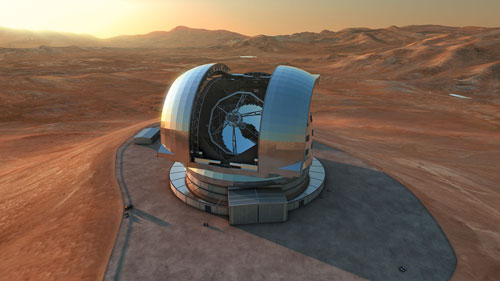
E-ELT

An artist’s impression of the European Extremely Large Telescope, on site at Cerro Armazones, Chile. (Courtesy: ESO/L Calçada)


By Tushna Commissariat

Although a site for the most ambitious project of the European Southern Observatory (ESO) – the European Extremely Large Telescope (E-ELT) – was picked in 2010, astronomers were not sure if the project would get the definite go-ahead. But yesterday, at a meeting at ESO’s headquarters in Garching, Germany, the ESO Council approved the construction of what is to be the largest optical/infrared telescope in the world.

The one remaining stumbling block is that four of ESO’s 12 member states – Belgium, Finland, Italy and the United Kingdom – have only provisionally voted in favour of the project. Construction will only begin when they have agreed and 90% of the €1.083bn funding required has been secured. ESO says that the facility should then be able to start operations early within the next decade.

The 39.3 m diameter E-ELT will be about 80 m high, with a monstrous dome almost the size of a football stadium and a base diameter of about 100 m. It is planned to be tens of times more sensitive than any current ground-based telescope of its kind and will be built in Cerro Armazones in northern Chile, close to ESO’s Paranal Observatory. ESO hopes that most of the funding, as well as the initial large-scale industrial contracts, will be approved by next year. Some contracts for specific parts that require a detailed design study have, however, already been signed.

With the E-ELT, astronomers will be primed to discover Earth-like extrasolar planets and to study the distribution of dark matter and dark energy, which are thought to make up most of our universe. John Womersley, chief executive of the UK’s Science and Technology Facilities Council, says that its commitment to the E-ELT “reflects its high priority in our science strategy, the world-leading position of the UK astronomy community, and the potential returns to UK industry”.

New tuner could bring terahertz to the masses

A new tunable source of terahertz radiation that delivers 10,000 times the power of previous devices has been created by scientists in the US. Unlike most other systems for generating terahertz radiation, the new tuner is made using the same CMOS technologies used in commercial integrated circuits. The researchers hope that their new approach could allow terahertz radiation to become more widely used outside the laboratory in applications such as security scanning and telecommunications.

Because it can penetrate several millimetres of tissue but is non-ionizing, terahertz radiation could have potential as a safe, non-ionizing alternative to medical X-rays. It could also be used for security screening because it can pass through clothes and because many illicit materials such as explosives and drugs have unique spectral fingerprints in the terahertz range. In addition, researchers have demonstrated that it could be used for much higher-bandwidth wireless internet technology than the present radio-wave-based system.

However, it has proved very difficult to create practical, tunable and low-cost terahertz sources that can easily be integrated with standard electronic devices. Current tunable terahertz devices are expensive and involve laboratory-based equipment such as free-electron lasers, quantum cascade lasers or stacks of Josephson junctions. Generating terahertz radiation using conventional solid-state electronic circuitry – the same way that radio waves are generated – has not proved feasible because the transistor in an electric circuit cannot sustain a current oscillating at terahertz frequencies. It is possible to produce an electrical output oscillating above the frequency limit of a circuit by using a frequency multiplier, but today’s technologies drastically limit the output power at terahertz frequencies. As a result, it had not been possible to produce a solid-state terahertz source with an output of even a microwatt, which itself is far too low to be useful.

Playing a new tune

Now, Ehsan Afshari and colleagues Cornell University in Ithaca, New York, have designed a new type of tunable frequency multiplier that exploits a fundamentally different tuning methodology than previous devices. Moreover, the team has built a CMOS-based terahertz source with an output power 10,000 times that its predecessors. The theory behind the device is based on the self-synchronization of coupled oscillators, which allows the circuit to produce an output frequency at a series of harmonics of a circuit’s fundamental frequency.

While other terahertz researchers are impressed by the original thinking that went into the new device, some point out that a milliwatt-output terahertz source is not likely to be powerful enough for practical applications. “The idea presented is new and might pave the way for commercial implementation. At present, however, the tuning range and output power do not make a revolution,” Martin Dressel of the University of Stuttgart in Germany told physicsworld.com.

Mark Rodwell of University of California, Santa Barbara agrees that the device is more interesting in theory than in practice. “The work is reporting a little less than 1 mW at a little below 300 GHz,” he says. “Radios operating between 100–1000 GHz, if they are to have reasonable range or interesting data rate, will need to radiate considerably more than 1 W.” He concludes that “The techniques reported in this work are intellectually attractive. The power levels being produced, and the energy efficiency, are not.”

However, Afshari told physicsworld.com that some applications should be possible. “Terahertz radiation has many applications in biosensing, imaging, and spectroscopy and for these applications 1 mW is more than enough,” he explained.

He also said that future implementations of the device using indium phosphide or gallium nitride instead of CMOS should deliver around 1 W. He also believes that the power of CMOS devices could be further boosted

“While this [1 mW] power might not be enough for some terahertz applications, the method can be used to generate even higher power.”

The research is published in Physical Review Letters.

Fused molecules guide magnetic plasmons

Researchers in the US have made waveguides for magnetic plasmons from “fused” organic molecules. The structures allow magnetic plasmons to be transmitted and focused in ways not possible with conventional electron plasmons. This could lead to a new family of nanoscale photonic devices, say the scientists.

Normally, light cannot be focused to a spot smaller than half its wavelength – a distance of about 300 nm for visible light. However, in recent years scientists have succeeded in focusing light down to nanometre distances by coupling it to plasmons that occur on the surfaces of metal nanostructures. These surface plasmons are collective excitations of the metal’s conduction electrons and they couple with light to create surface plasmon polaritons (SPPs), which behave like light but have much shorter wavelengths. SPPs are at the heart of an emerging technology called “nanoplasmonics”, which concentrates on using metallic nanostructures to develop tiny optoelectronics devices.

In this latest study, Naomi Halas and colleagues at Rice University in Houston have focused on magnetic plasmons, which are formed when electrons oscillate in a circular fashion to create a magnetic moment. This is different to conventional plasmons, which involve the back-and-forth oscillation of electrons. The researchers found that magnetic plasmons can propagate over distances of several micrometres along a conjugated chain of artificial aromatic molecules called heptamers. This is much farther than conventional electron plasmons, which can only travel a few hundred nanometres along linear chains of metallic nanoparticles.

Unique ring currents

The chain made at Rice comprises “fused” heptamers carefully arranged in such a way that they resemble the organic aromatic molecules chrysene and triphenylene. The heptamers are composed of ring-like components and support currents that circulate around the structures when illuminated with light from an infrared laser operating at 1500 nm.

In organic chemistry, rings are said to be fused if they share two or more atoms, explains team member Na Liu. “In our work, the fused heptamers share two gold nanoparticles that act as a mutual link for efficient current exchange between the two neighbouring heptamers,” she says.

Network building blocks

Halas and team showed that the fused heptamers can be used as building blocks for networks of magnetic plasmonic waveguides. The researchers succeeded in making a steering device that can direct the plasmons around bends with large angles and a Y-splitter than can transport plasmons along two separate optical paths. The Y-splitter can also act as an interferometric device to switch plasmon propagation and on and off, says Halas.

“We also made a Mach–Zehnder interferometer comprising two consecutive Y-splitters that can split and combine propagating plasmons,” adds Liu.

According to the researchers, the plasmon-based subwavelength waveguides could find applications in areas including low-loss energy transport, data storage and near-field microscopy.

The work is described in ACS Nano.

Solid-state quantum memories set endurance records

Two independent teams of physicists have created quantum memories, based on nuclear spin, that push the limits of how long quantum information can be stored in solid-state devices. One device – based on a doped crystal of ultrapure silicon-28 – is able to store data for more than 3 min. The other memory – based on nitrogen vacancies (NVs) in an isotopically pure carbon-12 diamond crystal – achieved a storage time of 1.4 s. While this latter result might not seem as impressive, the diamond memory works at room temperature, whereas the silicon device must be cooled to a temperature of below 2 K.

The new findings are of interest to anyone wishing to build quantum computers, which can, in principle, use quantum mechanics to perform certain calculations much faster than conventional computers. In particular, the results could help to tackle a fundamental problem for quantum-computing researchers that concerns how quantum information (qubits) are stored and manipulated.

The problem is that for a qubit to maintain its quantum nature, it must be isolated from its surroundings to stop it being destroyed in a process called decoherence. But to manipulate quantum information, a qubit must be controlled externally – and this connection to the outside world will lead to decoherence. One solution is to first store the quantum information in a very isolated qubit, before transferring it to a more accessible qubit where it can be quickly processed, then returning it to the safety of isolation.

Although ions trapped in a vacuum have been used to create memories that can store qubits for tens of minutes, many physicists believe that any practical quantum-computing device must be made from solid-state materials that can be integrated with conventional electronics. As a result, some researchers have pinned their hopes on what is perhaps the most isolated system in a solid – a nuclear spin. If an external magnetic field is applied to such a nuclear spin, quantum information can be stored in the spin state of the nucleus – whether it is pointing up or down with respect to the magnetic field, for example.

No nuclear spins in the background

The new silicon memory was made by Mike Thewalt and colleagues at Simon Fraser University in Vancouver, Canada, and Oxford University, UK. They worked alongside physicists at the PTB standards lab, the Leibniz Institute for Crystallography and Vitcon Projectconsult – all in Germany – to create a memory based on the nuclear spin of a phosphorous-31 nucleus embedded in silicon.

The diamond memory, meanwhile, was created at Harvard University in the US by Mikhail Lukin and his team, with help from physicists at the California Institute of Technology in the US and the Max Planck Institute for Quantum Optics in Garching, Germany. Their device uses a carbon-13 nuclear spin near a NV in diamond supplied by Luxembourg-based firm Element Six. Silicon-28 and carbon-12 were chosen because both nuclei have zero nuclear spin and therefore will not interact with the phosphorus-31 and carbon-13 nuclear spins, respectively – a process that leads to decoherence.

Both schemes use electron spin as a qubit that can be manipulated externally to exchange quantum information with memories based on nuclear spin. In the silicon memory, the electron spin is associated with the phosphorus atom itself, whereas the diamond memory uses an electron from the NV.

In both cases the connection between electron and nuclear spin comes via the “hyperfine interaction” between the spin magnetic moments of the electron and nucleus. The result is a tiny splitting of electron energy levels, which affects how the material absorbs and emits light. This allows the transfer of quantum information to be controlled using a sequence of laser and microwave pulses. By using carefully chosen sequences of laser and microwave pulses, both teams were able to transfer the quantum states of their electron-spin qubits to their nuclear-spin memories. The quantum data are then retrieved using further sequences of laser and microwave pulses.

Rogue interactions

An important challenge facing both teams was the presence of isotopic impurities of silicon-29 or carbon-13 in their devices. These devices have magnetic moments that will couple with both the electron and nuclear spins of interest, thereby upsetting energy levels and causing decoherence. To deal with this problem, both groups use schemes that place their systems into states in which these rogue interactions are minimized.

The diamond team go one step further and actually “switch off” the hyperfine interaction between qubit and memory while the datum is stored, which allows them to boost the storage time to more than 1 s.

Thewalt told physicsworld.com that the team is looking at using bismuth nuclei in silicon-28. As well as having a more pronounced hyperfine splitting, bismuth has a nuclear spin of 9/2, which gives the system a much richer hyperfine-state spectrum. “We are also interested in the nuclear spin of the ionized phosphorus donor in these same samples, which might have an even longer coherence time, and retain this long coherence time to higher temperatures,” he adds.

As for Lukin, he believes that his team’s memory could soon find applications beyond quantum computing, saying that the device’s sensitivity to magnetic fields “may enable a range of novel and disruptive quantum-sensor technologies, such as those being targeted to image magnetic fields on the nanoscale for use in imaging chemical and biological processes”.

The findings are reported in two papers in Science.

The physics of football

By Matin Durrani

With storm-force winds and heavy rain battering the Physics World headquarters here in Bristol, UK, I can’t say I’ve really got that summer feeling at all.

But summer it is and today marks the start of UEFA Euro 2012 in Poland and Ukraine, in which 16 of Europe’s top men’s international football teams fight it out to be crowned champions of Europe.

Spain, who won the tournament last time it was held in 2008, remain favourites in my book, but you can never write off the Germans in big competitions, while France and the Netherlands are in with a definite shout. As for England and Italy, I think both will struggle.

All of which is a decent excuse for me to remind you of one of Physics World‘s most popular feature articles ever, entitled simply “The physics of football”, which you can read here.

Co-authored by Steve Haake from Sheffield Hallam University in the UK, the article looks at why footballs can be made to swerve spectacularly through the air, using a famous 1997 free kick by legendary Brazilian defender Roberto Carlos as an example.

Struck 30 m from the opponents’ goal, the ball was heading so far wide of the net that a ball-boy, standing several metres to the right of the goal, instinctively ducked his head in response. Once the ball had cleared the wall of defenders, it took a wicked late swerve before arriving, astonishingly, in the top right-hand side of the net.

If Haake’s analysis of how this happened leaves you wanting more, then check out a paper published in 2010 by our colleagues on New Journal of Physics, which looked in greater detail at Carlos’s wonder goal.

And don’t forget this analysis by two US sports scientists of bending balls, which led to some interesting conclusions about another famous free kick, this time taken by David Beckham in 2001.

Georges Lemaître, father of the Big Bang

By Hamish Johnston

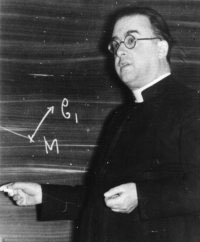
lemaitre lecture.jpg
Last night while I was tidying the kitchen there was a lovely programme on BBC Radio 4 about the father of the Big Bang theory – the Catholic priest (and famous Belgian) Georges Lemaître.

The action begins in 1923 in a Cambridge drawing room where Lemaître first encountered the pioneering astrophysicist and cosmologist Arthur Eddington…you can listen to the rest here.

Apparently Lemaître was never seen without his dog collar, as you can see in this photograph of him lecturing at the Catholic University of Leuven, where he spent most of his professional life. (Photograph courtesy of the Catholic University of Leuven)

Secret of super-power shrimp revealed

Scientists in the US have solved one of nature’s little mysteries – how the harlequin mantis shrimp can generate enough force to smash aquarium glass, without doing any significant damage to its pair of “dactyl” clubs. The researchers believe that the secret of the clubs, which are normally used by the shrimp to crack open tough shellfish, lies in how they combine materials with very different properties. Measurements reveal that the clubs have a much higher specific strength and toughness than any synthetic composite material – a finding that the researchers think could lead to stronger materials, including those for use in body armour.

Measuring just 3–18 cm in length, the harlequin mantis shrimp (Odontodactylus scyllarus) can accelerate its clubs to reach speeds in excess of 80 km per hour, allowing it to deliver an instantaneous force of more than 700 N. In addition to this blunt force, air bubbles are trapped between the club and the creature’s shell, which then collapse to create regions of great local stress. This process can be repeated thousands of times without any apparent damage to the club, which is eventually replaced in a moulting process.

To learn more about the shrimp’s prowess, James Weaver of Harvard University, Garrett Milliron of the University of California, Riverside and Ali Miserez of the Nanyang Technological University in Singapore used a variety of different analytical techniques to determine the structure and composition of the club, including electron microscopy, X-ray microtomography, synchrotron X-ray diffraction and energy-dispersive X-ray spectroscopy.

Fragile surface?

One surprising aspect of the club is that its striking face is made of a layer of very hard crystalline calcium-phosphate ceramic material, known as hydroxyapatite, that is about 60 µm thick. On its own, such a material would not be very durable because it would be likely to fracture on impact. Behind this hard surface, however, the team found a much thicker region comprising layers of fibres made from the polysaccharide chitosan – a much more elastic material that is commonly found in the exoskeletons of shrimp.

Each successive layer of fibres is parallel to the surface but offset from its neighbour by a small angle such that the layers are rotated 180° over a distance of about 75 µm. The club is held together at the edges by a third structure made from chitosan fibres. The team believes that it is the layered “helicoidal” structure that gives the club its extreme resistance to fracturing. Any crack propagating through the material, the researchers say, would have to continually change direction – making fracture unlikely.

Cracks change direction

The team also found that the elastic modulus of the club changes as a function of depth – the effect being that some of the impact energy is reflected back towards the surface as the shock propagates into the club. This change in the modulus could also reflect a propagating crack, thus reducing the risk of fracture. The team believes that insights from the shrimp’s formidable club could lead to better body armour based on composites of hard ceramic and elastic organic materials.

This is not the first time that mantis shrimps have been on biophysicists’ radar. The animals are known to have a highly developed visual system and in 2008 researchers showed that two species of the shrimp can detect the circular polarization of light – the first living organisms shown to do so.

The study is described in Science.

Copyright © 2026 by IOP Publishing Ltd and individual contributors