Physicists look round corners in 3D

The ability to see round corners would be nice – especially for police offers chasing criminals in a city or for motorists careering down winding country lanes. Although that prospect is still a long way off, researchers in the US have come up with a way of looking round corners using ultrafast laser pulses. Their technique creates a 3D image of what is round a corner by looking at how light reflects from objects in the local environment.

The technique has been developed by Andreas Velten and colleagues at the Massachusetts Institute of Technology, who hid an artist’s mannequin roughly 20 cm tall from the view of a camera by placing it behind an opaque wall that they called the occlude (see image above). A second wall – called a diffuser – was placed at a right angle to the occluder and a small distance away from the end of it. Light travels from the mannequin, scatters from the diffuser and is then captured by the camera – but because the light is scattered diffusely, the image of the mannequin does not appear on the diffuser wall.

In their experiment, Velten’s team positioned an ultrafast laser next to the camera before firing pulses lasting 50 femtoseconds at a beamsplitter. Half of the pulse goes on to a photodetector and the other half continues to the diffuser, from which it scatters and illuminates the mannequin. Some of the light bounces off the mannequin, scatters from the diffuser and finds its way back to the camera.

Arrival times

The distance travelled by the light can be calculated from the time differences between the arrival of the pulse at the photodetector and the light arriving at the camera. The device is, in fact, a specialized instrument called a streak camera, which records the arrival time of light to within 2 ps, which is the time that it takes light to travel about 0.6 mm. The camera also records the intensity of the light as a function of position along one direction.

To build up a 3D image of the mannequin, the position at which the laser pulse first strikes the diffuser is changed in a systematic way and 60 images are acquired, each at a different position. Finally, a computer algorithm is used to reconstruct the image, which can be rendered in 2D or with depth information to provide a 3D image. According to Velten, the algorithms can easily be implemented on a personal computer.

Because the camera only captures light over 2 ps intervals, any background noise from ambient light is small and Velten believes that it should be possible to use the technique even in broad daylight.

Peering into lungs

One possible application of the technology, according to the team, is in endoscopy, in which a tiny camera is inserted into the body. Seeing round corners could be useful in probing organs such as the lungs or heart, which contain corner-like structures. Other applications include locating survivors in an emergency situation and avoiding vehicle collisions at blind corners.

While the current set-up is not portable, Velten tells physicsworld.com that ongoing improvements in semiconductor laser and camera technologies should soon make it possible to create compact systems that could be deployed with firefighters or military personnel.

The system is described in Nature Communications.

Laser writer makes graphene supercapacitors


A routine laser-writing technique has been used to create sheets of graphene on the surface of a DVD. The work was done by researchers in the US, who then joined the sheets together to make electrochemical capacitors (or supercapacitors). The devices can store as much energy as a conventional battery but can be charged 100–1000 times faster. According to the researchers, the capacitors are completely flexible and robust, which makes them ideal energy-storage systems for flexible and portable electronics.

Electrochemical capacitors – also known as supercapacitors or electric double-layer capacitors – can store much more electrical charge than standard capacitors. This is thanks to the double layer formed at an electrolyte–electrode interface when voltage is applied to the device. Although promising energy-storage materials, supercapacitors still lag behind traditional batteries in terms of energy densities: 4–5 Wh/kg and 10–150 Wh/kg, respectively. They do, however, have a much longer shelf – and cycle life than batteries and can deliver large amounts of energy much more quickly.

Now, a research team led by Richard Kaner and Maher El-Kady at the University of California, Los Angeles, says that they have developed a graphene-based device that combines both the power performance of capacitors with the high energy density of batteries. The researchers have come up with a new process that involves coating an ordinary DVD with a film of graphite oxide supported on a sheet of plastic.

Brown fades to black

Kaner and colleagues begin by reducing the graphite oxide to graphene using a standard “LightScribe” DVD drive head – usually used optically to etch labels and images on DVD discs. The process can easily be monitored as the golden-brown-coloured graphite oxide turns into black-coloured graphene. The graphene-coated plastic is then peeled off and cut with scissors to make different devices (see video below).

The graphene sheets can be used as electrodes without the need for any additional binders or additives. Electrochemical capacitors are made by simply “gluing” together two identical pieces of graphene sheet with a little polymer gel electrolyte that is placed between them. “We also tested a variety of other electrolytes confirming that the material can be used in a number of device systems for different applications,” says Kaner.

Large surface area

The LightScribe graphene sheets have a large area per unit mass – greater than 1500 m2/g – which helps to increase their energy-storage capacity, and a high electrical conductivity of more than 1700 S/m. They are also flexible mechanically and can be bent thousands of times without suffering any damage to their electrical properties. All of these characteristics make them ideal not only for making supercapacitors but also for a host of other electronic devices, says El-Kady, who also lectures at Cairo University.

The LightScribe process overcomes another important problem, too, in that it produces non-stacked graphene sheets. Graphene sheets have a natural tendency to stack during production, something that reduces the overall surface area of the material.

“We believe that our work will help pave the way to making flexible supercapacitors for use in bendable electronic equipment for the upcoming boom in flexible portable electronics,” El-Kady tells physicsworld.com. “Applications include roll-up computer displays, wearable electronics that harvest and store energy produced by body movement, electronic wallpaper and energy-storage systems that can be combined with flexible photovoltaic cells.”

The team now plans to look at scaling up their production technique in a cost-effective manner. “Our initial calculations show that the price of the precursor, graphite oxide and the whole process is completely viable for commercial applications,” adds El-Kady.

Details of the current work are published in Science.

Neutrino-based communication is a first

The first ever transmission of information using a beam of neutrinos has be achieved by physicists in the US. The demonstration is highly preliminary – it operates at less than 1 bit/s – and will require a lot of development before it can have any useful application. Nevertheless, the work proves a concept that physicists have been contemplating for years and that could ultimately be used in situations where other means of communications are not feasible.

Electromagnetic radiation – particularly at visible, microwave and radio wavelengths – is today’s carrier of choice for moving information. It is easy to transmit, easy to detect and can carry a lot of information. However, there are some situations where it does not work very well. One example is the transmission of information to nuclear submarines, which can remain submerged almost indefinitely. The problem is that seawater is opaque to electromagnetic radiation at the wavelengths short enough to transmit information at a useful rate. Submarines therefore have to float a wire antenna to the surface, which restricts their speed and depth, making them easier to detect.

A ghostly solution

For ease of transmission through any material including seawater, nothing beats the neutrino. The ghostly particle is affected only by the weak nuclear force and, very faintly, by gravity. As a result, it can pass through almost everything and interacts with virtually nothing. A neutrino could easily pass through 1000 light-years of lead, so an ocean would pose no problem whatsoever. Indeed, some scientists have suggested that advanced extraterrestrial civilizations could communicate across vast distances in space using neutrino beams.

Although neutrino-based systems have been proposed here on Earth since the 1970s, they have all come up against the same problem: how to detect the neutrinos at the receiving end when the vast majority of the particles will pass straight through any detector. To detect enough neutrinos to transmit information at a reasonable rate, either an extremely intense neutrino source or a very large detector (or both) would be needed. In 2009, for example, Patrick Huber of Virginia Tech University came up with the idea of using the hull of a nuclear submarine to detect the radiation given off when neutrinos interact with the surrounding seawater. However, Huber admitted that such a scheme would also require an intense source of neutrinos that would cost several billion dollars to build.

At around the same time, Daniel Stancil at North Carolina State University was thinking about how to build a similar communication scheme based on axions – hypothetical weakly interacting particles that could comprise dark matter. While axion sources do not currently exist, Stancil’s former student Jim Downey at Carnegie Mellon University pointed out that the concept could be tested at Fermilab using the NuMI neutrino beam and the MINERvA detector. NuMI produces the most intense high-energy neutrino beam in the world, which then travels 1 km to MINERvA. The main purpose of the MINERvA–NuMI beam line is to study the neutrinos themselves, but Downey’s idea was to use the experiment as a data-transmission system.

Encoding “neutrino” with neutrinos

Stancil approached Fermilab with the proposal and, having gained agreement, the researchers encoded the word “neutrino” into binary code. This was then used to modulate the neutrino beam with a bit rate of 0.1 bits/s. The message was received with a bit error rate of just 1%, allowing the message to be decoded easily after one repetition. Nevertheless, given the short distance over which communication was achieved, the low data transmission rate and the extreme technology required to achieve it (MINERvA itself weighs several tonnes), neutrinos are clearly not a viable method of communication in the short term.

Huber, however, is excited by the work. “I think the most significant feature of this work is that somebody went out and did it,” he explains, adding “it makes an enormous difference because it proves it’s possible.”

A paper about the work is currently available on the arXiv preprint server.

Hope for superluminal neutrinos continues to fade

By Hamish Johnston

Physicists working on the ICARUS experiment have reported their first measurement of the speed at which neutrinos travel from CERN to the Gran Sasso lab in Italy – and the particles don’t appear to be moving faster than the speed of light.

That’s the same 730 km journey taken by the famous neutrinos that were clocked at speeds faster than light by the OPERA experiment last year. You may recall that this result generated much speculation about the possibility of superluminal flight – despite the fact that it flies in the face of the special theory of relativity and several other neutrino measurements.

In a brief press release today, Carlo Rubbia, Nobel-prize winner and ICARUS spokesperson, said “ICARUS measures the neutrino’s velocity to be no faster than the speed of light. These are difficult and sensitive measurements to make and they underline the importance of the scientific process.”

CERN Research Director Sergio Bertolucci added “The evidence is beginning to point towards the OPERA [superluminal] result being an artefact of the measurement.”

Interesting, he also said “Whatever the result, the OPERA [collaboration] has behaved with perfect scientific integrity in opening [its] measurement to broad scrutiny, and inviting independent measurements. This is how science works.”

I have no problem with the above statement, but what does bother me is the fact that CERN chose to hype the initial superluminal finding when it first came out last year. I think it’s safe to say that when the news broke in September, most physicists assumed that the result was caused by some sort of systematic error and wondered why CERN was making such a big fuss.

At least CERN has done the right thing by issuing this latest press release – it must have been tempting to keep quiet and hope that the superluminal story would just fade away.

You can read a preprint of the ICARUS result here.

David Tong: the human soliton

By Hamish Johnston

Our colleagues at the Institute of Physics in London are making a series of videos called Physics Lives that focuses on university research physicists and what they do in their working lives. The latest production stars David Tong, who is Professor of Theoretical Physics at the University of Cambridge, and you can watch it right here.

Tong is a big fan of solitons, so you might wonder why his video “Baths and Quarks” begins with him lying motionless in the bath and then blowing bubble rings. “Baths would be so much more relaxing if they weren’t so interesting,” he says. Then he pulls the plug and marvels at the vortex formed when the water goes down the drain.

“My job is to understand the beautiful things in the world that surrounds me,” he says, and points out that both the bubble rings and the vortex can be understood in terms of solitons.

The video continues with some lovely shots of water vortices, smoke rings and colliding marbles – all explained in a soothing dreamlike manner by Tong. Then the video moves on to Tong’s research on quarks, and he explains why solitons could hold the key to understanding the strong force, which binds together quarks in hadrons such as protons and neutrons.

A fundamental understanding of the strong force would involve establishing the mathematical basis underpinning Yang–Mills theory – which in 2000 was deemed one of the seven important challenges facing mathematicians by the Clay Mathematics Institute. Indeed, the US-based institute thinks the problem so important that it’s offering a cool $1m to anyone who can solve it.

So it’s back into the bath for Tong, where he says he does some of his best thinking. You can view all four videos in the Physics Lives series here.

The videos include “Ion Beam Cop”, in which Melanie Bailey of the University of Surrey does some forensic physics, and “Written in the Sky”, in which Jim Wild of the University of Lancaster flies to Iceland to investigate the mysteries of the aurora borealis.

Are university ranking exercises inherently biased?

By Hamish Johnston

Okay, I know that I should have looked the other way, but every year I fly into a rage when I look at the Times Higher Education (THE) ranking of world universities.

hands smll.jpg

This is always reported with a certain smugness in the UK because British universities do very well. Indeed, three institutes – Cambridge, Oxford and Imperial College London – are in the top 10.

But what gets me is the fact that all of the top 10 are Anglo-American universities. You have to dip down to 15th place to find the first non-Anglo institute, which is ETH Zurich.

There are three Canadian universities in the top 30, all of which follow the Anglo-American model. The second-best non-Anglo institute is the University of Tokyo, which is way down in 30th place.

Is it really the case that English-speaking countries have vastly superior universities, or is there some inherent bias in the THE’s ranking criteria?

In this week’s Facebook poll we want to know your opinion on university rating exercises in general.

Are university ranking exercises inherently biased?

Yes
No

Have your say by casting your vote on our Facebook page. As always, please feel free to explain your response by posting a comment.

In the case of the THE rankings, one possible bias is that a whopping 60% of the score each university receives is related to research and academic publishing. That’s great for research-intensive Anglo-American universities, but not so good for universities in places such as Germany – where much of the best scientific work is done at labs such as the Max Planck institutes.

The top place in Germany goes to the University of Munich, which comes in at 45th. This means that both Canada and Australia have three and two universities, respectively, that are ranked higher than Germany’s best. I know first-hand that Canada has some good universities, but I find it hard to believe that German universities are as poor as the survey suggests.

It looks as if some Germans don’t like it either, and have taken an “if you can’t beat them, join them” approach. Way back in 2006 the German federal government launched its Excellence Initiative that aimed to push some universities up to the elite status of Harvard or Oxford. The idea is to boost the funding of research at some universities to make them more attractive to top researchers and postgraduate students.

Of course, it is possible that Anglo-American universities are simply better than the rest. Anglo universities tend to have a much more international outlook than their non-Anglo counterparts and therefore could find it easier to attract the best and the brightest staff and students from around the world. Operating in English – the lingua franca of academia and business – can’t hurt either.

And what about teaching? On the THE site you can rank the universities based on teaching alone – and this doesn’t change the order that much at the top. So maybe Anglo-American universities are the best, or perhaps the education ranking itself is also biased towards the Anglo way of doing things!

Last week we asked you if the Fukashima nuclear incident in March 2011 had changed your opinion on nuclear power. About 63% of you said that the meltdown hadn’t changed your position, whereas 26% said it had hardened their opposition. The remainder said that Fukashima had strengthened their support.

‘Designer’ graphene makes its debut

Researchers in the US have created the first artificial samples of graphene with electronic properties that can be controlled in a way not possible in the natural form of the material. The samples can be used to study the properties of so-called Dirac fermions, which give graphene many of its unique electronic properties. The work may also lead to the creation of a new generation of quantum materials and devices with exotic behaviour.

Graphene is a single layer of carbon atoms organized in a honeycomb lattice. Physicists know that particles, such as electrons, moving though such a structure behave as though they have no mass and travel through the material at near light speeds. These particles are called massless Dirac fermions and their behaviour could be exploited in a host of applications, including transistors that are faster than any that exist today.

The new “molecular” graphene, as it is has been dubbed, is similar to natural graphene except that its fundamental electronic properties can be tuned much more easily. It was made using a low-temperature scanning tunnelling microscope with a tip – made of iridium atoms – that can be used to individually position carbon-monoxide molecules on a perfectly smooth, conducting copper substrate. The carbon monoxide repels the freely moving electrons on the copper surface and “forces” them into a honeycomb pattern, where they then behave like massless graphene electrons, explains team leader Hari Manoharan of Stanford University.

Described by Dirac

“We confirmed that the graphene electrons are massless Dirac fermions by measuring the conductance spectrum of the electrons travelling in our material,” says Manoharan. “We showed that the results match the two-dimensional Dirac equation for massless particles moving at the speed of light rather than the conventional Schrödinger equation for massive electrons.”

The researchers then succeeded in tuning the properties of the electrons in the molecular graphene by moving the positions of the carbon-monoxide molecules on the copper surface. This has the effect of distorting the lattice structure so that it looks as though it has been squeezed along several axes – something that makes the electrons behave as though they have been exposed to a strong magnetic or electric field, although no actual such field has been applied. The team was also able to tune the density of the electrons on the copper surface by introducing defects or impurities into the system.

“Studying such artificial lattices in this way may certainly lead to technological applications, but they also provide a new level of control over Dirac fermions and allow us to experimentally access a set of phenomena that could only be investigated using theoretical calculations until now,” adds Manoharan. “Introducing tunable interactions between the electrons could allow us to make spin liquids in graphene, for instance, and observe the spin quantum Hall effect if we can succeed in introducing spin-orbit interactions between the electrons.”

He adds that molecular graphene is just the first of this type of “designer” quantum structure and hopes to make other nanoscale materials with such exotic topological properties using similar bottom-up techniques.

The work is reported in Nature 483 306.

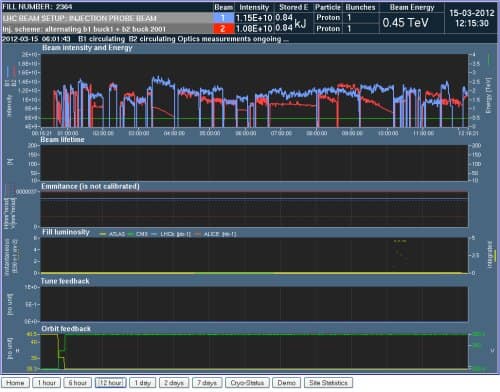
Beams are back at the LHC

The first beams of 2012 at the LHC


The first beams of 2012 at the LHC. (Courtesy: CERN)


By Hamish Johnston

Just before midnight last night the first proton beams of 2012 were circulated in the Large Hadron Collider (LHC) at CERN in Geneva. Above is a screenshot from the LHC Dashboard showing both clockwise and anticlockwise beams circulating in the LHC for much of today.

It looks as if the beam energy is still fairly low at 0.45 TeV – but the plan for this year is to run both beams at 4 TeV for a collision energy of 8 TeV. Last year, the collider ran at 7 TeV and may have caught the first glimpses of the Higgs boson. By running at a higher energy, LHC physicists hope that it will become clearer whether the Higgs is indeed emerging from collision data with a mass of about 125 GeV/c2.

Running at 8 TeV could also help physicists find evidence for the theory of supersymmetry (or SUSY). SUSY is an attractive route beyond the Standard Model because it offers solutions to some of the big questions in particle physics. Many physicists hope that the LHC will confirm SUSY’s central prediction: that for each of the Standard Model particles there exists a heavier sparticle sibling. But, so far, no evidence for SUSY has emerged from the LHC.

However, running at a slightly higher energy does not come without risks. Larger currents must flow through the LHC’s superconducting magnets and we know that in the past there was a problem with the electrical connectors between magnets. In 2008 the LHC failed spectacularly when one of these connectors overheated; and the remote chance of a repeat of this costly disaster must be weighing heavily on the minds of some at CERN.

When the Earth’s magnetic field flips

The Earth’s magnetic field provides us with a vital shield from the Sun’s deadly rays, as well as enabling compass bearers around the world to find their way. But the field is not as reliable as we first thought. There is strong evidence in the geological record to suggest that many times throughout the Earth’s history the north and south magnetic poles have reversed, as the major dipole component of the field has flipped.

How do we know that the Earth’s field has reversed direction in the past? Is another reversal likely to occur anytime soon? What processes deep within the Earth might cause these reversals to occur?

When the Earth's magnetic field flips

These are among the questions I put to the eminent French geophysicist Vincent Courtillot in this special audio interview with physicsworld.com. Courtillot, who is based at Paris Diderot University in France, explains how the Earth’s rocks have functioned as a natural tape recorder – the orientation of magnetic particles in the rocks reveals the state of the magnetic field in Earth’s past.

Having set the scene at the Earth’s surface, Courtillot takes us on a journey to the centre of our planet. He describes the physical processes taking place in the planet’s molten-iron outer core that lead to the generation of the magnetic field, and he tells us about his own studies of the boundary of the Earth’s core and the overlying mantle. Courtillot also describes how thermodynamics can help to explain how the frequency of reversals has varied throughout the Earth’s history.

This idea is developed in a feature article in the March issue of Physics World, a special issue focused on earth sciences. In this article, three other French geophysicists argue that the rate of reversals is also connected to the distribution of continents on the Earth’s surface, thus connecting geological processes through the entire planet. You can a free PDF download of the March issue via this link.

Graphene simulated using ultracold atoms

An important electronic property of graphene has been simulated for the first time using ultracold atoms. The experiment was carried out by physicists in Switzerland, who reproduced graphene's distinctive "Dirac points" in a 2D honeycomb lattice produced by criss-crossing laser beams. The lattice contained potassium atoms, which played the role of electrons in graphene.

The shape of the lattice and the interactions between the atoms can be controlled by adjusting the lasers and applied magnetic fields. As a result, the technique can be used to investigate what happens to the electronic properties of graphene if its structure is modified – as well as simulating certain frustrated magnetic systems.

Getting to the Dirac point

As a 2D honeycomb of carbon atoms just one atom thick, graphene has a number of unique electronic properties that arise because of its lattice structure. In particular, graphene is a "zero-gap" semiconductor, which means that its electron valence and conduction bands just touch each other – in contrast to conventional semiconductors, which have an energy gap between the bands. Where the bands touch, the relationship between the energy and momentum of the electrons is similar to that of a photon, with the electrons moving at a very high speed approaching an effective speed of light. This behaviour is described by the Dirac equation for relativistic electrons, which is why this part of graphene's band structure is called a Dirac point.

In 2011 physicists at the University of Hamburg in Germany managed to create the first honeycomb optical lattice, which they filled with rubidium-87 atoms. However, they were unable to see any evidence for Dirac points. Now, Tilman Esslinger and colleagues at the Institute for Quantum Optics at ETH Zurich have created a honeycomb optical lattice loaded with potassium-40 atoms and have found evidence for two Dirac points.

This measurement begins with a gas of several hundred-thousand potassium-40 atoms cooled to about 100 nK by allowing the most energetic atoms to escape, leaving only cool lethargic atoms behind. A square optical lattice is then created using two laser beams at the same wavelength that cross at 90° and interfere with each other. A third beam at a slightly different wavelength is then fired parallel to one of the two beams to create a standing wave, such that the relative positions of the square lattice and the standing wave can be controlled by adjusting the wavelength of the third beam. This allows the lattice to be manipulated into a range of different of patterns, including a honeycomb.

Such a lattice is expected to have two distinct Dirac points, which the team confirmed by accelerating the atoms using a magnetic-field gradient and then measuring their trajectories. The latter is done by switching off the lasers and watching the free atoms fly through the vacuum chamber. The physicists found that when the atoms had certain values of momentum, they were able to move effortlessly between the valence and conduction bands – the telltale signature of two Dirac points.

Moving easily between bands

The team then turned its attention to the relationship between the symmetry of the lattice and the existence of the Dirac points. By distorting the honeycomb, the researchers could make the Dirac points move, merge and even vanish. Since the electronic properties of graphene and graphene-like materials depend on the nature of the Dirac points, such quantum simulation could point towards new materials with potentially useful electronic properties. "Using this method, it may become possible to simulate the electronic properties of materials long before they can be physically realized," explains Esslinger.

The team is currently working on reducing the temperature of the lattice, which could allow it to be used to study the frustrated magnetic systems that occur in triangular lattices.

The work is described in Nature.

Copyright © 2026 by IOP Publishing Ltd and individual contributors