

Pass the wasabi

By Margaret Harris

wasabi

Courtesy: iStockphoto.com/SensorSpot

Bristol’s St Nicholas Market is an eclectic place, packed with hole-in-the-wall restaurants and shops selling everything from novelty T-shirts and herbal remedies to sheet music and sewing supplies. Today, however, it was even more eclectic than usual, since one of the customers at the curry house was Makoto Imai, the Japanese psychiatrist who won an Ig Nobel prize in 2011 for his role in inventing a wasabi-based smoke alarm.

Imai was accompanied by Ig Nobel organizer Marc Abrams, a friend of Physics World whom I met at a scientific conference back in 2009. They’re touring the UK right now as part of National Science and Engineering Week, putting on a show about the Ig prizes and other examples of science that – as Abrams explained to the slightly bemused Bristolian who shared our table at lunch – “first makes you laugh, and then makes you think”.

The wasabi smoke alarm is a good example. Wasabi is Japanese horseradish, otherwise known as that deceptively mild-looking green paste that comes with sushi. As anyone who has ever tasted it will know, a little bit of wasabi goes a very long way, and it turns out that a mere whiff of it can be enough to wake people from a deep sleep. In a creative leap worthy of Archimedes, Imai and his colleagues at Shiga University in Japan realized that this potent odour could make a very effective warning signal for people with deafness, who would not hear conventional sirens and might miss flashing lights if they were fast asleep. And so the wasabi smoke alarm was born.

From the outside, the alarm – which Imai obligingly got out of his bag to show me – is an unassuming grey box about as long as an A4 page and one-third as wide. Inside are the circuits needed to receive a signal from a modified ordinary smoke alarm, some batteries and a small but forbiddingly labelled aerosol can containing allyl isothiocyanate, the active ingredient in wasabi. The alarm has a radius of about 2.5 m, Imai told me, which makes it perfect for mounting above your bed. He also explained that, strictly speaking, it’s not an odour that wakes you up – it’s more of a sharp tickling sensation in the back of the throat that makes you cough.

Sadly I didn’t get a chance to try out the alarm at lunch – our fellow market-goers might have objected – and tonight’s Bristol Ig Nobel show featuring Imai is already sold out. However, I understand that Imai will be donating one of his devices to the Science Museum in London, and there are still tickets available for other UK Ig events later this week in Edinburgh and Dundee.

Dineutron emission seen for the first time

Physicists in the US claim to have witnessed, for the first time, the emission of a neutron pair in the decay of an atomic nucleus. Such “dineutron” decay could extend our understanding of the strong force, which is responsible for holding nuclei together, and the processes taking place in neutron stars.

Nuclear decay occurs when atoms change form in order to become more stable. The best known types are alpha decay, in which a helium nucleus is emitted, beta decay, in which an electron or positron is emitted, and gamma decay, in which gamma rays are emitted. In addition to these are decays involving the emission of a single proton or a single neutron.

However, for decades there has been an interest in rarer forms of decay. In 2002 scientists discovered that iron-45 – which contains nine fewer neutrons than the most stable iron isotope, iron-54 – decays with the emission of two protons. Since then, there has been some evidence that the two protons involved in such emission can be paired up into a short-lived “diproton”. However, this is not clear-cut: the charge of protons forces the particles apart, so they cannot be identified together easily.

In principle, the observation of a dineutron should be less equivocal, because neutrons have no electric charge to muddy the data. Dineutrons have been observed indirectly in neutron-rich helium isotopes, such as helium-6 and helium-8, where some neutrons exist in a “neutron halo” around a central nucleus. Now, however, Artemis Spyrou of Michigan State University and colleagues believe they have detected dineutrons outside a nucleus, during nuclear decay. “This is important on its own since it shows a property of nuclei that we did not know could be possible,” says Spyrou.

Too many neutrons

The obvious place to begin searching for dineutron decay is in nuclei that contain too many neutrons – that is, those nuclei that would want to lose at least two neutrons in order to become more stable. Such neutron-rich nuclei tend to decay one neutron at a time, rather than two at once. But not all nuclei opt for a step-by-step decay: beryllium-16 does not readily emit a single neutron because that would leave a nucleus of beryllium-15, which is more unstable.

Spyrou’s group examined beryllium-16 for dineutron decay. They created the isotope at the National Superconducting Cyclotron Laboratory at Michigan State University by removing a single proton from a boron-17 beam. Immediately, the resultant beryllium-16 decayed into two neutrons. After examining the energy and position information for all three particles – the two neutrons and the remaining beryllium-14 nucleus – the researchers calculated that the two neutrons were emitted together and in the same direction.

Spyrou says that the direction is important for labelling the process as dineutron decay. If the neutrons had been left the nucleus separately, she says, the angle between them would have been almost random.

“Ferreting out “true events

Bob Charity, a chemist specializing in nuclear structure and reactions at Washington University in St Louis, US, thinks the results are impressive. “A single neutron may interact with one part of a detector and in the process scatter and then interact with another part, making it hard to differentiate a single-neutron event from a true two-neutron event,” he says. “The experimental effort…should be praised for ferreting out the two-neutron events from this background of ‘fake’ two-neutron events.”

However, some scientists, including Charity, are sceptical that the dineutron should be considered a well-defined entity. Since the emitted neutrons are already correlated inside the beryllium nucleus’s halo, these scientists say, they are likely to be correlated outside, too – but that does not mean the neutrons are truly bound together.

“I am not convinced that what they see is a new type of particle,” Marek Pfützner told physicsworld.com. Pfützner is a nuclear physicist at the University of Warsaw in Poland and believes that the concept of a dineutron is “a very simplified way to describe the data, which is used a when more detailed and rigorous description is missing”.

Spyrou believes scientists must now understand why the two-neutron decay occurs, and which nuclei exhibit it. “We have already had some indication of similar behaviour in the nucleus oxygen-26, and we plan to study even more neutron-rich systems,” she says. “This is the only way to use this new finding to advance the field and improve our understanding of the nucleus.”

The research is described in Physical Review Letters.

Tracking our planet from above

By James Dacey

Advances in satellite technology are giving us fresh opportunities to monitor the Earth’s geography and track changes over time. During a recent visit to San Francisco, I got the chance to meet a few of the scientists who use such data to develop a better understanding of global processes. I met them alongside a giant screen, which was part of a NASA exhibition at the annual meeting of the American Geophysical Union.

In this first video interview, I meet NASA scientist Compton Tucker, who is interested in deforestation in the Amazon rainforest. He uses the screen to show me images of a region in north-west Brazil as captured by satellites from the Landsat Program, which has been collecting images since 1972. Tucker explains how he uses these images to identify where deforestation has increased over time and why these changes have occurred.

Tucker says that this information is useful for a number of reasons, including climate studies, because it can help to quantify the amount of carbon dioxide released as a result of deforestation. He explained that scientists collect the data and integrate them with scientific observations obtained on the ground. It was also interesting to hear about Tucker’s adventures in the jungle, particularly his experiences meeting the locals.

In this second video interview, I meet another NASA scientist, Eric Lindstrom, who uses the screen to show me an animation from NASA’s ECCO2 project. This project is designed to create an accurate model of the world’s oceans and sea-ice based on data collected by a whole fleet of satellites. He showed me how the model can identify the extent of turbulence in the oceans in the form of eddy currents.

If you enjoy these videos, then you may also be interested in one of the articles in the March issue of Physics World. It features a series of images focusing on different aspects of planet Earth, including the varying sea-surface temperatures and the elevation of the land surface. You can download a free PDF of this special earth-science issue via this link.

Department of Energy boost for small nuclear reactors

The US Department of Energy (DOE) will support the construction of three small nuclear reactors at its Savannah River Site in South Carolina. The reactors are designed to generate heat and electricity for use at remote facilities such as mines, oil fields or isolated communities. The three companies involved are Gen4 Energy (formerly Hyperion), Holtec International and NuScale Power.

The Savannah River Site is a commercial spin-out of the Savannah River National Laboratory that aims to provide the location and nuclear expertise required by firms that are developing nuclear technologies including small modular reactors (SMRs). Such reactors could be built in a factory and shipped to the desired location. Once the fuel is spent, the reactor could be replaced with a new module and the old one could be shipped back to the factory for reprocessing.

Based in Colorado, Gen4 Energy is working on an SMR that is not much larger than a hot tub and that could supply thermal energy at a rate of about 70 MW. That could be converted into about 27 MW of electricity, which would be enough to supply about 20,000 US households. Holtec, based in New Jersey, plans to build a larger modular reactor that can generate 160 MW – which is about 20% of the capacity of a modern large-scale reactor. Meanwhile in Oregon, NuScale has plans for modules that can each generate 45 MW of electricity. The firm expects that up to 12 modules could be co-located to create a 540 MW power plant.

Secure site

Forrest Rudin of Gen4 Energy told physicsworld.com that the arrangement with the Savannah River Site is very important for a small company planning to build a reactor. The agreement provides access to a secure site that has already had the necessary environmental assessment work done – something that would be far too expensive for a small firm to acquire on its own. In exchange for rent and fees, the three firms will also gain access to highly-skilled nuclear scientists and research-and-development facilities on site. “We have a unique combination of nuclear knowledge, laboratory expertise, infrastructure, location and much more to make the Savannah River Site a natural fit for advancing technology for small modular reactors,” says Dave Moody of the Savannah River Site.

Rudin adds that Gen4 will collaborate with the Savannah River Site in finalizing the reactor design to ensure that it can be licensed for operation. He believes that the reactor will be switched on sometime after 2020. According to Rudin, the agreement gives an important boost to the status of the firm’s technology. “This means that the DOE thinks we have a workable technology,” he says, adding that “the project is now real to the outside world.”

The Holtec reactor is expected to supply power to the entire Savannah River Site as well as some other US government facilities in the region.

Reeling in cheap plastic solar film

A UK-based start-up is developing printable, thin-film plastic solar cells aimed at providing affordable electricity to individual dwellings that have no grid connection, such as those in rural Africa. The flexible device’s photoactive layer will be a blend of two organic semiconductor materials positioned between metallic electrodes, all sandwiched by plastic substrates.

Slashing costs

Eight19, a Cambridge University spin-off firm, is named after the eight min, 19 s it takes sunlight to reach the Earth. The company believes that sheets of the lightweight plastic thin film will slash the cost of transporting and installing solar panels compared with conventional silicon-based solar panels or glass-based thin-film solar cells. This should make it more affordable for farmers and villagers in remote areas, who can fix the sheets to their roofs to power homes that do not have electricity.

“Today, 50% of the cost of solar power is the installation, and that’s going up as solar costs come down,” says Simon Bransfield-Garth, CEO of Eight19. Eight19 plans to start manufacturing the sheets by 2013, using reel-to-reel printing techniques.

Interactive boundaries

The design involves creating an inner photoactive layer using two organic semiconductor materials: a polymer for the “donor” portion and, most likely, a fullerene for the “acceptor”. Sunlight creates excitons – bound pairs of electrons and holes in the semiconductors. These diffuse into an interface formed where the polymer and fullerene meet – an artificial “heterojunction” – and an energy offset splits the pairs apart. The electrons move to the film’s metallic cathode layer and the holes to the anode.

Eight19 plans to use a transparent metal for the anode, so that sunlight is not prevented from hitting the photoactive layer. It has ruled out one logical choice – indium tin oxide (ITO), which is typically used in LCD displays – as being too expensive. “We’re working on ITO-free transparent conductors,” says Kieran Reynolds, Eight19’s chief operating officer. “And we’re making good progress.” The cathode could be an opaque metal, such as silver, aluminium or copper, that would cause the light to bounce back onto the photoactive layer or, in some applications, a semitransparent conductor.

Sheets and layers

The outer protective layers will be formed with polyethylene terephthalate (PET) – the material used to make plastic bottles – so that the films remain lightweight and flexible. The company will deposit the electrode and photo layers onto a PET substrate using reel-to-reel printing. Although PET will not last as long as glass – an Eight19 solar module will last about five years compared with 25 years for conventional panels – Eight19 can make tougher versions by adding extra PET layers.

The company claims that a small, 2.5 W sheet should provide enough electricity for rudimentary LED lighting and mobile-phone charging. Larger sheets could power media devices and appliances.

As Eight19 gears up, it is seeding the market in Kenya, South Sudan, Malawi and Zambia using conventional solar panels and an innovative service model. The company sells $10 kits comprising small, 2.5 W panels, two LED lamps and a rechargeable lithium-ion battery. For $1 a week, kit owners buy a scratch card from a merchant, text the card’s number and then receive a code they enter into a digital keypad on the battery pack to allows unlimited use of the panel. The system, which Eight19 says can provide rudimentary lighting, is aimed at replacing costly and environmentally hazardous kerosene or diesel generators in off-grid rural areas.

Wiping data will cost you energy

For the first time physicists have measured the tiny amount of heat released when an individual bit of data is erased. Although the value was first predicted more than 50 years ago, it is so small that measuring it has proved impossible – until now. The experiment, which involved trapping a tiny bead in a double well created by a laser and tracking its motion as it flipped between wells, places a lower limit on the energy dissipated by logic circuits, which could affect the design of future electronic devices.

For decades physicists and computer scientists have been making connections between thermodynamics and information theory. In 1961 the German–American physicist Rolf Landauer deduced that the irreversible erasure of information involves the dissipation of heat. “Landauer’s principle”, as it is known, applies to computing processes in which the number of bits of information decreases as the calculation progresses – something that happens in all conventional computers.

An important example of irreversible erasure is the “reset-to-one” process, whereby a bit holding information, which can be either 0 or 1, is reset to 1. As the information held by the bit is destroyed, this datum can no longer be recovered because, once the bit is set to 1, we have no way of knowing its previous value.

What has essentially happened is that the entropy – or randomness – of the bit has been reduced. And since the bit and its surroundings are physical entities that must obey the laws of thermodynamics, this entropy must be transferred from the bit to its surroundings as heat. In fact, according to Landauer’s theory, a minimum amount of heat – roughly 10–21 J per erased bit – must be dissipated when information is destroyed. Unfortunately, physicists have struggled to verify this prediction because 10–21 J per erased bit is less than a 1000th of the electrical energy dissipated when a modern silicon device is reset.

Tiny silica bead

Now, Eric Lutz at the University of Augsburg together with Sergio Ciliberto and colleagues at Ecole Normale Supérieure de Lyon and Raoul Dillenschneider at the University of Kaiserslautern are the first to confirm Landauer’s principle experimentally. Instead of using a silicon circuit, the team’s data bit comprises a tiny silica bead just 2 µm in diameter that is immersed in water and trapped using optical tweezers. The laser used to create the tweezers is alternatively focused at two different locations in rapid succession – creating two different locations where the bead can be trapped. The bit is assigned a value of “0” when the bead is in the left-hand position and “1” when it is in the right-hand position.

The system can be thought of as a classical particle that is trapped in two potential-energy wells with an energy barrier preventing the particle from jumping from one well to the other. If the barrier is very high compared with the bead’s thermal energy, the bead will never jump and the datum is stored. If the barrier is lowered to be on par with the thermal energy, then it becomes more likely that the bead will jump back and forth between 0 and 1. The physicists are also able to “tilt” the wells by raising the bottom of one relative to the other – ensuring that the bead always ends up in the lower well.

The experiment begins with the bit in a state in which it is equally probable that the bead is in the 0 or 1, which gives the system a non-zero initial entropy. The memory is then set to 1 by lowering the barrier, tilting the wells and then raising the barrier so that the bead cannot jump between the wells. After this reset process has been done, the value of the bit can only be 1 and therefore the entropy of the bit is zero.

Tracking the bead

Throughout this process, the position of the bead is monitored using a high-speed camera. This allows the team to calculate the energy dissipated as heat as the bead moves around. According to Lutz, this dissipation is caused by friction as the bead pushes against the surrounding water. The team also measured the heat dissipation associated with the tilting of the wells.

This process was repeated hundreds of times in order to obtain an average value for the amount of energy that is dissipated. The measurements were then repeated after changing the amount of time that was allotted for the erasure process to occur from about 5–40 s. The team found that as the time increased, the heat that was dissipated approached the limit predicted by Landauer. According to Lutz, this is in line with the laws of thermodynamics, which state that the erasure process must occur very slowly in order to be described by Landauer’s principle.

Now that Landauer’s principle has been verified, Lutz hopes that the energy-dissipation problem in electronic devices could be partially solved by devising erasure processes that are optimized to approach the Landauer limit. Indeed, if the ongoing miniaturization of electronics continues, designers could be creating circuits that operate near to the Landauer limit by 2035.

In the long term, the limit could be avoided by implementing “reversible” computing protocols that involve recovering the energy lost to heat – something that is possible but extremely challenging from a technical point of view.

The measurements are described in Nature.

Daya Bay nails neutrino oscillation

Physicists working at the Daya Bay Reactor Neutrino Experiment in China have made the best measurement so far of a key property of neutrinos – the “mixing angle” θ13, which describes the relationship between certain flavour and mass states of neutrinos. The experiment measured sin213 by working out the rate at which electron antineutrinos vanish after being produced in several nuclear reactors. The researchers found sin213 to be 0.092 with a statistical significance of 5.2σ – a high level of certainty that is usually associated with a “discovery” in the particle-physics community.

The relatively large value for sin213 should make it much easier to do long-baseline neutrino experiments, which could in turn provide important clues towards solving the mystery of why matter, rather than antimatter, dominates the universe. Daya Bay is a partnership between 19 Chinese and 16 US universities and is the largest international scientific facility to be built on Chinese soil. The first phase of the experiment was completed last year and this first value of sin213 was derived from data obtained over 55 days starting in December last year.

Halls of success

Neutrinos come in three “flavours” – electron, muon and tau – with the neutrinos able to change, or “oscillate”, between the different types. However, physicists also believe that neutrinos can be described in terms of combinations of three mass states – m1, m2 and m3. Interference between these mass states gives rise to the observed oscillations of neutrino flavour – after a certain period of time, an electron neutrino could change into a muon or tau neutrino, for example.

Although physicists have measured many of the parameters that describe this flavour/mass system, uncertainty has reigned over θ13, which is a measure of how the m1 and m3 mass states are combined within the flavour states. Three other experiments – T2K in Japan, MINOS in the US and Double Chooz in France – have all made preliminary measurements of sin213, each in different ways, obtaining values of 0.11, 0.04 and 0.086, respectively. While these measurements all have a much lower statistical significance than the Daya Bay result, they all agree to within experimental uncertainties.

The Chinese experiment detects electron antineutrinos produced via nuclear beta decay at two neighbouring facilities – the Daya Bay and Ling Ao power plants. It has six separate detectors, located in three different underground halls where they are shielded from cosmic radiation. One hall is relatively close to each of the Daya Bay and Ling Ao power plants, whereas the third is about 2 km away from both reactors. By comparing the antineutrino fluxes recorded near to the reactors with the flux measured further away, physicists can work out how the rate at which antineutrinos disappear as they travel through the Earth. This rate, along with known neutrino parameters, can be used to calculate sin213.

“Although we’re still two detectors shy of the complete experimental design, we’ve had extraordinary success in detecting the number of electron antineutrinos that disappear as they travel from the reactors to the detectors 2 km away,” says Kam-Biu Luk of the University of California, Berkeley, who heads the US part of the team.

Matter–antimatter imbalance

Hervé de Kerret, who is spokesperson for the Double Chooz experiment, welcomes the new findings, calling them “a beautiful confirmation of our measurement”. He adds that the relatively large value of sin213 bodes well for physicists planning to do long-baseline experiments that compare the properties of neutrinos to antineutrinos. One such project is the Long Baseline Neutrino Experiment (LBNE) proposed by physicists at Fermilab in the US. The LBNE will send neutrinos and antineutrinos over a distance of about 1300 km in order to look for a difference in their oscillation rates. Such a difference would violate the Standard Model of particle physics, which incorporates a fundamental symmetry between particles and antiparticles known as CP (“charge–parity”) symmetry.

Finding physics beyond the Standard Model would be exciting enough, but if CP violation were observed in neutrinos, it would suggest that these tiny, nearly massless particles could have tipped the balance between matter and antimatter in the early universe – thereby producing the matter-dominated universe we see today. Physicists at Daya Bay will be installing two new antineutrino detectors later this year, which should further boost the accuracy of the sin213 value when the experiment starts taking data again.

The results are described in the preprint on arXiv.

Blow for Australian SKA bid?

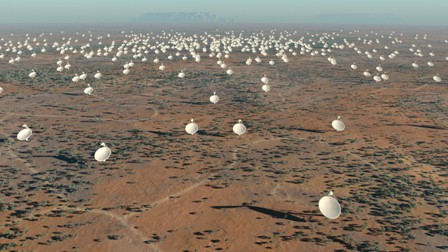
Square Kilometre Array


Artist’s impression of the proposed Square Kilometre Array site in Austrialia (Courtesy: Swinburne Astronomy Productions)

By Michael Banks

Is southern Africa a step nearer to hosting the Square Kilometre Array (SKA)? That is what an unconfirmed report in the Sydney Morning Herald is suggesting.

SKA, costing €1.5bn, is a massive next-generation radio-astronomy facility consisting of around 2000–3000 linked antennas that will probe the first 100 million years after the Big Bang for clues about galaxy evolution, dark matter and dark energy. Two rival bids are going head to head to host the telescope: one led by Australia and the other by South Africa.

Last month, an independent SKA site advisory committee sent its evaluation report and site-selection recommendation to SKA’s board of directors. The report was not published and only a vague press release was issued stating that a recommendation had been made. Since then, members of SKA have been tight-lipped about which bid may have got the thumbs up from the committee.

However, according to the report today in the Sydney Morning Herald, the site advisory committee has opted for southern Africa. “Australia, in a joint bid with New Zealand, has failed to convince an expert panel it offers a superior location for the project,” the report says.

Indeed, the rumour mill for a winning southern Africa bid was already set in motion late last month when African ambassadors meeting in Beijing issued a statement calling on the SKA organization to build the telescope “on the site recommended by the independent SKA site advisory committee”. The statement inferred that the South Africa-led bid had won the recommendation of the site committee. However, within a few hours of being posted on the press site AlphaGalileo the statement was taken down.

That is not the only recent SKA-related incident. A few days after the withdrawal of the press release, a server managing documents for SKA was apparently breached. However, according to Colin Greenwood, company secretary of the SKA Organisation, only “links to publicly available documents, such as the SKA research papers, were affected”.

The site advisory committee does not have the final say in where SKA will be sited. That will come when the seven members of the SKA organization – which includes China, Italy and the UK – meet in “late March or early April” to consider the report’s conclusions and make a decision about the location of the site. Only by then will we know for sure whether SKA is heading to southern Africa.

How has the Fukushima incident changed your attitude to nuclear power?

By Hamish Johnston

This Sunday marks one year since the Tōhoku earthquake and tsunami wreaked destruction on the east coast of Japan. One of the casualties of the day was the Fukushima Daiichi nuclear power plant, which, having survived the earthquake was then inundated by a 15 m wave. This initiated a chain of events leading to the meltdown of three of the plant’s six reactors.

hands smll.jpg

The Fukushima incident is second only to the Chernobyl disaster as the worst nuclear accident ever, and it has blighted the lives of thousands of people living around the plant – some of whom may never be able to return to their homes. However, proponents of nuclear power might point out that the situation was eventually brought under control and only a handful of deaths have been directly attributed to the Fukushima incident – whereas the earthquake and tsunami claimed more than 10,000 lives.

So our Facebook poll question this week is:

How has the Fukushima incident changed your attitude to nuclear power?

It’s hardened my opposition
It’s strengthened my support
No change at all

Have your say by casting your vote on our Facebook page. As always, please feel free to explain your response by posting a comment.

If you would like a bit of background reading before you cast your vote, check out this opinion piece by Mike Weightman, who led a team of nuclear inspectors to Fukushima less than three months after the incident.

Last week we asked you what level of computer-programming proficiency is appropriate for a physicist. The overwhelming majority of you thought that some programming knowledge is needed, with 51% saying that physicists should be conversant in machine code and 42% saying that some knowledge of FORTRAN is essential.

Graphene in new ‘battery’ breakthrough?

Researchers at Hong Kong Polytechnic University claim to have invented a new kind of graphene-based “battery” that runs solely on ambient heat. The device is said to capture the thermal energy of ions in a solution and convert it into electricity. The results are in the process of being peer reviewed, but if confirmed, such a device might find use in a range of applications, including powering artificial organs from body heat, generating renewable energy and powering electronics.

Ions in aqueous solution move at speeds of hundreds of metres per second at room temperature and pressure. The thermal energy of these ions can thus reach several kilojoules per kilogram per degree. However, until now, little work had been done on finding out how to tap into this energy and produce power from it.

Zihan Xu and colleagues made their battery by attaching silver and gold electrodes to a strip of graphene – which is a film of carbon just one atom thick. In their experiments, the researchers showed that six of these devices in series placed in a solution of copper-chloride ions could produce a voltage of more than 2 V. This is enough to drive a commercial red light-emitting diode.

The technology is quite different to conventional lithium-ion batteries, for example, which convert chemical energy into electricity. “The output of our device is also continuous and it works solely by harvesting the thermal energy of the surrounding copper-chloride ions, which, in theory, is limitless,” says Xu.

According to the researchers, the battery works rather like a solar cell. The copper ions (Cu2+) continually collide with the graphene strip in the battery. This collision is energetic enough to displace an electron from the graphene. This electron can then either combine with the copper ion or travel through the graphene strip and into the circuit.

Since electrons move through graphene at extremely high speeds (thanks to the fact that they behave like relativistic particles with no rest mass), they travel much faster in the carbon-based material than in the ionic solution. The released electron therefore naturally prefers to travel through the graphene circuit rather than through the solution. This is how the voltage is produced by the device, explains Xu.

Boosting voltage output

The researchers also found that the voltage produced by the device could be increased by heating the ionic solution and accelerating the Cu2+ ions with ultrasound. Both of these methods work because they increase the kinetic energy of the ions. The voltage also increases if the copper-chloride solution is more concentrated with Cu2+ ions, because the density of Cu2+ on the graphene is then greater. Other cationic solutions can be employed too, such as Na+, K+, Co2+ and Ni2+, although these produce lower voltage outputs.

The unique atomic-layer nature of graphene is crucial for this battery, say the researchers, who also experimented with graphite and carbon-nanotube thin films. They discovered that these materials only produced low voltages of around microvolts, which could be regarded as noise.

Bor Jang of Nanotek Instruments in Dayton, Ohio, who has worked on making supercapacitors from graphene, says that the concept described looks “very interesting” but that “more work will be needed to assess whether the approach could provide sufficient energy or power density for practical uses”.

For its part, the Hong Kong team now plans to improve the power output of its graphene-based device and further investigate how it works.

The work is described in a preprint on arXiv.

Copyright © 2026 by IOP Publishing Ltd and individual contributors