LED converts heat into light

A light-emitting diode (LED) that emits more light energy than it consumes in electrical energy has been unveiled by researchers in the US. The device – which has a conventional efficiency of greater than 200% – behaves as a kind of optical heat pump that converts lattice vibrations into infrared photons, cooling its surroundings in the process. The possibility of such a device was first predicted in 1957, but a practical version had proved impossible to create until now. Potential applications of the phenomenon include energy-efficient lighting and cryogenic refrigeration.

The energy of photons emitted by an LED is dictated by the band gap of the semiconductor used – the energy required to make an electron–hole pair. When an electron and hole recombine in a radiative process, a photon carries away the extra energy. The voltage across the LED creates the electron–hole pairs but its value does not affect the photon energy, since the semiconductor’s band gap is a permanent feature of the material.

However, it is possible for the individual emitted photons to have energies that are different to the band gap. The vast majority of electron–hole recombinations actually result in the production of heat, which is absorbed by the semiconductor in the form of quantized lattice vibrations called phonons. These vibrations create a heat reservoir that can then boost the energy of photons produced by radiative recombination. In 1957 Jan Tauc at the Institute of Technical Physics in Prague pointed out that, since this provided a mechanism for radiation to remove heat from a semiconductor lattice, there was no barrier in principle to an LED being more than 100% efficient, in which case it would actually cool its surroundings.

Obeys the second law

At first glance this conversion of waste heat to useful photons could appear to violate fundamental laws of thermodynamics, but lead researcher Parthiban Santhanam of the Massachusetts Institute of Technology explains that the process is perfectly consistent with the second law of thermodynamics. “The most counterintuitive aspect of this result is that we don’t typically think of light as being a form of heat. Usually we ignore the entropy and think of light as work,” he explains. “If the photons didn’t have entropy (i.e. if they were a form of work, rather than heat), this would break the second law. Instead, the entropy shows up in the outgoing photons, so the second law is satisfied.”

Despite the soundness of the physics, over the past five decades nobody had managed to demonstrate an LED actually cooling its surroundings. One way researchers tried to maximize the number of photons produced was to increase the bias voltage across the LED, but this also increases the heat produced through non-radiative recombinations.

So, Santhanam and colleagues did the exact opposite and reduced the bias voltage to just 70 µV. They also heated the LED to 135 °C to provide more lattice heat. In this regime, less than 0.1% of the electrons passing through the LED produced a photon. However, when the researchers measured the minute power of the infrared radiation produced by the LED, they measured 70 pW of power being emitted by the LED while only 30 pW was being consumed, an efficiency of more than 200%. This happens because as the voltage approaches zero, both light output and power dissipation also vanish. However, the power dissipated is proportional to the square of current, whereas light output is proportional to the current – halving the bias voltage therefore doubles the efficiency.

Important breakthrough

One possible application of the effect is a refrigeration device that removes heat in the form of light. As an expert in this field, Jukka Tulkki of Aalto University in Finland, told physicsworld.com, “I think this is a historically important breakthrough…that could eventually lead to more useful and technologically relevant applications.” However, he cautions that the cooling power of this particular device is extremely low and not great enough for any practical applications.

Santhanam, meanwhile, believes the principle may find applications in fields other than refrigeration. “My personal opinion is that it’s more likely to be useful as a light source,” he says. “Refrigerators are mostly useful when they are high power. Light sources, however, are used in all kinds of ways. In particular, light sources used for spectroscopy and communication don’t necessarily need to be very bright. They just need to be bright enough to be clearly distinguishable from some background noise.”

The research is published in Physical Review Letters.
Physics and the Earth: all you need to know

By Matin Durrani

cover

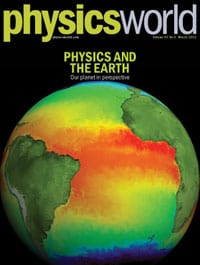
If you’re a member of the Institute of Physics (IOP), you’ll have had access for more than a week now – through our apps, in print or online – to the bumper 92-page March issue of Physics World magazine, which features a series of fabulous articles and images on the theme of “Physics and the Earth”.

If you’re not yet a member of the IOP, then to get a taste of what you’re missing out on each month, we’re offering a free PDF download of the March issue via this link.

Here’s a brief outline of what’s in the March issue and I’ve included details at the end of this blog about how to join the IOP so that you can get your hands on Physics World each and every month. Joining is easy and costs just £15, €20 or $25 a year.

• Gianpaolo Bellini and Livia Ludhova describe how geoneutrinos generated through radioactive decay within the Earth are providing a new technique for understanding our planet.

• François Pétrélis, Jean-Pierre Valet and Jean Besse explain why they think that the movement of the Earth’s plates could be linked to the rate of reversal of the Earth’s magnetic field.

• See what progress is being made in understanding the Earth’s core – including the bizarre possibility that it may hide huge crystals of iron some 10 km long.

• Learn more about the controversy over fracking, which involves pumping sand and chemicals into shale deposits to release trapped natural gas.

• Check out our interview with Robert Hazen, the head of the Deep Carbon Observatory, who wants to find out what happens to carbon that gets subducted into the Earth’s core.

• Mike Weightman, chief inspector of nuclear installations and executive head of the Office for Nuclear Regulations in the UK, describes what lessons we can learn from the incident at the Fukushima Daiichi plant one year on.

• Enjoy a series of spectacular images of the Earth from afar, showing the power of Earth observation.

• Find out how the latest advances in earthquake forecasting can give the odds that an earthquake above a certain size will occur within a given area and time.

Download a PDF of the issue now.

Remember, to get Physics World each month, you can join the IOP as an imember for just £15, €20 or $25 a year via this link. Being an imember gives you a full year’s access to Physics World, both online and through the apps.

Members of the IOP can also read the March issue through the digital version of the magazine by following this link or by downloading the Physics World app onto your iPhone or iPad or Android device, available from the App Store and Android Marketplace, respectively. The digital version lets you read, share, save, archive and print articles – either fully laid out or in text view – and even have them translated or read out to you.

To let us know what you think about the March issue, please e-mail us at pwld@iop.org.

Enjoy the issue!

Internal structure of antihydrogen probed for the first time


The first spectroscopy measurements of an atom of antimatter have been made by an international team of physicists working on the ALPHA experiment at CERN. The work is an important step towards understanding why the universe contains more matter than antimatter.

Antihydrogen – an atomic bound state of a positron and antiproton – was first produced at CERN towards the end of 1995. Over the past two years, physicists working on the ALPHA experiment have advanced our understanding of antimatter by becoming the first to capture and store anti-atoms for long enough to examine them in detail. The researchers trapped a total of 38 antihydrogen atoms for about one-fifth of a second in 2010 and then perfected their apparatus and technique to trap a total of 309 antihydrogen atoms for 1000 s in 2011. Now, the same team is the first to show that it is possible to probe the internal structure of an antihydrogen atom, reporting the first tentative measurement of the antihydrogen spectrum. Analysing the spectra of antimatter is essential to understand its structure and determine exactly how it differs from ordinary matter.

Trap and hold

Speaking to physicsworld.com last year, ALPHA spokesperson Jeffrey Hangst outlined the plan to detect the antihydrogen spectrum using microwaves, and now this is exactly what the team has done within nine short months. Hangst says that “it was easier said than done” and that he is very proud of the entire ALPHA team and what it has achieved.

The ALPHA apparatus, which uses a Penning trap to hold the antihydrogen, was considerably modified to enable the injection of microwaves into the trap. In a paper published today in Nature, the researchers describe how they first shine microwaves at a precise frequency on the trapped antihydrogen atoms, which causes their magnetic orientation to flip. The spin-flip allows most of the trapped anti-atoms to escape the trap, because the spin of the antihydrogen must point in a fixed direction with respect to the magnetic field in order for it to be held in the trap.

Antimatter in the microwave

“The atom is like a marble rolling around in a bowl – it can’t escape,” explains Hangst while referring to the trapped anti-atoms. “The microwaves cause the spin to flip if they have the right ‘resonant’ energy. Then it is as if the marble is on the top of a hill and it will roll away – in this case into the wall of the trap, where it annihilates,” he says. As the antihydrogen annihilates, it leaves a characteristic pattern in the particle detectors surrounding the trap, which provides evidence of the resonant interaction. “That is another really novel thing about working with antimatter…we can do this with just one atom of antihydrogen. With just one atom of hydrogen, it would be impossible, as no annihilation would occur,” explains Hangst.

Crosscheck and confirm

Hangst explains that the team ran several crosschecks and repeatedly checked its statistics, running six series of measurements to ensure the method works as accurately as possible. One of the controls used in the experiment is to inject microwaves at the wrong frequency – the “off-resonance” mode – and then make sure that no anti-atoms are liberated. Hangst does point out, however, that manipulating the spins of anti-atoms within the confines of a magnetic trap is difficult and that free space would be much more conducive environment. Unfortunately, as antihydrogen is a neutral atom, it is extremely difficult to synthesize and store, and it can be only held within the confines of magnetostatic trap. Irrespective of the difficulties, the ALPHA team will continue to look at different types of transitions that are less sensitive to the trap’s magnetic fields. “Ultimately, we want to probe the structure of the antimatter such that we can accurately measure the magnetic dipole moment – one of the most fundamental properties – of the antimatter,” Hangst says.

Hangst also points out that last year’s achievement of trapping the antihydrogen for 1000 s was pivotal to the success of the current experiment. “This is what the 1000 s trapping was about. While in the end we need only 240 s for this experiment, it was critical to know that we had a 1000 s if we needed it,” he says.

Looking with lasers

The team ran six series of experiments and concluded that it has observed quantum-resonant transitions in trapped antimatter atoms and that it is on the path towards being able to precisely compare the spectra of hydrogen and antihydrogen. This is essential as any differences between the structure of atoms and anti-atoms could explain why the universe has evolved to contain much more matter than antimatter.

In the months to come, Hangst and the team will be dismantling the current ALPHA set-up to build ALPHA 2 – an apparatus that will include lasers that will allow the team to carry out precision laser spectroscopy. This will be done to look at other energy levels within the antihydrogen system – for example the orbital energy of the positron around the antiproton. The researchers intend to commission and begin running ALPHA 2 in May this year and then begin the long process of perfecting the apparatus.

For now, this early measurement of the spectrum of antimatter is “the whole idea behind the antimatter experiments at CERN”, according to Hangst. “It is a historic find…we now know that we can continue to find better and more accurate values,” he says.

With members from seven nations, the ALPHA team shared the Physics World 2010 Breakthrough of the Year award for its capture of antihydrogen.

The work is published in Nature.

Fermilab chips in on the Higgs mass

Brazil-band results from Fermilab


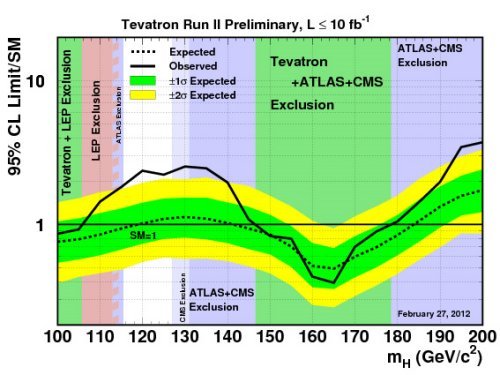
The latest results from the Tevatron. (Courtesy: Fermilab)

By Hamish Johnston

“The elusive Higgs boson may nearly be cornered”, that’s the rather vague message of a press release issued today by Fermilab. The release describes the analysis of data from the Tevatron’s two main experiments – CDF and DZero – that Fermilab claims sits well with previous attempts at finding the Higgs by the Tevatron, the Large Hadron Collider (LHC) and other accelerators.

The Fermilab results, along with information gleaned from other colliders including the LHC, are shown in the “Brazil band” plot above. While I don’t think that this latest announcement from the Tevatron is earth-shattering, the plot is a nice summary of where physicists are with the Higgs.

The horizontal axis is simply the mass of a hypothetical Higgs. The vertical axis is the ratio of the highest possible Higgs production rate compatible with data from the Tevatron divided by the production rate predicted by the Standard Model. Whenever this ratio (the solid curve) dips below one, the data exclude a Standard Model Higgs. The dashed line represents what is expected if the Higgs doesn’t exist. The green and yellow Brazil bands show the 1σ and 2σ uncertainties in the non-existence of the Higgs. If the solid line rises above the upper yellow band, it could be (very preliminary) evidence of the Higgs.

That’s why we should be mildly excited about the broad bump in the lower half of the mass range, which suggests that the Higgs could be in region of 115–140 GeV/c2.

In December, the two LHC experiments ATLAS and CMS found the strongest evidence yet of the Higgs – and the particle weighed in at about 125 GeV/c2. Therefore, this latest result jives with the tentative sighting by the LHC. However, the LHC bump appears to be much sharper – and is more statistically significant. If you want to know why (and much more), Matt Strassler gives his usual level-headed analysis here.

If more exuberant speculation is to your liking, Philip Gibbs has combined the Tevatron and LHC results to create nice bump, which you can see on his blog.

As well as backing up the growing belief that the Higgs mass is around 125 GeV/c2, this latest analysis also excludes the Higgs mass in the region 147–179 GeV/c2 – which widens the Tevatron’s previous exclusion of 156–177 GeV/c2.

The results were presented today at the Moriond Electroweak Conference in La Thuile in the Italian Alps.

Fusing the art and science of Hollywood

By James Dacey

Few of us know at the age of seven precisely what it is that we want to devote our lives to. But so it was for Ben Morris in 1977 after he was taken along to his local cinema in Oxford to watch the original Star Wars film. Young Ben knew from that day that when he grew up he wanted to create fantastical new worlds through the medium of cinema. The only question he had was: how do I get there?

Morris was talking last night at a public lecture organized by the University of Bristol, from which he graduated in 1993. Morris spoke about how his academic training had involved a true fusion of art and science. He studied physics, art and maths at A-level, before heading off to college to take a foundation course in art and design. Then, at this point in his life plan, Morris realized that a career in special-effects production would also benefit from a technical understanding of the physical world. This led him to enrol on a bachelor’s degree in mechanical engineering in Bristol.

In a fascinating talk, attended by several hundred people, Morris spoke of how his early work in the film industry had led on naturally from his studies in engineering. His final-year university project involved a study of animatronic puppets, and this knowledge helped him when he was hired as part of the team that created the puppet pig used in the 1995 film Babe. Morris said that while he has maintained his love of puppetry, the film industry has long-since shifted towards computer-generated graphics and so has his work.

Within a few years, Morris had already realized his childhood dream by working on an impressive array of blockbusters, including Gladiator (2000), Troy (2004) and Tim Burton’s Charlie and the Chocolate Factory (2005). More recently, he has been involved with the Harry Potter films, the film adaptation of Philip Pullman’s The Golden Compass (2007) and Steven Spielberg’s latest epic, War Horse (2011).

With the aid of a giant screen behind his lectern, Morris showed us a few specific examples of his work, and he described how the effects were created. I was amazed by the amount of labour that can go into very short sections of film. One example that stands out in my mind is from the 2003 film Prince of Persia: the Sands of Time (see the trailer above). The scene in question involves the prince becoming trapped in a sandstone palace that is rapidly collapsing into the surrounding desert.

Morris said that in creating this scene he and his team simulated up to 2.5 million grains of sand, having spent weeks carefully studying how sand flows. Their research included spending several days in a giant sandpit in Manchester where they triggered the collapse of giant piles of sand, and filmed the events at 125 frames per second. To get an idea of how sandstone architecture collapses, the team carried out a study of rigid body dynamics by observing the collapse of various smaller structures. The overall look of the scene is designed to possess the lightning of a Rembrandt painting. Then, of course, a few killer snakes are thrown into the sandy mix. The scene lasts a few seconds, but the creative vision is epic.

So, despite the mountains of patience required in the job, does Morris still recommend visual-effects production as a career? It is an unequivocal yes. “I’m still living the dream” he declared.

Physicists put a new twist on radio


Physicists in Italy have shown that, like light, radio waves can have their wavefronts twisted so that they take on a corkscrew shape. The researchers have successfully transmitted twisted beams several hundred metres across the lagoon in Venice using a specially shaped antenna. They believe that such beams could dramatically enhance the information capacity of wireless communications by multiplying the number of channels that can be encoded in a given frequency range.

Physicists have known for many years that a beam of light can be twisted so that its wavefront rotates around its direction of propagation in a spiral shape. The twisting is achieved by controlling the orbital angular momentum of the light. This property is associated with the shape of a light beam’s wavefront – the imaginary line or plane joining the points on a wave that have the same phase.

The phenomenon was first seen inside laser cavities and then researchers worked out how to tune a beam’s orbital angular momentum to create “optical tweezers” that can move tiny objects. The orbital angular momentum should not be confused with the more familiar spin angular momentum of light, which is associated with a wave’s polarization or direction of oscillation.

Inspired by black holes

Now, Fabrizio Tamburini of the University of Padova in Italy, Bo Thidé of the Swedish Institute of Space Physics in Uppsala and colleagues have manipulated the orbital angular momentum of radio waves. This work stems from earlier research by Tamburini and Thidé in which they calculated that a spinning black hole should distort space–time in such a way as to leave a noticeable twist in the wavefront of electromagnetic radiation that passes close by.

The researchers believe it should be possible to create a similar twisting effect on Earth, without the need for an ultra-massive object. To do this they set up a spiral-staircase-like structure inside a room insulated against sound and electromagnetic waves at the University of Uppsala. They bounced radio waves off the structure and used a pair of receiving antennas in a plane some metres from the structure to record the variation in phase across the plane. They found that the phase varied as would be expected from a twisted wavefront.

Now, the researchers have transmitted radio waves with a well-defined orbital angular momentum in noisy, real-world conditions – 442 m across St Mark’s Basin in Venice. A specially adapted satellite-dish-style antenna on the lighthouse on St George’s Island was used to create radio waves with a frequency of 2.4 GHz and an orbital angular momentum of 1 – the latter meaning that the wavefront is rotated 360° in the space of one wavelength. A standard “Yagi” antenna was also used to send waves of the same frequency but without orbital angular momentum across the same stretch of lagoon.

A “revolution” in radio technology

By varying the distance between the two receiving antennas on the balcony of the Doge’s Palace, the researchers were able to tune in to either the twisted or the untwisted beam. This proves, they say, that they were able to transmit two channels simultaneously using just a single frequency.

According to Tamburini, this demonstration could lead to a “revolution” in radio technology, since, he says, it means in principle being able to create an infinite number of channels in a given bandwidth, with each channel encoded using a different orbital angular momentum. He points out that a vast expansion of wireless capacity would be highly prized, given the huge and rapidly growing demand for wireless services, estimating that 11 new channels per frequency band (corresponding to five orbital angular momentum states – five clockwise, five anticlockwise and one untwisted) should prove “economically reasonable” in the short term.

Michael Berry of Bristol University, who with John Nye showed in the 1970s that phase singularities are pervasive features of waves of all kinds, was present at the demonstration. He says the event was “a splendid occasion” that caused him to change his mind about the potential of twisted radio waves. “I initially thought that this was a clever but unsurprising example of wave interference,” he admits, “but then I witnessed the intense interest of executives from the satellite broadcasting industry.” However, he adds that the practical importance of the technology “remains to be explored by communications engineers”.

Real-world demonstration

Taco Visser of the Delft University of Technology in the Netherlands is also enthusiastic about the latest research, describing it as “a very elegant real-world demonstration of encoding information by using orbital angular momentum”. But he too cautions that more work must be done to prove its practical utility. “How many beams with different angular momentum can you still distinguish when they have travelled through, say, two miles of atmospheric turbulence?” he asks.

In fact, Tamburini and colleagues hope to perform new tests of the twisted radio waves over distances of several kilometres within the next few months. These tests will be carried out with new kinds of antenna designed to minimize the “singularity” that is created at the centre of a twisted wave and that reduce the intensity of the transmitted radio signal. “The modified parabolic dish was a brutal approach that we know works,” he says. The new approach will involve generating the beam electronically using a set of dipole antennas rather than a dish.

Tamburini adds that the group is also continuing with its astronomical research. It is hoping to use the Very Large Array radio telescope (and possibly the planned Square Kilometre Array) to make measurements of the black hole at the centre of the Milky Way to prove that it is indeed rotating.

The work is described in New Journal of Physics.

Fabrizio Tamburini describes the research in great detail in the video below, which also contains images from the test in Venice.

My spider senses are tingling

By Hamish Johnston

If you hate spiders, look away now. But you will miss out on some exciting news about the wily arachnids and their sturdy silk.

orbweaver spider

Xinwei Wang and colleagues at Iowa State University in the US have discovered that spider silk is a surprisingly good conductor of heat – outperforming materials such as copper and aluminium. Indeed, with a thermal conductivity of 416 Wm–1 K–1, it’s only beaten by a handful of materials such as silver, diamond and graphene.

That’s one of the team’s golden silk orbweaver spiders pictured on the right.

The silk’s ability to conduct heat comes as a big surprise because materials created by living organisms tend to have very low conductivities. In a paper describing the finding, Wang writes “Our discoveries will revolutionize the conventional thought on the low thermal conductivity of biological materials.” While spider and silkworm silk are often thought of as being similar, the thermal conductivity of spider silk is 1000 times greater than that made by silkworms.

The team focused on the “drag-line” silk that some spiders use to anchor their webs in place. Despite being about one-fifteenth the thickness of a human hair, this silk is extremely strong and very stretchy. This inspired the researchers to measure the conductivity of stretched silk and led to another unexpected discovery – when stretched by 20%, the conductivity increased by 20%. This is unlike most other materials, which become poorer conductors when stretched. According to Wang, this “opens a door for soft materials to be another option for thermal-conductivity tuning”.

Wang believes that spider silk is such a good conductor because its crystalline structure tends to be defect free and because the presence of “spring-shaped” structures that link proteins. Both of these make it easy for heat-carrying vibrations to move along the strands.

Thanks to the discovery, spider silk could soon be used in clothes for hot climates and for bandages that keep wounds cool.

The research is described in the journal Advanced Materials.

In other spider news, Shigeyoshi Osaki of Nara Medical University in Japan has used drag-line silk to make a set of violin strings. You can listen to the results here.

Lessons from Fukushima

At 2.46 p.m. local time on 11 March 2011 the biggest earthquake recorded in Japan occurred off the country’s east coast. The magnitude-9 earthquake was one of half a dozen earthquakes greater than magnitude 7 to occur on that day. Within an hour, the first of a series of massive tsunamis hit that caused catastrophic damage and loss of life across Japan. The tsunami also led to a serious nuclear accident at the TEPCO Fukushima Daiichi site, with repercussions felt across the international community.

As time went on, the number of dead from the earthquake and tsunami started to rise: final estimates suggest 20,000 people died or are missing. More than 100,000 homes were damaged or destroyed, with whole villages and towns swept away. The disaster is on a scale that we can only imagine here in the UK. Even for Japan, which experiences high seismic activity, it was unimaginable.

In the UK, the Office for Nuclear Regulation (ONR) responded by setting up the Redgrave Court incident suite to provide expert advice for the UK government on the implications for the 17,000 UK citizens in Japan. We also required all of our licensed nuclear sites to promptly answer questions and justify the ongoing safety of their operations. For more than two weeks we operated our incident suite and provided advice to the Cabinet Office Briefing Room – the UK’s crisis response committee – and to John Beddington, the UK government’s chief scientific adviser. After this, as requested by the secretary of state for energy and climate change, we set about producing an interim report on the implications for the UK nuclear industry.

Getting back on track

At about the same time, it was with great honour and no little humility that I accepted an invitation from the International Atomic Energy Agency (IAEA) to lead a team of nuclear experts from around the world on a fact-finding mission to Japan from 24 May to 1 June 2011.

The earthquake and tsunami particularly affected the five nuclear plants along the Japanese east coast. My IAEA team visited three of them: Tokai, Fukushima Daiichi and Fukushima Daini. At all these sites I encountered tales of bravery, leadership and resilience. Workers at the Daini site laid 9 km of heavy power cabling by hand in 16 hours to ensure initial safety systems worked to cool and control the reactors, while those at the stricken Daiichi plant had to resort to novel means, using what they had to hand in attempts to secure cooling of the reactor.

I was particularly impressed by the commitment of the several-hundred-strong workforce at the Daiichi site, who all stayed on for days after the tsunami struck, despite not knowing whether it had affected their villages and put their families at great risk. This type of uncompromising loyalty and determination is commonplace in Japan; it is testament to the country’s spirit that its people approached the disaster with characteristic stoicism, discipline and organization. Everyone I encountered was willing to help with total openness and transparency.

Looking back, the visit achieved its aim to identify lessons from which the whole world can learn. Ultimately, it appears that the Japanese authorities underestimated the hazard presented by the tsunami. This was despite adequately estimating the hazard presented by the earthquake.

The magnitude-9 earthquake caused severe ground motions that lasted for several minutes at the Daiichi plant. The measured motions reasonably matched the predictions of the designers of the seismic protection measures. Upon detection of these ground motions, the safety systems at Daiichi shut down the reactors and started the back-up systems. All the evidence I have seen, including the evidence at the other Japanese nuclear power plants that witnessed similar ground motions, supports the view that the Daiichi plant safely survived this massive earthquake.

However, the flood protection measures at the Daiichi plant were originally designed to withstand a 3.1 m high tsunami, whereas the largest wave that crashed into the site in March inundated it to around 15 m. A review in 2002 by the operators of the Daiichi plant did result in increases to the tsunami defences to enable it to better survive a 5.7 m high tsunami. This improvement still proved to be inadequate, especially considering the history of tsunamis along that coast over the past century.

Lessons learned

The IAEA team presented a summary report to the Japanese Government on 1 June and, later that month, presented its full report to a ministerial meeting in Vienna, at which the world community sought to learn lessons from Fukushima. In response to a request from the secretary of state, I have produced two reports (with massive help from colleagues in the ONR and elsewhere) on lessons for the UK nuclear industry – an interim report in mid-May and a final report in September 2011.

My final report reaffirmed the conclusions and recommendations in my interim report and added to them, resulting in 17 conclusions and 38 recommendations in total. Overall, I remain confident that there are no fundamental weaknesses in the regulation of the UK nuclear industry or indeed in the industry itself. We have a consistent and well-founded approach to safety assessment in the UK , including for extreme natural hazards. Additionally, the affected reactors at the Daiichi plant were all boiling-water reactors, which do not form part of the UK fleet. The UK reactors are either advanced gas-cooled reactors or, in the case of Sizewell B, one of the most modern pressurized-water reactors in the world. The UK is also far from any edge of a tectonic plate and therefore is not at risk from frequent or extreme seismic activity (and their subsequent tsunamis). Although this is reassuring, this is not a time for complacency, hence my 38 recommendations.

All nuclear power plants in the UK and across Europe have undertaken a “stress test” to identify whether any improvements can potentially be made. We submitted the UK national report on stress tests in December and it is published on the ONR website. I have also required all non-power-plant licensed nuclear installations in the UK to undertake similar tests of relevant safety margins. The outcome of these stress tests will be added to the outcome of my already published reports. The aim of all these activities will be to transparently and openly ensure that the UK government, nuclear regulator and nuclear industry are doing all that they can to ensure the highest levels of nuclear safety both at home and across the world.

I have always said that safety is founded on the principle of continuous improvement. The ONR already requires protection of nuclear sites against the worst-case scenarios that are predictable for the UK, but no matter how high our standards, the quest for improvement must never stop. We will ensure lessons are learned from Fukushima. In many cases, action has already been taken, but work will continue to learn the lessons.

Topological quantum computing moves closer

An international team of physicists is the first to implement in the lab an important “error correction” technique that could play a vital role in the development of practical quantum computers. Known as topological error correction (TEC), the technique is based on “clusters” that each contain eight highly entangled photons. These clusters are useful for this purpose because a measurement on one photon does not destroy the entire entangled state.

The multiparticle cluster state at the centre of the current work was first proposed in 2001 by Robert Raussendorf and Hans Briegel, who were then at the University of Munich. Now at the University of British Columbia in Canada, Raussendorf is also involved in this latest research. Such a cluster could be used to perform “one-way” quantum computing, in which the states of individual particles are measured in a specific sequence so that the quantum state of the remaining particles gives the result of the computation.

Like a doughnut

Although quantum computers promise a lot, anyone wishing to build a practical device has to deal with the tricky fact that the quantum nature of qubits fizzles away rapidly as they interact with the heat and noise of the surrounding environment. Quantum error correction offers a way of staving off this “decoherence” – at least long enough for a quantum computation process to occur – by distributing the quantum information held in one “logical” qubit among a number of entangled “physical” qubits. Subjecting these physical qubits to an error-correction algorithm can then reveal if one or more qubits has undergone decoherence and, if so, to restore quantum information.

Developed by Jian-Wei Pan and colleagues at the University of Science and Technology of China in Shanghai, along with Raussendorf and other physicists in Canada and Australia, the new experimental demonstration of TEC involves defining qubits in terms of fundamental shapes that cannot be changed by continuous deformations. A doughnut, for example, remains a doughnut if it is poked, stretched or prodded – unless the perturbation is so violent that it cuts the loop. Topological qubits are similar in the sense that they are not easily perturbed by noise and heat, and must take a big hit before they are destroyed.

The team’s cluster state comprises eight entangled photons, each acting as a physical qubit that can have a value of “0” and “1” depending upon its polarization state. The state is made by creating four pairs of entangled photons from firing a laser pulse at a non-linear crystal. The pairs are separated and combined in new pairs that are entangled by having them interfere on polarization-dependent beamsplitters.

The photons can be thought of as forming a 3D cube, in which each photon is entangled with its nearest neighbours. This arrangement has a certain topology that protects a specific quantum correlation between two physical qubits – something that could be used as a building block to create logical qubits in a topological quantum computer.

Repairing qubits

The TEC is implemented on the cluster state by making a series of measurements on the photons – essentially performing a one-way quantum-computing algorithm. To test the correction scheme, the team purposely introduced errors into the system. First, the researchers caused decoherence in one specific qubit and found that the TEC algorithm could identify which photon was affected and correct the error. Next, the team introduced a fixed amount of decoherence to all photons simultaneously, and again the scheme was able to identify the problem and correct it.

“Our experiment provides a proof of principle that topological error correction would be one of the most practical approaches for designing quantum computers,” Pan told physicsworld.com.

Pan points out that TEC offers several benefits when compared with conventional schemes – in particular, it can handle the highest error rates of any scheme, making it easier to use with real physical devices, which will always suffer from errors. “Moreover, the architecture used in topological error correction is rather simple: it is sufficient to create interactions between two quantum bits that neighbour each other,” he adds. This means that TEC should be compatible with a range of different qubit schemes, including quantum dots and Josephson junctions. This is important because such solid-state qubits should be easier to integrate and scale up to create a practical quantum computer.

Important result

Raymond Laflamme, director of the Institute for Quantum Computing at the University of Waterloo in Canada, says that the work is an important result that shows that TEC can be implemented in principle. But given that not all types of qubits are compatible with TEC, Laflamme cautions that its future usefulness will depend on which qubit technologies are ultimately used to create practical quantum computers.

The next step in the team’s research is to create cluster states involving larger numbers of qubits – to do TEC on a logical qubit rather than just a correlation. Ultimately, physicists would like to develop systems that implement TEC on topological qubits and topological quantum-logic gates.

The work is described in Nature.

Isotope separation with a light touch

A new method of separating isotopes using lasers has been unveiled by scientists in the US. In the short term, the technique could be used to purify lithium-7, which is used to cool nuclear reactors. However, in principle, the method should be applicable to isotopes of a wide range of elements.

Isotopes are separated for a variety of uses. Perhaps the best-known use is nuclear medicine, whereby a patient is injected with or ingests a radioactive substance as a tracer. To avoid having to give the patient more of the substance than is necessary, the radioisotope of interest is first purified.

Isotopes are also used in the nuclear industry. Lithium, for example, is added to the water in a pressurized water reactor as a buffer against the boric acid used to control the reaction. In the future, physicists have also proposed reactors that are cooled by molten lithium fluoride. However, both applications run into problems because naturally occurring lithium-6 can produce radioactive tritium when exposed to neutrons. Tritium is easily absorbed by the body in the form of water, and so to avoid health risks, it is necessary to use only pure lithium-7 – which is the most common isotope of the element.

Better than COLEX?

Today, lithium-7 is purified using the column exchange method (COLEX), which relies on the fact that lithium-6 has a greater affinity for mercury than lithium-7 does. Lithium is first dissolved in mercury and the solution is then reacted with water. The aqueous solution of lithium hydroxide that forms at the top of the column is mostly lithium-7, whereas the mercury-rich amalgam at the bottom contains mostly lithium-6. The lithium-6 can then be removed from the amalgam and the mercury reused – at least in principle. In reality, however, any process using large quantities of mercury is fraught with hazards. Indeed, nearly 10% of the 10 million kilograms used to date in the COLEX process remains unaccounted for – with 330,000 kg of the toxic metal believed to have been lost in waste streams, evaporation and spills.

While a more environmentally friendly process would certainly be welcome, candidates are rather thin on the ground. Using lasers to separate isotopes with different nuclear magnetic moments has been suggested before, but the energy requirements have always been prohibitive. “Previous methods of enrichment using lasers were primarily based on ionization of the atoms, and that required several different wavelengths and very high-power lasers,” says Mark Raizen of the University of Texas at Austin, who led the research. “Ionizing an atom is a bit like climbing up a ladder that’s slippery – you have to do it fast to avoid slipping down.”

Optical Pumping

Raizen and fellow physicist Bruce Klappauf decided instead to investigate a subtler effect called optical pumping, whereby the absorption of laser light can change the magnetic state of a nucleus, making it move in a specific direction in response to a magnetic field. Different isotopes are excited at slightly different frequencies, and lasers emit at only one, very precise frequency, so this provides a very efficient way of changing the magnetic states of some isotopes but not others, and thus to separate the two. “The importance of this is that it can be done with an economy of light, which is important when one considers the scalability of the method,” says Raizen.

To show that the method should be possible, the pair used a computer simulation to calculate the trajectories of different isotopes of lithium in a magnetic field. They found that the two isotopes would indeed follow different paths and therefore could be separated (see image).

Raizen believes the method could be used for isotopes of other elements, although he concedes there may be problems with the very heaviest elements – actinides such as uranium. “We just don’t know,” he says.

“Highly speculative”

Nuclear physicist Magdi Ragheb of the University of Illinois at Urbana-Champaign is more circumspect. “The work attempts to combine two techniques used in isotopic separation: the electromagnetic separation or calutron method and the laser isotope-separation method,” he says. “It is highly speculative and discusses multiple options for its possible implementation. A trajectories simulation does not guarantee its feasibility without concrete experimental evidence.”

The research is published in New Journal of Physics.

Copyright © 2026 by IOP Publishing Ltd and individual contributors